
新概念英语第二册笔记完美打印版
新概念英语第二册笔记打印版Lesson 1 A private conversation【New words and expressions】★private① adj. 私人的private life 私生活private school 私立学校② adj. 普通的private citizen 普通公民I’m a private citizen. (citizen n. 公民)private soldier 大兵《Private Ryan》《拯救大兵瑞恩》) public adj. 公众的,公开的(private的反义词) public school 公立学校public letter 公开信public place 公共场所privacy n.隐私It’s privacy. 这是我的隐私!(不愿让别人知道的) ★conversation n.谈话have a + talk/chat/dialogue/conversation/gossip 名词变动词conversation 一般用于正式文体中, 内容上往往不正式subject of conversation 话题They are having a conversation.talk 内容可正式可不正式, 也可以私人Let’s have a talk.dialogue 对话, 可以指正式国家与国家会谈China and Korea are having a dialogue.chat 闲聊,就是北京人说的“侃”,无关紧要的事。
gossip 嚼舌头, 说长道短★theatre n.剧场, 戏剧cinema n.电影院★seat n.座位have a good seat/place,这里的seat指place(指地点),而不是chair.take a seat/take your seat 坐下来, 就坐Is the seat taken? 这个位置有人吗?请坐的3种说法:Sit down, please. (命令性)Take your seat, please.Be seated, please. (更礼貌)作为动词的seat与sit的区别sit(sat,)vi. 就座He is sitting there.他坐在那儿。
seat vt.让某人就座Seat yourself.seat sb. 让某人就坐,后面会加人You seat him.你给他找个位置.When all those present(到场者)_D_ he began his lecture.A. sit B. set C. seated D. were seated sit down 坐下;be seated=take a seat 就坐★angry adj. 生气的★angrily adv. 生气的angry =crossI was angry. /He was cross.annoyed: 恼火的;be blue in the face 脸上突然变色程I was annoyed.度I was angry/cross.加I was very angry.深I am blue in the face. (脸色都青了,相当生气) ★attention n. 注意Attention ,please. 请注意(口语)pay attention 注意pay attention to … 对……注意You must pay attention to that girl.pay a little attention 稍加注意pay much attention 多加注意pay more attention 更多注意pay no attention 不用注意pay close attention 特别注意★bear(bore, born) v. 容忍① vt. 承受,支撑,承担,负担Can the ice bear my weight?Who will bear the cost? 谁来承担这笔费用?② vt. 忍受(与can/could连用于疑问及否定句中) She eats too fast. I can’t bear to watch/watching her. How can you bear living in this place?bear =stand =put up with I can't bear/stand you. endure:忍受,容忍、put up with :忍受I got divorced(离婚).I could not put up with himbear/stand/endure 忍受的极限在加大bear n.熊white bear 白熊bear hug :热情(热烈)的拥抱give sb. a bear hug★business n. 事, 生意① n. 生意business man :生意人/do business: 做生意go to some place on business:因公出差② n. 某人自己的私人的事情It's my business. (指私人的事, 自己处理的事)It's none of your business. 不关你的事。
★rudely adv. 无礼地, 粗鲁地rude adj.★pay vt. &vi. 支付① vt. &vi. 支付(价款等)You can pay a deposit of thirty pounds… 您可以先付30英镑的定金……I’ll pay by installments. (pay…for sth. 花/支付……(钱)买……)② vt. &vi. 给予(注意等);去(访问)They did not pay any attention.We paid a visit to our teacher last Sunday.③ n. 工资,报酬I have not received my pay yet. 【课文讲解】1、Last week I went to the theatre.动词go的原义是离开一个地方去另一个地方,与介词to连用后,常加上主语所要去的目的来代表主语的动作目的。
go to the +地点表示去某地干嘛go to the theatre = go to the theatre to see a play去剧场看戏go to the cinema =see a film去电影院看电影go to the dairy 去牛奶店go to the + 人+ 's 表示去这个人开的店go to the doctor's 去看病;go to the butcher's 买肉以下短语中名词前不加冠词:go to school 去上学;go to church 去做礼拜;go to hospital(医院) 去看病;go to bed 上床,睡觉;go home(跟home相连一定表无事情可做,回家休息)I am at home. 在家休息2、I had a very good seat.seat一般指戏院、汽车等配置的固定座位,也可以抽象地表示“座位”或“位子”等概念。
the front seat of a car 汽车的前座Take a seat, please. 请坐。
3、I did not enjoy it.① enjoy +n. 喜欢,从当中得到一种享受(后面不能跟人I enjoy the music. /the dinner/film/program/game② enjoy oneself/代词玩的开心We always enjoy ourselves.③ enjoy +动名词Jane doesn’t enjoy swimming.4、I got very angry.get在这里有“逐渐变得”的含义,接近become,是个表示过程的动词,表示状态的变化。
而I was very angry则仅表示当时的状态是生气,并不暗示过程。
I am/was angry. 是一个事实、I got angry. 强调变化过程It is hot.、It got hot.got取代be动词,got是半系动词,可直接加形容词。
5、I could not hear the actors. I turned round.hear+人:听见某人的话I could not hear you. Beg your pardon?I couldn't hear you./I couldn't hear a word./I couldn't catch your words.I couldn't hear you clearly./I couldn't catch yourwords.Beg your pardon? /I couldn't catch your words.turn round =turn around 转身6、In the end, I could not bear it.in the end 最后,终于,表示一段较长的时间之后或某种努力之后She tried hard to finish her homework by herself. In the end, she had to ask her brother for help.7、I can't hear a word!I can't hear a word.美音:肯定I can [] 否定,I can't[],它的/t/是吞进去的, 在读音上很难区别, 只能根据上下文来定hear a word of sb. (a word 等于一句话)He didn't say a word.May I speak to Jim?/May I have a word with Jim? 8、It's none of your business.one’s business 指某人(所关心的或份内)的事It's none of your business./None of your business./It's my business. 不关你的事。
It is my business to look after your health.none相当于not any或no one,但语气较强。
She kept none of his letters. none of 这个短语有时可以表达一种断然、甚至粗暴的口气,尤其是在祈使句中:None of your silly remarks! 别说傻话了!【Key structures】简单陈述句的语序陈述句一定是有主语,有动词,有宾语,有句号1 ---主语,一般由名词、代词或名词短语构成,通常位于动词之前,动词必须与主语一致,即主语决定动词的单复数形式2 ---谓语,由动词充当3 ---宾语,一般为名词、代词或名词短语4 ---副词或介词短语,对方式或状态提问,往往做状语I like her very much5 --地点状语,一般在方式副词之后,时间副词之前6 ---时间状语,可以放在句首或句末简单陈述句一定不能少的是主语, 谓语.如果问何时何地,是一个固定搭配when and where[Multiple choice]7 The young man and the young woman paid ___d___ attention to the writer.a. noneb. anyc. not anyd. nonone——代词,没有任何东西、没有任何人None knows./None of us knows.not——否定词,要放在非实义动词后面not any=no He didn't pay attention.no——形容词、修饰名词I don't have any friends./I have no friends.I have no time./I don't have any time.11 The writer could not bear it. He could not ___c___ it.a. carryb. sufferc. standd. liftbear 忍受=standsuffer 遭受,忍受(精神或肉体上)痛苦,suffer后面必须加一种痛苦I suffer the headache.(肉体上的痛苦)He often suffers defeat.(精神上痛苦)Lesson 2 Breakfast or lunch?【New words and expressions】(5)★until prep.直到until用于表示动作、状态等的持续,可译为“一直到……为止”或“在……以前”。
新概念英语第二册笔记(精美打印版)
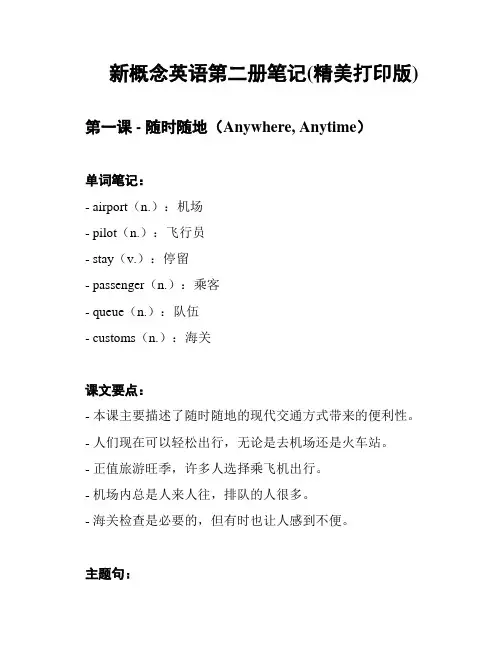
新概念英语第二册笔记(精美打印版)第一课 - 随时随地(Anywhere, Anytime)单词笔记:- airport(n.):机场- pilot(n.):飞行员- stay(v.):停留- passenger(n.):乘客- queue(n.):队伍- customs(n.):海关课文要点:- 本课主要描述了随时随地的现代交通方式带来的便利性。
- 人们现在可以轻松出行,无论是去机场还是火车站。
- 正值旅游旺季,许多人选择乘飞机出行。
- 机场内总是人来人往,排队的人很多。
- 海关检查是必要的,但有时也让人感到不便。
主题句:现代交通方式的进步使我们能够随时随地旅行。
语法重点:- 本课中出现了一些现在进行时的句子,如:People are going to airports and railway stations.(人们正前往机场和火车站。
)- 该课还涉及到一些定冠词的用法,如:I like the customs officer.(我喜欢海关工作人员。
)- 其他值得注意的语法点包括人称代词的宾格形式、形容词比较级等。
第二课 - 奇怪的事(Something Strange)单词笔记:- strange(adj.):奇怪的- fly(v.):飞- cloud(n.):云- monster(n.):怪物- little(adj.):小的- eat(v.):吃- bird(n.):鸟课文要点:- 本课主要讲述了一个小男孩和他的奇怪经历。
- 有一天,男孩看到了一只怪物,它是一个身穿红色衣服、长着绿色头发和眼睛的生物。
- 怪物告诉男孩,他不会飞,但是他能飞到云中间。
- 然后,怪物吃了一些小鸟。
- 最后,怪物告诉男孩他会在树上等待,然后就飞走了。
主题句:男孩看到了一个奇怪的怪物,并与它进行了交谈。
语法重点:- 这篇课文中包含了一些过去式的动词,如:He ate five small birds.(他吃了五只小鸟。
新概念英语第二册笔记(word版共275页)
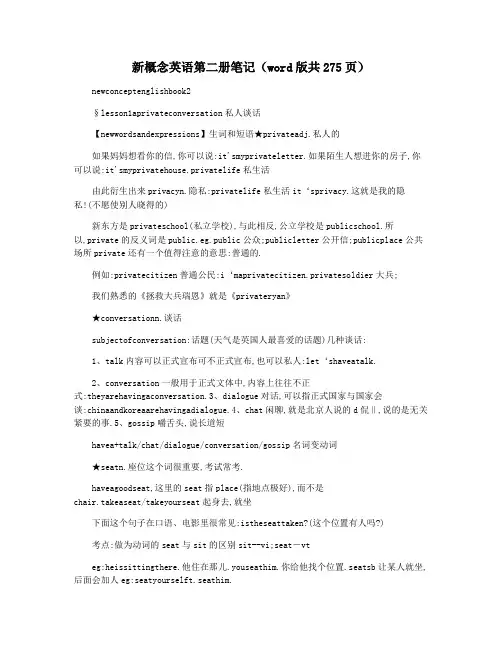
新概念英语第二册笔记(word版共275页)newconceptenglishbook2§lesson1aprivateconversation私人谈话【newwordsandexpressions】生词和短语★privateadj.私人的如果妈妈想看你的信,你可以说:it'smyprivateletter.如果陌生人想进你的房子,你可以说:it'smyprivatehouse.privatelife私生活由此衍生出来privacyn.隐私:privatelife私生活it‘sprivacy.这就是我的隐私!(不愿使别人晓得的)新东方是privateschool(私立学校),与此相反,公立学校是publicschool.所以,private的反义词是public.eg.public公众;publicletter公开信;publicplace公共场所private还有一个值得注意的意思:普通的.例如:privatecitizen普通公民:i‘maprivatecitizen.priv atesoldier大兵;我们熟悉的《拯救大兵瑞恩》就是《privateryan》★conversationn.谈话subjectofconversation:话题(天气是英国人最喜爱的话题)几种谈话:1、talk内容可以正式宣布可不正式宣布,也可以私人:let‘shaveatalk.2、conversation一般用于正式文体中,内容上往往不正式:theyarehavingaconversation.3、dialogue对话,可以指正式国家与国家会谈:chinaandkoreaarehavingadialogue.4、chat闲聊,就是北京人说的d侃‖,说的是无关紧要的事.5、gossip嚼舌头,说长道短havea+talk/chat/dialogue/conversation/gossip名词变动词★seatn.座位这个词很重要,考试常考.haveagoodseat,这里的seat指place(指地点极好),而不是chair.takeaseat/takeyourseat起身去,就坐下面这个句子在口语、电影里很常见:istheseattaken?(这个位置有人吗?)考点:做为动词的seat与sit的区别sit--vi;seat―vteg:heissittingthere.他住在那儿.youseathim.你给他找个位置.seatsb让某人就坐,后面会加人eg:seatyourselft.seathim.★playn.戏★loudlyadv.大声的★angryadj.生气的cross=angry;iwasangry.hewascross.annoyed:恼火的;程iwasannoyed.度iwasangry/cross.加iwasveryangry.深beblueintheface:iamblueintheface.(脸色都紫了,相当生气了)★bear(bore,borne)v.容忍bear,standican'tbear/standyouendure[]:忍受,容忍putupwith:忍受igotdivorced(再婚).icouldnotputupwithhimbear/stand/endure承受的音速在加强putupwith=bear=standbearn.熊whitebearbearhug:热情(热烈)的拥抱givesbabearhug★businessn.事,营生businessman:生意人dobusiness:经商gotosomeplaceonbusiness:因公出差iwenttotianjinonbusiness.thing可以指事情,也可以指东西business:某人自己的私人的事情it'smybusiness(指私人的事,自己处置的事)it'snoneofyourbusiness【课文讲解】gotothetheatreseeafilm=gotothecinemagotothe+地点则表示回去某地干嘛gotothedoctor's回去就医gotothedairy回去牛奶店gotothe+人+'s表示去这个人开的店gotothebutcher's买肉gotoschool:去上学gotochurch:去做礼拜gotohospital(医院):去看病gotothegreatwallgohome;跟home相连一定则表示没事情可以搞,回家歇息iamathome在家歇息enjoy,enjoyoneself:玩玩的高兴enjoy+sth:讨厌,从当中获得一种享用ilikesomethingverymuch./ilovesomething.ienjoytheclass.ienjoythemusic.ienjoythe book.enjoythedinner/film/progeam/gameweresitting:当时正座在过去进行时态:过去的某个时间正在发生的动作一个故事的背景往往用进行时态描述i+be+v(ing)thegirlwasreadingabookinthegarden.aboycametoher.got:显得,则表示一种变化,gotangryiam/wasangry就是一个事实igotangry:特别强调变化过程itishot.itgothot.got取代be动词,got是一个半联系动词,可以直接加形容词turnround:转头notpayanyattention=paynoattention表示注意,payattention;对什么加以注意,payattentiontosthnotany=noicouldnotbearit./you./thenoise.ican'thearaword.美音:肯定ican[]否定,ican't[]?,它的/t/是吞进去的,在读音上很难区别,只能根据上下文来定2.如果时间和地点连在一起,先摆地点,再放时间如果问何时何地,就是一个紧固配搭whenandwhere(4)...aheadof:在...前面(+时间、位置)(动态的行为)aheadoftimehegoesaheadofme.5______didthewriterfeel?angry.a.whereb.whyc.howd.when(5)...c...how――对一个方式、状态回答特定疑问词对后面的答案回答angry(adj)how(adv.)――对形容词、副词、介词短语提问where――用介词,地点when――用介词,时间why――用because回答11thewritercouldnotbearit.hecouldnot______it.a.carryb.sufferc.standd.lift(11). ..suffer:遭受,忍受(精神或肉体上)+痛苦bear:承受=standisuffertheheadache.heoftensuffersdefeat.§lesson2breakfastorlunch?早餐还是午餐?【newwordsandexpressions】生词和短语★untilprep.直至直至...才;直至...年才后面加(时间状语)从句,前面就是主句1)hisfatherdidn'tdieuntilhecameback.(确实)直至他回去,他爸爸才死去.2)hisfatherwasaliveuntilhecameback.(否定)直到他回来为止,他爸爸都是活着的.至他回去这一点之前,没有死去:notdie;活的:不作not.把until做为时间中止线从句的时间终点之前,这个动作做了还是没做?做了――肯定;没做――否定.forhe___a(c)___(wait)untilitstoppedraining.a.waitedb.didn'twaita.leaveb.leftc. didn'tleaveistayinbeduntiltwelveo'clock.ididn'tgetupuntil12o'clock.★outsideadv.外面作状语heiswaitingformeoutside.itiscoldoutsid.ring(rang.rung)v.(铃、电话等)响(刺耳的)[注]这种响是刺耳的,往往是提醒人做某事thetelephone(doorbell)isringing.而风铃等响要用jinglejingle(bell):(铃儿)响叮当给某人打电话:ringsb.tomorrowi'llringyou.打电话(名):givesb.aringremembertoringme/remembertogivemearing戒指(名词)n★auntn.姑,姨,婶,舅妈(所有长一辈的女性都用这个称呼)与此相同,男性则是uncle:叔叔他们的孩子:cousin:堂兄妹(不分男女)cousin的孩子:nephew:外甥,niece:外甥女[记:d挡下‖]★repeatv.重复【text】lesson2breakfastorlunch?早餐还是午餐?firstlistenandthenanswerthequestion.听到录音,然后提问以下问题.whywasthewriter'sauntsurprised?'buti'mstillhavingbreakfast,'isaid.'whatareyoudoing?'sheasked.'i'mhavingbreakf ast,'irepeated.'dearme,'shesaid.'doyoualwaysgetupsolate?it'soneo'clock!'参照译文那是个星期天,而在星期天我是从来不早起的,有时我要一直躺到吃午饭的时候.上个星期天,我起得很晚.我望望窗外,外面一片昏暗.d鬼天气!‖我想,d又下雨了.d正在这时,电话铃响了.是我姑母露西打来的.d我刚下火车,d她说,d我这就来看你.d“但我还在吃早饭,d我说道.“你在干什么?‖她问道.“我正在吃早饭,d我又说道了一遍.“天啊,d她说,d你总是起得这么晚吗?现在已经1点钟了!‖【课文传授】onsundays:所有的星期天,每逢星期天never:从来不(可以轻易用在动词前面)=not(变为否定句,前面一定会用助动词)idon'tlikeher.=ineverlikeher.因为就是上个星期,所以时态不是通常现在时.lookoutof:朝窗外看看outof就是紧固配搭从...里:from,outofdark:天很白whataday?what+a+n.――感叹句itisaterribleday.==>whataterribleday!what+a/an(+a.)+n.(+主语+谓语)whataterribleday!省略:1.主、曰随时可以省whatagoodgirl(sheis)!2.省形容词whataday!有上下文和一定的语境,才能省略形容词.justthen:就在那时itwasmyauntlucy.如果不晓得对方性别,可以用it替代。
《新概念英语》第二册完美笔记(L1-48)打印稿

PRACTICE & PROGRESS Lecture by Xu Yan of New Oriental School
Lesson 1-48
2020 年 3 月 30 日
CONTENTS
CONTENTS
LESSON1 A PRIVATE CONVERSATION..........- 5 -
LESSON4 AN EXCITING TRIP...............- 17 -
【NEW WORDS AND EXPRESSIONS】(6)...............- 17 【TEXT】AN EXCITING TRIP.................................- 18 【速记】不可用于进行时的情形 ................ - 19 【KS】现在完成时.........................................- 20 【速记】常与其连用的副词和副词短语....- 20 【MULTIPLE CHOICE QUESTIONS】 ......................... - 20 -
LESSON3 PLEASE SEND ME A CARD..........- 13 -
【NEW WORDS AND EXPRESSIONS】(11).............- 13 【TEXT】PLEASE SEND ME A CARD.........................- 15 【KS】一般过去时.........................................- 16 【SD】直接宾语与间接宾语 ........................ - 16 【速记】可与 TO 相连的单词 .......................- 16 【速记】可与 FOR 相连的单词......................- 16 【MULTIPLE CHOICE QUESTIONS】 ......................... - 16 【速记】如何提问.........................................- 17 【速记】ALL (THE) DAY 的用法 ......................- 17 -
(完整word版)《新概念英语》第二册课文、笔记
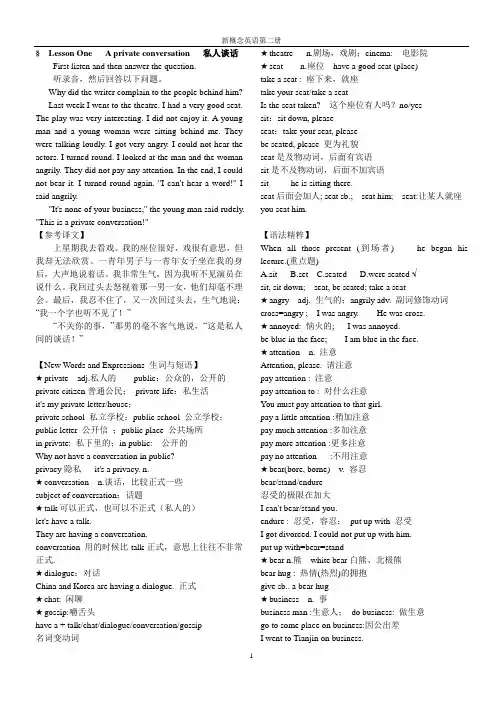
§Lesson One A private conversation 私人谈话First listen and then answer the question.听录音,然后回答以下问题。
Why did the writer complain to the people behind him?Last week I went to the theatre. I had a very good seat. The play was very interesting. I did not enjoy it. A young man and a young woman were sitting behind me. They were talking loudly. I got very angry. I could not hear the actors. I turned round. I looked at the man and the woman angrily. They did not pay any attention. In the end, I could not bear it. I turned round again. "I can't hear a word!" I said angrily."It's none of your business," the young man said rudely. "This is a private conversation!"【参考译文】上星期我去看戏。
我的座位很好,戏很有意思,但我却无法欣赏。
一青年男子与一青年女子坐在我的身后,大声地说着话。
我非常生气,因为我听不见演员在说什么。
我回过头去怒视着那一男一女,他们却毫不理会。
最后,我忍不住了,又一次回过头去,生气地说:“我一个字也听不见了!”“不关你的事,”那男的毫不客气地说,“这是私人间的谈话!”【New Words and Expressions 生词与短语】★private adj.私人的public:公众的,公开的private citizen普通公民;private life:私生活it's my private letter/house;private school 私立学校;public school 公立学校;public letter 公开信;public place 公共场所in private: 私下里的;in public: 公开的Why not have a conversation in public?privacy隐私it's a privacy. n.★conversation n.谈话,比较正式一些subject of conversation:话题★talk可以正式,也可以不正式(私人的)let's have a talk.They are having a conversation.conversation 用的时候比talk正式,意思上往往不非常正式.★dialogue:对话China and Korea are having a dialogue. 正式★chat: 闲聊★gossip:嚼舌头have a + talk/chat/dialogue/conversation/gossip名词变动词★theatre n.剧场,戏剧;cinema: 电影院★seat n.座位have a good seat (place)take a seat : 座下来,就座take your seat/take a seatIs the seat taken? 这个座位有人吗?no/yessit:sit down, pleaseseat:take your seat, pleasebe seated, please 更为礼貌seat是及物动词,后面有宾语sit是不及物动词,后面不加宾语sit he is sitting there.seat后面会加人; seat sb.; seat him; seat:让某人就座you seat him.【语法精粹】When all those present (到场者)____ he began his lecture.(重点题)A.sitB.setC.seatedD.were seated √sit, sit down; seat, be seated; take a seat★angry adj. 生气的;angrily adv. 副词修饰动词cross=angry ; I was angry. He was cross.★annoyed: 恼火的; I was annoyed.be blue in the face; I am blue in the face.★attention n. 注意Attention, please. 请注意pay attention : 注意pay attention to : 对什么注意You must pay attention to that girl.pay a little attention :稍加注意pay much attention :多加注意pay more attention :更多注意pay no attention :不用注意★bear(bore, borne) v. 容忍bear/stand/endure忍受的极限在加大I can't bear/stand you.endure : 忍受,容忍;put up with 忍受I got divorced. I could not put up with him.put up with=bear=stand★bear n.熊white bear白熊、北极熊bear hug : 热情(热烈)的拥抱give sb.. a bear hug★business n. 事business man :生意人;do business: 做生意go to some place on business:因公出差I went to Tianjin on business.★thing 可以指事情,也可以指东西It's my business 私人事情it's none of your business★rudely adv. 无礼地,粗鲁地;rude adj.【课文讲解】go to the theatre = see a film, go to the cinemago to the +地点表示去某地干嘛go to the dairy 去牛奶店go to the + 人+ 's 表示去这个人开的店go to the butcher's 买肉go to the doctor's 去看病go to school: 去上学go to church: 去做礼拜go to hospital(医院):去看病go home; I am at home.跟home相连一定表示没有事情可做,回家休息★enjoy, enjoy oneself:玩的开心enjoy+sth. : 喜欢, 从当中得到一种享受I like something very much. /I love something.I enjoy the music.★过去进行时态: 过去的某个时间正在发生的动作一个故事的背景往往用进行时态描述I+be+v(ing) were sitting :当时正座在The girl was reading a book in the garden. A boy came to her.★got : 变得, 表示一种变化I am/was angry 是一个事实I got angry: 强调变化过程got取代be动词, got是一个半联系动词, 可以直接加形容词说话的时候喜欢用缩略. I'm not, he isn't, they aren't写的时候会说: I am not, he is not, they are notI didn't do sth.., I did not do sth..★hear:听见;hear+人:听见某人的话I could not hear you. Beg your pardon?I couldn't hear you. /I couldn't hear a word. /I couldn't catch your words.I couldn't hear you clearly. /I couldn't catch your words. Beg your pardon? /I couldn't catch your words.★hear a word, a word 等于一句话hear a word of sb.. (actors)He didn't say a word.May I speak to Jim?/May I have a word with Jim?It's none of your business. /None of your business. /It's my business.★turn round:转头★pay (any) attention表示注意;对什么加以注意pay attention to sth.★This is private conversation!private : 私人的, 不想与别人共享【Key Structures关键句型】陈述句一定是有主语,有动词,有宾语,有句号;简单陈述句一定不能少的是主语、动词主语——>动词——>宾语——>状语1 ---主语一般有名词或代词构成2 ---谓语由动词充当3 ---宾语4 ---副词或介词短语,对方式或状态提问,往往做状语I like her very much5 ---地点状语6 ---时间状语可以放在句首或句末,先地点后时间I like the girl very much in Beijing last year.如果问何时何地,是一个固定搭配when and where【Multiple choice questions多项选择题】★pay attention: 注意(在思想上)notice: 注意(=see 眼睛看)★sitting behindbehind: 在...后面★in front of :在...前面(相对静止的概念)★before : 在...前面(+词、句子、一定和时间相连) ★above: 在...上面★ahead of: 在...前面(+时间、位置)(动态的行为) He arrived before six o'clock.Before he came backHe goes ahead of me.★特殊疑问词对后面的答案提问how(adv.) ——对一个方式、状态提问;对形容词、副词、介词短语提问where ——用介词,地点when ——用介词,时间why ——用because回答★any——用在否定句和疑问句中★some——用在肯定句中★none——没有任何东西、没有任何人None knows./None of us knows.★not any=nonot——否定词,要放在非实义动词后面He didn't pay attentionno——形容词、修饰名词I have no time./I don't have any time.★suffer:遭受,忍受(精神或肉体上)+痛苦bear: 忍受=standI suffer the headache.He often suffers defeat.§Lesson two Breakfast or lunch? 早餐还是午餐?First listen and then answer the question.听录音,然后回答以下问题。
新概念英语第二册笔记(精美打印版)

新概念英语第二册笔记(精美打印版)第一课:A private conversation 私人谈话课文概述本课程主要讲述了两个人之间的私人谈话,包括他们的家庭、工作和个人兴趣等方面。
重点词汇- private conversation: 私人谈话- employee: 员工- dentist: 牙医- individually: 分别地- keen on: 热衷于- instead: 反而课文详述课文中的两位对话者都是职业人士。
他们讨论了彼此的职业以及为什么选择这样的职业。
第一位对话者是一位雇主,他说自己的员工做事不利索,需要手把手地指导。
他所雇佣的人中,有一位牙医,这位牙医个人能力很强,但做事不守规矩。
第二位对话者是一位操控电视卫星的技术员,他对自己的工作很满意。
他认为这份工作能提供稳定的收入,而且他对这个技术很感兴趣。
相比之下,他并不喜欢在办公室工作。
他坚信个人的兴趣和爱好应该引导自己的职业选择,而不仅仅是为了赚钱。
在谈论个人爱好时,两位对话者发现他们都对音乐很感兴趣。
然而,他们的爱好有所不同。
第一位对话者表示,他喜欢个别的音乐会,而不是大型音乐会。
第二位对话者则喜欢大型音乐会,认为那种氛围和观众的热情是独一无二的。
课后练1. 为什么第一位对话者对自己的员工感到不满意?2. 第二位对话者为什么喜欢做电视卫星的技术员?3. 两位对话者的音乐兴趣有何不同?参考答案1. 第一位对话者对自己员工感到不满意是因为他们做事情不利索,需要手把手地指导。
2. 第二位对话者喜欢做电视卫星的技术员是因为这份工作能提供稳定的收入,而且他对这个技术很感兴趣。
3. 两位对话者的音乐兴趣不同。
第一位对话者喜欢个别的音乐会,而第二位对话者喜欢大型音乐会。
新概念英语第二册笔记(全部96课全)
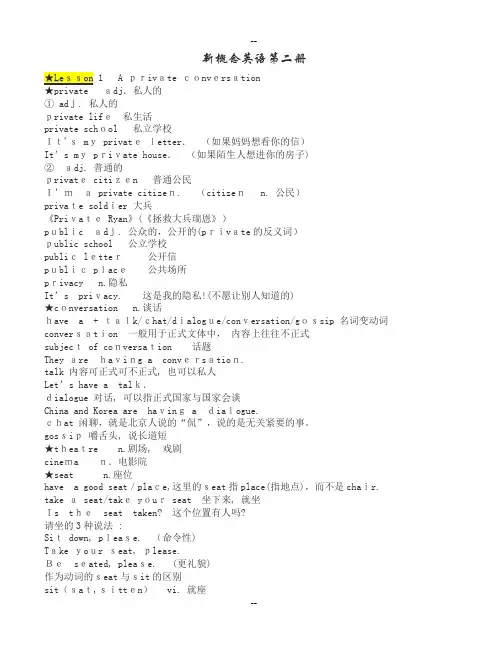
新概念英语第二册private conversationadj.私人的① adj. 私人的private life私生活private school 私立学校It's my privateletter.(如果妈妈想看你的信)It's my private house.(如果陌生人想进你的房子)②adj. 普通的private citizen 普通公民I’ma private citizen. (citizen n. 公民)private soldier 大兵《Private Ryan》(《拯救大兵瑞恩》)public adj. 公众的,公开的(private的反义词)public school 公立学校public letter公开信public place公共场所privacy n.隐私It’s privacy. 这是我的隐私!(不愿让别人知道的)★conversation n.谈话have a + talk/chat/dialogue/conversation/gossip 名词变动词conversation 一般用于正式文体中,内容上往往不正式subject of conversation 话题They are having a conversation.talk 内容可正式可不正式, 也可以私人Let’s have a talk.dialogue 对话, 可以指正式国家与国家会谈China and Korea are having a dialogue.chat 闲聊,就是北京人说的“侃”,说的是无关紧要的事。
gossip嚼舌头, 说长道短★theatre n.剧场, 戏剧cinema n.电影院★seat n.座位have a good seat/place,这里的seat指place(指地点),而不是chair. take a seat/take your seat 坐下来, 就坐Is theseat taken? 这个位置有人吗?请坐的3种说法 :Sit down, please. (命令性)Take your seat, please.Beseated, please. (更礼貌)作为动词的seat与sit的区别sit(sat,sitten)vi. 就座He is sitting there. 他坐在那儿。
新概念英语第二册笔记2(全部96课全)
. —-可编辑修改,可打印——别找了你想要的都有!精品教育资料——全册教案,,试卷,教学课件,教学设计等一站式服务——全力满足教学需求,真实规划教学环节最新全面教学资源,打造完美教学模式新概念英语第二册私人的① adj. 私人的private life:私生活private school:私立学校It's my private letter.(如果妈妈想看你的信)It's my private house.(如果陌生人想进你的房子)② adj. 普通的private citizen.普通公民I’m a private citizen.(citizen n. 公民)private soldier 大兵《Private Ryan》(《拯救大兵瑞恩》)public adj. 公众的,公开的(private的反义词)public school 公立学校public letter 公开信public place 公共场所privacy n.隐私It’s privacy. 这是我的隐私!(不愿让别人知道的)★conversation n.谈话have a+talk/chat/dialogue/conversation/gossi名词变动词conversation 一般用于正式文体中, 内容上往往不正式subject of conversation 话题They are having a conversation.talk 内容可正式可不正式, 也可以私人Let’s have a talk.dialogue 对话, 可以指正式国家与国家会谈China and Korea are having a dialogue.chat 闲聊,就是北京人说的“侃”,说的是无关紧要的事。
gossip 嚼舌头, 说长道短★theatre n.剧场, 戏剧cinema n.电影院★seat n.座位have a good seat/place这里的seat指place(指地点),而不是chair.take a seat/take your seat 坐下来, 就坐Is the seat taken? 这个位置有人吗?请坐的3种说法 :.Sit down, please. (命令性)Take your seat, please.Be seated, please. (更礼貌)作为动词的seat与sit的区别sit(sat,sitten)vi. 就座He is sitting there. 他坐在那儿。
新概念二册短语及语法总结打印版
Lessons1-2一、常用词组和语言点1.go to the theatre 去看戏go to the film/movie 去看电影2.interesting 令人感兴趣的(表示主动)Interested 对……感到有趣的(表示被动)3.get angry 生气get为系动词。
如:I got bored at the lecture.4.turn round 转过身round/around 指在周围如:look round/around 向四周看5.angrily adv. 生气地(形容词argry变y为i再加ly,成为副词。
)如:happy→happily6.pay attention 注意(后常接介词to)如:You should pay attention to your handwriting.7.in the end 最后(近义词:at last,finally)8.none of your business 不关你的事9.get up 起床10.stay in bed 呆在床上11.until 直到not…until直到……才……12.What a day! W对名词感叹,How对形容词、副词感叹。
13.just then 就在那时(just now刚才)Lessons3-4一、常用词组和语言点1.visit:go tu see 拜访,参观2.public gardens 公园3.teach sb .sth 教某人某事(teach接双宾语)lend sb.sth 借给某人某物4.send…to寄给……(比较:send of:派人去请)5.on the last night 在最后一天晚上(具体日期前用介词on)6.make a decision 做出决定 decide(V)7.receive/get a letter from sb;hear from sb 收到某人的来信8.a great number of:many 许多(后加可数名词)9.fly to:go to…by planetake a plane to…飞往Lessons7-8一、常用词组和语言点1.at the aiport 在机场(at强调“点”)2.try to do…设法做(不一定成功)3.while 当……时候(常及进行时连用)4.keep guard 守卫5.to one’s surprise令某人惊讶的是(如:to my surprise)to one’s relief令人长舒一口气的是to one’s excitement令人兴奋的是to one’s disappointment令人失望的是6.be full of 装满(近义词组be filled with)7.enter for 报名参加(考试等)8.win+比赛/战斗…获胜Lessons5-6一、常用词组和语言点1.be five miles from+地点离……5英里2. cover (1)覆盖,经常用作be covered with由……覆盖(2)+距离,相当于travelWe cavered 15 miles yesterday.昨天我们走了15英里。
新版新概念英语(第二册)单词默写 A4打印
111
v.停放(汽 车)
park
112
n.交通
traffic
第4页
113
n.交通违 规罚款单;
ticket
114
传 n.票便条,笔 记
note
115
n.地段, 面积
area
116
n.指示牌
sign
117
n.提示
reminder
118
v.无视,忘
记;失败,
fail
不及格
119
v.服从
obey
120
vi.登场, 扮演
新版新概念英语(第二册)默写
默写第1遍英语时,盖住后面英语,默写第2遍英语时,盖住后面英语和第1遍默写的英语,以此类推。默写完成后错 误的用红笔改正
第1遍 第2遍 第3遍 第4遍 第5遍
第1遍 第2遍 第3遍
1
a.私人的
private
2
n.谈话
conversa tion
3
n.剧场, 戏院
theatre
58
n.沙子
sand
59
n.比赛, 竞赛
competiti on
60
a.整齐 的,整洁
neat
61
的 n.小路, 小径
path
62
a.木头的
wooden
63
n.水池
pool
64
n.欢迎;v. 欢迎
welcome
65
n.一群
crowd
66
vt.聚集
gather
67
n.(表或机 器的)指针
hand
68
v./n.喊叫
261
a.固体 的,硬的
裕兴新概念英语第二册完美打印版笔记_第28课
Lesson 28 No parking 禁止停车一.单词讲解:rare1) adj. 稀有的,罕见的,不寻常的(rarer, rarest )not often happening or seen, unusual eg. He is a rare person. 他是个少见的人。
a rare book 珍本 a rare plant 珍稀植物a rare butterfly 一只罕见的蝴蝶a rare visitor 稀客a rare edition 珍藏本It is rare + for (sb) + to do sth 某人很少做某事eg. It is rare for him to be absent. 他很少缺席。
2) adj. (气体等)稀薄的,稀疏的thinthe rare air of the mountains 山里的稀薄空气3)adj. 半熟的,煮得嫩的I ’d like my steak rare, please.我要的牛排要三、四分熟。
half-done 半熟well-done 全熟rarity ['re?r?ti:] n. [c] 珍品,奇事 [u] 稀有rareness n. [u] (空气等)稀薄,稀有rarely adv. 不常(否定含义)not often, seldomI rarely eat in restaurants. I often cook myself. 我很少到饭店里吃。
我一般都是自己做。
ancient adj. 古代的,古老的old adj. 老的,旧的,先前的an old lady 一个老太太an old church 一个古老的教堂an old friend 老朋友my old job 我以前的工作senior ['si:nj ?] adj. 较年长的,资深的junior ['d ?u:nj ?] adj.年少的, 较年幼的;资历较浅的,地位较低的senior citizen 老人,退休的人the senior partner 大股东aged adj. (正式)年老的,体衰的(人)an aged gentleman 一位老人ancient adj. (仅物)远古的,古代的an ancient civilization 古代文明an ancient history 古代历史antique [?n'ti:k] adj. (仅物)古旧的,珍贵的antique furniture 古董家具an antique coin 古钱币myth n. 神话尤指与某一民族早期历史或信仰有关,或解释自然现象的故事。