
译林英语四下 Unit8 How are you
( Story time)
淮安市淮阴实验小学 杨秋月
Rules:
Try to introduce yourself !
试着介绍自己吧!
I’m …
like
have
I …at/ in …
Try to say
...
Why?
How?
Who? Where?
What?
Listen and answer Yang Ling is speaking to_______.
Read and underline
读课文P50,划出电话用语。
Watch and say What’s the matter with Yang Ling ?
She has _______ and ________. She can't _____________today.
Thank you! Goodbye!
Help each other 相互帮助
Love each other 彼此关爱
Homework
1. Read picture book 《Care about others》.
2.Try to call your friends to invite them to go to the park this Sunday.
A. fever B. cough C. cold D. headache
What’s the matter? I have a cold and a fever. I can't come to school today.
ear-hear
I’m sorry to hear that.
听到这个我很抱歉。
A. fever B. cough C. cold D. headache
What’s the matter with Yang Ling ?
What’s the matter with Yang Ling ?
She has __a_c_o_l_d_ and __a_f_e_v_er__. She can't _c_o_m__e_to__sc_h_o_o_l_today.
Hello, Miss Li. This is Yang Ling.
Tip:
How are you now?
1、跟读课文,注意模仿正确的语音、语调、语气哦!
· I’m fine. Thank you.
2、注意阅读记号,可以帮助你读得更好听哦!
Great. Can you come to school tomorrow?
·· 表示Y重es,读I can. 表示降调
表示升调
See you tomorrow, Yang Ling.
See you, Miss Li.
Show time Choose one and try to act it out.
两人一组,选择故事中的某一片段,试着将它表演出来。
1.Act in roles 分角色表演 2.Act with emotions 有感情地表演
Take care, Yang Ling.
make-take
保重。
Can you help Yang Ling?
Take some pills.
Stay in bed.
Drink some water.
advice
建议
Have a rest.
Eat some fruit.
See the doctor.
Read and discuss Tip:阅读课文51页,与同桌讨论问题。
Q1: How is Yang Ling now? Q2: Can she come to school tomorrow(明天)?
Q1. How is Yang Ling now?
She ith emotions fluently 有感情、流利地表演
Think and write
班级日志
Friday 2019.5.24
fever school
can hear
!
cold come to fine
Yang Ling is ill. She has a _____ and a ______. She can’t ___ ___ ___ today. Miss Li is sorry to ___that. So she calls her in the afternoon. Yang Ling is _co_m_e__tonfosecwvhe. orSohl eto_m_too_r_r_ow. MisscshoLoi lis happy tfoinehear that.
I’m fine. Thank you!
Q2. Can she come to school tomorrow(明天)?
Yes, she can.
Can you come to school tomorrow?
Yes, I can.
Try to read
Hello,this is Miss Li speaking.
Care about Yang Ling
放学后,你给杨玲打电话。你们会说些什么? 选择其中一个场景,和同伴来演一演吧。
Useful sentences:
Hello. This is … speaking. May I speak to…? How are you? / What’s the matter? I’m happy to hear that. Let’s ...
译林 英语 四年级下册 Unit 8 How are you
Let’s talk How does Yang Ling call to Miss Li?
Let’s read
How does Yang Ling call to Miss Li?
Dear, you can read it by yourself and underline some useful sentences.
Hi, Tina. Is Bobby there?
Cartoon time
It’s Sunday today. We don’t have any lessons on Sunday.
This is Bobby. Ha! Ha!
Cartoon time
Is Tina there,too?
A. Yes. She is talking to Sam.
How are you?
Fun time
Make a paper phone 1、 We need two paper cups. 2、 Use a pin(钉子) or a pen to
make a hole(洞). 3、 Connect (连接)two paper cups
with strings(绳子).
Let’s make a chant Hello, may I speak to...?
This is ... speaking.How are you? I have a cold, and a fever too.
Well, go and see Doctor Wu!
Tips:If your friend is ill, you can call to him or her. Let’s imitate.
小学英语课内外融合阅读教学的实践——以译林版《英语》四(下)Unit_8_How_are_you?S
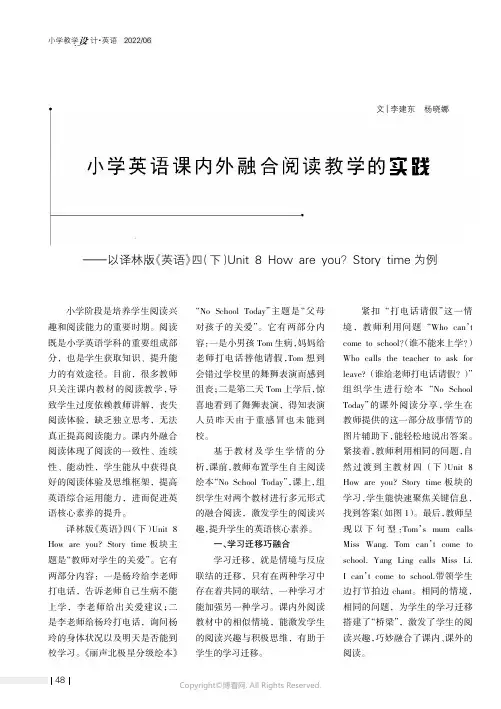
小学教学计·英语2022/06小学阶段是培养学生阅读兴趣和阅读能力的重要时期。
阅读既是小学英语学科的重要组成部分,也是学生获取知识、提升能力的有效途径。
目前,很多教师只关注课内教材的阅读教学,导致学生过度依赖教师讲解,丧失阅读体验,缺乏独立思考,无法真正提高阅读能力。
课内外融合阅读体现了阅读的一致性、连续性、能动性,学生能从中获得良好的阅读体验及思维框架,提高英语综合运用能力,进而促进英语核心素养的提升。
译林版《英语》四(下)Unit8 How are you?Story time板块主题是“教师对学生的关爱”。
它有两部分内容:一是杨玲给李老师打电话,告诉老师自己生病不能上学,李老师给出关爱建议;二是李老师给杨玲打电话,询问杨玲的身体状况以及明天是否能到校学习。
《丽声北极星分级绘本》“No School Today”主题是“父母对孩子的关爱”。
它有两部分内容:一是小男孩Tom生病,妈妈给老师打电话替他请假,Tom想到会错过学校里的舞狮表演而感到沮丧;二是第二天Tom上学后,惊喜地看到了舞狮表演,得知表演人员昨天由于重感冒也未能到校。
基于教材及学生学情的分析,课前,教师布置学生自主阅读绘本“No School Today”,课上,组织学生对两个教材进行多元形式的融合阅读,激发学生的阅读兴趣,提升学生的英语核心素养。
一、学习迁移巧融合学习迁移,就是情境与反应联结的迁移,只有在两种学习中存在着共同的联结,一种学习才能加强另一种学习。
课内外阅读教材中的相似情境,能激发学生的阅读兴趣与积极思维,有助于学生的学习迁移。
紧扣“打电话请假”这一情境,教师利用问题“Who can’tcome to school?(谁不能来上学?)Who calls the teacher to ask forleave?(谁给老师打电话请假?)”组织学生进行绘本“No SchoolToday”的课外阅读分享,学生在教师提供的这一部分故事情节的图片辅助下,能轻松地说出答案。
译林英语四下教学设计Unit 8 How are you 第四课时
译林英语四下教学设计Unit 8 How are you 第四课时一、教学目标1.认识和掌握单词barbecue, delicious, hamburger, noodle和spaghetti。
2.运用日常交际用语,表达自己对食物的喜好和不喜好。
3.能够听懂并模仿有关食物的对话,并运用所学知识进行交流。
二、教学重点1.听力训练:能够听懂并模仿有关食物的对话。
2.日常交际用语:表达自己对食物的喜好和不喜好。
三、教学准备课件、音频播放器。
四、教学过程1. Warming up1.Greeting: T greets Ss and checks attendance.2.Free talk: T asks Ss about their favourite food and why they like it.2. Presentation1.T presents the new words: barbecue, delicious, hamburger, noodle, and spaghetti.2.T explains the meanings of the words and helps Ss to remember.3. Listening1.T plays the audio clip for Ss to listen to the dialogue.2.T asks Ss to repeat after the audio clip.3.T plays the audio clip again and asks Ss to answer the questions about the dialogue.4. Practice1.T asks Ss to work in pairs and practice the following dialogue: A: What do you like for dinner? B: I like spaghetti. How about you? A: Ilike hamburger. I think it’s delicious.2.T walks around the classroom and helps Ss with their pronunciation and grammar.5. Production1.T asks Ss to work in pairs and create their own dialogues about their favourite food.2.T asks some pairs to present their dialogues to the class.6. Summary and homework1.T summarizes the key points of the lesson.2.T assigns homework: Ss are asked to write a short paragraph about their favourite food.五、教学反思这节课主要是介绍有关食物的词汇和日常交际用语,让学生在实际生活中能够更好地表达自己的喜好和不喜欢,从而提高其英语口语交流能力。
四年级下册英语教案-Unit 8 How are you Period 5-译林版三起
四年级下册英语教案-Unit 8 How are you Period 5-译林版三起本文为四年级下册英语教案第八单元第五课时的教学设计,教学内容为“How are you?”这一话题的进一步拓展。
教材采用的是译林版三起英语教材。
一、教学目标1.能够用完整的句子问候对方,如“How are you?”等;2.能够用适当的方式回应别人的问候,并表达自己的感受,如“I’m fine.”、“I’m not very well.”等;3.能够学会用简单的词汇来介绍自己,如名字、年龄、家庭等基本信息;4.能够在交流中正确运用目标语言,如:“How old are you?”、“What’s your name?”等;5.能够构建口头和书面表达的基础,为日后的英语学习打下基础。
二、教学重点1.学生能够正确理解How are you?这一简单的问候语,并能够用“I’m fine.”、“I’m not very well.”等简单的句子来回应;2.学生能够学会用简单的词汇和句子介绍自己。
三、教学难点1.学生能够用适当的方式回应别人的问候,并表达自己的感受,同时避免在表达过程中出现语法错误;2.学生能够理解对面所问问题,并且在语言中正确表达自己的愿望和需求。
四、教学过程1. Warming up教师根据学生已学内容出示照片,以让学生口头介绍出照片中的人物,同时老师也可以请学生选出一个自己最喜欢的老师或同学并介绍他们。
2. Introduction教师以How are you?这一简单的问候语开场。
“Hello, everyone! How are you today?”教师询问几个学生的近况,同时学生也可以回答老师所问的问题。
3. PresentationA)学生学习并掌握一些新的问候语,如“What’s up?”、“How’s it going?”;B)学生根据教师提供的照片进行练习,回答How are you? 或其他相关问候语。
2020春四年级英语下册Unit8Howareyou第1课时教案说课稿(新版)牛津译林版
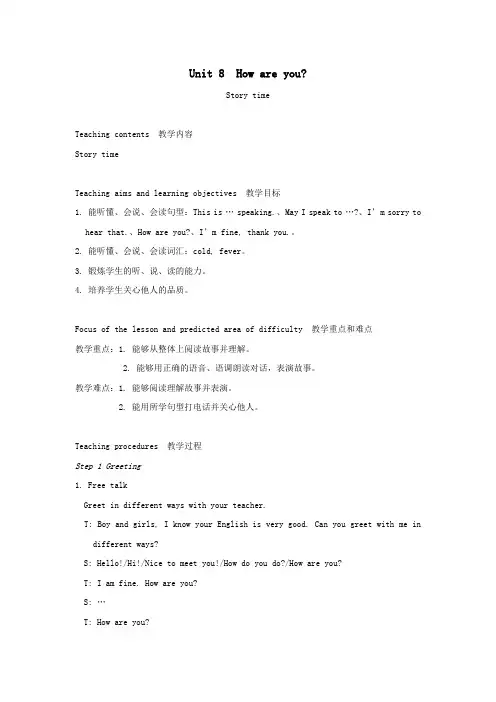
Unit 8 How are you?Story timeTeaching contents 教学内容Story timeTeaching aims and learning objectives 教学目标1. 能听懂、会说、会读句型:This is …speaking.、May I speak to …?、I’m sorry tohear that.、How are you?、I’m fine, thank you.。
2. 能听懂、会说、会读词汇:cold, fever。
3. 锻炼学生的听、说、读的能力。
4. 培养学生关心他人的品质。
Focus of the lesson and predicted area of difficulty 教学重点和难点教学重点:1. 能够从整体上阅读故事并理解。
2. 能够用正确的语音、语调朗读对话,表演故事。
教学难点:1. 能够阅读理解故事并表演。
2. 能用所学句型打电话并关心他人。
Teaching procedures 教学过程Step 1 Greeting1. Free talkGreet in different ways with your teacher.T: Boy and girls, I know your English is very good. Can you greet with me in different ways?S: Hello!/Hi!/Nice to meet you!/How do you do?/How are you?T: I am fine. How are you?S: …T: How are you?S: …T: I am happy to hear that. And today we will learn Unit 8 How Are you? Show and read the title.【设计意图:课堂伊始,通过让学生用不同的方式向老师打招呼,引出本课课题,让学生在轻松愉悦的环境中进入本节课的学习。
江苏译林版四下《Unit8Howareyou》word第3课时教案

利用自制电话听筒进行打电话游戏。
【活动三】
1、请一名学生朗读单词,其他学生边听边体会,找出这些单词的共同音素。
2、听录音,跟读单词,模仿朗读绕口令。
3、让学生找出含有相同音素的单词。
4、找出几个生词,让学生试着朗读,体会发音。
【活动四】
1、课后与同学交流,进一步练习打电话,并用How are you ?进行交流。
教师巡视,给予必要的语言提示和帮助。
Step3.Sound time
1、请一名学生朗读单词,其他学生边听边体会,找出这些单词的共同音素。
2、听录音,跟读单词,模仿朗读绕口令。
3、让学生找出含有相同音素的单词。
4、找出几个生词,让学生试着朗读,体会发音。
Step4 Homework.
2、课后与同学交流,进一步练习打电话,并用How are you ?进行交流。
教学重点
教学难点
1、熟练掌握本单元词汇及句型。
2、了解字母o在单词中的发音。.
3、能用句型This is …speaking.May I speak to…?进行对话。
课前准备
调查表,录音机,磁带
学生活动案
教师导学案
调整反思
【活动一】
1、Free talk.
2、Revision.
【活动二】
1、扮演角色,表演对话,给人物配音.
< Unit8 How arre you?
小学英语第四下 册
第 8 单元 第3 教时
教学目标
1、进一步熟练掌握本单元词汇及句型,并能运用。
2、了解字母o在单词中的发音。.
3、能用句型This is …speaking.May I speak to…?进行对话。
四年级下册英语说课稿-Unit8 How are you 译林版(三起)
四年级下册英语说课稿 - Unit 8 How are you 译林版(三起)一、教材分析1.1 教材内容《四年级下册英语》Unit 8 How are you 部分分为三个部分:Part A, Part B 和 Part C。
Part A 引入身体部位词汇,Part B 介绍礼貌用语,Part C 是关于询问健康状况的交际用语,同时也包含了一些单词和短语。
1.2 教学目标1.2.1 知识目标1.让学生掌握身体部位的英文单词2.让学生掌握如何用礼貌用语问候和回答问候3.让学生掌握 How are you? 以及常见回答: I’m fine. / I’m not fine. 的使用方法1.2.2 技能目标1.提高学生的英语听力、口语、阅读和写作技能2.培养学生的交际能力和合作精神1.2.3 情感目标1.增强学生对英语学习的兴趣和信心2.培养学生的自信心和自主学习意识二、教学内容与过程安排2.1 教学内容2.1.1 教学重点1.身体部位的英文单词2.礼貌用语3.How are you? 以及常见回答: I’m fine. / I’m not fine.2.1.2 教学难点掌握新单词和语法结构,以及如何正确表达英语问候和回答。
2.2 教学过程安排2.2.1 上课前准备在教室内布置海报,提醒学生注意英文单词的书写和口音。
2.2.2 上课过程•Step 1:自我介绍教师向学生介绍自己并向学生问好,同时鼓励学生回答How are you?•Step 2: Part A 身体部位单词学习通过图片或视频展示每个身体部位单词,并教授正确的发音和书写。
•Step 3: Part B 礼貌用语学习学习礼貌用语,如Excuse me, Thank you, You’re wel come 等。
教师通过多种形式,如播放视频,讲述英短文等,帮助学生掌握这些词语。
•Step 4: Part C 询问健康状况用语学习教师教授 How are you? 以及常见回答: I’m fine. / I’m not fine.的使用方法。
四年级下册英语教案-Unit 8 How are you 课时1 译林三起
四年级下册英语教案-Unit 8 How Are You 课时1课程背景本课程是四年级下册英语教学中的第八单元,共有4个课时。
本单元的主要内容是学习关于询问健康状况以及回答的表达方式。
通过本单元的学习,学生将掌握一些基本的英语口语表达能力,提高听说能力和英语语感。
教学目标1.学会用How are you? 或How’s everything?等询问别人健康状况的词汇与句型。
2.学会用I’m fine, thank you. 等表达自己的健康状况。
3.通过听说练习,提高英语口语表达能力和听说能力。
4.提高学生对英语的兴趣和自信心。
教学重点1.How are you? 和I’m fine, thank you. 的使用。
2.练习日常口语表达。
教学难点1.能够流利地用How are you? 和I’m fine, thank you. 进行日常口语对话。
2.通过听说练习,提高口语表达能力和听说能力。
教学方法1.任务型教学法:通过让学生完成一系列任务,从而使学生获得相关知识和技能。
2.情境教学法:通过模拟实际语境,让学生更容易理解并掌握英语口语表达能力。
教学过程Step 1 教师引入1.Good morning, class.2.How are you today?Step 2 听力练习1.教师播放Listening Part 1录音,并让学生跟读。
2.提问:What questions did the woman ask?Step 3 练习对话1.教师与学生们进行对话练习,通过模拟不同场景实现目的,例如:•A: How are you?•B: I’m fine, thank you. And you?•A: I’m good, too.2.通过不断的练习,提高学生的口语表达能力和听说能力。
Step 4 任务型教学1.教师向学生放一张图片或者提供一个情景,例如:•图片:一位病人躺在医院的病床上。
•情景:学习班级中有一位同学生病了,大家去探望他。
译林英语四下教案Unit 8 How are you 第二课时
译林英语四下教案Unit 8 How are you 第二课时教学目标:1. 知识目标:a. 了解并掌握询问他人身体状况的表达方式。
b. 学会能够回复他人身体状况的表达方式。
c. 能够使用“状况轮流问”来表达。
2. 能力目标:a. 提高学生听、说、读、写的能力。
b. 培养学生的口语表达能力。
c. 通过学习,让学生养成关心他人的好习惯。
3. 情感目标:a. 通过交流,增进学生间的感情,培养团队合作的精神。
b. 让学生养成积极问候和关心他人的良好思想行为习惯,塑造良好人格。
教学重点:1. 学生能够理解和运用重点词汇和句型。
2. 学生在进行口语练习时能流利地进行询问和回答。
教学难点:1. 学生在进行状况轮流问时能够正确地运用句式。
2. 学生能够养成关心他人的良好思想行为习惯。
教学方法:情景教学法、任务教学法、合作学习法、情感教育法。
教学过程:Step 1: 教学!1. 教师引入新课,通过积极向上的口号营造欢愉的学习气氛。
2. 学生重复上一课的 Zhi's Day,瞬间用英语教室呢称和学习用品。
3. 通过表情模仿学生的体型举手,引导学生学习“How are you?”这一能问候的表达方式。
4. 通过情境演示让学生理解“Fine, thank you. And you?”的回答方式。
Step 2: 操练!1. 制定问候口诀“Hello! How are you? I’m fine. Thank you. And you?”。
2. 情境模拟,让学生进行交流,通过模仿其他学生强化语言输入与输出的一致性。
3. 学生合作完成状况轮流问,通过互相询问打通情感交流的通道。
Step 3: 教学得失!1. 通过简单的问候和回答来进行身体状况的交流。
2. 通过交流和帮助压缩心中的负面情绪和情感压力。
3. 通过交流感受到他人的关爱和理解,从而产生内在的平衡和安宁感。
教学评估:1. 通过师生互动来检验学生的听力和表达能力。
课件 译林版英语四年级下册Unit 8 How are you 同步课件(第一课时)
两人一组,表演对话。注意表情、动作、语调!
Hello, this is Sam speaking .
Hello, Sam . This is Tina .
Hi, Tina . Is Bobby there ?
No. He’s at school .
It’s Sunday today. We don’t have any lessons on Sunday .
If we want to make a telephone call, we can use …. 说一说可以使用的电话用语。
If we know someone is ill, we can say …. 怎样询问身体状况,关心他人。
猜猜Tom到底怎么了呢?
What’s the matter with him ? He … , I
模仿语音语调哦! It’s Sunday today. We don’t have any lessons on Sunday .
This is Bobby . Ha ! Ha !
1.Read the whole dialogue by yourselves. 自己读整篇对话!
2. Read the dialogue together ! 齐读!
2个
4个
6个
I can make a telephone caln continue to the cartoon.
1、Read Cartoon time 5 times and try to recite it. 2、Preview Sound time and Song time. 3、Finish the exercise on your exercise book.