
高中英语Unit5Intothewild单元要点回扣教案外研版必修第一册
Unit 5 Into the wild
Ⅰ重点单词
重点词汇夯实练
1.①It is hard to measure(measure) his ability when we haven’t seen his work.
②It is high time that we should take some measures to control(control) the spread of this disease.
③The new bridge under construction, measuring(measure) twice as long as the old one, will be completed next month.
2.We are now in a good position where all is in our hands.
3.①He is a determined man and he believes determination and effort can lead to success.(determine)
②He left home without saying a word and determined never to come(come) back before he could make a big fortune.
4.①This country has found the effective solution to poverty.
②We have to solve(solution) the problem from the root.
5.①—How do you like the new film?
—Well, it’s quite amazing and I am really amazed at it.(amaze)
②From his amazed(amaze)look, I could see that he didn’t believe what I said.
③Much to my amazement(amaze), he was able to recite the whole poem from memory.
6.①NotreDame de Paris(巴黎圣母院)was destroyed(destroy) by fire in 2019.
②The flood caused serious destruction(destroy) to the railway.
7.Only two passengers survived the air crash.When the two survivors were interviewed, they said their survival was a wonder.(survive)
8.①The police observed him driving(drive) at 90 miles per hour.
②The policeman observed the man open(open) the window and enter(enter) the house.
③So far, the villagers have been observing/have observed(observe) the traditional custom.
9.①Everyone arrived late at the party for various (vary)reasons.
②There are a variety of/varieties of(各种各样的) flowers on sale in the market.
10.①(2019·四川成都期末)When you begin to work, you should be able to concentrate on your subject.
②There is too much noise.I can’t concentrate my attention on(集中我的注意力) the
work.
11.I stared at the girl, trying to remember who she was.
Ⅱ重点短语
会书写
会应用
1.manage to do 设法做成某事
2.cut down 砍倒;缩减;降价
3.lead to 导致;造成(后果);通向……
4.add...to 把……添加到……
5.up to 达到,多达……
6.after all 毕竟,终究,归根结底
(句首); 别忘了(句尾或句中)
1.We firmly believe that war never settles anything.It only leads to violence.
2.Lots of woods have been cut down in order to make great profits.
3.Don’t worry too much.After all, it’s not your problem.
4.Some new sports games include Karate, rock climbing, etc.will be added to the 2020 Olympic Games.
Ⅲ重点句型
1.the+比较级, the+比较级,意为“越……就越……”
The more we know about this lovely creature, the greater the chance it will survive and keep its place in the natural world for a long time to come.
[仿写] 你看的书越多,你理解的越好。
The more you read, the better you understand.
2.with+宾语+宾补
With water falling off its thick, brown hair, the bear stared back at me.
[仿写] 由于得到许多人的帮助,最终他成功了。
With many people helping him, he succeeded at last.
3.It is/was+被强调部分+that/who...
It is after all we who are the visitors to their world.
[仿写] 昨天就是在公园里他遇见了一位老朋友。
It was in the park that he met an old friend yesterday.
Ⅳ单元语法
单句语法填空
1.Beijing is the place where I was born.
2.Is this the reason why he refused our offer?
3.We don’t know the exact time when the English Evening will be held. 4.The place where we’re to have the Speech Contest has not been decided yet. 5.They explained the reason to us why they had misunderstood us before.。
《Into the wild》单元要点回扣 图文

Ⅰ 重点单词 重点词汇夯实练 1.①It is hard __t_o__m_e_a_s_u_r_e___ (measure) his ability when we haven’t seen his work. ②It is high time that we should take some measures _t_o_c_o_n_t_r_o_l (control) the spread of this disease. ③The new bridge under construction, __m__e_a_su_r_i_n_g__ (measure) twice as long as the old one, will be completed next month.
Unit 5 Into the wild
5.①—How do you like the new film? —Well, it’s quite _a_m__a_z_in_g_ and I am really _a_m__a_z_e_d_ at it.(amaze) ②From his _a_m__a_z_ed__ (amaze)look, I could see that he didn’t believe what I said. ③Much to my ___a_m_a_z_e_m__e_n_t___ (amaze), he was able to recite the whole poem from memory.
设法做成某事 砍倒;缩减;降价 导致;造成(后果);通向…… 把……添加到…… 达到,多达…… 毕竟,终究,归根结底 (句首); 别忘了(句尾或句中)
Unit 5 Into the wild
高中英语1UNIT5Intothewild外研版必修一Writing教学设计

外研版必修一UNIT 5 Into the wildM3 My First Ride on A Train四川省渠县中学周兴斌The last one WritingTeaching design教学设计Aims and requirements● To revise the vehcles and feelings in the wild.●To let students speak as much as possible using the vocabulary and expressions in this unit.●To write a passage about your first experience.Teaching proceduresStep 1. Warming upWarming up by discussing, do the exercises.the sentences from the passage and answer the questions.r ecently… a lo ng time ago…d uring the day… a hundred and fifty years ago…o ne night… u ntil the 1920s…a t (about) midnight… i n 1925…Use similar time expressions to complete these sentences.1). People first started traveling by train _________.2). We had a nice holiday last year. ________ , we visited museums. ________, we went to a music club.3). There are a lot of cars in cities nowadays. ______, you could see a lot more bicycles in the streets.4)._________ , I traveled by bus to meet a friend of mine who now lives in another city.5). _________, there was a huge railway station in the middle of the city, but it isn’t there any more.6). I am sorry , but I didn’t see you here ______ .2. If you have a chance to travel, where do you want to go? Why?a book about a couple who like travelling in the wild around the world.Step 2. Talking1).Firstly let students make a conversation with their partner, accordinging to Chaeles Chaplin’s photo , talking about Chaeles Chaplin’s experience.2).Then let stuengts talk about him from his information.Step talkWhy do more and more people like to travel?People travel for different purposes:➢learn about the outside world➢get excitement or relax oneself➢do some research➢enjoy the beauty of nature➢study wildlife or plants➢be interested in delicious food➢do business or make friends …StepSay something about your travel.Answer:WhenWhereWith whomHow you went thereWhat you did and sawWhat was your feelingStep 5: HomeworkChoose one of the two topics. Try to share experiences with your group members according to the topic. Put down anything you think are useful in your writing.Write a paragraph about one of these topics to describe one of your experiences.☆My first family holiday☆My first train ride☆My winter holidayStep 6. Exercises for consolidationPossible samples:(GIVEN OUT TO STUDENTS)My winter holidayIt was my winter holiday. I was very happy. I read my favourite books which were very moving. But I could not read these books too much. I also had a lot of homework to do. I like playing computer games, too. It’s very interesting. But I could not play it too much. I wear glasses, I’m very sad. It’s not good for my eyes to play computer games too much.Oh! It was the Spring Festival. It is Chinese traditional festival. People were very happy. They went shopping, cleaned their houses, and had supper together……I went to my grandparents’home with my parents. My grandparents were very happy to see us. They prepared many kinds of nice food, such as fish, meat, vegetables and fruit. In the evening, we watched TV and lighted fireworks. We also knocked on people’s doors and gave some presents to them.. After the Spring Festival, we went to Shanghai to go shopping. We bought clothes, shoes and some delicious food.I had a good holiday, I think. I also have very nice school life now.。
高中英语 Unit 5 Into the wild单元重点知识回顾教学案 外研版必修第一册-外研版高

Unit 5 Into the wildⅠ.重点词汇1.seek v. 寻找,寻求seek to do sth. 设法做某事seek (for) sth. 寻找/谋求某物seek after 追求;寻求seek out 找出;搜出2.measure v. 量,测量;评估linkingverb有……长/宽n. 尺寸;措施measure ... by ... 用……来衡量……make ... to one's measure 按某人的尺寸做(衣服等)take measures to do sth. 采取措施做某事3.position n. 位置;处境,状况;地位;职位;姿势in a(n) ... position 处于……地位/位置in/out of position 在/不在恰当的位置hold the position of ... 担任……的职务take up (one's) position 就位4.determine v. 测定,确定;决定,决心→determined adj. 坚决的,有决心的,果断的→determination n. 决心,决定determine to do sth. 决心做某事(表动作)determine on/upon (doing) sth. 决定(做)某事be determined to do sth. 决心做某事(表状态)5.amazing adj. 惊人的,了不起的→amaze vt. 使吃惊→amazed adj. 感到惊奇的;吃惊的→amazement n. 惊讶be amazed to do ... 对做某事感到惊奇be amazed at/by 对……很惊奇(much) to one's amazement 令某人(非常)惊讶的是in amazement 惊讶地6.survive vi. 活下来;幸存vt. 幸免于;从……中逃生;比……活得长→survival n. 幸存→survivor n. 幸存者survive sth. 幸免于……,从……中艰难度过survive sb. (by three years) 比……活得长(三年)7.effect n. 影响,结果→effective adj. 有效的→effectively adv. 有效地have an effect on/upon ... 对……有影响bring/put ... into effect 使生效;实行,实施e into effect 生效,开始实施in effect 有效;在实施中;实际上8.acmodation n. 住处,工作场所;食宿;膳食供应→acmodate vt. 容纳(乘客);向……提供膳宿;使适应,顺应make/provide acmodations for 为……提供食宿acmodate sb. with sth. 给……提供……acmodate ... to ... =adapt ... to ... 使……适应/迎合……(其中to为介词) acmodate oneself to 使自己适应……acmodate sb. for the night 留某人过夜9.variety n. [C]种类,品种 [U]变化,多样性→vary v. (使)变化,不同→various adj. 各种各样的→variation n. 变化a variety of=varieties of 各种各样的vary from ... to ... 从……到……不同vary with ... 随……而变化10.concentrate v. 集中(注意力、思想等)→concentration n. 专心,集中concentrate ... on/upon ... 把……专注于……concentrate on/upon ... 专注于……11.cut down 砍倒;削减,缩小(尺寸、数量等);降价cut off 切断;停掉;隔绝cut in 插嘴;插队cut across/through 抄近路穿过12.after all 毕竟,归根结底;终究in all 总共above all 尤其是,最重要的是(强调重要性)all the time 始终,一直all of a sudden=suddenly 突然,冷不防地Ⅱ.教材原句1.Somehow they manage to travel around 4,000 kilometres south and find their way to California or Mexico. (P50)不知怎么地,它们成功地向南行进了4,000公里,到达了加利福尼亚或墨西哥。
新教材外研版必修第一册Unit5 Into the wild学案讲义知识点汇总及配套习题

Unit 5 Into the wild1、Starting out & Understanding ideas ........................................................................... - 1 -2、Using language ......................................................................................................... - 15 -3、Developing ideas ...................................................................................................... - 21 -1、Starting out & Understanding ideasMigrationAnimals do many different, amazing things to get through the winter. Some of them “migrate”. This means they travel to other places w here the weather is warmer or they can find food.Many birds migrate in the fall. Because the trip can be dangerous, some travel in large flocks. For example, wild geese fly in noisy, “V”-shaped groups. Other kinds of birds fly alone.How do they know when it is time to leave for the winter? Scientists are still studying this. Many see migration as part of a yearly cycle of changes a bird goes through. The cycle is controlled by changes in the amount of daylight and the weather.Birds can fly very long distances. For example, the Arctic tern(北极燕鸥) nests close to the North Pole in summer. In autumn, it flies south all the way to Antarctica(南极洲). Each spring it returns north again.Most birds migrate shorter distances. But how do they find their way to the same place each year? Birds seem to navigate like sailors once did, using the sun, moon and stars for direction. They also seem to have a compass in their brain for using the Earth’s magnetic field.[词海拾贝]1. migrate v. → migration n. 迁徙2. flock n. 一群3. nest vt. 筑巢n. 巢, 窝4. navigate vt. 导航; 航行5. compass n. 指南针6. magnetic adj. 地磁的; 有磁性的[我学我思]1. get through度过2. go through 经受3. all the way(to) 一直(到)4. List out other animals that migrate.There are a few mammals, like some bats and whales that travel in search of food each winter. Insects such as butterflies and moths fly very long distances, too.Ⅰ. 必备单词: 根据提示填写单词1. an international charity一个国际慈善机构2. the British monarch英国国王3. an Atlantic port 一个大西洋港口4. a baby whale幼鲸5. a respectable professor一位值得尊敬的教授6. the best position for each player 每个球员最适合打的位置7. an explanation of the great mystery这个巨大的谜团的解释8. crash to an all-time low 跌至历史最低点9. in the caterpillar stage 在毛虫阶段10. the system flow chart diagram 系统流程图11. an annual report 年度报告→about 8, 500 new words enter the English language annually (adv. ) 每年大概有8 500个新词出现在英语中12. measure the distance from A to B 测量从A到B的距离→ measurement (n. ) in miles 英里的度量制度13. determine the date for the meeting确定会议(会见)的日子→a determined (adj. ) character果断的性格→a man of great determination(n. ) 决心坚定的人14. eventually rose to the position of vice president最终升到了副总裁的职位→his eventual (adj. ) success 他最终的成功15. the solution to a problem问题的解答→ solve (v. ) this feeling of loneliness解决这种孤独感16. an amazing discovery一项了不起的发现→ amaze(v. ) his friends by suddenly getting married 突然结婚使他的朋友们感到惊讶→ an amazed (adj. ) look一副惊愕的神色→stare at the animal in amazement (n. )吃惊地盯着动物17. seek advice 寻求建议→a seeker (n. ) after truth一名真理的追求者18. the seasonal migration of birds鸟类的季节性迁徙→ migrate(v. )to warmer countries in the winter在冬天迁徙到较温暖的国家19. be lucky to survive the accident在事故中幸免于难→ the fight for survival (n. )为生存而战斗a lung cancer survivor (n. ) 肺癌幸存者20. interest at 3 per cent 3%的利息→the percentage (n. ) of middle school leavers 中学毕业生的百分比21. destroy the whole town 摧毁整个城镇→ the destruction (n. ) of the rainforests 对热带雨林的破坏→the destructive (adj. ) power of modern weapons 现代武器的毁灭性力量22. the overuse of chemicals in agriculture化学物质在农业中的过度使用→the chemical (adj. ) industry 化学工业→study chemistry (n. ) and physics at college在大学里学习化学和物理→a research chemist (n. ) 从事研究工作的化学家23. all living creatures所有的生物(众生)→ create(v. ) the world 创造世界→the creator (n. ) of a new television series新的电视系列片的发明者→the latest creation (n. ) in the field of computer design计算机设计领域的最新创作24. have a good effect on me对我有好的影响→ effective (adj. )measures有效的措施Ⅱ. 必备短语: 英汉双译1. from one place to another从一处到另一处2. in search of寻找, 搜寻3. millions of数以百万的, 许多的4. manage to do设法做成5. a team of一队6. tell the time报时7. in trouble有麻烦, 处于困境中8. as much as多达9. in the last few years 在过去几年里10. the number of ……的数量11. cut down 削减; 砍倒12. lead to 导致, 引起13. work together 合作; 共事, 共同工作14. make sure 确保15. once again 再一次16. feed on 以……为食必备句式: 翻译课文原句, 并观察黑体部分1. One of the most wonderful migrations in nature is that of the North American monarch butterfly.译文: 自然界中最壮观的迁徙之一是北美洲黑脉金斑蝶的迁徙。
新外研版高一英语必修1:Unit5 Into the wild Period4 Developing ideas 教案
教学设计课题Unit5 Into the wild--Developing ideas学科英语班级Class授课教师教学目标1 引导学生读懂课文内容,准确把握课文结构,理清故事发展的脉络;2 引导学生通过完成阅读任务,了解如何介绍一种动物,能够理解与动物有关的文章内容的写作特点;3 引导学生联系自身实际,进一步理解人与动物之间的关系,认识到爱护动物、尊重动物、尊重自然的重要性,树立人与动物和谐相处的价值观。
重点掌握动物介绍类文章的写作特点和常见的阅读方法。
难点能够运用所学内容用写文章的形式向别人介绍一种动物,并能够给动物创建档案。
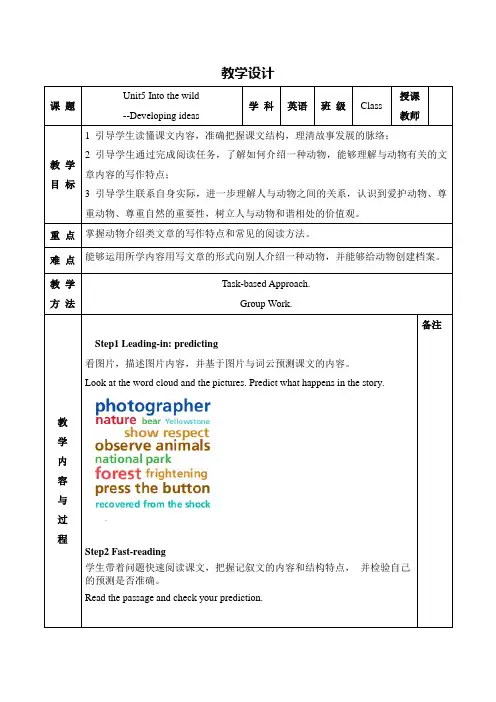
教学方法Task-based Approach.Group Work.教学内容与过程Step1 Leading-in: predicting看图片,描述图片内容,并基于图片与词云预测课文的内容。
Look at the word cloud and the pictures. Predict what happens in the story.Step2 Fast-reading学生带着问题快速阅读课文,把握记叙文的内容和结构特点,并检验自己的预测是否准确。
Read the passage and check your prediction.备注a surprising way.2 “Reflected”means that images can be seen on the surface of the mirror, glass or water.3 “Frightening”means that something is making people feel afraid, anxious or nervous.Step4 Group Work教师利用此活动,结合文本内容,引导学生了解其他与动物相关的职业,感知人与动物的和谐相处,帮助学生树立关爱动物、尊重动物的意识。
高中英语Unit5IntothewildPartⅢDevelopingideas教案外研版必修第一册

Part ⅢDeveloping ideasAn Encounter with NatureAs a nature photographer, I have to brave the elements.But despite the wind and the rain, I still enjoy working outside in the wild.One of the best things about this job is (1)that you can observe animals in their natural environment.My favourite place to take photos is Yellowstone National Park.As the world’s first national park, Yellowstone is famous for the variety of its wildlife, but it is probably best known for its bears.These huge, strong animals can live for 30 years.Despite a weight of up to 300 kilograms, they can run at a speed of around 64 kilometres per hour and are also excellent swimmers.Last spring in Yellowstone, I followed a path (2)that took me through a dark forest.(3)When I finally stepped out of the trees, the view was breathtaking.An eagle flew over the snow-capped mountains, (4)which were reflected in the still lake below.(5)While I was concentrating on photographing this amazing scene,I suddenly had a feeling that I was being watched.Slowly, and with the camera still held to my eye, I turned...and froze.Only meters away from me was a bear.(6)With water falling off its thick, brown hair, the bear stared back at me.Time stood still as the bear and I both waited to see (7)who would move first.My legs started shaking.Somehow, I forced my finger to press the button.A second later, the bear turned and ran back into the forest.(8)When I recovered from the shock, I looked at my camera.My most frightening but magical experience was now captured forever in a single image.From time to time I look at the photo as a reminder to show respect to all animals.(9)It is after all we who are the visitors to their world.(1)that引导表语从句,无意义,也不作句子成分。
新教材高中英语Unit5Intothewild单元重点知识回顾教学案外研版必修第一册
新教材高中英语Unit5Intothewild单元重点知识回顾教学案外研版必修第一册Ⅰ.重点词汇1.seek v. 寻找,寻求seek to do sth. 设法做某事seek (for) sth. 寻找/谋求某物seek after 追求;寻求seek out 找出;搜出2.measure v. 量,测量;评估linking verb有……长/宽n. 尺寸;措施measure ... by ... 用……来衡量……make ... to one's measure 按某人的尺寸做(衣服等)take measures to do sth. 采取措施做某事3.position n. 位置;处境,状况;地位;职位;姿势in a(n) ... position 处于……地位/位置in/out of position 在/不在恰当的位置hold the position of ... 担任……的职务take up (one's) position 就位4.determine v. 测定,确定;决定,决心→determined adj. 坚决的,有决心的,果断的→determination n. 决心,决定determine to do sth. 决心做某事(表动作)determine on/upon (doing) sth. 决定(做)某事be determined to do sth. 决心做某事(表状态)5.amazing adj. 惊人的,了不起的→amaze vt. 使吃惊→amazed adj. 感到惊奇的;吃惊的→amazement n. 惊讶be amazed to do ... 对做某事感到惊奇be amazed at/by 对……很惊奇(much) to one's amazement 令某人(非常)惊讶的是in amazement 惊讶地6.survive vi. 活下来;幸存vt. 幸免于;从……中逃生;比……活得长→survival n. 幸存→survivor n. 幸存者survive sth. 幸免于……,从……中艰难度过survive sb. (by three years) 比……活得长(三年)7.effect n. 影响,结果→effective adj. 有效的→effectively adv. 有效地have an effect on/upon ... 对……有影响bring/put ... into effect 使生效;实行,实施come into effect 生效,开始实施in effect 有效;在实施中;实际上8.accommodation n. 住处,工作场所;食宿;膳食供应→accommodate vt. 容纳(乘客);向……提供膳宿;使适应,顺应make/provide accommodations for 为……提供食宿accommodate sb. with sth. 给……提供……accommodate ... to ... =adapt ... to ... 使……适应/迎合……(其中to为介词) accommodate oneself to 使自己适应……accommodate sb. for the night 留某人过夜9.variety n. [C]种类,品种 [U]变化,多样性→vary v. (使)变化,不同→various adj. 各种各样的→variation n. 变化a variety of=varieties of 各种各样的vary from ... to ... 从……到……不同vary with ... 随……而变化10.concentrate v. 集中(注意力、思想等)→concentration n. 专心,集中concentrate ... on/upon ... 把……专注于……concentrate on/upon ... 专注于……11.cut down 砍倒;削减,缩小(尺寸、数量等);降价cut off 切断;停掉;隔绝cut in 插嘴;插队cut across/through 抄近路穿过12.after all 毕竟,归根结底;终究in all 总共above all 尤其是,最重要的是(强调重要性)all the time 始终,一直all of a sudden=suddenly 突然,冷不防地Ⅱ.教材原句1.Somehow they manage to travel around 4,000 kilometres south and find their way to California or Mexico. (P50)不知怎么地,它们成功地向南行进了4,000公里,到达了加利福尼亚或墨西哥。
新外研社(19)高中英语必修一Unit5Into the wild-Using Language教案
新外研社(19)高中英语必修一Unit 5 Into the wild-Using Language教案Teaching objectives:1.Enable the students to learn more about the structures and functions of the attributive clauses and master the usage of relative adverbs as well as their applications in real contexts.2.Guide the students to deepen the understanding of English and stimulate their interest in learning English.Meanwhile,they will learn to observe,research and summarize in English thinking models.3.Lead the students to learn more about the attributive clauses by observing,analyzing and illustrating.Thus,they will deepen their own understanding of the attributive clauses.4.Help the students to explore more usage of the attributive clauses,especially that of the relative adverbs through self-study and cooperation.Evaluation objectives:1.Ask the students whether they could recognize the attributive clauses and whether they have mastered the usage of relative adverbs as well as their applications in real contexts.2.Ask the students whether they could properly use the idioms related to animals and whether they know some other common idioms.3.Check students’ ability to understand the conversations about animals and let them debate on the topics about protecting animals and express their opinions.Teaching key and difficult points:1.Enable the students learn more about the structures and functions of the attributive clauses and master the usage of relative adverbs as well as their applications in real contexts.2.Help the students master and properly use the idioms related to animals, and learn the meanings of some common idioms.3.Improve students’ ability to understand the conversations about animalsand encourage them to debate on the topics and express their agreements and disagreements.4.Lead the students to think about the relationship between human beings and animals, realize the importance of harmony between us and set up the ecological view of sustainable development.Teaching methods:Task-based Approach; Cooperative Teaching MethodTeaching procedures:Step1: Lead-inThe teacher leads the students to review the reading passage on Page50-51 and underline all the attributive clauses in the passage. Then, the teacher will introduce the main topic of this class.(Intention:Introduce the grammar item of this class; the attributive clauses introduced by relative adverbs)Step2: Teach a new class1.Autonomic LearningThe teacher requires the students to discuss the similarities of the underlined attributive clauses in the passage and then summarize the law of the application of their conjunctions, such as where, when and why.(Intention:Summarize the usage of the relative adverbs in the attributive clauses)2.Achievement displayWhen the relative words function as adverbials of time, place and reason in the attributive clauses, we should use relative adverbs, such as when, where and why.(Intention:It will be much more effective to let the students summarize the law of application of the relative adverbs on their own.)3.Cooperative researchStudents are required to discuss why the author uses the attributive clauses rather than two simple sentences in the passage and then they should complete the Activities 1,2 and 3 on Page 53.(Intention:Let students realize the importance of the attributive clauses in the composition and lead the students to try to use the attributive clauses in their following writing.)4.Break through the difficulties(1)Students are required to analyze the usage of relative adverbs again and compare their usage with those of relative pronouns.①The usage of the relative adverb:whenWhen the antecedents are nouns representing time, such as time, day, year, month, week etc. And the relative words function as an adverb of time in the attributive clauses, we will use“when”to introduce the attributive clauses.Eg. I still remember the time when I was in college.I have forgotten the exact date when this country became independent.②The usage of the relative adverb:whereWhen the antecedents are nouns representing place, such as place, room, mountain, airport, etc. and the relative words function as an adverb of place in the attributive clauses, we will use“where”to introduce the attributive clause.Eg. This is the hotel where they stayed.When the antecedents are nouns, such as situation, case, stage, point etc. And meanwhile the relative words function as an adverb of place in the attributive clauses, we will use“where”to introduce the attributive clauses, too.Eg. They have reached the point where they have to separate with each other.③The usage of the relative adverb:whyWhen the antecedent are nouns representing reason, such as reason, and the relative words function as an adverb of reason in the attributive clauses, we will use“why”to introduce the attributive clauses.Eg. This is the reason why he left in a hurry.(Intention:Let the students learn more about the usage of relative adverbs by showing them some typical sentences.)Step3:Explanation当关系词在定语从句中作时间、地点、原因状语时,应使用关系副词,,。
2019_2020学年新教材高中英语Unit5Intothewild单元要点回扣教案外研版必修第一册
Unit 5 Into the wildⅠ重点单词重点词汇夯实练1.①It is hard to measure(measure) his ability when we haven’t seen his work.②It is high time that we should take some measures to control(control) the spread of this disease.③The new bridge under construction, measuring(measure) twice as long as the old one, will be completed next month.2.We are now in a good position where all is in our hands.3.①He is a determined man and he believes determination and effort can lead to success.(determine)②He left home without saying a word and determined never to come(come) back before he could make a big fortune.4.①This country has found the effective solution to poverty.②We have to solve(solution) the problem from the root.5.①—How do you like the new film?—Well, it’s quite amazing and I am really amazed at it.(amaze)②From his amazed(amaze)look, I could see that he didn’t believe what I said.③Much to my amazement(amaze), he was able to recite the whole poem from memory.6.①NotreDame de Paris(巴黎圣母院)was destroyed(destroy) by fire in 2019.②The flood caused serious destruction(destroy) to the railway.7.Only two passengers survived the air crash.When the two survivors were interviewed, they said their survival was a wonder.(survive)8.①The police observed him driving(drive) at 90 miles per hour.②The policeman observed the man open(open) the window and enter(enter) the house.③So far, the villagers have been observing/have observed(observe) the traditional custom.9.①Everyone arrived late at the party for various (vary)reasons.②There are a variety of/varieties of(各种各样的) flowers on sale in the market.10.①(2019·四川成都期末)When you begin to work, you should be able to concentrate on your subject.②There is too much noise.I can’t concentrate my attention on(集中我的注意力) thework.11.I stared at the girl, trying to remember who she was.Ⅱ重点短语会书写会应用1.manage to do 设法做成某事2.cut down 砍倒;缩减;降价3.lead to 导致;造成(后果);通向……4.add...to 把……添加到……5.up to 达到,多达……6.after all 毕竟,终究,归根结底(句首); 别忘了(句尾或句中)1.We firmly believe that war never settles anything.It only leads to violence.2.Lots of woods have been cut down in order to make great profits.3.Don’t worry too much.After all, it’s not your problem.4.Some new sports games include Karate, rock climbing, etc.will be added to the 2020 Olympic Games.Ⅲ重点句型1.the+比较级, the+比较级,意为“越……就越……”The more we know about this lovely creature, the greater the chance it will survive and keep its place in the natural world for a long time to come.[仿写] 你看的书越多,你理解的越好。
外研版(2019)必修第一册Unit5IntotheWildUsinglanguage教学设计
教师提问学生关于课文内容的问题,如“What is the main idea of the text?”, “What is the author's attitude towards survival in the wild?”等,检查学生对课文内Байду номын сангаас的理解和分析能力。
学生回答问题,教师给予评价和反馈,鼓励学生积极参与课堂讨论。
4.听力作业:要求学生观看一部关于野外生存的电影或纪录片,并完成相关的听力练习。电影或纪录片可以选择《荒野求生》、《荒野挑战》等。
5.实践作业:要求学生结合本节课所学内容,与家人或朋友共同设计一个野外生存的短途旅行计划。计划中应包括目的地选择、食物准备、水源获取、住宿安排等方面的考虑。学生可以将计划实施并记录下实际生存过程中的经验和感受,以便在课堂上与同学分享。
本节课的教学重点为:1.掌握本单元的生词和短语;2.理解课文内容,概括文章大意;3.运用所学知识进行口语交流和写作训练。教学难点为:1.正确运用本单元的语法知识;2.在实际情境中运用所学词汇和短语。
教学过程中,教师应注重启发式教学,引导学生主动探究、积极参与,通过小组合作、讨论等方式,提高学生的语言运用能力。同时,注重情感教育,培养学生的环保意识和团队合作精神。
(三)改进措施
1.关注学生个体差异:针对不同学生的特点,制定个性化的教学计划和辅导措施,鼓励内向学生积极参与课堂活动,提高他们的自信心和口语表达能力。
2.加强实践环节:增加户外实践活动,如野外生存体验营、实地考察等,让学生在实际环境中运用所学知识,提高他们的实际应用能力。
3.丰富教学资源:充分利用网络资源和校内外资源,引入更多的文化背景知识,拓展学生的知识视野,提高他们的文化意识和跨文化交际能力。