
人教版高中英语必修1上学期+Unit+3+Travel+journal+PPT说课稿
Lesson Plan InterpretationNSEFC Book1 Unit3 Travel JournalHello, everyone. It’s an honor for me to stand here and interpret my lesson. The lesson plan I am going to talk about is fro m NSEFC Book 1 Unit 3 Travel Journal. I’ll explain how to teach and why do so from the following 5 aspects: the theoretical basis, understanding of the teaching material, teaching methods and studying ways, teaching procedure, blackboard design.Ⅰ. The theoretical basisFirst, I’d like to show my theoretical basis--schema theory and top-down model (Goodman, 1971). Journey down the Mekong is a reading course. According to schema theory, reading comprehension is an interactive process between the reader’s bac kground knowledge and the text (Carrel and Eisterhold, 1983), or between the new information and the old knowledge store (Anderson and Pearson, 1984). So in order to improve the students’ reading speed and reading comprehension, language teachers should tr y to activate the Ss’ old knowledge store and add more relevant background knowledge before they get the students to read. According to the top-down model, general idea of the text will be got first, and then come the details.II. Understanding of the teaching materialMy understanding of the teaching material includes 3 parts: the status and the function, teaching objectives, the important and difficult points.At the beginning, let’s focus on the first part. Journey down the Mekong is a piece of travel j ournal written by Wang Kun. It’s mainly about Wang Kun and his sister’s dream of taking a great bike trip down the Mekong River, their preparation for the trip and some more details of the Mekong River. General speaking, it is not difficult for the students to understand the text, but there are some new phrases and sentences that may be a little bit difficult. So before the students’ first reading, I will explain the new words and phrases briefly and after reading the whole passage, I will embody the usage of the news words and phrases, and get the student understand the difficult sentences. As it is a piece of journal, besides learning the new words and phrases, students can get the general idea of how to write a journal.That’s all for the first part, now let’s move to the second part. According to the teaching material and the new curriculum of English, in order to fulfill the learning task of this lesson, I establish the following objectives:a) Knowledge objectivesBy the end of the lesson, Ss will have a better understanding of the meaning and structure of the text. Then Ss will grasp some useful words and expressions such as determined, make up one’s mind, give in, be fond of …, care about…, stubborn, etc.b) Ability objectivesActually students should be encouraged to do speed reading in the first period of reading lesson. But the students in my class are lack of independent readingability. In this class, I will encourage and help them to read, think and find out information by themselves most time. Since the main objective of reading course is to improve the Ss’ reading ability, I’ll train their ability of identifying the general idea in the fast reading. And in intensive reading their ability ofinformation-gathering and summarizing is developed. And the whole class is for Ss to develop their reading skills as scanning, skimming, information-gathering, summarizing and guessing the new words from the text.c) Moral objectivesThough Journey down the Mekong is mainly about the trip down the river, it also talks about the scenery and life along the river. So before learning the text, we will have a short discussion about the importance of the river. I want the Ss to have the awareness of protecting the river and protecting our environment.Well, so much for the teaching objectives, let's come to deal with the third part: the important points and the difficult points. According to the national curriculum of English and language learning theory, when teaching reading, we should encourage the Ss to do speed reading for the first time, that’s to say, we should encourage our Ss to read as fast as they can when they do the first reading. So much emphasis should be put on reading skills and reading comprehension as well. So the important points are that how to make Ss grasp the new words and phrases and how to improve their reading skills as scanning, skimming, information-gathering and summarizing. As to the difficult points, they are the same as the important ones.III. Teaching methods and studying waysThat’s all for my understanding of the teaching material. Now let’s focus on the ways of teaching and learning.Generally speaking, I adopt task-based language teaching and communicative approach in my class. As for learning, Ss will learn through independent reading, discussing and cooperating.I will use computer and blackboard as my teaching aids.Ⅳ. Teaching procedureHere comes the most important part, the teaching procedure. It includes 5 steps: Step I: Lead-in and pre-reading, Step II: While-reading, Step III: Consolidation, Step IV: Post-reading, Step V: Homework.Step I: Lead-in and pre-reading (7mins)Now let’s come to the first step. There are three activities in this step and I will spend 7mins on them.In activity one, I will ask Ss two questions "Do you know some great rivers in China?" and "Why they are great?” Here, as the Ss get famili ar with the Chinese great rivers, I choose to ask them some great rivers in China. And the answer to the second question can lead in the next activity--brainstorming.In activity two, I will ask the Ss to discuss in pairs and answer the question "How do pe ople who live along a river use it?” My purpose of this activity is to remind the Ss the importance of the river, thus stimulate the Ss' awareness of protecting the rivers.In the last activity, I will show the Ss a picture of the Mekong River and ask them to list the countries that it flows through. This activity leads in the while-reading. Step II: While-reading (21mins)While-reading is the main part and it will take 21mins. Here I adopt the top-down reading model. This step is divided into 2 parts: fast reading and careful reading. Before reading, I will ask the Ss to predict what will talk in the text according to the title. It can exert the Ss' imagination.1) Fast readingDuring fast reading, I will ask the Ss to reading the whole passage quickly and get the main idea of each paragraph. Usually, the main idea of each paragraph is the first sentence or the last sentence, but this text is not. So the main idea of each paragraph will be matched because the Ss are lack of the skill of summarizing the main idea by themselves.2) Careful readingAfter getting the general idea of each Para., I will deal with the details Para. by Para..In paragraph one, I will ask the Ss to read quickly and do the exercises T or F. And if it is F, I will ask them to correct it. This exercise can help the Ss get the key information of the first paragraph in a short time and can deepen the Ss’ understanding of the first paragraph.In paragraph two, I will ask Ss one question “Is it a difficult journey to cycle along the Mekong? W hy?” This can help the Ss develop their ability of summarizing. If theSs can’t answer the question briefly, I will encourage them to find the key sentences and try to join them together.And in the last paragraph, I will ask Ss two questions “How does th e water of Mekong River change?” and “What can you see when you travel along the Mekong River?” Both questions are required to answer in keys word. In order to lower the difficulty of the questions, I will show them the examples. After that, I will present some pictures to deepen the Ss’ impression on the new words. And these two questions can help the Ss gain a deeper understanding on the Mekong River. Step III: Consolidation (6mins)After dealing with the detailed information of each paragraph, I will ask the Ss to read the whole passage again and answer two questions to consolidate what they’ve learnt. It will take 6 minutes. The two questions are “Where is the source of the Mekong River and which sea does it enter?” and “How do Wang Kun and Wang Wei prep are for the trip?” It is easy for the Ss to find the answer to the first question in the text. As to the second question, it may be a little difficult, so I will list some tips for the Ss to find the answer more easily.Step IV: Post-reading (10mins)That’s all for the while-reading. Now let’s move to the fourth step. In this step, I will design two activities and I will spend 10 minutes on them.The first activity is filling in the blanks. In this activity, Ss are required to find the different attitudes of Wang Kun and Wang Wei to the trip, and then the teacher will express her attitude to this trip. After demonstrating, Ss are encouraged toexpress their attitudes. It can help the Ss train their ability ofinformation-gathering and expression.The second activity is thinking. In this activity, I will ask the Ss to discuss in groups of four and try to use some words to describe the characteristics of Wang Kun and Wang Wei according to their attitudes. It is really difficult, but it can not only train their ability of analysis and comprehension, but also cultivate their spirit of cooperationStep V: Homework (1min)Finally it comes to the homework. Ss are required to review the learnt lesson and underline the useful words and phrases in the text. This one is for them to consolidate what they’ve learnt and make preparation for the next lesson—Learning about the Language..Ⅴ. Blackboard designOn the top, there is the title of this lesson. On the left, it lists some important roles that the river plays. On the right, there are some useful words and expressions. That’s all for my interpretation. Thank you for your att ention。
高中英语人教版必修1Unit3Traveljournalreading课件
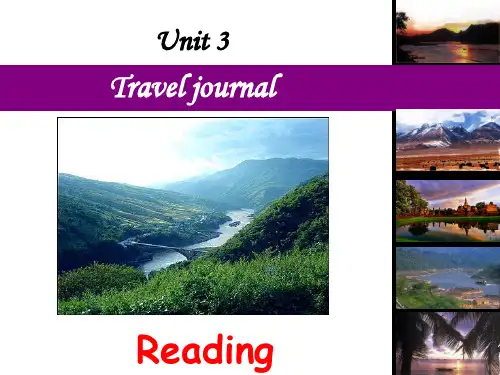
adventurous
Wang Kun enthusiastic, careful, thoughtful, easygoing
* What can we learn from the story ?
Life is just a series of trying to make up your mind. 生活是由一系列下决心的努力所构成的. Success belongs to the persevering. 胜利属于有毅力者.
South China Sea
glacier
rapids
waterfall
valley
plain
delta
rapids glacier mountain delta plain valley waterfall bank
I really enjoyed my school field trip in geography two months ago. We saw so many beautiful thing: a _g_l_ac_i_er_ that flowed like a river of ice through a __va_l_le_y_ that cut the mountains into two parts. We also discovered a river that was falling off the mountain and became a wonderful __w_at_e_r_f_a_ll. This was even more exciting to see than the __ra_p_i_ds___ where the water seemed to boil. Later we followed the river to a quieter __p_l_ai_n____ and finally into a ___d_e_lt_a____ and the sea.
人教版高中英语 必修一 Unit3 《Travel journal---Reading》 课件 (共43张PPT)
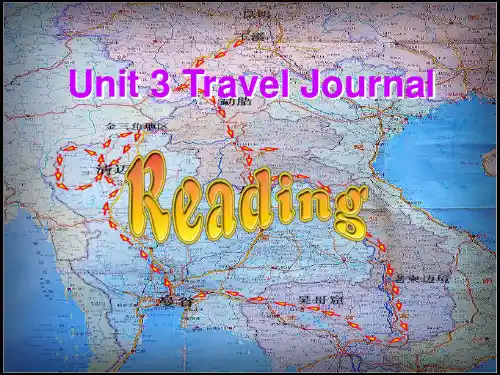
train
1. cheaper than the airplane
2. journey ends in the center of the town/city
1. takes longer than the airplane
2. does not provide meals
When are you leaving? How are you going to …? When are you arriving in/at …? Where are you staying? How long are you staying in …? When are you coming back?
Read the passage again and answer the following questions.
1. What can you see when you travel along the Mekong? You can see the source glacier, rapids, hills, valleys, waterfalls and plains.
3. It makes wide bends or meanders through low valleys to the plains where rice grows. The sentence means that the Mekong River flows slowly and gently through the valleys and reaches the farming plains.
on foot by bike by bus by train by ship/sea by plane/air
高中英语人教版必修1Unit3Traveljournal单元课件
cheaper than the airplane, views along the road arrive at the centre of the cities
takes longer than the airplane no meals, crowded
cheaper than plane comfortable, accommodation and meals entertainment
Warming up
Have you ever been to these places? How do you get there?
White House
New York
Have you ever been to these places? How do you get there?
Suzhou Gardens
Have you ever been to these places? How do you get there?
Taishan (Mountain)
Have you ever been to these places? How do you get there?
Hukou Waterfall
Have you ever taken these?
(1) Wang Kun and Wang Wei’ idea of a good
tripe is to take a long bike trip. (T) (2) Wang Kun planed the trip. (F) (3) The source of the river is in Yunnan Province.(F) (4) The river enters the South China sea.(T)
人教版高中英语高一上学期必修一 unit3 travel journal reading(共23张PPT)
Timing & Occurrence1. Ever sin来自e middle school
2. Two years ago
Dreaming about a bike trip
Wang Wei bought an expensive mountain bike
3. Last year
Wang Wei visited their cousins and got them interested in cycling.
4. After graduation
A chance to take a bike trip.
5. Now
Planning for the bike trip.
My name is Wang Kun.Ever since middle school, my sister Wang Wei and I have dreamed about taking a great bike trip.Two years ago she bought an expensive mountain bike and then she persuaded me to buy st year, she visited our cousins, Dao Wei and Yu Hang at their college in Kunming.They are Dai and grew up in western Yunnan Province near the Lancang River, the Chinese part of the river that is called the Mekong River in other countries.
Journey travel, trip Down the Mekong
人教版高中英语 必修一 Unit3 《Travel journal---Reading》 课件 (共43张PPT)
3. It makes wide bends or meanders through low valleys to the plains where rice grows. The sentence means that the Mekong River flows slowly and gently through the valleys and reaches the farming plains.
Read the passage again and answer the following questions.
1. What can you see when you travel along the Mekong? You can see the source glacier, rapids, hills, valleys, waterfalls and plains.
Wang Wei’s reactions A. She said she could
organize the trip properly. B. She would not change her mind. C. She appeared to be excited about it. D. She does not care about details. E. She said it would be an interesting experience.
YAMYemaPeNlnlekaoigalzowetroznlnRegiver
Look at the map and list the countries that the Mekong flows through.
China Myanmar
Laos Thailand Cambodia Vietnam
人教版高中英语必修一 Unit 3 Travel Journal reading 课件(共36张PPT)

3. ___B____ planned the schedule for the trip.
A. Wang Kun
B. Wang Wei
C. Dao Wei
D. Yu Hang
Who will join in the trip?
Wang Kun
}
Wang Wei
Dao Wei
{ cousins
Yu Hang
Para 3
1. When you travel along the Mekong River
maybe you can not see ___D______.
A. waterfalls
B. hills and valleys
C. plains where rice grows D. desert
Para 1:
1. Wang Kun and Wang Wei’s dream was to______.
A. travel around China
B. travel around Yunnan Province
C. take a great motorcycle trip
D. take a great bike trip
ቤተ መጻሕፍቲ ባይዱ
2. The source of the Mekong is in __D_____
and it enters the________. A. Yunnan Province; South China Sea B. Guizhou Province; East China Sea C. Hunan Province; East China Sea D. Qinghai Province; South China Sea
人教版高一英语必修一课件:Unit3Travel journal (共79张PPT)
4.My plane _________(take off)at 9:20,so I must be takes off
at the airport by 8:30.
5.They _________(get)there by air in an hour. are getting
Ⅴ.教材活用 Wang Kun and Wang Wei have dreamed about __1__ (take)a great bike trip.It was Wang Wei who first had the idea __2__ (cycle)along the entire Mekong River.
:00 this afternoon.
2.The Browns a_r_e__c_o_m_i_n(ggo)to North China by train next week.
3.Some friends __________ (come)to Anne's birthday
party this evening.
working with us.______
3.determine vt.& vi.决定;确定;(使)下定决心 [经典例句] (朗文P594)How hard the swimmers work now will determine how they perform in the Olympics. 游泳运动员现在训练的努力程度将决定他们在奥运会 上的表现。
偏爱;爱好
4.d_e_t_e_rm__i_n_e__ vt. 决定;确定; 下定决心 d_e_te_r_m__in__ed__adj. 坚决的;有决心的 de_t_e_r_m_i_n_a_t_io_n__n. 决心 5.o_rg_a_n__iz_e__ vt. 组织;成立 o_r_g_a_n_iz_e_r__n. 组织者 or_g_a_n_iz_a_t_i_o_n_ n. 组织 or_g_a_n_i_z_e_d__ adj. 有组织的
人教 高中英语必修一unit3 Travel journal-Reading课件(共42张PPT)
Careful reading
After, It travels slowly through _lo_w__v_a_l_le_y_s_ to __p_la_i_n_s_(平__原__)__.
Careful reading
delta 三角洲
At last, the river _d_e_lt_a_ enters the South China Sea.
Read the passage carefully and answer the following questions . 1.What was Wang kun and Wang Wei’s idea of a good trip? 2.Who planned the trip to the Mekong?
on foot by bike by bus
by train by ship/sea by plane/air
Here are some famous rivers in China. Do you
know their names?
Which river is the longest river in China.
the _S_o_u_t_h__C_h_i_n_a_S__ea__.
In China it is called The Lancang River – 澜沧江
Out of China, it is called the Mekong River
Reading
Journey down the Mekong
√C. During college time D. After graduating from college
人教版高中英语 必修一 Unit3 《Travel journal---Reading》 课件 (共43张PPT)
on foot by bike by bus by train by ship/sea by plane/air
Which kind of transport do you prefer to use: bus or train? Think about the advantages and disadvantages of each form of transport and fill in the chart.
Many people live beside a river. How do they make use of it in their daily life?
The world has many great rivers. If you could follow the route of only one of them, which one would you choose? Why?
Sample dialogue A: Tom, where are you going on holiday? B: I’m going to Laos. A: When are you leaving? B: Next Sunday. A: How are you going to Laos? B: I’m taking a plane. A: How long are you staying in Laos? B: About two weeks. A: Great. Have a good trip. B: Thanks.
When are you leaving? How are you going to …? When are you arriving in/at …? Where are you staying? How long are you staying in …? When are you coming back?
人教版高中英语 必修一 Unit3 《Travel journal---Reading》 课件 (共37张PPT)
Skimming:
1.Who are Wang Kun and Wang Wei?
They are brother and sister,
and both are college students.
2. What was their dream?
Their dream was to take a great bike
trip.
3.Who are Dao Wei and Yu Hang?
They are Wang Kun’s cousins
who are at a college in Kunming.
Careful Reading
Read Paragraph1 quickly and answer the following questions 1.Who are Wang Kun and Wang Wei? 2.What is their dream? 3.Who are Dao Wei and Yu Hang?
the longest river in Southeast Asia the Mekong River
In China it is called
the Lancang River – 澜沧江
Out of China, it is called the Mekong River
What countries does the Mekong
Paragraph 3: Preparation
What can you see along the Mekong?
It makes wide_b_e_n__d_sor meanders through __lo__w_v_a_ll_e_y_s_ to the_p_l_a_in_s_where rice grows.