
人教版英语七年级下册:Unit 9 Section A~1a--1c~教案
作品名称:Unit9 What does he look like?
教学设计
步骤2.给出几个人物图片,让学生用He/She is…. He/She has. He/She wears描述人物。
(5 minutes)
设计意图:培养学生语言组织能力,这样每一个学生都能参与到学习中来。
为接下来的1a和后面的1b的听力奠定了基础。
步骤3.总结(2 minutes)
设计意图:培养学生的观察能力和归纳总结的能力。
步骤4.Make up your sentences with the words we have learned today. If you are creative,you will get more points.
罗盘的指针停在哪个词或短语上,请用这个词或短语造句。
有创意者,分数加倍 . (5minutes)设计意图:培养学生造句的能力。
步骤5.Guessing games
学生以4人小组为单位在组内描述一个任课老师让其他小组来猜。
小组成员每人说一句。
例如He is tall. He is thin. He is of medium height. He has long straight hair.He wears glasses. Who is he?(5 minutes)
设计意图:学生以小组为单位描述本班任课老师的某位同学让其他小组来猜,难度增加但更有趣。
积极参与,发挥想象,运用新知识解决问题。
培养学生熟练运用新知识,激发学生的思维,推理和想象能力。
注重面向全体又兼顾个体的学习差异。
步骤6:小练笔(12minutes)Please describe your friend or your teacher at least 5 sentences,we'll guess who he/she is? 请至少用5句话描写你的好朋友或是老师,让我们猜他/她是谁?。
Unit9 What does he look like? SectionA 1a-1c。
英语人教版七年级下册Unit 9 SectionA(1a-1c) 教案
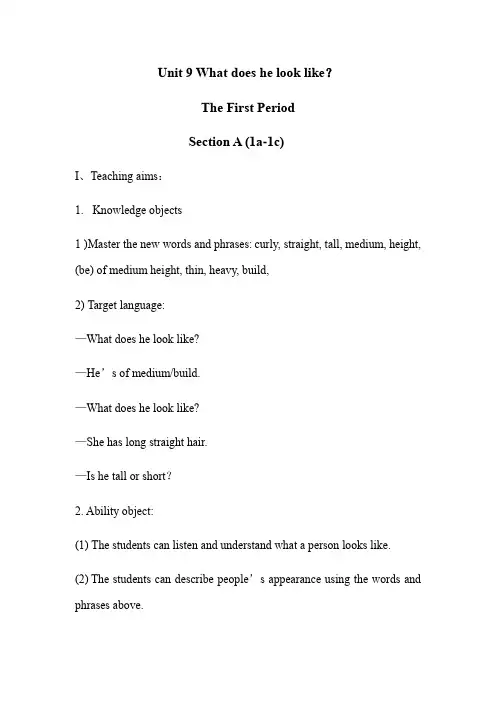
Unit 9 What does he look like?The First PeriodSection A (1a-1c)I、Teaching aims:1. Knowledge objects1 )Master the new words and phrases:curly, straight, tall, medium, height, (be) of medium height, thin, heavy, build,2) Target language:—What does he look like?—He’s of medium/build.—What does he look like?—She has long straight hair.—Is he tall or short?2. Ability object:(1) The students can listen and understand what a person looks like.(2)The students can describe people’s appearance using the words and phrases above.3. Moral object:The students can learn to respect and understand others and not to judge the person from their appearance.II、Teaching key points and difficulties:1.To master the vocabulary about people’s looks.2.To describe people’s looks.3.To know the differences between “is”and “has”.III. Teaching procedures:Step 1 Greeting and warm up1. Greet as usual.2. Show and read the learning aims .Step 2 Presentation1. Show the pictures to learn the main words.2. Match the words with the people in the picture. (1a)Now please look at P49, Use the letters to match the people in the picture with one of the numbered words. Write each letter next to a numbered word. You can use some letters more than once. Point out the sample answer.Then check the answers.3. Show the pictures to present the sentence patternsStep 3 Practice.1. Read the conversation in 1c and recite it.2.Practice the conversation according to some pictures.3. ListeningLook at the picture of 1a, listen and fill the blanks in the picture. (1b) Listen carefully and fill in the blanks and find Amy’s friend? We will listen twice.The first time, just listen.The second time,listen and fill in the blanks.And say the look of Amy’s friend.( He's really tall.And he has curly hair.)Correct the answers.Step 4 ConsolidationAsk Ss to describe their friends. Get students to work in pairs. As they are working, move around the room offering help as needed.Get some pairs of students to act out their conversations to the class. Step 5 SummaryLet Ss show what they’ve learnt in this class.Step 6 Homework1. Finish the exercises2. Describe your friends and draw a picture of them. IV. Blackboard Design。
人教新目标英语七年级下册unit9SectionA1a2c教学设计

此外,学生在小组合作活动中,能够积极参与、互相学习,但在分工、协调方面仍有待提高。因此,在教学过程中,教师应引导学生学会倾听、尊重他人意见,培养良好的团队协作能力。
三、教学重难点和教学设想
(一)教学重难点
1.教学重点:
(1)掌握描述人物外貌的形容词,如tall, short, fat, thin, young, old等。
(2)运用一般疑问句“What does he/she look like?”进行询问。
(3)听懂并准确回答关于人物外貌的问题。
2.教学难点:
1.教师呈现Section A 1a的图片,引导学生用形容词描述人物外貌,如“Look at this man. He's tall and strong.”,教授新词汇,如strong, medium build等。
2.学生跟随教师一起朗读描述外貌的句子,注意形容词的词序和语法。
3.教师创设情境,如警察抓捕嫌疑犯,引导学生运用一般疑问句“What does he/she look like?”进行询问,如“Excuse me, what does the suspect look like?”,并教授回答方法。
1.学生能够学会尊重他人,关注他人的外貌特征,培养良好的人际交往能力。
2.学生能够树立正确的价值观,认识到外貌不是衡量一个人价值的唯一标准,提高自我认识。
3.学生能够增强合作意识,学会在小组活动中倾听他人意见,提高团队协作能力。
七年级英语下册(人教版)Unit9第1课时(SectionA1a2c)教学设计
1.教师展示教材中的图片,引导学生学习本节课的核心词汇和短语,如:sleep, wake, brush, tooth, wash, face, dressed, undressed, put on等。
2.教师通过示例、模仿等方式,让学生掌握词汇和短语的正确发音及用法。
3.教师结合实际情境,引导学生学习一般现在时,通过示例句型展示、练习,让学生学会使用一般现在时描述日常作息和习惯。
1.编写对话:结合本节课所学词汇和短语,编写一段关于自己日常作息的对话。要求至少包含5个以上本节课所学词汇和短语,以及一般现在时的句子表达。对话内容要真实、有趣,能体现个人生活特点。
2.角色扮演:与同学合作,进行角色扮演,演绎所编写的对话。在表演过程中,注意语音、语调的准确性,以及表情、动作的自然流露。
1.教师通过播放一段关于日常作息的视频,引导学生关注视频中人物的活动,激发他们对本节课话题的兴趣。
2.视频播放完毕后,教师提出问题:“What do you usually do in the morning?”,让学生结合自己的生活实际,进行思考和回答。
3.教师根据学生的回答,板书相关词汇和短语,如:get up, brush teeth, wash face等,为接下来的新课学习做好铺垫。
(三)学生小组讨论(500字)
1.教师将学生分成小组,每组讨论一个话题:“What does your group member do in the morning?”。
2.学生在小组内运用所学词汇和短语,用一般现在时进行句子表达。
3.各小组选取一名代表,向全班展示讨论成果,其他小组成员进行评价和反馈。
(四)课堂练习(500字)
1.教师设计听力练习,让学生听懂并记录关于日常作息的对话内容,提高他们的听力理解能力。
人教版七年级英语下册Unit9SectionA1a1c教学设计
一、教学目标
(一)知识与技能
本章节的教学目标是让学生掌握人教版七年级英语下册Unit9 Section A 1a-1c的核心词汇和语法结构,提高学生在实际场景中的英语听说能力。具体包括:
1.掌握词汇:学生能够熟练掌握并运用以下词汇:goal, soccer, basketball, game, player, team, win, lose, play, match, competition, practice, score, success等。
4.通过学习运动项目,让学生了解各国文化,拓宽国际视野,增强跨文化交际能力。
二、学情分析
针对人教版七年级英语下册Unit9 Section A 1a-1c的教学内容,我对学生的学情进行分析。七年级学生正处于青春期,他们对新鲜事物充满好奇,尤其是与生活密切相关的运动话题。在英语学习方面,他们已经具备了一定的词汇和语法基础,能够进行简单的英语交流和表达。然而,学生在听说能力、词汇运用和语法掌握方面仍存在一定程度的不足。
(二)教学设想
1.创设情境:在教学过程中,我将创设与学生生活密切相关的运动场景,如篮球比赛、足球比赛等,让学生在真实语境中学习英语,提高他们的学习兴趣和参与度。
2.分层教学:针对不同学生的学习需求和能力水平,我将设计不同难度的教学活动,使每个学生都能在课堂上得到有效的提升。对于基础较好的学生,可以设置更高难度的任务,如复述对话、编写小短文等;对于基础薄弱的学生,则以巩固词汇和语法为主,逐步提高他们的听说能力。
(四)课堂练习
1.教学活动:教师设计一系列练习题,包括填空、选择、连线等,让学生巩固所学词汇和语法结构。
2.教学方法:教师引导学生独立完成练习题,然后进行讲解和反馈。
初中英语人教版七年级下册unit9 Section A(1a-1c)
重庆市江津区支坪中学教学设计
Unit 9 What does he look like?(1a-1c)
单元话题What does he look like? 单元功能是描述人的外貌
一. 教材分析:现行人教版英语课本每一单元的第一课安排的都是听说课,听和说是此课型最重要的特征。
Unit 9是新课标所倡导理念的较全面的展示,1a-1c以贴近学生生活的话题入手,直接且高效地激发学生的课堂积极性。
教师在以教材内容为载体的基础上,整合教材内容,有目的地引入,创设形象、鲜活的教学情境,以引起学生的态度体验。
本单元以贴近学生生活的描述外貌的话题为语言目标,教师在此基础上巧设情境、整合教材,合理安排操练,此类的教学设计便与新课标要求的知识与技能、过程与方法、情感态度价值观的“三维目标”不谋而合。
二. 学情分析:七年级下的学生由于年龄小,生性活泼好动,喜欢直观形象思维,对猜测方面的游戏感兴趣,有一定的词汇基础,能自主拼读单词,能简单对话.对谈论自己喜欢的人物感兴趣.
三. 教学设计主要思路:以Running man 为脉络,通过展开听说活动,让学生能熟练运用相关词汇,句型描述人物外貌.
四. 教学过程:
五. 板书设计:
Unit 9 What does he look like? (SectionA 1a-1c)What does he/she look like?
He/She is tall short of medium height
heavy thin of medium build
He/She has long hair short hair
curly hair straight hair。
Unit 9 Section A 1a-1c教学设计 人教版七年级英语下册
教学设计课题:Unit 9 Section A What does he look like? (1a--1c)教材分析:本单元第一课时部分(1a--1c)通过图文听力及练习导入整个单元的语境、话题,是整个Section A的基础,重点是呈现描述人的外貌的基本词汇和询问人物外貌的句型。
教材通过听取信息的任务引导学生关注和区分描述人物外貌的两个不同句型:Sb. is .. 和Sb. has ...,同时在听力和口语活动中增加了选择疑问句的输入和训练,穿插巩固前面所学的描述外貌的词汇,让学生能在相应的语境中综合运用核心句型和重点句型,表达初步的语言输出。
学情分析:学生了解基本的描述外貌的词汇:short\long\tall\fat等,在此基础上补充其他相关词汇;六班学生基础较薄弱,课堂各个环节应注意节奏,循序渐进,不可难度太大、容量太多。
教学目标:学生学会简单的外貌相关的词汇和句型,学会询问他人外表及如何回答。
教学重难点:本部分的教学重点是有关外貌描述的词汇及相关句型,难点是学生在运用句型描述人物外貌时需要分清何时用is,何时用has。
教学法:直观演示法、任务驱动法、情景交际法。
教具:ppt, 希沃白板,黑板教学过程:Step 1: Lead-inPlay a conversation to lead in the topic.T: I have a friend in America. I miss her, so I sent a message to her. That’s our conversation on We-Chat. (Play it)T: What’s it about? Yes, my friend’s father gets lost around Belt Tower, so she asks me to help her find him. Because she is in America now, and she can’t come back. So we need to know: what does her father look like? That’s what we will learn today ---- What does he look like? (Write down the topic on the blackboard.) (设计意图:通过微信聊天这一贴近生活的方式导入,让学生更有代入感,从而吸引他们的注意力。
人教版英语七年级下册 Unit 9 Section A (1a-1c) 教案
Teaching Design of Unit 9 Section A (1a-1c)Zeng Chunfang一、Teaching aims1.Knowledge aimsa>Master the following words, curly, straight, tall, medium, thin, heavyb>Master the following patterns①―What does he/ she look like? ―He has short /long /curly hair/ long straight hair②―What does he/she look like? ―He is tall /short /of medium height.③―Is he thin or heavy?―He is thin/ heavy/ of medium build.2.Ability aimsStudents can describe people’s looks using the adjectives and patterns we study. 3.Moral attitudeLet the students learn to know different people have different looks.Everyone is special.二、Teaching key pointsMaster the key words and the patterns that describe people’s looks.三、Teaching difficult pointsMaster the patterns that describe people’s appearance correctly.四、ObjectivesTo learn to ask about people’s appearance.To be able to recognize the people according to the description of their looks.To learn to describe people’s looks.五、Teaching procedureStep 1.Lead inShow a picture on the screen to make the students know different people have different looks.Step 2.Watch a video and answer the questionHow to ask and describe people’s looks .Step 3.PresentationT: Let’s learn how to describe people’s looks. We can describe people’s looks from the hair;the height and the build.Learn new words by showing different photos of different people on the screen.New words:tall, short, of medium height, thin, heavy, curly ,of medium buildN ew patterns:-What does she look like? -She is of medium build.- Is she thin or heavy?- She is thin.-Does she have short hair or long hair? -She has long hair.Step 4 PracticeAsk the Ss to describe the people’s looks in the picture of1a.Step 5 PresentationFinish the task of 1a Match the words with the people in the picture . You can usesome letters more than once.And then check the answers.Step 6. Listening.Listen and fill in the blanks in the picture above . Find who is Amy’s friend. Step 7. Groupwork.(three students in a group)Talk about your classmate’s new look.Step 8.Guessing gameDescribe(描述) one of your classmates in our class.Then let other students guess(猜) who he/she is?Step 9: HomeworkRemember the new words and expressions in this period.Blackboard design:Unit 9 What does he look like?has short hairhas long hairHe/She has curly hairhas short straighthairis tallHe / She is of medium heightis shortis thinHe / She is of medium buildIs heavy。
2020-2021学年人教版英语七年级下册Unit9SectionA(1a-1c)教案
一、教学内容
2020-2021学年人教版英语七年级下册Unit 9 Section A (1a-1c)教案,本节课主要内容包括:
1.词汇:学习与问路和指路相关的词汇,如:crossing, traffic lights, turn left, turn right等。
其次,在句型运用方面,学生在实际场景中进行问路和指路时,有时会出现语法错误。这说明我在讲解句型时,还需要进一步强化学生对语法规则的理解。我可以设计更多针对性的练习,让学生在实际操作中熟练掌握这些句型。
此外,小组讨论环节,我发现有些学生参与度不高,可能是由于他们对主题不感兴趣或者不知道如何表达自己的观点。针对这个问题,我可以在以后的课堂中,多设置一些开放性问题,鼓励学生发表自己的看法,提高他们的课堂参与度。
(二)新课讲授(用时10分钟)
1.理论介绍:首先,我们要了解问路和指路的基本概念。问路是获取方向信息的过程,指路是向他人提供方向信息的行为。它们在我们的日常生活中非常重要,帮助我们解决寻路的问题。
2.案例分析:接下来,我们来看一个具体的案例。这个案例展示了如何在实际中运用所学词汇和句型来问路和指路。
四、教学流程
(一)导入新课(用时5分钟)
同学们,今天我们将要学习的是Unit 9 Section A (1a-1c)这一章节。在开始之前,我想先问大家一个问题:“你们在日常生活中是否遇到过找不到地方需要问路的情况?”这个问题与我们将要学习的内容密切相关。通过这个问题,我希望能够引起大家的兴趣和好奇心,让我们一同探索问路和指路的奥秘。
在实践活动方面,角色扮演活动受到了学生的欢迎,他们能够在轻松愉快的氛围中练习英语口语。但同时,我也注意到有些学生在活动中过于紧张,导致表达不够流畅。针对这一问题,我可以在活动前对学生进行更多的指导,帮助他们克服紧张情绪,提高口语表达能力。
初中英语人教版七年级下册Unit9_Section_A(1a-1c)教学设计
Unit9 Section A(la-1c)教学设计【教学目标】1. 在听说训练中,学生能掌握本课重点词汇:short hair, curly hair, long hair, straight hair; tall, medium height, thin, heavy。
2. 通过听说训练,理解以下句型的意义,初步掌握描述人的外貌的句型:-What does your friend look like?-She’s of medium height, and she has long strai ght hair.-Is he short or tall?-Well, he’s really tall.3. 学生能基本听懂含有本课重点词汇和目标语言的听力材料。
初步了解听前预测的技巧,并在听的过程中学会关键词,做到有目的地获取有效信息。
4. 能通过描述外貌,培养学生的观察能力,并学会欣赏别人的长处和优点,增进同学友谊。
【教学重难点】●重点:学会运用What does...look like?询问某人的外貌,并能作出相应回答。
●难点:在描述外貌时is/has的恰当使用,选择疑问句句式特点。
【课前准备】课本、录音机、多媒体课件、视频材料、学案。
【教学方法】视频激趣导入、情景交际法、图片直观教学、自主探究、合作学习。
【教学进程】Teaching procedures【新课导入】Step l: GreetingDaily greetings to the students.【新知呈现】Step 2: Presentation1. 多媒体展示一些人物图片,引导学生学习有关外貌的单词和短语。
如:tall, short, medium height, short hair, curly hair, long hair, straight hair, thin, heavy...2. 学习生词的过程中,引导学生关注/Ɵ/和/ð/的发音以及句中重读单词。
人教版英语七年级下册Unit9SectionA1a1c说课稿
一、教材分析
(一)内容概述
本节课是人民教育出版社英语七年级下册Unit9 SectionA 1a-1c的内容。本单元主题为“Where did you go on vacation?”,旨在让学生学会用英语描述假期经历和活动。1a-1c部分在整个课程体系中属于听力训练环节,通过听力练习帮助学生掌握本节课的核心词汇和句型。教学内容主要包括以下知识点:
4.表扬激励:对学生在学习过程中的积极表现给予及时的表扬和鼓励,提高他们的自信心。
5.融入游戏元素:设计一些英语学习游戏,如听力竞赛、角色扮演等,让学生在游戏中学习,提高学习积极性。
6.家长参与:鼓励家长参与学生的学习,了解孩子的学习进展,共同关注孩子的成长。
三、教学方法与手段
(一)教学策略
在本节课中,我将主要采用以下教学策略:任务型教学法、情景教学法和合作学习法。任务型教学法强调通过完成实际任务来学习语言,这有助于学生将所学知识应用到实际情景中,提高语言的实用性和学生的动机。情景教学法通过创建贴近学生生活的场景,激发学生的学习兴趣,使他们在自然的语境中学习英语。合作学习法则鼓励学生在小组中共同完成任务,这不仅可以提高学生的团队合作能力,还能通过同伴互助促进语言能力的提升。选择这些方法的理论依据在于它们都能有效地促进学生的主动学习和语言的实践运用,符合语言学习的基本规律。
五、板书设计与教学反思
(一)板书设计
我的板书设计注重布局合理、内容清晰、风格简洁。板书分为三个部分:标题区、知识点区和总结区。标题区位于黑板顶部,写明课程标题和日期;知识点区用于呈现本节课的核心词汇、句型和语法点,采用列表或思维导图形式,便于学生快速理解和记忆;总结区位于黑板底部,用于总结课程要点和布置作业。板书在教学过程中的作用是提供视觉辅助,帮助学生把握知识结构。为确保板书清晰、简洁,我会提前规划板书内容,避免过度拥挤,使用不同颜色的粉笔突出重点,并在课后及时擦除,保持黑板整洁。