
外研版七上Module 6 A trip to the zoo Unit 3 Language in use
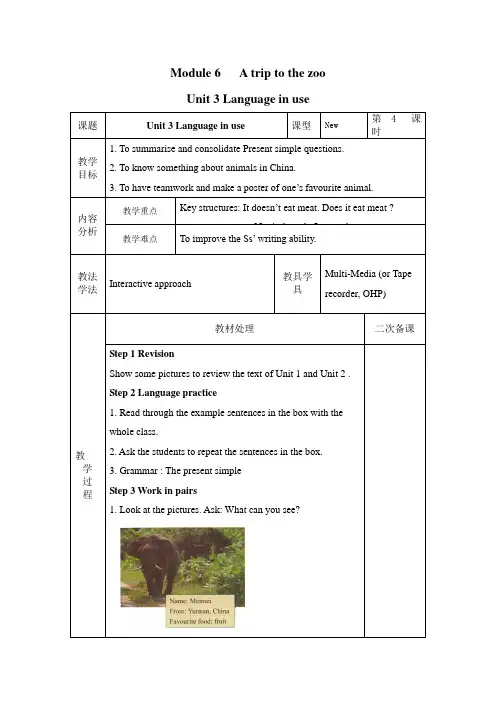
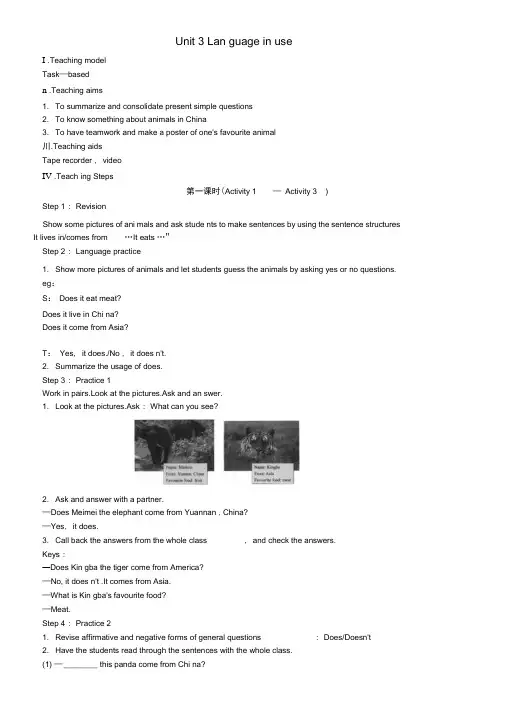
Name: Kingba From: Asia Favourite food: meat
— Does Kingba the tiger come America? — No, it doesn’t. It comes from Asia. — What is Kingba’s favourite food? — Meat.
They ea_t__(5) other animals. Does the tiger come from Europe? No, it d_o_es_n_’__t(6). It comes from Asia. The e_l_e_p_h_a_n_t_(7) comes from the Africa, and it doesn’t like to eat mea_t___(8). Would you like to go to see Lingling? It is a
morning. (get) 5. John _l_o_o_k_s_ like his father. (look)
B. 按要求改写下列句子: 1. He likes watching TV. (改为否定句)
H__e_d__o_es_n_’__t_l_i_k_e_w__a_tc_h_i_n_g_T__V_______. 2. She has lunch at twelve.(改为否定句)
Summary行为动词第三人称的句式
肯定
否定
疑问
回答
He speaks He does not good English. (doesn’t)
speak good English.
She lives in the esn’t) live in the city.
The students like learning English. Do the students like learning English? (2) Does + 主语(第三人称单数)+ 动词原
形…?
He watches TV every evening. Does he watch TV every evening? My father teaches Chinese. Does your father teach Chinese?
p_a_n_d_a__(9). She lives in China and she eats b_a_m_b__o_o_(10).
Homework
1. Sum up this Unit. 2. Prepare for the next Unit.
Look at the pictures. What can you see?
Look at the pictures. Ask and answer.
Name: Meimei From: Yuannan,
China Favourite food: fruit
— Does Meimei the elephant come from Yuannan, China?
S_h_e__d_o_e_s_n_’__t_h_a_v_e_l_u_n_c_h__a_t_t_w_e_lv_e_.___. 3. Mike does his homework at six. (改为否定句)
M__i_k_e_d_o_e_s_n_’__t_d_o__h_i_s _h_o_m__ew__o_r_k_a_t__si_x.
Complete the word map
giraffe
panda
zebra
tiger
elephant Africa
Asia monkey
The world
monkey
of animals
elephant
Europe
America
monkey
The camel lives in the deserts of Africa and Asia and eats grass. Some people think it carries water in the humps on its back, but it’s not true. In fact, it’s fat.
evening?
2. 行为动词一般现在时的疑问式和回答 一般现在时的疑问式在句首加助动词 do, 主语为第三人称单数时在句首加 does, 其结构是: (1) Do + 主语+ 动词原形…? 如:
They live near our school. Do they live near our school?
(3) 简略回答用助动词 do / does 和 don’t / doesn’t 代替行为动词。
—Do you often go shopping with your mother?
—Yes, I do. / No, I don’t.
—Does his mother work in that factory? —Yes, she does. / No, she doesn’t.
Present your poster to the class.
1. 实义(行为)动词一般现在时的否定形式 一般现在时的否定式在动词前加 do not (don’t), 主语为第三人称单数时在动词 前加 does not (doesn’t), 其结构是: (1) 主语+ do not (don’t) +动词原形…, 如:They live near our school.
Kangaroos kangaroo jumps across
the grassland.
Making a poster of your favourite animal
Work in groups. Find out about an animal.
Talk about your favourite animal. Choose one animal to write about. Find out about the animal.
Camel
The kangaroo is an Australian animal. It eats grass and leaves, but it doesn’t eat meat. It carries its babies in a pocket on the front of its body. With its strong tail and back legs, the
_D_o_e_s__h_e_u_s_u_a_l_ly__g_o_t_o_s_c_h_o_o_l_a_t_7_:_3_0_? _N_o_,_h__e_d_o_e_s_n_’__t_. ____
C.综合填空: Welcome to Guangzhou Zoo, There are many kinds of an__im__a_ls_(1), such as bears, z_e_b_r_a_s(2), giraffes and pandas. They come from many different c_o_u_n_t_r_ie_s_(3) and they eat different food. The lion comes from E_u_r_o_p_e_(4).
It’s
It comes from It eats
big/ small / tall, black and white /…
Asia / Africa /…
meat / grass/ bamboo /…
Make a poster about your
group’s animal.
Draw it or find a photo. Write some information about it.
They don’t live near our school.
You like learning history. You don’t like learning history. (2) 主语(第三人称单数)+ does not (doesn’t) + 动词原形…? 如:He watches TV every evening. He does not (doesn’t) watch TV every
— No, it _d_o_e_sn_’__t.
3. — ___D_o_e_s___ this monkey like fruit? — Yes, it __d_o_e_s _.
4. — __D_o_e_s___ this monkey live in Africa?
— No, it _d_o_e_s_n_’__t. 5. The zebra __d_o_e_sn__’__t like meat.
Complete the passage with the correct form of the words in the brackets.
My favourite animals (1) _a_r_e_ ( be ) zebras. Look at this one ( 2). It _is___ (be ) cute. It (3) __i_s__ ( be ) black and white like the panda. But it (4) _d_o_e_s_n_’__t( do not ) come from Asia. It ( 5) c_o_m__e_s_ ( come ) from Africa. It ( 6) __e_a_ts___ ( eat ) grass.
4. Jack likes Chinese food very much.(改 为一般疑问句,并作肯定回答)
D__o_e_s_J_a_c_k_l_ik__e_C_h__in_e_s_e_f_o_o_d__v_er_y__m_u__ch__? Y__e_s,_h_e__d_o_e_s_. ________ 5. He usually goes to school at 7:30. (改 为一般疑问句,并作否定回答)
外研社七年级上册 Module 6 A trip to the zoo Unit 3教案
3.Call back the answers from the whole class, check the answers.
Step5Important and difficult points.
行为动词 一般现在时的疑问式和回答
一般现在时的疑问式在句首加助动词do,主语为第三人称单数时在句首加does,其结构是:
1.Do +主语+动词原形…?
They live near our school.
Do they live near our s chool?
The students like learning English.
3. To have teamwork and make a poster of one’s favourite animal.
内容
分析
教学重点
Key structures: It doesn’t eat meat.Does it eat meat ?
No, it doesn’t. It eats plants.
2. Ask the students to repeat the sentences in the box.
3. Grammar : The present simple
Step 3 Work in pairs
1. Look at the pictures. Ask: What can you see?
The tiger lives inAsia.
教学难点
To improve the Ss’ writing ability.
新外研版七年级英语上册Module6AtriptothezooUnit3Languageinuse第
Unit 3 Lan guage in useI .Teaching modelTask—basedn .Teaching aims1. To summarize and consolidate present simple questions2. To know something about animals in China3. To have teamwork and make a poster of one's favourite animal川.Teaching aidsTape recorder , videoIV .Teach ing Steps第一课时(Activity 1 —Activity 3 ) Step 1 : RevisionShow some pictures of ani mals and ask stude nts to make sentences by using the sentence structures It lives in/comes from …It eats …”Step 2 : Language practice1. Show more pictures of animals and let students guess the animals by asking yes or no questions.eg:S: Does it eat meat?Does it live in Chi na?Does it come from Asia?T:Yes, it does./No , it does n't.2. Summarize the usage of does.Step 3 : Practice 1Work in pairs.Look at the pictures.Ask and an swer.1. Look at the pictures.Ask : What can you see?2. Ask and answer with a partner.—Does Meimei the elephant come from Yuannan , China?—Yes, it does.3. Call back the answers from the whole class , and check the answers.Keys :—Does Kin gba the tiger come from America?—No, it does n't .It comes from Asia.—What is Kin gba's favourite food?—Meat.Step 4 : Practice 21. Revise affirmative and negative forms of general questions : Does/Doesn't2. Have the students read through the sentences with the whole class.(1) —________ this panda come from Chi na?—Yes, it _______ .⑵一_________ this panda eat fish? —No, it _________ .(3) — ______ this monkey like fruit?— Yes , it _____(4) — ______ this monkey live in Africa?—No ,it ______ .(5) ________________ The zebra like meat.3. Ask the students to complete the sentences with does or doesn't.4. Ask the students to complete the sentences with their partners.5. Call back the answers from the whole class Keys :(1)Does ,does (2)Does ,doesn't (3)Does , does (4)Does ,doesn't 6. Ask students to read through the passage with the whole class.My favourite animals (1) ______________ (be) zebras.Look at this one.It (3) _______ (be) black and white like the panda.But it (4) ________________________ (do (5) _______ (come) from Africa.It (6) _______ (eat) grass.7. Let students complete the passage with the correct form of the words in the brackets. 8. Call backthe answers from the whole class , check the answers. Keys : (1)are (2)is (3)is (4)doesn't (5)comes(6) eats9. Read the passage together loudly.Step 5 : Homework1. Revise all the key points in this module.2. Finish the workbook.Blackboard DesignUnit 3 Language in use ( Activity 1 - Activity 3 ) 1. It doesn't eat meat.2. The tiger lives in Asia.3.— Does it eat meat?— No , it doesn't.It eats plants. ,check (5)doesn't (2) _______ (be)not) come fromcute.It Asia.It。
外研版七年级上册Module 6 A trip to the zoo Unit 3课件

3. — __D_o_e_s____ this monkey like fruit? — Yes, it __d_o_e_s_.
4. — __D_o_e_s___ this monkey live in Africa?
— No, it _d_o_e_s_n_’_t _. 5. The zebra __d_o_e_s_n_’_t_ like meat.
Complete the sentences with does or doesn’t. 1. — _D_o_e_s_____ this panda come from
Chinad?oes — YDeose,s it ________. 2. — _____d_o_e_snt’ht is panda eat fish?
Summary
How to write a composition about your favourite animal.
My favorite animal is … It comes from … It is tall … It looks cute … It eats … It doesn’t eat … I think it is …
Module task
Make a poster of your group’s animal.
1.Draw it or find a photo. 2.Write some information about it. Show and talk about your poster to other
Acmooekrsica. 5. The wolf ______ (live) in the forests.
Practice
7. Tom usually ___g_o_es_ (go) to bed at ten. 8. They sometimes _r_e_a_d___ (read) after supper. 9. Lily never _d_r_a_w__s_(draw) on Saturday. 10. My father always __d__ri_v_e_s__ (drive) a car to work. 11. Sam and Tom often __t_a_lk___ (talk) in English class. 12. He _s_e_es__ (see) films on Monday evening
七年级英语上册-Module-6-A-trip-to-the-zoo-Unit-3-Language

语法探究
( D ) 3. Sue is a very quiet girl. She _____ very
much.
A. not talk
B. isn’t talk
C. don’t talk
D. doesn’t talk
13/56
语法探究
( B ) 4. —Does the polar bear come from
D. Are;play
( C ) 6. _____ Brian good at doing sports? A. Do B. Does C. Is D. Are
15/56
目录 contents
巩固提升
16/56
巩固提升
一、短语填空。 1. 看……___lo_o_k__a_t_ 2. 在它背上__o_n__i_ts__b_ack 3. 实际上__i_n_f_a_c_t__ 4. 一只澳洲动物_a_n_A__u_s_tr_a_lian animal 5. 欢迎到……来_w_e_l_c_o_m_e__to …
11/56
语法探究
三、单项填空。 ( B ) 1. She _____ a lot of tea. It’s her favourite. A. drink B. drinks C. is drink D. are drink ( A ) 2. People in our city _____ a break at 11:30 in the morning. A. have B. has C. is have D. are have
A. Such as
B. In fact
C. A little
D. Very much
21/56
外研版英语七年级上册M6-3《A trip to the zoo》教学设计
外研版英语七年级上册M6-3《A trip to the zoo》教学设计一. 教材分析《A trip to the zoo》是人教版英语七年级上册Module 6 Unit 3的内容,本节课主要通过描述一次动物园之行,让学生掌握一般现在时态的运用,以及动物的名称和特点。
教材包括Zoom和Zip在动物园的情景,以及他们看到的各种动物,如lion, tiger, panda, elephant等。
此外,教材还提供了听力材料,让学生能够听懂并运用一般现在时态描述动物的特点。
二. 学情分析七年级的学生已经掌握了基本的英语语法和词汇,对于描述事物和人物的特点已经有了一定的基础。
但部分学生对于一般现在时态的运用还不够熟练,需要通过课堂操练来加强。
同时,学生对于动物的认识和了解有限,需要通过课堂呈现和拓展环节来丰富他们的知识。
三. 教学目标1.能够听懂、会说、会读本课的生词和句子。
2.能够运用一般现在时态描述动物的特点。
3.能够通过听力材料,了解动物的生活习性。
4.提高学生的观察能力和团队合作能力。
四. 教学重难点1.重点:掌握一般现在时态的运用,以及动物的名称和特点。
2.难点:一般现在时态的运用,尤其是主语为动物时态的运用。
五. 教学方法1.任务型教学法:通过设定任务,让学生在完成任务的过程中,运用所学知识。
2.情境教学法:通过呈现动物园的情景,让学生在真实的情境中学习英语。
3.游戏教学法:通过游戏,让学生在轻松愉快的氛围中学习英语。
六. 教学准备1.教学PPT:包括动物园的图片、动物的名称和特点、听力材料等。
2.教学卡片:用于游戏环节,展示动物的名称和特点。
3.听力材料:用于听力训练,让学生听懂并描述动物的特点。
七. 教学过程1.导入(5分钟)利用动物园的图片,引导学生谈论他们所知道的动物,激发学生的兴趣。
2.呈现(10分钟)展示Zoom和Zip在动物园的情景,以及他们看到的各种动物,如lion, tiger, panda, elephant等。
初中英语外研版七年级上册《M6 A trip to the zoo U3 Language in u
2. It _d_o_e_s_n_’t_ _e_a_t __ (not eat) meat.
3. — __D_o_e_s it _e_a_t__ (eat) meat?
— No, it __d_o_es_n_’_t _. It _e_a_ts__ (eat) plants. 4. The tiger _l_iv_e_s__ (live) in Asia. 5. It __e_at_s_ (eat) plants and leaves, as well as grass, but the zebra __e_a_t____ _d_o_es_n_’_t (not eat) bamboo.
teach→teaches wash→washes
以字母o结尾的动词 加-es
go→goes
以辅音字母加y结尾的 carry→carries 动词,先变y为i,再加-es worry→worries
把下列动词变为第三人称单数情势。
read reads carry carries watch watches do does
总结行动动词一样现在时的各种句式变化:
肯定
否定
疑问
回答
He does… He does not/ Does he do…? Yes, he does.
doesn’t do…
No, he doesn’t.
She does… She does not/ Does she do…? Yes, she does.
从以上例子可以看出,行动动词的第三人称单数一样现在时疑 问情势是在首加助动词does ,而加does之后,后面的谓语 动词像否定句一样也要用原形。
外研七年级上Module 6 A trip to the zoo Unit 3 Language in use
Linda ’s favourite animal
Sam ’s favourite animal
No. 5.
Helen ’s favourite animal
Name
Home
ቤተ መጻሕፍቲ ባይዱ
Food
Something special black and white
zebra
leaves, Africa grass, not bamboo
Home
Food
Something special
Grass not often has drink Africa, … A camel My favorite Asia two humps, fat is/looks... eats... lives on… Its animal is can do… ais... pocket, strong tail and favourite food the ... A Grass, leaves, likes doing... back legs, comes from… catches... for food Australia kangaroo lives in .... not meat is good at ... but it doesn’t ... is good at… sleeps / is an … animal Europe, plays …/ 18 A wolf small animals dangerous Asia hours a day A koala Leaves, Oceania not meat I like it very much because it is so ... We should…. the fish, shrimps ocean a big head, small eyes, likes sleeping…
外研版七上Module6《Atriptothezoo》(Unit3)word教案
七年级英语上册Module 6 A trip to the zoo Unit 3 Language inuse教案一、学习目标:1.重点单词:bear, elepha nt, giraffe, lion, mon key, pan da, tiger, zebra, zoo, guide, ani mal, such,as, come, different, country, other, dangerous, ugh, also, plant, look, tall, leaf(pl. leaves), sure, bamboo, cute, shall, them, which, over, funny, call, Africa,Asia, Europe, little, only, about, kilo (= kilogram ), people, African, grass, large, usually, alone, strong, catch, even2.重点短语:such as, come from, look at, over there, a little, all over the world, as well as,be good at, many kinds of3.重点句子:1.—That ' s a giraffe.—Yes, and there are some giraff es2.—Do lio ns eat meat?—Yes, they do.3.—Does it eat meat?—No, it doesn ' t. It eats plants.4.—Do pan das eat pla nts and leaves?—Sure. They love bamboo.5.Shall we go and …?6.That ' s very funny.7.It doesn ' t eat meat.8.The tiger lives in Asia.二、重点及难点:Prese nt simple questi ons.三、教学设计:Un it 3 Lan guage in useI Teaching modelRevisi on and appli catio nn Teaching methodFormal and in teractive practice川Teach ing aims1.To summaries and consolidate Present simple questions.2.To know someth ing about ani mals in China.3.To have teamwork and make a poster of one ' s favourite animal. IV Teach ing ObjectivesKey structures: It doesn ' t eat meat.The tiger lives in Asia.Does it eat meat?No, it doesn ' t. It eats plants.V Teach ing aidsTape recorder, OHP, han doutsW Teach ing StepsStep 1 Revisio nShow some pictures to review the text of Un it 1 and Unit 2.Step 2 Lan guage practice1.Read through the example sentences in the box with the whole class.2.Ask the stude nts to repeat the sentences in the box.3.Grammar: The prese nt simpleStep 3 Work in pairs1.Look at the pictures. Ask: What can you see?2.Ask and an swer with a part ner.4.Call back the an swers from the whole class, check the an swers. Keys:1.—Does Meimei the elepha nt come from Yuannan, China?—Yes, it does.2.— Does Kin gba the tiger come America?—No, it doesn ' t. It comes from Asia.Step 4 Complete the sentences with does or doesn' t.1.Read through the senten ces with the whole class.2.Ask the stude nts to complete the senten ces with a part ner.3.Call back the an swers from the whole class, check the an swers. Keys:1.Does, does2. Does, doesn ' t3. Does, does4. Does, doesn ' t Step 5 Complete the passage with the correct form of the words in t1.Read through the passage with the whole class.2.Ask the students to fill in the blank individually, then check with a partner.3.Call back the an swers from the whole class, check the an swers.4.Read the passage together loudly.Keys :1.are2. is3. is4. doesn ' t5. comes6. eatsStep 6 Complete the word map with the words from the box.1.Read through the words in the box with the whole class.2.Ask the students to complete the word map with the words from the box with apart ner. 5. doesn ' t he brackets.From: Yunnan, Chinaf'avniirite food: thiit From: AsiaFavourite food: meat3.Call back the answers from the whole class, check the answers.Step 7 Around the world:1.Ask the stude nts to look at the picture and discuss what they can see.with the whole class, and talk something about them.Step 8 Module task: Maki ng a poster of your favourite an imal.1. Work in groups.1)Find out about an ani mal.2)Talk about your favourite ani mal.3)Choose on e animal to write aboutIt ' s big/ small / . tall, black and white / …It come from Asia / Africa / …It eats meat / grass/ bamboo/ …2.Make a poster about your group ' s animal.1)Draw it or find a photo.2)Write some in formati on about it.3.Prese nt your poster to the class.Step 9 Importa nt and difficult poin ts.行为动词一般现在时的疑问式和回答一般现在时的疑问式在句首加助动词do,主语为第三人称单数时在句首加does,其结构是: 1.Do +主语+动词原形…?They live n ear our school.Do they live n ear our school?The stude nts like lear ning En glish.Do the stude nts like lear ning En glish?2. Read thro ugh the information2.Does +主语(第三人称单数)+动词原形…?He watches TV every evening.Does he watch TV every evening?My father teaches Chin ese.Does your father teach Chin ese?3.简略回答用助动词do / does 和don' t / doesn ' t代替行为动词。
Module 6 A trip to the zoo Unit 3 公开课教学设计(外研版七上)
Module 6 A trip to the zooUnit 3 Language in use教学设计Teaching aims:1. Master the key words and expressions in Module 6.2. Learn about the general questions and the Simple Present Tense.3. Cultivate their ability of creation.Teaching important and difficult points:1. Key words and expressions:2. Key sentences:3. How to introduce the life of a kind of animals in English.Teaching steps:Step 1.Warming up:Read and observe the sentences in language practice. Find some rules and include them. Step 2. Introduction.1. Show the picture in Part 1, ask and answer questions in pairs.Step 3. Complete the sentences.1. Complete the sentences in part 2 on their own, check answers one by one.2. Read Part 2 in pairs.Step 4. Complete the passage.1. Complete the passage in part 3 on their own, check answers in class.2. Read Part 3 together. Find some rules.Step 5. Complete the word map.Complete the word map in Part 4 to revise the key words they have learnt.Step 6. Around the world.Go through the passages of around the world to learn about the life of animals.Step 7. Making a poster.1. Go through the information in Part 5.2. Show possible poster in class.3. Make a poster in groups in class.4. Present their posters, encouragement should be given.Step 8. Language points.Sum up the Simple Present TenseStep 9. Quick test.Have a quick test to check the Chinese meaning or English spelling of words in Module 6.Step 10. Love animals.Show some pictures of rare animals in China and a short poem to tell people to love animals.Step 11. ExercisesDo some exercises in class to consolidate what they have learnt in this lesson. Encouragement should be given.Step 12. Homework1. Exchange your short passage about animals and correct it each other.2. Search for more information on the Internet to learn more about the life of animals.3. Read Module 6 smoothly.4. Additional exercises.。
外研社七年级上册-Module-6---A-trip-to-the-zoo-Unit-3教案设计
1. Look at the pictures. Ask: What can you see?
2. Ask and ansFra biblioteker with a partner.
3.Call back the answers from the whole class, check the answers.
赤溪中心学校电子备课纸
主备老师二次备课老师:学科:英语
课题
Module 6 Unit 3 Language in use
总课时数
第35课时
教学
目标
1. To summarise and consolidate Present simple questions.
2. To know something about animals in China.
3. To have teamwork and make a poster of one’s favourite animal.
内容
分析
教学重点
Key structures: It doesn’t eat meat.Does it eat meat ?
No, it doesn’t. It eats plants.
Step 2 Language practice
1. Read through the example sentences in the box with the whole class.
2. Ask the students to repeat the sentences in the box.
3. Grammar : The present simple