
译林版五年级英语上学期第七单元试卷及语法讲解
五年级英语练习(二)及答案Name________________语法:一般现在时定义:一般现在时表示现在经常反复发生的动作、存在的状态或习惯性的动作的时态。
1)经常性或习惯性的动作,常与表示频度的时间状语连用。
2) 客观真理,客观存在,科学事实。
3) 表示格言或警句中。
4) 现在时刻的状态、能力、性格、个性。
5).表示按规定、计划或时间表将要发生的事。
时间状语:often(经常), always(总是), usually(通常), sometimes(有时), every day(morning/afternoon/evening/week/year……), in the morning(afternoon, evening), never等。
构成:(一)Be动词一般现在时:1、Be动词肯定句I + am + a + 单数名词You + are + a + 单数名词He/She/It + is + a + 单数名词We/You/They + are + 名词复数(缩写I am=I’m You are=You’re We are=We’re They are=They’re He is=He’sShe is=She’s It is=It’s)2、Be动词否定句:主语+ Be动词+not +名词单数或复数(缩写:is not=isn’t are not=aren’t )3、Be动词一般疑问句:Am/Is/are + 主语+ 宾语回答:Yes, 主语+Be动词. No, 主语+Be动词+not.4、特殊疑问句:特殊疑问词+ Be 动词+ 宾语(特殊疑问词包括:What/Where/When/Which/How/Who/Whose )(二)行为动词一般现在时:1、行为动词肯定句I/You/ We/They /复数名词+ V原形+ 其它She/He/It/单数主语+ v第三人称单数形式+其它2、行为动词否定句:I/You/ We/You/They/复数主语+ don’t +v词原形+ 其它She/He/It/单数主语+ doesn’t + v词原形+ 其它(动词第三人称单数形式:一般的动词词尾+S。
以sh/ch/s/x结尾的词+es.以辅音字母Y结尾的把Y变成i,+es。
辅音字母+o结尾的+es.)3、行为动词一般疑问句:Do +I /you/ we/ They/复数主语+ v词原形+ 其它?Does +she/he/it/单数主语+ v词原形+ 其它?回答:Yes, 主语+do/does. No, 主语+don’t/doesn’t.4、特殊疑问句:特殊疑问词+do + I /you/ we/ They/复数主语+ v词原形+ 其它?特殊疑问词+does +she/he/it/单数主语+ v词原形+ 其它?课内知识点梳理一、词组1. 在周末at weekends2. 拜访我的祖父母visit my grandparents3. 和……玩play…with4. 喜欢和他们的猫一起玩like playing with their cat5. 非常喜欢like…very much6. 吃晚饭have dinner7. 我们的祖父母our grandparents 8. 和他们聊天chat with them9. 在网上on the Internet 10. 在网上聊天chat on the Internet11.上舞蹈课have dancing lessons 12. 去看电影go to the cinema13. 去公园go to the park 14. 放风筝fly a kite15. 去野餐have a picnic/have picnics 16. 看电视watch TV17. 吃很多eat a lot 18. 出来come out19. 去游泳go swimming 20. 喜欢野餐like picnics21. 太胖too fat 22. 出去get out23. 上课have lessons24. 向我们展示所有可爱的玫瑰show us all the lovely roses25. 你呢?What about you? =How about you?二、句型1. 在周末我通常和他们在网上聊天。
I usually chat with them on the Internet at weekends.2. 她有时和她的朋友们去电影院。
She sometimes goes to the cinema with her friends.3. 你在周末做什么?我经常和我的祖父母吃晚饭。
What do you do at weekends? I often have dinner with my grandparents.4. 他们在周末做什么?他们通常放风筝和野餐。
What do they do at weekends? They usually fly a kite and have a picnic.5. 他在周末做什么?他有时去公园。
What does he do at weekends? He sometimes goes to the park.6. 她在周末做什么?她总是有舞蹈课。
What does she do at weekends? She always has dancing lessons.7. 比利总是在周末看电视。
Billy always watches TV at weekends.8. 他总是吃很多。
He always eats a lot. 9. 出来打篮球。
Come out and play basketball.10. 萨姆和波比经常打篮球。
Sam and Bobby often play basketball.11. 我不喜欢打篮球。
I don’t like playing basketball.12. 萨姆和波比经常去游泳。
Sam and Bobby often go swimming.13. 让我们去游泳吧。
Let’s go swimming.14. 我不喜欢游泳。
I don’t like swimming.15. 让我们去野餐吧。
Let’s go and have a picnic.16. 当然。
我喜欢野餐。
Sure. I like picnics.17. 比利太胖了。
Billy is too fat.18. 我不能出去了。
I can’t get out.三、作文(1)介绍你自己的周末。
At weekendsI’m a student. I always read English. I usually play football at weekends. I often chat on the Internet too. I sometimes have a picnic in the park. I always have a good time.(2)介绍你家人的周末。
I have a happy family. My father often chats on the Internet. My mother sometimes has a picnic in the park. I usually play football at weekends. We always have a good time.实战练习一、选出单词画线部分读音与其余不同的选项。
( )1. A. cinema B. pencil C. ice cream D. juice( )2. A. fly B. like C. you D. why( )3. A. come B. home C. glove D. sometimes( )4. A. watch B. week C. who D. what( )5. A. lake B. make C. chat D. cake二、英汉互译。
1. 一堂舞蹈课_________________2. go to the cinema ______________3. 拜访我的老师_________________4.fly a kite ______________5. 和他聊天_________________6. get out ______________7. 在网上_________________ 8. too fat ______________9. 举行野餐_________________ 10. eat a lot ______________三、单项选择。
( ) 1. Peter often emails to his friends.A. sendB. giveC. sends( ) 2. My e-friend often chats with on the Internet.A. IB. meC. we( ) 3.Su Yang sometimes in the park.A. flys kitesB. flies kitesC. flies kite( ) 4. He often ___________with me.A. doing homeworkB. go homeC. watches cartoon( ) 5..I like _________ very much.A. drawB. MusicC. swiming( ) 6. —Where ________ Nancy study?—She at the No.1 Primary School.A. does; studiesB. do; studiesC. does; study( ) 7. —Does he go swimming every day?—Sometimes he ,sometimes he .A. do ; doesn’tB. does; don’tC. does; doesn’t( ) 8. Yang Ling and I going fishing at weekends.A. likeB. are likeC. likes( ) 9. Miss Li teaches English this term. We all like .A. us; sheB. us; herC. me; her( ) 10. I always at weekends.A.has dinnerB. have dancing lessonC. doing my homework四、用所给词的正确形式填空。
译林英语五年级上册第七单元练习试卷(word版,含答案)

译林五年级上册Unit 7 At weekends一、重点单词。
1. 拜访;参观____________2. 经常,常常_____________3. 聊天_______________4. 总是,一直____________5. 有时___________________6.那里_______________7. grandparent _____________8. Internet_________________二、重点短语。
1. 看望我的祖父母_______________________2. 住在英国_______________________3. 踢足球_______________________________4. 去野餐__________________________5. 去看电影_____________________________6. 放风筝__________________________7. 我的家人_____________________________8. 看电视__________________________9.去游泳________________________________ 10. 在网上聊天_____________________ 11. 在周末______________________________ 12. very much_______________________ e out______________________________ 14.get out _________________________ 15.play with their cat_______________________ 16.have dancing lessons ______________ 17. go to the park with my family _____________ 18. eat a lot _________________________ 19.have dinner with our parents ______________三、按要求写词。
译林版英语 五年级上册 第七单元测试卷(含答案)
译林版英语五年级上册第七单元测试一、英汉互译1.在周末2.拜访我的祖父母3.非常喜欢4.和他们聊天5.very popular6. on the Internet7.with my family8.展示给我们看9.吃得太多10.参观他们的农场11.出来12.grow lovely roses13.居住在公园附近14.三节游泳课15.和他打乒乓球16.eat a lot of snacks17.在秋天野餐18.summer comes二、按要求写单词1.chat(现在分词)2.a lot of (同义词)3.dance(现在分词)4.there(反义词)5.swim(现在分词)6.they(形容词性物主代词)7.weekend(复数)8.he(宾格)三、单项选择()1. He often at home.A.doing homeworkB.go homeC.watches cartoons ()2. What they do at weekends? They often go skating.A.do;themB.do;theirC.does;their()3.Danny usually kites in the park with his friends.A.flysB.flyingC.flies()4.Helen always has lessons at weekends.A.dancesB.danceC.dancing()5. Can’t I use your ruler?A.Yes, you do.B.You’re right.C.Sure.()6. He likes and .A.sing;danceB.sings;dancesC.singing;dancing ()7.Let go and play basketball.A.IC.she()8.I live Beijing. I like playing football.A.in;aB.in;/C.on;the()9.Table tennis is very popular China.A.inB.atC.for()10. I usually chat my friends on the Internet.A.onB.forC.with()11.Football is very popular in .A.the UKB.the USC.China()12. How do you spend your holiday?I often watch TV. I play basketball.A.Some timeB.Some timesC.Sometimes()13.We all listen to the teacher carefully in class.A.theB.aC./()14.Billy is too fat. He can’t get the door.A.ofB.atC.out of()15.Autumn after summer.esingC.is come()16.Jim’s hobby is computer games.A.playB.to playingC.playing()17.She always watches TV .A.a lotB.a lot ofC.lots of()18.He’s not .He can’t play basketball .A.fast;goodB.strong;wellC.strong;goodD.strong;better ()19.What Helen’s family usually do?A.doesB.isC.doD.are()20.It’s time .A.play basketballB.to beC.for play basketballD.for bed()21. Does she read storybooks every day?Sometimes she . Sometimes she .A.do;doesn’tB.do;don’tC.does;doesn’t()22. What Nancy usually do after school?She usually the flowers.A.do;waterB.does;waterC.does;waters()23. like going fishing at weekends.A.Mike and IB.I and MikeC.Mike and me()24.They often go to the zoo Sunday afternoon.A.onB.inC.at()25.I forget to the door.A.closingB.closesC.close()26.They any flowers.A.haveB.don’t haveC.doesn’t have四、用所给单词的适当形式填空1.Su Yang’s parents usually (visit)her grandparents on Saturdays.2.Helen often (go)to the cinema.3.What (do)Su Yang usually do at weekends? She usually (go)to the cinema.4.My father often (have)dinner at home.5.Sam (like)(picnic).6.Let’s (play)football now.7.Mike likes having (sing)lessons.8.Nancy (watch)TV in the afternoon.9.Billy can’t (get)out of the room.10.I often go (skate).11.Nick (not go)to the zoo on Saturdays.12.My parents can (send)emails an the Internet.13.Don’t (eat)too much food.14.Daniel and Tommy (be)in China One.15.I like (flower)very much.16.Let him (chat)with his friends on the Internet.17.My hobby is (swim).18.Don’t (sit)by the river.19.There are some (China)students in the US.20.(not)worry, Miss Li can speak English. She can help you.五、按要求改写句子1.I usually watch TV at weekends.(对画线部分提问)usually at weekends?2.Mike often goes to the park on Sundays.(对画线部分提问)Mike often on Sundays?3.He has picnics with his friends.(改为否定句)He picnics with his friends.4.He sometimes visits his friends.(改为否定句)He sometimes his friends.5.He always goes home at five.(对画线部分提问)always ?6.I have a picnic with my family in the park.(对画线部分提问)with your family in the park?7.Please give me some flowers.(改为否定句)Please give me flowers.8.She does her homework in the evening.(改为否定句)She her homework in the evening.9.We have a lot of pictures here.(对画线部分提问)pictures do you have here?10.We study Chinese, Maths and English.(对画线部分提问)do you study?六、改错()1.Does May likes reading stories?A B C()2.We often fly kite in the park.A B C()3.What about have a picnic there?A B C()4.Nancy wants have a dancing lesson this afternoon.A B C()5.My mother sometimes goes shop at weekends.A B C()6.Let’s go and playing football.A B C()7.I want to buy a card to my sister.A B C()e and plays basketball.A B C()9.Does Helen go and you?A B C()10.It is on Monday morning . We have a Chinese lesson.A B C()11.There is a lot of fish in the river.A B C()12.He doesn’t goes fishing on Sundays.A B C七、根据首字母提示完成短文At weekends, Wang Bing o plays table tennis. Sometimes he g to the park with his friends. They fly k and h a picnic. Yang Ling often h dancing lessons at weekends. Sometimes she g to the c with her parents. How a Jia Y uhang and Jia Yushun ? They often v their grandparents. They like p with their cat Kitty very much.八、完形填空There are 1 days on the weekends, 2 . 3 Saturdays, I often go to my dancing class 4 the morning and 5 my homework in the afternoon, and I often 6 my mother wash the clothes. On Sundays, I always 7 my grandparents in the morning and read some booksin the afternoon. After dinner I often watch TV 8 my parents. At that time, we can 9 with each other. We often 10 a good time.()1.A.one B.two C.three()2.A.Monday and Tuesday B.Wednesday and Thursday C.Saturday and Sunday ()3.A.On B.At C.In()4.A.at B.in C.on()5.A.do B.does C.doing()6.A.play B.talk C.help()7.A.say B.talk C.visit()8.A.and B.with C.or()9.A.talk B.tell C.say()10.A.have B.has C.having参考答案一、1.at weekends2.visit my grandparents3.like... very much4.chat with them5.非常流行6.在网上7.和我的家人们8.show us9.eat too much10.visit their e out12.种美丽的玫瑰13.live near the park14.three swimming lessons15.play table tennis with him 16.have a picnic in autumn17.吃很多零食18.夏天来了二、1. chatting2. lots of3. dancing4. here5. Swimming6. their7. weekends8. him三、1-5:CBCCC 6-10:CBBAC 11-15:ACCCA 16-20:CABCD21-25:CCAAC 26:B四、1.visit2.goes3.does , goes4.has5.likes picnics6.play7.singing8.watches9.get10.skating11.doesn't go12.send13.eat14.are15.flowers16.chat17.swimming18.sit19.Chinese20.Don't五、1. What do you, do2. What does, do3. doesn't have4. doesn't, visit5. When does he, go home6. What do you do7. don't, any8. doesn't do9. How many10. What subjects六、1. B like2. B fly kites3. B having4. A wants to5. B shopping6. C play7. B for8. B play9. C with you10.C 去掉on11.A are12.A go七、often, goes, kites, have, has, goes, cinema, about, visit, playing八、BCABA CCBAA。
江苏译林版小学五年级英语上册第七单元复习资料含知识点语法知识练习题
江苏译林版小学五年级英语上册第七单元复习资料含知识点语法知识练习题Unit7知识点默写 Name:Unit 7 知识点默写 Name:一、语音:s /z//s/二、词组:1.在周末2.拜访我的祖父母3.和猫玩4.和他们吃晚饭5.住在英国6.在网上聊天7.和(某人)聊天 8.上舞蹈课9.去电影院 10.去公园11.放风筝 12.进行一次野餐13.看电视 14.出去15.周末活动 16.划船17.骑自行车 18.种一些玫瑰花19.成长 20.字母的发音Unit 7 At weekends一、单词(要求会读、会背、会默写)1.参观visit2.祖父,祖母,外祖父,外祖母 grandparent3.经常often4.总是always5.聊天chat6.网络,互联网Internet 7有时 sometimes 8.那里there9.春天spring 10.夏天summer 11.秋天autumn 12.冬天winter二、词组(要求会读、会背、会默写)1.在周末at weekends2.看望我的爷爷奶奶visit my grandparents3.吃晚饭have dinner4.和……一起玩play…with…5.和他们的猫一起玩play with their cat6.放风筝fly a kite7.我们的父母our parents8.住在英国live in the UK9.在网上聊天chat on the Internet 10.和她的网友聊天chat with her efriend 11. 和他/她聊天chat with him/her12.和他们聊天chat with them 13.怎么样what about 14.去电影院go to the cinema。
新译林版英语五年级上册Unit7语法归纳和专项练习
五上Unit7复习与练习班级___________姓名__________ 一、重难点突破:1.“询问别人周末做什么”的问句及其答语。
What do you/they do at weekends? I/We/They always/ sometimes/…+动词原形。
What does he/she do at weekends? He/she always/ sometimes/…+动词三单形式。
(前面有助动词do/does 后面的动词do用原形。
)2.频率副词always, usually , often , sometimes的用法。
它们常用于“一般现在时”的句子中,通常放在be动词,助动词之后,实义动词之前。
always “总是,一直”,表示的频度最高。
usually “通常”,表示一般情况下做某事,很少有例外。
频度仅次于always。
often “经常”,表示动作重复,但中间有间断。
sometimes“有时”,它所表示的频度在这四个词中最低。
使用时既可以放在句子中间,也可以放在句首。
I sometimes play basketball at weekends.Sometimes I play basketball at weekends.3.He always eats a lot.a lot 意为“许多”,是副词词组,一般修饰动词,“动词+ a lot”意为“……许多”:eata lot 吃许多drink a lot喝许多know a lot 知道许多a lot of/ lots of 是形容词词组,一般修饰名词,后面接可数名词复数或不可数名词:a lot of books lots of trees4.Su Yang and I like play ing with their cat Kitty very much.play with… “和……一起玩”,后面加名词或代词宾格。
Unit 7 必备知识(复习讲义)五年级英语上册(译林版三起)
16.toofat太胖
17.getout出来
必背句型
四会
1.—Whatdoyoudoatweekends,SuHai?苏海,你在周末做什么?
—Iusuallyvisitmygrandparents.我通常拜访我的(外)祖父母。
2.SuYangandIlikeplayingwiththeircatKittyverymuch.
词组
1.atweekends在周末
2.visitmygrandparents拜访我的(外)祖父母
3.playwiththeircat和他们的猫一起玩
4.verymuch非常
5.havedinner/gotothecinema/play
football/gototheparkwith...
和……一起吃晚饭/去看电影/踢足球/去公园
e out出来
15.go swimming去游泳
16.like picnics喜欢野餐
17.too fat太胖
18.get out出来
二、句子
1.—What do you do at weekends, Su Hai?苏海,你在周末做什么?
—I usually visit my grandparents.我通常拜访我的(外)祖父母。
6.和……一起吃晚饭/去看电影/踢足球/去公园
7.chat with …和……聊天
8.on the Internet在互联网上
9.fly a kite放风筝
10.have a picnic进行一次野餐
11.all the lovely roses所有好看的玫瑰花
12.watch TV看电视
13.eat a lot吃很多
年牛津译林苏教五年级英语上册Unit7 At weekends 全单元教案+单元测试卷(附答案)
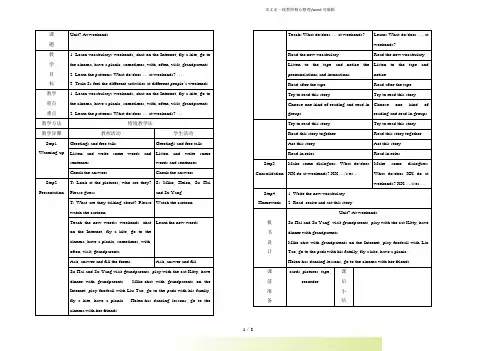
课题Unit7 At weekends教学目标1. Learn vocabulary: weekends, chat on the Internet, fly a kite, go to the cinema, have a picnic, sometimes, with, often, visit, grandparents.2. Learn the patterns: What do/does … at weekends? …..3. Train Ss feel the different activities at different people’s weekends.教学重点难点1. Learn vocabulary: weekends, chat on the Internet, fly a kite, go to the cinema, have a picnic, sometimes, with, often, visit, grandparents.2. Learn the patterns: What do/does … at weekends? …..教学方法情境教学法教学步骤教师活动学生活动Step1 Warming-up Greetings and free talk. Greetings and free talk. Listen and write some words andsentences.Listen and write somewords and sentences. Check the answers. Check the answers.Step2 Presentation T: Look at the pictures, who are they?Please guess.S: Mike, Helen, Su Haiand Su Yang.T: What are they talking about? Pleasewatch the cartoon.Watch the cartoon.Teach the new words: weekends, chaton the Internet, fly a kite, go to thecinema, have a picnic, sometimes, with,often, visit, grandparentsLearn the new words.Ask, answer and fill the forms. Ask, answer and fill.Su Hai and Su Yang-visit grandparents, play with the cat Kitty, havedinner with grandparents Mike-chat with grandparents on theInternet, play football with Liu Tao, go to the park with his family,fly a kite, have a picnic Helen-has dancing lessons, go to thecinema with her friendsTeach: What do/does … at weekends? Learn: What do/does … atweekends?Read the new vocabulary. Read the new vocabulary.Listen to the tape and notice thepronunciations and intonations.Listen to the tape andnotice.Read after the tape. Read after the tape.Try to read this story. Try to read this story.Choose one kind of reading and read ingroups.Choose one kind ofreading and read in groups.Try to read this story. Try to read this story.Read this story together. Read this story together.Act this story. Act this story.Read in roles. Read in roles.Step3ConsolidationMake some dialogues: What do/doesXX do at weekends? XX …/s/es ….Make some dialogues:What do/does XX do atweekends? XX …/s/es ….Step4Homework1. Write the new vocabulary.2. Read, recite and act this story.板书设计Unit7 At weekendsSu Hai and Su Yang- visit grandparents, play with the cat Kitty, havedinner with grandparentsMike-chat with grandparents on the Internet, play football with LiuTao, go to the park with his family, fly a kite, have a picnicHelen-has dancing lessons, go to the cinema with her friends课前准备cards, pictures, tape,recorder课后小结课题Unit7 At weekends教学目标1. Learn the vocabulary: fly-flies, go-goes2. Learn the patterns: What do/does XX do at weekends? XX sometimes/often …/s/es ….3. Learn the third person singular in the sentences.教学重点难点1. Learn the patterns: What do/does XX do at weekends? XX sometimes/often …/s/es ….2. Learn the third person singular in the sentences.教学方法操练教学法教学步骤教师活动学生活动Step1 Warming-up Greetings and free talk. Greetings and free talk. Listen and write some words Listen and write. Check the answers. Check the answers. Read and act this story. Read and act this story.Step2 Presentation Look at the pictures. Look at the pictures.Talk about the pictures and thesentences.Talk about the pictures andthe sentences.Look and write. Look and write.Check the answers: Check the answers.I usually play football with Liu Tao at weekends. I also chat with mygrandparent on the Internet. I sometimes fly a kite and have a picnicwith my family.Su Yang and I usually visit our grandparents at weekends. We playwith their cat Kitty. We have dinner with our grandparents.I always have dancing lessons at weekends. I sometimes go to thecinema with my friends.Read and write the sentences. Read and write.Read the sentences. Read the sentences.Teach the new words :goes, flies Learn the new words.Teach the third person singular in thesentences.Learn the third personsingular in the sentences.Complete the grammar. Complete the grammar.Teach the different words: always,usually, often, sometimesLearn the different words:always, usually, often,sometimesLook at the pictures and talk about thepictures and the sentences.Look at pictures and talkabout them and sentences.Play a game “Ask and answer”Play a game.Check the answers. Check the answers.Step3ConsolidationRead and write the sentences. Read and write.Make some dialogues: What do/doesXX do at weekends? ….Make some dialogues.Make some sentences with the thirdperson singular.Make some sentences withthe third person singular.Step4Homework1. Copy and write some sentences..2. Describe the activities of the weekends.板书设计Unit7 At weekendsWhat do you do at weekends? I ….they Theydoes he He …s/es ….she She …s/es ….fly-flies go-goes课前准备cards, pictures, tape,recorder课后小结课题Unit7 At weekends教学目标1. Learn the vocabulary: rose, grow, get out.2. Learn the phonetic of the letter “s”.3. Learn the patterns: Let’s go …. He/She ……s/es ….4. Train Ss enjoy the great fun of this cartoon story.教学重点难点1. Learn the vocabulary: rose, grow, get out.2. Learn the phonetic of the letter “s”.3. Learn the patterns: Let’s go …. He/She ……s/es ….教学方法谈话教学法教学步骤教师活动学生活动Step1 Warming-up Greetings and free talk. Greetings and free talk. Listen and write some sentences. Listen and write. Check the answers. Check the answers.Step2 Presentation Look at the pictures. Look at the pictures.Listen to the tape. Listen to the tape.Find the same letter “s”. Find the same letter “s”.Say the phonetic /z/ of the letter “s”. Say the phonetic /z/.Teach the new words: rose-roses,grow-growsLearn the new words:rose-roses, grow-growsRead the short text. Read the short text.Act the short text. Act the short text.Find the other words. Find the other words.Do some exercises. Do some exercises.Check the answers: Check the answers.T: Look at the pictures, who are they? S: They’re Billy, Sam andBobby.T: What are they doing? Watch thecartoon, please.Watch the cartoon.Ask, answer and fill the forms: Ask, answer and fill.Billy-watch TV, eat a lot, don’t like playing basketball andswimming, can’t get outSam and Bobby-play basketball, go swimming, go and have a picnicListen to the tape and notice thepronunciations and intonations.Listen to the tape andnotice.Teach the new word: get out Learn new word.Read after the tape. Read after the tape.Choose one kind of reading and read ingroups.Choose one kind ofreading and read in groups.Read this cartoon story together. Read this cartoon together.Act this cartoon story. Act this cartoon story.Teach the learning tip. Learn the tip.T: What about this cartoon story? S: ….Step3ConsolidationMake some sentences with the thirdperson singular.Make some sentences withthe third person singular.Step4Homework1. Write some vocabulary and patterns.2. Read, recite and act this cartoon story.板书设计Unit7 At weekendsrose-roses grow-grows get outw-/w/Let’s go …. He/She …s/es ….课前准备cards, pictures, tape,recorder课后小结课题Unit7 At weekends教学目标1. Learn the vocabulary: popular.2. Learn the different ball cultures in different countries.3. Review the vocabulary and patterns of this unit.4. Appraise the harvest of this unit.教学重点难点1. Learn the vocabulary: popular.2. Learn the different ball cultures in different countries.3. Review the vocabulary and patterns of this unit.教学方法复习教学法教学步骤教师活动学生活动Step1 Warming-up Greetings and free talk. Greetings and free talk. Do some exercises of the letter “s”. Do some exercises. Check the answers. Check the answers.Step2 Presentation Look at the pictures. Look at the pictures.Talk about the pictures. Talk about the pictures.Listen to the tape. Listen to the tape.Teach the new words: popular Learn the new words:popularRead the short text. Read the short text.Act the short text. Act the short text.Teach the different ball cultures indifferent countries.Learn the different ballcultures in differentcountries.Look at the pictures. Look at the pictures.Talk about the pictures and sentences. Talk about the pictures andsentences.Ask, choose and say. Ask, choose and say.Check the answers. Check the answers.Look at the pictures. Look at the pictures.Talk about the pictures and sentences. Talk about the pictures andsentences.Think and write. Think and write.Check the answers: Check the answers.I usually do homework at weekends. I often play football. Isometimes watch TV. My friend XX always does homework atweekends. He/She usually has skating lessons. He/She sometimesgoes to the cinema.Read and write the sentences. Read and write.Review this unit. Review this unit.Say the rules of it. Say the rules of it.Appraise the harvest of this unit. Appraise the harvest.Total the stars. Total the stars.Step3ConsolidationMake some dialogues: This is myfriend. He/She ……s/es ….Make some dialoguesStep4Homework1. Recite the vocabulary and patterns.2. Finish the workbooks.板书设计Unit7 At weekendsBasketball is popular in the US.Football is popular in the UK.Table tennis is popular in China.课前准备cards, pictures, tape,recorder课后小结初二英语综合测试卷( 8B Unit6 )一、单项选择(共15小题,每小题1分,满分15分)1. We often hear birds __________ when we walk in the countrysideA. singB. sangC. to singD. sings2. All of us find the film very ___________, so we want to see it again.A. boringB. interestingC. boredD. interested3. It is difficult __________ teenagers to finish the walk within four hours.A. forB. thatC. toD. what4. Our school organized a charity walk _________ Walk for Children for UNICEF last week.A. callB. callsC. calledD. was called5. He was a child, but he tried to find ways ___________ people ________ life more.A. to help; enjoyB. help; enjoyC. to help; enjoyingD. help; enjoying6. The Olympic Games of will _________ in Beijing.A. took placeB. happenedC. holdD. take place7. He is _________ honest boy that we all like him.A. such anB. a suchC. so anD. a so8. I _________ people to support our work ________ sending donations to us.A. hope; byB. wish; byC. hope; toD. wish; to9._______ is impossible ________ him to come here tomorrow.A. This; forB. That; forC. It; forD. It; of10.We can provide the poor children __________ food, clothes and so on.A. toB. forC. inD. with11. It is ___________ for me to help other people.A. meanB. meaningC. meaningfulD. meaningfully12. ___________ go to the Beijing Zoo with us?A. How aboutB. Why don’tC. Why notD. What about13. The tree is about __________.A. 15 metres longB. 15-metre-longC. 15-metres longD. 15 metre long14. It’s important _________ we ________ the water clean.A. that; keepB. for; keepC. for; to keepD. that; to keep15. I advise you to pay attention to _________ new uses of old words.A. recordB. recordingC. recordedD. be recorded二、完形填空(共10小题,每小题1分,满分10分)On your birthday, when someone asks you to 16 , you may say you want to have a cool school bag or do well in school. But some teenagers in Beijing may have a 17 one from you. They want a peaceful world in which everyone can live 18 .In 20XX, the United Nations decided to make Sepetember 21 19 . This year in Beijing, “Roots and Shoots”, an enviroment group, asked the teenages what wishes they have for the day. So the young people got together to 20 peace songs. They hope the world will become a better place for everyone. They also flew some 21 doves ( 鸽子). People around 22 think that the white bird means peace and love.Simon, a student in Beijing, saw the children in Iraq ( 伊拉克) and said 23 wanted to write letters to them and help them. Many 24 also made kites. Daniel spent three days making a kite for three days. John, a Grade 9 student, said, “I want to stop wars, 25 the lovely animals and plants can live well.”16. A. hope B. wish C. poster D. friend17. A. different B. same C. special D. usual18. A. sadly B. quietly C. heavily D. happily19. A. World Bird Day B. World Kite Day C. World Peace Day D. World Song Day20. A. write B. sing C. read D. see21. A. danger B. safety C. peace D. beauty22. A. China B. Beijing C. the world D. Iraq23. A. he B. I C. we D. they24. A. teachers B. boys C. students D. girls25. A. because B. since C. because of D. so that三、阅读理解(共15小题,每小题1分,满分15分)AMy mother loves flowers. We live next door to each other, so she often spends much time planting flowers in my garden. In summer, she often makes colourful bouquets(花束) and puts them inside the houses---both hers and mine.One year, shortly before Christmas, a local flower shop offered an activity for mothers in each month of the next year. It seemed to be a great way to thank her for all of the flowers she had given me through the years. I couldn’t wait the new year so that I could give a bouquet to her!After the Christmas, in early January. I drove her to the flower shop to pick up her first month’s bouquet. The small bouquet would hardly fill a small vase. I was so embarrassed ( 尴尬). “Mum, I’m sorry,” I told her. “I didn’t know how skimpy that bouquet was.” She looked at me and smiled. “It’s okay,” she said. “It allows me to enjoy the beauty of each one better.”I was amazed at what she said. It helped me realized something more important---we often fail to enjoy the beauty of each thing when we have too many good things.Mum! Thanks for helping me understand that less is sometimes more.26. The mother often spends much time .A. cleaning he r son’s houseB. planting flowers in her own gardenC. planting flowers in her son’s gardenD. making bouquets in a flower shop27. We can infer(推断) from the story that .A. the writer couldn’t afford a big bouquetB. the mother was unhappy when receiving the bouquetC. the writer would pick up another bouquet the next monthD. the mother would send back the bouquet to the flower shop28. The underlined word “skimpy” means .A. smallB. cheapC. beautifulD. colourful29. What is the mother like?A. She is a lazy woman.B. She is a strict mother.C. She is always optimistic(乐观的) .D. Sometimes she isn’t honest.30. What did the writer learn from his mother?A. How to buy flowers.B. How to enjoy flowers.C. How to grow flowers.D. How to consider things in another way.BWilliam Shakespeare was a writer of plays and poems. Some of his most famous plays are Hamlet, Romeo and Juliet, Macbeth. He wrote thirty-seven plays in all. They are still popular today.He was born in 1564 in England. At school he liked watching plays. He decided to be an actor when he finished school at the age of fourteen. In 1582, he married a far mer’s daughter. She was eight years older than he was. Their first child was a daughter. Later they had twins. In 1585, Shakespeare left his hometown, Stratford-upon-avon. His wife and children stayed behind. No one knows why he left or what he did between 1585 and 1592.At twenty-eight he moved to London and joined a theatre company which opened the globe theatre in 1599. He became an actor, and he also wrote plays. He usually acted in his own plays. He earned almost no money from his writing, but he made a lot of money from acting. With the money he bought a large house in his hometown.At the age of forty-nine, Shakespeare retired(退休)and went to live in Stratford-upon-avon. He died at the age of fifty-two. He left his money to his family. He left his genius ( 天才) to the world. You still see his plays in English and in many other languages. He is one of the most famous writers in the world.31. Shakespeare wrote many famous plays except __________.A. HamletB. MacbethC. Romeo and JulietD. Man and Superman32. Shakespeare decided to be an actor in _________.A. 1578B. 1582C. 1599D. 161633. In 1585, Shakespeare left his hometown Stratford-upon-avon _______.A. with his wifeB. with his daughterC. with his wife and childrenD. alone34. Shakespeare got much money from _________.A. writingB. playsC. actingD. retirement35. According to the passage, which of the following is true?A. Shakespeare had two children.B. Shakespeare wrote both plays and poems.C. Shakespeare left his money to the globe theatre.D. Shakespeare wrote plays in English and some other languages.CIn Canada and the United States, people enjoy entertaining(请客)at home. They often invite friends over for a meal, a party, or just for coffee and conversation.Here are the kinds of things people say when they invite someone to their home:“Would you like to come over for dinner S aturday night?”“H ey, we’re ha ving a party on Friday. C an you come?”To reply to an invitation, either say thank you and accept, or say you’re sorry and give an excuse.“Thanks, I’d love to. What time w ould you like me to come?” or “Oh, sorry. I’ve tickets for a movie.”Sometimes, however, people use expressions that sound like invitations but which are not real invitations. For example:“Please come over for a drink sometime.”“W hy not get together for a party sometime?”“W hy don’t you come over and see us sometime soon?”They are really just polite ways of ending a conversation. T hey are not real invitations because they don’t mention a specific(确定的)time or date. They just show that the person is trying to be friendly. To reply to expression s like these, people just say “Sure, that would be great!” or “OK. Y es, thanks.”So next time when you hear what sounds like an invitation, listen carefully. Is it a real invitation or is the person just being friendly?36. Why do Canadians and Americans often invite friends for meals at home?A. Because they can save time.B. Because they can spend less money.C. Because they enjoy entertaining at home.D. Because they have modern and beautiful houses.37. Which of the following is a real invitation?A. “I f you’re free, let’s go for a drink sometime.”B. “Please go to the cinema with me some day.”C. “W ould you like to have a cup of tea with us sometime?”D.“I’ve two tickets here. Can you go to the concert with me?”38. I f people say “L et’s get together for lunch some day”, you just say “_________”.A. That would be nice.B. How about this weekend?C. Oh, sorry. I’m very busy.D. T hat’s great. I’ll be there on time.39. P eople use “an unreal invitation” in order to show that ________.A. T hey’re trying to be friendlyB. T hey’re trying to be helpfulC. T hey’re try ing to make friends with othersD. They haven’t got ready for a party yet40. The passage is mainly about ________.A. entertainment at home.B. real invitations or notC. expressions of starting a conversationD. ways of ending a conversationClass______ No._______ Name________四、填空。
牛津译林版小学英语五年级上册Unit 7测试卷(含答案)
译林版小学英语五年级上册Unit 7测试卷一、选出下列每组单词中不同类的一项。
1.A.eyes B.ears C.short 2.A.big B.fat C.nose 3.A.our B.he C.she 4.A.thin B.hair C.long 5.A.his B.her C.we二、根据字母/中文提示完成单词6.This is Mike’s ______(娃娃).7.I have a ______(长的) pencil.8.Leo’s ______(眼睛) are small, but his nose is big.9.--Can you ______(跳)? --Yes, I can.10.These ______(机器人) are cool.11.Her ______(嘴巴) is big.三、单选题12.Let’s a picnic tomorrow. ( )A.have B.has C.having 13.——What Mike at weekends? ( ) ——He always with his friends on the Internet.A.do; do; chats B.does; do; chat C.does; do; chats 14.My sister and I like the piano at home. ( ) A.play B.playing C.plays 15.My brother likes films very much. He often them on Sundays. ( ) A.watch B.watches C.watching16.Helen always has lessons at weekends. ( )A.swim B.swims C.swimming17.Autumn _____after summer. ( )A.comes B.come C.coming18.Jack usually a kite and a picnic in the park. ( ) A.flies; has B.fly; have C.flies; have19.——Where do you live, Leo? ( )——I live Shanghai.A.on B.for C.in20.Wang Bing doesn’t like football. He likes basketball. ( ) A.play; playing B.playing; playing C.playing; play21.is very popular in China. ( )A.Basketball B.Football C.Table tennis四、中英互译:单词/短语22.在周末______________23.去那儿______________24.拜访我的老师_____________25.和……一起玩_____________26.和她聊天_____________27.上一节舞蹈课____________28.on the Internet _______29.去电影院________30.eat a lot ______________31.have a picnic ________五、补全句子32.I often _________ (踢足球) in the playground _________ . (放学后) 33.Do you often _________ (去电影院) _________ ? (在周末) 34.—What does your father usually do at night?—He _________. (总是看电视)35.Can he _________? (放风筝)六、选出句子的正确答语。
【单元热点难点】译林版(三起)英语五年级上册Unit 7 At weekends 语法划重点
【讲练结合】五年级上册英语Unit7 My weekends语法划重点1. 语法精讲一、always, usually, often, sometimes的用法always,usually,often,sometimes都是用来表示时间的频度副词,但它们所表示的动作频率不同。
通常说来,always表示100%,usually表示80%,often表示60%,sometimes表示40%。
1. always是频度最高的词,表示动作的重复,状态的继续,中间没有间断。
意为“总是、一直”,其反义词是never。
如:He always helps me. 他总是帮助我。
2. usually意为“通常”,表示通常如此,很少例外,频度仅次于always。
如: I usually get up at six in the morning. 我通常在早上六点钟起床。
3. often意为“经常、常常”,不如usually那么频繁,表示动作重复,中间有间断。
如:My parents often take me to the zoo at weekends. 我父母常常在周末带我去动物园。
4. sometimes意为“有时、不时”,表示动作偶尔发生,中间常有间断,频率比often低。
Sometimes they play football on Saturday afternoon. 他们有时在星期六下午踢足球。
=They sometimes play football on Saturday afternoon.=They play football on Saturday afternoon sometimes.注意 :一般情况下,这四个词都位于行为动词之前,be动词、助动词或情态动词之后。
sometimes的位置较灵活,可以放在句中,也可以放在句首或句末。
补充:always > usually > often > sometimes > seldom 偶尔 > neve从不对这些频率副词提问时,用 how often。
牛津译林版小学英语五年级上册unit7单元测试卷含听力原文.docx
小学英语牛津译林版五年级上册Unit 7测试卷(含听力原文+答案解析)听力部分一、听录音,给下列单词排序。
(10分)1、A、often B、usually C、always2、A、weekends B、Internet C、chat3、A、cinema B、dance C、park4、A、sometimes B、family C、friend5、A、kite B、picnic C、cinema二、听录音,选出你所听到的单词。
(10分)]、What do you do at weekends?2、I usually visit my grandparents.3、I usually chat with them on the Internet at weekends4、She sometimes goes to the cinema with her friends.5、She always goes to the park.三、听录音,判断下列图片与你所听内容是(T)否(F)相符。
(10 分)笔试部分一、按要求填入适当的词。
(10分)1、fly a kite(汉语)2、去电影院(英语)3、sometimes (汉语)4、go (三单)5、去野餐(英语)6、at weekends(汉语)—7、fly (三单)8、on the Intemet(汉语)9、和他聊天(英语)10、一堂舞蹈课(英语)二、单项选择(10分)()1、Peter often emails to his friends.A、sendB、giveC、sends()2、My e-friend often chats with on the Internet.A、IB、meC、we()3、Su Yang sometimes in the park.A、flys kitesB、flies kitesC、flies kite()4、He often with me.A、doing homeworkB、go homeC、watches cartoon()5、I like very much.A、drawB、singC、swimming()6、一Where Nancy study?一She at the No.l Primary School.A、does; studiesB、do; studiesC、does; study()7、Jim often with his parents.A、goes swimmingB、going swimmingC、go swimming ()8、Yang Ling and I going fishing at weekends.A、likeB、are likeC、likes()9、Miss Li teaches English this term. We all like.A、us; sheB、us; herC、me; her()10、I always at weekends.A、has dinnerB、have dancing lessonC、doing my homework三、根据句义提示,补全单词,完成句子。
新版译林版五年级上册英语第七单元测试试题及答案 译林版五年级上册英语
新版译林版五年级上册英语第七单元测试试题及答案:译林版五年级上册英语每当英语测试前,我们都要抓紧时间做好练习才能有效巩固好知识!为此,下面WTT就带大家一起来做份新版译林版五年级上册英语第七单元测试试题,希望对大家有帮助!新版译林版五年级上册英语第七单元测试试题笔试部分(70分)一、选出单词画线部分读音与其余不同的选项。
(每小题1分,共5分。
)( )1.A.cinema B.pencil C.ice cream D.juice( )2.A.fly B.like C.you D.why( )3.A.e B.home C.glove D.sometimes( )4.A.watch B.week C.who D.what( )5.A.lake B.make C.chat D.cake二、英汉互译。
(共10小题,每小题1分,满分10分)1.一堂舞蹈课______________________________________________________ ______________2.go to the cinema______________________________________________________ __3.拜访我的老师______________________________________________________ ______________4.fly a kite______________________________________________________ __5.和他聊天______________________________________________________ ______________6.get out______________________________________________________ __7.在网上______________________________________________________ ______________8.too fat______________________________________________________ __9.举行野餐______________________________________________________ ______________10.eat a lot______________________________________________________ __三、单项选择。