
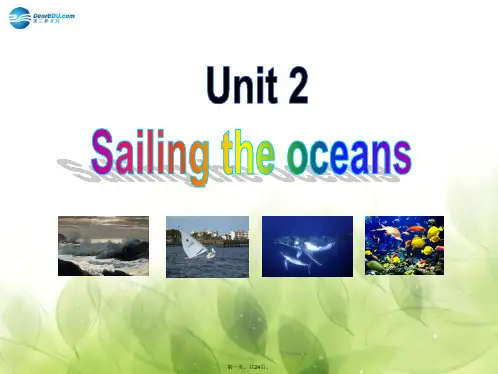
高中英语 Unit2Sailing the oceans-Textbook课件 新人教选修9 公开课精品课件
2 What problems would you anticipate for this journey?
I would anticipate very hot weather (around the equator), cold weather (around the Cape of Good Hope), very stormy seas (around the Cape), and problems with food and water (unless helped by local natives the water may be contaminated and the food scarce), etc.
4 Which ones do you think are still used today? Sea charts are still used today.
Comprehending
1 Read the passage and answer the following questions. 1 What is the use of a bearing circle, astrolabe, quadrant or sextant? (B)
2 A sailor knew that land was nearby if he saw _fr_e_s_h_s_e_a_w_e_e_d_,_n_e_s_ti_n_g_b_i_rd_s__re_t_u_rn_i_n_g _h_o_m_e__in__th_e__ev_e_n_i_n_g_o_r__fo_g__ .
3 What would you do if you came across the following problems during your voyage? Read the chart below and fill in your plans of action to deal with them.
Very often navigators are also explorers.
Pre-reading
• Look at the pictures. Then answer the questions. 1 How do you think seamen found their way before modern accurate methods of navigation were invented? Kept close to the shore, used nature such as the sun, wind, birds, tide, etc, to help them, and used some of the instruments including a compass, astrolabe, etc.
What is the use of a compass? (A) A to set the course of the ship B to measure the position of the ship C to measure the speed of the ship D to tell the time
2 Suppose you were a sea captain aiming to sail round Africa. Discuss in groups:
1 What skills would you seek in your sailors?
The sailors would need to be excellent navigators, able to cope with both hot and cold weather, experienced in sailing through very bad weather and able to co-operate in a team.
3 Why is the position of the sun and various stars useful for working out latitude?
The position of the sun and stars are useful for working out latitude because they are fixed points in the sky and their movements in relation to the earth are already known. So they can be used to measure a ship's position.
2 Why are speed and time important in working out the longitude of a ship?
Speed and time are important in finding out the longitude of a ship because the earth moves fifteen degrees westwards every hour. If you know your direction, speed and time, you can work out the approximate longitude or change in your position in relation to the stars.
2 Which do you think was easier to work out: latitude or longitude?
Latitude, because it was used to measure how far you had travelled from land on a straight line. It was discovered a long time before longitude.
What would you do if: Plan of action
wait till the storm is You were far from over, and then find land and a storm arose. your new position
and return to your original course
3 Sailors used _se_a__c_u_rr_e_n_ts__o_r_ti_d_e_s_a_n_d__w_i_n_ds to increase their speed.
Using instruments 4 There were two methods to find longitude:
use knots to find your
You knew your
speed and work out
Hale Waihona Puke latitude but didn't your approximate
know your longitude. longitude
use the compass and
You were blown off- the astrolabe,
• Beating circle: _to__c_o_m_p_a_r_e_t_h_e_h_e_i_g_h_t _o_f_th_e__s_u_n_n_o_w____ _w_i_th__th_e__p_o_s_it_io_n__o_f_t_h_e_'s_u_n__at__m_i_d_d_ay.
• Astrolabe: __to__c_o_m_p_a_r_e_t_h_e_p_o_s_i_ti_o_n_o_f_t_h_e_s_h_i_p_i_n__ __r_el_a_ti_o_n__to__s_o_m_e__st_a_r_s_o_r_t_h_e_s_u_n___ .
In pairs discuss these questions: 1 What is a navigator?
A navigator explores new routes across the sea. 2 What is the difference between a navigator and an explorer?
Navigator sea nautical instruments
find new islands or continents
Navigator is someone who finds the position and plots the course of a ship, an aircraft, a car, etc, using maps and instruments.
4 Read the passage again and use the information to analyse the navigational skills. Write the answers in your own words. Using nature
1 To find the ship's position at sea a sailor used the North Star and the sun.
course.
quadrant or sextant to
find out your position,
return to your former
course
You were offshore but you needed more food and water.
follow nesting birds to shore; look for special cloud formations or fog over streams to find land
You wanted to keep a straight course.
Unit;2;Sailing;the;oceans1

Unit;2;Sailing;the;oceans选修9unit 1 breaking records unit 2 sailing the oceans 1. fitadj.安康的;精力充足的;适宜的n. 适合vt. 适合;安装;使合身vi. 适合,符合exercise keeps you fit.运动能使你保持安康。
常用构造:be fit for sth.适合某事be fit to do sth.适合做某事易混辨析:fit/suitfit与suit都可作动词,意为iexcl;°适合iexcl;±。
fit多指尺寸,大小的iexcl;°适宜iexcl;±; suit多指款式、颜色、条件、身份、口味等的iexcl;°适宜iexcl;±。
this coat fits him.这件外套他穿正合身。
(指大小)the style of the clothes suits him well.这件衣服的款式很适合他。
〔指款式、颜色〕高手过招选词填空〔fit/suit〕①we all think that he is for the position.②does the new post your brother?③the climate here me very well.答案:①fit ②fit ③suits2. doomvt. 注定;判决n. 厄运;消灭常用构造:be doomed to 注定(后接名词或不定式)go to oneiexcl;macr;s doom 走向死亡fall to oneiexcl;macr;s doom 坠入死亡/灭亡meet oneiexcl;macr;s doom 死亡;灭亡oneiexcl;macr;s doom is sealed 某人在劫难逃send sb. to his doom 将某人处死the species was doomed to extinction.这一物种注定要灭亡。
高中英语 Unit 2 Sailing the oceans课件 新人教版选

Sailing the oceans
• James Cook was born in 1728 in Marton,England.His father, a Scottish migrant farm worker,allowed James to work on coal -carrying boats at eighteen.Cook spent his free time learning math and navigation.This led to his appointment as mate (大 副).
• The Third Voyage.
• The Navy wanted Cook to determine if there was a Northwest Passage,a mythical waterway between Europe and Asia across the top of North America.Cook set out in July of 1776 and rounded the southern tip of Africa and headed east across the Indian Ocean until his navigation of the Bering Sea was stopped by the impassible Arctic ice.
• Cook’s explorations greatly increased European knowledge of the world.As a ship captain and skilled cartographer,he filled in many gaps on world maps.His contributions to eighteenth century science helped further exploration and discovery for many generations.
高中英语Unit2SailingtheoceansSectionⅠWarmingUpReading—

The cross-cultural educational experience focuses on the Mississippi and China’s longest river,the Yangtze.
been________method(s) to find longitude by the 17th century.
A.two
B.three
C.one
D.no
5.What’s the main idea of the passage? A.Why early seaman wanted to sail the ocean. B.There is useful information in an encyclopedia. C.Early sailing men went exploring the seas using their skills and simple instruments. D.Latitude and longitude are important to plot a ship’s position. 答案:1-5.AADAC
1._____a_t____ the mercy of 2.work ___o_u_t_____ 3.compare sth.___w_i_t_h____ sth. 4.in __r_el_a_t_io_n___ to... 5.make __m_i_s_ta_k_e_s__
受……支配 制定出 把……与……相比较 与……相关联 犯错误
高中英语 Unit 2 Sailing the oceans Warming up课件 新人教版选修
第七页,共24页。
He (1254-1324) was born in Venice. He is probably the most famous Westerner to travel the Silk Road. He reached further than any of his predecessors, travelling beyond Mongolia and into China. Finally his adventures were written down and this book was published and became a best-seller.
第十六页,共24页。
sextant
第十七页,共24页。
The sextant is a navigational instrument for measuring the angle between the horizon and some object in the sky. First a sailor looks at the horizon through an eyepiece. At the same time he can see light from the sun or a star reflected off a small mirror on top of the instrument, onto a second mirror and into the eyepiece.
an aircraft, a car, etc, using maps and instruments.
第五页,共24页。
Explorer
land use of compass and landmarks
高中英语知识讲解:Unit+2+Sailing+the+oceans+2 Unit+2 Section+Ⅱ —Language+Points含答案

Section ⅡWarming Up & Reading—Language PointsThe voyages of travellers before the 17th century show that they were not at the mercy of the sea even though they did not have modern navigational aids.17世纪以前的航海记录显示,尽管没有现代航海技术的帮助,他们(旅行者们)也不是任凭海洋摆布的。
(1)voyage①He made a voyage to Japan.他航行至日本。
②I wish you a happy voyage.祝你航行平安。
[自我探究]voyage是名词,意为航行,(尤指)航海,航天。
单词意义区别trip指定期的较短的往返旅行journey表示去某地所花的时间和旅行的距离,尤其指较长距离的定期旅行;多指陆地旅行travel泛指从一地到另一地的“旅行,游历”(用单数形式,不加定冠词)。
指“国外的游历、游记”时常用复数形式,但前面不加many或数词修饰,它也可以用作动词tour“周游,观光,旅游;考察”,指周游若干地方,有一定的旅行路线,最后又回到出发地voyage指海上航行或太空旅行。
是可数名词③We went on a trip to the mountains.我们到山里去旅游了。
④We had a long journey ahead of us.我们前面的旅程还很长。
⑤Foreign travel never really appealed to him until he retired.他到退休后才真正对出国旅行产生了兴趣。
⑥We went on a 10-day tour of central Africa.我们到中非游玩了10天。
⑦This is a voyage of exploration.这是一次探索之旅。
高中英语 Unit2《Sailing the oceans》教案(1) 新人教版选修9
英语:Unit2《Sailing the oceans》教案(1)(新人教版选修9)分课时教案The First Period SpeakingTeaching Aims:a. Key words and expressionsnavigate, navigator, navigation, navigational; explore, explorer, exploration b. Talk about sailing the oceans.Teaching Methods:Discussion to arouse the students’ interest in sailing and exploring the oceans. Individual, pair or group work to make every student work in class.Teaching Aids:The multimedia; a tape recorder; the blackboardTeaching Procedures:Step1 GreetingsGreet the whole class as usual.Step2 RevisionCheck the homework exercises.Step 3 PresentationPresent the students a map of the world and tell them “Today we are going to learn a new unit “Sailing the oceans”. Then ask them to turn to page 11 and give them a few minutes to have a discussion.Step 4 DiscussionIn pairs discuss the questions on page11.This discussion is intended for students to explore the difference between a navigator and an explorer. This difference is important to establish because it encourages students to appreciate shades of meaning in the definitions f words and also because it establishes the idea of categories.After a few minutes, ask some pairs to speak out their result of the discussion. Then sum up and check the answers.A navigator explores new routes across the sea.An explorer discovers new places on land.A navigator is somebody who finds the position and plots the course of a ship, an aircraft, a car, etc, using maps and instruments. An explorer is somebody who travels into or through a place in order to learn about it. Very often navigators are also explorers.In history there are four famous voyage explorers in the world, including Zheng He in China, James Cook in England, Christopher Columbus in Spain and Abel Tasman in Holland.In this unit we’ll talk about Zheng He, James Cook and some other explorers like Marco Polo and Captain Bligh.Step 5 Pre-speakingAsk the students if they want to know some famous navigators and explorers. Then present them some pictures and some related information about them.About Zheng He.About Marco PoloAbout James CookAbout Ferdinand MagellanStep 6 SpeakingAfter showing the students the pictures and their background information, ask the students to think about the question: How do you think seamen found their way before modern accurate methods of navigation were invented? If time is limited, this can be left as their homework.Step 7 Homework1. Read the new words.2. Preview Reading SAILING THE OCEANS on page 12.The Second Period ReadingTeaching Aims:a. Learn and master the key words and expressionsvoyage mercy minimum nowhere pole overhead offshore accelerate outward longitude latitude precise simplify portable shortcoming updated tendency reliableat the mercy of, even though, work out, be used to, in relation to, aim to , …b. Train the students’ reading ability. Let the students have some knowledge of early navigational methods. Explain how seamen explored the oceans and what kind of navigational instruments were used to sailors before the 17th century when they were navigating the open seas without seeing the land.Teaching Difficult Points:How to help the students understand the reading passage better.How to im prove the students’ reading ability.Teaching Methods:Scanning the text to get the general idea of it.Carefully reading to finish the Comprehending exercises on page 14.Discussion after reading to make the students understand the text better. Teaching Aids:The multimedia; a tape recorder; the blackboardTeaching procedures & waysStep1 GreetingsGreet the whole class as usual.Step2 RevisionCheck the homework exercises.Step3 Pre-readingShow the students some pictures to see if they can identify the early navigational instruments seamen used and explain how they used.Step 4 DiscussionDiscuss the questions on page11.Step 5 Listening and comprehendingAfter listening to the contents of the text do the comprehending exercises on page 14&15.Step 6 ExplanationAfter comprehending, it is a good time to deal with the new words and language points in this part, esp. the following:voyage mercy minimum nowhere pole overhead offshore accelerate outward longitude latitude precise simplify portable shortcoming updated tendency reliableat the mercy of, even though, work out, be used to, in relation to, aim to , Step7 DiscussionLet’s the students have a discussion by working in pairs or in groups.Topic: Imagine you are on a boat with twenty-nine other people. You have a small box for your personal things but it can only hole ten items. What would you need for a week’s journey across the North Sea to England?Step8 SummaryThis reading explains how seamen explored the oceans and what kind of navigational instruments were used to sailors before the seventeenth century when they were navigating the open seas without seeing the land.Step9 HomeworkFinish the exercises about using words and expression on page61.The Third Period Extensive ReadingTeaching Aims:a. Learn and master the key words and expressionsincident departure crew deposit dilemma drawback dusk routine pretty starvation extreme psychologically tension gradually foresee thirst hardshipb. Train the students’ reading ability.Teaching Difficult Points:a. How to help the students understand the reading passage better.b. How to improve the students’ reading ability.Teaching Methods:Scanning the text to get the general idea of it and do some other comprehending exercises.Discussion after reading to make the students understand the text better. Teaching Aids:The multimedia; a tape recorder; the blackboardTeaching procedures & waysStep1 GreetingsGreet the whole class as usual.Step2 RevisionCheck the homework exercises.Suggested answers to Exercise3:I have gradually accepted the routine at school now that I am in the advanced class and make my own study plan.The drawback of using that girl for the advertising was her square jaw which made her look unfriendly.Mathematics is a subject which demands precise and accurate work.In the park I saw a small boy holding the string of a kite overhead, which was rising and falling at the mercy of the wind.That explorer wanted to secure his place in history by being the first man to reach the South Pole.Step3 Readinga. Listen to the passage and then let them do some true or false questions according to the text.1. I was forced to join Captain Bligh in the small boat.2. After the crew took over the ship “Boundy”, Captain Bligh was allowed to take with him a chart , a compass and a quadrant.3. It was very difficult for us to get a correct reading from the quadrant as the boat moved constantly during the course.4. Captain Bligh used a system called “dead reckoning” and he knew there was land directly southwest of their original position.5. We completely believed Captain Bligh when he talked hopefully about what we would do when we got back to England.6. Captain Bligh was as weak as the rest of us but he was determined not to give up.7. Captain Bligh kept us busy and tried to take our minds off our stomach and thirst all the way.8. We finally escaped the jaws of death and arrived in Timor over fifty days after being set loose in our small boat.Answers: (FFTFFTTF)b. Give the students a few minutes to read the passage again and then get the general idea of the text.This is the storey of Captain Bligh’s amazing journey across the Pacific Ocean in an open boat with his followers after another group of sailors under Fletcher Christian had taken over the ship. Later Captain Bligh and his men made for the island of Timor using a combination of navigational skill and “dead reckoning”, which is guessing the correct direction. The voyage lasted over 40 days and was one of the greatest examples of survival at sea.c. Explain some difficult sentences, phrases and words.Key phrases:1. in addition 另外There was an earthquake and, in addition, there were tsunamis.除了地震之外,还有海啸。
Unit 2 Sailing the oceans-Textbook教学课件
2 Suppose you were a sea captain aiming to sail round Africa. Discuss in groups:
1 What skills would you seek in your sailors?
The sailors would need to be excellent navigators, able to cope with both hot and cold weather, experienced in sailing through very bad weather and able to co-operate in a team.
2 A sailor knew that land was nearby if he saw _fr_e_s_h_s_e_a_w_e_e_d_,_n_e_s_ti_n_g_b_i_rd_s__re_t_u_rn_i_n_g _h_o_m_e__in__th_e__ev_e_n_i_n_g_o_r__fo_g__ .
What would you do if: Plan of action
wait till the storm is You were far from over, and then find land and a storm arose. your new position
and return to your original course
• Beating circle: _to__c_o_m_p_a_r_e_t_h_e_h_e_i_g_h_t _o_f_th_e__s_u_n_n_o_w____ _w_i_th__t_h_e_p_o_s_it_io_n__o_f_t_h_e_'s_u_n__at__m_i_d_d_ay.
人教版高中英语选修9《Unit2Sailingtheoceans》教案
人教版高中英语选修9《Unit2Sailingtheoceans》教案人教版高中英语选修9《Unit 2 Sailing the oceans》教案教学准备教学目标1、知识目标(1).理解并记住Reading部分本单元的单词和短语。
(2).理解并掌握整个故事的情节,并能填写summary.2、能力目标(1)充分发挥学生的主体地位,调动学生思维的积极性,提高综合语言的运用能力(2)通过对学生说读写的训练,增大学生的语言输入,增强其语言输出能力。
3、情感、态度、价值观目标学生分析布莱船长在40多天的航程中所采用的航海技术以及所表现出的领导才能。
同时,又适时地对他们进行情感教育:在任何困难面前绝不畏惧,不抛弃,不放弃。
教学重难点教学重点与难点:读写说均为本节课的重点,写和说部分应为难点,需加大指导和练习。
教学过程Teaching procedures:Lead-in:通过歌曲Sailing导入,让学生在轻松愉悦的音乐下近入新课的学习之中。
促使学生积极主动地进入学习状态。
ComprehensionStep I Please Skim the passage and get the main idea.Step II. Scan the passage: True or False.1. I was forced to join Captain Bligh in the small boat.2. After the crew took over the ship “Bounty”, Captain Bligh was allowed to take with him a chart , a compass and a quadrant.3. It was very difficult for us to get a correct reading from the quadrant as the boat moved constantly during the course.4. Captain Bligh used a system called “dead reckoning” and he knew there was land directly southwest of their original position.5. Captain Bligh was as weak as the rest of us but he was determined not to give up.6. Captain Bligh kept us busy and tried to take our minds off our stomachs and thirst all the way.7. We finally escaped the jaws of death and arrived in Timor over fifty days after being set loose in our small boat.Step III. Group work: further reading.When captain Blight returned home he was honored as a hero. Discuss in groups whether he should receive a special medal or not.Step IV. Affective educationAfter learning the text, as senior three students, what can we learn from Captain Blight in our life?Step V. Summary:I am _____ to have sailed with Captain Bligh on his journey of over40 days through about4,000 miles in an open boat ______the Pacific Ocean in 1789.In the beginning, on our ________(depart), some of the crew took _____theship and the captain ___________(deposit) into a small boat. Thus we werecaught _____a dilemma. We decided to stick with him _______thick and thin though we seemed to face _____uncertaindeath.During the long and toughjourney, we encountered manyunexpected hardships. Despite _____(lack) of foodand water, he kept us _______(occupy) and cheerful to take our minds ____troubles. All the way he taught us how to cope _______various situations. Finallythey arrived at Timor __________(success) andthey were honored as _______(hero).The story shows that one man’sspirit and his determination should not ________ (defeat) by circumstances.Complexsentences(分析并翻译1-2个长难句)Challengeyourself!---Grammar Filling1. I’m proud to have sailed withCaptain Blight ____his journey of over 40 days _________about 4,000miles ____anopen small boat _______ the Pacific Ocean.2. On our _________(depart) from T ahiti, some crew took _____the ship. And those of us onboard ____________(catch) in a dilemma.3. As you can see from the map we kept_____a straight course pretty well.4. The captain kept us busy________ (read) the tables to work out our position .5. It was the extreme lack of waterthat was hard to cope with ______________ (psychology)6.He kept us busy and tried to take our minds课后习题Challenge yourself!---Grammar Filling1. I’m proud to have sailed with Captain Blight ____his journey of over 40 days _________about 4,000miles ____an open small boat _______ the Pacific Ocean.2. On our _________(depart) from T ahiti, some crew took _____the ship. And those of us on board ____________(catch) in a dilemma.3. As you can see from the map we kept _____a straight course pretty well.4. The captain kept us busy________ (read) the tables to work out our position .5. It was the extreme lack of water that was hard to cope with ______________ (psychology)6.He kept us busy and tried to take our minds _____our __________(stomach).。
高中英语 Unit 2 Sailing the oceansU2P6 Workbook re
Sample Writing
One warm sunny day Sindbad was sitting in its Baghdad home when a messenger came banging on his door. He carried a letter from the government begging Sindbad to join an expedition bound for the islands where he had earlier found so many diamonds. He quickly agreed.
S2: Good thinking. Perhaps another iceberg can hit the place where the penguins live. It rocks the nests and releases the gold. In addition it exposes an old and abandoned boat covered by ice and snow and forgotten by its owners. Sindbad can use that to sail back to Baghdad. S1: Great! Let's get writing.
Now begin to write your own Sindbad story. Use the stories you have read and heard to improve your writing. Follow the process set out below (given in the text book p.65).
Uቤተ መጻሕፍቲ ባይዱit 2
高中英语Unit2SailingtheoceansSectionⅠReading讲义新人教版选修91
高中英语Unit2SailingtheoceansSectionⅠReading讲义新人教版选修9101236Unit 2 Sailing the oceans当今航海技术达到前所未有的水平,那么你知道古代一些有关航海方面的仪器吗?It was invented by Zhang Heng in the Han Dynasty.It is madeup of a bronze foundation (青铜底盘) and magnetic spoon(磁勺)which is made of natural magnet,positioned right in the centerof the foundation.The handle of the spoon points to the south,while the other side points to the north.When the Sinan is in the still,the handle of the spoon points to the south because of the influence of the terrestrial magnetism (地磁).AstrolabeIt has 17 stars listed as well as a map of the sky overhead(for 37 degrees) and the ecliptic (黄道).The time of day or nightis on the outside edge with noon at the top of the Astrolabe andmidnight at the bottom.It comes with a carrying chain,a pouch,and a book on its use.The reverse side has a sight for measuringthe elevations of the heavenly bodies.SextantThe sextant is a navigational instrument for measuring theangle between the horizon and some object in the sky.First a sailorlooks at the horizon through an eyepiece.At the see light fromthe sun or a star reflected off a small mirror on top of theinstrument,onto a second mirror and into the eyepiece.The navigator can then see two images,the horizon and the sun side by side.He can then measure the angle between them on a scale at the bottom of the instrument.The scale goes from 0 to 120 degrees.An earlier instrument,called a quadrant,measured in angle in the same way but it could only measure angles from 0 to 90 degrees.Nautical chartNautical charts are maps of the depth of the sea and thecurrents of the oceans.They provide modern sailors with routesthrough the seas,rather like roads through the countryside.Theinformation began to be collected in the nineteenth century andhas continued to be updated ever since.These charts were not available to Captain Bligh or Zheng He.两个诱思问题1.What is the theory of the Sinan invented by Zhang Heng?2.Why were the Nautical charts not able to be used by Captain Bligh or Zheng He?【答案】1.The influence of the terrestrial magnetism.2.Because the information began to be collected in the nineteenth century.Section ⅠReading (Warming Up, Prereading,Reading & Comprehending)Ⅰ.根据词性及英文释义写出单词的正确形式1.n.kindness;forgiveness2.n.activity of exploring3.adj.above one's head4.adj.at sea not far from land5.adj.made or done without any plan6.adj.difficult to use7.n.act of mentioning;act of looking at for information8.adj.light and that can be(easily) carried or moved【答案】 1.mercy 2.exploration 3.overhead4.offshore5.random6.awkward7.reference8.portableⅡ.短语填空may well;at the mercy of;work out;be close to;the number of;compare with;in relation to;rather than1.I prefer to walk there take a bus.2.The boat was the rapid river.3.This novel become a classic.4. those who are suffering,we are better off.5.I believe that you can this problem by yourself.【答案】 1.rather than 2.at the mercy of3.may wellpared with5.work outⅠ.阅读P12-13课文内容,从三个选项中选择最佳答案1.How many traditional methods used by seamen are mentioned in the passage?A.Four. B.Five. C.Eight.2.The passage doesn't tell us whether skilledseamen used to use the to judge his position at sea.A.North Star B.sun C.moon3.By studying the winds,seamen could .A.judge the direction of the shipB.know how far away they were from their homeC.tell the distance they had discovered4.From the passage we can learn that .A.why early seamen wanted to sail the seven seasB.there is useful information in an encyclopediaC.early sailors went exploring the seas using their skills and simple instruments5.The purpose of the passage is to tell us .A.keeping a longitude of the coastline is the first and most useful form of explorationB.about the skills and navigational aids early seamen used while sailing the oceansC.the finding of latitude and longitude is a must to plot a ship's position on a map【答案】 1.A 2.C 3.A 4.C 5.BⅡ.阅读P12-13课文内容,完成下列表格6.identify7.direct8.calculating 9.the sun's position 10.starsⅢ.阅读P12-13课文内容,完成下面课文缩写This reading explains how seamen 1. (explore)the oceans and what kind of navigational instruments were used to sailors 2.the seventeenth century 3. they were navigating the open seas without seeing land.The 4. (voyage) of travellers before the 17th century show that they were not 5. the mercy of the sea even though they did not have modern 6. (navigation) aids.The seamen could use celestial bodies, wildlife, the weather or the sea to keep 7. the coastline.They could also use 8.compass to help find the direction that the ship needs to go.They could use the 9. (bear) circle to measure the sun's position and tell if they were sailing on their correct rather than a random course. While the astrolabe,the quadrant and the sextant could help give the seamen the local time and allowed them 10. (find)their latitude at sea.【答案】 1.explored 2.before 3.when 4.voyages 5.at 6.navigational 7.alongside 8.the9.bearing 10.to find。