
牛津译林版-英语-六下-教案(表格式)-Unit 1 The lion and the mouse 译林版(三起)
教后反思:
这是一节高年级的语篇教学课,题材为经典故事《狮子与老鼠》,都说“一千个人眼中有一千个哈姆雷特”,课堂上教师鼓励同学们将自己代入角色用口语化的方式展现故事人物的内心世界,并在此过程中学习语篇,突破副词的用法。
狮子是整个故事的主线人物,其前后的情感由狂妄到伤心最后到开心,与老鼠与其展开的故事密不可分,因此除去文章的开头和结尾,通过问题Can you find the lion’s emotion in this story?引导学生将故事分成狮子由angry到sad转变到happy三个部分来学习,首先是狮子的angry部分,通过听读故事,了解Why was the lion angry?挖掘故事发展脉络,梳理动词过去式,猜想What else did the lion\mouse say?揣摩人物情感及语言,重点学习副词loudly\quietly的强烈对比,再读文本并表演的形式较大地调动了学生学习的积极性;第二段狮子的sad部分,教师帮助提炼第一部分的学习过程:第一步进行课文自读找到Why was the lion sad?以及What else did they say?第二步进行课文创编,教师在第二部分示范带领学习,让学生体会learning tip中的学习步骤;最后第三部分的happy放手学生进行自主的小组式合作学习并进行汇报。
整个故事的学习过程教师由扶到放,循序渐进,学生在本节课中的学习能力得到有效提升,学习策略也有了进一步优化。
尽管本课教学中学生的参与面广、积极性高,然而在语言学习的人文教育方面,教师对故事寓意的提炼与升华还不够,教师在第二部分教学后设计了The lion was large and strong, could he do all the things by himself? 进行追问让学生明白Even the strongest man has its weakness.并在最后部分学习完之后设计问题Do you think the lion will laugh at the small and weak animals from then on?引发学生对故事寓意的思考,由于备课时间紧张,没有很好地将这两个问题在适时的时候抛出来,引导大家进行交流探讨,故不能深入浅出地起到很好的启发教育意义。
牛津译林版-英语-六下-Unit 1 The lion and mouse.名师教案
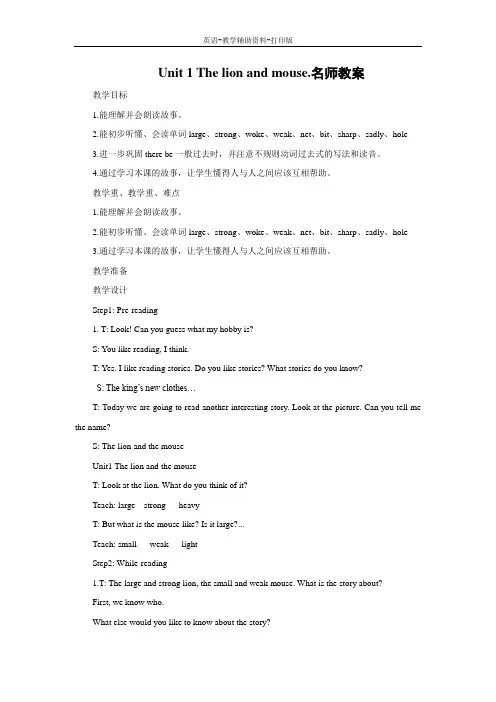
Unit 1 The lion and mouse.名师教案教学目标1.能理解并会朗读故事。
2.能初步听懂、会读单词large、strong、woke、weak、net、bit、sharp、sadly、hole3.进一步巩固there be一般过去时,并注意不规则动词过去式的写法和读音。
4.通过学习本课的故事,让学生懂得人与人之间应该互相帮助。
教学重、教学重、难点1.能理解并会朗读故事。
2.能初步听懂、会读单词large、strong、woke、weak、net、bit、sharp、sadly、hole3.通过学习本课的故事,让学生懂得人与人之间应该互相帮助。
教学准备教学设计Step1: Pre-reading1. T: Look! Can you guess what my hobby is?S: You like reading, I think.T: Yes. I like reading stories. Do you like stories? What stories do you know?S: The king’s new clothes…T: Today we are going to read another interesting story. Look at the picture. Can you tell me the name?S: The lion and the mouseUnit1 The lion and the mouseT: Look at the lion. What do you think of it?Teach: large strong heavyT: But what is the mouse like? Is it large?...Teach: small weak lightStep2: While-reading1.T: The large and strong lion, the small and weak mouse. What is the story about?First, we know who.What else would you like to know about the story?S: Where? When? What? How?Where? in the forest2. T: What happened? There are some sentences for you. Let’s read them together. The lion caught the mouse but let it go.The lion and the mouse became good friends.The lion could not get out from the net.The mouse helped the lion get out.The mouse woke the lion up.3. Read and match4. Watch and order5. Read and thinkTeach: one day, the next day, just then, from then on6.Read and thinkQ: Why did the lion let the mouse go?Q: What happened to the lion?Q: How did the mouse help the lion?Picture1&2Pic2: How did the mouse say to the lion. QuietlyHow did the lion say to the mouse? LoudlyThe mouse was afraid.Picture 3-5Underline the new words and phrasesTeach: bite—bit holeHow? Sadly happily7. T: If you were the mouse. What would you say?I am small and weak,but I am clever and brave(勇敢).I can help the lion!Step3: Post-reading1. Let’s read.2. Try to retell.3. T: What do you learn from the story?Sometimes, the strong can be weak.再高的人也有屈身的时候,Sometimes, the weak can be strong.再矮的人也有垫脚的时候。
译林版六年级下册英语教学设计:Unit 1 The lion and the mouse Cultu
译林版六年级下册英语教学设计:Unit 1 The lion and themouseCulture TimeObjectivesIn this section, students will learn about the culture of Tanzania and the importance of lions in African culture. Students will also learn about the importance of kindness.Preparation•Pictures of Tanzania•Pictures of lions•Video of The Lion King (optional)•Handout about the importance of kindness (optional)Procedure1.Introduction - ask students if they have ever heard of Tanzania or seen pictures of lions. Show pictures of Tanzania and brief students on facts about the country and lions. You can ask students what they know about Tanzania and lions.2.Story of Mufasa and Simba - you can show a video clip of The Lion King that highlights the relationship between Mufasa and his son, Simba. Explain the importance of the relationship between lions in African culture. If you are not using The Lion King, tell a story about a lion and its family.3.Discussion - initiate a discussion about the importance of kindness in our lives. Ask students why they think being kind is important. You can also relate kindness to the story of Mufasa and Simba or the relationship between the lion and the mouse.4.Handout - give out a handout about the importance of kindness. You can also ask students to write a short paragraph about what kindness means to them.Cartoon TimeObjectivesIn this section, students will watch an animated video of The Lion and the Mouse and learn about the moral of the story. They will also use English words to describe the characters and the events in the story.Preparation•Animated video of The Lion and the Mouse•Writing materials for studentsProcedure1.Introduction - ask students if they have ever watched an animated video of The Lion and the Mouse before. Briefly explain the story of the lion and the mouse.2.Video - show the animated video of The Lion and the Mouse. Encourage students to listen and watch closely.3.Discussion - initiate a discussion about the moral of the story. Ask students what they think it means. You can also ask students to describe the characters and events in the story using English words.4.Writing exercise - ask students to write a short paragraph about the story. Encourage them to use English words and phrases they learnedin the discussion.ConclusionWith this lesson, students learned about the culture of Tanzania and the importance of lions in African culture. They also learned about the importance of kindness in their lives. They watched an animated video of The Lion and the Mouse and learned about the moral of the story. Overall, this lesson is designed to encourage students to appreciate different cultures and learn important values.。
2023六年级英语下册Unit1ThelionandthemousePeriod1教案译林牛津版
2. 教学难点:
(1)词汇掌握:对于一些较难的词汇,如cage、climb、run away等,学生可能存在理解困难和记忆不准确的问题。教师需要通过多种教学方法,如单词卡片、游戏等,帮助学生巩固记忆,提高词汇掌握程度。
2023六年级英语下册 Unit 1 The lion and the mouse Period 1教案 译林牛津版
课题:
科目:
班级:
课时:计划1课时
教师:
单位:
一、教学内容分析
本节课的主要教学内容为译林牛津版六年级英语下册Unit 1 "The lion and the mouse" 第一课时。本节课主要让学生学习并掌握以下内容:
例题4:请用英语描述狮子和老鼠故事中的一个有趣的情节。
答案:A funny plot in the story is when the mouse runs around the lion's head, making the lion dizzy and laugh. This shows the mouse's cleverness and sense of humor, and also shows the lion's playful side.
例如,教师可以创设一些情境,让学生模仿和表演,从而提高他们的口语表达能力。同时,教师还可以设计一些练习题,让学生在纸上完成,以检测他们对于句型的理解和掌握。
(3)故事情节理解:本节课的故事情节主要讲述了一只狮子和一只老鼠之间的关系以及它们之间的互动。教师需要引导学生理解故事内容,把握故事的主线,理解老鼠和狮子之间的关系以及它们之间的互动。
六年级下册英语教案-Unit1Thelionandthemouse(Storytime)译林版
六年级下册英语教案 Unit 1 The lion and the mouse(Storytime)译林版教学目标:1. 学生能够理解并讲述故事《狮子和老鼠》的主要情节。
2. 学生能够正确拼读并使用故事中出现的关键词汇和短语。
3. 学生能够通过故事学习并运用寓言故事的基本要素和道德寓意。
4. 培养学生的合作能力、想象力和创造力。
教学内容:1. 故事《狮子和老鼠》的文本阅读与理解。
2. 故事中出现的关键词汇和短语的学习与应用。
3. 讨论故事的道德寓意,并鼓励学生发表自己的看法。
教学重点与难点:1. 教学重点:学生能够理解并讲述故事的主要情节,掌握故事中的关键词汇和短语。
2. 教学难点:学生能够理解故事的道德寓意,并能够运用所学知识进行创造性表达。
教具与学具准备:1. 教具:PPT展示故事情节,图片,视频等。
2. 学具:学生自备笔记本和文具。
教学过程:1. 导入:通过图片或视频引起学生对故事主题的兴趣,引导学生预测故事情节。
2. 阅读故事:学生跟随老师一起阅读故事,理解故事的主要情节和角色特点。
3. 学习关键词汇和短语:通过PPT展示和讲解,帮助学生学习和掌握故事中出现的关键词汇和短语。
4. 讨论故事情节:学生分组讨论故事情节,分享自己的理解和感受。
5. 道德寓意讨论:引导学生思考故事中的道德寓意,并鼓励学生发表自己的看法。
6. 创造性表达:学生分组进行角色扮演或故事改编,展示自己的理解和创造力。
板书设计:1. 故事和作者。
2. 故事的主要情节和角色特点。
3. 故事中出现的关键词汇和短语。
4. 故事的道德寓意。
作业设计:1. 写一篇关于故事《狮子和老鼠》的读后感,表达自己对故事情节和道德寓意的理解和感受。
2. 用自己的话复述故事,并尽量使用故事中出现的关键词汇和短语。
课后反思:教学重点与难点教学重点教学重点是指学生在学习过程中必须掌握的基本知识、技能和概念。
对于本课的教学重点,我们需要确保学生能够:1. 理解并讲述故事情节:学生需要能够概述《狮子和老鼠》的故事情节,包括故事的开端、发展、高潮和结局。
六年级英语下册Unit1《Thelionandthemouse》教案(新版)牛津译林版
3. 教学策略:
A. 加强单词的朗读指导。
B. 通过观看光盘,创设情境,组织游戏等活动帮助学生建构知识
C. 让学生在主动探究、合作学习的过程中,内化知识,提升能力。
4.教学准备:
PPT,卡片
预 习
作 业
U1Story time,试着朗读课文,大致理解课文意思。
学 程 预 设
2 能正确地理解并朗读对话内容,在教师的引导和帮助下尝试表演对话。
3 通过本课学习,学生能够了解中西方寓言的相同之处。
Step 2:Revision(4分钟)
1. Review the story
One day, a ______ mouse woke up the ______ lion. The lion caught the mouse and wanted to eat him. However, the lion _____ the mouse go.
2. Students dub.
Step 3:Presentation (20分钟)
Fun time
a.学生扩充故事并读一读
b.小组表演故事
Grammer time
1.复习五年级学过的复习
2.play games
学生快速说出形容词及副词
3.组词比赛
ask sadly
laugh loudly……
Culture time
教学难点
1.能理解并会朗读故事。
2.能初步听懂、会读单词large、strong、woke、weak、net、bit、sharp、sadly、hole
3.进一步巩固there be一般过去时,并注意不规则动词过去式的写法和读音。
译林英语六下教案Unit 1 The lion and the mouse 第一课时
译林英语六下教案Unit 1 The lion and the mouse 第一课时教学目标:1. 能正确朗读课文中出现的生词和短语。
2. 能理解课文内容,复述故事情节。
3. 学会使用英语描述动物的外貌、习性等。
4. 学会运用简单的英语句子表达自己的观点、描述图画。
教学重点:1.听说技能的训练。
2.理解课文,能够复述故事情节。
3.学会使用英语描述动物的外貌、习性等。
教学难点:1. 能使用英语表达自己的观点,描述故事情节。
2.能够用英语描述动物的外貌、习性等。
教学过程:Step 1. 导入新课 (5分钟)教师问: Do you like to hear stories about animals? Why?引导学生回答,激发他们的学习兴趣。
Step 2. 预习生词和短语 (10分钟)展示单词和短语:pair, eventually, trap, roarAsk and answer:T: Do you know what 'pair' means?Ss: It means two things that go together.T: Good job. And what about 'eventually'?Ss: It means something that happens eventually will happen after some time.T: Excellent. Can you tell me what 'trap' means?Ss: It means to catch something so it can't get away.T: Great. And what about 'roar'?Ss: It means a very loud noise made by a lion.Step 3. 听录音并朗读课文 (10分钟)播放课文录音,让学生跟读。
译林英语六下教案Unit 1 The lion and the mouse 第一课时
译林英语六下教案 Unit 1 The Lion and the Mouse 第一课时课前准备教师:音响设备、教学PPT、小黑板。
学生:书本、笔、本单元单词卡片。
教学目标1.了解故事《The Lion and the Mouse》的情节,理解其中的道理;2.掌握本单元的重点词汇;3.能够正确运用目标语言句型。
教学重点1.掌握本单元的重点词汇;2.能够正确运用目标语言句型。
教学难点1.掌握本单元的重点词汇;2.能够正确运用目标语言句型。
教学过程1.Warming-up–教师通过课件展示图片,引导学生谈论图片内容,激发学生的学习兴趣。
2.Pre-reading–英语单词会读:教师通过教学PPT依次出示本单元的重点词汇,让学生逐一朗读并理解词义;–猜词义:教师出示一幅图片,学生通过图片所展现的内容,猜测单词的意思,同时学生可以通过本单元单词卡片,查找单词的具体意义。
3.While-reading–教师让学生安静地阅读故事《The Lion and the Mouse》,学生可以在读完故事后,回答教师的提问。
–教师提问的问题:•What’s the story about?•Who is the main character in the story?•Why did the lion let the mouse go?–学生可以通过小组合作的方式,解答问题,受到教师的肯定后,对故事情节的理解会更加深刻。
4.Post-reading–教师运用教学PPT,出示故事中的关键图片,引导学生侃侃而谈,进行学生感悟活动。
5.Homework–让学生先理清故事情节,然后分别写出故事中的两个主要角色的人物形象和性格特点,以及对故事的感想。
学习小结本课时学生重点掌握了本单元的重点词汇,并理解了故事《The Lion and the Mouse》中体现的道理。
在课堂中,教师运用教学PPT,生动形象地展示了故事情节,让学生通过图片感受与理解,通过积极参与,让教学效果得到了充分的保证。
牛津译林版-英语-六下-教案-Unit1 The lion and the mouse (story time)译林版(三起)
unit1 The lion and the mouse (story time)Knowledge aims:1. Enable students to get the main idea of the story.2. Enable students to read and understand key words and sentences in the story,such as:large, strong, quietly, weak, loudly, happily, The mouse said quietly, The lion laughedloudly.Capability aims:1.Enable students to act out the story actively.2.Guide students to retell the story briefly according to key information.3.Help students to adopt good study habits and effective learning strategies.Emotion values:1.Get students to enjoy the sense of success and the confidence of English-leaning.2.Improve students’ interest in English and their imagination.3.Cultivate students’ spirit of teamwork and consciousness of cooperation.Teaching emphasis:Students can read and understand the story effectively.Teaching difficulties:Students can have a general understanding of simple past tense and adverbs.Teaching aids: multi-media playerTeaching procedures:Step 1: Pre-reading1.Free talkT: Nice to meet you, boys and girls. I’m your new English teacher for this lesson. I hope we can enjoy the lesson together. You can call me Annie or Miss Xu.Look at the pictures.Do you want to know more about me? You can ask me some questions.Ss: ...(教师引导学生以提问的方式增进对彼此的了解,锻炼学生的思维和口语表达,同时也希望以此引出故事的学习,如:I like reading books, especially storybooks at weekends.或者I like animals.)Step2: While-reading1.Watch and answerT: Where do animals live happily?(forest). Yes, they live happily in the forest. Do you still remember this story? It happened in the forest too. It is called Beauty and the Beast. Today ,we’re going to learn a new story. It is about the lion and the mouse.(出示本单元题目并带读)Look at the lion, he’s large and strong.(贴图,板书large, strong并带读). But the mouse is so small and weak.(贴图,板书small, weak并带读). Let’s watch and answer: Did the lion eat the mouse?2.Read and answerT: Now, l et’s read the story carefully. Take out your paper, read para1 and 2. Then answer the question: Who woke the lion up?Yes, the mouse woke the lion up. Then the lion became very angry. Look at the mouse, he was so small and weak. How did he feel at that tim e? Let’s imagine.Maybe he was afraid at first. But he had to save himself. What did he say? (教师呈现老鼠说的话,请学生加入想象示范读,读出老鼠的冷静和机智。
译林英语六下教学设计Unit 1 The lion and the mouse 第一课时
译林英语六下教学设计Unit 1 The lion and the mouse 第一课时教学目标1.通过学习绘本《The Lion and the Mouse》,让学生进一步了解并熟练掌握故事中的词汇及短语。
2.学生能够理解故事情节,表达出注意事项并表演出来。
3.学生能够进一步了解动物的习性,并且在观察和研究过程中,进一步发现和了解自然现象,提高科学素养。
教学重难点•故事中的单词拼读和使用•理解故事情节并表达出注意事项的能力•学生能够准确描述动物的一般习性,提高科学素质。
教学准备•《The Lion and the Mouse》绘本、PPT•电脑、投影仪、音响设备•教学道具:小狮子、老鼠等道具教学步骤Step 1 Warm-up1.Greeting: 老师向学生问好并介绍第一课。
2.Introduction to animals: 和学生一起复习前几个学期学过的动物单词,如lion, mouse, tiger等。
Step 2 Pre-reading1.Ask questions: 老师向学生提问,在生活中是否曾经遇到过困难,大家是如何解决困难的?这样的情景出现后你会感到怎样?并让学生写下自己的回答。
Step 3 Reading1.在学生的感受激发之下,老师开始引入绘本,展示绘本封面,并让学生看看这只狮子和老鼠长什么样子。
2.让学生在老师的带领下,一起朗读故事,带着问题去了解故事情节。
3.提醒学生留意故事中可能出现的重要词汇并记录下来,如:lion, mouse, big, angry, kind等。
Step 4 Post-reading1.进行口语练习,让学生在小组内分享他们在阅读故事时记录下的单词,并提醒他们注意单词的发音和用法。
2.让学生利用故事来制作5幅小海报,以描述故事情节。
3.演讲:请学生就自己制作的海报来进行分享,并根据其他同学的分享,互相提出改善意见和建议。
Step 5 Art and Science1.在故事完成之后,老师放出老鼠和大狮子等道具,让学生观察此时的质量和形状。
六年级下册英语教案-Unit1ThelionandthemousePeriod2译林版
六年级下册英语教案-Unit1 The lion and the mouse Period 2译林版教学目标本节课旨在让学生理解并运用故事《狮子和老鼠》中的重点单词和句型,培养学生的阅读理解能力和合作学习能力。
同时,通过故事的学习,让学生明白友谊的重要性,学会尊重他人。
教学内容本节课主要学习《狮子和老鼠》的故事,包括故事中的重点单词、句型以及故事的阅读和理解。
教学重点与难点重点:掌握故事中的重点单词和句型,能够理解并复述故事。
难点:理解故事中的深层含义,培养学生的阅读理解能力和合作学习能力。
教具与学具准备教具:PPT,故事卡片,教学视频。
学具:学生自备笔记本和笔。
教学过程1. 导入:通过图片和问题引导学生回顾上一节课的内容,激发学生的学习兴趣。
2. 新课导入:通过PPT展示故事《狮子和老鼠》的封面,引导学生预测故事内容。
3. 故事学习:播放教学视频,让学生跟读并学习故事中的重点单词和句型。
4. 小组合作:学生分组,根据故事内容进行角色扮演,培养学生的合作学习能力。
5. 故事理解:通过问题引导学生深入理解故事内容,培养学生的阅读理解能力。
6. 总结与反思:学生分享学习心得,教师进行点评和总结。
板书设计板书设计简洁明了,突出重点单词和句型,方便学生复习和理解。
作业设计1. 完成课后练习题,巩固所学知识。
2. 写一篇关于《狮子和老鼠》的故事续写,培养学生的创新思维和写作能力。
课后反思本节课通过故事的学习,让学生掌握了重点单词和句型,培养了学生的阅读理解能力和合作学习能力。
同时,通过故事的教育意义,让学生明白了友谊的重要性,学会了尊重他人。
在今后的教学中,我将继续注重培养学生的阅读理解能力和合作学习能力,提高他们的英语素养。
重点关注的细节是教学过程,因为这个部分涵盖了整个课堂的教学步骤和活动安排,是教学设计的核心部分,直接关系到学生的学习效果和教学目标的实现。
教学过程详细补充和说明1. 导入在导入环节,教师可以通过展示与故事相关的图片,如狮子的图片,让学生回顾上一节课学到的相关知识,如狮子的英文单词是lion,以及上一节课学到的简单句型。