
北外北京外国语大学英语语言文学考研真题试题试卷
北京外国语大学英语语言文学专业英美文学真题2008年.doc
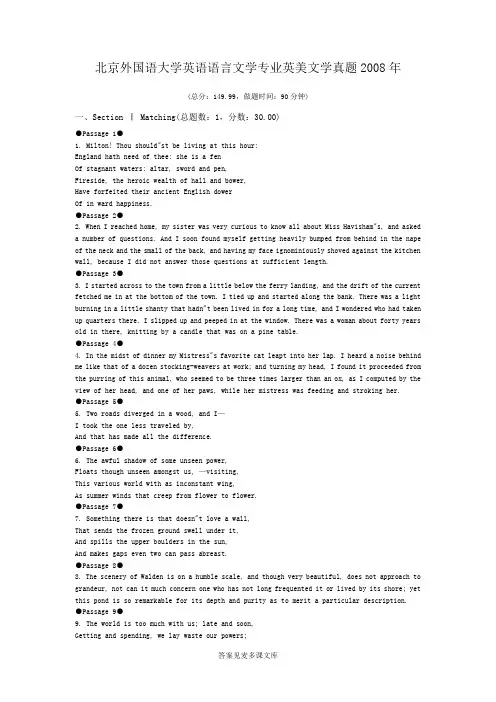
北京外国语大学英语语言文学专业英美文学真题2008年(总分:149.99,做题时间:90分钟)一、Section Ⅰ Matching(总题数:1,分数:30.00)●Passage 1●1. Milton! Thou should"st be living at this hour:England hath need of thee: she is a fenOf stagnant waters: altar, sword and pen,Fireside, the heroic wealth of hall and bower,Have forfeited their ancient English dowerOf in ward happiness.●Passage 2●2. When I reached home, my sister was very curious to know all about Miss Havisham"s, and askeda number of questions. And I soon found myself getting heavily bumped from behind in the nape of the neck and the small of the back, and having my face ignominiously shoved against the kitchen wall, because I did not answer those questions at sufficient length.●Passage 3●3. I started across to the town from a little below the ferry landing, and the drift of the current fetched me in at the bottom of the town. I tied up and started along the bank. There was a light burning in a little shanty that hadn"t been lived in for a long time, and I wondered who had taken up quarters there. I slipped up and peeped in at the window. There was a woman about forty years old in there, knitting by a candle that was on a pine table.●Passage 4●4. In the midst of dinner my Mistress"s favorite cat leapt into her lap. I heard a noise behind me like that of a dozen stocking-weavers at work; and turning my head, I found it proceeded from the purring of this animal, who seemed to be three times larger than an ox, as I computed by the view of her head, and one of her paws, while her mistress was feeding and stroking her.●Passage 5●5. Two roads diverged in a wood, and I—I took the one less traveled by,And that has made all the difference.●Passage 6●6. The awful shadow of some unseen power,Floats though unseen amongst us, —visiting,This various world with as inconstant wing,As summer winds that creep from flower to flower.●Passage 7●7. Something there is that doesn"t love a wall,That sends the frozen ground swell under it,And spills the upper boulders in the sun,And makes gaps even two can pass abreast.●Passage 8●8. The scenery of Walden is on a humble scale, and though very beautiful, does not approach to grandeur, not can it much concern one who has not long frequented it or lived by its shore; yet this pond is so remarkable for its depth and purity as to merit a particular description.●Passage 9●9. The world is too much with us; late and soon,Getting and spending, we lay waste our powers;Little we see in Nature that is ours;We have given our hearts away, a sordid boon!●Passage 10●10. Mr. Harthouse professed himself in the highest degree instructed and refreshed by this condensed epitome of the whole of Coketown question.●Authors●A. Henry David ThoreauB. William WordsworthC. Charles DickensD. Jonathan SwiftE. John MiltonF. Francis BaconG. Percy Bysshe ShelleyH. Robert FrostI. Mark TwainJ. William ShakespeareK. Emily DickinsonL. Christopher Marlowe(分数:30.00)二、Section Ⅱ Short Stor(总题数:1,分数:100.00)A Worn PathEudora WeltyIt was December—a bright frozen day in the early morning. Far out in the country there was an old Negro woman with her head tied red rag, coming along a path through the pinewoods. Her name was Phoenix Jackson. She was very old and small and she walked slowly in the dark pine shadows, moving a little from side to side in her steps, with the balanced heaviness and lightness of a pendulum in a grand father clock. She carried a thin, small cane made from an umbrella, and with this she kept tapping the frozen earth in front of her. This made a grave and persistent noise in the still air that seemed meditative like the chirping of a solitary little bird.She wore a dark striped dress reaching down to her shoe tops, and an equally long apron of bleached sugar sacks, with a full pocket: all neat and tidy, but every time she took a step she might have fallen over her shoelaces, which dragged from her unlaced shoes, she looked straight ahead. Her eyes were blue with age. Her skin had a pattern all its own of numberless branching wrinkles and as though a whole little tree stood in the middle of her forehead, but a golden color ran underneath, and thee two knobs of her cheeks were illumined by a yellow burning under the dark. Under the red rag her hair came down on her neck in the frailest of ringlets, still black, and with an odor like copper.Now and then there was a quivering in the thicket. Old Phoenix said, "Out of my way, all you foxes, owls, beetles, jack rabbits, coons and wild animals... Keep out from under these feet, little bob-whites. Keep the big wild hogs out of my path. Don"t let none of those come running my direction.I got a long way." Under her small black-freckled hand her cane, limber as a buggy whip, would switch at the brush as if to rouse up any hiding things. On she went. The woods were deep and still. The sun made the pine needles almost too bright to look at, up where the wind rocked. The cones dropped as light as feathers. Down in the hollow was the mourning dove—it was not too late for him.The path ran up a hill. "Seem like there is chains about my feet, time I get this far," she said, in the voice of argument old people keep to use with themselves. "Something always take a hold of me on this hill—pleads I should stay."After she got to the top she turned and gave a full, severe look behind her where she had come. "Up through pines," she said at length. "Now down through oaks."Her eyes opened their widest, and she started down gently. But before she got to the bottom of the hill a bush caught her dress.Her fingers were busy and intent, but her skirts were full and long, so that before she could pull them free in one place they were caught in another. It was not possible to allow the dress to tear. "I in the thorny bush," she said. "Thorns, you doing your appointed work. Never want to let folks pass, no sir. Old eyes thought you was a pretty little green bush."Finally, trembling all over, she stood free, and after a moment dared to stoop for her cane. "Sun so high!" she cried, leaning back and looking, while the thick tears went over her eyes. "The time getting all gone here."At the foot of this hill was a place where a log was laid across the creek."Now comes the trial," said Phoenix.Putting her right foot out, she mounted the log and shut her eyes. Lifting her skirt, leveling her cane fiercely before her, like a festival figure in some parade, she began to march across. Then she opened her eyes and she was safe on the other side."I wasn"t as old as I thought," she said.But she sat down to rest. She spread her skirts on the bank around her and folded her hands over her knees. Up above her was a tree in a pearly cloud of mistletoe. She did not dare to close her eyes, and when a little boy brought her a plate with a slice of marble-cake on it she spoke to him. "That would be acceptable," she said. But when she went to take it there was just her own hand in the air.So she left that tree, and had to go through a barbed-wire fence. There she had to creep and crawl, spreading her knees and stretching her fingers like a baby trying to climb the steps. But she talked loudly to herself: she could not let her dress be torn now, so late in the day, and she could not pay for having her arm or her leg sawed off if she got caught fast where she was. At last she was safe through the fence and risen up out in the clearing. Big dead trees, like black men with one arm, were standing in the purple stalks of the withered cotton field. Thee sat a buzzard."Who you watching?"In the furrow she made her way along."Glad this not the season for bulls," she said, looking sideways, "and the good Lord made his snakes to curl up and sleep in the winter. A pleasure I don"t see no two-headed snake coming around that tree, where it come once. It took a while to get by him, back in the summer."She passed through the old cotton and went into a field of dead corn. It whispered and shook and was taller than her head. "Through the maze now," she said, for there was no path.Then there was something tall, black, and skinny there, moving before her.At first she took it for a man. It could have been a man dancing in the field. But she stood still and listened, and it did not make a sound. It was as silent as a ghost."Ghost", she said sharply, "who be you the ghost of? For I have heard of nary death close by." But there was no answer—only the ragged dancing in the wind.She shut her eyes, reached out her hand, and touched a sleeve. She found a coat and inside that an emptiness, cold as ice."You scarecrow," she said. Her face lighted. "I ought to be shut up for good," she said with laughter. "My senses is gone. I too old. I the oldest people I ever know. Dance, old scarecrow," she said, "while I dancing with you".She kicked her foot over the furrow, and with mouth drawn down, shook her head once or twice in a little strutting way. Some husks blew down and whirled in streamers about her skirts. Then she went on, parting her way from side to side with the cane, through the whispering field.At last she came to the end, to a wagon track where the silver grass blew between the red ruts. The quail were walking around like pullets, seeming all dainty and unseen."Walk pretty," she said. "This the easy place. This the easy going."She followed the track, swaying through the quiet bare fields, through the little strings of trees silver in their dead leaves, past cabins silver from weather, with the doors and windows boarded shut, all like old women under a Spell sitting there. "I walking in their sleep," she said, nodding her head vigorously.In a ravine she went where a spring was silently flowing through a hollow log. Old Phoenix bent and drank. "Sweet gum makes the water sweet," she said, and drank more. "Nobody know who made this well, for it was here when I was born."The track crossed a swampy part where the moss hung as white as lace from every limb. "Sleep on, alligators, and blow your bubbles." Then the track went into the road.Deep, deep the road went down between the high green-colored banks. Overhead the live-oaks net and it was as dark as a cave.A black dog with a lolling tongue came up out of the weeds by the ditch. She was meditating, and not ready, and when he came at her she only hit him a little with her cane. Over she went in the ditch, like a little puff of milkweed.Down there her senses drifted away. A dream visited her, and she reached her hand up, but nothing reached down and gave her a pull. So she lay there and presently went to talking. "Old woman", she said to herself, "that black dog come up out of the weeds to stall you off and now there he sitting on his fine tail, smiling at you."A white man finally came along and found her—a hunter, a young man, with his dog on a chain. "Well, Granny!" he laughed. "What are you doing there?""Lying on my back like a June-bug waiting to be fumed over, mister," she said, reaching up her hand.He lifted her up, gave her a swing in the air, and set her down. "Anything broken, Granny?", "No, sir, them old dead seeds is spring enough," said Phoenix, when she had got her breath. "I thank you for your trouble.""Where do you live, Granny?" he asked, while the two dogs were growling at each other. "Away back yonder, sir, behind the ridge. You can"t even see it from here?""On your way home?""No sir, I going to town...""Why, that"s too far! That"s as far as I walk when I come out myself, and I get something for my trouble." He patted the stuffed bag he carried, and there hung down a little closed claw. It was one of the bobwhites, with its beak hooked bitterly to show it was dead. "Now you go on home, Granny!""I bound to go to town, mister", said Phoenix. "The time comes around."He gave another laugh, filling the whole landscape. "I know you old colored people! Wouldn"t miss going to town to see Santa Claus!"But something held old Phoenix very still. The deep lines in her face went into a fierce and different radiation. Without warning, she had seen with her own eyes a flashing nickel fall out of the man"s pocket onto the ground."How old are you, Granny?" he was saying."There is no telling, mister," she said, "no telling."Then she gave a little cry and clapped her hands and said, "Git on away from here, dog! Look! Look at that dog!" She laughed as if in admiration. "He ain"t scared of nobody. He a big black dog." She whispered, "Sic him!""Watch me get rid of that cur," said the man. "Sic him, Pete! Sic him!"Phoenix heard the dogs fighting, and heard the man running and throwing sticks. She even hearda gunshot. But she was slowly bending forward by that time, further and further forward, the lids stretched down over her eyes, as if she were doing this in her sleep. Her chin was lowered almost to her knees. The yellow palm of her hand came out from the fold of her apron. Her fingers slid down and along the ground under the piece of money with the grace and care they would have in lifting an egg from under a setting hen. Then she slowly straightened up, she stood erect, and the nickel was in her apron pocket. A bird flew by. Her lips moved, "God watching me the whole time. I come to stealing."The man came back, and his own dog panted about them. "Well, I scared him off that time," he said, and then he laughed and lifted his gun and pointed it at Phoenix.She stood straight and faced him."Doesn"t the gun scare you?" he said, still pointing it."No, sir, I seen plenty go off closer by, in my day, and for less than what I done," she said, holding utterly still.He smiled, and shouldered the gun. "Well, Granny," he said, "you must be a hundred years old, and scared of nothing. I"d give you a dime if I had any money with me. But you take my advice and stay home, and nothing will happen to you.""I bound to go on my way, mister," said Phoenix. She inclined her head in the red rag. Then they went in different directions, but she could hear the gun shooting again and again over the hill. She walked on. The shadows hung from the oak trees to the road like curtains. Then she smelled wood-smoke, and smelled the river, and she saw a steeple and the cabins on their steep steps. Dozens of little black children whirled around her. There ahead was Natchez shining. Bells were ringing. She walked on.In the paved city it was Christmas time. There were red and green electric lights strung and crisscrossed everywhere, and all turned on in the daytime. Old Phoenix would have been lost if she had not distrusted her eyesight and depended on her feet to know where to take her.She paused quietly on the sidewalk where people were passing by. A lady came along in the crowd, carrying an armful of red, green and silver wrapped presents; she gave off perfume like the red roses in hot summer, and Phoenix stopped her."Please, missy, will you lace up my shoe?" She held up her foot."What do you want, Grandma?""See my shoe," said Phoenix. "Do all right for out in the country, but wouldn"t look right to go in a big building." "Stand still then, Grandma," said the lady. She put her packages down on the sidewalk beside her and laced and tied both shoes tightly."Can"t lace"em with a cane," said Phoenix. "Thank you, missy. I don"t mind asking a nice lady to tie up my shoe, when I gets out on the street."Moving slowly and from side to side, she went into the big building, and into a tower of steps, where she walked up and around and around until her feet knew to stop.She entered a door, and there she saw nailed up on the wall the document that had been stamped with the gold seal and framed in the gold frame, which matched the cream that was hung up in her head."Here I be," she said. There was a fixed and ceremonial stiffness over her body."A charity cases, I suppose," said an attendant who sat at the desk before her.But Phoenix only looked above her head. There was sweat on her face, the wrinkles in her skin shone like a bright net."Speak up, Grandma," the woman said. "What"s your name? We must have your history, you know. Have you been here before? Want seems to be the trouble with you?"Old Phoenix only gave a twitch to her face as if a fly were bothering her."Are you deaf?" cried the attendant.But then the nurse came in."Oh, that"s just old Aunt Phoenix," she said. "She doesn"t come for herself she has a little grandson. She makes these trips just as regular as clockwork. She lives away back off the old Natchez Trace." She bent down. "Well, Aunt Phoenix, why don"t you just take a seat? We won"t keep you standing after your long trip." She pointed.The old woman sat down, bolt upright in the chair."Now, how is the boy?" asked the nurse.Old Phoenix did not speak."I said, how is the boy?"But Phoenix only waited and stared straight ahead, her face very solemn and withdrawn into rigidity. "Is his throat any better?" asked the nurse. "Aunt Phoenix, don"t you hear me? Is your grandson"s throating any better since the last time you came for the medicine?" With her hands on her knees, the old woman waited, silent, erect and motionless, just as if she were in armor."You mustn"t take up our time this way, Aunt Phoenix," the nurse said. "Tell us quickly about your grandson, and get it over. He isn"t dead, is he?"At last there came a flicker and then a flame of comprehension across her face, and she spoke. "My grandson. It was my memory had left me. There I sat and forgot why I made my long trip." "Forgot?" The nurse frowned. "After you came so far?"Then Phoenix was like an old woman begging a dignified forgiveness for waking up frightened in the night. "I never did go to school, I was too old at the Surrender," she said in a soft voice. "I"m an old woman without an education. It was my memory fail me. My little grandson, he is just the same, and I forgot it in the coming.""Throat never heals, does it?" said the nurse, speaking in a loud, sure voice to old Phoenix. By now she had a card with something written on it, a little list. Yes. Swallowed lye. When was it? —January—two, three years ago...Phoenix spoke unasked now. "No, missy, he not dead, he just the same. Every little while his throat begin to close up again, and he not able to swallow. He not get his breath. He not able to help himself. So the time come around, and I go on another trip for the soothing medicine.""All right. The doctor said as long as you came to get it, you could have it," said the nurse. "But it"s art obstinate case.""My little grandson, he sit up there in the house all wrapped up, waiting by himself," Phoenix went on. "We is the only two left in the world. He suffer and it don"t seem to put him back at all. He got a sweet look. He going to last. He wear a little patch quilt and peep out holding his mouth open like a little bird. I remember so plain now. I not going to forget him again, no, the whole enduring time. I could tell him from all the others in creation.""All right." The nurse was trying to hush her now. She brought her a bottle of medicine. Charity, she said, making a check mark in a book.Old Phoenix held the bottle close to her eyes, and then carefully put it into her pocket."I thank you," she said."It"s Christmas time, Grandma," said the attendant. "Could I give you a few pennies out of my purse?""Five pennies is a nickel," said Phoenix stiffly."Here"s a nickel," said the attendant.Phoenix rose carefully and held out her hand. She received the nickel and then fished the other nickel out of her pocket and laid it beside the new one. She stared at her palm closely, with her head on one side.Then she gave a tap with her cane on the floor."This is what come to me to do," she said. "I going to the store and buy my child a little windmill they sells, made out of paper. He going to find it hard to believe three such a thing in the world. I"ll march myself back where he waiting, holding it straight up in this hand."She lifted her free hand, gave a little nod, turned around, and walked out of the doctor"s office. Then her slow step began on the stairs, going down.(分数:99.99)(1).Summarize the plot of the following story in your own words (around 200 words).(分数:33.33)__________________________________________________________________________________________ (2).Make a brief comment on the characterization of Phoenix Jackson. (分数:33.33)__________________________________________________________________________________________ (3).Define the major theme of the following short story. (分数:33.33)__________________________________________________________________________________________三、Section Ⅲ Critical T(总题数:4,分数:20.00)1.Birds normally can fly.Tweety the Penguin is a bird.Therefore, Tweety can fly.(分数:5.00)__________________________________________________________________________________________ 2.You"ll never find any additives in our tobacco. What you see is what you get. Simply 100% whole-leaf natural tobacco. True authentic tobacco taste. It"s only natural.(分数:5.00)__________________________________________________________________________________________ 3.If we guillotine the king, then he will die.Therefore, if we don"t guillotine the king, then he won"t die.(分数:5.00)__________________________________________________________________________________________ 4.Everyone is selfish; everyone is doing what he believes will make himself happier. The recognition of that can take most of the sting out of accusations that you"re being "selfish". Why should you feel guilty for seeking your own happiness when that"s what everyone else is doing, too?(分数:5.00)__________________________________________________________________________________________。
2015年北京外国语大学英美文学考研真题,参考答案,考研参考书,复习方法,考研资料
1/9【育明教育】中国考研考博专业课辅导第一品牌官方网站: 12015年北京外国语大学考研指导育明教育,创始于2006年,由北京大学、中国人民大学、中央财经大学、北京外国语大学的教授投资创办,并有北京大学、武汉大学、中国人民大学、北京师范大学复旦大学、中央财经大学、等知名高校的博士和硕士加盟,是一个最具权威的全国范围内的考研考博辅导机构。
更多详情可联系育明教育孙老师。
(01)英语语言学及应用语言学1.Yule,G.(2010).The Study of Language (4th ed.).Cambridge:Cambridge University Press.2.McGregor,W.(2009).Linguistics:An Introduction.London:Continuum.3.Davies,A.(2007).An Introduction to Applied Linguistics:From Practice to Theory (2nd ed.).Edinburgh:Edinburgh University Press.4.McCarthy,M.(2001).Issues in Applied Linguistics.Cambridge:Cambridge University Press.5.陆俭明:《现代汉语语法研究教程》北京大学出版社,2005年。
(02)英美文学1、M.H.Abrams 编:《诺顿英国文学选集》W.W.Norton ,2002年。
2、Nina Baym 编:《诺顿美国文学选集》W.W.Norton ,2005年。
3、金莉、张剑编:《文学原理教程》,外语教学与研究出版社,2005年。
4、Raman Selden :《当代文学理论导读》外语教学与研究出版社,2004年。
5、赵一凡等编:《西方文论关键词》外语教学与研究出版社,2004年。
(03)美国研究1、Thomas A.Bailey,David M Kennedy &Lizabeth Cohen.The American Pageant-A History of the Republic,11th edition,Houghton Mifflin Company 1998,北外研招办(或者其它英文版美国历史书,历史阶段截止到里根政府时期)2、梅仁毅主编:《美国研究读本》,外语教学与研究出版社,2002年。
北京外国语大学 北外 2004年英美文学 考研真题及答案解析
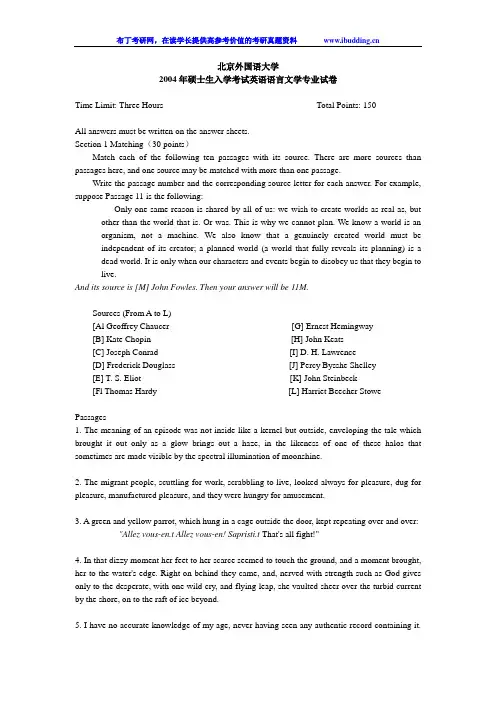
北京外国语大学2004年硕士生入学考试英语语言文学专业试卷Time Limit: Three Hours Total Points: 150All answers must be written on the answer sheets.Section 1 Matching(30 points)Match each of the following ten passages with its source. There are more sources than passages here, and one source may be matched with more than one passage.Write the passage number and the corresponding source letter for each answer. For example, suppose Passage 11 is the following:Only one same reason is shared by all of us: we wish to create worlds as real as, but other than the world that is. Or was. This is why we cannot plan. We know a world is an organism, not a machine. We also know that a genuinely created world must be independent of its creator; a planned world (a world that fully reveals its planning) is a dead world. It is only when our characters and events begin to disobey us that they begin to live.And its source is [M] John Fowles. Then your answer will be 11M.Sources (From A to L)[Al Geoffrey Chaucer [G] Ernest Hemingway[B] Kate Chopin [H] John Keats[C] Joseph Conrad [I] D. H. Lawrence[D] Frederick Douglass [J] Percy Bysshe Shelley[E] T. S. Eliot [K] John Steinbeck[Fl Thomas Hardy [L] Harriet Beecher StowePassages1. The meaning of an episode was not inside like a kernel but outside, enveloping the tale which brought it out only as a glow brings out a haze, in the likeness of one of these halos that sometimes are made visible by the spectral illumination of moonshine.2. The migrant people, scuttling for work, scrabbling to live, looked always for pleasure, dug for pleasure, manufactured pleasure, and they were hungry for amusement.3. A green and yellow parrot, which hung in a cage outside the door, kept repeating over and over:"Allez vous-en.t Allez vous-en! Sapristi.t That's all fight!"4. In that dizzy moment her feet to her scarce seemed to touch the ground, and a moment brought, her to the water's edge. Right on behind they came, and, nerved with strength such as God gives only to the desperate, with one wild cry, and flying leap, she vaulted sheer over the turbid current by the shore, on to the raft of ice beyond.5. I have no accurate knowledge of my age, never having seen any authentic record containing it.By far the larger part of the slaves know as little of their ages as horses know of theirs, and it is the wish of most masters within my knowledge to keep their slaves thus ignorant.6. We two whites stood over him, and his lustrous and inquiring glance enveloped us both. I declare it looked as though he would presently put to us some question in an understandable language; but he died without uttering a sound, without moving a limb, without twitching a muscle. Only in the very last moment, as though in response to some sign we could not see, to some whisper we could not hear, he frowned heavily, and that frown gave to his black death-mask an inconceivably somber, brooding, and menacing expression.7. It is the same! —For, be it joy or sorrow,The path of its departure still is free;Man's yesterday may ne'er'be like his morrow;Nought may endure but Mutability.8. A snake came to my water troughOn a hot, hot day, and I in pajamas for the heat,To drink there.9.The river's tent is broken: the last fingers of leafClutch and sink into the wet bank. The windCrosses the brown land, unheard. The nymphs are departed.10.Good table manners she had learnt as well:She never let a crumb from her mouth fall;She never soiled her fingers, dipping deepInto the sauce; when lifting to her lipsSome morsel, she was careful not to spillSo much as one small drop upon her breast.Her greatest pleasure was in etiquette.The following sections of the examination will be graded on both what you say and how you say it.Section2 Short Essays (90 points)I. Summarize the plot of the following story in your own words (around200 words). (30points)2. Comment on the role of the wicked boy in the story. (30points)3.What is the theme of the story? Pay particular attention to the ending. (30points)A Wicked BoyBy Anton ChekhovIvan Ivanych Lapkin, a young man of nice appearance, and Anna Semionovna Zamblitskaia, a young girl with a little mined-up nose, went down the steep bank and sat down on a small bench. The bench stood right by the water among some thick young osier bushes. What a wonderful little place! Once you've sat down, you were hidden from the world—only the fish saw you, and the water-tigers, running like lightning over the water. The young people were armed with rods, nets, cans of worms, and other fishing equipment. Having sat down, they started fishing right away."I'm glad we're alone at last," Lapkin began, looking around. "I have to tell you a lot of things, Anna Semionovna... an awful lot... when I saw you the first time.... You've got a bite.... then I understood what I'm living for, understood where my idol was--to whom I must devote my honest, active life... that must be a big one that's biting.... Seeing you, I feel in love for the first time, feel passionately in love! Wait before you give it a jerk.... let it bite harder.... Tell me, my darling, I adjure you, may I count on--not on reciprocity, no! I'm not worthy of that, I dare not even think of that—may I count on .... Pull!"Anna Semionovna raised her hand with the rod in it, yanked, and cried out. A little silvery-green fish shimmered in the air."My Lord, a perch! Ah, ah.... Quickly! It's getting free!"The perch got free of the hook, flopped through the' grass toward its native element.... and plopped into the water!In pursuit of the fish, Lapkin somehow inadvertently grabbed Anna Semionovna's hand instead of the fish, inadvertently pressed it to his lips.... She quickly drew it back, but it was already too late; their mouths inadvertently merged in a kiss. It happened somehow inadvertently. Another kiss followed the first, then vows and protestations.... What happy minutes! However, in this earthly life there is no absolute happiness. Happiness usually carries a poison in itself, or else. is poisoned by something from outside. So this time, too. As the young people were kissing, a laugh suddenly rang out. They glanced at the river and were stupefied: a naked boy was standing in the water up to his waist. This was Kolia, a schoolboy, Anna Semionovna's brother. He was standing in the water, staring at the young people, and laughing maliciously."Ah-ah-ah... you're kissing?" he said. "That's great! I'll tell Mama.""I hope that you, as an honest young man..." muttered Lapkin, blushing. "It's low-down to spy, and to tell tales is foul and detestable... I assume that you, as an honest and noble young man...""Give me a ruble and then I won't tell!" said the noble young man. "Or else I will."Lapkin pulled a ruble out of his pocket and gave it to Kolia. Kolia squeezed the ruble in his wet fist, whistled, and swam off. And the young people didn't kiss any more that time.The next day Lapkin brought Kolia some paints and a ball from town, and his sister gave him all her empty pill-boxes. After that they had to give him some cuff-links with dogs' heads on them. The wicked boy obviously liked all these things very much and, in order to get still more, he started keeping his eye on them. Wherever Lapkin and Anna Semionovna went, he went, too. He didn't leave them alone for a minute."The bastard!" Lapkin gnashed his teeth. "So little, and already such a real bastard! What's he going to be like later?!"All through June, Kolia made life impossible for the poor lovers. He threatened to tell on them, kept his eye on them, and demanded presents; it all wasn't enough for him, and he finally started talking about a pocket watch. And what then? They had to promise the watch.One time at dinner, when the waffle cookies were being passed, he suddenly burst out in aguffaw, winked an eye, and asked Lapkin:"Shall I tell? Huh?"Lapkin blushed terribly and started eating his napkin instead of the cookie. Anna Semionovna jumped up from the table and ran into the other room. And the young people found themselves in this position until the end of August, until the very day when, at last, Lapkin proposed to Anna Semionovna. Oh, what a happy day that was! Having talked to the parents of his bride, and having received their consent, Lapkin first of all ran out into the garden and started looking for Kolia. Once he had found him, he almost sobbed from delight and seized the wicked boy by the ear. Anna Semionovna, who had also been looking for Kolia, ran up, and seized him by the other ear. And you really ought to have seen what joy was written all over the lovers' faces as Kolia cried and begged them:"Dearest, darling, angels, I'll never do it again! Ow, ow! Forgive me!"And afterwards they both admitted that during the whole time they had been in love with each other they had never once felt such happiness, such breath-taking bliss as during those moments when they were pulling the wicked boy's ears.Section 3 Creative Thinking (30points)If you were the author, Somerset Maugham, what title would you give to the story below? Generate as many titles as you can before deciding on the best one. Be creative and go for quantity; list at least 10 titles.There was a merchant in Bagdad who sent his servant to market to buy provisions, and in a little while the servant came back, white and trembling, and said, "Master, just now when I was in the market, I was jostled by a woman in the crowd and when I turned I saw it was Death that jostled me. She looked at me and made a threatening gesture; now, lend me your horse, and I will ride away from this city and avoid my fate. I will go to Samarra and there Death will not find me." The merchant lent him his horse, and the servant mounted it, and he dug his spurs in its flanks and as fast as the horse could gallop he went. Then the merchant went down to the market, and he saw Death standing in the crowd and he came to Death and said, “Why did you make a threatening gesture to my servant when you saw him this morning?” “That was not a threatening gesture,”Death said. “It was only a start of surprise. I was astonished to see him in Bagdad, for I had an appointment with him tonight in Samarra.”Section4 Critical Thinking (20-point bonus)You do not have to do the task in this section, but you will get a 20-point bonus if you do it correctly.Identify errors in logic, if any, in the following arguments. Justify your answers.1. Hey, John, check this out! Two weeks ago, I bought this good luck charm, and I’ve been carrying with me every day. Since the, I’ve been carrying it around with me every day. Since then, I found $50 on the street, I got the apartment I was hoping for, and I got a date with Elaine! This good luck charm really works!2. Look, either we do a full-color glossy brochure or we don’t do anything at all. It’s better to have nothing than to have something shabby. Do it right or don’t do it at all.3. If we legalize marijuana, watch out-the legalization of cocaine and other drugs can’t be far behind.4. Do you support the ban of nuclear and biological weapons that would leave us defenseless against those countries that will continue to build nuclear and biological warheads in secret?5. One of the things those animal rights people want to do is to make you believe that a monkey has the same rights as a human being.This is the end of the examination.答案部分:北京外国语大学2004年硕士生入学考试英语语言文学专业试卷Time Limit: Three Hours Total Points: 150All answers must be written on the answer sheets.Section 1 Matching(30 points)(北京外国语大学2004年研)Match each of the following ten passages with its source. There are more sources than passages here, and one source may be matched with more than one passage.Write the passage number and the corresponding source letter for each answer. For example, suppose Passage 11 is the following:Only one same reason is shared by all of us: we wish to create worlds as real as, but other than the world that is. Or was. This is why we cannot plan. We know a world is an organism, not a machine. We also know that a genuinely created world must be independent of its creator; a planned world (a world that fully reveals its planning) is a dead world. It is only when our characters and events begin to disobey us that they begin to live.And its source is [M] John Fowles. Then your answer will be 11M.Sources (From A to L)[Al Geoffrey Chaucer [G] Ernest Hemingway[B] Kate Chopin [H] John Keats[C] Joseph Conrad [I] D. H. Lawrence[D] Frederick Douglass [J] Percy Bysshe Shelley[E] T. S. Eliot [K] John Steinbeck[Fl Thomas Hardy [L] Harriet Beecher StowePassages1. The meaning of an episode was not inside like a kernel but outside, enveloping the tale which brought it out only as a glow brings out a haze, in the likeness of one of these halos that sometimes are made visible by the spectral illumination of moonshine.2. The migrant people, scuttling for work, scrabbling to live, looked always for pleasure, dug for pleasure, manufactured pleasure, and they were hungry for amusement.3. A green and yellow parrot, which hung in a cage outside the door, kept repeating over and over:"Allez vous-en.t Allez vous-en! Sapristi.t That's all fight!"4. In that dizzy moment her feet to her scarce seemed to touch the ground, and a moment brought, her to the water's edge. Right on behind they came, and, nerved with strength such as God gives only to the desperate, with one wild cry, and flying leap, she vaulted sheer over the turbid current by the shore, on to the raft of ice beyond.5. I have no accurate knowledge of my age, never having seen any authentic record containing it. By far the larger part of the slaves know as little of their ages as horses know of theirs, and it is the wish of most masters within my knowledge to keep their slaves thus ignorant.6. We two whites stood over him, and his lustrous and inquiring glance enveloped us both. I declare it looked as though he would presently put to us some question in an understandable language; but he died without uttering a sound, without moving a limb, without twitching a muscle. Only in the very last moment, as though in response to some sign we could not see, to some whisper we could not hear, he frowned heavily, and that frown gave to his black death-mask an inconceivably somber, brooding, and menacing expression.7. It is the same! —For, be it joy or sorrow,The path of its departure still is free;Man's yesterday may ne'er'be like his morrow;Nought may endure but Mutability.8. A snake came to my water troughOn a hot, hot day, and I in pajamas for the heat,To drink there.9.The river's tent is broken: the last fingers of leafClutch and sink into the wet bank. The windCrosses the brown land, unheard. The nymphs are departed.10.Good table manners she had learnt as well:She never let a crumb from her mouth fall;She never soiled her fingers, dipping deepInto the sauce; when lifting to her lipsSome morsel, she was careful not to spillSo much as one small drop upon her breast.Her greatest pleasure was in etiquette.参考答案:1C 2K 3B 4L 5D 6C 7J 8I 9E 10 ?The following sections of the examination will be graded on both what you say and how you say it.Section2 Short Essays (90 points) (北京外国语大学2004年研)I. Summarize the plot of the following story in your own words (around200 words). (30points)2. Comment on the role of the wicked boy in the story. (30points)3.What is the theme of the story? Pay particular attention to the ending. (30points)A Wicked BoyBy Anton ChekhovIvan Ivanych Lapkin, a young man of nice appearance, and Anna Semionovna Zamblitskaia, a young girl with a little mined-up nose, went down the steep bank and sat down on a small bench. The bench stood right by the water among some thick young osier bushes. What a wonderful little place! Once you've sat down, you were hidden from the world—only the fish saw you, and the water-tigers, running like lightning over the water. The young people were armed with rods, nets, cans of worms, and other fishing equipment. Having sat down, they started fishing right away."I'm glad we're alone at last," Lapkin began, looking around. "I have to tell you a lot of things, Anna Semionovna... an awful lot... when I saw you the first time.... You've got a bite.... then I understood what I'm living for, understood where my idol was--to whom I must devote my honest, active life... that must be a big one that's biting.... Seeing you, I feel in love for the first time, feel passionately in love! Wait before you give it a jerk.... let it bite harder.... Tell me, my darling, I adjure you, may I count on--not on reciprocity, no! I'm not worthy of that, I dare not even think of that—may I count on .... Pull!"Anna Semionovna raised her hand with the rod in it, yanked, and cried out. A little silvery-green fish shimmered in the air."My Lord, a perch! Ah, ah.... Quickly! It's getting free!"The perch got free of the hook, flopped through the' grass toward its native element.... and plopped into the water!In pursuit of the fish, Lapkin somehow inadvertently grabbed Anna Semionovna's hand instead of the fish, inadvertently pressed it to his lips.... She quickly drew it back, but it was already too late; their mouths inadvertently merged in a kiss. It happened somehow inadvertently. Another kiss followed the first, then vows and protestations.... What happy minutes! However, in this earthly life there is no absolute happiness. Happiness usually carries a poison in itself, or else. is poisoned by something from outside. So this time, too. As the young people were kissing, a laugh suddenly rang out. They glanced at the river and were stupefied: a naked boy was standing in the water up to his waist. This was Kolia, a schoolboy, Anna Semionovna's brother. He was standing in the water, staring at the young people, and laughing maliciously."Ah-ah-ah... you're kissing?" he said. "That's great! I'll tell Mama.""I hope that you, as an honest young man..." muttered Lapkin, blushing. "It's low-down to spy, and to tell tales is foul and detestable... I assume that you, as an honest and noble young man...""Give me a ruble and then I won't tell!" said the noble young man. "Or else I will."Lapkin pulled a ruble out of his pocket and gave it to Kolia. Kolia squeezed the ruble in his wet fist, whistled, and swam off. And the young people didn't kiss any more that time.The next day Lapkin brought Kolia some paints and a ball from town, and his sister gave him all her empty pill-boxes. After that they had to give him some cuff-links with dogs' heads on them. The wicked boy obviously liked all these things very much and, in order to get still more, he started keeping his eye on them. Wherever Lapkin and Anna Semionovna went, he went, too. He didn't leave them alone for a minute."The bastard!" Lapkin gnashed his teeth. "So little, and already such a real bastard! What's he going to be like later?!"All through June, Kolia made life impossible for the poor lovers. He threatened to tell on them, kept his eye on them, and demanded presents; it all wasn't enough for him, and he finally started talking about a pocket watch. And what then? They had to promise the watch.One time at dinner, when the waffle cookies were being passed, he suddenly burst out in a guffaw, winked an eye, and asked Lapkin:"Shall I tell? Huh?"Lapkin blushed terribly and started eating his napkin instead of the cookie. Anna Semionovna jumped up from the table and ran into the other room. And the young people found themselves in this position until the end of August, until the very day when, at last, Lapkin proposed to Anna Semionovna. Oh, what a happy day that was! Having talked to the parents of his bride, and having received their consent, Lapkin first of all ran out into the garden and started looking for Kolia. Once he had found him, he almost sobbed from delight and seized the wicked boy by the ear. Anna Semionovna, who had also been looking for Kolia, ran up, and seized him by the other ear. And you really ought to have seen what joy was written all over the lovers' faces as Kolia cried and begged them:"Dearest, darling, angels, I'll never do it again! Ow, ow! Forgive me!"And afterwards they both admitted that during the whole time they had been in love with each other they had never once felt such happiness, such breath-taking bliss as during those moments when they were pulling the wicked boy's ears.参考答案:1. A young man, Lapkin fell in love with Anna. One day by the river as they were doing fishing, he expressed his love for her and they kissed. However, their kissing was discovered by Anna’s brother, Kolia. Kolia asked for a ruble, or he would go to Mama to tell on them. And he got the ruble. The next day Lapkin and Anna again gave him some presents for him to shut his mouth. Then the boy saw how much he could benefit from them. From time to time he demanded presents from the lovers and his small tricks would always work. While Kolia was content, it was the lovers who suffered. On the one hand, they were forced to meet Kolia’s demands for presents. On the other hand, Kolia kept a close watch on them so that they did not have free time of their own. It lasted about three months until the day when Lapkin proposed to Anna and got her parents’approval. Finally they got rid of the threat of Kolia and became librated. Then the lovers found out Kolia and punished him by seizing his ears.2. The wicked boy mainly plays two roles, one is that of obstruction, and the other is that of catalyst. Firstly, the wicked boy keeps a close watch on the lovers and goes wherever they go. Therefore, the lovers do not have time that belongs to them. So the wicked boy is an obstruction to the lovers. However, paradoxically, the wicked boy is also a catalyst in the development of the lovers’ relationship. On the one hand, with his tricks, the wicked boy becomes the common enemy of the lovers. And the two lovers work together to solve the problems raised by the wicked boy,which promotes the development of their relationship and also avoids the possibilities of their quarreling. Meanwhile, Lapkin’s proposal to Anna so early also to some extent attributes to the wicked boy’s tricks.3. The theme of the story is that freedom is the most valuable of all things. As we can see in the story, the lovers are kept watch by the wicked boy and are never left alone for even a minute. The wicked boy’s interference with the lovers’ life makes their life miserable so that they are not able to enjoy fully the time when they are dating. At last, after the proposal, they suddenly become overjoyed, as they finally bring their freedom back. That’s why at the end of the story, the lovers admits that they have never been so happy during their dating time as during the moments when they are punishing the boy by pulling his ears.Section 3 Creative Thinking (30points) (北京外国语大学2004年研)If you were the author, Somerset Maugham, what title would you give to the story below? Generate as many titles as you can before deciding on the best one. Be creative and go for quantity; list at least 10 titles.There was a merchant in Bagdad who sent his servant to market to buy provisions, and in a little while the servant came back, white and trembling, and said, "Master, just now when I was in the market, I was jostled by a woman in the crowd and when I turned I saw it was Death that jostled me. She looked at me and made a threatening gesture; now, lend me your horse, and I will ride away from this city and avoid my fate. I will go to Samarra and there Death will not find me." The merchant lent him his horse, and the servant mounted it, and he dug his spurs in its flanks and as fast as the horse could gallop he went. Then the merchant went down to the market, and he saw Death standing in the crowd and he came to Death and said, “Why did you make a threatening gesture to my servant when you saw him this morning?” “That was not a threatening gesture,”Death said. “It was only a start of surprise. I was astonished to see him in Bagdad, for I had an appointment with him tonight in Samarra.”参考答案:How Far Can He Escape?; The Doomed; Fate; Appointment with Death; The Meeting with Death: Escape Into His Destiny; To Escape or Not to Escape, That is a Question; The Servant and the Death; Stay Where You Are; Is to Escape the Best Strategy out of the Thirty-six Stratagem?Section4 Critical Thinking (20-point bonus)(北京外国语大学2004年研)You do not have to do the task in this section, but you will get a 20-point bonus if you do it correctly.Identify errors in logic, if any, in the following arguments. Justify your answers.1. Hey, John, check this out! Two weeks ago, I bought this good luck charm, and I’ve been carrying with me every day. Since the, I’ve been carrying it around with me every day. Since then, I found $50 on the street, I got the apartment I was hoping for, and I got a date with Elaine! This good luck charm really works!2. Look, either we do a full-color glossy brochure or we don’t do anything at all. It’s better to have nothing than to have something shabby. Do it right or don’t do it at all.3. If we legalize marijuana, watch out-the legalization of cocaine and other drugs can’t be far behind.4. Do you support the ban of nuclear and biological weapons that would leave us defenseless against those countries that will continue to build nuclear and biological warheads in secret?5. One of the things those animal rights people want to do is to make you believe that a monkey has the same rights as a human being.This is the end of the examination.参考答案:1. Doubtful cause. The good luck charm is not the cause of his recent good luck.2. False dilemma. The speaker gives only two extreme options and no middle ground.3. Slippery slope. The legalization of marijuana does not necessarily leads to the legalization of cocaine and other drugs.4. Begging the question.Nuclear and biological weapons are being discussed here.5. Straw man. The speaker intends to misrepresent the opinions of the animal rights people.本文档来源于布丁考研网(),全国最真实、最全面的考研真题及资料库。
北京外国语大学硕士研究生入学考试试题(样卷)

北京外国语大学硕士研究生入学考试试题(样卷)招生专业:翻译学科目名称:英汉互译(笔译)(考试时间3小时,满分150分,全部写在答题纸上,答在试题页上无效)I.Translate the following passage into Chinese and write yourtranslation on the answer sheet. (50 points)Between Demond’s excursions he like s to accompany me to the Chinese Theatre, of which I had become a fervent votary. Peking is as much the home of the Chinese Theatre as Hollywood is of the films. I had invited many friends to performances that I thought wonderful, but after a very short time they pleaded earache, headache or frank boredom and beat a hasty retreat. Desmond was one of the rare exceptions: he understood instinctively the Chinese drama was the most vital of the traditional arts.A Pekingese enthusiast is mainly concerned with the vocal side of the drama: he goes to the theater to enjoy sustained and difficult flights of falsetto (假声) singing in a sociable atmosphere. The plot, which always drives home a sound moral, is a subsidiary attraction, and the same plays are performed year in year out to packed houses of listeners as critical as the audience of an opera in Italy. As for me, I was first struck by parallels with the Elizabethan stage.The Chinese Theatre provided that ideal synthesis of the arts which I had always been seeking, a synthesis which only the Russian Ballet had approached in Europe. It was a harmonious combination of dialogue, singing, dancing and acrobatics. The beauty of costume, make-up and movement, the subtlety of the pantomime(哑剧), were thrilling even when one was ignorant of the plot and indifferent to the music. The technique of Chinese actors made scenery superfluous. Everything on this stage was simplified and intensified.The stage itself projected squarely into the audience without a drop curtain, though an embroidered curtain might hang at the back between the two doors for actors’ entrances and exits, and the few stage properties were symbolic. On this bare jutting platform only the comedians were allowed to be clumsy; all the others, who specialized in a certain type of role from which they never deviated, had to move with dignity, elegance and grace. In the popular drama, which had been perfected in Peking since the eighteen century, I preferred the ‘military’ or chronicle plays reviving remote periods of Chinese history in a shrill, vivid, stylized succession of tableaux(舞台造型), teeming with characters in sumptuous costumes who performed dazzling feats in mimic battle, prodigies of swift, supple and precise sword-play, to the staid and sentimental ‘civil’ plays, with their demu re heroines, so correctly Confucian and tantalizingly deliberate, and their righteous elders warbling into the most improbableof beards.The rhythmic beauty of the battle-scenes was intoxicating; they heightened one’s blood pressure. And the technical resources of the actors seemed infinite. Being peaceable by nature, the Chinese reserved their few bellicose(好战的)strains for the theatre, where they became sublimated and polished by art. Sipping tea and nibbling melon seeds, they blandly watched the evolution of generals more ferocious than anything outside the jungle. To the clash of gongs, each carrying his favourite weapon, as decorative as it could be dangerous, the generals in gorgeous coats of mail(盔甲)strutted up like giant fighting cocks with vast plumes in their helmets, showing the thick white soles of buskin-like boots as they advanced in perfect tempo; then they juggled with their weapons to exhibit their skills. No two were alike in costume or make-up. The generals formed ranks while the supreme commander swaggered into their midst. In voices of thunder they proclaimed that they were wolves, tigers and leopards eager for the fray. The supreme commander boasted that his army of heroes would sweep his enemies off the face of the earth. (598)II.Translate the following passage into English and write yourtranslation on the answer sheet. (50 points).大宛之迹*,见*自张骞。
2020年考研北京外国语大学译硕士英语真题回忆版
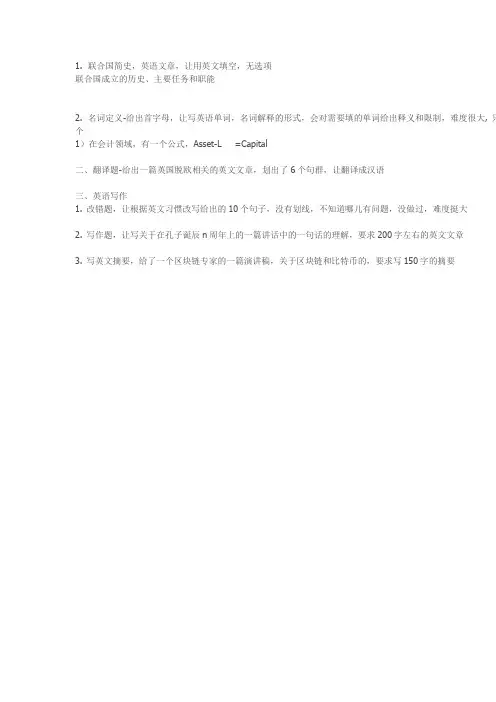
1. 联合国简史,英语文章,让用英文填空,无选项
联合国成立的历史、主要任务和职能
2. 名词定义-给出首字母,让写英语单词,名词解释的形式,会对需要填的单词给出释义和限制,难度很大, 只个
1)在会计领域,有一个公式,Asset-L =Capital
二、翻译题-给出一篇英国脱欧相关的英文文章,划出了6个句群,让翻译成汉语
三、英语写作
1. 改错题,让根据英文习惯改写给出的10个句子,没有划线,不知道哪儿有问题,没做过,难度挺大
2. 写作题,让写关于在孔子诞辰n周年上的一篇讲话中的一句话的理解,要求200字左右的英文文章
3. 写英文摘要,给了一个区块链专家的一篇演讲稿,关于区块链和比特币的,要求写150字的摘要。
北京外国语大学(已有10试题)
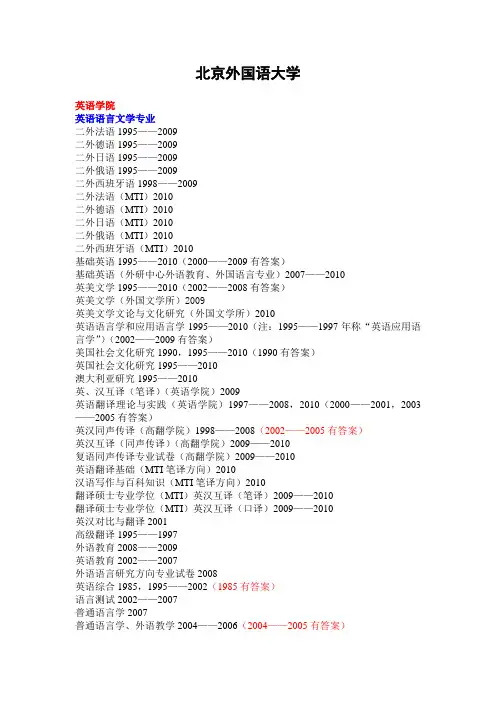
北京外国语大学英语学院英语语言文学专业二外法语1995——2009二外德语1995——2009二外日语1995——2009二外俄语1995——2009二外西班牙语1998——2009二外法语(MTI)2010二外德语(MTI)2010二外日语(MTI)2010二外俄语(MTI)2010二外西班牙语(MTI)2010基础英语1995——2010(2000——2009有答案)基础英语(外研中心外语教育、外国语言专业)2007——2010英美文学1995——2010(2002——2008有答案)英美文学(外国文学所)2009英美文学文论与文化研究(外国文学所)2010英语语言学和应用语言学1995——2010(注:1995——1997年称“英语应用语言学”)(2002——2009有答案)美国社会文化研究1990,1995——2010(1990有答案)英国社会文化研究1995——2010澳大利亚研究1995——2010英、汉互译(笔译)(英语学院)2009英语翻译理论与实践(英语学院)1997——2008,2010(2000——2001,2003——2005有答案)英汉同声传译(高翻学院)1998——2008(2002——2005有答案)英汉互译(同声传译)(高翻学院)2009——2010复语同声传译专业试卷(高翻学院)2009——2010英语翻译基础(MTI笔译方向)2010汉语写作与百科知识(MTI笔译方向)2010翻译硕士专业学位(MTI)英汉互译(笔译)2009——2010翻译硕士专业学位(MTI)英汉互译(口译)2009——2010英汉对比与翻译2001高级翻译1995——1997外语教育2008——2009英语教育2002——2007外语语言研究方向专业试卷2008英语综合1985,1995——2002(1985有答案)语言测试2002——2007普通语言学2007普通语言学、外语教学2004——2006(2004——2005有答案)普通语言学及应用语言学(外研中心)2010句法、第二语言习得2003综合考试(含国际政治、汉语)2000——2002英语新闻业务与新闻学基础知识2006——2009国际新闻2010国际法学专业(无此试卷)外交学专业综合考试(含国际政治、汉语)2000——2002中国外语教育研究中心外国语语言学及应用语言学专业二外法语1995——2009二外德语1995——2009二外日语1995——2009二外俄语1995——2009二外西班牙语1998——2009二外法语(MTI)2010二外德语(MTI)2010二外日语(MTI)2010二外俄语(MTI)2010二外西班牙语(MTI)2010基础英语1995——2010(2000——2009有答案)基础英语(外研中心外语教育、外国语言专业)2007——2010英美文学1995——2010(2002——2008有答案)英美文学(外国文学所)2009英美文学文论与文化研究(外国文学所)2010英语语言学和应用语言学1995——2010(注:1995——1997年称“英语应用语言学”)(2002——2009有答案)美国社会文化研究1990,1995——2010(1990有答案)英国社会文化研究1995——2010澳大利亚研究1995——2010英、汉互译(笔译)(英语学院)2009英语翻译理论与实践(英语学院)1997——2008,2010(2000——2001,2003——2005有答案)英汉同声传译(高翻学院)1998——2008(2002——2005有答案)英汉互译(同声传译)(高翻学院)2009——2010复语同声传译专业试卷(高翻学院)2009——2010英语翻译基础(MTI笔译方向)2010汉语写作与百科知识(MTI笔译方向)2010翻译硕士专业学位(MTI)英汉互译(笔译)2009——2010翻译硕士专业学位(MTI)英汉互译(口译)2009——2010英汉对比与翻译2001高级翻译1995——1997外语教育2008——2009英语教育2002——2007外语语言研究方向专业试卷2008英语综合1985,1995——2002(1985有答案)文化语言学2007语言测试2002——2007普通语言学2007普通语言学、外语教学2004——2006(2004——2005有答案)普通语言学及应用语言学(外研中心)2010句法、第二语言习得2003综合考试(含国际政治、汉语)2000——2002外国文学所英语语言文学专业二外法语1995——2009二外德语1995——2009二外日语1995——2009二外俄语1995——2009二外西班牙语1998——2009二外法语(MTI)2010二外德语(MTI)2010二外日语(MTI)2010二外俄语(MTI)2010二外西班牙语(MTI)2010基础英语1995——2010(2000——2009有答案)基础英语(外研中心外语教育、外国语言专业)2007——2010英美文学1995——2010(2002——2008有答案)英美文学(外国文学所)2009英美文学文论与文化研究(外国文学所)2010英语语言学和应用语言学1995——2010(注:1995——1997年称“英语应用语言学”)(2002——2009有答案)美国社会文化研究1990,1995——2010(1990有答案)英国社会文化研究1995——2010澳大利亚研究1995——2010英、汉互译(笔译)(英语学院)2009英语翻译理论与实践(英语学院)1997——2008,2010(2000——2001,2003——2005有答案)英汉同声传译(高翻学院)1998——2008(2002——2005有答案)英汉互译(同声传译)(高翻学院)2009——2010复语同声传译专业试卷(高翻学院)2009——2010英语翻译基础(MTI笔译方向)2010汉语写作与百科知识(MTI笔译方向)2010翻译硕士专业学位(MTI)英汉互译(笔译)2009——2010翻译硕士专业学位(MTI)英汉互译(口译)2009——2010英汉对比与翻译2001高级翻译1995——1997外语教育2008——2009英语教育2002——2007外语语言研究方向专业试卷2008英语综合1985,1995——2002(1985有答案)语言测试2002——2007普通语言学2007普通语言学、外语教学2004——2006(2004——2005有答案)普通语言学及应用语言学(外研中心)2010句法、第二语言习得2003综合考试(含国际政治、汉语)2000——2002德语语言文学专业二外英语1997——2003(2000——2003有答案)德国外交经济2000——2005德国文学2001——2005德语翻译理论与实践2000——2005基础德语2000——2005德语教学法2004——2005德语跨文化经济交际2000——2005德语语言学2000——2005国际问题研究所外交学专业综合考试(含国际政治、汉语)2000——2002社会科学部外交学专业综合考试(含国际政治、汉语)2000——2002国际商学院外交学专业综合考试(含国际政治、汉语)2000——2002俄语学院俄语语言文学专业二外英语1997——2003(2000——2003有答案)俄罗斯社会与文化2002——2003,2005俄罗斯文学2002——2005俄语翻译2004俄语翻译技巧2002翻译理论(俄语专业)2003俄语翻译理论与实践2005俄语基础2004——2005俄语语言学基础理论2002——2004现代俄语语言学2005俄语综合2002法语系法语语言文学专业二外英语1997——2003(2000——2003有答案)欧洲语言学专业二外英语1997——2003(2000——2003有答案)德语系德语语言文学专业二外英语1997——2003(2000——2003有答案)德国外交经济2000——2005德国文学2001——2005德语翻译理论与实践2000——2005基础德语2000——2005德语教学法2004——2005德语跨文化经济交际2000——2005德语语言学2000——2005日语系日语语言文学专业二外英语1997——2003(2000——2003有答案)日本社会文化2004(日语系)日本语言文学2004(日语系)以下试卷为日研中心试卷,仅供参考:专业日语2009(2009有答案)基础日语1997——2006,2008——2009(2000——2006,2008——2009有答案)日本概况2003——2005(2003——2005有答案)日本社会1997——2004(2000——2004有答案)日本社会经济2008(2008有答案)日本社会日本经济2005——2006(2005——2006有答案)日本文化1997——2004,2008(2000——2004,2008有答案)日本文学1997——2004,2008(2000——2004,2008有答案)日本文学日本文化2005——2006(2005——2006有答案)日本语言1997——2004(2000——2004有答案)日本语教育2008(2008答案)日本语言日本教育2005——2006(2005——2006有答案)日本语学2008(2008有答案)综合考试(日语专业)1997——2002(2000——2002有答案)日研中心日语语言文学专业二外英语1997——2003(2000——2003有答案)专业日语2009(2009有答案)基础日语1997——2006,2008——2009(2000——2006,2008——2009有答案)日本概况2003——2005(2003——2005有答案)日本社会1997——2004(2000——2004有答案)日本社会经济2008(2008有答案)日本社会日本经济2005——2006(2005——2006有答案)日本文化1997——2004,2008(2000——2004,2008有答案)日本文学1997——2004,2008(2000——2004,2008有答案)日本文学日本文化2005——2006(2005——2006有答案)日本语言1997——2004(2000——2004有答案)日本语教育2008(2008答案)日本语言日本教育2005——2006(2005——2006有答案)日本语学2008(2008有答案)综合考试(日语专业)1997——2002(2000——2002有答案)西葡系西班牙语语言文学专业二外英语1997——2003(2000——2003有答案)西班牙语基础2003——2004(其中2004年的试卷共12页,缺P11-12)西班牙语专业2003——2004欧洲语言学专业二外英语1997——2003(2000——2003有答案)阿语系阿拉伯语语言文学专业二外英语1997——2003(2000——2003有答案)欧洲语系欧洲语言文学专业二外英语1997——2003(2000——2003有答案)亚非语系亚非语言文学专业(无此试卷)国际交流学院语言学及应用语言学专业比较文学概论2004海外汉学2003——2004现代汉语1999古代汉语1999综合考试(含国际政治、汉语)2000——2002综合考试(含古代汉语、古代文学、现当代文学)2001中国历史文化2001历史文化综合1999——2000语言学与应用语言学专业综合2000语言学及现代汉语2000——2001比较文学与世界文学专业比较文学概论2004海外汉学2003——2004中国古代文学专业综合考试(含古代汉语、古代文学、现当代文学)2001高翻学院外国语语言学及应用语言学专业二外法语1995——2009二外德语1995——2009二外日语1995——2009二外俄语1995——2009二外西班牙语1998——2009二外法语(MTI)2010二外德语(MTI)2010二外日语(MTI)2010二外俄语(MTI)2010二外西班牙语(MTI)2010基础英语1995——2010(2000——2009有答案)基础英语(外研中心外语教育、外国语言专业)2007——2010英汉互译(同声传译)(高翻学院)2009——2010英汉同声传译(高翻学院)1998——2008(2002——2005有答案)英、汉互译(笔译)(英语学院)2009英语翻译理论与实践(英语学院)1997——2008,2010(2000——2001,2003——2005有答案)复语同声传译专业试卷(高翻学院)2009——2010英语翻译基础(MTI笔译方向)2010汉语写作与百科知识(MTI笔译方向)2010翻译硕士专业学位(MTI)英汉互译(笔译)2009——2010翻译硕士专业学位(MTI)英汉互译(口译)2009——2010英汉对比与翻译2001高级翻译1995——1997外语教育2008——2009英语教育2002——2007外语语言研究方向专业试卷2008英语综合1985,1995——2002(1985有答案)语言测试2002——2007普通语言学2007普通语言学、外语教学2004——2006(2004——2005有答案)普通语言学及应用语言学(外研中心)2010句法、第二语言习得2003综合考试(含国际政治、汉语)2000——2002英语语言学和应用语言学1995——2010(注:1995——1997年称“英语应用语言学”)(2002——2009有答案)。
2022年北京外国语大学611英语基础测试考研真题和答案
2022年北京外国语大学611英语基础测试考研真题和答案2022年北京外国语大学《611英语基础测试》考研全套内容简介•北京外国语大学《611英语基础测试(技能)》历年考研真题及详解•全国名校基础英语考研真题详解说明:本部分收录了本科目近年考研真题,提供了答案及详解,并对常考知识点进行了归纳整理。
此外提供了相关院校考研真题,以供参考。
2.教材教辅•2022年考研基础英语专用教材•2022年基础英语考研题库说明:以上为基础英语科目配套的辅导资料。
英语基础测试(技能)考查的知识点与基础英语基本一致。
•试看部分内容2000年北京外国语大学611基础英语考研真题及详解I. Reading Comprehension.(32分)1. Re ad th e f o l lo wi n g arti cl e an d p arap h r ase th e u n de rlined parts:Th e twe n ty-f i r st ce n tu r y wi l l m ar k th e e r a o f te r ti a ry an d l i f e l o n g l e a rn i n g f o r e v e r y b o dy-o r al m o s t e ve r yb o dy. Th u s the We st Re p o rt f ro m Au stral i a,e cho in g a ke y t h e m e o f th e i m m e di a te l y p r e c e di n g D e a r i n g Re p o rt i n th e U K①(Nati o n al C o m mi tte e o f In qu i ry into Hi gh er Education [NCIHE], 1997).Th e n o ti o n o f l if e l o n g l e arn i n g h as p e r v ade d h i gh e r e ducation aroun d the world as gove rnmen ts h ave incre a si n gl y co m e to re co gn i ze a l i n k b e twe e n th e i r e du ca ti on sy ste ms an d nation al e con o mic p erf ormance. Ho we v er, poli cy rel ati ng to the actu al makin g of the lin k ne e ds de e pe r consi de ratio n. Th e de ve lo p me n t o f ke y ski l ls’has been seen in the UK as an important way in wh i ch hi ghe r e du cati on can contri b u te to e co no mi c de ve l o pm e n t, b u t i t can b e argu e d th at to fo cu s o n th ese ski l l s re pre se n ts a n arro w an d i n su f f i ci e n t resp o n se to wh a t e m p l o y e r s-an d th e wi de r i n te r e s t-re al l y n e e d (see Stephenso n’s [1998] argument for a ‘capability’appro ach to h igh e r e du cati o n an d, m o re b ro adl y, th e di scu ssio n i n part 2o f B arn e tt [1994].Howe ver th e c o n te s te d n a tu re o f th i s asp e c t o f h i gh e r e du ca ti o n m i gh t be re so l ve d, cu rre n t di scu s si o n s h ave l e f t re l ati ve l y u n ex plo re d the b ro ade r im plicati o n s fo r cu rricu l a②a nd, in particular, for fist-cy cle provi sion.In e a rl i e r ti m e s m an y to o k th e vi e w th a t a f i r st de gre e③ was a suffi ci ent basis for lifetime career. Th e accel erating pace of knowl edge de velopmen t h as u ndermine d th i s co n ce ptio n, an d i n cre asin g atte n ti o n i s n o w b e i n g gi ven to the p ro vi sio n of high e r degre e p rogram s an d o th e r o ppo rtun i tie s fo r p ro fe ssio n al de velo pme n t. Th i s rai se s a se ri o u s qu e sti o n: wh at f u n cti o n do e s th e first degree se rve in the context of lifelong learning? Logically, it makes no sense in today’s world to try t o pa c k f i rs t de gre e cu r ri cu l a wi t h al l th e kn o wl e dge, unde rstan din g and skill s n ee d f or the re st of a life tim e.T h e r e s i m p l y i s n o t t h e t i m e a v a i l a b l e,a n d a n y w a y cu rri cu lum-p acki ng run s th e ri sk o f su pe rf i ci al ity o f le ar n i n g.④ Af i r s t deg re e sh o u l d,i f th e y h av e n o t al re ady acqu i re d i t, de ve l o p i n stu de n ts th e ab i l i ty to le a rn how to le arn, as well as en han ce thei r subj ect-spe c i f i c e x p e rti se an d o th e r re l e van t s ki l l s. Th e o l d sayi n g i s v al i d h e re: gi vi n g i n d i vi du a l s e ach a f i sh m i gh t f e ed them for a day, bu t te achin g them the skill s o f fis hing could feed them for life.There is a need to think of the first de gree in terms of the quality, rather th an the quantity, of stu dents’learning, In today’s world the first degree becomes m ore of a foundation qualifi catio n, upon which gradu ate s will expect to build during their lives. Some might r eact b y sayin g that to make su ch a sh ift im pli es a dil u ti o n o f ac ade m i c s tan da rd s—bu t th e co u n te r i s th a t stan dards re l ate p rim aril y to th e qu ali ty, an d n ot the quan tity, of stu dents’le arnin g.⑤The re cons trued first de gre e n e e d be n o in te ll e ctu al p o o r rel ati o n: acade m i c ri go u r c an be b u i l t i n to cu r ri cu l a o f wi de l y di f f e ri n g f o cu s. Th e s t an d ar d s m ay we l l b e di f f e re n t, bu t th e y do have to be inferior.S o me re du ctio n i n th e vol u me o f di sci p li n e-speci f i c co nten t will re qui re an adjustmen t of thought⑥—i n particu l ar, o n th e p ar t o f e m pl o y e r s an d p ro f e s si o n al b o di e s. The pro fe ssi on al accre di tati on of som e f irst de gree program s is se en by some as an essen tial con dition. Ho we ve r, t h e re se e m s n o n e ce s s ar y re a so n f o r th i s to be the case-an d it might well be to the profe ssion s’longer-te rm advan tage if fi rst degree cu rri cul a were t o pay p arti cul ar atte n ti on to de ve l opin g in gradu ate s th e abili ty to le arn to le arn,⑦ l eavin g su bse que nt p rof essional and de velopmental acti v itie s to provide the ‘t opping-up’that would cohere with the profe ssional b odies’expectations.A strategi c visio n for highe r educatio n in the next mil lennium requires more th an a m utte ring o f the man tra o f l if el on g le arn i ng. M aki ng l ife l on g le arni n g ‘wo rk de m an ds a su st ai n e d co m mi tm en t to f i tti n g to ge th e r t he pieces of th e multidimen sio nal jigsaw who se compo n e n ts i n cl u de edu cati o n al pu rp o se s, v al u e s an d p racti c alitie s. Academi cs are among th e people who ought to relish this jigsaw’s challenge.Whippi er-sn app e r: an in sign ificant, e sp. yo ung, person who appears impertinent.【答案】①re pe ati n g th e m ai n su bj e ct of re ce n t De ari ng Re po rt in the UK②Di s cu s si o n o f th e p re se n t ti m e pay s n o a tte n ti o n to th e e x ami n ati on o f th e de e p e r i m pli e d me an i ng an d f u n cti o n o f co u rse s, n o m at te r h o w p e o p l e h a ve de al t with the probl em that higher education serve s as skil l training.③bachelor’s degree④To o m an y co urse s m ay le ad to th e re sul t th at stu de n ts o n l y ge t th e su rf ace m e an in g o f stu di e s in ste ad of exploring deep.⑤th e argu men t is th at stan dards sho ul d rathe r base o n the excellency of students’l earning than on the qu antity of course s they have attended to⑥Pe o ple ne e d to adju st the i r th ou gh t to de crease th e amount and content of courses.⑦i f co u r se s w e r e de s i gn e d t o t e a ch t h e g r a du a te s h o w to l e arn du rin g th e bach el o r’s de gre e stu dy, i t wo u l d be h el p fu l to th e pro f e ssion s f ro m th e lo ng-te rm perspe cti veII. Re ad th e fo l lowin g passage an d an swe r the foll owi ng questions:(28分)W h e n th at Gran d o l d M an of Vi cto ri an, W i l l i am Evart Gl a d sto n e, w as i n h i s 85t h y e a r,h e was ste e ri n g th e s econd home-rul e bill foe Irel an d throu gh a re calci tran t parl iamen t an d going home to tran sl ate th e odes of Ho race at ni gh t, When Ron al d Re agan re ache d the ten de r age of 73, he was f igh tin g his se cond p re si den ti al election campaign. Alan Green span, the world’s most su cce ssf ul cen tral ban ke r, i s al so 73. Poli tics an d e co n o m i c s a re pl ai n l y j o bs th at th e o l d can do w e l l. Th e y are not alone. The boardroom s of the world’s big c o m p an i e s a re f u l l o f n o n-e x e cu ti ve s age s, te l l i n g wh i p persn apper 40-somethings how to run their firms.①Why, then, are so few of the rich world’s older folk i n e mplo y m en t? Th e y l i ve lo n ge r an d e n jo y b ette r h e a l th th an th ei r pare n ts di d. Mo st j o b s h ave be co me le s s phy sically de manding; mo st people in late middle ag e a re w e l l se n si bl y, i s n o h a r d e r th an t r ai n i n g th e yo u n g. B u t th e f i gu re s sh o w an1960, m e n co u l d e x p e ct to spend 50 of their 68 years of life in paid work. T oday, the y are l i kel y to wo rk fo r o nl y 38 of th ei r 76 years. Fewer tha n two-thi rds of men in their late 50a and early 60s ate in the rich world’s labour f orce, bythe time the y celebrate thei r 55t h bi rth day, m ore th an h al f of Eu ro pe’s m e n h ave g o n e h om e to tran sl ate Horace.②For most, that is something to celebrate. Ne ver be fore have so m an y people been abl e to loo k forward to s o m an y y e a r s o f h e al th y l e i su r e. T wo-th i r ds o f p e o p l e say th at the y l ike b eing re tire d an d have no desire t o go back to work. There are grandchildren to enjoy, forei gn coun trie s to vi si t, boo ks to re ad and golf gam e s to pl a y.Th e p l e a su re s o f o l d age l e s s e x p e n si ve, a nd more widely available, th an ever before.③Silver-hai red liningThe bi g que sti o n is whe the r all of this reti rem ent i s v oluntary. It is worth askin g for its own sake; in a libe ral socie ty, the old, too, should be free to cho ose. Bu t, in addi tion, the stampe de to re tire has con sequen ce s n o t m e re l y f o r th e o l d th e m s e l v e s. An d i t i s o f te n being encourage d by perverse public policy.W i de spre ad an d e arl y re ti rem ent wi ll in cre asi n gl y aff e c t the lives of everyone else, for two reasons. The first i s a f am i l i ar on e: as th e sh are o f o l d f o l k in th e p o pu l ati o n ri se s, so wi ll th e bu rde n on th e yo ung o f p ayin g fo r thei r pension s and he alth care. Th e se con d is less discu ssed: the ri se of the grey-he aded l e isu red c lass h as con sequence s for e con omic growth, be cau se o f its impact on the supply of labour and of capital. Many go ve rnme nts, thei r eye s focuse d on the impact t h at f u tu re pen sio n s cl ai m s wi l l h ave o n p u bl i c f i n an ce s, h ave e m ba rke d o n re f o rm s bu t n o t al ways r e f o rm s th at fi ve pe nsio ners a free r ch oice.For the ir e ye s are al so trai n e d i n th e sh o rte r te r m, o n hi gh un em p l o ym e nt.④Go vernmen ts, e speci al ly in weste rn Euro pe, are p r essin g mo re pe ople to re ti re e arly, on the mi staken vi ew that thi s wil l provi de jobs f or the young, even as they try to trim pensioners’entitlements in order to re du ce th e bu rde n on pu b li c fin an ce s. Th i s i s u nf o rgi v ab l e f ro m a l i be ral p o i n t o f vi e w. I t i s al so f o o l i sh f r om the perspective of public policy.The she er si ze of the baby-boo m gene ration th at start s to te ach re ti re me n t age o ve r th e co min g decade m e ans th at there will be a simple, but huge imbalan ce: t oo few people in work, paying taxe s and pen si on cont ri bu ti o n s; to o m an y i n re ti re m e n t, drawi n g o n p e n si o n s an d ru n n i n g u p h e al th co sts.In th at case, t h e m ai na l t e r n a t i v e s w i l lb e t o r e n e ge o n t h e p e n s i o n s t h a t wo rke rs tho u gh t th e y h ad bee n pro mi se d, o r to rai se t a x e s.I t w o u l d b e f a r b e t t e r f o r t h e h e a l t h o f ec o n o mie s if m u ch ol de r peo pl e wen t on workin g i n ste ad.Q u i te sm al l r i se s i n th e age s at wh i ch p e o p l e re ti re h a ve l arge effe cts.⑤As long as older fol k stay in the jo b marke t, the y pay taxes (helpi ng one side of the fisc al bal an ce) and drawe i th e r n o p e n si o n, o r a sm al l e r one(helping the other).第1章全国院校英语专业基础英语考研真题分析对于绝大多数报考英语专业的考生而言,“基础英语”是全国各院校英语专业研究生入学考试必考的科目。
2015年北京外国语大学外国语言文学考研真题,参考答案,考研参考书,复习方法,考研资料
1/9【育明教育】中国考研考博专业课辅导第一品牌官方网站: 12015年北京外国语大学考研指导育明教育,创始于2006年,由北京大学、中国人民大学、中央财经大学、北京外国语大学的教授投资创办,并有北京大学、武汉大学、中国人民大学、北京师范大学复旦大学、中央财经大学、等知名高校的博士和硕士加盟,是一个最具权威的全国范围内的考研考博辅导机构。
更多详情可联系育明教育孙老师。
0502外国语言文学050201英语语言文学(01)英语语言学与应用语言学001英语学院79①101政治②二外(242俄语、243法语、244德语、245日语、246西班牙语,选一)③611英语基础测试(技能)④811英语能力测试(写作)含自费32名(02)英美文学(03)美国研究(04)英国研究(05)澳大利亚研究(06)爱尔兰研究(07)英美文论与文化研究2/9【育明教育】中国考研考博专业课辅导第一品牌官方网站: 2018外国文学所5含自费2名考生在考研复习的过程中总是难免会遇到一些自己不清楚的问题,有些同学可能会感到比较苦恼,甚至影响自己的复习效率。
为了帮助考生更加顺利的复习,特别为大家归纳总结出了几门专业课的重难点知识复习,以便大家来参考复习,排除心中的苦恼,继续认真高效的复习。
下面,先为考生们归纳一下中国近现代史的重难点知识供考生们参考:第一部分列强的对外侵略(1)两次鸦片战争的原因、过程、后果要好好把握。
有可能在这部分内容出非常细节的选择题和名词解释。
(2)资本主义世界性扩张的必然性。
《南京条约》、《北京条约》、《马关条约》等不平等条约的内容及特点,以及对中国社会造成的影响。
(3)中法战争和中日甲午战争及八国联军侵华战争中的重要战役要记住。
(4)战争后签订的重要不平等条约,可能会以简答题的形式出题。
(5)中国边疆危机产生的原因及主要内容。
(6)《中法新约》、《马关条约》和《辛丑条约》对中国社会造成的影响。
3/9【育明教育】中国考研考博专业课辅导第一品牌官方网站:3(7)鸦片战争爆发后,中国社会矛盾错综复杂,在诸多矛盾中,民族矛盾上升为主要矛盾。
【北京外国语大学-英美文学-考研真题及答案】考过的名词解释整合
1. ballad2. Calvinism3. dramatic irony4. epic5. metaphysical conceit6. Oedipus complex7. round character8. transcendentalism1. balladBallad is a narrative poem, usually simple and fairly short, originally designed to be sung. Ballads often begin abruptly, imply the previous action, utilize simple language, tell the story tersely through dialogue and described action, and make use of refrains. The folk ballad, which reached its height in Britain in the sixteenth and seventeenth centuries, was composed anonymously and handed down orally, often in several different versions. The literary ballad, consciously created by a poet in imitation of the folk ballad, makes use (sometimes with considerable freedom) of many of its devices and conventions. Coleridge’s “Rime of the Ancient Mariner”, Keats’s “La Belle Dame sans Merci”, and Wilde’s “Ballad of Reading Gaol” are all literary ballads.2. CalvinismCalvinism is the doctrine of John Calvin, the great French theologian who lived in Geneva. It’s doctrine of predestination, original sin and total depravity, and limited atonement (or the salvation of a selected few) through a special infusion of grace from god.3. dramatic ironyDramatic (or tragic irony) depends on the structure of the play more than on the actual words of the characters. An extraordinary example of sustained dramatic irony is Sophocles’Oedipus Rex, in which Oedipus seeks throughout the play for the murderer of Laius, the former king of Thebes, only to find that he himself is the guilty one. The term dramatic irony is also used to describe the situation which arises when a character in a play speaks lines which are understood in a double sense by the audience though not by the characters onstage. When Brabantio warns Othello against being betrayed by Desdemona, the Moor replies, “My life upon her faith.” For an audience who knows the story, Othello’s remark presages the tragedy to come.4. epicEpic is a long narrative poem in which action, characters, and language are on a heroic level and style is exalted and majestic. Basically, there are two kinds of epic: (a) primary-also known as oral or primitive, (b) secondary-also known as literary. The first belongs to the oral tradition and is thus composed orally and recited; only much later, in some cases, is it written down. The second is written down at the start. Major characteristics of an epic are 1) a vast setting remote in time and place, 2) a noble and dignified objective, 3) a simple plot, 4) a central incident (or series of incidents) dealing with legendary material, 5) a theme involving universal human problems, 6) a towering hero of great stature, 7) superhuman strength of body, character, or mind, 8) supernatural forces such as gods, angels, and demons, intervening from time to time. Among noted epics are Homer’s the Iliad and the Odyssey, the Old English Beowulf, Milton’s Paradise Lost, and Longfellow’s Hiawatha. Sometimes Whitman’s long poem Leaves of Grass isalso called an epic.5. metaphysical conceitConceit means concept, idea and conception. As a literary term this word has come to denote a fairly elaborate figurative device of a fanciful kind which often incorporates metaphor, simile, hyperbole or oxymoron and which is intended to surprise and delight by its wits and ingenuity. The pleasure we get from many conceits is intellectual rather than sensuous. The Metaphysical conceit, characteristic of Donne and other Metaphysical poets of the seventeenth century, is a comparison, often elaborate, extended, or startling, between objects which are apparently dissimilar, e.g. John Donne’s comparison of two souls with two bullets in “The Dissolution” and that of two lovers with compasses.6. Oedipus complexIt is a Freudian term, drawn from the myth of Oedipus who without knowing the truth married his mother. The term designates attraction on the part of the child toward the parent of the opposite sex and rivalry and hostility toward the parent of its own. It occurs during the phallic stage of the psychosexual development of the personality, approximately years three to five. Resolution of the Oedipus complex is believed to occur by identification with the parent of the same sex and by the renunciation of sexual interest in the parent of the opposite sex. Freud considered this complex the cornerstone of the superego and the nucleus of all human relationships.7. round characterThis is a term first used by E. M. Forster to designate a character drawn with sufficient complexity to be able to be recognizable, understandable, and different from all others appearing in the same selection. A round character must, according to Forster, be capable of surprising a reader “in a convincing way.” Complexity of characterization, moreover, must be accompanied by an organization of traits or qualities. The round character is opposite to flat character whose personal traits can be summed up in one or two points. In Shakespeare’s Henry IV the Prince changes and develops, and he is a round character.8. transcendentalismTranscendentalism is a New England movement which flourished from about 1835 to 1860. It had its roots in romanticism and in post-Kantian idealism by which Coleridge was influenced. It had a considerable influence on American art and literature. Basically religious, it emphasized the role and importance of the individual conscience, and the value of intuition in matters of moral guidance and inspiration. The actual term was coined by opponents of the movement, but accepted by its members (e.g. Ralph Waldo Emerson, 1803-82, one of the leaders, published The Transcendentalist in 1841). The group of people was also social reformers. Some of the members, besides Emerson, were famous, including Bronson Alcott, Henry David Thoreau and Nathaniel Hawthorne.1. classicism2. expressionism3. hermeneutics4. Jacobean Age5. low comedy6. mood7. myth8. parody9. point of view10.soliloquy1. Classicism:Classicism as commonly opposed to Romanticism, and in particular as the ideal of 17th century France, implies a social ideal: man is viewed as a social being consciously and willingly subject to certain disciplines. This term, when applied generally, means clearness, elegance, symmetry, and repose produced by attention to traditional forms. It is sometimes synonymous with excellence or artistic quality of high distinction. When we speak of classicism we refer to the styles, rules, modes, conventions, themes and sensibilities of the Classical authors, and, by extension, their influence on and presence in the work of later authors. More precisely, the term refers to the admiration and imitation of Greek and Roman literature, art, and architecture. Because the principles of classicism were derived from the rules and practices of the ancients, the term came to mean the adherence to specific academic canons. Classicism tends naturally to be expressed in such classical forms as the Alexandrine, the heroic couplet and the ode, and places importance on such values as order, clarity, harmony, grace and humanity. The major English authors to follow Classical rules and modes were Ben Jonson, Dryden, Pope, Swift, Addison and Dr Johnson.2. Expressionism:The term refers to a movement in Germany very early in the 20th century (c. 1905) in which a number of painters sought to avoid the representation of external reality and, instead, to project themselves and a highly personal vision of the world. In fine arts it involves such techniques as exaggerating or distorting forms and applying intensified colors to express emotion. In literature expressionism involves the presentation of life and world through intensified impressions and moods of characters. Often emphasized emotions, subjective reactions of characters and symbolic or abstract representations of reality are apparent in such literature. Works noted for expressionistic tendencies and techniques are: Strindberg’s Dream Play, Eugene O’Neill’s The Emperor Jones, James Joyce’s Ulysses and Finnegans Wake, and T. S. Eliot’s The Waste Land.3. Hermeneutics:In its most general sense, it refers to any theory of interpretation. Originally, the term was limited to Biblical exegesis, but since the nineteenth century it has been extended to any theory or procedure in interpreting literary, legal, or social science texts. The “hermeneutic circle,” first described in the early nineteenth century by the German theologian Friedrich Schleiermacher, was so named later in the century by the philosopher Wilhelm Dilthey to describe an approach to understanding: the meaning of constituent parts of a whole can be understood only if the whole has prior meaning, but only when those constituent parts are understood can the full meaning of the whole be grasped. Thus, the interrelationships of words, sentences, paragraphs to whole literary works involve a progressive clarification of mutually conferred meanings. In The Validity of Interpretation (1967) and The Aims of Interpretation (1976), the American critic E. D. Hirsch has argued that, in employing the hermeneutic circle, a reader may determine the meaning of awork by progressively testing a hypothesis of interpretation while examining the relationship of the whole to its parts: the result is likely to be a close approximation of the author’s intent.4. Jacobean Age:Referring to the reign of King James I of England (1603-1625), the term came from the Latin form of James, Jacobus. It is generally applied to the literature (especially drama), furniture, art and architecture of that period. The literature of this era was really a late flowering of Elizabethan writing, although toward the end of James’reign, cynicism and realism began to flourish. The King himself published at least four books: two on poetry, a work on demonology, and the famous A Counterblaste to Tobacco. During this epoch, many of Shakespeare’s greatest plays were written; John Donne, Ben Jonson, and Francis Bacon were at the peak of their creative powers; the King James Bible appeared in 1611.5. Low comedy:Low comedy is a coarse type of comedy sometimes used as comic relief. The mirth it provokes is likely to come from the belly rather than the brain. It commonly contains buffoonery, slapstick, violent action and ribald jokes. It is thus a crudely fundamental form which trades upon people’s relish at seeing others humiliated and ridiculed and involved in scabrous episodes. The punch-up, the custard-pie contest are common examples of low comedy situations. It is frequent in Aristophanic comedy, farce, medieval English drama, Tudor and Jacobean drama and also Restoration comedy. In Shakespeare’s The Merry Wives of Windsor, for instance, Falstaff, getting into a basket to hide from a suspicious husband, has “foul linen” piled atop him. The basket is then carried offstage to be dumped into the Thames.6. Mood:Mood is the emotive attitude conveyed by a literary work, such as gaiety, gloom, resignation and irony. It is a synonym to tone, while some distinguish mood –the author’s attitude toward the subject—from tone, the writer’s attitude toward the audience. In works of dramatic irony, the speaker’s mood is probably serious, earnest or self-important, in contrast with the author’s view of the speaker, amused, condescending, contemptuous, wry, or whatever.7. Myth:A myth is a traditional sacred story, usually featuring gods and heroes, which purports to explain a natural phenomenon or cultural practice. It is a religious story, and will therefore involve the existence and activities of a supernatural being, such as a god, a demigod, a goddess, or several such entities. It will seek to explain at least some aspect of the origin or manner of things (e.g. where people came from) if not of the very universe itself. It connects up in some significant way with other similar stories within a culture. Its authorship is communally shared and it came into existence through oral tradition, and therefore usually has more than one version. It is believed to be essentially true by those in the society for whom it is one part of a cultural mythology. With an increase in scientific knowledge, however, myths are often supplanted and they survive simply as stories.8. Parody:Parody is the imitative use of the words, style, attitude, tone and ideas of an author in such a way as to make them ridiculous. This is usually achieved by exaggerating certain traits, using more or less the same technique as the cartoon caricaturist. In fact, it is a kind of satirical mimicry. As a branch of satire its purpose may be corrective as well as derisive. Parodies have existed since literature began. Aristophanes brilliantly parodied the plays of Euripides; Cervantes’s Don Quixote(1605–15) paro dies chivalric romances; Henry Fielding’s novel Joseph Andrews(1742) parodies Samuel Richardson’s moral novel Pamela(1740); and Max Beerbohm’s A Christmas Garland (1912) wickedly parodies such authors as Kipling, Conrad, and Henry James. Noted 20th-century parodists include Ogden Nash, S. J. Perelman, Robert Benchley, James Thurber, E. B. White, and Woody Allen.9. Point of view:The term is used in the analysis and criticism of fiction to describe the way in which the writer presents the reader with the materials of the story. Simply speaking, point of view is who tells the story and how it is told. It falls into two categories, first person point of view and third person point of view. The latter is further divided into three groups, omniscient point of view, limited omniscient point of view and objective point of view.10. Soliloquy:It is the speech delivered by a character in a literary composition, usually a play, while the speaker is either alone addressing the audience directly or the other actors are silent. It is most commonly used to reveal the innermost concerns or thoughts of the speaker, thus pointing up the drama of internal conflict. The soliloquy may also act simply as a vehicle for information about absent characters or events occurring at some other time or place. The form is quite popular in Elizabethan drama, notably in the plays of Shakespeare, such as Hamlet’s “to be or not to be”. In the modern theater the soliloquy has tended to disappear completely, although experimentations in its use were attempted by such playwrights as Eugene O’Neill, who sought through the soliloquy to achieve a greater psychological realism.。
北外英语专业考研真题(2)
北外英语专业考研真题(2)CGap Filling (14 points).Please choose the best sentence from the list after the passage to fill in each of the gaps in the text. There are more sentences than gaps.Truths to live byThe art of living is to know when to hold fast and when to let go. (18)____________________. The rabbis of old put it this way: "A man comes into this world with his fist clenched, but when he dies, his hand is open."(19)_______________. We know that this is so, but all too often we recognize this truth only in our backward glance when we remember with far greater pain that we did not see that beauty when it flowered, that we failed to respond with love to love when it was tendered.(20)_______________. I was hospitalized following a severe heart attack and had been in intensive care for several days. It was not a pleasant place.One morning, I had to have some additional tests. The required machines were located in a building at the opposite end of the hospital, so I had to be wheeled across the courtyard.As we emerged from our unit, the sunlight hit me. That's all there was to my experience. Just the light of the sun. (21) ______________.I looked to see whether anyone else relished the sun's golden glow, but everyone was hurrying to and fro, most with their eyes fixed on the ground. Then I remembered how often I, too, had been indifferent to the grandeur of each day, too preoccupied with petty and sometimes even mean concerns to respond to thesplendor of it all.The insight gleaned from that experience is really as commonplace as was the experience itself: life's gifts are precious but we are too heedless of them.Here then is the first pole of life's paradoxical demands on us: Never be too busy for the wonder and the awe of life. (22) ____________. Embrace each hour. Seize each golden minute.(23) _____________. This is the second side of life's coin, the opposite pole of its paradox: we must accept our losses, and learn how to let go.This is not an easy lesson to learn, especially when we are young and think that the world is ours to command, that whatever we desire with the full force of our passionate being can, may, will, be ours. (24)____________.[A]Surely we ought to hold fast to life, for it is wondrous, and full of a beauty that breaks through every pore of God's own earth.[B]But then life moves along to confront us with realities, and slowly but surely this second truth dawns upon us.[C]For life is a paradox: it enjoins us to cling to its many gifts even while it ordains their eventual relinquishment.[D]When life is treated with the proper attitude, regret will surely not be left behind.[E]A recent experience re-taught me this truth.[F]Hold fast to life ... but not so fast that you cannot let go.[G] Be reverent before each dawning day.[H]And yet how beautiful it was --- how warming, how sparkling, how brilliant!II.Please read the following passage and translate the underlined parts into Chinese (40 points, 8 points each).Developing self-confidence(25)Confidence is a feeling —an inner fire and an outer radiance, a basic satisfaction with what one is plus a reaching out to become more. Confidence is not something a few people are born with and others are not, for it is an acquired characteristic.Confidence is the personal possession of no one; the person who has it learns it—and goes on learning. The most gifted individual on earth has to construct confidence in his gifts from the basis of faith and experience, like anybody else. The tools will differ from one person to the next, but the essential task is the same. Confidence and pose are available to us all according to our abilities and needs—not somebody else's—provided we utilize our gifts and expand them.。