
PEP小学英语五年级下册第五、六单元知识点汇总
【人教版】小学PEP英语五年级下册第五单元知识点归纳
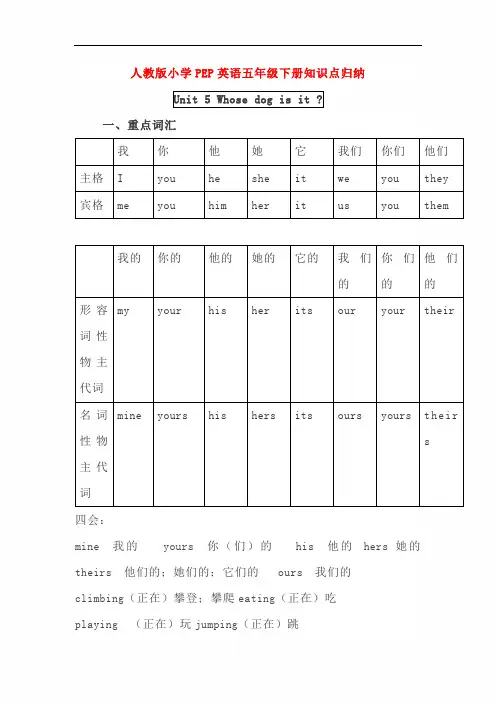
人教版小学PEP英语五年级下册知识点归纳Unit 5 Whose dog is it ?一、重点词汇我你他她它我们你们他们主格I you he she it we you they 宾格me you him her it us you them我的你的他的她的它的我们的你们的他们的形容词性物主代词my your his her its our your their名词性物主代词mine yours his hers its ours yours theirs四会:mine 我的yours 你(们)的his 他的hers她的theirs 他们的;她们的;它们的 ours 我们的climbing(正在)攀登;攀爬eating(正在)吃playing (正在)玩jumping(正在)跳drinking(正在)喝(水) sleeping (正在)睡觉三会:each 每一;各个other 其他each other 相互excited 兴奋的;激动的like 像……那样二、掌握的短语climb trees 爬树play football 踢足球look at 看 a beautiful painting 一幅美丽的画in the kitchen在厨房play with each other一起玩耍drink water 喝水listen to music 听音乐read books读书三、名词性物主代词和形容词性物主代词表示所有关系的代词叫做物主代词,即表示事物主人的代词。
它包括名词性物主代词和形容词性物主代词。
注意:1、形容词性物主代词相当于一个形容词,不能单独使用,后面需要跟名词,常用来修饰、限定后面的名词。
如:This is my book.(这是我的书。
).That is his bag.(那是他的书包。
)2、名词性物主代词需独立使用,后面不能跟名词,它相当于“形容词性物主代词+名词”。
如:It’s mine. (它是我的。
PEP小学英语五年级下册各单元知识重点总结
PEP小学英语五年级下册各单元知识重点总结Unit 1: My School- Grammar: Singular and plural nouns, possessive 'sUnit 2: My Family- Vocabulary: mother, father, sister, brother, grandparents- Grammar: The verb 'to be' (am, is, are) to describe family membersUnit 3: Out and About- Vocabulary: park, zoo, museum, supermarket, post office- Grammar: Present continuous tense to talk about actions happening nowUnit 4: Let's Eat!- Vocabulary: breakfast, lunch, dinner, fruit, vegetables- Grammar: Imperative sentences to give instructionsUnit 5: At the Farm- Vocabulary: farmer, barn, cow, pig, chicken- Grammar: There is/There are to talk about existenceUnit 6: Our Town- Vocabulary: street, hospital, police station, fire station, city- Grammar: Prepositions of place (in, on, under, behind, next to)Unit 7: Weather Report- Vocabulary: sunny, cloudy, rainy, snowy, windy- Grammar: Adjectives to describe weatherUnit 8: Fun with Friends- Vocabulary: play, sing, dance, swim, draw- Grammar: Simple present tense to talk about daily activitiesUnit 9: In the Ocean- Vocabulary: fish, dolphin, shark, octopus, seahorse- Grammar: Wh- questions using 'What' and 'Where'Unit 10: Happy Holidays- Vocabulary: Christmas, Easter, Halloween, New Year's Day, Thanksgiving- Grammar: Use of can for ability。
小学英语人教版PEP五年级下册1-6单元知识点总结
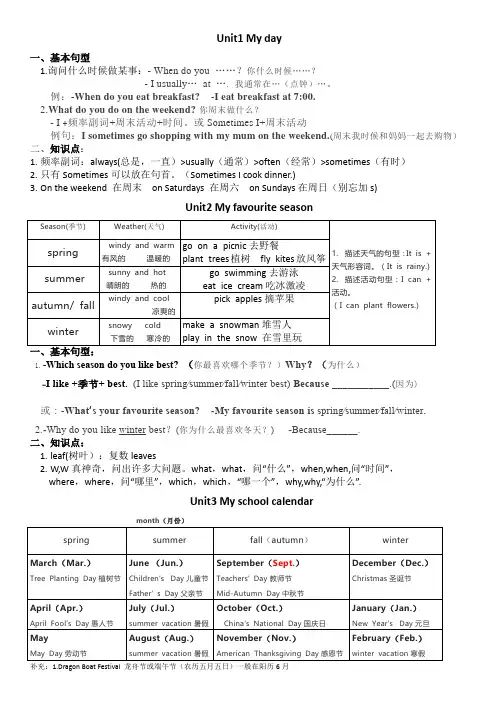
Unit1 My day一、基本句型1.询问什么时候做某事:- When do you ……?你什么时候……?- I usually…at …. 我通常在…(点钟)…。
例:-When do you eat breakfast?-I eat breakfast at 7:00.2.What do you do on the weekend?你周末做什么?- I +频率副词+周末活动+时间。
或Sometimes I+周末活动例句:I sometimes go shopping with my mum on the weekend.(周末我时候和妈妈一起去购物)二、知识点:1.频率副词:always(总是,一直)>usually(通常)>often(经常)>sometimes(有时)2.只有Sometimes可以放在句首。
(Sometimes I cook dinner.)3.On the weekend 在周末on Saturdays 在周六on Sundays在周日(别忘加s)Unit2 My favourite season1.-Which season do you like best? (你最喜欢哪个季节?)Why?(为什么)-I like +季节+ best.(I like spring∕summer∕fall∕winter best) Because ___________.(因为)或:-What‘s your favourite season? -My favourite season is spring∕summer∕fall∕winter.2.-Why do you like winter best?(你为什么最喜欢冬天?) -Because______.二、知识点:1.leaf(树叶):复数leaves2.W,W真神奇,问出许多大问题。
what,what,问“什么”,when,when,问“时间”,where,where,问“哪里”,which,which,“哪一个”,why,why,“为什么”.Unit3 My school calendar补充:1.Dragon Boat Festival 龙舟节或端午节(农历五月五日)一般在阳历6月2.月份首字母大写。
PEP小学五年级下册英语知识点总结 全册

PEP小学五年级下册英语知识点总结全册第一单元知识点一、主要单词:do morning exercises 晨练,做早操 eat breakfast吃早饭 have English class 上英语课 play sports进行体育活动 eat dinner吃晚饭 eat lunch吃午饭 climb mountains 爬山 go shopping购物,买东西 play the piano 弹钢琴 visit grandparents 看望(外)祖父母 go hiking去远足二、主要句子: When do you eat dinner?你什么时候吃晚饭? I eat dinner at 7:00 in the evening. 我晚上七点吃晚饭。
When do you get up? 你什么时候起床?I usually get up at 12:00 at noon.我通常在中午12点起床。
What do you do on the weekend?你在周末干什么? Usually I watch TV and go shopping. 我通常看电视和购物。
Sometimes I visit my grandparents.有时候我去看望我的外祖父母。
I often play football. 我经常踢足球。
Sometimes I go hiking.有时候我去远足。
三、同义词eat breakfast―have breakfast eat lunch―have lunch eat dinner―have dinner play sports―do sports usually―often复数形式:policeman―policemen policewoman―policewomen 现在分词:tell―telling 三单:say―says同义句:What do you do ? ---What are you? 你是干什么的?四、表示频度的副词:always 总是,一直 usually 通常,常常 often 经常 sometimes 有时候五、以复数形式出现的词组:visit grandparents plant trees六、介词后跟表示时间的词语时,表示在某年、某月、某个季节,某个时候(在上午,在下午,在晚上)用in;表示在某一天,在星期几用on,在具体的几点几分用at.七、too 和either的用法区别:too和either都是“也”的意思,但too用于肯定句,either用于否定句。
人教PEP版五年级下册英语Unit6知识点归纳及同步练习

PEP人教版五年级下册英语知识点归纳及同步练习Book5 Unit 6 A Field Trip重点词汇:take pictures照相watch insects 观察昆虫wood树林pick up leaves 采摘树叶ant蚂蚁do an experiment 做实验interesting有趣的catch butterflies 捉蝴蝶him他(宾格)count insects 数昆虫thing东西,物collect leaves 收集树叶leave离开write a report 写报告us 我们(宾格)play chess 下棋over there在那边have a picnic 举行野餐have a look 看一看honey 蜂蜜二.重点句型。
1.What are you doing ? 你正在干什么?I’m watching my classmates. 我在看我的同学。
2. Are they catching butterflies?他们在捉蝴蝶吗?No, they aren’t . They are picking up leaves. 不,他们在采摘树叶。
一.语法:(现在进行时)含义:表示此时此刻正在做的事情。
常与now. look .listen 等词连用。
如:I am listening to music now. 我正在听音乐。
Look! Our classmates are counting insects.Listen! Our English teacher is singing .am(1)结构:主语+ be is + V-ing +其他。
areE.g. I am watching TV. 我正在看电视。
(2)否定句: am主语+ be is +not + V-ing +其他。
areE.g. I am not watching TV. 我不在看电视。
(3)一般疑问句:amBe is + 主语+ V-ing +其他?AreE.g:Are you watching TV? 你在看电视吗?(4)特殊疑问句:amWhat + is +主语+doing?areE.g:What are you doing now? 你正在干什么?Exercise for Unit 6一.选词填空。
人教PEP五年级英语下册Unit 6 四会单词导图助记
keep your desk clean
保持你的课桌干净
Please keep your desk clean. 请保持你的课桌干净。
talk quietly
小声讲话
They talk quietly. 他们小声讲话。
turn
/tɜːn/
动词 转弯;变得
Turn right,and you will see the cat. 向右转,你将会看到那只猫。
人教PEP 五年级英语下册 Unit 6(四会) 单词
导图助记
doing morning exercises
(正在)做早操
We are doing morning exercises. 我们正在做早操。
having... class
(正在)上……课
We are having a maths class. 我们正在上数学课。
keep
/kiːp/
动词保持某种状 态;保留;饲养
Keep quiet.The baby is sleeping. 保持安静,那个婴儿正在睡觉。
keep to the right
靠右
In China, all vehicles should keep to the right.在中国,所有车辆一律靠右行驶。
eating lunch
(正在)吃午饭
They are eating lunch. 她们正在吃午饭。
reading a book
(正在)看书
He is reading a book.他正在看书。
listening to music
(正在)听音乐
We are listening to music. 我们正在听音乐。
人教版PEP小学英语五年级下册知识点汇总(最新)
人教版PEP小学英语五年级下册知识点汇总(最新)Unit One: This Is My DayBasic Vocabulary:Activities: get up。
do morning exercises。
have English class。
play sports。
play the piano。
climb mountains。
go shopping。
go hiking。
visit grandparents。
eat breakfast。
eat dinner.Basic XXX Structures:1.Asking about daily routines:When do you。
(你什么时候。
)XXX I。
(我通常在。
(点钟)。
(做什么事)。
有时。
)XXX: When do you go to school。
(你每天几点去上学?)I usually go to school at 7:00.Sometimes I go to school at7:10.2.Asking about XXX:What do you do on the weekend。
(你周末做什么?)XXX I。
(我通常/经常。
有时。
)XXX: What do you do on the weekend?I often play XXX I go shopping with my mom.3.Introducing one's own habits:Every weekend。
I go hiking。
(我每个周末远足。
)Every day。
I do my homework at 8:00 in the evening。
(我每天晚上8点做作业。
)4.Asking XXX:What do you do。
(你是干什么的?)Time:morning。
afternoon。
evening。
noon。
at night。
6:00.on Sunday。
PEP小学五年级英语下册知识清单
PEP小学五年级英语下册Unit 1 My day 知识清单【句型/语法知识点】一. 频度副词(放主语之后)。
always总是(100%); usually通常(80%); often 经常(60%);sometimes有时(30%);never从不(0%)二. 重点句型。
1. 询问别人什么时候做某事的句型及回答。
句型结构:问:When +助动词do/does + 主语(非三单/三单)+ 动原+ 其他?答:①主语(非三单)+(频度副词)+动原+ at + 时间点.例:问:When do you go to bed?答:I go to bed at 9:00p.m答:②主语(三单)+(频度副词)+动词三单形式(动词s/es)+ at + 时间点.例:问:When does Amy go to bed?答:She goes to bed at 9:00 p.m.2. 询问别人周末做什么的句型及回答。
句型结构:问:What +助动词do/does + 主语(非三单/三单)+ do + on the weekend?答:①主语(非三单)+(频度副词)+动原.例:问:What do you do on the weekend?答:I usually read books.答:②主语(三单)+(频度副词)+动词三单形式(即动词s/es).例:问:What does Amy do on the weekend?答:She often goes shopping with her mother .三.句型转换:1.肯定句↔一般疑问句:I usually get up at 6:00. ↔ Do you usually get up at 6:00?肯定回答:Yes, I do. 否定回答:No, I don’t.(第三人称时) He eats dinner at 6:00p.m. ↔ Does he eat dinner at 6:00p.m.?肯定回答:Yes, he does. 否定回答:No, he doesn’t.2.肯定句↔否定句:I like playing the piano. ↔ I don’t like playin g the piano.I can play the piano. ↔ I can’t play the piano.3.划线提问:⑴ I often go shopping on the weekend. → When do you go shopping ?⑵ I often go shopping on the weekend. → What do you do on the weekend?⑶ I go to school at 7:00. → When do you go to school?四. 语音:cl /kl/ clean clock class clever pl /pl / plate eggplant please playPEP小学五年级英语下册Unit 2 My favourite season 知识清单【四会单词】【重点句型】【句型/语法知识点】一. 重点句型1. 询问别人天气怎么样的句型及回答。
五年级下册英语五六单元单词表人教版
五年级下册英语五六单元单词表人教版全文共2篇示例,供读者参考人教版五年级英语下册第五单元复习重点基本句型:⒈look at the tiger. it’s running. ( look at 是固定搭配,意思是:看)⒉询问别人看到什么:---- what do you see? 你看见什么了? ---- i see … 我看见…⒊询问什么动物正在干什么:what is / are + animal + doing?⑴动物个数是单数时:---- what is the elephant doing? 大象在做什么?---- it is drinking water. 它在喝水。
⑵动物个数是复数时:---- what are the elephants doing? 大象们在做什么?---- they are drinking water. 它们在喝水。
⒋描述某种动物在干什么:the… is / are …the panda is sleeping. 熊猫在睡觉。
the tworabbits are jumping.两只兔子在跳。
⒌what about the baby elephant? 小象呢?⒍it is hungry. 它饿了。
⒎that elephant is drinking water with its trunk. 那只大象在用象鼻喝水。
⒏what a big nature park! (感叹句)多么大的一个自然公园啊!⒐here come two tigers. 这里就有两只老虎。
⒑ca n tigers really swim? yes, they can. 老虎真的会游泳吗?会。
⒒they are good climbers. 它们是很棒的攀登者。
句型转换:⒈肯定句→一般疑问句:把be动词(is/are)∕can调到句首,其他保持不变:the tiger is running. → is the tiger running? (yes, it’s. / no, it isn’t. )the pandas are sleeping. → a re the pandas sleeping? (yes, they are. / no,they aren’t. )the tiger can swi → can the tiger swim? (yes, it can. / no, they can’t. )⒉肯定句→否定句:在be动词(am/is/are)、情态动词can后+ notthe tiger is running. → the tiger isn’trunning. (isn’t = is not)the pandas are sleeping. → the pandasaren’t sleeping. (aren’t = are not)the tiger can swi → the tiger can’tswi (can’t = can not)⒊划线提问:⑴ the tiger is running. →what is the tiger doing?the tigers are running.→ what arethe tigers doing?⑵ i see five birds. → what do you see?⑶ i see five birds. →howmany birds do you see?知识延伸:⒈在英语中,当表示妈妈时,无论是人类的妈妈还是动物的妈妈,都可以用she来指代。
五年级下册英语 5单元
五年级下册英语5单元五年级下册英语第五单元的主题是“My Favorite Activities”。
以下是该单元的笔记内容:1. 词汇:运动类词汇:swim、play basketball、play football、jump rope、skate、snowboard等。
描述性词汇:fun、easy、hard、boring等。
2. 句型:My favorite activity is... (我最喜欢的活动是...)Why do you like...? (你为什么喜欢...?)It's fun/easy/hard/boring... (它很有趣/简单/困难/无聊...)3. 语法点:现在进行时态(Present Continuous Tense):I am swimming/playing basketball等。
原因状语从句(Because):I like swimming because it's easy for me.(我喜欢游泳,因为这对我来说很容易。
)4. 文化知识:介绍一些国际性的运动和活动,例如瑜伽起源于印度,滑雪起源于挪威等。
可以讨论一些国际性的体育赛事,例如奥运会、世界杯等。
5. 练习题及答案:选择题:1. My favorite activity is _______.A. play soccerB. playing soccerC. played soccerD. it's fun to play soccer答案:B解析:动名词短语作主语表示经常性、习惯性的动作,符合题意。
2. Why do you like _______?A. runB. runningC. runsD. to run答案:B解析:动名词短语作宾语表示经常性、习惯性的动作,符合题意。
因此选项B为正确答案。