
牛津译林版英语八年级下册8BUnit2单元复习课件
“在……末尾”,多用于一般过 去时或将来时,后接的名词既可 表时间,也可表地点。
“最后”,多作状语,相当于at last/finally。
“到……为止”,后常接时间, 通常用于完成时或将来时。
典型例题
在这条路的尽头,你就能找到这家医院。 __A_t__ __t_h_e__ __en__d____ _o_f_____ the road, you can find the hospital.
A. for example
B. such as
C. so as
D. such like
考点3 stop doing sth/stop to do sth
意为“停止做某事Biblioteka ,表示停 stop doing sth 止正在做的事情,doing是stop
的宾语。 意为“停下来去做某事”,表 stop to do sth 示停下来去做另一件事,to do 是stop的目的状语。
Ⅱ.用所给词的适当形式填空
1. __S_a_il_i_n_g_ (sail) is becoming more and more popular among
young people.
2. It's great fun to visit _n_a_t_u_r_a_l_ (nature) sights in Jiuzhaigou. 3.Don't forget Millie's __fl_ig_h__t __ (fly) number. 4.Tom used to do some __sh__o_p_p_in_g(shop) in the supermarket. 5.In Suzhou, you can feel the __b_e_a_u_ty__ (beautiful) of Chinese gardens. 6.All the children got _e_x_c_it_e_d__ after seeing the _e_x_c_it_in_g__ film.(excite) 7.The idea sounds __r_e_a_ll_y__ (real) wonderful. 8.John couldn't stop _l_a_u_g_h_i_n_g(laugh) when he heard the joke. 9.There are many places of interest _t_o_v_i_s_it__ (visit) in
(2) 我买了一双新鞋。 I bought __a___ _n_e_w____ __p_a_i_r___ ___o_f___ __sh__o_es___.
考点5 at the end of/in the end/by the end of
at the end of in the end by the end of
13.动身去(某处) __le_a_ve__fo_r…_____
14.自然景观 __p_la_ce_s_o_f_n_a_tu_ra_l beauty
┃考点巧突破┃
考点1 have been to/have gone to/have been in
表示“到过某地”,强调人已经回 have been to 来。
表示“除了;除……之外”,用法与 except类似,但常用于everyone, everything等词后面且不位于句首。
典型例题
-- All the workers went home yesterday __A___ Mr
White. Why?
---Because he was on duty.
考点4 a couple of 一对;几个,几件
[点拨] a couple of作主语时,谓语动词通常 用复数形式。
[辨析] couple/pair
couple 指任何两个同类的人或物品。
pair
指两件组成一套,通常修饰不分 开使用的物品。
典型例题
(1)我在卧室里找到两只杯子。 I found __a_____co_u_p_l_e___ _o_f_____c_u_p_s______ in the kitchen.
┃智能双提升┃
基础过关
Ⅰ.根据汉语提示完成句子 1.Tina is really a _fa_n_t_a_s_t_ic_ (极好的) social worker. 2. You can watch different kinds of _c_a_r_to_o_n_s_ (卡通片) on the
Internet. 3.The roller coaster is moving at high ___s_p_e_e_d_ (速度). 4.You can take a __d_i_r_e_c_t _ (直达的) train to Chengdu. 5.Jack's father has been on __b_u_s_in_e_s_s (生意) in Thailand for many years. 6.There are a lot of tall trees in the m__o_u_n_t_a_in_s (高山). 7.The meeting has been _o_v_e_r____ (结束) for twenty minutes. 8.There will be a wonderful _m__a_g_ic___ (魔术) show this evening. 9.We had some _d_e_li_c_io_u__s (美味的) seafood at the restaurant. 10.Millie is generous enough to buy lots of presents for her __r_e_la_t_iv_e_s (亲戚).
(2) It’s dinnertime. Let’s ____A____ dinner.
A. stop to have
B. to stop to have
C. stop having
D. to stop having
(2) 句意:晚餐时间到了。我们停下来去吃晚饭吧。 stop to do sth意为“停下手头的事去做另一件事”,符 合题意。let's后跟动词原形。
考点10 hurry to…匆忙去…… [点拨] hurry to…相当于go to…in a hurry。
典型例题
Tom hurried to the park. (改为同义句) Tom went to the park ___i_n__ ____a___ __h_u_r_r_y__.
考点11 whole/all
常用于一般过去时,指以过去的某 一天为起点的第二天。
常用于一般将来时,指以现在为起 点的第二天。
第10课时 八年级下册 [Unit 2]
考点9 leave for… 动身去……
[辨析] leave/leave for/leave…for…
词条 leave+地点 leave for+地点 leave+A地+for+B地
表示“到某地去了”,指人可能在 have gone to 路上,也可能已经到达,但一定不
在说话者这里。 表示“待在某地”,常和表示一段 have been in 时间的状语连用。
典型例题
-- Where is your father?
---He ___B_____ America and he ________New York
类别 中考考点助记
1.对某人来说是个假期 b_e_a_h_o_li_da_y_f_o_r _sb_ 2.……的首都 __th_e__ca_p_it_al_o_f__ 3.高速运行 _m_o_v_e_at_h_i_gh__sp_e_ed 短语 4.例如 s_u_ch__as_/_fo_r_e_xa_m_p_le 精选 5.追逐 __ru_n_a_f_te_r_____ 6.忍不住一直做某事ca_n'_t _st_o_p_d_o_in_g_st_h_ 7.一对;几个,几件 __a_c_o_u_pl_e_o_f___
含义 离开某地 前往某地 离开A地去B地
典型例题
(1)你什么时候离开北京? _W__h_e_n__ did you __l_e_a_v_e__ Beijing?
(2)他昨天动身去英国了。 He __le_f_t ___ __f_o_r___ England yesterday.
(3) 我父母上周离开北京去海南了。 My parents __l_e_ft_____ Beijing __f_o_r_____ Hainan last week.
A. except
B. besides
C. except for
D. beside
句意:“昨天除了怀特先生所有的工人都回家 了。为什么?”“因为他值班。”except指 “除……之外(从整体中去除一部分)”,符合 题意。
考点7 the next day/next day
the next day next day
such as
用于列举前面概述过的同类事物, 可置于被列举的事物与前面表概述 的名词之间,且其后不能用逗号。
用于列举说明,一般用逗号与其他 for example 成分隔开。
典型例题
My brother likes ball games, _____B____ football and
basketball.
牛津译林版英语八年级下册 8B Unit2 复习课件
┃基础精梳理 ┃
类别 中考考点助记
1. travelling n. 旅行→__t_ra_v_e_l __ (动词)→__tr_a_v_e_lle_r_ (旅行者) 2. dead adj. 死的→___d_i_e___ (动词)→__d_e_a_th___ (名词) 3.beauty n. 美丽→_b_e_a_u_ti_fu_l_ (形容词) 4.sailing n. 航行,帆船运动→___s_a_il___ (动词) 词语 5.direct adj. 直达的→_d_i_re_c_t_ly__ (副词) 联想 6.flight n. 航班→____fl_y___ (动词) 7.feel vt. 感觉到→____fe_lt___ (过去式) →_f_e_lt_____ (过去分词) 8.marry vi.&vt. 结婚,嫁,娶 →_m__a_rr_ie_d__(形容词)
牛津译林版8BUnit2现在完成时延续性动词
For example:
Eddie has been to South Hill many times.
It is very nice and he wants to go there
again.
CHENLI
3
We use ‘have (has) gone’ to express the idea that someone went to some place and is still there.
CHENLI
18
-When did you get to know Jack?
-Two years ago.
-Then you've known each other for more than two years.
-That's right.
7.终止性动词的用法特征
1).终止性动词可用来表示某一动作完成,因此可 用于现在完成时。如:
years.
Mike borrowed the books two days ago.
Mike has kept the books for two days.
CHENLI
11
We have learnt English
__f_o_r_ 3 years. __s_in_c_e_ 3 years ago. ___s_n___c_e_w_e___c_a__m____e___(c_o_m__e)_h_e_r_e
I have been here since five months ago.
自从五个月前,我已经在这儿了。
CHENLI
14
3).since+从句
牛津译林版英语八年级下册8B Unit 2 Grammar(2)课件
现在完成时和一般过去时
He _h_a_s__w_o_r_k_e_d__(work) in our school for one
year.
He _c_a_m_e__(come) to our school last year/in
her husband to open the door. • I can’t find the way to the railway station
because I have lost my map.
用法: 二. for + 时间段
since + 时间点 present perfect tense
• in the past(last/ recent)three years
• recently,over / during the past century
• how long, all one’s life
2. 上下文提示结果 • He’s crying. He hasn’t passed the exam. • She has lost her key so she has to wait for
3. Tommy has had this motorcycle ___f_o_r___ three years.
4. I have been in Jiangyin __f_o_r____ forty years.
5. My parents has been married since twenty years __a_g_o____.
• buy → have • open → be open • close →be closed • join →be in / be a member of… • go to school → be at / in school • borrow → keep • catch a cold → have a cold • get to know → know • begin to study → study • get married → be married • wake up → be awake
Unit2知识点和考点2021-2022学年牛津译林版八年级英语下册
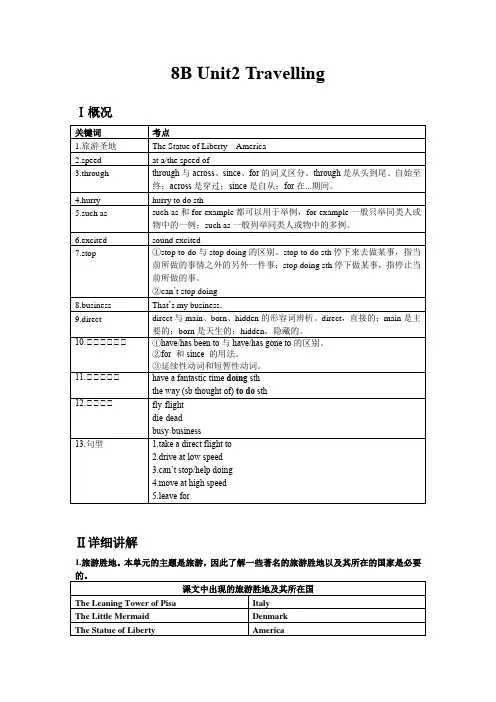
8B Unit2 TravellingⅠ概况Ⅱ详细讲解1.旅游胜地。
本单元的主题是旅游,因此了解一些著名的旅游胜地以及其所在的国家是必要【2020年五中】I will go on a trip to the USA to visit ______ this summer holiday.A. the Sydney Opera HouseB. the Little MermaidC. Tower BridgeD. the Statue of Liberty答案DI miss you so much.21.【2022年树中】—Is anything worth seeing in Nanjing?—Yes. Don’t __________ Zhongshan Mountain National Park with lots of cultural relics and natural beauty.A.forgetB. missC. avoidD. prevent答案BWe’re having a fantastic time here.【2022年十二】10. great fun it is to fly kites! fantastic time the children are having!A. What; What aB. What; WhatC. How; How aD. What a; What【答案】A2.It moved at high speed and was really exciting.(1)speed的基本含义作名词,意思是速度(2)speed的核心考点,考察speed的固定搭配at a/the speed of,以...样的速度,介词用at,speed前用冠词。
而搭配at high speed中没有冠词。
2. The train is running the speed of 200 kilometers per hour.A. withB. atC. inD. for答案B3.We were screaming and laughing through the ride.(1)through的基本含义作介词,意思是从头到尾,自始至终(2)through的核心考点考察through与across、since、for的词义区分。
2014年牛津译林版8B Unit2 Travelling Reading2课件

昨天我们在公园里玩得很开心
———————————————————————————— ———————————————————————————— ———————
A
the trip:
whole day in Hong Kong Disneyland--- a famous theme park
First went to Space Mountain an indoor roller coaster had fun on Space Mountain move at high speed scream and laugh through the whole ride
11. a couple of key rings 几串钥匙扣 12. at the end of... 在......的末尾 13. watch the fireworks 看烟火 14. let me have a look 让我看一看 15. through the ride 在乘坐过程中
My parents and I are having a really fantastic time here
watched the fireeworks in front of Sleeping Beauty Castle .The castle looked bright .
Some phrases: 1. have a fantastic time 过的极开心 2. an indoor roller coaster 一个室内的过山车 3. at high speed 高速地 4. hurry to a restaurant 匆匆赶到一家饭店 5. have a quick meal 快速地吃了饭 6. such as 比如 7. a parade of... .....的游行 8. later in the afternoon在傍晚时候 9. run after... 追赶...... 10. can’t stop taking photos忍不住拍照
牛津译林版八年级下册课件:8Bunit1 复习课 (共33张)

conclusion: already 已经, 常常用于肯定句
yet 仍,还 用于否定和疑问句 ever 表曾经 ,never 表从未。
填一填
1.They h_a_v_e__le_a_r_n_ed_ (learn) English for three years/ since three years ago/since 2011.
3. Tom and Mary _g_o_t_m__a_rr_ie_d_ in 1965. ( 结婚)
4. Tom _h_a_s__b_e_e_n_m__a_r_ri_e_d__to_ Mary for ten years . (和…结婚)
高频考点
used to do sth 过去常常做某事 1)我父亲过去是个老师.
from time to time
9.在镇的北部 in the northern part of town
10.采访某人 interview sb/have an interview with sb
11.把...变成
turn into
12.一生
all one's life
13.往返
return to and from
He is / gets used to riding a bike to school
every day.
going to school by bike
used to:
3.In the past ,I used to___B______ late,but now I am used to__________ early.
牛津译林版英语八年级下册Unit8Agreenworld复习课件(27张PPT)
often makes mistakes.
Things like glass, plastic and paper are separated and then recycled.
2. Why does the government make laws?
They make laws to protect the environment.
3. What is our greatest treasure?
8.我们的环境正在变得更糟。 9.循环利用也是帮助减少污染的好办法。
1.例如,我们不被允许砍树。
We are not allowed to cut down trees.
2.如果我们在公共场所丢垃圾,,我们将被警察罚款。
If we drop litter in a public place,we will be
■harmful adj.有害的 反义词:harmless 无害的
10.produce v. 生产,制造
product n. 产品 producer n.生产者
e.g. More cars_w__i_ll__b_e__p__r_o_d__u_c_e_d___(produce) in the
future.
go to the supermarket. 4.allow v.允许
■allow sb. to do sth.-改--被---动-→ sb. be allowed to do sth.
2020年牛津译林版八年级英语下册Unit2 travelling优质课课件(共25张PPT)
True or false?
1. Sandy liked the Hello Kitty
apple pie best.
T
2. The Hello Kitty biscuits and
a fast-food restaurant
sweets were so lovely that she
wanted to eat them.
see Sleeping Beauty Castle
meet many Disney characters and take photos with them
see a parade of Disney characters
Performers : wore different costumes and waved to people while they marched across the park, singing and dancing all the way
3 What did they see at the entrance? 4 Why couldn't Kitty stop takinTghepwhhoalteofsouwntiatihn.
Disney characters?
Because they all looked nice
5 What waansd ctuhtee. best part of the day?
It moved at high speed and we were screaming and laughing through the whole ride.
I met many of my favourite Disney characters, such as Sleeping Beauty
牛津译林版八年级英语下册8B Unit2 考点语法复习归纳
8B Unit2 考点复习归纳一、核心词汇1.fantastic adj.[考点点拨]意为“极好的,美妙的”。
a fantastic beach一片极好的海滩;a fantastic achievement 一项了不起的成就;have a fantastic time=have a good/great/wonderful time玩得开心。
fantasy n.(pl. fantasies)幻想,想象。
如:Stop living in a fantasy world别再生活在幻想世界中了。
2.such det.& pron.[考点点拨] such意为“这样的(人或物)”,常用于以下结构:such+a/an+adj.+可数名词单数。
如:This is such a big house.这是一座如此大的房子。
such+adj.+可数名词复数。
如:They are such kind girls.她们是如此好心的女孩。
such+adj.+不可数名词。
如:It is such sad music.它是如此悲伤的音乐。
[辨析] so常用于以下结构:so+adj.+a/an+可数名词单数。
如:so clever a boy如此聪明的一个男孩so+adj./adv.。
如:so clever如此聪明;so quickly如此迅速so many/much/few/little+n.。
如:so many mistakes如此多的错误3.couple n.[考点点拨]意为“两人,两件事物,几个人”。
a coupleof…一对,几个,几件。
如:I saw a couple of men get out我看见有两个男人出去了。
We went there a couple of years ago.我们几年前去过那儿。
二、核心句型1.I don't think it'll be a holiday for me.我想这对我来说不会是个假期了。
牛津译林版8B unit2 知识点梳理及语法
重点短语过去和现在past and present过去常常做某事,曾经做某事used to do sth.过去常常是……,曾经是……used to be + n./adj.习惯于做某事,适应于做某事be/get used to doing sth.习惯于…,适应于…be/get used to + 名词或代词被用来做某事(被动语态) be used to do sth.不同时期的运输工具transport at different times过去常常骑自行车去学校used to go to school by bike= used to ride the bike to school环游城市go around the city搬家move house搬到某地move to sp搬离(某地)move away (from sp.)(从某地)搬出来move out (of sp.)搬进新的公寓move into the new flats住在镇北live in the northern part of town= live in the north of town结婚(动作)/ 结婚(状态)get married / be married (adj.) 和某人结婚 get/be married with sb嫁给某人/ 娶某人marry (vt.) sb.把A嫁给B marry A to B对…..很了解know …very well从那时起since then在几年间改变很多change a lot over the years搬到两个街区远的地方move two blocks away在镇中心in the town centre = in the centre of town把A变成B turn A into B= change A into B把镇中心的部分地方变成一个新地方turn part of the town centre into a new park把废弃物倒进河里put the waste into the river意识到这个问题realize the problem采取行动改善这个情况take action to improve the situation一家钢铁厂/ 两家钢铁厂 a steel factory / two steel factories在某些方面,在某种程度上in some ways通过很多方法in many ways打牌下中国象棋play cards and Chinese chess感到有点寂寞feel a bit lonely= feel a little lonely一座偏远的山村 a lonely mountain village独自生活live alone有时,偶尔,间或,时不时地from time to time = at times = sometimes像以前一样经常/频繁as often as before采访某人have an interview (n.) with sb.= interview (vt.) sb.一生(从出生到死或到现在)all one’s life / all ones' lives在过去的世纪over the past century到现在为止 till/until now变成一个现代化的小镇become a modern town 乘公交车进出小镇travel to and from the town by bus居住环境living conditions天气状况weather condition当地人local people从美国回来 return from the USA = come back from America回到某地去 return to sp = go back to spreturn sth. to sb. = give sth. back to sb.火车站the railway station去国外,出国go abroad上一次互相见面last see each other (adv.)主要通过邮件联系mainly communicate by email和某人交流communicate with sb. = have a communication with sb.使联系变得容易多了make communication much easier和某人保持联系keep in touch with sb.(河流)流过,流经run through独自on one’s own = by oneself = alone到处是垃圾 rubbish everywhere两边都是绿色green trees on both sides在一些宽阔的空地in some large open spaces 狭窄和脏的马路narrow and dirty roads享受舒服的生活enjoy a comfortable life重点句子:1. —Have you seen my food? 你见到过我的食物了吗?—Yes, I have just eaten it. 是的,我刚刚吃了它。
牛津译林版英语8B八年级下册Unit2Grammar2课件
Verb
come/go/arrive (get to/reach)
Used for a
have/has been in/at
continuous state
She has left home. She left home last Tuesday. She has been away from home since last Tuesday.
have been to, have gone to ,have been in 1.Guilin is a good place. I __h__a_v_e_b_e_e_n___
there twice. 2.Sandy _h__a_s_g_o_n_e_t_o__the library. She will be
night . 4. Mr. Huang has kept the books __si_n_c_e_ a
week ago . 5.I have taught in the school _s_in_c_e_ I
came here . 6.We have been friends f_o_r_ a long time .
He has lived here since he was born.
Some verbs, such as come, go, buy and leave, can be used in the present perfect sense, but they cannot be used with for or since in positive statements. come, go, buy, leave 可以用于现在完成时, 但不能和for或since连用; for 和since和持续 性动词连用,不能和短动作连用