
北师大版英语二年级上册全册教案
北师大版二年级上册英语教案精品

CONTENTS
METHODS
PURPOSE
3.Post-task Activities
2: Read the new words after the tape.
Listen to the tape and repeat.
Reads aloud many times, deepens the student impression.
PROCEDURES
CONTENTS
METHODS
PURPOSE
1. Pre-task Preparation
Hello/Hi I’m----. What’s your name?
Teacher and student dialogue.
Review, repeatedly consolidated.
METHODS
PURPOSE
3.Post-task Activities
2:Listen to the tape and play a game what’s your name?
Group work
reads loudly.
Listen to the tape and read the text.
Show a picture
How many people are there in the picture?
Who are they?
What are they talking?
Observes through the student to has already appeared the character carries on recognizes again.
Listen to the tape and read the text.
二年级英语上册Unit1Hello教案北师大版
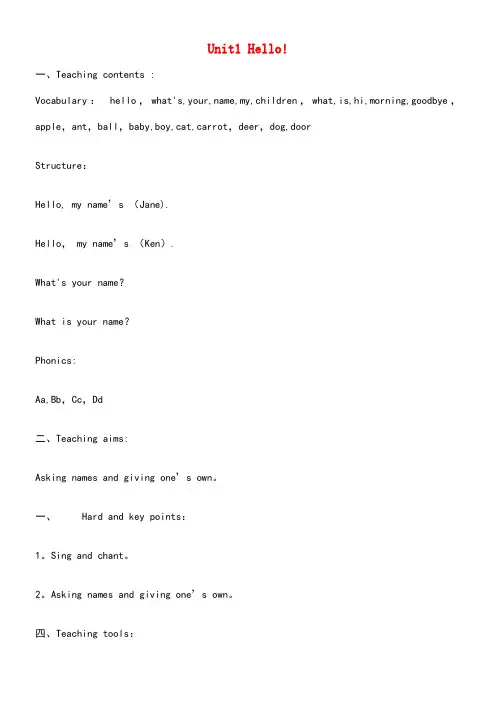
Unit1 Hello!一、Teaching contents :Vocabulary:hello,what's,your,name,my,children,what,is,hi,morning,goodbye,apple,ant,ball,baby,boy,cat,carrot,deer,dog,doorStructure:Hello, my name’s (Jane).Hello,my name’s (Ken).What's your name?What is your name?Phonics:Aa,Bb,Cc,Dd二、Teaching aims:Asking names and giving one’s own。
一、 Hard and key points:1。
Sing and chant。
2。
Asking names and giving one’s own。
四、Teaching tools:Really objects, tape, picturesPeriod 1一、Greetings:Sing a song: Please sit down.二、Revision:Review the words learnt in Grade 1 with the pictures。
三、Presentation and practice.Step 1 Give and use English name。
1. Give each child an English name tag to pin on. As each name tag is assigned, say the name and have the class repeat it after teacher.2。
Hold up the card, ask Ss to stand up when they see the card that matches their name tag。
北师大版(一起)英语二年级上册全册教案第一学期全套教学设计
Unit 1 Hello!课时安排:8教学目标:知识:1、单词:Core: hello, what’s, your, name, my, children, what, is hi, good, morning, Good-bye.Phonics: apple, ant, ball, baby, boy, ca t, carrots, deer, dog, doorContextual: Let’s go! Be careful.2、Phonics: Aa, Bb, Cc, Dd3、句型:H ello, my name’s (Jane).Hello, my name’s (ken).What’s your name?What is your name?能力:1、培养学生运用英语与老师、同学进行交流的能力2、培养小组合作的能力。
情感:关注学生的内在需要,在活动中培养学生的协作精神和竞争意识,培养学生学习英语的积极情感态度。
教学重、难点:1、正确朗读新单词。
2、对本课中新句型及以前旧句型的正确朗读及应用。
3、表演the rhyme and the song.教具准备:教学卡片、剪刀、彩笔、录音机和磁带教学过程:Lesson 1Teaching contents(教学内容)story.Teaching aims(教学目标):1.能听懂并理解故事大意。
2.能读出故事内容。
3.学习hello, What’s your name?等句型。
Key points(教学重点)理解故事大意,朗读故事,学习句型hello, What’s your name? Difficult points(教学难点)句型What’s your name?读音及语调。
Preparation(教具准备): 1、给每个学生制作一张简单的英文名字卡片。
卡片上端留一个小也,别一个别针。
另外把每个学生的英语名字写在大卡片上。
2、把Ann, Ken, Mocky 和Uncle Booky等四个人物的面具草图复印一份并剪下来,涂上适当的颜色并制作成简单的面具。
北师大版小学英语二年级上册教案 全册

北师大版小学英语二年级上册教案全册第一课:Greeting目标- 研究使用基本的问候语- 能够与他人进行简单的交流教学过程1. 呈现问候语的图片和词语,引导学生认读。
2. 老师模仿问候语的语音和表情,引导学生模仿。
3. 操练问候语的对话,例如:- A: Good morning!- B: Good morning! How are you?- A: I'm fine, thank you! How about you?- B: I'm good too, thanks!4. 分角色进行角色扮演,以加强学生的实际应用能力。
5. 小组内讨论和分享自己常用的问候语,培养学生合作和交流能力。
6. 教师总结本课所学内容,提醒学生巩固复。
拓展活动- 学生可编写问候语的对话,并与其他小组进行交流。
- 在课堂上进行问候语的表演或比赛,以激发学生的兴趣和参与度。
第二课:Colors目标- 研究基本的颜色词汇- 能够用基本的句型描述物品的颜色教学过程1. 呈现不同颜色的图片,引导学生观察并说出颜色。
2. 研究颜色词汇,并进行发音训练。
3. 引导学生用句型"This is a [color] [object]." 描述物品的颜色。
4. 进行游戏,例如:“Teacher says”,老师用指令引导学生说出正确的句子。
5. 老师出示物品,学生用适当的颜色进行描述,例如:“This isa blue pen.”6. 教师总结本课所学内容,提醒学生巩固复。
拓展活动- 学生制作个人颜色卡片,通过游戏来识别和配对颜色。
- 学生可以在班级中进行颜色展示,用英语描述展示物品的颜色。
...(继续完整的教案内容)。
新北师大版小学二年级英语上册全册教案
新北师大版小学二年级英语上册全册教案Unit 1: Greetings- Lesson 1: Introduction to greetings- Objective: To learn basic greetings such as "Hello" and "Goodbye"- Activities:- Students greet each other using different greetings- Role-play situations where greetings are used- Materials: Flashcards with different greetings written on them- Lesson 2: Asking and answering "How are you?"- Objective: To learn how to ask and answer the question "How are you?"- Activities:- Students practice asking and answering "How are you?" in pairs - Teacher presents different emotions (happy, sad, tired) and students express how they feel- Materials: Emotion flashcardsUnit 2: Numbers- Lesson 1: Introduction to numbers 1-10- Objective: To learn how to count from 1 to 10- Activities:- Students practice counting from 1 to 10 individually and as a class - Teacher presents objects and students count them- Materials: Counting flashcards- Lesson 2: Numbers 11-20- Objective: To learn numbers from 11 to 20- Activities:- Students practice counting from 11 to 20 using flashcards- Teacher presents random numbers and students say the corresponding number word- Materials: Number flashcardsUnit 3: Colors- Lesson 1: Introduction to colors- Objective: To learn basic colors in English- Activities:- Students learn color words through singing a color song- Teacher presents objects of different colors and students name the colors- Materials: Color flashcards, color song- Lesson 2: Mixing colors- Objective: To learn how to mix primary colors to create secondary colors- Activities:- Students mix primary colors using paint and create secondary colors- Teacher shows pictures of objects of different colors and students identify the colors used to create them- Materials: Primary color paints, pictures of objectsUnit 4: Animals- Lesson 1: Introduction to animals- Objective: To learn names of different animals in English- Activities:- Students learn animal names through a matching activity- Teacher presents flashcards with different animals and students name them- Materials: Animal flashcards, matching activity- Lesson 2: Animal sounds- Objective: To learn sounds made by different animals- Activities:- Students listen to audio recordings of animal sounds and guess the animal- Teacher presents pictures of animals and students imitate the sounds they make- Materials: Audio recordings of animal sounds, animal flashcards ... (continue with lessons for the remaining units)Assessment:- At the end of each unit, there will be a short assessment to test students' understanding of the content covered. The assessment may include multiple-choice questions, matching activities, and basic written exercises.Note for Teachers:- This lesson plan is designed for the textbook "新北师大版小学二年级英语上册."- Make sure to provide ample opportunities for students to practice speaking and listening skills.- Encourage students to participate actively and provide positive feedback to reinforce their learning.。
二年级英语上册 Unit 1 Hello教案3 北师大版

Unit 1 Hello!Lesson 1⑴教学目标①知识目标:Hello! What’s your name? My name’s … .②能力目标:Listen and talk.③情感目标:鼓励学生大胆开口说英语,培养学生的自信心。
⑵教学重难点:Asking names and giving one’s own.⑶教学过程:1. Warm-up (Greetings)Give each child an English name to use in class.Give each child an English name on a light card tag to pin on. As each name is assigned, say the name and have the class repeat it after you.2. Use English namesChoose one child. Ask, “What’s your name?” The child replies using the name of his or her card.If necessary, help with pronunciation. Repeat for the whole class.3. Introduce the charactersTell the children that they are going to read some stories about these characters: Uncle Booky, Mocky, Ken, Ann.Tell the children that they are going to meet some new friends.Hold up the mask for Peter and Wang Ling.4. Model the dialogUse any two of the masks. Use one mask and say, “Hello, what’s your name?” Use the other mask and reply, “My name’s … .”5. Talk about the storyHave the children open their books and talk about the characters.(What do you think they are saying?)6. StoryHave the class look at the pictures in their books as you play the tape.Play the tape again, and encourage the children to say the words.7. Sum up.8. HomeworkEncourage the children to practice greeting their family and friends in English, “Hello, my name’s … . What’s your name?”9. 教学后记:Lesson 2⑴教学目标①知识目标:Hello! What’s your name? My name’s … .②能力目标:Listen, say, talk and sing.③情感目标:在歌曲中激发学生学习的兴趣,寓学于乐。
最新北师大版二年级英语上册全英文教案(全册 共81页)
最新北师大版二年级英语上册全英文教案(全册共81页)Unit 7 Is it a pear?第一课教案Teaching aims: Present the new words and sentence structures of this Unit.Get Ss to understand and read the dialogue.Teaching importance: The new sentence structure: “What’s this/that? It’s a/an...”Teaching difficulties: The new sentence structure:“Is it a/an…? Yes, it is./No, it isn’t.Teaching tools: flashcards for this UnitPrepare the Student Book used last term.Teaching procedure:1.ReviewThe following exercise reviews some of the English expressions in Units 2 and 3.Display your copy of pages 14 and 15 of Book one. Show the children the pictures and ask what they remember of the story. You may have to prompt the children by asking specific questions about each picture.Tell the children, “In Unit 2, Mocky takes Ann and Ken to meet Uncle Booky. Mocky says to them, ‘Come on!’ when they set out. What do we say when we want someone to come with us?” Elicit an appropriate expression in Chinese.Say, “Yes, and in English we say Come on!” Rep eat the words Come on! and mime an appropriate gesture as you do so. Have the children do the same.Say, “Mocky says, ‘Oh, no!’ when he sees that the leopard is going to eat a lemon. What is Mocky feeling?” The children can answer in Chinese.Say, “Yes, in English we say Oh, no! when we are surprised or frightened or worried.” Elicit a similar expression in Chinese. Have the children say Oh, no! with an appropriate expression on their faces.Display your copy of page 27 of Book One. Say, “Later i n the story Mocky falls down and Ken says, ‘Oh! Poor Mocky.’” Ask, “What is Ken feeling?” Have the children answer in Chinese.Confirm their answer. “Yes, Ken feels sorry for Mocky. He says, ‘Oh! Poor Mocky.’” Have the children repeat Oh! Poor Mocky. wi th expression in their voices and on their faces.2.Model the dialogAsk the children what they say when they see something exciting or amazing. Tell them, “In English, we can say Wow!” Have the children repeat the word a few times, with expression on their faces.Ask the children what they say when they taste something really delicious. Tell them, “In English, we can say Oooh, yum!” Have the children repeat the words a few times.Ask the children what they say when they taste something very unpleasant. Tell them, “In English, we can say Yuk!” Allow the children to repeat the word a few times.Practice the expressions Oooh, yum! and Yuk! by asking, for example, “What do you think of the ice cream?” “Oooh, yum!”3.Talk about the storyStudent Book pages 2 and 3Have the children open their books at pages 2 and 3. Ask these questions about the pictures:Picture 1: “Where are Mocky and Lulu?”Picture 2: “Who has a stall there?”“What does she sell?”Picture 3: “What does Lulu taste first?”“Does she like it?”Picture 4: “What does she taste next?”Picture 5: “What is the little fruit?”Picture 6/7: “What does Lulu try now?”Picture 8: “Does she like it?”4.StoryStudent Book pages 2 and 3Say, “Now we’re going to hear what the characters said.”Play the tape once without stopping.Play the tape again, pausing after each picture. Have the children repeat each sentence after hearing it on the tape.Divide the class into two groups. One group will be Mocky, the other group will be Lulu.Play the tape again. Stop the tape after each sentence. Have each group repeat the dialog for their character. Then the groups change roles.5.Set homeworkRemind the children to practice some of the new English expressions(Wow! Oooh, yum! and Yuk!) at home.Unit 7 Is it a pear?第二课教案PreparationYou will need:any six flashcards from previous Units.nguage drillChoose any six flashcards from previous Units. Hold up the first card so that the children cannot see the picture. Give one or two clues about the object on the card, for example, “It’s something big. It floats on water, etc.” Have the children try to guess what it is.Model the question Is it a (bike)? Have them repeat the question with different English words. Answer, “No, it isn’t.” or “Yes, it is.”Make the clues less clear for each card. The children then have to ask more Is ita (bike)? questions.2.Words to learnStudent Book page 4Have the children open their books at page 4. Draw their attention to the “Words to learn” exercise at the top of the page.Play the tape. Stop the tape after each new vocabulary word. Ask the children to repeat it. Do this a second time.Play the tape straight through. While it is playing, hold up your copy of the page and point to each fruit as it is named.Hold up your copy of the page. Point to each fruit in turn. Ask, “What is it?” If the children cannot answer, ask, “Is it a lemon?” etc. The children should answer,“Yes, it is.” or “No, it isn’t.” Then repeat, “What is it?” Elicit, “It is a (nut).”Play the guessing game outlined in the first part of the lesson. This time, use only the words for fruit in “Words to learn”.3.Listen to thisStudent Book page 4Display your copy of the page and point to the bottom half. Tell the children, “Mocky says, ‘What’s this?’” Point to the picture of a banana. Elicit the answer, “It’s a banana.”Repeat for the other two pictures.Display your copy of the page. Point to the first sentence. Read the words as you point to each one.Have the children repeat the sentence and touch each word.Ask, “Is it a peach?” Elicit, “No, it isn’t.”Read the next sentence and have the children repeat it as before.Ask, “Is it a banana?” Elicit, “Yes, it is.”Read the third sentence together. Ask, “Is it a strawberry?” Elicit, “No, it isn’t.”Tell the children that you are going to play a tape. Explain that you want them to put a check (??)beside the answer in their books that matches the answer on the tape.Play the first question and answer. Check that the children have chosen the correct sentence.Repeat the procedure for pear and lemon.4.Play the gameStudent Book page 5Hold up a pen. Say, “Is this a pen?” Elicit, “Yes, it is.” Now indicate an item farther away. Say, “Is that a (ruler)?”Put the children into pairs to practice each question and answer.Have the class open their books at “Play the game”. Still in pairs, have the children ask and an swer questions about the numbered items, for example, What’s this? It’s a (ball). Is this a hat? Yes, it is./No, it isn’t.When you say the number of an object in Chinese, they say its name together in English. If they are uncertain of the English name for some objects,you could say the word and have the children repeat it.Extend this activity by asking the children to find any items in the picture that begin with the letter b (ball, banana, book). Repeat for the letter c (computer, cup).5.Set homeworkAsk the children to practice structures:What’s this/that? It’s a ... Is it a ...?Yes, it is./No, it isn’tUnit 7 Is it a pear?第三课教案PreparationYou will need:flashcards for the vocabulary introduced in this Unit.1.ReviewThis is a vocabulary review. Use the flashcards for this Unit.Hold up each of the flashcards in turn. Ask the children, “Is it a (nut)?” Elicit, “Yes, it is.” If necessary, give the answer to the first question. Have the children repeat it.Hold up ea ch of the four cards in turn. Ask, “What’s this?” Elicit, “It’s a (pear).”Choose one child to hold up the cards in turn again. This time, ask, “What’s that? Is it a (nut)?” Deliberately give the wrong name for some of the fruit. Elicit No, it isn’t.It’s a (lemon). or Yes, it is.2.Talk togetherStudent Book page 6Display your copy of the page. Direct the children’s attention to the top of the page.Say, “Now we can read what we said.”Read the words in the speech bubbles aloud, pointing to the words as you do so. Have the children repeat the words after you.3.Listen and numberStudent Book page 6Have the children open their books at page 6. The children will number each pair of sentences on a picture.Play the tape two sentences at a time. Stop after each pair. Ask, “Which picture matches those sentences?” Have the children touch the matching picture.Play the tape a second time. This time have the children number the pictures in the order they hear on the tape.4.Sounds and lettersStudent Book page 7Draw the children’s attention to the top of the page.Play the tape for baby and ball. Ask, “Do these words have the sound /b/?”Play the tape again and have the children say the words aloud.Repeat the procedure for the/p/words.5.Listen and writeStudent Book page 7Have the children look at the two rows of pictures at the bottom of the page. Show your copy of the page. Point to the first picture and ask, “What’s this?” The children should answer, “It’s a peach.” Write the letter p in the blank.Play the tape for peach. Draw the children’s attention to the word under the picture. Say, “Which letter is missing?” Elicit from the children p.Play the tape again and this time have children write the letter p on the line to complete the word.Repeat the procedure for the other words. Have the children write the letters in the blanks.6.Set homeworkStudent Book pages 6 and 7Tell the children to color the pictures on pages 6 and 7.Unit 7 Is it a pear?第四课教案PreparationPhotocopy Drillcard Master 7(page 160)onto light card. Cut it up to make a set of drillcards.You will need:flashcards for vocabulary introduced in this Unit.1.Trace the wordsStudent Book page 8Hold up the flashcard for banana. Ask, “What is it?” Elicit from the children “It’s a banana.”Have the children open their books at page 8. Show your copy of the page. Draw their attention to the first sentence. Say, “We are going to write what we said just now.” Have the children trace the phrase a banana.On the second box, have the children copy the phrase a banana by themselves.Repeat the procedure for the other sentences.2.Find and circleStudent Book page 8Draw the children’s attention to the bottom of the page. Show your copy of the page. Point to the picture of the lemon and ask, “What’s this?” Elicit, “It’s a lemon.” Point to the word lemon and have the children circle the word.Repeat the procedure for the other pictures of fruit.Explain to the children that they can find all the fruit names in the puzzle.Put the children into pairs. Tell them that together they must find the other fruit names in the puzzle and circle them out.Check that the children find all the words and circle them correctly.3.Uncle Booky’s BlackboardStudent Book page 9Hold up the What’s and this? drillcards. Read the sentence aloud. Have the children repeat the words after you. Do the same with the What is drillcard.Repeat the procedure, substituting that? for this?Have two children stand in front of the class. Have one child hold up the It is a drillcard, and the other child hold up a flashcard for this Unit. Together they make a sentence, It is a (pear).Point to each card in turn and say the words as you point. Repeat with two other children holding up the It’s a drillcard and a different flashcard.Repeat the two procedures. Have the children say the words.Choose four different children. Give one child the Is it a drillcard. Give each of the other children a “fruit” drillcard.Have two of the children form a sentence, Is it a (nut)? Read the words to the class as you point to each word. Hold up the appropriate flashcard next to the drillcard. Elicit the answer, “Yes, it is.”Repeat the procedure, but this time have the children say the words as you point to each one.Now hold up the banana flashcard. Say, “Is it a pear?” Elicit the answer, “No, it isn’t/is not.”Repeat the procedure for the other flashcards. Occasionally hold up the matching flashcard. Make sure that all the children change to Yes, it is.Have the children open their books at page 9. Say, “Now we will read these words together.” Encourage the children to touch the words as they read them. Use all possible combinations.4.Guess and sayStudent Book page 9Ask the children to take out their small fruit flashcards in this unit.Put children in pairs. Have each pair mix their cards together and then spread them face down on the desk.Student A puts his/her hand on one card and asks student B to guess. StudentB says, “Is it a (lemon)? ” Student A flips over the card and answers, “No, it isn’t. It’s a (pear).” or “Yes, it is.”Continue the game until all the cards are flipped over. Then the two students change their roles.5.Set homeworkAsk the children to finish tracing words on page 8.Unit 7 Is it a pear?第五课教案1.ReviewReview the flashcards for this unit. Hold up one of the flashcards and ask, “What’s this?” Elicit, “It’s a pear.”Repeat this for peach, lemon, orange, nut, strawberry, banana.2.Read and check ()Student Book page 10Have the children turn to page 10. Display your copy of the page. Point to the first picture. Then point to the question Is it a lemon?. Read the words aloud as you point to each one. Elicit the answer, “Yes, it is.”Now ask the children to point to the answer in their books. Have them read the words with you.Repeat the procedure for the other pictures. Check each answer.Put the children into pairs. Have one child in each pair ask the other child the first question. The other child then checks () the box beside the correct answer.Have the children change roles for the second question, and so on. Repeat until every child has asked and answered all questions.Now hold up your copy of the page and read the questions and the correctanswers. Have the children check their own answers.3.Let’s chantStudent Book page 11Use pictures or real objects to review the following words: orange, pear, apple, lemon, nut, strawberry, kite, bird. Make sure the children can say these things when given a picture or a real object.Read the rhyme to the children, pointing to each word.Play the tape for the whole rhyme. Have children listen and point to the words and the matching pictures on the page.Play the tape again and have children join in, encouraging them to hum or clap with the rhyme.Have children point to the pictures in their books as they listen to the tape again. They can also add some actions and act the rhyme out.4.An additional activity: Match the namesTeacher’s Book page 28Photocopy the page and give each child a copy.Ask the students to say the words and color the pictures.Have the children use their fingers to follow the ant trail between the pictures and the words.Note: An additional activity is provided at the end of Unit 7 through Unit 11. You can decide to use or not to use according to your own situation.5.Set homeworkStudent Book page 10Explain to the children that you want them to:ask their families about the fruit, using the structure Is this a (pear)?, and the。
北师大英语二年级上全册教案
2009----2010学年度第一学期英语课教案二年级先锋英语学年计划:1 使学生掌握表示问候的问候语及回答语。
Hello , What’s your name ?...2 能够自己介绍某种物品的名称,会使用简单的问候语进行交流。
Stand up ! Sit down .3 能够询问“那是谁?”并做出简单回答。
4 掌握几个重点单词(国家名称)5 能够介绍自己的家庭成员(掌握单词)6 掌握形容词性物主代词的基本使用方法并能做替换练习。
My his herThis is my car.7 A类单词要求听说读。
剩余单词要求理解词义,会说。
8 要求学生每人一本单词卡片,充分利用卡片进行学习。
9 坚持听录音作训练,要求有听说的训练。
单元备课:教材分析:《先锋英语》小学教材根据教育部颁发的“小学英语课程教学基本要求”的精神,遵循英语学习的规律和儿童心理生理发展的要求,以小学生的生活经验和认知发展水平为基本出发点循序渐进地设计课程,充分体现现代教学理念和素质教育思想,寓教娱乐,强调学生在学习过程中的感悟、体验、实验、参与以及思维能力的发展,在良好的语言环境中融学习情感、学习能力和跨文化交际意识的形成语言学习的全过程中,力求体现素质教育思想。
1、在教材总体设计目标上,重兴趣、重成就感、重自信心的建立。
2、在教学方法上,重体验、重实践、重参与、重创造性思维的发展。
3、在语言教学内容上,重语感、重语音语调基础、重交际能力的培养。
教材内容:unit 1:Hello !unit 2:This is Danny Deer.unit 3: Who’s that?Unit 4:Ann’s family .Unit 5:He’s my father .Unit 6:Review .年级要求:一、突出对学生学习兴趣的培养。
二、采用话题---功能---结构---任务相结合的编写思路。
三、在内容安排上注意由远及近,由表及里,由浅入深逐步递进,保证词汇重复。
北师大二年级英语上册教案设计【三篇】
北师大二年级英语上册教案设计【三篇】【导语】英语教案设计是改进课堂教学的一种更高层次的探索,是提高课堂教学质量和效率的一项必要工作,它可以增进教学的系统化,使老师掌控讲课节奏。
以下是作者为您准备的与(北师大二年级英语上册教案设计)相干的资料,期望可以帮助到您!【篇一】《Review》Lesson1教学目标:知识目标:1、能听懂、会说以下单词Weather snowy fine sunny cloudy rainy windy hot warm cool cold tomorrow ride等表示日常天气的单词,能在交换中运用。
2、能听懂、运用以下日常交际用语句型What are you going to do on Sunday?I‘m going to play football on Sunday.It’s going to be a fine day3、学习故事,初步感知句型,知道内容。
能力目标:1、能初步认读运用单词及句型2、能够知道故事内容,并朗诵课文故事情感目标:通过课文故事的学习,培养、提升学生养成关注天气的意识和习惯。
教学重点:能够运用句型句型What are you going to do on Sunday?I‘m going to play football on Sunday.It’s going to be a fine day教学难点:单词发音:Weather snowy fine sunny cloudy rainy windy及描写的句型。
教具准备:卡片、光盘、录音机教学进程:1.句型复习:going to学生用书第76页·让学生翻开书第76页,看“Going to”句型的插图。
指着第一幅插图,提问:What are they going to do?”引导学生回答:“They are going to eatdinner.”·用同样的方法练习其他插图。
二年级英语上册 Unit 1 Hello教案3 北师大版(2021年整理)
二年级英语上册Unit 1 Hello教案3 北师大版编辑整理:尊敬的读者朋友们:这里是精品文档编辑中心,本文档内容是由我和我的同事精心编辑整理后发布的,发布之前我们对文中内容进行仔细校对,但是难免会有疏漏的地方,但是任然希望(二年级英语上册Unit 1 Hello 教案3 北师大版)的内容能够给您的工作和学习带来便利。
同时也真诚的希望收到您的建议和反馈,这将是我们进步的源泉,前进的动力。
本文可编辑可修改,如果觉得对您有帮助请收藏以便随时查阅,最后祝您生活愉快业绩进步,以下为二年级英语上册Unit 1 Hello教案3 北师大版的全部内容。
Unit 1 Hello!Lesson 1⑴教学目标①知识目标:Hello! What’s your name? My name's … .②能力目标:Listen and talk.③情感目标:鼓励学生大胆开口说英语,培养学生的自信心.⑵教学重难点:Asking names and giving one’s own.⑶教学过程:1. Warm-up (Greetings)Give each child an English name to use in class。
Give each child an English name on a light card tag to pin on。
As each name is assigned, say the name and have the class repeat it after you。
2。
Use English namesChoose one child。
Ask,“What's your name?” The c hild replies using the name of his or her card.If necessary, help with pronunciation. Repeat for the whole class。