
英语北师大版选修7 Unit21 Lesson 3 《Epidemics Explained》 课件PPT2
Lesson 3 Epidemics Explained
Look at the Key Words. Which of these diseases can be epidemic?
Epidemics:
AIDS Cancer Headache Flu Heart disease Stomachache TB
15.in highly populated areas… 在人口密集的地区
16.one half to one third of the population was lost to the Black Death
有三分之一到一半的人死于黑死病. be lost to不再属于...所有;对...无动于衷
21.such as adv.例如...,象这种的;诸如..., 譬如说; 象...那样的; 如此...以致 Eg. such things as iron, silver, and gold铁、银和金这一类东西
22.natural defences against the disease 对抗这种病的自然抗体
Work in pairs. Do you think these statements are true(T) or false(F)?
1.TB and flu kill millions of people every year.
2.Most of diseases are very new. 3.Epidemics have affected historical events.
Answers: 1.of,on 2.of,from 3.of,of,of 4.near,of,after
Work in pairs. Which of these things do you think will happen within the next 25 years?
1.New drugs will stop all diseases. 2.Doctors will find a cure for SARS. 3.Flu will disappear. 4.AIDS will cause large epidemics.
Complete these sentences about the text in your own words
Voice your opinion:
How did you feel after reading the article? Tell the class
Language points
Now use the strategies to match the five paragraphs (A-E) with gaps 2,4,7,9 and 11 in the text.
The answers:
Paragraph A Paragraph B Paragraph C Paragraph D Paragraph E Gap 2 Gap 4 Gap 7 Gap 9 Gap 11
Sequencing of in formation: 1.read the text with gaps to get the general idea and see how it develops. 2.Read the sentences before and after the gaps to give you an idea of what the beginning or end of the missing paragraph might refer to. 3.Read the missing paragrapphs and look for these references. 4.If a paragraph doesn’t seem to fit, you may have made a mistake, so carefully reread each paragraph.
1.epidemics explained解释传染病 epidemics n.流行[传染]病, 时疫. (风尚等的)流行; (流行病的)蔓延 adj.传染[流行性]的 cholera epidemic霍乱流行 mass epidemic大流行; 集体流行 Eg. Violence is reaching epidemic levels.暴力达到了流行的程度。 2.epidemics throughout history历史上的传染病病例 throughout prep.遍及, 贯穿 adv.到处, 始终, 全部 Eg. The road is kept open throughout the year.这条路全年开通. 3.with new health threats on the rise. 对人类健康造成威胁的因素在不断增加。 rise n.上升, 增加, 上涨, 高地, 小山, 发生, 出现 vi.升起, 起身, 发源, 起义, 高耸, 增长, 上升, 复活 vt.使飞起 4.look at v.看, 考虑, 着眼于;回顾
a)Doctor b)Bad c)Get d)Part e)Grow f)Results g)Results h)Unusual i)Ways j)workers
Find the correct prepositions to complete each of these phrases from the text
1….the beginning life Earth…(para.1) 2….25% and 50% the area’s population died the disease…(para 3) 3….was one the key causes the fall the Roman Empire…(pare 3) 4….struck the end the first World War and continued the war..(para 6)
12.be known as v.被认为是;以...知名; 被认为是; 称为 be known for 因...而著名 be known to 为...所知 13.a lack of (常与of连用)缺乏;需要 a lack of money 缺乏金钱 There is no lack of vegetable.蔬菜不缺。 14.provide the perfect conditions for.. provide for v.提供生活费; 养活; 为...作准备, 防备;规定 provide for old age防老
5.Bacteria and viruses have been around since the beginning of life on earth 自从地球上有了生命,便有了各种细菌和病毒.
6.as long as只要, 在...的时候;既然;以…为条件 Eg. You may borrow this book as long as you promise to give it back. 只要你答应归还,你就可以把这书借走。 As long as you've offered, I accept.既然你已给我,我就接受. I will cooperate as long as I am notified on time.只要及时告诉我,我就会合作. 7.as early as 430 BC早在公元前430年 as early as早在 8.on record adv.记录在案, 公开宣布的;记录下来的 Eg. the coldest winter on record有记录以来最冷的冬天力, 尝试, 企图 vt.尝试, 企图 Eg. The boys attempted to leave for camping but were stopped by their parents. 男孩子们想去野营但被他们的父母们拦住了。 She made an attempt to cook the dinner.她试着做这顿饭。
23.be harmful to Eg. Smoking can be harmful to your health.吸烟对身体有害。 24.make up v.弥补, 虚构, 缝制, 整理, 包装, 和解, 编辑, 化妆;补足,拼凑 Eg. She made up her face to look prettier. 她把脸化了妆以便看上去漂亮些。 The boy made up a story; it was not true. 男孩编了个故事,这故事不是真的。 make up a bed整理床铺 25.expand across expand vt.使膨胀, 详述, 扩张 vi.张开, 发展 Eg. The bird expanded its wings and flew off.鸟展开翅膀飞走了 expand one's view阐述自己的观点
10.sweep through sweep v.扫, 打扫, 清扫, 席卷, 冲光, 扫过, 掠过 Eg. The wind swept over the plain.疾风横扫平原
11.die from the disease (病以外)因某事而死 Eg. Every winter some old people die from hypothermia. 每年冬天都有些老人死于体温过低。
Match the words from the passage(1-10)with their meanings(a-j)
1.Effects 2.Abnormal 2.Physician 4.Harmful 5.Staff 6.Aspect 7.Expand 8.Techniques 9.Accounts 10.acquire
作为一个集合名词, number既可以跟动词单数形式也可以跟动词复数形式。 当它前面是定冠词 the时,后跟单数动词.
北师大版选修七Unit21-lesson3-Epidemics-explained教案
Unit 21 Human BiologyLesson 3 Epidemics explained教案一教学设计,目的和思路、1.教材内容说明Epidemics explained 是北师大版教材选修模块7 的最后一个单元中的阅读课,介绍瘟疫在历史上的流行和发展, 文章生词量大, 有一定的教学难度.2.教学目的学生通过阅读课文, 了解文中一些科普知识, 学会描述瘟疫的特点, 掌握阅读科普文章的一些方法3.课堂形式提倡学生自学, 以检查预习, 合作讨论, 你说我猜的形式学习, 体现学生学习的主动性, 还课堂以学生4.教材内容的加工处理用相关插图, 图表等直观的教学形式, 让学生能更快理解课文; 必要的阅读指导,有利于学生技巧的形成; 相关文章的阅读, 能扩大学生知识面; 一些直观的教具如红丝带和抽象的音乐, 希望培养学生的人文素质和高尚情感二教学过程简述1.布置学生预习包括读单词, 找出文中数字的含义, 简单口头描述各次瘟疫的特点,做好文中的一道涉及段落补全的练习2.课文导入包括简介和听英文歌曲“Tears in heaven”, 讨论死亡的原因, 以及有哪些常见的瘟疫3.课文的阅读和学习Step 1: 阅读标题, 预测文章主题,同时找出文中主要瘟疫Step 2: 讨论数字在文中不同的含义, 进一步了解和熟悉课文Step 3: 进一步阅读文章, 了解造成瘟疫的元凶---病毒;描述瘟疫的传播途径, 找出各次瘟疫造成的巨大影响; 描述和猜测不同的瘟疫Step 4: 完成段落补全练习, 介绍相关方法4.点出阅读技巧5. 读一段有关爱滋病对儿童危害的文字, 提示我们应该做点什么课堂的延伸和升华三感受体会在教学过程存在一些问题, 最主要的是课堂时间的把握和安排. 在设计中内容太多, 在课堂上有些环节没有把握好, 如讨论数字用时过多; 提问学生差生面多, 造成进展不顺; 全班朗读课文也费时太多.下面谈谈我本人对这次活动的感想:1.还课堂与学生由于面临着高考的压力, 我们平时的教学中有时舍不得拿出时间让学生在课堂上说,讨论, 而且要设计直观有效的练习形式也相对费力; 可是英语课上我们还是可以还课堂与学生, 尽量让他们自己来学会学懂2.教师的工作真的是只有更好, 没有最好我的教案前期后后修改了几次, 我自己都觉得惊奇: 一堂课, 可以这样上, 也可以那样上, 前后顺序可以不一样, 教学重点可以不一样, 课堂形式可以有天壤之别---那些天我满脑子都在想这堂课要怎么上呢? 而你自己想的和学生的实际情况也不一定想府, 你觉得感动的歌学生可能听不懂, 这个班学生都会的问题, 另一个班的学生会表现出不知所措( 如知道病毒造成瘟疫, 2班学生感到困难, 这是我没有料想到的)---这份工作真的是要有极大的热情才能做3.我学会了许多东西我在和大家的讨论中, 进一步地思考课堂结构和课堂节奏的安排问题; 由于这一次公开课的主题是学法研讨, 我更多地关注学生在课堂上的表现; 在孔艳焰老师帮我润色修改课件的过程中, 我学到了许多电脑知识---我还了解了自己的许许多多不足之处, 明白自己努力的方向4.我心中充满了感激我感谢学校安排的这次活动, 使我们有学习交流的良好契机: 我感谢高中学段英语组全体老师对我的信任和无私的帮助, 使我有了锻炼和提高的机会; 希望大家多多指出我的不足, 使我能够不断进步; 也希望我们要更多的机会学习交流, 把我们的工作越做越好.Teaching Aims:To read an article about epidemicsTo improve the Ss’ readin g abilityTo improve the Ss’ speaking abilityLearning method: ConcludingTeaching procedure:Step 1: AddressingStep 2:Lead-in1.Listen to the song “Tears in heaven” .2.What’s your feeling after hearing the song?3.Why was the singer so sad?4.What else may cause death?5.Epidemics can cause more deaths than anything else.Step 3 : Reading Strategies: how to read a science article1.Read the title carefully(1)To present question 1What’s the main idea of the text?A.New health threats is on the rise.B. A lot of epidemics happened in history.C.SARS used to be out of control, now people are trying to stop it on the track.D.We should pay more attention to our health.(2)We can predict what will happen in the text from the titleIn this text, some epidemics in the history will be talked.(3)Give more titles and ask the Ss what will be talkedA.EpidemicsB.Epidemics and economyC.SARSD.The history of the Black Death2. Read the text fast and get the general idea and basic information(1)To present question 2Read the following graphic and try to tell which epidemics are described?(To see the PPT.)(2)We will try to know some basic information about epidemics in history.3.Read the text carefully and understand related science termsIn this text, a lot of medicine words are involved.(1)To present question 3What does the word “affect” mean in the 5th paragraph?A 影响B效果C感染D死亡(2)Now read the text carefully and complete the sentences using medicine words in the text:1.Bacteria and __________(病毒)have been around since the beginning of life onEarth.2.It’s important to look at the __________(传播)of diseases throughout history todiscover the __________(原因)and __________(影响) of epidemics.3.Another epidemic __________(开始) and __________(传播)in similar conditionswas the Great Flu. It __________(侵袭)near the end of the first World War and __________(持续)after the war.4.Doctors weren’t sure how to __________(治疗)or __________(预防)it and sincemost people had no natural __________(防御)against the disease, it was harmful to doctors.5.One half to one third of the population was __________(死于)to the Black Death.Less populated areas were less severely__________(感染).6.SARS epidemic quickly __________(扩大)across the globe. Health expertsworked together to __________(阻止)the virus in its __________(路径).7.It __________(席卷)North Africa, the middle East and Europe.(3)While doing these kind of exercise, explain some words such as “track”.4.Try to know more science knowledge through reading the text carefully(1)To present question 4The Black Death spread rapidly in Asia and Europe because_________A It was the terrible bubonic plague that returned.B There were so many people in these areas.C At that time, people didn’t know how to treat it.D People suffered from the bad climate , the war and hunger. There were so many people and they didn’t have daily health care.(2)To show a picture to demonstrate(3) To answer more questions about science knowledge●Why do we say epidemics have been with us for thousands of years? (ppt)●Why was bubonic plague one of the key cause in the fall of the Roman Empire?●How did SARS spread from Hong Kong to Canada, Vietnam and Singapore?●Why did many doctors and nurses become ill with SARS ?5.To figure out the development of the text(1)To introduce sequencing exercise (ppt )(2)To present question 5Read the whole text and match the five paragraph(A-E) with gaps 2,4,7,9 and 11 in the text(3) Read the text with gaps to get the general idea and see how it develops(4)To analyze the beginning and ending words of each paragraph6.Conclusion●Read (Find ) the title carefully●Read the text fast and get the general idea●Read the text carefully and understand related science terms●Try to know more science knowledge through reading the text carefully●To figure out the development of the textStep 4:Read the text again and give your own questions using the strategies we have learnt1.Show an example about giving questionsQuestions about general ideaWhat can be inferred from the text?A.Epidemics develops with the development of human beingsB.An old epidemic will cause another oneC.Epidemics may disappear one day due to the development of medical scienceD.Epidemics can cause a lot of deaths.2.Show the Ss ways to ask questions●The purpose of the writer is to---●●The story tells us that----●According to the text,-------●●It can be learned from the text that----●The best title for the text would be---●●Which of the following statement is true (false)?●Arrange the event in the text according to the correct order.●After reading the text, we know that---●●The word “---” in the text means-----●What’s the Chinese meaning of these words?●The word “---”can be replaced by---●●Why----- ?●●What is the reason for-----?●What is----?●We learn from the text that -----3.The Ss are asked to give out their own questions in groupsGroup 1-2: questions about basic details in the textGroup 3-4: questions about wordsGroup 5-6: questions about science knowledgeGroup 7-8: questions about sequencing4.5.Ask the Ss to change their questions and answer it.Good question: 1o score Good answer: 6 scoreOrdinary question: 7 score Ordinary answer : 4 score Bad question: 4 score Wrong answer: 2 score Step 5: HomeworkRead another science article and give 5 questions of your ownTears in HeavenWould you know my nameif I saw you in heaven?Would you feel the sameif I saw you in heaven?I must be strong and carry on'Cause I know I don't belong here in heaven...Would you hold my handif I saw you in heaven?Would you help me standif I saw you in heaven?I'll find my way through night and day'Cause I know I just can't stay here in heaven..Time can bring you down,time can bend your kneesTime can break your heart,have you begging please,begging please...Beyond the door there's peace I'm sureAnd I know there'll be no more tears inheaven...歌手简介:1945年3月30日Eric Patrick Clapton出生于英国萨里郡的瑞普雷在演出过程中逐渐形成了自己的蓝调风格,是摇滚乐坛中首屈一指的吉他大师.五十多岁方育得一子,然造化弄人,稚龄爱子竟从纽约数十层高的公寓阳台意外摔下身亡,这个打击几乎让他再度一蹶不振,不过将近50岁的Eric Clapton将他思念之苦寄情歌中,于是产生"Tears In Heaven"这首歌,它首先被收录于电影《迷途枷锁》(Rush)的原声带中,他的歌声苍凉悲壮却又柔情似水,能够净化人的灵魂。
英语北师大版选修7 Unit21 Lesson 3 Epidemics throughout history

Epidemics throughout history1.With new health threats on the rise, James Madison looks at epidemics throughout history. Bacteria and viruses have been around since the beginning of life on Earth and many of today’s diseases have been existed as long as humans have. It’ s important to look at the spread of diseases throughout history to discover the causes and effects of epidemics.2.----Scientists now think that Justinian’s Plague was actually a disease called bubonic plague. They estimate that between 25% and 50% of the area’s population died from the disease and think that the epidemic was one of the key causes of the fall of the Roman Empire.4----5. In highly populated areas all over Europe, Asia, Africa and the Middle East, one half to one third of the population was lost to the Black Death. Less populated areas, mostly in northern Europe, were less severely affected.6. Another epidemic that started and spread in similar conditions was the Great Flu Epidemic of 1918( also called the Spanish Flu). It struck near the end of the first World War and continued after the war was finished.7.-----8. One epidemic that we haven’t forgotten yet is the SARS epidemic of 2002/2003. it began with an abnormal lung disease in Guangdong Province and spread worldwide after Dr Liu Jianjun came to Hong Kong. He stayed at a hotel where the disease spread to four more people. When these people left the hotel and returned home, they spread the disease to Canada, Hong Kong, Vietnam and Singapore.9 -----10.No one really knew much about SARS as it was completely new to physicians. Doctors weren’t sure how to treat it or prevent it and since most people had no natural defences against the disease. It was also harmful to the doctors and purses treating the SARS patients. Hospital staff, especially nurses, made up 21% of the cases.11----A Having killed between 25 and 50 million people in 18 months. It is believed to be the most acute worldwide epidemic in history. More people died of the flu than died in the war. Yet, somehow, it has been forgotten by history.B. Although aspects of modern life, such as widespread air travel, allowed the SARS epidemic to quickly expand across the globe, other aspects, such as improved communication technology and improved medical research techniques, allowed health experts the world over to share knowledge and work together to stop the virus in its tracks.C In the 1330’s, the bubonic plague returned , this time in Asia. It would spread rapidly and come to be known as “ The Black Death”. The conditions in much of Asia and Europe –war, climate change, a lack of adequate food, crowded cities and a lack of basic health routines---provided the perfect conditions for the disease to spread worldwide.D Over nine months, the number of global cases passed 8,000 and 774 people died. Although these numbers are much smaller than the number for other diseases such as TB or flu, which kill millions every year, the outbreak was still very alarming for a few key reasons.F. Epidemics are described in historical accounts as early as 430 BC and one of the earliest on record is Justinian’s Plague. It happened about 500-550 AD as Roman Emperor Justinian was attempting to rebuild and acquire more land for the Roman Empire. It swept through North Africa, the Middle East and Europe.(2)教案小说人物形象归纳法Read a science article easilyTeaching Aims:To read an article about epidemicsTo improve the Ss’ reading abilityTo improve the Ss’ speaking abilityLearning method: ConcludingTeaching procedure:Step 1: AddressingStep 2:Lead-in1.Listen to the song “Tears in heaven” .2.What’s your feeling after hearing the song?3.Why was the singer so sad?4.What else may cause death?5.Epidemics can cause more deaths than anything else.Step 3: Read the text( 1 ) Read the title carefully and get some general ideas of the text1.Predict what will be talked in the text2.Read other titles and discuss what will be involved3.What is an epidemic?(show pictures about AIDS and bird flu, and ask the Ss to give their own answers) 4.Which of the following diseases are epidemics?AIDS, cancer, headache, flu, heart disease, stomach-ache, TB, malaria, smallpox, SARS5.Causes of epidemics: virus6.Tracks of epidemics7.Epidemics in history( 2 ) Find out the meanings of the different numbers and know more facts about the text1.Ask the Ss to find out the numbers in the text and to talk about the related factsabout them2.Give the Ss an example3.Ask the Ss to practise in pairs4.Ask questions in turns in class( 3 ) Know the fact about an event or phenomena in details(use a form to help you if necessary )1. Talk about the events and fill in the blanks2. Guess the names of the epidemics in the text3. Guess the names of the other epidemics( 4 ) To know the development of the article1.Show the sequencing exercise2.Show the ways to do this exercise3.Ask the students to do the exercise in the text( 5 ) conclusion:Step 4: Read another science article1.Discuss the title2.Talk about some numbers3.Do the sequencing exerciseStep 5: HomeworkFinish reading the new article and retell the text in your own words. (120words ) 附: (1)Tears in HeavenWould you know my nameif I saw you in heaven?Would you feel the sameif I saw you in heaven?I must be strong and carry on'Cause I know I don't belong here in heaven...Would you hold my handif I saw you in heaven?Would you help me standif I saw you in heaven?I'll find my way through night and day'Cause I know I just can't stay here in heaven.. Time can bring you down,time can bend your kneesTime can break your heart,have you begging please,begging please... Beyond the door there's peace I'm sureAnd I know there'll be no more tears in heaven...2. The History of SmallpoxThe Rise and Fall of a Disease1. The history of the rise and fall of smallpox is a success story for "modern" medicine and public health. Even though the disease has been eradicated, the threat of its return has once again brought it to the forefront of public controversy.2.----3. Epidemics occurred in the North American colonies in the 17th and 18th centuries. At one time smallpox was a significant disease in every country throughout the world except Australia and a few isolated islands. Millions of people died in Europe and Mexico as a result of widespread smallpox epidemics.4. The fall of smallpox began with the realization that survivors of the disease were immune for the rest of their lives. This led to the practice of variolation - a process of exposing a healthy person to infected material from a person with smallpox in the hopes of producing a mild disease that provided immunity from further infection. The first written account of variolation describes a Buddhist nun practicing around 1022 to 1063 AD. She would grind up scabs taken from a person infected with smallpox into a powder, and then blow it into the nostrils of a non-immune person.5.----6.The next step towards the eradication of smallpox occurred with the observation by English physician, Edward Jenner, that milkmaids who developed cowpox, a less serious disease, did not develop the deadly smallpox. In 1796, Jenner took the fluid from a cowpox pustule on a dairymaid's hand and inoculated an 8-year-old boy. Six weeks later, he exposed the boy to smallpox, and the boy did not develop any symptoms.7. -----8. The "modern" vaccine that was licensed by the FDA was taken from a weak strain of virus called the New York City Board of Health strain. It was produced by Wyeth Laboratories and licensed under the name Dryvax.9.------10.In 1967 the World Health Organization (WHO) started a worldwide campaign to eradicate smallpox. This goal was accomplished in 10 years due in a large part to massive vaccination efforts. The last endemic case of smallpox occurred in Somalia in 1977. On May 8, 1980, the World Health Assembly declared the world free of smallpox.11------A Jenner coined the term "vaccine" from the word "vaca" which means "cow" inLatin. His work was initially criticized, but soon was rapidly accepted and adopted. By 1800 about 100,000 people had been vaccinated worldwide.B. The United States stopped vaccinating the general population in 1972, butcontinued to vaccinate military personnel. It was recommended that vaccination of military personnel stop in 1986, and vaccination was officially stopped in military recruits in 1990.C.The origin of smallpox is uncertain, but it is believed to have originated in Africaand then spread to India and China thousands of years ago. The first recorded smallpox epidemic was in 1350 BC during the Egyptian-Hittite war. Smallpox reached Europe between the 5th and 7th centuries and was present in major European cities by the 18th century.D. The last outbreak of smallpox in the United States occurred in Texas in 1949with 8 cases and 1 death. Even though most of North America, Western Europe, Australia, and New Zealand were free of smallpox by this time, other countries such as Africa and India continued to suffer from epidemics.D.By the 1700's, this method of variolation was common practice in China, India,and Turkey. In the late 1700's European physicians used this and other methods of variolation, but reported "devastating" results in some cases. Overall, 2% to 3% of people who were variolated died of smallpox, but this practice decreased the total number of smallpox fatalities by 10-fold.(3)Epidemics explained 教学反思一教学设计,目的和思路、1.教材内容说明Epidemics explained 是北师大版教材选修模块7 的最后一个单元中的阅读课,介绍瘟疫在历史上的流行和发展, 文章生词量大, 有一定的教学难度.2.教学目的学生通过阅读课文, 了解文中一些科普知识, 学会描述瘟疫的特点, 掌握阅读科普文章的一些方法3.课堂形式提倡学生自学, 以检查预习, 合作讨论, 你说我猜的形式学习, 体现学生学习的主动性, 还课堂以学生4.教材内容的加工处理用相关插图, 图表等直观的教学形式, 让学生能更快理解课文; 必要的阅读指导,有利于学生技巧的形成; 相关文章的阅读, 能扩大学生知识面; 一些直观的教具如红丝带和抽象的音乐, 希望培养学生的人文素质和高尚情感二教学过程简述1.布置学生预习包括读单词, 找出文中数字的含义, 简单口头描述各次瘟疫的特点,做好文中的一道涉及段落补全的练习2.课文导入包括简介和听英文歌曲“Tears in heaven”, 讨论死亡的原因, 以及有哪些常见的瘟疫3.课文的阅读和学习Step 1: 阅读标题, 预测文章主题,同时找出文中主要瘟疫Step 2: 讨论数字在文中不同的含义, 进一步了解和熟悉课文Step 3: 进一步阅读文章, 了解造成瘟疫的元凶---病毒;描述瘟疫的传播途径, 找出各次瘟疫造成的巨大影响; 描述和猜测不同的瘟疫Step 4: 完成段落补全练习, 介绍相关方法4.点出阅读技巧5. 读一段有关爱滋病对儿童危害的文字, 提示我们应该做点什么课堂的延伸和升华三感受体会在教学过程存在一些问题, 最主要的是课堂时间的把握和安排. 在设计中内容太多, 在课堂上有些环节没有把握好, 如讨论数字用时过多; 提问学生差生面多, 造成进展不顺; 全班朗读课文也费时太多.下面谈谈我本人对这次活动的感想:1.还课堂与学生由于面临着高考的压力, 我们平时的教学中有时舍不得拿出时间让学生在课堂上说,讨论, 而且要设计直观有效的练习形式也相对费力; 可是英语课上我们还是可以还课堂与学生, 尽量让他们自己来学会学懂2.教师的工作真的是只有更好, 没有最好我的教案前期后后修改了几次, 我自己都觉得惊奇: 一堂课, 可以这样上, 也可以那样上, 前后顺序可以不一样, 教学重点可以不一样, 课堂形式可以有天壤之别---那些天我满脑子都在想这堂课要怎么上呢? 而你自己想的和学生的实际情况也不一定想府, 你觉得感动的歌学生可能听不懂, 这个班学生都会的问题, 另一个班的学生会表现出不知所措( 如知道病毒造成瘟疫, 2班学生感到困难, 这是我没有料想到的)---这份工作真的是要有极大的热情才能做3.我学会了许多东西我在和大家的讨论中, 进一步地思考课堂结构和课堂节奏的安排问题; 由于这一次公开课的主题是学法研讨, 我更多地关注学生在课堂上的表现; 在孔艳焰老师帮我润色修改课件的过程中, 我学到了许多电脑知识---我还了解了自己的许许多多不足之处, 明白自己努力的方向4.我心中充满了感激我感谢学校安排的这次活动, 使我们有学习交流的良好契机: 我感谢高中学段英语组全体老师对我的信任和无私的帮助, 使我有了锻炼和提高的机会; 希望大家多多指出我的不足, 使我能够不断进步; 也希望我们要更多的机会学习交流, 把我们的工作越做越好.谢谢大家!Step 3 : Reading Strategies: how to read a science article1.Read the title carefully(1)To present question 1What’s the main idea of the text?A.New health threats is on the rise.B. A lot of epidemics happened in history.C.SARS used to be out of control, now people are trying to stop it on the track.D.We should pay more attention to our health.(2)We can predict what will happen in the text from the titleIn this text, some epidemics in the history will be talked.(3)Give more titles and ask the Ss what will be talkedA.EpidemicsB.Epidemics and economyC.SARSD.The history of the Black Death2. Read the text fast and get the general idea and basic information(1)To present question 2Read the following graphic and try to tell which epidemics are described?(To see the PPT.)(2)We will try to know some basic information about epidemics in history.3.Read the text carefully and understand related science termsIn this text, a lot of medicine words are involved.(1)To present question 3What does the word “affect” mean in the 5th paragraph?A 影响B效果C感染D死亡(2)Now read the text carefully and complete the sentences using medicine words in the text:1.Bacteria and __________(病毒)have been around since the beginning of life onEarth.2.It’s important to look at the __________(传播)of diseases throughout history todiscover the __________(原因)and __________(影响) of epidemics.3.Another epidemic __________(开始) and __________(传播)in similar conditionswas the Great Flu. It __________(侵袭)near the end of the first World War and __________(持续)after the war.4.Doctors weren’t sure how to __________(治疗)or __________(预防)it and sincemost people had no natural __________(防御)against the disease, it was harmful to doctors.5.One half to one third of the population was __________(死于)to the Black Death.Less populated areas were less severely__________(感染).6.SARS epidemic quickly __________(扩大)across the globe. Health expertsworked together to __________(阻止)the virus in its __________(路径).7.It __________(席卷)North Africa, the middle East and Europe.(3)While doing these kind of exercise, explain some words such as “track”.4.Try to know more science knowledge through reading the text carefully(1)To present question 4The Black Death spread rapidly in Asia and Europe because_________A It was the terrible bubonic plague that returned.B There were so many people in these areas.C At that time, people didn’t know how to treat it.D People suffered from the bad climate , the war and hunger. There were so many people and they didn’t have daily health care.(2)To show a picture to demonstrate(3) To answer more questions about science knowledge●Why do we say epidemics have been with us for thousands of years? (ppt)●Why was bubonic plague one of the key cause in the fall of the Roman Empire?●How did SARS spread from Hong Kong to Canada, Vietnam and Singapore?●Why did many doctors and nurses become ill with SARS ?5.To figure out the development of the text(1)To introduce sequencing exercise (ppt )(2)To present question 5Read the whole text and match the five paragraph(A-E) with gaps 2,4,7,9 and 11 in the text(3) Read the text with gaps to get the general idea and see how it develops(4)To analyze the beginning and ending words of each paragraph6.Conclusion●Read (Find ) the title carefully●Read the text fast and get the general idea●Read the text carefully and understand related science terms●Try to know more science knowledge through reading the text carefully●To figure out the development of the textStep 4:Read the text again and give your own questions using the strategies we have learnt1.Show an example about giving questionsQuestions about general ideaWhat can be inferred from the text?A.Epidemics develops with the development of human beingsB.An old epidemic will cause another oneC.Epidemics may disappear one day due to the development of medical scienceD.Epidemics can cause a lot of deaths.2.Show the Ss ways to ask questions●The purpose of the writer is to---●The story tells us that----●According to the text,-------●It can be learned from the text that----●The best title for the text would be---●Which of the following statement is true (false)?●Arrange the event in the text according to the correct order.●After reading the text, we know that---●Th e word “---” in the text means-----●What’s the Chinese meaning of these words?●The word “---”can be replaced by---●Why----- ?●What is the reason for-----?●What is----?We learn from the text that -----3.The Ss are asked to give out their own questions in groupsGroup 1-2: questions about basic details in the textGroup 3-4: questions about wordsGroup 5-6: questions about science knowledgeGroup 7-8: questions about sequencing4.Ask the Ss to change their questions and answer it.Good question: 1o score Good answer: 6 scoreOrdinary question: 7 score Ordinary answer : 4 score Bad question: 4 score Wrong answer: 2 score Step 5: HomeworkRead another science article and give 5 questions of your ownTears in HeavenWould you know my nameif I saw you in heaven?Would you feel the sameif I saw you in heaven?I must be strong and carry on'Cause I know I don't belong here in heaven...Would you hold my handif I saw you in heaven?Would you help me standif I saw you in heaven?I'll find my way through night and day'Cause I know I just can't stay here in heaven..Time can bring you down,time can bend your kneesTime can break your heart,have you begging please,begging please...Beyond the door there's peace I'm sureAnd I know there'll be no more tears inheaven...歌手简介:1945年3月30日Eric Patrick Clapton出生于英国萨里郡的瑞普雷在演出过程中逐渐形成了自己的蓝调风格,是摇滚乐坛中首屈一指的吉他大师.五十多岁方育得一子,然造化弄人,稚龄爱子竟从纽约数十层高的公寓阳台意外摔下身亡,这个打击几乎让他再度一蹶不振,不过将近50岁的Eric Clapton将他思念之苦寄情歌中,于是产生"Tears In Heaven"这首歌,它首先被收录于电影《迷途枷锁》(Rush)的原声带中,他的歌声苍凉悲壮却又柔情似水,能够净化人的灵魂。
北师大版高中英语选修7Unit 21 Lesson 3 Epidemics Explained 课件2
Lesson 3 英语常用同义词辨析1agree with ,agree to ,agree on 用法agree with ,agree to ,agree on 都可以表示同意;agree to 一般表示个人同意,而agree on 表示对...取得一致意见,达成共识。
agree with 还可以表示与(气候或食物等)相适合.1. They agreed on the project at last.最后他们就这项工程达成了共识。
2. I agree with you =I agree with what you said.我同意你的话。
3. We agreed on a price for the car.我们商定了这辆汽车的价格。
4. The climate here doesn’t agree with me .我不适应这儿的气候。
5. Do you agree to that plan?你同意那个计划吗?6. He has agreed to the arrangement?他已经同意了那个安排。
7. Do you agree with what I have just said ?你同意我刚刚说的吗?8. Your story agrees with what I have heard.你说的话与我听到的一致。
agree with 后面一般跟某人或是某人说的话;后面还可以跟words。
agree to 后面一般跟建议、议案、计划、安排等。
agree on 后面一般跟表示具体协议的文件、计划等。
determine 与decide1. We determined to get the work done before May Day.我们决定在五一之前把工作做完。
2. He has determined that nothing can prevent him doing what he wants to do .他已经决定没什么能阻止他想做的事情。
Unit 21 Human Biology Lesson 3 Epidemics Explained 课件-北师大版高中选修7精品
[归纳拓展] faith n.信心,信任;诚意,善意 have faith in sb.信任某人/对某人有信心 lose faith in对……失去信心/不再相信 in good faith真诚;诚心诚意地 faithful adj.忠诚的;诚实的,如实/一丝不变的;可信 任的 be faithful to忠实于,忠诚于 faithfully adv.准确地;如实地;忠实地
(3)—The man is said to have been to many places.
—No wonder that he knows so much. ——据说那人去过很多地方。 ——难怪他知道的那么多。
4.It struck near the end of the First World War and left
families mourning worldwide. 它爆发于第一次世界大战接近尾声时,使全球的家庭陷
入了一片哀声之中。
[归纳拓展] 本句中使用了“leave+宾语+宾补”的结构,其常见句 式结构为:
doing(表示与宾语之间是主动关系,且具
有正在进行的含义)
leave+宾 语+宾补
done(表示与宾语之间是被动关系) to do(表示与宾语之间是主动关系,
他建议再举行一次会议,以表示他的诚意。
(2)The lovers promised to be faithful forever.
这对情人互相许诺永不变心。
Modern communication technology and medical research techniques allow health experts all over the world to unite,share knowledge,and work together without pause to help put SARS behind us.
高中英语Unit21HumanBiologyLesson3EpidemicsExplained课件北师大选修7
1
3
4
5
6
7
活学活用 语法填空 The government has decided to try to wipe in our country.
out
this disease
1
2
3
4
5
6
7
2.One of the earliest epidemics on record happened about 500-550 AD when the Roman emperor at the time was attempting to rebuild the Roman Empire. 历史上有记载的最早的流行病之一发生在公元500~550 年,当时的 罗马皇帝正在试图重建罗马帝国。 剖析 本句是一个复合句。when引导定语从句,修饰500-550 AD。 考点一at the time 当时 【高考典句】At the time,people did not have dishwashers in their homes. 当时,人们家中还没有洗碗机。 I was living in France at the time. 我当时住在法国。
一
二
三
四
二、完成短语 wipe 1.彻底毁灭 out 2.席卷 sweep through to 3.达到 up as 4.像……一样长 as long to 5.对……有害 be harmful to 6.导致 lead
一
二
三
四
三、阅读EPIDEMICS THROUGHOUT HISTORY,将下列事 件按时间顺序排列 A.One of the earliest epidemics swept through North Africa,the Middle East and Europe about 500-550 AD. B.Experts united to stop SARS spreading. C.The Spanish Flu killed up to 50 million people in 18 months. D.Over nine months,the number of global cases of SARS passed 8,000 and 774 people died. E.The Black Death spread in the 1330’s in Asia. 正确顺序为: 答案:A→E→C→D→B
北师大版高考英语选修7同步检测 Unit 21 Period 3 Lesson 3 Epidemics Explained
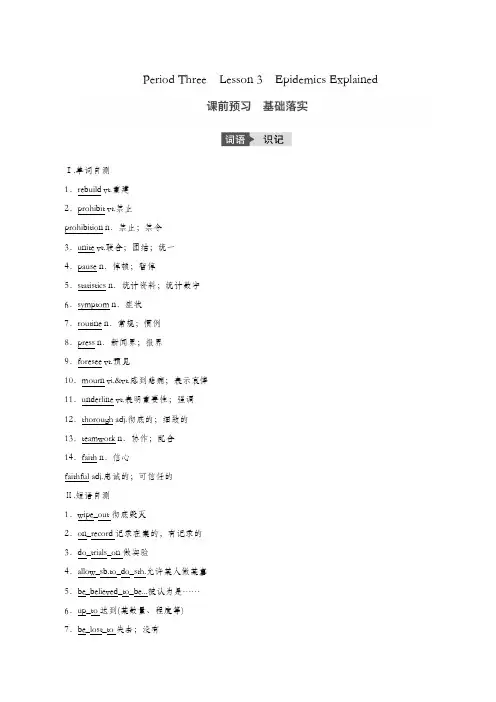
Period Three Lesson 3 Epidemics ExplainedⅠ.单词自测1.rebuild vt.重建2.prohibit vt.禁止prohibition n.禁止;禁令3.unite vt.联合;团结;统一4.pause n.停顿;暂停5.statistics n.统计资料;统计数字6.symptom n.症状7.routine n.常规;惯例8.press n.新闻界;报界9.foresee vt.预见10.mourn vi.&vt.感到悲痛;表示哀悼11.underline vt.表明重要性;强调12.thorough adj.彻底的;细致的13.teamwork n.协作;配合14.faith n.信心faithful adj.忠诚的;可信任的Ⅱ.短语自测1.wipe_out彻底毁灭2.on_record记录在案的,有记录的3.do_trials_on做实验4.allow_sb.to_do_sth.允许某人做某事5.be_believed_to_be...被认为是……6.up_to达到(某数量、程度等)7.be_lost_to失去;没有8.stop_sth.in_its_tracks终止;消灭1.Since the SARS epidemic ended,scientists have_been_doing trials on treatments to prohibit any future outbreaks.自从“非典”疫情结束后,科学家们就已经着手做治疗实验以防止将来再次爆发。
2.Many people fear it could be the next global epidemic,especially as scientists who studied tissue from the bodies of people who died of the 1918 Spanish Flu proved that Bird Flu is a modern adaptation of the same virus.许多人担心它会成为下一个全球性的传染病,特别是在一些科学家研究了死于1918年西班牙流感的人的尸体组织后,证明了禽流感是同一种病毒的现代变异体。
北师大高中英语选修七21.3
consists of three parts.
答案:The United Kingdom
4)pause n.& vi.暂停;中断;间歇 After a brief pause the speaker continued. 稍稍停顿一下后演讲者继续讲下去。 He paused when he heard the steps behind him. 他听到后面有脚步声便停了下来。
表将来。
答案:A
I called Hannah many times yesterday evening,but I couldn���t���get through.Her
brother
on the phone all the time.
A.was talking
B.has been talking
A.stop
B.prohibit
C.preverom doing sth.“禁止某人做某事”,尤指以法令、规章或
条例的形式。
答案:B
3.Modern communication technology and medical research techniques allow health experts all over the world to unite,share knowledge,and work together without pause to help put SARS behind us.(Page 38,Lines 8-12) 现代通信技术和医学研究技术使全世界的医学专家们能够联合起来, 分享知识,不停顿地通力合作,这将有助于将“非典”抛在我们的身后。 1)句子结构分析: 主语:modern communication technology and medical research techniques 谓语:allow 宾语:health experts all over the world to unite,share knowledge and work together without pause 是三个不定式连 用,作宾语补足语。 to help put SARS behind us 作目的状语。
英语北师大版选修7Unit21Lesson3《ScientificBreakthroughs》教案
Epidemics throughout history1.With new health threats on the rise, James Madison looks at epidemics throughout history. Bacteria and viruses have been around since the beginning of life on Earth and many of today’s diseases have been existed as long as humans have. It’ s important to look at the spread of diseases throughout history to discover the causes and effects of epidemics.2.----Scientists now think that Justinian’s Plague was actually a disease called bubonic plague. They estimate that between 25% and 50% of the area’s population died from the disease and think that the epidemic was one of the key causes of the fall of the Roman Empire.4----5. In highly populated areas all over Europe, Asia, Africa and the Middle East, one half to one third of the population was lost to the Black Death. Less populated areas, mostly in northern Europe, were less severely affected.6. Another epidemic that started and spread in similar conditions was the Great Flu Epidemic of 1918( also called the Spanish Flu). It struck near the end of the first World War and continued after the war was finished.7.-----8. One epidemic that we haven’t forgotten yet is the SARS epidemic of 2002/2003. it began with an abnormal lung disease in Guangdong Province and spread worldwide after Dr Liu Jianjun came to Hong Kong. He stayed at a hotel where the disease spread to four more people. When these people left the hotel and returned home, they spread the disease to Canada, Hong Kong, Vietnam and Singapore.9 -----10.No one really knew much about SARS as it was completely new to physicians. Doctors weren’t sure how to treat it or prevent it and since most people had no natural defences against the disease. It was also harmful to the doctors and purses treating the SARS patients. Hospital staff, especially nurses, made up 21% of the cases.11----A Having killed between 25 and 50 million people in 18 months. It is believed to be the most acute worldwide epidemic in history. More people died of the flu than died in the war. Yet, somehow, it has been forgotten by history.B. Although aspects of modern life, such as widespread air travel, allowed the SARS epidemic to quickly expand across the globe, other aspects, such as improved communication technology and improved medical research techniques, allowed health experts the world over to share knowledge and work together to stop the virus in its tracks.C In the 1330’s, the bubonic plague returned , this time in Asia. It would spread rapidly and come to be known as “ The Black Death”. The conditions in much of Asia and Europe –war, climate change, a lack of adequate food, crowded cities and a lack of basic health routines---provided the perfect conditions for the disease to spread worldwide.D Over nine months, the number of global cases passed 8,000 and 774 people died. Although these numbers are much smaller than the number for other diseases such as TB or flu, which kill millions every year, the outbreak was still very alarming for a few key reasons.F. Epidemics are described in historical accounts as early as 430 BC and one of the earliest on record is Justinian’s Plague. It happened about 500-550 AD as Roman Emperor Justinian was attempting to rebuild and acquire more land for the Roman Empire. It swept through North Africa, the Middle East and Europe.(2)教案小说人物形象归纳法Read a science article easilyTeaching Aims:To read an article about epidemicsTo improve the Ss’ reading abilityTo improve the Ss’ speaking abilityLearning method: ConcludingTeaching procedure:Step 1: AddressingStep 2:Lead-in1.Listen to the song “Tears in heaven” .2.What’s your feeling after hearing the song?3.Why was the singer so sad?4.What else may cause death?5.Epidemics can cause more deaths than anything else.Step 3: Read the text( 1 ) Read the title carefully and get some general ideas of the text1.Predict what will be talked in the text2.Read other titles and discuss what will be involved3.What is an epidemic?(show pictures about AIDS and bird flu, and ask the Ss to give their own answers) 4.Which of the following diseases are epidemics?AIDS, cancer, headache, flu, heart disease, stomach-ache, TB, malaria, smallpox, SARS5.Causes of epidemics: virus6.Tracks of epidemics7.Epidemics in history( 2 ) Find out the meanings of the different numbers and know more facts about the text1.Ask the Ss to find out the numbers in the text and to talk about the related factsabout them2.Give the Ss an example3.Ask the Ss to practise in pairs4.Ask questions in turns in class( 3 ) Know the fact about an event or phenomena in details(use a form to help you if necessary )1. Talk about the events and fill in the blanks2. Guess the names of the epidemics in the text3. Guess the names of the other epidemics( 4 ) To know the development of the article1.Show the sequencing exercise2.Show the ways to do this exercise3.Ask the students to do the exercise in the text( 5 ) conclusion:Step 4: Read another science article1.Discuss the title2.Talk about some numbers3.Do the sequencing exerciseStep 5: HomeworkFinish reading the new article and retell the text in your own words. (120words ) 附: (1)Tears in HeavenWould you know my nameif I saw you in heaven?Would you feel the sameif I saw you in heaven?I must be strong and carry on'Cause I know I don't belong here in heaven...Would you hold my handif I saw you in heaven?Would you help me standif I saw you in heaven?I'll find my way through night and day'Cause I know I just can't stay here in heaven.. Time can bring you down,time can bend your kneesTime can break your heart,have you begging please,begging please... Beyond the door there's peace I'm sureAnd I know there'll be no more tears in heaven...2. The History of SmallpoxThe Rise and Fall of a Disease1. The history of the rise and fall of smallpox is a success story for "modern" medicine and public health. Even though the disease has been eradicated, the threat of its return has once again brought it to the forefront of public controversy.2.----3. Epidemics occurred in the North American colonies in the 17th and 18th centuries. At one time smallpox was a significant disease in every country throughout the world except Australia and a few isolated islands. Millions of people died in Europe and Mexico as a result of widespread smallpox epidemics.4. The fall of smallpox began with the realization that survivors of the disease were immune for the rest of their lives. This led to the practice of variolation - a process of exposing a healthy person to infected material from a person with smallpox in the hopes of producing a mild disease that provided immunity from further infection. The first written account of variolation describes a Buddhist nun practicing around 1022 to 1063 AD. She would grind up scabs taken from a person infected with smallpox into a powder, and then blow it into the nostrils of a non-immune person.5.----6.The next step towards the eradication of smallpox occurred with the observation by English physician, Edward Jenner, that milkmaids who developed cowpox, a less serious disease, did not develop the deadly smallpox. In 1796, Jenner took the fluid from a cowpox pustule on a dairymaid's hand and inoculated an 8-year-old boy. Six weeks later, he exposed the boy to smallpox, and the boy did not develop any symptoms.7. -----8. The "modern" vaccine that was licensed by the FDA was taken from a weak strain of virus called the New York City Board of Health strain. It was produced by Wyeth Laboratories and licensed under the name Dryvax.9.------10.In 1967 the World Health Organization (WHO) started a worldwide campaign to eradicate smallpox. This goal was accomplished in 10 years due in a large part to massive vaccination efforts. The last endemic case of smallpox occurred in Somalia in 1977. On May 8, 1980, the World Health Assembly declared the world free of smallpox.11------A Jenner coined the term "vaccine" from the word "vaca" which means "cow" inLatin. His work was initially criticized, but soon was rapidly accepted and adopted. By 1800 about 100,000 people had been vaccinated worldwide.B. The United States stopped vaccinating the general population in 1972, butcontinued to vaccinate military personnel. It was recommended that vaccination of military personnel stop in 1986, and vaccination was officially stopped in military recruits in 1990.C.The origin of smallpox is uncertain, but it is believed to have originated in Africaand then spread to India and China thousands of years ago. The first recorded smallpox epidemic was in 1350 BC during the Egyptian-Hittite war. Smallpox reached Europe between the 5th and 7th centuries and was present in major European cities by the 18th century.D. The last outbreak of smallpox in the United States occurred in Texas in 1949with 8 cases and 1 death. Even though most of North America, Western Europe, Australia, and New Zealand were free of smallpox by this time, other countries such as Africa and India continued to suffer from epidemics.D.By the 1700's, this method of variolation was common practice in China, India,and Turkey. In the late 1700's European physicians used this and other methods of variolation, but reported "devastating" results in some cases. Overall, 2% to 3% of people who were variolated died of smallpox, but this practice decreased the total number of smallpox fatalities by 10-fold.(3)Epidemics explained 教学反思一教学设计,目的和思路、1.教材内容说明Epidemics explained 是北师大版教材选修模块7 的最后一个单元中的阅读课,介绍瘟疫在历史上的流行和发展, 文章生词量大, 有一定的教学难度.2.教学目的学生通过阅读课文, 了解文中一些科普知识, 学会描述瘟疫的特点, 掌握阅读科普文章的一些方法3.课堂形式提倡学生自学, 以检查预习, 合作讨论, 你说我猜的形式学习, 体现学生学习的主动性, 还课堂以学生4.教材内容的加工处理用相关插图, 图表等直观的教学形式, 让学生能更快理解课文; 必要的阅读指导,有利于学生技巧的形成; 相关文章的阅读, 能扩大学生知识面; 一些直观的教具如红丝带和抽象的音乐, 希望培养学生的人文素质和高尚情感二教学过程简述1.布置学生预习包括读单词, 找出文中数字的含义, 简单口头描述各次瘟疫的特点,做好文中的一道涉及段落补全的练习2.课文导入包括简介和听英文歌曲“Tears in heaven”, 讨论死亡的原因, 以及有哪些常见的瘟疫3.课文的阅读和学习Step 1: 阅读标题, 预测文章主题,同时找出文中主要瘟疫Step 2: 讨论数字在文中不同的含义, 进一步了解和熟悉课文Step 3: 进一步阅读文章, 了解造成瘟疫的元凶---病毒;描述瘟疫的传播途径, 找出各次瘟疫造成的巨大影响; 描述和猜测不同的瘟疫Step 4: 完成段落补全练习, 介绍相关方法4.点出阅读技巧5. 读一段有关爱滋病对儿童危害的文字, 提示我们应该做点什么课堂的延伸和升华三感受体会在教学过程存在一些问题, 最主要的是课堂时间的把握和安排. 在设计中内容太多, 在课堂上有些环节没有把握好, 如讨论数字用时过多; 提问学生差生面多, 造成进展不顺; 全班朗读课文也费时太多.下面谈谈我本人对这次活动的感想:1.还课堂与学生由于面临着高考的压力, 我们平时的教学中有时舍不得拿出时间让学生在课堂上说,讨论, 而且要设计直观有效的练习形式也相对费力; 可是英语课上我们还是可以还课堂与学生, 尽量让他们自己来学会学懂2.教师的工作真的是只有更好, 没有最好我的教案前期后后修改了几次, 我自己都觉得惊奇: 一堂课, 可以这样上, 也可以那样上, 前后顺序可以不一样, 教学重点可以不一样, 课堂形式可以有天壤之别---那些天我满脑子都在想这堂课要怎么上呢? 而你自己想的和学生的实际情况也不一定想府, 你觉得感动的歌学生可能听不懂, 这个班学生都会的问题, 另一个班的学生会表现出不知所措( 如知道病毒造成瘟疫, 2班学生感到困难, 这是我没有料想到的)---这份工作真的是要有极大的热情才能做3.我学会了许多东西我在和大家的讨论中, 进一步地思考课堂结构和课堂节奏的安排问题; 由于这一次公开课的主题是学法研讨, 我更多地关注学生在课堂上的表现; 在孔艳焰老师帮我润色修改课件的过程中, 我学到了许多电脑知识---我还了解了自己的许许多多不足之处, 明白自己努力的方向4.我心中充满了感激我感谢学校安排的这次活动, 使我们有学习交流的良好契机: 我感谢高中学段英语组全体老师对我的信任和无私的帮助, 使我有了锻炼和提高的机会; 希望大家多多指出我的不足, 使我能够不断进步; 也希望我们要更多的机会学习交流, 把我们的工作越做越好.谢谢大家!Step 3 : Reading Strategies: how to read a science article1.Read the title carefully(1)To present question 1What’s the main idea of the text?A.New health threats is on the rise.B. A lot of epidemics happened in history.C.SARS used to be out of control, now people are trying to stop it on the track.D.We should pay more attention to our health.(2)We can predict what will happen in the text from the titleIn this text, some epidemics in the history will be talked.(3)Give more titles and ask the Ss what will be talkedA.EpidemicsB.Epidemics and economyC.SARSD.The history of the Black Death2. Read the text fast and get the general idea and basic information(1)To present question 2Read the following graphic and try to tell which epidemics are described?(To see the PPT.)(2)We will try to know some basic information about epidemics in history.3.Read the text carefully and understand related science termsIn this text, a lot of medicine words are involved.(1)To present question 3What does the word “affect” mean in the 5th paragraph?A 影响B效果C感染D死亡(2)Now read the text carefully and complete the sentences using medicine words in the text:1.Bacteria and __________(病毒)have been around since the beginning of life onEarth.2.It’s important to look at the __________(传播)of diseases throughout history todiscover the __________(原因)and __________(影响) of epidemics.3.Another epidemic __________(开始) and __________(传播)in similar conditionswas the Great Flu. It __________(侵袭)near the end of the first World War and __________(持续)after the war.4.Doctors weren’t sure how to __________(治疗)or __________(预防)it and sincemost people had no natural __________(防御)against the disease, it was harmful to doctors.5.One half to one third of the population was __________(死于)to the Black Death.Less populated areas were less severely__________(感染).6.SARS epidemic quickly __________(扩大)across the globe. Health expertsworked together to __________(阻止)the virus in its __________(路径).7.It __________(席卷)North Africa, the middle East and Europe.(3)While doing these kind of exercise, explain some words such as “track”.4.Try to know more science knowledge through reading the text carefully(1)To present question 4The Black Death spread rapidly in Asia and Europe because_________A It was the terrible bubonic plague that returned.B There were so many people in these areas.C At that time, people didn’t know how to treat it.D People suffered from the bad climate , the war and hunger. There were so many people and they didn’t have daily health care.(2)To show a picture to demonstrate(3) To answer more questions about science knowledge●Why do we say epidemics have been with us for thousands of years? (ppt)●Why was bubonic plague one of the key cause in the fall of the Roman Empire?●How did SARS spread from Hong Kong to Canada, Vietnam and Singapore?●Why did many doctors and nurses become ill with SARS ?5.To figure out the development of the text(1)To introduce sequencing exercise (ppt )(2)To present question 5Read the whole text and match the five paragraph(A-E) with gaps 2,4,7,9 and 11 in the text(3) Read the text with gaps to get the general idea and see how it develops(4)To analyze the beginning and ending words of each paragraph6.Conclusion●Read (Find ) the title carefully●Read the text fast and get the general idea●Read the text carefully and understand related science terms●Try to know more science knowledge through reading the text carefully●To figure out the development of the textStep 4:Read the text again and give your own questions using the strategies we have learnt1.Show an example about giving questionsQuestions about general ideaWhat can be inferred from the text?A.Epidemics develops with the development of human beingsB.An old epidemic will cause another oneC.Epidemics may disappear one day due to the development of medical scienceD.Epidemics can cause a lot of deaths.2.Show the Ss ways to ask questions●The purpose of the writer is to---●The story tells us that----●According to the text,-------●It can be learned from the text that----●The best title for the text would be---●Which of the following statement is true (false)?●Arrange the event in the text according to the correct order.●After reading the text, we know that---●The word “---” in the text means-----●What’s the Chinese meaning of these words?●The word “---”can be replace d by---●Why----- ?●What is the reason for-----?●What is----?We learn from the text that -----3.The Ss are asked to give out their own questions in groupsGroup 1-2: questions about basic details in the textGroup 3-4: questions about wordsGroup 5-6: questions about science knowledgeGroup 7-8: questions about sequencing4.Ask the Ss to change their questions and answer it.Good question: 1o score Good answer: 6 scoreOrdinary question: 7 score Ordinary answer : 4 score Bad question: 4 score Wrong answer: 2 score Step 5: HomeworkRead another science article and give 5 questions of your ownTears in HeavenWould you know my nameif I saw you in heaven?Would you feel the sameif I saw you in heaven?I must be strong and carry on'Cause I know I don't belong here in heaven...Would you hold my handif I saw you in heaven?Would you help me standif I saw you in heaven?I'll find my way through night and day'Cause I know I just can't stay here in heaven..Time can bring you down,time can bend your kneesTime can break your heart,have you begging please,begging please...Beyond the door there's peace I'm sureAnd I know there'll be no more tears inheaven...歌手简介:1945年3月30日Eric Patrick Clapton出生于英国萨里郡的瑞普雷在演出过程中逐渐形成了自己的蓝调风格,是摇滚乐坛中首屈一指的吉他大师.五十多岁方育得一子,然造化弄人,稚龄爱子竟从纽约数十层高的公寓阳台意外摔下身亡,这个打击几乎让他再度一蹶不振,不过将近50岁的Eric Clapton将他思念之苦寄情歌中,于是产生"Tears In Heaven"这首歌,它首先被收录于电影《迷途枷锁》(Rush)的原声带中,他的歌声苍凉悲壮却又柔情似水,能够净化人的灵魂。
高中英语Unit21Lesson3EpidemicsExplained教案2北师大版选修7
高中英语Unit21Lesson3EpidemicsExplained教案2北师大版选修7Lesson 3 英语常用同义词辨析1agree with ,agree to ,agree on 用法agree with ,agree to ,agree on 都可以表示同意;agree to 一般表示个人同意,而agree on 表示对...取得一致意见,达成共识。
agree with 还可以表示与(气候或食物等)相适合.1. They agreed on the project at last.最后他们就这项工程达成了共识。
2. I agree with you =I agree with what you said.我同意你的话。
3. We agreed on a price for the car.我们商定了这辆汽车的价格。
4. The climate here doesn’t agree with me .我不适应这儿的气候。
5. Do you agree to that plan?你同意那个计划吗?6. He has agreed to the arrangement?他已经同意了那个安排。
7. Do you agree with what I have just said ?你同意我刚刚说的吗?8. Your story agrees with what I have heard.你说的话与我听到的一致。
agree with 后面一般跟某人或是某人说的话;后面还可以跟words。
agree to 后面一般跟建议、议案、计划、安排等。
agree on 后面一般跟表示具体协议的文件、计划等。
determine 与decide1. We determined to get the work done before May Day.我们决定在五一之前把工作做完。
2. He has determined that nothing can prevent him doing what he wants to do .他已经决定没什么能阻止他想做的事情。
北师大版高中英语选修七Unit 21《Human Biology》(Lesson 3)课件
scientists have been doing tri. Lines 6- 8) (Page 38, treatments to prohibit any future outbreaks. 科学家们就一直在做治疗实验以防止将来再次 疫潮结束后, 非典” 从“ 爆发。 句子使用了现在 时间状语是 since the SARS epidemic ended, 1)在本句中, 完成进行时。 而要用 不能用现在完成时, 还要进行下去时, 在强调指出动作还未结束, 现在完成进行时。 t finished it yet. but I haven������ ve been writing the composition for two hours, I������ 还要继续 强调动作没有结束, 但还没写完。( 这篇作文我写了两个小时, 写下去)
1. Epidemics can wipe out up to half of the population in urban areas. (Page 38) 流行病可以消灭居住在城市的多达一半的人口。 wipe out 彻底毁灭 They have wiped out the enemy������ s major military targets. 他们已彻底摧毁了敌人的主要军事目标。 The storm wiped the building out in two hours. 在两个小时内, 暴风雨把那座建筑物毁坏了。
⑤—I have got a headache. —No wonder. You A. work B. are working C. have been working D. worked 提示: 用现在完成进行时表示一直在进行, 有可能还会继续进行下去的 动作。 答案: C in front of that computer too long.