
人教版高中英语必修一《Unit 2 English around the world》ppt课件4
B.What's more D.Believe it or not
考查了状语的用法。本题题意:再次收到我
学校老师的来信我非常吃惊,信不信由你,自从上次见面 or not“信不信由你”;in a word“总之,一句话”;what's 是”;that's to say“也就是说”。 more“而且,更重要的
课上重点讲解
1.Believe it or not, there is no such thing as standard English. 信不信由你,(世界上)没有什么标准英语。 [点津1] believe it or not 表示“信不信由你”;在句中作插入 语。 ①Believe it or not, he walked 12 miles to get help for you. 信不信由你,为你们求援,他步行了十二英里。
5.accent n. 口音;腔调;重音 6.lightning n. 闪电 7.straight adv. 直接;挺直 adj. 直的;笔直的 8.block n. 街区;块;木块;石块
Ⅱ.短语自查 1.扮演一个角色;参与 play_a_part(in) 2.信不信由你 believe_it_or_not 3.建立;增进(健康) build_up 4.世界各地 all_over_the_world 5.从一个地方到另一个地方 from_one_place_to_another 6.转过拐角 go_around_the_corner 7.不断地/总是干某事 keep_doing_sth.
①Such a clever boy. 如此聪明的一个男孩。 ②Such an excellent student. 如此出色的一个学生。
[巩固训练] (1)(2010· 浙江-18)—According to my grandma, it is a good idea to eat chicken soup when you have a cold. —________, scientists agree with her. A.Sooner or later B.Once in a while C.To be exact D.Believe it or not
Unit2
English around the world
第四课时
Using
Language
课前自主预习
课上重点讲解
课后强化作业
课前自主预习
Ⅰ.词汇过关 1.expression 示;表达 2.African adj. 非洲的;非洲人的→Africa n. 非洲 3.eastern adj. 东方的;东部的→southeastern adj. 东 南方的;来自东南的→northwestern adj. 西北方的;来自西 北的 4.recognize vt. 辨认出;承认;公认 n. 词语;表示;表达→express v t. 表
②Believe it or not, we were left waiting in the rain for two hours. 信不信由你, 我们冒雨一直等了两个小时。 [点津2] no such... 没有这样/类的…… There is no such student in our class. 我们班上没有这样一个学生。
Ⅲ.经典句子 1.Believe_it_or_not,there standard English. 信不信由你,(世界上)没有什么标准英语。 2.So people from the mountains in the southeastern USA speak with almost the_same dialect as people in the northwestern USA. 因此,美国东南山区的人同美国西北部的人所说的方言 几乎相同。 is no_such thing as
答案:(3)One such book (5)few such (4)many such books
2.When people use words and expressions different from the“standard language”, it is called a dialect. 当人们使用不同于“标准英语”的词语时,那就叫方 言。
[点津] expression n. 词语;表示;表达;表情 ①Hearing her son was ill, the mother showed a worried expression on her face. 听说儿子病了,这位母亲脸上流露出焦急的表情。 ②The beauty of the Bird's Nest is beyond expression. 鸟巢的美无法形容。
[拓展] 当such与no/other/many/some/one等同时修饰名词时, 应该no/other/many/some/one在前,such在后。 One such collection of coins was found in America. 在美国发现了这样一堆硬币。 注意:当such与不定冠词a/an同时修饰某一可数名词单 数时,such应该在前,a/an在后。如:
答案:D
本题题意:“在我奶奶看来,在你感冒时喝
鸡汤是个好主意。”“信不信由你,科学家们与她的观点一 致”。A项“迟早”;B项“偶尔”;C项“确切地说”;D 项“信不信由你”。
(2)I'm
amazed
to
hear
from
my
school
teacher
again.________,it is ten years since we met last. A.In a word C.That's to say
完成句子 (3)________________________is enough. 这样的书一本就够了。 (4)There are____________________in the library. 图书馆里有很多这样的书。 (5)There are________________stories in this book. 这本书里很少有这样的故事。
(完整版)高中英语人教版必修一课文内容电子版Unit2
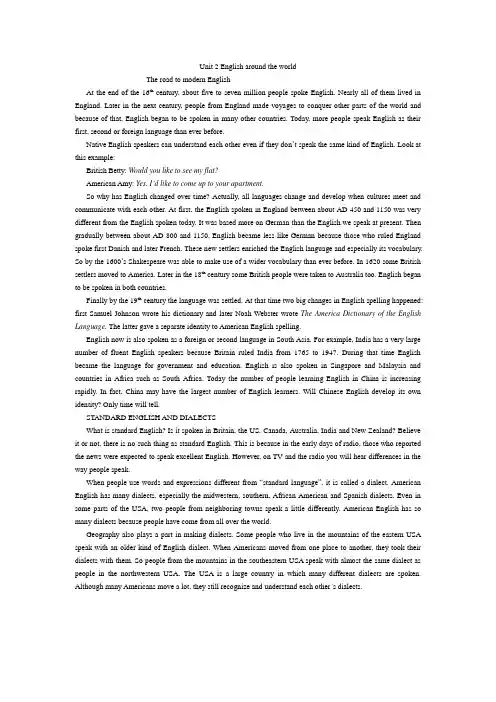
Unit 2 English around the worldThe road to modern EnglishAt the end of the 16th century, about five to seven million people spoke English. Nearly all of them lived in England. Later in the next century, people from England made voyages to conquer other parts of the world and because of that, English began to be spoken in many other countries. Today, more people speak English as their first, second or foreign language than ever before.Native English speakers can understand each other even if they don’t speak the same kind of English. Look at this example:British Betty: Would you like to see my flat?American Amy: Yes. I’d like to come up to your apartment.So why has English changed over time? Actually, all languages change and develop when cultures meet and communicate with each other. At first, the English spoken in England between about AD 450 and 1150 was very different from the English spoken today. It was based more on German than the English we speak at present. Then gradually between about AD 800 and 1150, English became less like German because those who ruled England spoke first Danish and later French. These new settlers enriched the English language and especially its vocabulary. So by the 1600’s Shakespeare was able to make use of a wider vocabulary than ever before. In 1620 some British settlers moved to America. Later in the 18th century some British people were taken to Australia too. English began to be spoken in both countries.Finally by the 19th century the language was settled. At that time two big changes in English spelling happened: first Samuel Johnson wrote his dictionary and later Noah Webster wrote The America Dictionary of the English Language. The latter gave a separate identity to American English spelling.English now is also spoken as a foreign or second language in South Asia. For example, India has a very large number of fluent English speakers because Britain ruled India from 1765 to 1947. During that time English became the language for government and education. English is also spoken in Singapore and Malaysia and countries in Africa such as South Africa. Today the number of people learning English in China is increasing rapidly. In fact, China may have the largest number of English learners. Will Chinese English develop its own identity? Only time will tell.STANDARD ENGLISH AND DIALECTSWhat is standard English? Is it spoken in Britain, the US, Canada, Australia, India and New Zealand? Believe it or not, there is no such thing as standard English. This is because in the early days of radio, those who reported the news were expected to speak excellent English. However, on TV and the radio you will hear differences in the way people speak.When people use words and expressions different from “standard language”, it is called a dialect. American English has many dialects, especially the midwestern, southern, African American and Spanish dialects. Even in some parts of the USA, two people from neighboring towns speak a little differently. American English has so many dialects because people have come from all over the world.Geography also plays a part in making dialects. Some people who live in the mountains of the eastern USA speak with an older kind of English dialect. When Americans moved from one place to another, they took their dialects with them. So people from the mountains in the southeastern USA speak with almost the same dialect as people in the northwestern USA. The USA is a large country in which many different dialects are spoken. Although many Americans move a lot, they still recognize and understand each other’s dialects.。
人教版高中英语必修一 Unit2English around the world
人教版高中英语必修一Unit2English around theworld人教版高中英语必修一Unit2English around the world 的单词和词组练习一、基本词汇:n. :1) elevator 电梯2) gas气体;汽油;煤气;毒气3) apartment(美)公寓4) spelling拼写;拼法5) Singapore新加坡6) lorry(英)卡车7) lightning闪电8) cab出租车9) petrol(英)汽油10)voyage航行;航海11)vocabulary词汇;词汇量;词汇表12)identity本身;本体;身份13)Malaysia马来西亚;马来群岛14)accent口音;腔调;重音15)block街区;块;木块;石块adj. :1) latter较后的;后半的;(两者中)后者的2) African非洲的;非洲人的;非洲语言的3) southeastern东南方的4) Midwestern中西部;有中西部特征的5) eastern东部的;东方的6) northwestern西北方的n./v. :1)base以……为基础;基部;基地;基础2)mand命令;指令;掌握;命令;指挥;支配3)request请求;要求n./adj.:1)native本地人;本国人;本国的;本地的2)Danish丹麦语;丹麦的;丹麦人的;丹麦语的3)Spanish西班牙人;西班牙语;西班牙的;西班牙人的;西班牙语的adj/adv.1) straight直接;挺直;直的;笔直的;正直的二、重点词汇:1) use n&v. 用处;使用 usage n.用法;词语惯用法2) express v.表达 expression n.词语;表达;表情3) recognize v. 辨认出;承认 recognition n.认出;识别;承认4) actually adv. 实际上 actual adj.实际上的5) graadually adv. 逐渐地;逐步地 gradual adj.逐渐的;逐步的6) fulently adv. 流利地 fluency n.流利;流畅 fulent adj.流利的7) frequently adv. 常常;频繁地 frequent adj.频繁的;常见的8) office n. 办公室 official adj.官方的三、重点短语:1) because of… 由于;因为because of和 because的区别:beccause of(后接词组或单词)because (作连词,后跟句子)eg:He was late not only because of his illness but also because he missed the train.不仅因为他的病痛而且因为他误了火车他才迟到的。
高中英语必修一unit2单词

高中英语必修一unit2单词《高中英语人教版必修一Unit2 “English around the world”单词详细资料》。
1. native [ˈneɪtɪv].- 词性:形容词、名词。
- 出处:高中英语人教版必修一Unit2。
- 解释:- 作形容词时,意为“本国的;本土的;当地的;天生的”。
例如:She can speak her native language very well.(她能非常流利地说她的母语。
)。
- 作名词时,意为“本地人;本国人;土生土长的人”。
例如:The natives here are very friendly.(这里的本地人非常友好。
)。
- 造句:He is a native speaker of English.(他是英语的母语使用者。
)。
- 近义词:local(当地的);indigenous(本土的,土生土长的)。
- 反义词:foreign(外国的)。
2. actually [ˈæktʃuəli].- 词性:副词。
- 出处:高中英语人教版必修一Unit2。
- 解释:事实上;实际上;居然,竟然。
例如:He looks young, but actually he is already in his fifties.(他看起来很年轻,但实际上他已经五十多岁了。
)。
- 造句:I thought he would come, but actually he didn't.(我以为他会来,但实际上他没来。
)。
- 近义词:in fact;really;truly。
- 反义词:theoretically(理论上)。
3. base [beɪs].- 词性:名词、动词。
- 出处:高中英语人教版必修一Unit2。
- 解释:- 作名词时,意为“基地;根据地;基础;底部”。
例如:The company has a base in New York.(这家公司在纽约有一个基地。
人教高中英语 必修一 Unit-2-English-around-the-world(共51张PPT)

The seeds come up in spring. 长出来 A few new questions came up at the meeting. 被提出
come up with 意为“提出,
想出”。如:
He came up with a new suggestion.
come across v. 偶遇;无意中发现 come back v.回来;记起;恢复 原状,重新流行
用base的适当形式填空。
1. This book ________ is based on a true story.
2. Mary always ______ bases her ideas on
scientific experiments.
2) present
adj.
当前的, 现在的 (作前置定语)
vt. 赠与, 赠给予, 给, 提出
present sb. with sth.或 present sth. to sb.
把……交给, 颁发, 授予
e.g. Mother presented a gift to me just now.
On his birthday, his friends presented him
with a series of readers /presented a series
of readers to him. (送给他一套读本)
5. Then gradually between about AD 800 and 1150, English became less like German because those who ruled England spoke first Danish and later French. 【翻译】 然后,渐渐地,大约在公元 800年到1150年期间,英语不那么像德 语了,因为那时英国的统治者起初讲丹 麦语后来讲法语。
人教版高中英语必修一Unit2Englisharoundtheworld整个单元课件

15
Reading–III(5m)
Groupwork: Whatcanyoulearnfromthispassage? (discussingroupoffour,thenaskthestudentsto showtheirideas.)
2.Prepareforthenextclass. 3.FinishtheexercisesonWB.
19
20
Period3Learningaboutl anguage
Unit2Englisharoun dtheworld
21
Period3:幻灯片27-48页
Revision(3m)
Match:(Reivewthenewwords)
sIspoketothemjustnow? Helpthestudentsunderstandwhatisaco mmandorarequest.
27
Learningusefulstructure–II(2m)
Makeclearthedifferencebetweencommandsan drequestsandfinishthefollowingexercises:
apartment
autumn
fall
underground(地铁) subway university(大学) college
rubbish(垃圾) garbage
dustbin(垃圾箱) trashcan
holiday
vacation
fortnight(两星期)twoweeks
12
Reading–I(3m)
&
英语人教必修一Unit 2English around the world 教案
Unit 2 English around the world 教材分析第二单元的中心话题是“世界英语”,表面上从词汇使用、读音、拼写三个方面的不同,让英语学习者直观感受英式英语与美式英语的差异,而深层中则是激发高中生对于语言文化的历史起源、发展、变化及趋势等方面的学习与思考,强化英语学习的重要性和英语学习的必要性。
Warming up是一组代表英美词汇区别的对话,通过较为熟悉的一些英美常用词汇感知英语的种类,但同时不难发现,在英语的沟通过程中,哪种版本的英语形式都不会影响到用词达意的;Reading部分介绍了英语作为世界语言目前的使用状况及现代英语的发展历程。
阅读之前普及下学生目前的对于使用英语国家的地理范围感知,尤其是英语作为官方语言和重要第二外语的国家。
文章核心可以划分为三个部分:1.英语在年代和使用中的重要地位;2.举例说明英语的表达有差异,但是沟通是无障碍的;3.现在英语的历史变迁,包括几个重要性的人物、时代及相关事件;4.英语影响下的其它国家使用状况。
以时间线索带动语言发展上的探索和推动意义。
Learning about Language以一些英式英语和美式英语的通用词汇为主,另外包含一些英语的重要性及表达过程中所需的常用词汇(动词与副词),继续要求学生熟悉词性转换的运用模式和表达文章逻辑顺序的词组,例如:such as , because of , the former, the latter…;Using Language有一篇较短的文段就标准英语和方言问题发表了一些基本认知基础,让学生们继续在语言学习中追寻适合自己的学习方式,展现英语表达过程中对于语音学习的包容性,试图从更多的角度打开对于英语学习必修发音标准的不自信;Grammar还是直接引语变间接引语,并进行操练。
不同于上个单元,本单元侧重于根据直接引语的语气---要求和命令,将祈使句类型转化为间接引语,基本规则不变;Listening &Speaking &Writing 在输出部分重要探讨英语的重要性和掌握英语的学习方法上,让学生产生有逻辑顺序的表达及分类;在本单元的Learning Tip中提到找到英语学习的趣味点。
人教版高中英语必修一第二单元ppt课件
number example countries of speakers
the native language
375
million
USA, UK, Canada, Australia, South Africa, Ireland, New Zealand
the foreign language
750
Homework
1. Reread the passage and list the reasons why English is spoken in many countries.
2. Review the words and expressions in the passage and try to use it in the sentences with context.
words
British English American English
lift (电梯) petrol (汽油)
elevator gas
flat (公寓)
apartment
autumn
fall
underground(地铁) subway university(大学) college
rubbish(垃圾) garbage
Seeing English movies
As we all know English is very important nowadays. So we should study hard. How much do you know about the English language? Let’s do a quiz.
sweets.
A: Well, I want a can of beer and some candies.
人教版高中必修一 Unit 2English around the world language points
3. Because / because of (p21 导) 4) 因为花了很多时间打点衣服, 这个年轻女子 错过了航班。 Because Because of she spending spent too too much much time time packing packing ———————————————————— up the clothes —————————— the young lady missed the flight. 5). The open-air celebration has been put off because of the bad weather. _____________ because of , due to , owing to , thanks to , on account of, as a result of 因为, 由于
―比…多‖ ―超过‖
More than one student wants to go to swim.
我不止一次向他打招呼,但他仍然不理我. I said hello to her more than one time, but she still ignored me.
2. more than + 名词n. :‖ ―不止是, 不仅仅
ever before.
This year’s yield of wheat is higher than ever before
4.Native English speakers can understand each other even if they don’t speak the same kind of English. (p22) 把英语作为母语的人相互之间可以交流,即使他 们说的不是同一种英语。 Native: adj.本地的, 本国的,本国人 native country/ land / language 祖国 母语 / 故乡 / 原产于 a native of ….的人
人教高中英语必修一unit-2-English-around-the-world-单词讲解
latest adj.最新的;最近的;最后的 lately(=recently) adv.最近;近来
选词填空(latter/later/late/lately/latest) ①Here are Tom and David; the _l_a_t_te_r__ is my
04 come up
come up①_上__来__,走__近_②__被__提_出____ ③__发_生__,__出__现___④__发__芽____
英译汉 (1)A foreigner came up to me and asked me the way to the railway station. 一个外国人走到我面前问我去火车站的路。 (2)The grass is just beginning to come up.
(1)vt. 以……为根据
base... on/upon 把……建立在……的基础上 be based on/upon 以……为基础/依据
(2)n.基部;基地;基础 at the base of 以……为基点;在……的底部
1.你不应该把自己的快乐建立在别人的痛苦之上。
You shouldn’t base your happiness on/upon the other’s sadness.
④The koala(考拉) is native ___to____Australia.
____考__拉__原___产__于__澳__大__利__亚__。________________________
请替换文字内容
点击添加相关标题文字,点击添加相关标题文字,点击添加相关标题 文字,点击添加相关标题文字,点击添加相关标题文字。
人教新课标高中英语必修一Unit 2 English around the world课件
BritishEnglish
10
BritishEnglish
AmericanEnglish
spelling
pronunciation
colour, favourite, theatre, centre, travelled, metre
color, favorite, theater, center, traveled, meter
2.Prepareforthenextclass. 3.FinishtheexercisesonWB.
19
20
Period3Learningaboutl anguage
Unit2Englisharoun dtheworld
21
Period3:幻灯片27-48页
Revision(3m)
Match:(Reivewthenewwords)
dtous. Themonitortoldusnottoplaygamesintheclassroom. “Willyoupleasenotsmokehere?”sheadded. Sheaskedmenottosmokehere.
29
Learningusefulstructure–IV(10m)
apartment
autumn
fall
underground(地铁) subway university(大学) college
rubbish(垃圾) garbage
dustbin(垃圾箱) trashcan
holiday
vacation
fortnight(两星期)twoweeks
12
Reading–I(3m)
Paragraph2:tellsusnativespeakerscanund erstandeachotherbutnoteverything.