
牛津深圳版英语七上Unit 2《Daily life》(more practice)ppt课件
牛津深圳版英语七上Unit 2《Daily life》(Grammar)ppt课件
请根据句意,用括号内所给单词的适 当形式填空。
1. I usually ___ go (go) to school on foot.
2. You ___ are (be) always my best friend.
plays (play) basketball 3. Tom often ______ with his classmates after school. 4. All these children ____ come(come) from Sichuan Province.
two)
S2: ____, ___________. Yes she _____ has lessons twice a week
以上我们已经通过归纳总结和练
习对本课的语法内容有了一定的
了解,下面就让我们根据
之前练习的考察情
况进一步选择讲解
该语法项的重难点。
The forms of the simple present tense
She brushes her hair every morning.
I have a shower every evening.
What do you do every evening?
I have a shower every evening.
Mary has a bath every evening.
对划线部分提问。
1)I brush my teeth every morning.
What do you do every morning?
I brush my teeth every morning.
Mary brushes her hair every morning.
牛津深圳版英语七上Unit 2《Daily life》(Grammar)ppt课件
以上我们已经通过归纳总结和练
习对本课的语法内容有了一定的
了解,下面就让我们根据
之前练习的考察情
况进一步选择讲解
该语法项的重难点。
The forms of the simple present tense
school? (drive)
S2:____, she ______ her own ___. Yes car drives
3. S1: How often ____ she _____ cakes to does make
her daughter? (make, sometimes)
S2: She ____________ to her daughter makes cakes
2) 客观真理,客观存在,科学事实
The earth moves around the sun. Shanghai lies in the east of China. 3) 表示格言或警句中。
Pride goes before a fall. 骄者必败。
一般现在时的疑问句形式及回答:
Do I/you/we/they play the guitar? Yes, I/you/we/they do. No, I/you/we/they don’t.
always usually often sometimes seldom never
Practice
Talk about the different ways Sam and his classmates go to school, using adverbs of frequency. Follow the example.
深圳牛津英语七上Unit 2 Daily life

Unit 2 Daily life Lesson 1Daily life (A)1. daily life 日常生活 两次3. ride a bicycle 骑自行车 5. on foot 步行 7. learn about sth. 了解某事 9. play games 玩游戏 11. make sth. together 一起做某物 心2. once or twice a week 每周一4. in the world 在世界上 6. be late 迟到 8. from… to…从……到…… 10. take part in 参加 12. have a good time 玩得很开1. go to … on foot = walk to 步行去某地 2. have/take a break = take/have a rest 休息一下 3. have a good/great/wonderful time = enjoy oneself = have fun 玩得很开心重点句型解析1. That’s right, Lo. 正确,Lo。
【拓展】That’s right. /All right. /That’s all right. 辨析That’s right.对的。
正确。
对别人所说的话表示肯定或认同好的。
对别人所提建议表示欣然接受All right.身体好,病好了 令人满意的,顺利的表示健康状况,相当于 fine 或 well 用于连系动词之后That’s all right.不用谢。
别客气。
没关系。
对别人所说的客气话的回应 对别人道歉的回应2. Which of these things do you do once or twice a week? 这些事情中哪些你每周做一两次?【考点】在英语中,表示“一次”用 once,表示“两次”用 twice,表示“三次或三次以上”时,用基数词+times,此时 time 是可数名词,表示“次数”。
牛津深圳版英语七年级上册unit 2(3)教案

课题Unit 2 Daily life 课型Reading (Ⅱ)备课时间1 period教材分析教学目标1.The students can use the expressions and the useful sentence structures freely.2.To master some usages of some useful expressions and develop an ability ofhow to get a further understanding of the text.教学重点The mastering of the usef ul sentence structure and useful phrases.How often do you watch TV? I watch TV twice a day.教学难点Learn the phrases : take part in , pratice doing , seldom never 教学关键Try to drill the structure “How often do you do ……教法与学法指导Competition, Self-study, Partner work教学环节主要教学步骤或内容学生主体活动教师活动设计意图时间分配第一环节复习回忆平移的根本性质,引入课题StepⅠ: Warming up1.Free talk2. Recite the text1 Talk about yourdaily life and what doyou like to do moste very day , thenrecite the first twoparagraphs1.Askquestions ,Howoften do youtake part in theschool bandpractice ? Whatdo you usuallydo afterschool ? Howoften do you dosome running ?1.Reviewthe text as wellas train thestudents’ability ofspeaking5第二环节观察操作、探索归纳平移的作法Step Ⅱ: Detailedreading.Fi lling the blanks.2.Fill the blanksabout the text andfind out the usefulexpressions andstructures in the textlike close to , onfoot , enjoylearning , etc. Thencheck the answeraccording to the text.2.desing theblank fillingexerciseaccording to thetext , and missthe importantphrases anddifficult pointin the blankfillingexercise2.Let them topay attention tothe details andcultivate theirability ofthinking.StepⅢ:Important phrases and Sentence str uctures learning. 3.Take notes about theusages of theimportant phrases,and use the phrases todescribe thepictures ,try to makeas many sentences aspossbile4.Group work to showthe structure andinvite one to makesimilar sentences.3. Show somepictures by PPT,and explain theusage of theimportantphrases and themain languagepoints ,thebasicstructures ofthe text. Thenshow somepictures to letstudents makesentences4.Choose theactive groups tocompete.3.To develop thestudents’ability o fcooperation andto make everysure studenttake part in thework.4.To cultivatetheir spirit ofcompetition andstrengthentheir learningfruit.第三环节课堂练习StepVI: More practice 5. Use the right formsof the expressions tofinish the sentences.6. Translate theChinese sentencesinto English by usingthe important phrasesin the text , like lovedoing , always , e njoydoing , seldom , learnabout5.Give them anexample to dothe exercise.6. work in groupto check theanswers.5.To provide thechances foreveryone tocheck theirlearningeffects.第四环节课时小结StepⅥ: sum up 7.write down andremember theimportant points ofthis class.6.Show a PPT andsum up the mainpoints of thetext and leadstudents to readit6. to cultivatethe ability oftaking notes.第五环节课后作业Step V: Homework 1. remember theimportant points andprepare for thedictation2. Make sentences withthe important pointsand structureslearn ed in this class课堂教学流程Free talk→ Reciting→ Get the important points and make sentences→Useful-structur e→Exercise效果评价与反思。
新版深圳牛津版英语七年级上chapter2_Daily_Life

新版深圳牛津版七年级英语上Unit 2 Daily Life一、重点词汇,短语1. article2. geography3. break4. practice5. market6. band7. daily8. end9. prepare/ready 10. arrive 11. together12. seldom 13. once or twice a week 14. three times a day15. brush teeth 16. love/enjoy/like doing sth. 17. on foot18. be late for 19. learn about 20. run to21. from…to…22. take part in = join in 参加23. have a good time / have fun / enjoy oneself 玩的开心24. between…and…在(两者)之间25. do morning exercise 做晨炼26. go to bed 27. have lunch 28. get up29. help sb. (to) do sth./help sb. with二、必背句子1. My school is close to my home, so I always go to school on foot.= My school is close to my home, so I always walk to school.2. When the bell rings, I run to the playground with my best friends Tom and Jack.3. She always arrives a t school at 7:25am.=She always gets to school at 7:25a.m.=She always reach school at 7:25a.m.三、语言点重难点1.①also: 也;常用与实意动词之前,be动词之后too: 也;常用在肯定句的句末,否定用either②like: v喜欢;prep 像2. helphelp(to)do sth帮忙做某事help sb (to) do sth帮助某人做某事help sb with sth 在某方面帮助某人四.单元语法一般现在时1. 基本用法表示经常的或习惯性的动作,常与表示频度的副词(从高到低):always、usually、often、sometimes、seldom、never等以及时间状语:every day、every morning、everyafternoon、every evening等连用。
七年级英语上册 Unit 2 Daily life教案4 (新版)牛津深圳版-牛津深圳版初中七年级上
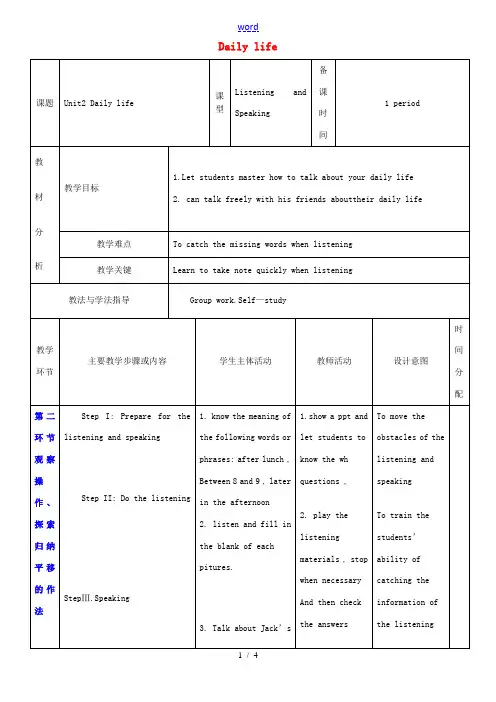
堂
教
学
流
程
Prepare for listening→ Listening →Speaking→summary
效
果
评
价
与
反
思
4.Talk about yourfriend’s lifeby asking thequestionslike :
When do you get up ?
Whatdo you do in the morning
How do you go to school ?
To move theobstacles of the listening and speaking
To train the students’ability of catching the informationof thelisteningmaterials
3.To develop the students’ability of listening and speaking.
4.To provide a chance for the partner to cooperate and create.
第五环节 课后作业
Make a dialogue in written way totalk about your daily life ,use the simple present tense andthewords like : always , often , seldom , never ,once a week , ect.
Between 8 and 9 , later in the afternoon
2. listen andfillin theblank of each pitures.
牛津深圳版英语七年级上册Unit 2 Daily life 重难点知识归纳总结
牛津深圳版英语七年级上册Unit 2 Daily life【重点单词】1.daily /ˈdeɪli/ adj. 每日的;日常的2.article /ˈɑːtɪkl/ n. 文章3.never /ˈnevə(r)/ adv. 从不4.ride /raɪd/ v. 骑;驾驶ually /ˈjuːʒuəli/ adv. 通常地6.so /səʊ/ conj. 因此;所以7.seldom /ˈseldəm/ adv. 不常;很少8.geography /dʒiˈɒɡrəfi/ n. 地理9.break /breɪk/ n. 休息10.bell /bel/ n. 钟;铃11.ring /rɪŋ/ v.(使)发出钟声,响起铃声12.end /end/ v. 结束;终止13.band /bænd/ n. 乐队14.practice /ˈpræktɪs/ n. 练习15.together /təˈɡeðə(r)/ adv. 在一起16.market /ˈmɑːkɪt/ n. 集市;市场17.guitar /ɡɪˈtɑː(r)/ n. 吉他18.grade /ɡreɪd/ n. 年级【重点短语】1.junior high school 初级中学2.on foot 步行3.take part in 参加4.have a good time 过得愉快5.go to bed 去睡觉6.get up 起床7.once a week 一周一次8.twice a week 一周两次9.enjoy doing sth. 喜欢做某事10.play the guitar 弹吉他11.do morning exercises 做早操;晨练12.have breakfast/lunch/dinner 吃早/午/晚饭13.get up 起床14.have classes 上课15.go home 回家16.a piece of bread 一片面包17.a glass of milk 一杯牛奶18.keep a diary 写日记【重点句型】1.What do students say most often in school?学生在学校最常说什么?2.My school is close to my home, so I always go to school on foot.我的学校离我家很近,所以我总是步行去上学。
牛津深圳新版 七年级上CHAPTER 2 DAILY LIFE
CHAPTER 2 DAILY LIFE【翻译下列短语】一周两次步行learn about从......到......参加玩得开心,过得愉快after-school activitiestalk about在......与......之间给某人送某物到达帮助某人做某事on the way to...work on...one of the best...喜欢做某事日常生活骑自行车弹钢琴睡觉【一般现在时】一. 意义:表示经常发生的事情,动作或存在的状态二. 构成及变化I like Chinese.He likes English.Lily likes singing.(1)一般现在时中的be动词:一般用原形:am is are(2)一般现在时中的动词:只有第三人称单数用动词三单,其余动词均用原形三单变化:多数在动词后加s play—plays like—likes 以s,x,sh,ch,o结尾的动词加es go—goes wash--washes12.He usually goes to school by bike._______ _________ _________ to school by bike? (改为一般疑问句)He ______ ________ ________ to school by bike. (改为否定句)一、单项选择题I选出可以替换划线部分的选项。
1.( )Ben seldom has breakfast in the morning.A.oftenuallyC.rarelyD.never2.( )I took part in the football club yesterday.A.attendedB.joinedC.leftD.eacaped3.( ) Did you have a good time at Lily’s birthday party.A.feel goodB.be happyC.enjoy yourselfD.smell good4.( )The meeting ends at 4:30 p.m.A.stopsB.opensC.startsD.begins5.( )Let’s go to the library together.A.with youB.with each otherC.every oneD.one anotherII.选出最符合题意的选项。
Unit 2Daily life 单元复习课件-英语七年级上册(牛津深圳版)
单词解析
For example
1. At the end of the party, they sang a song. 晚会结束时,他们唱了 一首歌。 2.In the end, they arrived here. 最后,他们来到这里。
拓展
1.in the end 最终;终于=at last = finally at the end of在…的尽头 end=finish 结束 2.endless adj.无止境的
【例句】 1.I play table tennis everyday 我每天都打乒乓球。
拓展
1.play tennis打网球 play volleyball打排球 play basketball打篮球 play chess 下棋 play football 踢足球 play badminton 打羽毛球 play the violin 拉小提琴 play the guitar 弹吉他 play the piano 弹钢琴 2.球和棋:零冠词 (吃早中晚饭同) 3.西洋乐器:+the
单词解析
=passage文章 paragraph段落 theory理论topic话题
For example
【例如】1.Read a student's article about his daily life.读这篇关于他日常生活的文章。 2.Today we'll discuss the use of the article.今天我们 将讨论这篇文章的用法。
单词解析
For example
【例句】 1.In the morning, we usually study Chinese. Maths and English. 在早上,我们通常学习语文、数学和英语。 2. I usually wake叩early.我通常很早就起床。
牛津深圳初中英语七年级上册Unit 2《Daily life more practice》精品课件
2. To talk about daily schedule with the simple present tense
最新初中英语精品课件设计
I usually get up at six o’clock. 最新初中英语精品课件设计
最新初中英语精品课件设计
Read and fill in the blanks
My mother’s daily schedule
6 a.m. 6:30 a.m. 7:25 a.m. 9–10:40 a.m. Lunchtime 1–1:40 p.m. 4–4:30 p.m. 6 p.m. 6:45 p.m. 7:30–10 p.m.
11 p.m.
(1)___g_e_t_s_u_p________ has breakfast (2) _a_r_r_iv_e_s__a_t _s_c_h_o_o_l__ has two lessons
(3) _h_a_s_o_n_e__le_s_s_o__n____ (4) _p_l_a_y_s_v_o_l_le_y_b_a_l_l ___ with some students (5) _c_o_o_k_s__d_in__n_e_r_____ has dinner (6)p_r_e_p_a_r_e_s_h_e_r__le_s_s_o_n_s____and helps me with my homework goes to bed
最新初中英语精品课件设计
Retell the schedule
gets up
arrives at school
plays volleyball with some students