
仁爱版七年级英语下册unit5-topic1重要知识点和语法点归纳
Unit 5 Our School Life
Topic1 How do you go to school?
一、重点词语:
1. wake up 醒来,唤醒get up 起床
2. go to school 去上学go home 回家
3. go dancing / shopping / skating / swimming 去跳舞;购物、滑冰;游泳
拓展总结:go+v ing可用于表达去进行某种娱乐休闲活动。
4. 表示交通方式:
by+交通工具名称,表示使用某种交通方式,中间不加限定词,如果交通工具前有a, the, my 等限定词,就不能用by,而是用in或是on. 例如:on the train=by train on his bike=by bike in my car=by car.
on foot 步行by boat 坐船by ship 坐船by air 乘飞机by plane 乘飞机by train坐火车by subway 搭乘地铁by car 坐小汽车by bus 坐公共汽车by bike 骑自行车
5. take the subway / bus / car 搭乘地铁;公共汽车;小汽车
6. drive a car to work = go to work by car 驾车去上班take a bus to work = go to work by bus 乘公共汽车去上班
go to school on foot = walk to school 步行去上学
7. ride a bike / horse 骑自行车;骑马
8. after school / class 放学以后;下课以后
9. play the piano / guitar / violin 弹钢琴;吉他;小提琴play basketball / soccer / football 打篮球;踢足球;打橄榄球
play computer games 玩电脑游戏play with a computer 玩电脑play sports 做运动
10. next to 紧挨着,在…旁边
11. know about 知道,了解
12. on weekdays 在工作日at weekends 在周末
13. have breakfast / lunch / supper / dinner / meals吃早餐;中餐;晚餐;正餐;一日三餐
have classes / lessons / a meeting 上课;上课;开会
14. watch TV / movies / games / the animals 看电视;电影;比赛;动物
read novels / newspapers / books 看小说;报纸;书
15. wash one’s fa ce / clothes 洗脸;衣服
16. 反义词:up – down, early – late 近义词:quickly – fast get up early 早起be late for 迟到
17. the first / second / third / fourth day 第一;二;三;四天
18. clean the house 打扫房子
19. 表示建筑物(尤其学校建筑物):
on the playground 在操场at school / home / table 在学校;家里;桌旁
in a computer room / teachers’ office / classroom b uilding / gym / library / lab / canteen
在电脑室;教师办公室;教学楼;体操馆;图书馆;实验室;食堂
20. around six o’clock = at about six o’clock大约在六点
21. 频率副词:never, seldom, sometimes, often, usually, always
22. do my homework at school 在学校做作业
do one’s homework 做家庭作业(注意:one’s 要随主语的变化而变化,常用形容词性物主代词my, your, their, our, his, her 等)。
二、重点句型:
1. It’s time to get up.该起床的时候了。
It’s time for breakfast. = It’s time to have breakfast = It’s time for having breakfast.该吃早饭了
2. You must go to school early. 你必须早点去上学。
(主观因素造成“必须”)
I have to wash my face quickly. 我不得不迅速地洗脸。
(客观因素造成“必须”)
3. Happy New Year! The same to you! 新年快乐!也祝你新年快乐!
4. How about you? = What about you? 你怎么样?
5. It tastes good. 它尝起来很好。
It sounds good.它听起来很好。
6. How do you usually go to school? I usually go to school by bike.
你通常怎样去上学?我通常骑自行车去上学。
What do you usually do after school? I usually play computer games.
你通常放学做什么?我通常玩电脑游戏。
7. How does she usually go to work? She usually goes to work by car.
她通常怎样去上班?她通常开车去上班。
What does he usually do after class? He usually reads novels.
他通常下课后做什么?他通常看小说。
8. The early bird catches the worm! 早起的鸟儿有虫吃。
/ 笨鸟先飞。
9. Where’s Mr. Zhou going? He’s going to S hanghai. 周先生将要去哪里?他将要去上海。
10.How often do you go to the library?
how often“多久一次”,问频率。
答语常用频度副词never, always,often等或单位时间内的次数once a week一周一次twice a month每月两次three times a year每年三次。
三、语法学习:复习一般现在时和现在进行时
一般现在时:
1. 区别含有be动词和行为动词的肯定句式。
I am at home.√ I stay at home.√I am stay at home. × She stay at home. ×
2. 一般疑问句、否定句表达的不同方式:
Are you at home? Do you stay at home? Does she stay at home?
Yes, I am. No, I am not. Yes, I do. No, I don’t.Yes, she does. No, she doesn’t.
I am not at home. I don’t stay at home.She doesn’t stay at home.
3. 主语为第三人称单数时,谓语行为动词的变化。
(掌握动词的第三人称变化规则)
She plays computer games on Sundays. She studies English every morning.
She goes to school on weekdays. She has breakfast at 6:45.
4. 用法:
(1) 表示现在的状况:I am a teacher. You are student. They are in London.
(2) 表示经常性的或习惯性的动作:I usually go to school on foot. She plays tennis every morning.
(3) 表示主语具备的性格和能力等:He likes playing basketball. They do the cooking.
现在进行时:
1. 基本句式结构:I am play ing with a computer.
2. 现在分词构成法:
go – going play – playing have – having drive – driving
run – running swim – swimming begin – beginning
3. 用法:
(1)表示现在正在进行的动作:She is having dinner. 她正在用餐。
(2)方位动词的现在进行时可用来表示将要发生的动作:I’m going. 我要走了。
四、交际用语:谈论交通工具及如何上学和校园生活。
主要句型:
How do you usually go to school? I usually go to school by bike. I’m riding a bike now.
What’s she doing? She’s dancing.Do you often go to the library?。
七年级英语(仁爱版)下册 Unit-5-Topic-1 知识点总结语言点归纳
知识点七年级英语(仁爱版)下册Unit-5-Topic-1语言点归纳Unit 5 Topic 1I 重点词汇和短语gate, by, always, plane, train, ship, boat, Ms., grandmother, group, weekday, early, bird, catch, seldom, walk, never, sometimes, ride, park, watch, TV, homework, life, American, or, few, day, rest, play, basketball, swim, ball, game, read, listen, library, once, twice, week, every, must, first, music, begin, while, wall, bed.the same to, come on, on foot, by plane, know about, for a while, watch TV, do (one’s) homework, have lunch, at school, have a rest, be different from, go swimming, listen to, go to bed, go to school, have classes.II 语言点Section A1. a) ---Happy New Year! ---- The same to you! / You, too. 新年快乐!也祝你新年快乐!b) ----Happy birthday! -----Thank you! 生日快乐!谢谢!2. How about you? = What about you? 你怎么样?3. Oh, your new bike looks very nice! 哦,你的新自行车看起来很好看。
仁爱版七年级下Unit5-Topic1语法专项课件频度副词PPT课件一等奖新名师优质课获奖比赛公开课
考 察 频 度 副 词 。 hardly 几 乎 不 , sometimes 有 时 , only仅仅,usually经常。由too expensive(太贵)可 知,“几乎不看电影”,所以答案选A。
考点大观 易错辨析 通关训练
【典例3】— _____ is it from home to the shopping mall?
→How often do you write to your brother?
考点大观 易错辨析 通关训练
易错点1 how often与how long/far/soon旳使用方法
区别 How often “多久一次”,用来对表达频率旳副词或短语提问。
(多用于一般目前时)
How long
问询时间时,表达“多长时间”,回答用“for+时间段”或
“有时;不时”,意思与at times相近,多用于一般目前 时。
some times “几次;几倍”,其中time为“次;倍”,是可数名词。
some time “某些时间”,其中time意为“时间”,是不可数名词。 sometime “某个时候”,常用于一般将来时。
易错点3
考点大观 易错辨析 通关训练
这冰很硬,能够在上面滑。
考点大观 易错辨析 通关训练
【典例1】— Zhang lili, “The most beautiful teacher”, is good to
her students.
— Yes, and she is ________ popular with her
students.
never旳频度是0,意为“历来不;永不”。
频度副词经典例句
考点大观 易错辨析 通关训练
仁爱七年级unit5单元知识点总结
仁爱七年级unit5单元知识点总结仁爱七年级 Unit5 单元知识点总结自古以来,“万事开头难”,所以学生们在学习新内容时,第一步就是要全面掌握各个知识点。
对于仁爱七年级的 Unit5 单元来说,也不例外。
因此,在这篇文章中,我将对该单元中的各项知识点进行总结和解析。
一、名词性物主代词名词性物主代词是一个非常常见的语法点。
该代词用于指代或代替一个名词,并表明该名词所属的所有者是谁。
在本单元中,我们主要学习了它的主要用法,如:①表示单数所有格:我的,你的,他的,她的,它的,这个,那个②表示复数所有格:我们的,你们的,他们的,这些,那些二、物主代词与名词性物主代词的区别物主代词和名词性物主代词的用法很相似,但它们之间存在一些明显的区别。
如:①物主代词可以独立使用,但名词性物主代词不能。
②物主代词表达的是一个人或物的所有权,而名词性物主代词则表达的是某个名词的所有权。
三、指示代词指示代词是另一种常见的代词类型。
它可以指出与某人或某物位置相对应的人或物。
在本单元中,我们通过以下指示代词进行了学习:①this,表示离说话人比较近的人或物②that,表示离说话人较远的人或物③these,表示离说话人比较近的人或物(复数)④those,表示离说话人较远的人或物(复数)四、数量词在 Unit5 单元中,我们学习了另一个重要的语法知识点——数量词。
数量词是用来表示数量或次数的词,它可以分为基数词和序数词。
基数词表示事物的数量,它们是我们所熟知的数字;而序数词则表示事物的位置或顺序,如 first、second、third 等。
五、比较级和最高级比较级和最高级的使用非常广泛,学好它们对我们来说非常重要。
在 Unit5 中,我们简单了解了它们的使用方法:①比较级表示两个或两个以上的事物之间的比较。
通常在两个事物之间加 -er 后缀。
②最高级表示三个或更多事物之间的比较。
通常在事物前加the 并加 -est 后缀。
需要注意的是,在使用比较级和最高级时应注意一些特殊情况,如双音节和多音节的单词等。
仁爱英语七年级五单元知识点
仁爱英语七年级五单元知识点仁爱英语七年级第五单元主要包括比较级和最高级、动词的时态、副词的用法等内容,是英语学习中非常基础和重要的一部分。
本文将介绍仁爱英语七年级第五单元的重点知识点。
一、比较级和最高级1. 比较级原级和最高级的构成方法比较级的构成方法为:形容词或副词+er,如taller、stronger;或者在单音节词和少数双音节词的后面加上more,如more beautiful、more helpful。
最高级的构成方法为:形容词或副词+est,如tallest、strongest;或者在单音节词和少数双音节词的后面加上the most,如the most beautiful、the most helpful。
2. 形容词、副词的比较级和最高级的用法形容词、副词的比较级和最高级用于对两个及以上的人或物进行比较。
比较级表示“更……”,最高级表示“最……”。
3. 不规则比较级和最高级有些形容词、副词的比较级和最高级是不规则的,如good-better-best、well-better-best、bad-worse-worst等,需要多加练习记忆。
二、动词的时态1. 一般现在时一般现在时表示习惯性动作、永久性状态或客观真理。
动词第三人称单数加s,否定句在动词前加don’t,一般疑问句用Do/Does+主语+动词原形。
2. 一般过去时一般过去时表示过去某个时间发生的动作或存在的状态。
动词加ed,不规则动词需牢记。
否定句在动词前加didn’t,一般疑问句用Did+主语+动词原形。
3. 现在进行时现在进行时表示正在进行的动作。
构成为be+Ving,第一人称用am,第二人称用are,第三人称用is,否定句在be前加not,一般疑问句用Be+主语+Ving。
4. 过去进行时过去进行时表示过去某个时刻正在进行的动作。
构成为was/were+Ving,否定句在was/were前加not,一般疑问句用Was/Were+主语+Ving。
仁爱版英语七年级下全部知识点总结
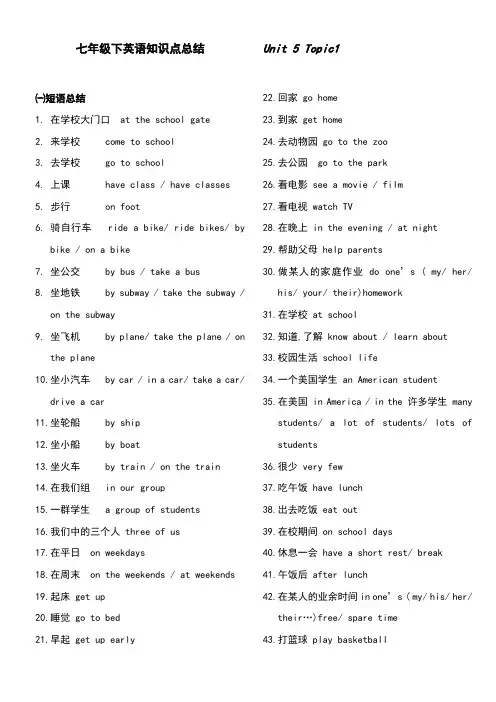
七年级下英语知识点总结Unit 5 Topic1㈠短语总结1.在学校大门口 at the school gate2.来学校 come to school3.去学校 go to school4.上课 have class / have classes5.步行 on foot6.骑自行车 ride a bike/ ride bikes/ bybike / on a bike7.坐公交 by bus / take a bus8.坐地铁 by subway / take the subway /on the subway9.坐飞机 by plane/ take the plane / onthe plane10.坐小汽车 by car / in a car/ take a car/drive a car11.坐轮船 by ship12.坐小船 by boat13.坐火车 by train / on the train14.在我们组 in our group15.一群学生 a group of students16.我们中的三个人 three of us17.在平日 on weekdays18.在周末 on the weekends / at weekends19.起床 get up20.睡觉 go to bed21.早起 get up early 22.回家 go home23.到家 get home24.去动物园 go to the zoo25.去公园 go to the park26.看电影 see a movie / film27.看电视 watch TV28.在晚上 in the evening / at night29.帮助父母 help parents30.做某人的家庭作业 do one’s ( my/ her/his/ your/ their)homework31.在学校 at school32.知道,了解 know about / learn about33.校园生活 school life34.一个美国学生 an American student35.在美国 in America / in the 许多学生 manystudents/ a lot of students/ lots of students36.很少 very few37.吃午饭 have lunch38.出去吃饭 eat out39.在校期间 on school days40.休息一会 have a short rest/ break41.午饭后 after lunch42.在某人的业余时间in one’s ( my/ his/ her/their…)free/ spare time43.打篮球 play basketball44.踢足球play soccer / football45.弹钢琴 play the piano46.弹吉他play the guitar47.拉二胡 play erhu48.去游泳 go swimming / go for a swim49.去划船 go boating50.球赛 a ball game / ball games51.一年四次 four times a year52.听音乐 listen to music53.读书 read books54.看报 read newspapers 55.看医生 see a doctor56.去图书馆 go to the library57.一周两次 twice a week58.见朋友 meet friends59.每天 every day60.在七点半 at half past seven61.一小会 for a little while / for a shorttime62.晚饭后 after supper63.吃饭 have dinner64.吃早饭 have breakfast㈡重要句型1.I usually come to school by subway.同义句: I usually take the subway to school.对划线部分提问: How do you usually come to school类似的有:go to school by bike=go to schoolon a bike= ride a bike to school=ride to schoolgo home by bus=go home on a bus=take a bus home2.How do you usually/ often…你通常/经常怎样…3.It’s time for class.=It’s time to haveclass. =It’s time for having class.4.What about you =How about you5.How often …询问频率,回答可以用频率副词:always, usually, often, sometimes, seldom, never, every day ,every +其他时间名词或表示频率的短语回答表示频率的短语:次数+单位时间. : once a day / twice a week / three timesa month6. The early bird catches the work. (谚语) 笨鸟先飞7. Work / Study must come first. 工作/ 学习必须放在第一位!8. Classes begin at eight. =Class begins at eight.提问: What time does the class begin / What time do the classes begin㈢重要单词的用法1.look (感官动词) 看起来,后面加形容词His mother looks very young.They look very cute.Her dress looks very nice.You look very cool in this coat.2.by 介词by 后面直接加表示交通工具的名词,中间不用任何词修饰,如:by bikeby +动词ing形式,表示通过某种方式People show love to their mothers by giving cards.You can be a good student by working hard.3.over (形容词)School / Class is over.4.begin现在分词: beginning 过去式: beganbegin to do sth , begin doing sthHe begins to write a letter. =He begins writing a letter.如果begin本身为分词,只能用begin to do sthHe is beginning to run.5.listen to 听(动作), hear 听见(结果)6.always 反义词 never7.本话题涉及的时态为一般现在时,句中常有频率副词或表示频率的短语,如果主语为三单,动词一定要用三单!(四)易错题1.You new watch ______ (look) very nice!2.Here ______(be) some news.3.Oh, come on! It’s time_____ going toschool.4.They usually go to school on________(feet).5.In my class, forty of _______(we) go toschool by bike.6.The early bird ______ (catch) the worm.7.Kangkang often _____ (ride) a bike to thepark.8.What time _____ (be)school over9.Work must come ______(once).10.It’s time ____you to get up.11.We often _____ books in the morning.12.Jill’s friend like ______(study) in ourschool.13.Mr. Wang teaches ______(we) English._____ of us like him.14.How about ______(go) out with me15.Most students go to school _____ theschool bus.16._______ do you go shopping with yourmotherA. How soonB. How farC. How oftenD. How much17.What time do you usually get up _____weekdays18.He ______ busy, so he has no time to playwith us.A. is alwaysB. seldom isC. always isD. often is19. The last class______(finish) at twelve o’clock.20. Let’s go______(boat).21. It’s time to have breakfast. (同义句) _________________________________________ _____________.22. Michael often rides a bike to school. (同义句)_________________________________________ _____________.23. I always go to work on foot. (对划线部分提问)_________________________________________ _____________.24. My mother goes shopping twice a week. (对划线部分提问)_________________________________________ _____________.25. Mary always reads books in the library. (反义句)_________________________________________ _____________.26. He usually does his homework at school. (否定句)_________________________________________ _____________.27. They often go to school by bus in the morning. (对划线部分提问)_________________________________________ _____________.28. Jane seldom watches TV on weekdays. (改为一般疑问句)_________________________________________ _____________.29. He usually has lunch at home. (对划线部分提问)_________________________________________ _____________.30. Li Ping often goes to work on foot. (同义句)_________________________________________ _____________.31. 几乎没有学生乘地铁去学校。
仁爱英语七年级下五单元topic1 知识点
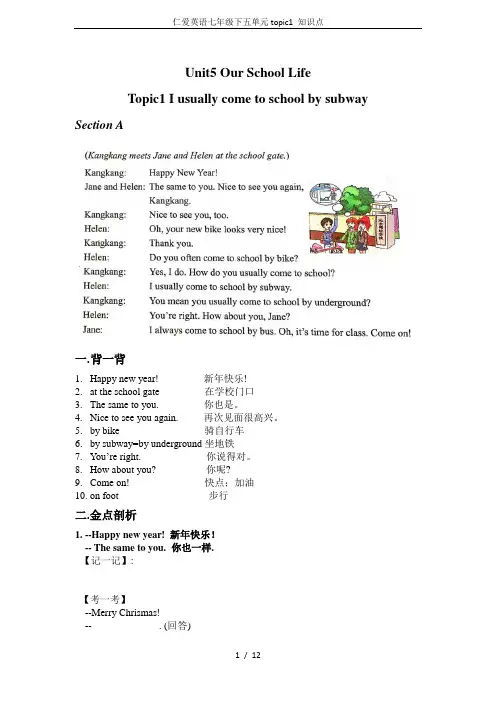
Unit5 Our School LifeTopic1 I usually come to school by subway Section A一.背一背1.Happy new year! 新年快乐!2.at the school gate 在学校门口3.The same to you. 你也是。
4.Nice to see you again. 再次见面很高兴。
5.by bike 骑自行车6.by subway=by underground坐地铁7.You’re right. 你说得对。
8.How about you? 你呢?e on! 快点;加油10.on foot 步行二.金点剖析1. --Happy new year! 新年快乐!-- The same to you. 你也一样.【记一记】:【考一考】--Merry Chrismas!-- _____________. (回答)2. Oh, your new bike looks very nice! 你的新车看起来很漂亮!【记一记】:拓展:look ____ 看look ____ 看上去像look ____ 照看【考一考】1. Ann’s mother is not at home. So Ann has to _________ her sister.2.Jim _______ his father. They both(都) have small eyes.3. Please _______ the photo! It’s wonderful.4. Your dress _____ very nice. May I have a look?A. watchB.seesC. looksD. shows3.--How do you usually come to school? 你平时怎么去上学?-- I usually come to school by subway.【记一记】:注意:① by,on, in 引导的短语在句中只能作状语,与go,come,get等连用。
仁爱英语七年级下册Unit5课本重点总结
仁爱英语七年级下册Unit5课本重点总结Unit 5 Topic 1 Key Knowledge Review Summarymon greetings and responses include "Happy New Year!" and "The same to you," as well as "Happy birthday!" and "Thank you."2.XXX on their new bike can be done with the phrase "Your new bike looks very nice," and acknowledging that it suits them can be expressed as "It looks nice on you." Both of these XXX to connect the subject and complement.3.When asking XXX。
it'XXX methods。
For example。
"How do you usually come to school?" can be used to ask about their usual mode of XXX with "Yes。
I do" confirms that they often come to school by bike.4.The verb "mean" can be used to ask for n。
For example。
"You mean you usually come to school by underground?" can beused to XXX。
仁爱版英语七年级下册知识点归纳(完整版)
仁爱版英语七年级下册知识点归纳(完整版)-CAL-FENGHAI-(2020YEAR-YICAI)_JINGBIAN仁爱版英语七年级下册知识点归纳?英语七年级下册知识点归纳Unit?5?Topic1?重点语法一般现在时(常与频度副词never,?seldom,?sometimes,?often ,usually,?always等连用)重点句型?—How?do?you?usually?come?to?school???—I?usually?come?to?school?by?subway.????????????—How?often?do?you?go?to?the?library????—Once/Twice/Three?times?a?week/Very?often/Every?day/Seldom重点详解1I?always?come?to?school?by?bus.???by+交通工具名称,表示使用某种交通方式,中间不加限定词,如果交通工具前有a,?the,?my?等限定词,就不能用by,而是用in或是on.???on?the?train=by?train???on?his?bike=by?bike???in?my?car=by?car.???巧辩异同on?foot?与?walk????on?foot?“走路”,是介词短语,不能作谓语,只作方式状语,位于句末。
??walk?“走路”,是动词,可以作谓语。
? ? ??go?to…on?foot=?walk?to? ? ???I?often?go?to?school?on?foot.?=I?often?walk?to?school.?????同样,go?to….by?bike?=?ride?a?bike?to?????? ? ? ? ? go?to….?by?car?=?drive?a?car?to????????? ??go?to?…?by?plane?=?fly?to????????? ? ? ? ? go?to…?by?bus?=?take?a?bus?to2???Come?on!?It’s?time?for?class.???????come?on?“快点,加油,来吧”。
仁爱版英语七年级下册 第五单元 知识点汇总
Unit5 Topic1Section A1.在学校大门口at the school gate2.来/去学校come/ go to school3.上课have class / have classes4.步行on foot骑自行车by bike坐公交by bus坐地铁by subway坐飞机by plane坐小汽车by car坐轮船by ship坐小船by boat坐火车by train5.该做某事了It’s time for sth./doing sth.=It’s time to do sth.6.加油,快点,来吧come onby +交通工具单数还可以替换成:in/on + a/an/the/one’s+交通工具单数(on foot除外)by car= in a car by bike=on his bikeby bus=on the bus by plane=on the planeby subway=on the subway by ship/boat=on the ship/boat by train= on the train 记忆小技巧:除了car是in,其他都是on;公共交通工具是the,其他的可以是a/an或所有格重点句子1. 你也一样The same to you.2. 你的新自行车看起来非常漂亮!谢谢!Your new bike looks very nice! Thank you.3. 你经常骑自行车来上学吗?Do you often come to school by bike?4. 你/他通常如何来上学?乘地铁。
How do/does you/he usually come to school?I/ He usually come/comes to school by subway.5. 你呢?How/ What about you?6. 该上课了。
It’s time for class.=It’s time for having class.=It’s time to have class.7. 他步行来上学。
仁爱英语七年级下册Unit5topic1知识点重点讲解
Unit5 Our school lifetopic1 How do you ususally come to school一.重点句型1.Happy New Year! The same to you.2.Your new bike looks very nice. Thank you.3.How do you usually come to school? —I usually come to school by subway.4.How often do you go to the library?5.—Once/Twice/Three times a week/Very often/Every day/Sedom6.The early bird catches the worm. (谚语) 笨鸟先飞7.Work / Study must come first. 工作/ 学习必须放在第一位!8.Classes begin at eight. =Class begins at eight.9.What time does the class begin? / What time do the classes begin?10.We have no more time. 我们没有更多的时间了。
11.I have four classes in the morning and two in the afternoon.我早上上四节课,下午上两节。
12.She goes to bed at about a quarter to ten. 她九点四十五分睡觉。
二.重点短语1.on foot go …on foot = walk ( to )…2.at the school gate在学校大门口3.on weekdays 在平日 ,在工作日4. on weekends=on the weekend在周末5.after school 放学后6.after class 下课后7.after breakfast / lunch / supper早餐/ 午餐/ 晚餐后8.in one’s free time在某人空闲时间9.have a rest 休息一下10.read books 读书11.go swimming 去游泳12.listen to music 听音乐13.watch TV 看电视14.do(one’s)homework 做作业15.go to the zoo / park 去动物园/ 公园16.once a week 一周一次17.every day 每天18.have classes 上课19.for a short time一会儿20.go to bed 上床睡觉e on 快点,加油,来吧22.get up 起床23.talk with / to sb.与某人谈话24.at school 在学校、在上课25.go to school 去上学26.and so on ……等等三.重点详解1.by+交通工具,表示使用某种交通方式,中间不加限定词,如果交通工具前有a, the, my 等限定词,就不能用by,而是用in或是on. by +动词ing形式,表示通过某种方式乘坐交通工具:by +交通工具(by car/bus/train/ship)t ake the+交通工具(take the bus/car)on+大型封闭式工具(on the bus/ train/ship/plane)on the train=by train on his bike=by bike on a bike/motorbikein +小型封闭交通工具(in a car/taxi)in my car=by carI always come to school by bus.(表交通工具)People show love to their mothers by giving cards.(表方式)You can be a good student by working hard.(表方式)He often go back home____________/_____________ (bus) (使用两种表达方式)Jane always comes to China____________/_____________ (plane) (使用两种表达方式)I don’t want to go there ____________/_____________ (bike) (使用两种表达方式)巧辩异同on foot 与walk on foot “走路”,是介词短语,不能作谓语,只作方式状语,位于句末。