
外研版英语七年级上册模块知识点归纳
Module 1 My classmatesNice to meet you.必背单词1.Chinese (n.)中国人;汉语;(adj.)中国的,中国人的→China中国2.America (n.)美国;美洲→American (adj.)美国的3.England (n.)英格兰→English (n.)英语(adj.)英国的4.our (pron.)我们的→we我们5.he (pron.)他→his他的6.where (adv.)在哪里,去哪里7.Ms (n.)女士8.not (adv.)不,不是,没有9.hi (int.)嘿,喂必背短语10.be from来自11.12 years old 12岁12.welcome to...欢迎来到……13.Class 4 Grade 7七年级四班必背句子14.Nice to meet you.见到你很高兴。
15.What about you?你呢?16.How old are you?你多大了?I'm Wang Lingling andI'm thirteen years old.必背单词1.everyone (pron.)大家;每人→作主语时,谓语动词用第三人称单数2.but (conj.)但是,然而→表转折关系3.big (adj.)大的→small(反义词)小的4.city (n.)城市→cities (pl.)5.all (pron.)每个,全体→both(用于两者)都6.first (adj.)第一(位)的;首先的(adv.)先;首先7.last (adj.)最后的;最末的(adv.)最后,最末必背短语8.first name名字9.last name姓10.in my class在我的班里11.a very big city一座很大的城市必背句子12.I'm twelve years old.我十二岁了。
13.Beijing is the capital of China.北京是中国的首都。
14.Her English name is Lucy.她的英文名字叫露西。
15.It's a small city in England.它是英格兰的一座小城市。
16.It's nice to meet you all.见到你们所有人很高兴。
Language in use必背句子1.In Chinese, the family name is first and the given name is last.在汉语里,姓氏在前面,名字放在后面。
2.In English, the given name is first and the family name is last.在英语里,名字在前面,姓氏在后面。
Starter Module 4 My everyday lifeWhat day is it today?必背单词1.day (n.)一天→days (pl.)2.birthday (n.)生日→birthdays (pl.)3.today (n.)今天4.Monday (n.)星期一5.Tuesday (n.)星期二6.Wednesday (n.)星期三7.Thursday (n.)星期四8.Friday (n.)星期五9.Saturday (n.)星期六10.Sunday (n.)星期日必背短语11.your favourite day你最喜欢的一天必背句子12.—What day is it today? ——今天星期几?—It's Monday.——星期一。
13.Today is Saturday.今天星期六。
What's the weather like? 必背单词1.warm (adj.)暖和的;温暖的→cool (反义词)凉快的2.hot (adj.)热的→cold(反义词)冷的3.spring (n.)春天4.summer (n.)夏天5.autumn (n.)秋天6.winter (n.)冬天必背短语7.in spring在春天必背句子8.It's hot in summer.夏天炎热。
9.What's the weather like in autumn?秋天天气怎么样?What's your favourite sport?必背单词1.swimming (n.)游泳→swim (v.)游泳2.play (v.)参加(体育运动或球赛);玩耍→plays(第三人称单数形式)3.us (pron.)(宾格)我们→we(主格)4.basketball (n.)篮球5.football (n.)足球6.sport (n.)运动必背短语7.table tennis乒乓球8.play football踢足球9.after school放学后必背句子10.—What's your favourite sport,Daming?——大明,你最喜欢的运动是什么?—Football.——足球。
11.Good idea!好主意!12.Let's go swimming on Wednesday.咱们周三去游泳吧。
Starter Module 3 My English bookWhat's this in English?必背单词1.write (v.)写→writing(现在分词)2.pen (n.)笔,钢笔→pens (pl.)3.pencil (n.)铅笔→pencils (pl.)4.do (v.aux.)(用于构成疑问句和否定句)→does (第三人称单数形式)5.bird (鸟)→birds (pl.)6.cat (n.)→cats (pl.)7.dog (n.)→dogs (pl.)8.flower (n.)花→flowers (pl.)9.OK (int.)行,好(用于表示同意、赞成或理解)必背短语10.on the blackboard在黑板上11.a pen一支钢笔12.a pencil一支铅笔必背句子13.—What's this in English?——这个用英语怎么说?—It's a book.——它是一本书。
14.How do you spell“pencil”?你如何拼写“pencil”?Can you help me, please?必背单词1.know (v.)知道,懂得→no(同音词)不,不是2.say (v.)说,讲→says(第三人称单数形式) 3.classroom (n.)教室4.again (adv.)再(次);又(一次)必背短语5.of course是的,当然必背句子6.Can you help me, please, Lingling?请问,你能帮我一下吗,玲玲?7.I don't know.我不知道。
8.Can you say that again, please?请您再说一遍,好吗?9.You're welcome.不用谢。
What colour is it?必背单词1.black (adj.)黑色的2.white (adj.)白色的3.blue (adj.)蓝色的4.green (adj.)绿色的5.yellow (adj.)黄色的6.red (adj.)红色的7.brown (adj.)棕色的8.orange (adj.)橘黄色的(n.)柑橘;橙9.colour (n.)颜色必背短语10.in the classroom在教室里11.animals and plants动物和植物必背句子12.—What colour is it?——它是什么颜色?—It's black.——黑色。
Starter Module 2 My English lessonOpen your book.必背单词1.sit (v.)坐→stand(对应词)站立2.down (adv.)向下地;(prep.)向下→up(反义词)(adv.)向上地(prep.)朝上;向上3.open (v.)(打)开→close (v.)合上;关闭4.book (n.)书5.listen (v.)听,倾听6.draw (v.)绘画;画7.hand (n.)手必背短语8.sit down坐下9.stand up起立必背句子10.Open your book.打开你的书。
11.Put up your hand.举起你的手。
12.Close your book.合上你的书。
What's your number?必背单词1.new (adj.)新的→old(反义词)旧的2.here (adv.)这里,在这里→there(反义词)在那里,那里3.student (n.)学生4.one (num.)一5.two (num.)二6.three (num.)三7.four (num.)四8.five (num.)五9.six (num.)六10.seven (num.)七11.eight (num.)八12.nine (num.)九13.ten (num.)十14.telephone (n.)电话15.number (n.)号码必背短语16.a new student一名新同学必背句子17.—What class are you in?——你在几班?—I'm in Class 3.——我在3班。
18.What's your telephone number?你的电话号码是多少?I'm twelve. 必背单词1.boy (n.)男孩→girl(对应词)(n.)女孩2.desk (n.)桌子→desks (pl.)3.chair (n.)椅子→chairs (pl.)4.bag (n.)包,书包→bags (pl.)5.eleven (num.)十一6.twelve (num.)十二7.thirteen (num.)十三8.fourteen (num.)十四9.fifteen (num.)十五10.sixteen (num.)十六11.seventeen (num.)十七12.eighteen (num.)十八13.nineteen (num.)十九14.twenty (num.)二十必背短语15.how many多少必背句子16.—How old are you? ——你多大了?—I'm twelve. ——我十二岁了。
Module 4 Healthy foodWe've got lots of apples.必背单词1.candy (n.)糖果→candies (pl.)2.potato (n.)马铃薯,土豆→potatoes3.have (v.aux.)助动词(v.)有,吃、喝→has(第三人称单数形式) 4.kind (n.)种类→kinds (pl.)5.bad (adj.)坏的,不好的→good(反义词)好的6.food (n.)食物,食品7.drink (n.)饮料;(v.)喝8.fruit (n.)水果9.meat (n.)肉10.vegetable (n.)蔬菜11.apple (n.)苹果12.bean (n.)豆13.beef (n.)牛肉14.carrot (n.)胡萝卜15.chicken (n.)鸡肉16.chocolate (n.)巧克力17.coffee (n.)咖啡18.juice (n.)果汁19.milk (n.)牛奶20.tea (n.)茶21.water (n.)水22.shop (v.)逛商店;购物23.get (v.)得到24.some (adj.)若干,一些,少量的(pron.)一些,某些25.so (conj.)因此,所以必背短语26.go shopping去买东西,去购物27.have got有;拥有28.too much太多29.lots of大量;许多必背句子30.Let's get some chicken.我们买些鸡肉吧。
新版外研版英语七年级(上册)知识点大全
新版外研版英语七年级(上册)知识点大全一、词汇与短语1. hello-词性:感叹词-词义:喂;你好-用法:用于打招呼。
-常见搭配:hello to sb,例如Hello to my friends at school. 在学校的时候我会和我的朋友们说hello。
2. class-词性:名词-词义:班级;课-用法:表示班级时,是可数名词,如I'm in Class 3. 我在三班;表示课时,也可数,例如We have an English class today. 我们今天有一节英语课。
-常见搭配:classmate(同学),例如My classmate Tom is very friendly. 我的同学汤姆非常友好。
3. name-词性:名词-词义:名字-用法:可作主语、宾语等。
例如My name is Lily. 我的名字是莉莉(作主语);I like your name. 我喜欢你的名字(作宾语)。
-常见搭配:name card(名片),不过对于七年级学生来说可能接触名片比较少,那name list(名单)就很常见了,像The teacher checks the name list every day. 老师每天都会检查名单。
4. be动词(am/is/are)-词性:动词-词义:是-用法:am用于第一人称单数I;is用于第三人称单数(he/she/it等);are 用于第二人称you和复数(we/they等)。
-例句:I am a student. 我是一个学生;He is my father. 他是我的爸爸;You are my good friends. 你们是我的好朋友。
5. this-词性:代词-词义:这;这个-用法:可作主语、定语等。
例如This is my book. 这是我的书(作主语);This pen is mine. 这支笔是我的(作定语)。
6. that-词性:代词-词义:那;那个-用法:和this类似。
外研版七年级英语上册详细知识点汇总
Module1 My Classmates一、单词1. Chinese n. 汉语;中国人adj. 中国的,中国人的(1)作“语文,汉语”讲时,为不可数名词;作“中国人”讲时,为可数名词,单复数形式相同。
Eg. He can speak a little English. 他能说一点英语。
We are all Chinese. 我们都是中国人。
(2)作为“中国的,中国人的” 讲时,为形容词。
在句中作定语和表语。
eg. I’m Chinese. 我是中国人。
I’m a Chinese student. 我是一名中国的学生。
2.American n. 美国人;美洲人Adj. 美国的;美国人的;美洲的2.welcome v.欢迎adj.受欢迎的(1)“欢迎”welcome sb.to...“欢迎某人到......”eg.Welcome you to China.欢迎你来到中国。
(2)“受欢迎的”①作为形容词在句中常做表语eg.You are welcome here.你在这儿是受欢迎的。
②用作答谢的客套话,表示“不客气,别客气”eg.—Thank you!谢谢你!—You are welcome!不客气!3.too adv. 也;太(1)表示“也”,常放在肯定句句尾,表示某情况也适合某人,句尾常用逗号隔开。
eg. I’m a student, too. 我也是一名学生。
(2)表示“太”,修饰形容词或副词的原级。
eg: The room is too big. 这个房间太小了。
二、基本句型1. ---What’s your name?你叫什么名字?---My name is.../I’m...我是......2.---Where are you from?/Where do you come from?你来自哪里? ---I’m from…/I come from...我来自...3. --- How old are you?你多大了? ---I’m...years old./I’m...我... 岁了。
外研版七年级英语上册全部知识点

外研版七年级英语上册全部知识点外研版七年级英语上册全部知识点一、知识点概述本册书共有12个单元,每单元都有一个主题,如问候、家庭、学校生活、购物等。
每个单元都包含听说读写四个方面的练习,帮助学生全面提升英语能力。
二、知识点详解1、Unit 1:问候与告别1、常用问候语:Hello, Hi, Good morning, Goodbye等。
2、自我介绍:I’m ...,My name’s ...等。
3、询问姓名:What’s your name? Can you tell me your name?等。
2、Unit 2:家庭与朋友1、家庭成员:father, mother, brother, sister等。
2、描述人物特征:She’s ... years old. She has ... hair.等。
3、描述友谊:We’re friends. We like to ...等。
3、Unit 3:学校与课程1、校园设施:library, playground, classroom等。
2、课程名称:English, Maths, Science等。
3、时间表述:It’s ... o’clock. We have ... at ... o’clock.等。
4、Unit 4:食物与饮食1、食物分类:fruit, vegetables, meat, dairy等。
2、饮食习惯:I like to eat ... I don’t like ...等。
3、餐厅用语:Can I have ...? What would you like to eat/drink?等。
5、Unit 5:购物与交易1、商品价格:It costs ...,They sell ... for ...等。
2、购物用语:Can I help you? I want to buy ...等。
3、交易过程:Here’s the change. Thank you.等。
外研版英语七年级上册模块知识点归纳
外研版英语七年级上册模块知识点归纳外研版英语七年级上册模块知识点归纳:课本中的模块一共分为六个单元,包括Unit 1 Nice to meet you, Unit 2 Where's the post office?, Unit 3 What does she look like?, Unit 4 I have a pen pal, Unit 5 Do you have a soccer ball? 和 Unit6 I'm more outgoing than my sister。
Unit 1 Nice to meet you:这个单元主要介绍了一些问候语和自我介绍的表达方式。
学生们学会了用英语打招呼和回答,还学会了询问和告知自己的名字、年龄、国籍等个人信息。
Unit 2 Where's the post office?:这个单元主要介绍了一些问路和指路的表达方式。
学生们学会了询问和指示去某个地方的方法,学会了使用There be句型描述某个地方附近的事物。
Unit 3 What does she look like?:这个单元主要介绍了人物外貌特征的表达方式。
学生们学会了描述人物的身高、体型、头发颜色等,还学会了描述他人穿着。
Unit 4 I have a pen pal:这个单元主要介绍了一些谈论朋友和家人的表达方式。
学生们学会了介绍自己的朋友和家人,并描述他们的职业、爱好等。
Unit 5 Do you have a soccer ball?:这个单元主要介绍了一些谈论个人物品和所属关系的表达方式。
学生们学会了询问和回答关于所拥有物品的问题,以及描述这些物品的特征。
Unit 6 I'm more outgoing than my sister:这个单元主要介绍了一些比较人物特征的表达方式。
学生们学会了用形容词比较级来描述人物特征的差异,并学会了表达自己的个人喜好和特点。
外研版英语七年级上册知识点总结
最新外研版英语七年级上册知识点总结Module1 Classmates1. be from = come from 来自I am from China. = I come from China. 我来自中国; Where are you from = Where do you come from 你来自哪儿2. ---What’s your name ---What’s his name ---What’s her name ---My name is Tom. / I’m Tom.---His name is Daming. ---Her name is Lingling.3. ---How old are you ---How old is he / she ---I’m 15 years old. ---He / she is 14 years old.4. ---What class are you in ---What class is he in---I am in Class 1, Grade 7. ---He is in Class 1, Grade 7.5. Good to see you. = Nice to see you. = Glad to see you. 见到你很高兴;6. What about …= How about …怎么样询问What / How about your school life7. the capital of……的首都Beijing is the capital of China.8. a very big city 一个非常大的城市Shanghai is a very big city.9. first name = given name 名字last name = family name 姓10. welcome to sp. 欢迎来到某地Welcome to China.11. I’m from China. I’m Chinese. I can speak Chinese. I’m from England. I’m English. I can speak English.12. I am from China, too. I can also speak English. I don’t like the book , either.13. Is everyone here today 今天大家到齐了吗14. Chinese: 中国人,中国的I am Chinese. 中国人I am a Chinese girl. 中国的English: 英国人,英国的I am English. 英国人I am an English girl. 英国的作文1 About myself.My name is Tom. / I’m Tom. I’m a student in No. 3 Middle School. I am 15 years old. I’m from China and I am Chinese. I can speak English , too. I am in Class 1, Grade 7. I like sports. / I like doing sports. My favourite sport is basketball. / Playing basketball is my favourite sport.范文2 My friendThis is my friend. His name is Tom. He is from America. Now he is in Beijing. He is 13 years old. He’s in No. 14 Middle Schoo l. He is in Class One, Gr ade One. We’re in the same class. His father is a teacher. He teaches English. His mother is a teacher , too. His parents are in the same school. But his parents aren’t in our school.Module2 My family Vocabulary:A family: father—mother dad daddy—mum mom / mummy parent –parentsuncle —aunt brother—sister son—daughter husband—wife man -- womanboy — girl grandfather -– grandmother grandpa –- grandma grandparent – grandparents cousinB job: a driver, a farmer, a worker, a manager, a teacher, a student, a doctor, a nurse,a singer, a writer, an actor, an actress, a policeman, policewoman,C place: at a bus station, in a hospital, in a hotel, at a theatre, on a farm, at school, in the shop, in a factory1. I have an elder brother. 哥哥She has a younger / little sister. 妹妹2. This is a photo of my family. 一张我的全家福My family is a big one. 家庭This is Jim’s family tree. 家谱My family are watching TV now. 家人3. on the left 在左边on the right 在右边on the left / right of 在…的左边/ 右边4. next to 在…旁边,紧挨着= beside = near5. in front of 在…前面相对独立in the front of 在……前部在…内部There is a tree in front of the house.There is a blackboard in the front of the classroom.6. at the bus station 在公共汽车站at school 在学校at the same hospital 在同一所医院at a police station 在警局7. be in hospital生病住院in the hospital 在医院Tom is ill in hospital because he is ill. Tom’s father works in the hospital.8. in the photo 照片上There is a big house in the photo.9. a manager of a theater = a theater manager 一个剧院经理10. a manager of a hotel = a hotel manager 一个旅馆经理11. a bus driver 一位公共汽车司机 a farm worker 一位农场工人a shop worker 一名店员an English teacher 一位英语老师12. man –woman men –women a woman doctor –women doctors 女医生 a man teacher –men teachers 男老师There are three men teachers in the office.13. Is this / that your family →Yes, it is. / No, it isn’t.Are these / those your parents →Yes, they are. / No, they aren’t.14. Who is this Who is this boyWho are the boy and the girl They are my friends.15.问职业:What is your mother = What does your mother do = What is your mother’s job What be + 名词主语What do / does + 主语+do What be one’s job16. 介绍家庭常用的句型;1 This is a photo of my family.2 I have a big / small family.3 There are ____ people in my family. They are _____ and I.4 This is … and this is ….5 My father / mother is a ________ in a ________.6 I love my family very much. / I have a happy family.范文:My familyI have a big and happy family. There are six people in my family. They are my grandfather, grandmother, father, mother, my brother and me. This is my grandfather Henry. He is 65 years old. And Maria is my grandmother. She is 63 years old this year. These are my parents. My father is George, He is 37 years old. He is a doctor. My mother’s name is Sandra. She is 34 years old. My little brother is Tom. He is an eight-year-old boy. My name is Lily and I am 12 years old. I am a student. I love my family.Module3 My schoolV ocabulary:A: in the dining hall have meals, in the library read books, in the office work, on the playground do sports, in the sports hall play table tennison the blackboard, in the classroom, in the computer room play computer at the school gate, in the science lab, on the desk,a map, a television, a dictionary, a teaching building, a classroom building, a science building, an office building, some furnitureB: in, on, near = next to = beside, at / in front of, in the front of, on the left / right of, in the middle of, between…andC: one, two, three, four, five, six, seven, eight, nine, ten, eleven, twelve, thirteen, fourteen, fifteen, sixteen, seventeen, eighteen, nineteen, twenty, thirty, forty, fifty, sixty, seventy, eighty, ninety, hundred1. a lot of furniture, a piece of furniture :一件家俱There is lots of furniture in my room. Furniture是不可数名词2. a map of China, a map of the world, a map of England, a map of America is a map of the world on the wall. There are 4 windows in the wall. 4. There are many apples on the tree. There is a bird in the tree. 5. There is a tree in front of the house.The driver is sitting in the front of the bus.6. This is the classroom building with 24 classrooms. 这座教学楼有24间教室;7. The building is for science. 这座楼是科技楼;8. What is your classroom like →It’s very big. What is your brother like→He is friendly. What is the weather like today→It’s sunny.9. The gym is next to the office. = Next to the office is the gym.10. go to school 上学leave school 毕业主语+ be +方位方位+ be + 主语There be句型总结:be 句型表示在某地或某时有某物或某人;There be + 某物/ 某人+ 地点/ 时间There are 50 students / 50 desks in the classroom. There will be a party tomorrow.2. there be句型就近原则:be动词由其后接的最近的名词来决定其单复数; 1 There is a book and some boxes on the desk. 2 There are some boxes and a book on the desk. 3 There is some water in the cup.3. there be句型的特殊疑问句形式有以下三种变化:①对主语提问:当主语是人时,用"Who's+介词短语";当主语是物时; 用"What's + 介词短语";注意:无论原句的主语是单数还是复数,对之提问时一般都用be的单数形式is回答时却要根据实际情况来决定;如:There are many books over there. →What's over thereThere is a little girl in the room.→Who is in the room②对地点状语提问:提问地点用”Where is / are+主语”; 例如:There is a computer on the desk. →Where is the computerThere are four children in the classroom. →Where are the four children③对数量提问:How many + 复数名词+ are there + 介词短语How much + 不可数名词+ is there + 介词短语例如:There are twelve months in a year. →How many months are there in a yearThere is some money in my wallet. →How much money is there in your wallet4. there be 句型的时态:be有一般现在时,一般过去时,将来时和完成时;There are more and more high buildings in the city. There was a knock at the door. 有人敲门;There is going to be a meeting tonight.= There will be a meeting tonight. There has been a girl waiting for you. 有个女孩一直在等你;描述学校常用的句型:1. Welcome to my school.2. Let me tell you something about my school.3. This is a map of my school.4. There is / are ……in my school.5. It is + 方位.6. I think my school is very big and beautiful.7. We all like it very much.范文:My schoolMy school is very big. There is a library and some offices. The library is in front of the offices. There are some science labs, too. They are next to the offices. There is a teaching building and a sports hall. The teaching building is next to the offices and there are nineteen classrooms in the teaching building. The sports hall is next to the teaching building. There is a dining hall behind the teaching building and there are some computer rooms behind the offices. I love my school very much.Module4 Healthy food一、V ocabularyFruit: apple, orange, banana, pear, strawberry, blueberry Meat: beef, pork, chicken, fish.Vegetables: beans, tomatoes, potatoes, carrots, Drink: tea, water, milk, juice, cola, coffee, Candy: chocolate, sugar Others: rice, noodles, ice cream, hamburger, bread,表示数量:a bottle of milk, a cup of tea, a glass of water, a box of chocolate, a basket of eggs, a bowl of rice, a plate of fish, a piece of bread, a kilo of meat, a kind of fruit, many kinds if fruits形容词adj.: delicious, sour, sweet, hot, fresh, big, small,二、单词与句型:1. Is your food and drink healthy 饮食Let’s go for a drink. 一杯饮料Milk and water are healthy drinks. 饮料种类I drink a glass of milk every day. V.动词喝2. Do you have any fruit 水果总称不可数名词There are many kinds of fruits in the supermarket. 水果种类3. I have too much homework to do. I have too many books.4. We have got some tomatoes and potatoes.5. healthy food, unhealthy drink, be/ keep /stay healthy, be in good health, our health,6. some bread, a piece of bread,7. I like eating fish. n.名词鱼肉The boy caught a fish. There are a lot of fish in the river. n. 鱼Let’s go fishing. V.动词钓鱼8. Eating vegetables is good for our health. 吃蔬菜对我们的健康有益; Drinking cola isn’t good for us. = Drinking cola is bad for us. 对……有害I am good at speaking English. 擅长9. This film is a bit boring. a bit + adj. a bit tired / happy10. He plays football very well. adv.副词He is very well now. adj. 形容词健康的This is a good book. adj.形容词11. go shopping for sth. = go to buy sth. 去买某物12. have/ has got 某人拥有We have got a new school. Tom has got a sister.13. too many + 可数名词复数too much + 不可数名词太多的14. get fat 发胖15. fruit and vegetables 果蔬16. what kind of 哪种 a kind of 一种many kinds of = all kinds of各种各样的17. get sth. for sb. 为某人买Please get a book for me, Daming. 大明,请为我买本书;18. have a good breakfast 吃一顿丰盛的早餐19. have something for breakfast 早餐吃We have noodles for breakfast.20. be good for 对……有好处be bad for 对……有害处21. a lot of = lots of = many / much 大量的,许多的22. chicken soup 鸡汤23. It is important for us to learn English well. It’s time to go home now.24. I don’t like cola or coffee.25. There is some milk in the glass. 肯定句Would you like some tea 委婉语气Have you got any brothers 一般疑问句How about some orange juice 征示意见She hasn’t got any brothers. 否定句三、谈论食物常用句型:1. Fruit and vegetables are healthy food. 5. I like orange juice.2. My favourite food / food is _________. 6. I like eating hamburgers.3. Eating rice is good for us. 7. I have 食物for breakfast /lunch/dinner.4. Drinking cola is bad for us. 8. It is / They are healthy /sweet /delicious.四、范文Healthy foodWe should have some healthy food and drink every day. I’m Kitty. I have some bread and milk for breakfast. For lunch, I have some rice with meat and vegetables. After lunch, I often eat an egg. I have some noodles and fruit for supper. They are all healthy food.There are some healthy foo d and drink in our fridge. My favourite food is fish. It’s good for my teeth. And my favourite drink is juice. They are healthy and they are good for our health.I never eat chocolate and cola. They are not healthy food. They are bad for me.Module 5 My school life一、V ocabulary1. Subject:Chinese, maths, English, history, art, PE, IT, science, music, politics, biology, physics, chemistry,2. Activity: get up, wash one’s face, brush one’s teeth, have breakfast, have lunch, have dinner, go to school, start work, start lesson, have a break, have lessons, go home, watch TV, play computer games, do one’s homework, go to bed,3. Time: in 2014 / 2015 in spring / summer / autumn / winter on Monday / Tuesday in the morning, in the afternoon, in the evening, at noon, at night, at 7:00, On Monday morning / afternoon / evening, on weekdays, on weekend,4. adj.形容词: easy –difficult interesting –boring二、单词及句型:1. like v.喜欢like doing sth. I like playing basketball after class.2. difficult –easy English isn’t easy. It is difficult.3. because –so Tom can’t go to school, because he is ill.Tom is ill, so he can’t go to school.4. interesting –interested The film is very interesting. It is an interesting film. I am interested in the film.5. talk to sb. 对……交谈talk with sb. 跟……交谈talk about sb. / sth. 谈论……6. begin –start 开始end –finish 结束Begin with: 以……开始The students begin their party with an English song.7. work: His father works in a factory. work v. 工作I have much work to do. work n. 总称不可数名词job: He finds a good job in the city. n. 工作可数名词8. break have a break = have a rest 休息9. look, see, watch, read1 Look at the blackboard, please. 看…2 What can you see看见/ 看到 3 Let’s watch TV. 观看 4 Let’s read English books . 阅读、看书10. --What’s the time = What time is it 几点了-- It is + 8 o’clock. 点钟11. -- What day is it today 今天星期几-- It is Monday. / Today is Monday.12. – What are our lessons on Monday / What lesson do we have on Monday -- We have English. have English = have an English lesson / classhave + 学科= have a/an + 学科+ lesson / class 上…课13. I am good at history. = I do well in history.be good at擅长= do well in 在……方面做得好14. Maths is difficult for Betty. = Maths is difficult for Betty to study Maths.15. start work 开始工作start lessons 开始学习16. Mr. Li makes maths lessons interesting. 李老师使数学课有趣;Make + sb. / sth. + 形容词使某人/某物17. I do my maths homework first after school. 放学后我首先做我的数学作业;18. 时间的读法:1 顺读法:8:10 -- eight ten 8:30 –eight thirty 8:40 –eight forty2 逆读法:8:10 –ten past eight 8:30 –half past eight 8:40 –twenty to nine 三、谈论学校生活常用句型:1. let me tell you something about my school day.2. I get up at 6:30 in the morning, and then I …3. There are 4 lessons in the morning and 3 lessons in the afternoon.4. My favourite subject is English because it is interesting.5. I go home at 5:00.6. This is my school day.范文:My school dayLet me tell you something about my school day. I usually get up at half past six. Then I have breakfast. I go to school at seven. School starts at eight o’clock. I have four classes in the morning and three in the afternoon. I like . and music because the y are interesting. Lessons finish at 5:00 pm. After school, I often play basketball with my classmates on the playground. I go home at half past five. That’s my school day.Module 6 A trip to the zoo一、V ocabulary:1 Animals: bear , elephant , giraffe , lion, monkey , panda , tiger, zebra ,2 plant , bamboo , leaf , grass,3 Africa , Asia , Europe , zoo , country , all over the world ,4 形容词:dangerous , tall , cute , funny , large , 二、词组及句型:1. trip to …到……的旅行 a trip to the zoo2. welcome to sp. 欢迎来到Welcome to my school.3. many kinds of... 许多种类的There are many kinds of books in the library.4. such as... 例如I like fruits, such as apples, bananas and pears.5. different countries 不同的国家These animals come from many different countries.6. look at.... 看一看Look at the picture on the wall.7. be from = come from 来自My friend is from Beijing. = My friend comes from Beijing.8. the black and white animal 黑白相间的动物9. a kilo of …一千克The panda eats about 30 kilos of bamboo a day.10. as well as …并且,还…The zebra eats leaves as well as grass.favourite of people = people’s favourite 人们最喜欢的A panda is the favourite of people all over the world.12. all over the world 全世界People all over the world like visiting Guilin every year.13. an African animal 一只非洲的动物The zebra is an African animal.14. live alone 独居The tiger usually lives alone.15. catch …for food 捕食The tiger catches many kinds of animals for food. 16. go and see 去看看Shall we go and see the pandas三、描写动物的常用句型:1. It is big / small / fat / thin / strong. 6. It is … metres high / long.2. It is / comes from …. 7. Its name is ….3. It lives in …. 8.has got … and it’s very nice.4. … is a kind of … animal. 9. is its favourite ….5. It is lovely / cute / dangerous. 10. It likes eating …/ playing with….范文: A visit to the zooWelcome to the zoo. There are two new animals in the zoo. The panda’s name is Feifei. She is from China. She likes eating bam boo. She is lovely and shy. She is two years old. The other animal is a lion. His name is Karl. He is from Africa. He likes eating meat. He is very strong and dangerous. He is three years old. You will like them.Module 7 Computers一、重点短语及句型:1. turn on 打开电器、电源14. check the times of trains 查找火车时刻表2. search for information 搜索信息15. make travel plans 制订旅行计划3. on the computer 通过电脑16. listen to music 听音乐4. connect …to/with 连接…和…17. watch movies 看电影5. open a document 打开文件18. check emails 查收邮件6. click on 点击19. send emails to sb. 给某人发邮件7. on the left of 在…的左边20. play computer games 玩电脑游戏8. use sth. to do sth. 使用某物做…21. Search for information 查找信息9. save the document 保存文件22. print the document 打印文件10. write name for it 为它命名23. work for a company 为一家公司工作11. of course 当然可以24. plan for our holiday 计划我们的假期12. share sth. with sb. 与某人分享某物25. buy train tickets 买火车票13. go on the Internet 上网26. play music 播放音乐二、范文:ComputersNow the computer is very popular. We can get information from the Internet. We can download music, read novels and watch films. Also, we can send emails to our friends and talk with them on the Internet. The computer is very useful.But many students spend too much time in playing computer games. It’s bad for their health and study. We should use the computer to help us study.Module 8 Choosing presents一、重点短语及句型:1. have a birthday party for sb 为某人举行生日聚会2. go to one’s birthday party 去参加某人的生日聚会3. at the birthday dinner 在生日晚宴上What do you usually do at a birthday party4. make a birthday cake for sb 为某人制作生日蛋糕5. give/send birthday cards 送生日卡片We sometimes give birthday presents.6. get birthday presents 收到生日礼物Do you get birthday presents in China7. on one’s birthday 在某人生日那天8. a box of chocolates 一盒巧克力9 .a cinema ticket 一张电影票concert ticket 一张音乐会入场券11. choose a birthday present for... 为……选生日礼物Which birthday presents do you choose for them 你为他们选择什么生日礼物12. stay/keep healthy 保持健康/take /do some exercise 锻炼14. eleven silk scarves 11条丝巾spend +时间/钱+on sth 在某物上花费时间/钱spend +时间/钱+in doing sth 在做某事上花费时间/钱17. read magazines 阅读杂志read books 看书18. go to the cinema 去看电影see a film 看电影19. watch sports 观看体育赛事20. go to concerts 去听音乐会CDs of one’s favourite songs 某人最喜爱歌曲的唱片22. go to the football match 去看足球赛23. watch football matches on TV 在电视里看足球比赛24. at weekends = at the weekend 在周末25. stay at home 呆在家26. on Saturday evening 在星期六晚上27. hear from sb. 收到某人的来信It’s great to hear from you Mike.28. watch sb. do sth. 观看某做某事I always watch my little sister play football at weekends.29. go shopping 去购物30. at once 立刻,马上31. buy sb. sth. = buy sth. for sb. 为某人买某物I will buy my mother some flowers tonight. = I’ll buy some flowers for my mother tonight.二、频度副词1. usually, sometimes, always, often, 等词用来表示动作频率的,在英文中被称为“频度副词”,但程度上有别;一般来说可按频率大小排列:Always > usually > often > sometimes > seldom很少> never 从不2. 频度副词的位置;1 在be动词之后; Boys are always good at playing ball games.2 在第一个助动词或情态动词之后; He doesn’t often go on the Internet. I can never search for information on the Internet.3 在实义动词之前; My father often goes to work by car.4 sometimes可以放在句首、句中或句末,often也可以放在句末;Sometimes she writes to me. She writes to me often.口诀:频度副词常位于be动词、助动词、情态动词后,实义动词前;三、描述某人喜欢做的或经常做的事情范文1:My friendJ ohn is my good friend. He always gets up at half past six. He usually goes to school at seven o’clock. He often helps his fri ends. His classmates like him very much. He often listens to music at home. Sometimes he plays computer games. This Sunday is his birthday. His friends are going to give him some presents.范文2 My hobbyDifferent people have different hobbies. My hobby is collecting coins.I got my first coin on my 8th birthday from my grandpa. It was an old Chinese coin. I like it very much. I have been collecting coins for 7 years, and I have over 2,500 coins from different countries in different shapes till now. I store them in the box under the bed. My mother often said we had run out of room to store them. Collecting coins helps me learn a lot about different cultures and history. Last year, I donated some of my coins to charity for homeless children. I really think it is worth doing.A good hobby can influence people a lot. This is my hobby. What about yoursModule 9 People and places一、重点短语及句型:1. stand in line 排队,站成一排2. take photos = take pictures 拍照take a photo of... 给……拍照3. wait for sb. / sth. 等侯某人/某物I’m waiting for the bus / Tom.4. walk on the Great Wall 爬长城with sb on the phone 在电话里和某人说话6. at the moment =now= right now 现在,此时At this moment, in different places of the world, people are doing different things.7. be with sb. 和某人在一起Are they with you8. be on sale 在出售9. lie in the sun 躺在阳光下He is having lunch and lying in the sun.10. send sth. to sb. by email 通过电子邮件发送某物给某人11. enjoy the trip a lot 非常喜欢这次旅行We are enjoying the school trip a lot.12. it’s time to do sth. = it’s time for sth. 该做某事的时间了It’s time to have lunch. = It’s time for lunch.13. go/be on a trip to +地点参加去某地的旅游We are on a school trip. 我们正在进行学校之旅;14. get off / on 下/上车Some people are getting off buses or trains.15. leave work 下班Some people are leaving work.16. drive home 开车回家Some people are driving home.17. have afternoon tea 喝下午茶Some are having afternoon tea at home.18. have a drink 喝一杯, 喝饮料19. go to the theater 去剧院20. watch a film = see a film 看电影21. go home from work 下班回家22. start lessons 开始上课23. see friends=visit friends 看望朋友,拜访朋友24. call home 打电话回家call a friend 给朋友打电话call sb. 给某人打电话25. enjoy doing sth = like / love doing sth.喜欢做某事26. go back to... 回I will go back to my home town tomorrow.27. thank sb. for sth. 因某事感谢某人thank sb. for doing sth. 因做某事感谢某人Thank you for your post card from the Great Wall. Thank you for helping me.28. enjoy the sun 晒太阳,享受阳光29. the homes of the movie stars 影星之家30 . a movie star 电影明星31. write postcards to sb. 给某人写明信片32. have a good time =have fun =enjoy oneself 玩得开心33. play taijiquan 打太极拳34. play yangge 扭秧歌35. run for a bus 追赶公共汽车36. There are several time zones. 有好几个时区;二、写明信片描述自己正在做某事的常用句型:1. How are you2. Let me tell you what we are doing now.3. I am … and my parents are ….4. Please tell me what you are doing.5. Best wishes.6. See you soon.三、范文:描述一个公园里的活动情况This is a picture of a park. You can see many people in the park. There are some trees, and there are some birds in them. Under the tree, there are two old men. They are drinking and talking. There are some boys in the lake. They are swimming. Near the lake, a young man is playing football. A tall boy is flying a kite. A girl is sitting on the grass. She is eating an ice cream. A woman in a hat is reading. A man is near her. He is drawing.Module 10 Spring Festival一、重点短语及句型:1. get / be ready for...... 为……做准备We are getting ready for Spring Festival.2. make lanterns 制作灯笼I’m making big red lanterns.3. learn a dragon dance 学舞龙4. clean the house 打扫屋子5. sweep the floor 扫地6. cook the meal 做饭7. be busy with sth. 忙于某事busy doing sth. 忙于做某事9. be at work = be working 正在工作10. put sth. away 把某物放好;整理11. work hard 努力工作;努力学习12. jion sb. 加入某人13. hurry up 赶快to +地点匆忙去某地15. sweep away 扫走sweep away bad luck 扫走霉运16. have a look at... =look at... 看一看17. celebrate sth. 庆祝某事celebrate Spring Festival 庆祝春节18. have a traditional family dinner 吃一顿传统的家庭团圆饭19. watch a special programme on TV 在电视里看一个特别的节目20. lucky money 压岁钱;红包21. have a big family dinner 吃一顿丰盛的家庭团圆饭22. on Christmas Day 在圣诞节23. Merry Christmas 圣诞快乐24. tell sb. about sth. 告诉某人某事25. help sb. with sth. = help sb. to do sth. 在某事上帮助某人= 帮助某人做某事26. on the same day 在同一天27. a kind of dumpling 一种饺子28. get food ready 准备好食物29. because of 因为30. say …to sb. 对某人说…say happy new year to sb. 祝某人新年快乐31. get presents from... 从……收到礼物32. at Lantern Festival 在元宵节33. a man with a long white beard 一个留有长白胡子的人34. What’s happening 怎么了35. quite busy 十分忙二、范文:Spring FestivalSpring Festival is the most important festival in China.We celebrate Spring Festival in January or February. We have many kindsof traditions. A few days before Spring Festival, we do some cleaning to sweep away all bad luck. On the evening before Spring Festival we have a big family dinner and watch a special programme on TV. Parents usually give their children lucky money. We also play fireworks. It’s really wonderful. We enjoy Spring Festival a lot。
外研版英语七年级上册知识点总结
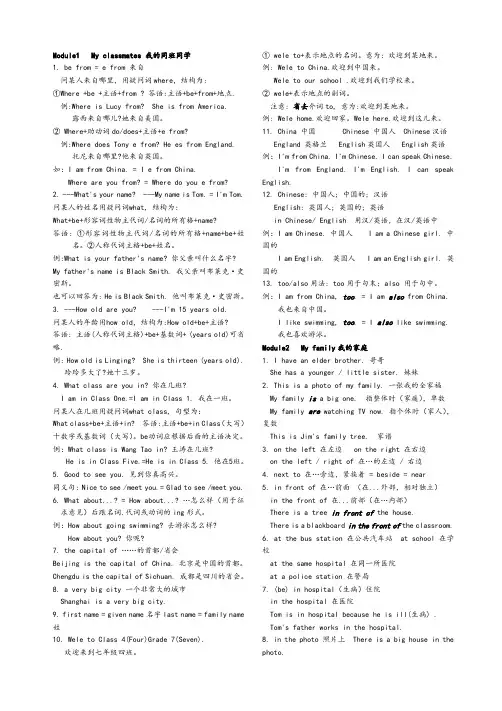
Module1 My classmates 我的同班同学 1. be from = e from 来自问某人来自哪里,用疑问词where ,结构为: ①Where +be +主语+from ? 答语:主语+be+from+地点. 例:Where is Lucy from? She is from America.露西来自哪儿?她来自美国。
② Where+助动词do/does+主语+e from?例:Where does Tony e from? He es from England.托尼来自哪里?他来自英国。
如:I am from China. = I e from China.Where are you from? = Where do you e from? 2. ---What's your name? ---My name is Tom. = I'm Tom. 问某人的姓名用疑问词what, 结构为:What+be+形容词性物主代词/名词的所有格+name? 答语: ①形容词性物主代词/名词的所有格+name+be+姓名。
②人称代词主格+be+姓名。
例:What is your father's name? 你父亲叫什么名字? My father's name is Black Smith. 我父亲叫布莱克·史密斯。
也可以回答为: He is Black Smith. 他叫布莱克·史密斯。
3. ---How old are you? ---I'm 15 years old. 问某人的年龄用how old ,结构为:How old+be+主语? 答语: 主语(人称代词主格)+be+基数词+ (years old)可省略.例: How old is Linging? She is thirteen (years old). 玲玲多大了?她十三岁。
外研版七年级英语上册M1-10重点知识大全
外研版七年级英语上册M1-10重点知识大全Module1 My classmates重要知识点讲解Unit 1一、be动词的用法[点拨]1.be动词有三种形式: am, is, are,都是“是”的意思。
be动词与不同人称搭配:我(I)用am,你(you)用are; is用于他(he)她(she)它(it);单数is,复数are。
2.be动词的否定形式表达肯定句改为否定句时,直接在be动词后加not构成。
He is a teacher.他是一名老师。
(肯定句)He is not a teacher.他不是一名教师。
(否定句)3.be动词的一般疑问句表达陈述句改为一般疑问句时直接将be动词提到主语之前构成。
He is a teacher.他是一名老师。
(肯定句)Is he a teacher.他是一名教师吗?(疑问句)肯定回答:Yes, he is.是的,他是。
否定回答:No, he isn’t.不,他不是。
二、询问对方来自哪里的句型-Where are you from? 你来自哪里?-I'm from Beijing.我来自北京。
[点拨]"Where + be + 主语+ from?"意为“...来自哪里/是哪里人?”,多用于询问国籍/籍贯。
回答为“主语+be from+地点”。
be from意为“来自”,其中的be动词要随主语人称和数的变化而变化。
三、用于确定对方国籍的句型-Hi, are you English too?嘿,你也是英国人吗?-No, I’m not. I’m American and my name is Betty King. 不,我不是。
我是美国人,我叫贝蒂·金。
[点拨]"Are you+国籍?"通常在没有把握确定对方国籍时用此句型。
该句是一般疑问句,肯定回答用“Yes,I am.”否定回答用“No,I'm not.”。
最新外研版七年级英语上册各单元知识点汇总(全册)
最新外研版七年级英语上册各单元知识点汇总(全册)MODULE 1一、同义句1.My name's Daming. = I'm Daming.2.I'm from England. = I come from England.3.Are you a new student.?= Are you new?4.Nice to meet you. = Nice to see you. =Glade to meet you. = Glade to see you.5.What's your name. = May I have your name ?6.Welcome to +地点二、用法集萃—What's your name.—How old are you?—My name is ....— Where do you come from?—I come from...—I'm twelve years old.—I’m 12.—Where are you from?—What class are you in?—I'm from...—I'm in Class One, Grade One.—What about ...?—What about doing ...?=How about doing ...?With 和 andJim and Lily go to the bank.(and 表并列)Jim with Lily goes to the bank.(with 是介词,和...一起,动词的形式 要与 with 前面的主语一致)三 语法专项。
Be 动词用法口诀我用 am 你用 are,is 跟着他,她,它. 单数名词用 is ,复数名词全用 are. 变疑问,往前提,句末问号莫丢弃。
变否定,更容易,be 后 not 莫忘记。
否定疑问任你变,句首大写莫迟疑。
外研版英语七年级上册知识点汇总归纳23页
外研版英语七年级上册知识点汇总归纳Starter 01-02 模块大盘点单词必背名词:class同学;班级name名字teacher老师friend朋友book 书tomorrow明天hand手student学生boy男孩girl女孩desk桌子chair椅子bag包,书包代词:my我的what什么your你的;你们的you你,你们it它this这She她his他的her她的数词:one一two二three三four四five五six六seven七eight八nine九ten十eleven十一twelve十二thirteen十三fourteen十五seventeen十七eighteen十八nineteen十九twenty二十动词:spell拼写thank谢谢meet遇见,结识go走;去see看见sit坐Open(打)开listen听,倾听draw绘画,画put 放,置stand站立Close合上;关闭词组必背句型必背人称代词人称代词用来代替上文提到的人或事物。
人称代词分为主格和宾格两种形式。
主格用作主语,宾格用作宾语。
Be动词与人称代词主格搭配be动词的一般现在时形式有三种,即am,is和are。
be动词在句中的形式取决于句子主语的人称和数。
21世纪教育网版权所有I am fine ,thank you.我很好,谢谢你He ’s my teacher.他是我的老师How are you ,Tom ? Starter 03-04 模块基础知识单词必背名词:blackboard 黑板 pen 笔,钢笔 bird 鸟 cat 猫 dog 狗 flower 花Classroom 教师 orange 柑橘,橙 colour 颜色day 一天 today 今天 weather 天气Birthday 生日 spring 春天 summer 夏天 autumn 秋天 winter 冬天 basketball 篮球Football 足球 swimming 游泳 sport 运动 school 学校 idea 注意,想法形容词:welcome 受欢迎的 black 黑色的 white 白色的 blue 蓝色的 green 绿色Yellow 黄色的 red 红色的 brown 棕色的 orange 橘色的 favourite 最喜爱的Warm 暖和的,温暖的 hot 热的 cool 凉快的 cold 冷的词组必背情态动词1.can是情态动词,意思“能,能够”没有人称和数的变化,不能单独作谓语,必须与后面的动词原形共同构成谓语。
外研版七年级英语上册重点知识点复习归纳
外研版七年级英语上册重点知识点复习归纳module1一、同义句1.myname'sdaming.=i'mdaming.4.很高兴见到你很高兴见到你很高兴见到你很高兴见到你。
5.你叫什么名字也许我有你的名字。
2、特殊疑问句―what'syourname.―howoldareyou?=canyoutellmeyourage?―mynameis....=what's yourage?―i'mtwelveyearsold.―whereareyoufrom?―whatclassareyouin?―我来自……―我是一年级一班。
3、词组1.practise+dingsth.2.与银行合作。
A到银行去。
4、形容词所有格代词i--myyou--yourhe--hisshe--herit--itswe--ouryou--yourthey--them模块2 I.词汇职业:doctormanagersecretaryworkerteacher工作地点:工厂医院酒店办公室学校大学二。
短语:像篮球一样的\\马靴球说英语\\日语\\中文播放Tenniss(asong)表格Tennis WimthePianoappoto\\PictureOfMyFamily Factory Esciences University两所大学的秘书处III.语法(can)candosthican\\can'trideabike.canyourideabike?yes,ican.\\no,ican't.四、句子你的。
你怎么办你是什么sjob?=你的。
?他和sheisa。
他们是。
module3一、言语3.numbers:thirteenfourteenfifteensixteenseventeeneighteennineteenthirtyfortyfi ftysixtyseventyeightyninety4.介词:nextto≈nearbehind≠infrontofinonunder5.infrontof:在......前面在前面:在里面前面6右正确≠ 对不对≠ 左边二、语音er、or、ur发/?/三、语法(therebe)----有学校办公室吗?thereissomemeatandtwoappleonthedesk.2.名词所有格:米斯利·谢雷格:lilyandlucy's两人共有的lilyandlucy'sfather.莉莉和露西的路module4一、familymembers:阿姨克莱奶奶奶奶奶奶奶奶奶奶奶奶奶奶奶奶奶奶奶奶奶奶妹妹弟弟二世。