
2019-2020年人教版英语七年级下册 Unit6-7单元知识点总结
2019-2020学年人教版英语七年级下册Unit6-7单元知识点总结Unit 6 I’m watching TV一、词组、短语及用法1. 现在进行时态的构成:主语+ be+ v-ing表示此时此刻正在发生或正在进行的动作2. do one’s homework (此处的do是“做”的意思)3. talk on the phone 打电话,在电话中交谈4. watch look see read 的大致区别:watch 观看,看watch TV 看电视watch a football game 看一场足球比赛see 看见(看的结果)I can see the bird in the tree.look 看(看的动作)Please look at the blackboard.read 阅读,读书,读报She is reading a story.5. wait for sb /sth 等侯某人/某物I am waiting for you.6. all 、also 、often 、never 等副词应该放在be动词,情态动词及助动词之后,行为动词之前。
He never stop talking. I often get up at six.例如:We are all students. The boys can also swim.They all like English. Lions also come from South Africa.7.thanks for sth 谢谢某物Thanks for your letter. thanks for doing sth 谢谢做了某事Thanks for joining us.8. some of + 宾格代词(us / you /them )some of us 我门当中的一些人Some of +名词复数some of the students 一些学生9. in the first /second /next / last photo 在第一/第二/下一个/最后一张照片里10. be with sb 与某人一起He is with his parents. 他和他的父母在一起。
with 是一个介词,with短语不能做主语:请区别以下两个句子:Tom with his friends is playing soccer. Tom and his friends are playing soccer.二、句型(1)-What+be+主语+doing? 正在做什么?-主语+be+doing…正在做某事。
例:-what are you doing? -I’m doing my homework.(2)-Thanks for …为。
而感谢例:Thanks for your letter. (3)-Here are/is…例:Here are some of my photos.Here is a photo of my family. (4)-That sounds good. (5)-This TV show is boring.三、语法Ⅰ现在进行时的用法表示现在(说话瞬间)正在进行或发生的动作Ⅱ现在进行时时间状语及标志性词①now 现在②at this time 在这时③at the moment 现在④look 看(后面有“!”)⑤listen 听(后面有“!”)Ⅲ现在分词的构成①一般在动词结尾处加ing Eg: go—going look--looking②以不发音字母e结尾的动词,去e加ing。
Eg: write—writing close--closing③以重读闭音节结尾的动词,如果末尾只有一个辅音字母,应先双写这个字母,再加ing. Eg: get—getting run—running (swim, run, put,get,sit,begin)Ⅳ现在进行时的构成肯定句: 主语+ am/is/are+ doing +其他+时状. Eg: He is doing his homework now.否定句:主语+am/is/are +not+ doing+其他+时状. Eg: He is not doing his homework now.一般疑问句:Am/Is/Are +主语+ doing+其他+时状?Eg: Is he doing his homework now?特殊疑问词+is/am/are+主语+现在分词+其他? 例:What is your brother doing?肯定回答:Yes,主语+am/is/are Eg:Yes, he is.否定回答:No, 主语+am not/isn’t/aren’t Eg: No, he isn’t.Unit 7 It’s raining知识点讲解1、rain①I like walking in the rain.②It is going to rain.rain可用作名词,意为“雨水”,通常用作不可数名词;也可用作动词,意为“下雨”,通常用it作主语。
rainy是rain的形容词形式,意为“阴雨的;多雨的”。
如:What do you usually do in the rainy weather?2、How's the weather?①一How's the weather today?一It's cloudy②一How is the weather in Beijing?一lt's raining.询问天气的句型及其答语.--How’s the weather ? 天气怎么样?-- It’s cloudy./It’s sunny./It’s raining.多云./晴天./在下雨.(1)询问天气的句型:常见的询问天气的句型有:How’s the weather? What's the weather like? What’s the weather like ?两个句型后面都可以加“in+ 地点”,用以询问“某地天气如何”(2)回答天气状况回答询问天气的问句时,通常用:“It’s +表示天气的形容词”。
常见的该类形容词有:fine(晴朗的) dry(干燥的) warm(温暖的) cold( 寒冷的) cool(凉爽的) hot(炎热的)rainy(下雨的) snowy(下雪的) sunny(晴朗的) cloudy(多云的)等。
同时也可以用现在进行时进行回答:It’s raining/snowing. 正在下雨/ 下雪。
例句: --How’s the weather in your city?—It’s warm.--What’s the weather like in Shanghai?—It’s raining now.3、againIs Lisa talking on the phone again?again用作副词意为“再一次;又一次”,常用来修饰动词,表示动作再一次发生,一般用于句尾。
again的常用短语有:again and again 一再地once again 再一次She tells her son again and again not to do that.4、visit①I'm also visiting some of my old friends.②She wants to visit Tian'anmen Square this weekend.visit用作及物动词时,意为“拜访;参观visit也可用作名词,意为“参观;看望”,其后常接介词to,其常用短语为:have / pay a visit to ...,意为“参观某地/拜访某人”。
It's my first visit to the history museum.This afternoon, we pay a visit to Mr.White.5、hardAre you studying hard, or are you having fun?hard可用作副词,意为“努力地”,常用来修饰动词。
hard还可以用作形容词,意为“困难的”,常用在名词前作定语或be动词后作表语。
This is a hard question. It's hard to find a good job.6 常见的打电话用语It’s Steve.“我是史蒂夫。
”是打电话的常用语。
在打电话时一般用it或this表示“我”,that表示“你”,而不用I和you来表示。
---Hi, is that Laura? ---No, it’s / this is her mother.打招呼:Hello!/Hi!找某人接电话:May/ Could/ Can I speak to...? 我可以和......通电话吗?I’d like to speak to ...我想和......通电话。
询问对方是谁及其答语:---Who’s that (speaking)? 你是谁?/谁在讲话?---This is ...(speaking). 我是......---Is that ...(speaking)? 你是......吗?/是......在讲话吗?---Yes, this is ... (speaking) 是的,我是....../是的,......在讲话。
请求某人稍等:Hold on for a moment.等一会儿。
为某人稍口信:Could I take a message? 我可以捎个口信吗?7. ---How’s it going? 最近怎么样?---Not bad, thanks. 还不错,谢谢。
用法:How’s it g oing ?=How is everything?常用答语有:Great! 好极了!Not bad!还不错!Terrible! 糟糕透了!Pretty good! 相当好!Just so-so! 一般般8、反意疑问句。
反意疑问句即附加疑问句,用来询问对方的看法或对某事没有把握需要对方证实。
反意疑问句由两部分组成:“陈述句+简短的疑问句”,两部分的人称及时态应保持一致。
反意疑问句遵循以下原则:a) 陈述部分肯定+疑问部分否定b) 陈述部分否定+疑问部分肯定。
It’s rainy today, isn’t it? 今天下雨,不是吗?Tom didn’t like vegetables, did he? 汤姆不喜欢蔬菜,是吗?---They work hard, don’t they? 他们工作努力,不是吗?---Yes, they do / No, they don’t. 是的,他们工作努力。
2019-2020年人教版英语七年级下册Unit6 I’m watching TV 知识点与练习(
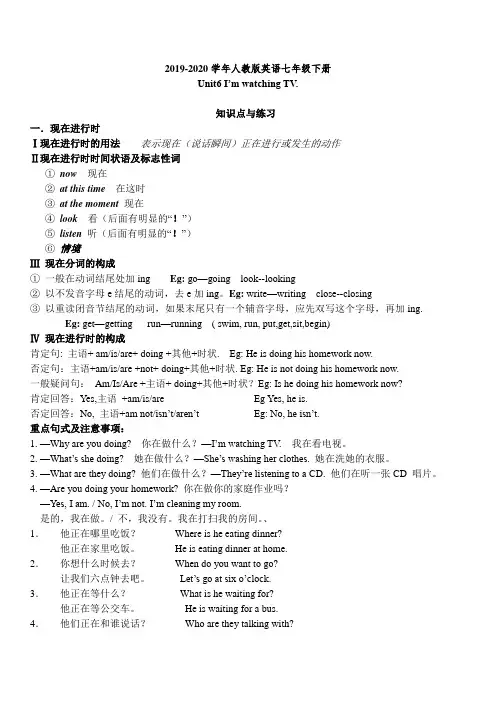
2019-2020学年人教版英语七年级下册Unit6 I’m watching TV.知识点与练习一.现在进行时Ⅰ现在进行时的用法表示现在(说话瞬间)正在进行或发生的动作Ⅱ现在进行时时间状语及标志性词①now现在②at this time 在这时③at the moment 现在④look 看(后面有明显的“!”)⑤listen听(后面有明显的“!”)⑥情境Ⅲ现在分词的构成①一般在动词结尾处加ing Eg: go—going look--looking②以不发音字母e结尾的动词,去e加ing。
Eg: write—writing close--closing③以重读闭音节结尾的动词,如果末尾只有一个辅音字母,应先双写这个字母,再加ing.Eg: get—getting run—running ( swim, run, put,get,sit,begin)Ⅳ现在进行时的构成肯定句: 主语+ am/is/are+ doing +其他+时状. Eg: He is doing his homework now.否定句:主语+am/is/are +not+ doing+其他+时状. Eg: He is not doing his homework now.一般疑问句:Am/Is/Are +主语+ doing+其他+时状?Eg: Is he doing his homework now?肯定回答:Yes,主语+am/is/are Eg Yes, he is.否定回答:No, 主语+am not/isn’t/aren’t Eg: No, he isn’t.重点句式及注意事项:1. —Why are you doing? 你在做什么?—I’m watching TV. 我在看电视。
2. —What’s she doing? 她在做什么?—She’s washing her clothes. 她在洗她的衣服。
3. —What are they doing? 他们在做什么?—They’re listening to a CD. 他们在听一张CD 唱片。
2019-2020年人教版英语七年级下册Unit6 单元知识点复习
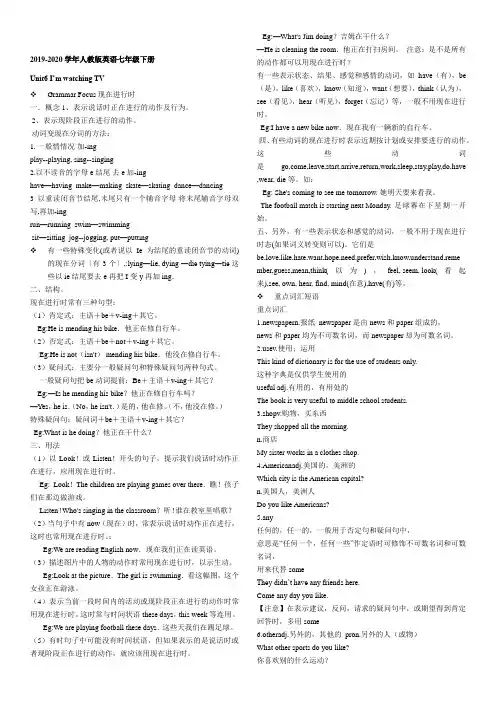
2019-2020学年人教版英语七年级下册Unit6 I’m watching TV❖Grammar Focus现在进行时一.概念1、表示说话时正在进行的动作及行为。
2、表示现阶段正在进行的动作。
动词变现在分词的方法:1. 一般情情况加-ingplay--playing, sing--singing2.以不读音的字母e结尾去e加-inghave—having make—making skate—skating dance—dancing3以重读闭音节结尾,末尾只有一个辅音字母将末尾辅音字母双写,再加-ingrun—running swim—swimmingsit—sitting jog--jogging, put—putting❖有一些特殊变化(或者说以Ie为结尾的重读闭音节的动词)的现在分词〔有3个〕,:lying—lie, dying ―die tying―tie这些以ie结尾要去e再把I变y再加ing.二、结构。
现在进行时常有三种句型:(1)肯定式:主语+be+v-ing+其它。
Eg:He is mending his bike.他正在修自行车。
(2)否定式:主语+be+not+v-ing+其它。
Eg:He is not(isn't) mending his bike.他没在修自行车。
(3)疑问式:主要分一般疑问句和特殊疑问句两种句式。
一般疑问句把be动词提前:Be+主语+v-ing+其它?Eg:—Is he mending his bike?他正在修自行车吗?—Yes,he is.(No,he isn't.)是的,他在修。
(不,他没在修。
)特殊疑问句:疑问词+be+主语+v-ing+其它?Eg:What is he doing?他正在干什么?三、用法(1)以Look!或Listen!开头的句子,提示我们说话时动作正在进行,应用现在进行时。
Eg: Look!The children are playing games over there.瞧!孩子们在那边做游戏。
七下英语六单元知识点总结
七下英语六单元知识点总结Title: A Comprehensive Review of Unit 6 in 7th Grade English.Unit 6 in 7th grade English covers a range of important language concepts and skills. The focus of this unit is on present continuous tense, as well as exploring different activities and hobbies that students may engage in. Let's delve into the key points of this unit in detail.1. The Present Continuous Tense.The present continuous tense is a key grammatical concept introduced in Unit 6. It is used to describe actions that are happening right now or at the moment of speaking. This tense is formed by using the present form of the verb 'to be' (am, is, are) followed by the present participle (-ing form) of the main verb. For example: "I am studying" or "She is singing."Students learn to recognize and use this tense in different contexts, such as when asking what someone is doing at a particular moment: "What are you doing?" or when describing their own or someone else's current activities: "I am watching TV" or "He is playing football."2. Describing Activities and Hobbies.Unit 6 also focuses on describing different activities and hobbies that students may have. This involves using vocabulary related to various sports, hobbies, and daily routines. Students learn to express their likes and dislikes, as well as describe what they are doing in their free time.Some of the key vocabulary introduced in this unit includes words like 'reading a newspaper,' 'using the Internet,' 'going to the movies,' 'doing homework,' and more. Students practice using these words in sentences to communicate their activities and hobbies effectively.3. Useful Expressions and Phrases.In addition to grammar and vocabulary, Unit 6 also introduces several useful expressions and phrases that help students communicate more fluently. These expressions cover a wide range of topics, including expressing surprise, asking for clarification, and making suggestions.For example, students learn to use expressions like "What are you doing?" to ask about someone's current activity, and "I'd love/like to do sth." to express their desire to do something. They also learn phrases like "any other" to compare things, and "wish to do sth." to express their desires or wishes.4. Practical Applications.Throughout Unit 6, students are encouraged to apply their knowledge of grammar, vocabulary, and expressions to real-world scenarios. This helps them understand the practical value of learning English and how they can use it to communicate effectively in daily life.For instance, students might be asked to describe their daily routine, their favorite hobbies, or what they are doing at a particular moment. By doing so, they not only practice their language skills but also gain a deeper understanding of how English is used in everyday contexts.5. Conclusion.In conclusion, Unit 6 in 7th grade English is a rich and diverse unit that covers a wide range of language concepts and skills. It focuses on the present continuous tense, describing activities and hobbies, useful expressions and phrases, and practical applications.By mastering these concepts, students will be able to communicate more fluently and effectively in English, whether it's describing their current activities, expressing their likes and dislikes, or simply engaging in meaningful conversations with their peers.Moreover, the practical applications and real-world scenarios introduced in this unit help students appreciatethe value of learning English and understand its importance in their daily lives. This, in turn, motivates them to continue learning and improving their language skills, making Unit 6 a crucial milestone in their English learning journey.。
2019-2020年人教版英语七年级下册Unit6 I'm watching TV单元知识点(含习题
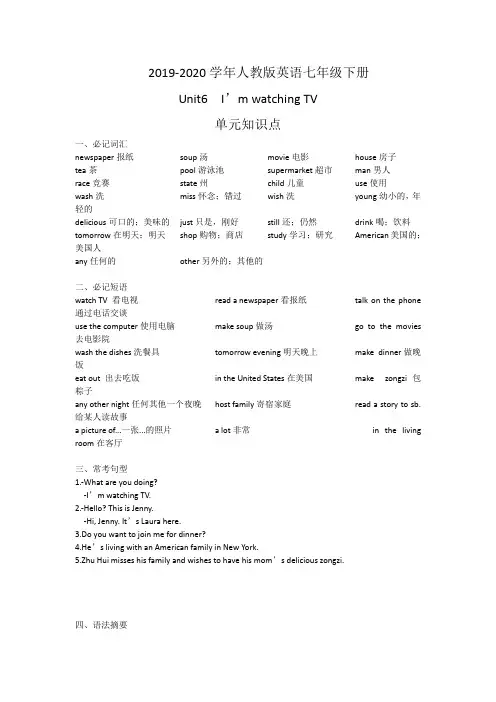
2019-2020学年人教版英语七年级下册Unit6 I’m watching TV单元知识点一、必记词汇newspaper报纸soup汤movie电影house房子tea茶pool游泳池supermarket超市man男人race竞赛state州child儿童use使用wash洗miss怀念;错过wish洗young幼小的,年轻的delicious可口的;美味的just只是,刚好still还;仍然drink喝;饮料tomorrow在明天;明天shop购物;商店study学习;研究American美国的;美国人any任何的other另外的;其他的二、必记短语watch TV 看电视read a newspaper看报纸talk on the phone 通过电话交谈use the computer使用电脑make soup做汤go to the movies 去电影院wash the dishes洗餐具tomorrow evening明天晚上make dinner做晚饭eat out 出去吃饭in the United States在美国make zongzi包粽子any other night任何其他一个夜晚host family寄宿家庭read a story to sb.给某人读故事a picture of...一张...的照片 a lot非常in the living room在客厅三、常考句型1.-What are you doing?-I’m watching TV.2.-Hello? This is Jenny.-Hi, Jenny. It’s Laura here.3.Do you want to join me for dinner?4.He’s living with an American family in New York.5.Zhu Hui misses his family and wishes to have his mom’s delicious zongzi.四、语法摘要重点:现在进行时的定义、结构、标志词及动词ing形式的变化规则。
七年级英语下册u6知识点梳理

七年级英语下册u6知识点梳理在七年级英语的下册中,第六单元是一个关于“幸福的秘诀”的主题。
这个话题涉及到了很多不同的知识点和概念,因此理解这些知识点是非常重要的。
在本篇文章中,我们将简单回顾并梳理这个单元中的所有英语知识点。
词汇:1.幸福 (happiness)2.秘诀 (secret)3.纪念 (memorial)4.家族 (family)5.讨论 (discussion)6.分享 (share)7.自由 (freedom)8.快乐 (joy)9.健康 (health)10.资料 (information)11.喜悦 (delight)12.忧虑 (concern)13.信仰 (faith)14.成功 (success)15.贡献 (contribution)16.友情 (friendship)17.耐心 (patience)18.宽容 (tolerance)19.理解 (understanding)20.尊重 (respect)句型:1. What makes you happy? (什么使你感到幸福?)2. I think that…(我认为……)3. How do you share your happiness with others? (你如何与别人分享你的幸福?)4. I believe that…(我相信……)5. In my opinion, …(在我看来,……)6. What is the secret to happiness? (幸福的秘诀是什么?)7. I am concerned about…(我很关心……)8. Do you believe in destiny? (你相信命运吗?)9. I respect people who…(我尊重那些……的人)语法:本单元的语法知识点主要包括现在进行时和不定式的用法。
现在进行时:现在进行时表示现在正在进行的动作。
例如:I am studying English.(我正在学习英语。
七年级下 英语 Unit 6-7
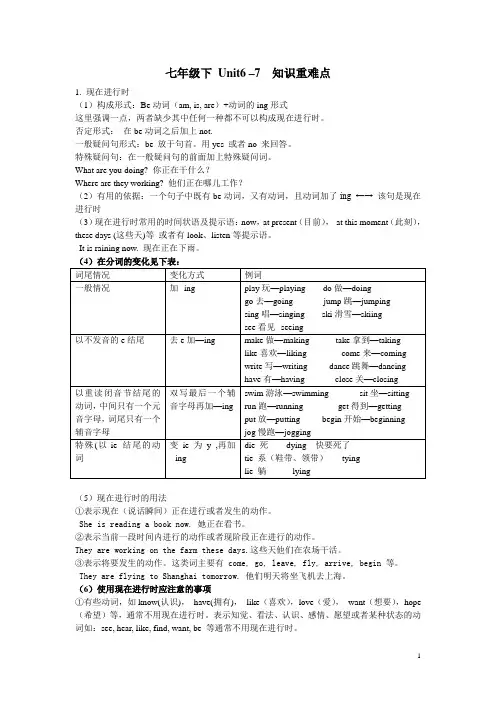
七年级下Unit6 –7 知识重难点1. 现在进行时(1)构成形式:Be动词(am, is, are)+动词的ing形式这里强调一点,两者缺少其中任何一种都不可以构成现在进行时。
否定形式:在be动词之后加上not.一般疑问句形式:be 放于句首。
用yes 或者no 来回答。
特殊疑问句:在一般疑问句的前面加上特殊疑问词。
What are you doing? 你正在干什么?Where are they working? 他们正在哪儿工作?(2)有用的依据:一个句子中既有be动词,又有动词,且动词加了ing ←→ 该句是现在进行时(3)现在进行时常用的时间状语及提示语:now,at present(目前),at this moment(此刻),these days (这些天)等或者有look、listen等提示语。
It is raining now. 现在正在下雨。
(4)在分词的变化见下表:(5)现在进行时的用法①表示现在(说话瞬间)正在进行或者发生的动作。
She is reading a book now. 她正在看书。
②表示当前一段时间内进行的动作或者现阶段正在进行的动作。
They are working on the farm these days.这些天他们在农场干活。
③表示将要发生的动作。
这类词主要有 come, go, leave, fly, arrive, begin 等。
They are flying to Shanghai tomorrow. 他们明天将坐飞机去上海。
(6)使用现在进行时应注意的事项①有些动词,如know(认识),have(拥有),like(喜欢),love(爱),want(想要),hope (希望)等,通常不用现在进行时。
表示知觉、看法、认识、感情、愿望或者某种状态的动词如:see, hear, like, find, want, be 等通常不用现在进行时。
e.g. I am wanting to go to America. ( )I want to go to America. ( )②使用现在进行时易出的错误:A.在现在进行时的构成上忘记写be: I working near the house.应改为:I am working near thehouse.B.忘记写-ing形式:She is stand near a tree.应改为She is standing near a tree.C.忘记某些动词的-ing形式的特殊变化:He is siting in a boat.应改为He is sitting in a boat.2. 【辨析】表示时间的on, in, 与at①在一天中的早上、下午、晚上,或者周、年、季节前用in.in summer 在夏天in the morning/ afternoon / evening 在早晨/下午/晚上②具体到某一天或者某一天的早上、下午、晚上用on.on Saturday 在周六on the evening of Friday 在星期五的晚上③在几点钟前用atat six in the morning 在早上6点at three in the afternoon 在下午3点钟(7)现在进行时和一般现在时用法的差异一般现在时表示现在的状态;表示经常性或习惯性的动作;表示主语具备的性格和能力等。
人教版七年级英语下册第6单元重点知识总结
Unit6 单元知识归纳总结一、重点短语1. any other night 其他任何一个晚上一样2. clean the house 打扫房子3. drink tea 喝茶4. eat out 出去吃饭5. every night 每个晚上6. go to the movies 去电影院7. his host family 他的寄宿家庭8. in the mornings 在(每天)早上9. join me for dinner和我一起吃晚饭10.listen to a CD 听唱片11. live with an American family 和一个美国家庭住在一起12. make soup做汤13. miss his family 想念他的家人14.not much 没什么事15.on Mondays 在每周一16.read a newspaper 看报纸17.read a story to her young children 念故事给她年幼的孩子们听18.see you tomorrow明天19. shop at the supermarket 在超市购物20.study for a test为考试而学习21. study in the United States 在美国学习22. swim in a river 在河里游泳23. talk on the phone 打电话24. the night before the festival 节日前的晚上25. think about 考虑26. use the/a computer用电脑27. wash the dishes 清洗餐具28. watch the boat races on TV看电视上的划船比赛29 . wish to do sth. 想要做某事30. wish sb. to do sth. 希望某人做某事二、重点句型1.—What's he doing?他在做什么?—He's using the computer.他在用电脑。
Unit6单元知识点归纳总结--人教版七年级英语下册
Unit 6 知识归纳重点短语read a newspaper 看报纸in the/a newspaper 在报纸上use the puter 使用电脑shop for sth. 购买……shopping center 购物中心(dragon) boat races 龙舟赛wash the dishes / clothes 洗餐具 / 衣服go to the movies 去电影院;去看电影eat out 出去吃饭take out 拿出,取出work out 计算出,解决drink tea 喝茶make soup 做/煮汤in the living room 在客厅host family 寄宿家庭each other 互相,彼此just now 刚才right now 现在,立刻,马上in the swimming pool 在游泳池里Dragon Boat Festival 端午节study/work hard 努力学习the day after tomorrow 后天tomorrow evening 明天晚上join sb. for sth. 与某人一起做某事use sth. to do sth. 用……来做某事read a story to sb. 给某人读故事listen to the radio 听收音机study for a test 为考试学习;备考talk show 脱口秀,谈话节目talk to / with sb. on the phone 跟某人通talk to / with sb. on QQ/Wechat 跟某人QQ/微信聊天any other+单数名词其他任何一个……;任何其他的……I’ d love/like to do sth. 我很乐意做某事。
wish to do sth. 希望做某事wish sb. to do sth. 希望某人做某事Not much. 没做什么(没什么事儿)。
2019-2020年人教版英语七年级下册Unit6-7单元知识点总结
2019-2020学年人教版英语七年级下册Unit6-7单元知识点总结Unit 6 I’m watching TV一、词组、短语及用法1. 现在进行时态的构成:主语+ be+ v-ing表示此时此刻正在发生或正在进行的动作2. do one’s homework (此处的do是“做”的意思)3. talk on the phone 打电话,在电话中交谈4. watch look see read 的大致区别:watch 观看,看watch TV 看电视watch a football game 看一场足球比赛see 看见(看的结果)I can see the bird in the tree.look 看(看的动作)Please look at the blackboard.read 阅读,读书,读报She is reading a story.5. wait for sb /sth 等侯某人/某物I am waiting for you.6. all 、also 、often 、never 等副词应该放在be动词,情态动词及助动词之后,行为动词之前。
He never stop talking. I often get up at six.例如:We are all students. The boys can also swim.They all like English. Lions also come from South Africa.7.thanks for sth 谢谢某物Thanks for your letter. thanks for doing sth 谢谢做了某事Thanks for joining us.8. some of + 宾格代词(us / you /them )some of us 我门当中的一些人Some of +名词复数some of the students 一些学生9. in the first /second /next / last photo 在第一/第二/下一个/最后一张照片里10. be with sb 与某人一起He is with his parents. 他和他的父母在一起。
Unit6单元知识点总结人教版七年级英语下册
Unit6 I'm watching TV 知识点总结一、短语read a newspaper = read newspapers 看报 on the phone 通过on the radio 通过收音机on the puter 在电脑上 on TV 在电视上on the Interet 通过互联网wash the dishes = do the dishes 清洗餐具go shopping = do the/some shopping 去购物go to the movies 去电影院go to the party 去参加聚会go to a meeting 去参加会议go to a concert 去听音乐会not much = nothing much 没什么eat out 出去吃go out 出去玩the day before yesterday 前天the day after tomorrow 后天green tea 绿茶 black tea 红茶lemon tea 柠檬茶iced tea 冰茶talking on the phone with sb 和某人在打二.语法现在进行时:1、含义:表示现在进行或发生的动作,也可以表示当前一段时间内的活动或现阶段正在进行的动作。
eg: I’m doing my homework now.2、句子构成:①肯定句:主语+be+ving+(其他).②否定句:主语+be+not+ving+(其他).③一般疑问句:Be+主语+ ving+(其他)?—Yes,主语+be.(肯定回答)/—No, 主语+be not.(否定回答)④特殊疑问句:特殊疑问词+ be+主语+ ving+(其他)?3、动词变ing变化规则:①直接+ing:standstanding;singsinging;playplaying;gogoing②以不发音的e结尾,去e加ing:writewriting;taketaking;dsncedancing③以重读闭音节结尾且末尾只有一个辅音字母,双写末尾辅音字母加ing:putputting;runrunning;sitsitting;swimswimming;beginbeginning④以ie结尾,变ie为y加ing:diedying;lielying4、标志词(时间状语)①now现在right now立刻;马上at the/this moment此刻(表示此时此刻正在做的事)②these days最近this week这周this month这个月this term本学期(表示现阶段正在进行的动作)③"Look!""Listen!""Be quite!"等(说明事情正在发生,通常用现在进行时)④语境暗示句子用现在进行时态:1、打:— Hello! May I speak to Kate? — Soory,She isn't in. She is playing pingpong outside.2、询问某人在什么地方 Where is Mr. Wang? Oh, he is reading a newspaper in the office.3、描述天气 How's the weather today? It's raining.三重点单词及其相关用法:1、any adj:任何的,任一的pron:任何,任一①any+可数名词单数(用在肯定句中)"任何一个..."指在不同范围内比较Shanghai is bigger than any city in Japan.上海比日本的任何一个城市都大。