
牛津译林版七年级英语下册Unit4FindingyourwayWelcometotheunit教案
7B Unit 4 Finding your way Welcome to the unit
Teaching aims and demands:
New words: follow, path, north, west, south, east, trip
Teaching methods: task-based approach
Teaching task: 1. To introduce the topic of places and transport.
2. To talk about visits and means of transport using mode l sentences. Teaching aids: tape recorder
Teaching procedures:
Ⅰ. Warm-up (presentation)
Ask the students on duty to give us a short report about the Sunshine Town.
Ⅱ. Listening
Listen to the tape, answer my question, “Did Hobo, in fact, know the way?” Help the Ss t o answer.
Listen again, Ss read after the tape recorder, then do some True or False exercises. Ch eck the answers with the whole class.
Language points:
follow me
go up and down
e.g. Let’s go down the hill together.
Don’t be afraid.
e.g. (1) Don’t be late for school.
(2) Don’t play in the street. It’s too dangerous.
be afraid to do. be afraid of sth.. I’m afraid that+从句
e.g. (1) The little girl is afraid to go out in the evening.
(2) Little Tom is afraid of dogs.
(3) I’m afraid that I can’t go with you. I have a lot of work to do.
Ⅲ. Main task
Introduce the topic of place and transport.
Ⅳ. Discussion (task)
Tal k about visits and means of transport using the model sentence ‘---Let’s go to the zoo .---OK. We can go by bus.
Language points:
The zoo is north of Beijing Sunshine Secondary School.
north of south, west, no rth-west, south-west
e.g. The library is south of the classroom.
The playground is west of the classroom.
---How do we get there?
---We can go by bus.
by air/bus/car/bike/underground
Ⅴ.Sum-up
Go through the new words and the language points during this lesson. Ⅵ. Homework
.Review the contents of this lesson.
教后记:。
牛津译林版七年级下册Unit 4《Finding your way》(welcome)教案
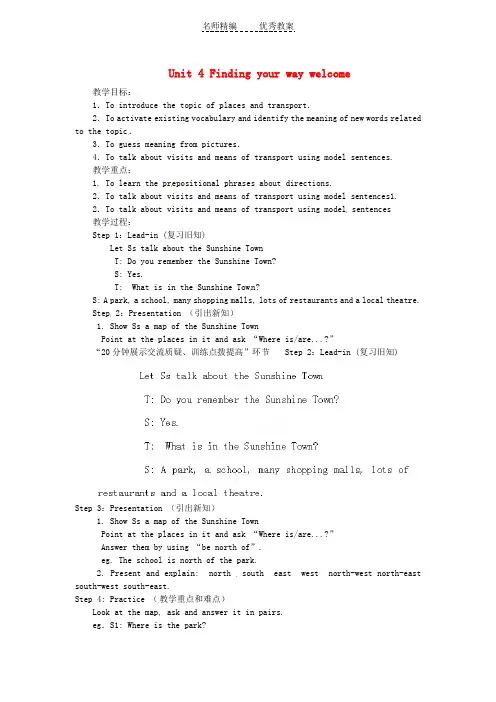
Unit 4 Finding your way welcome教学目标:1.To introduce the topic of places and transport.2.To activate existing vocabulary and identify the meaning of new words related to the topic.3.To guess meaning from pictures.4.To talk about visits and means of transport using model sentences.教学重点:1. To learn the prepositional phrases about directions.2.To talk about visits and means of transport using model sentences1.2.To talk about visits and means of transport using model sentences教学过程:Step 1:Lead-in (复习旧知)Let Ss talk about the Sunshine TownT: Do you remember the Sunshine Town?S: Yes.T: What is in the Sunshine Tow n?S: A park, a school, many shopping malls, lots of restaurants and a local theatre.Step 2:Presentation (引出新知)1. Show Ss a map of the Sunshine TownPoint at the places in it and ask “Where is/are...?”“20分钟展示交流质疑、训练点拨提高”环节Step 2:Lead-in (复习旧知)Step 3:Presentation (引出新知)1. Show Ss a map of the Sunshine TownPoint at the places in it and ask “Where is/are...?”Answer them by using “be north of”.eg. The school is north of the park.2. Present and explain: north south east west north-west north-east south-west south-east.Step 4: Practice (教学重点和难点)Look at the map, ask and answer it in pairs.eg.S1: Where is the park?S2: The park is south-west of the schoo1.S1: Where is the zoo?S2: The zoo is north of t he school.……Step 5: Welcome to the Unit1. T: The Class 1, Grade 7 Ss are planning a class trip. Read the instr uctions. Look at the map and find the places they plan to visit. Then write the numbers in the boxes.2. T: Simon and Daniel are talking about the trip. Listen to the tape and answer these questions.(1) Where are they going for the trip?(2) Where’s the zoo?(3) How will they get there?3. Repeat the conversation after the tape.4. Work in pairs and make dialogues, think of more forms of transport or places they can visit。
牛津译林版英语七下Unit 4《Finding your way》(Welcome to the u
牛津译林版英语七下Unit 4《Finding your way》(Welcome to the unit)教学设计一. 教材分析《Finding your way》是人教版牛津译林英语七年级下的一个单元,主题是关于方向和地点的询问与描述。
本节课的主要内容是通过学习如何描述路线和地点,提高学生的语言运用能力和人际沟通能力。
教材中包含了丰富的图片、对话和活动,为学生提供了充足的语言实践机会。
二. 学情分析七年级的学生已经掌握了基本的英语语法和词汇,对于日常生活中的简单交流已经没有太大问题。
但是,他们在描述具体地点和路线时,可能会存在一定的困难。
此外,部分学生可能对方向感不强,需要在教学过程中加以引导和训练。
三. 教学目标1.知识目标:学生能够掌握描述路线和地点的常用词汇和句型,如:turn left/right, go strght on, take the second/third turning on the left/right等。
2.能力目标:学生能够在实际情境中运用所学语言描述路线和地点,提高人际沟通能力。
3.情感目标:培养学生对探索和发现的兴趣,增强团队协作精神。
四. 教学重难点1.重点:描述路线和地点的词汇和句型。
2.难点:如何在实际情境中灵活运用所学语言进行交流。
五. 教学方法1.情境教学法:通过设定具体的生活场景,让学生在实际情境中学习和使用语言。
2.任务型教学法:通过完成各种任务,培养学生运用英语进行实际交流的能力。
3.小组合作学习:鼓励学生分组进行讨论和实践活动,提高团队协作能力。
六. 教学准备1.准备相关图片和地图,用于展示和练习。
2.准备录音机和磁带,用于播放对话和歌曲。
3.准备教案和教学课件。
七. 教学过程1.导入(5分钟)利用图片和歌曲《London Bridge》引导学生进入话题,激发学生对方向的兴趣。
2.呈现(10分钟)展示一幅学校地图,引导学生观察并找出学校各个场所的位置。
牛津译林七年级英语下unit4 Finding your way welcome Reading2课

the kings of the animal world
Remember that they are dangerous
Never go near them
2021/10/27
Does it sound beautiful?
link v.
Birds make beautiful sounds
when they sing.
Sunshine Zoo
Rule out 1 Showing the way
1. G__o_s_t_ra_i_g_h_t _o_n_, and you will find the Panda House. 2. _W__a_lk__a_lo_n_g_t_h_e_r_o_a_d__. To the north of the Panda House, you will find the lions. 3. _T_u_r_n_l_e_ft___ and to the west of the Lions’ Area, you will find the World of Birds.
3. make sb./sth + adj. 使某人/某物怎么样
Motnhkeeryosfoteftnenmmakaeksehpeerodpaleughhatpepry_.w__a_t_e_r__ flowers.
交朋友 生火 制定计划 做鬼脸
make friends make a fire make plans make faces
4. C__ro_s_s__th_e__b_ri_d_g_e_, and you will see the elephants.
A: How can we get to…? B: … and you will see….
2021年牛津译林版七年级英语下册Unit4 welcome to the unit 课件2

Where do some birds fly in autumn? They fly to the south. Where do they fly in spring? They fly back to the north.
1. A is in the...of B (A在B内部……方位)
江苏在中国的东部。
BA
Jiangsu is in the east of China.
2. A is on the…of B (A与B接壤)
俄罗斯在中国的北部。
A
Russia is on the north of China. B
3. A is to the…of B (A与B不接壤)
3. How will they get there? They'll get there by bus.
Read the conversation after the recorder.
May Day is coming. Our class is going to organize a trip. Please make a plan trip with your partner.
bus
car
train taxi
van[væ n]
underground
plane
Listen and answer questions: 1. Where are they going for the trip?
They're going to Sunshine Zoo.
2. Where's the zoo? It's north of the school.
牛津译林版七年级英语下册Unit4FindingyourwayWelcometotheUnit优质教案
7B Unit4 Finding your way Welcome to the unitTeaching aims and demands:New words: follow, north, north-west, south-westTeaching methods: task-based approachTeaching task: 1. To introduce the topic of places and transport.2. To talk about visits and means of transport using model sentences. Teaching aids: tape recorderTeaching procedures:Ⅰ. Warm-up (presentation)Ask the stud ents on duty to give us a short report about the Sunshine Town.Ⅱ. ListeningListen to the tape, answer my question, “Did Hobo, in fact, know th e way?” Help the Ss to answer.Listen again, Ss read after the tape recorder, then do so me True or False exercises. Check the answers with the whole class.Language points:1.follow me2.go up and downe.g. Let’s go down the hill together.3.Don’t be afraid.e.g. (1) Don’t be late for school.(2) Don’t play in the street. It’s too dangerous.be af raid to do. be afraid o f sth.. I’m afraid that+从句e.g. (1) The little girl is afraid to go out in the evening.(2) Little Tom is afraid of dogs.(3) I’m afraid that I can’t go with you. I have a lot of work to d o.Ⅲ. Main taskIntroduce the topic of place and transport.Ⅳ. Discussion (task)Tal k about visits and means of transport using the model sentence ‘---Let’s go to the zoo .---OK. We can go by bus.Language points:1.The zoo is north of Beijing Sunshine Secondary School.north ofsouth, west, north-west, south-weste.g. The library is south of the classroom.The playground is west of the classroom.2. ---How do we get there?---We can go by bus.by air/bus/car/bike/undergroundⅤ.Sum-upGo through the new words and the language points during this lesson. Ⅵ. Homework.Review the contents of this lesson.教后记:。
牛津译林初中英语七下Unit 4 Finding your way Welcome to the unit教案

7B Unit 4 Finding your way Welcome to the unitTeaching aims and demands:New words: follow, path, north, west, south, east, tripTeaching methods: task-based approachTeaching task: 1. To introduce the topic of places and transport.2. To talk about visits and means of transport using mode l sentences. Teaching aids: tape recorderTeaching procedures:Ⅰ. Warm-up (presentation)Ask the students on duty to give us a short report about the Sunshine Town. Ⅱ. ListeningListen to the tape, answer my question, “Did Hobo, in fact, know the way?” Help the Ss t o answer.Listen again, Ss read after the tape recorder, then do some True or False exercises. Ch eck the answers with the whole class.Language points:follow mego up and downe.g. Let’s go down the hill together.Don’t be afraid.e.g. (1) Don’t be late for school.(2) Don’t play in the street. It’s too dangerous.be afraid to do. be afraid of sth.. I’m afraid that+从句e.g. (1) The little girl is afraid to go out in the evening.(2) Little Tom is afraid of dogs.(3) I’m afraid that I can’t go with you. I have a lot of work to do.Ⅲ. Main taskIntroduce the topic of place and transport.Ⅳ. Discussion (task)Tal k about visits and means of transport using the model sentence ‘---Let’s go to the zoo.---OK. We can go by bus.Language points:The zoo is north of Beijing Sunshine Secondary School.north of south, west, no rth-west, south-weste.g. The library is south of the classroom.The playground is west of the classroom.---How do we get there?---We can go by bus.by air/bus/car/bike/undergroundⅤ.Sum-upGo through the new words and the language points during this lesson.Ⅵ. Homework.Review the contents of this lesson. 教后记:。
牛津译林初中英语七下Unit 4 Finding your ways Welcome to the unit》课件
You and your partner are talking about the ways to get to the places in the map. Use Simon and Daniel’s conversation as a model.
OK. We can go by bus Let’s go to the zoo.
Sunshine Zoo is north of Sunshine Middle school.
Go straight on, and you’ll find the Panda house.
…
Travel in Beijing
北京动物园
北 京 朝 阳 公 园
nortHhwest noBrth
Simon goes to the supermarket on foot. 6. They go to the park by bike.
(同义句) They ride a bike to the park.
1.别太确定.我们请老师帮忙吧. Don’t be so sure. Let’s ask the teacher for help.
语文
小魔方站作品 盗版必究
谢谢您下载使用!
更多精彩内容,微信扫描二维码获取 扫描二维码获取更多资源
“手”)
上古时期汉民族以“三”代表多 数,因此用三个相同部件的重叠 来给“众多”的词义特点造字。
这种字书写麻烦,结构不但难看 ,更重要的是,不符合汉字左右 布局的主流结构,因此,有些被 其他字所替代,有些被废弃不用
,成为死字。被替代的有: 羴——膻 掱——扒 鱻——鲜 姦—
—奸 犇——奔 麤——粗 淼——渺 歮——涩 劦——协 馫—
牛津译林初中七年级下册英语 Unit 4 Finding your way Welcome 2课件
▪ Don’t be afraid.
▪ ①祈使句:e.g. (1) 上学不要迟到
▪
(2) 不要再街上踢足球
▪ ②(1) be afraid of (doing) sth. 害怕(做)某事,表示 “怕……”“担心……”
这个小孩怕狗。 The little boy i_s___a__fr_a__id____o_f_____ the dog .
Make a dialogue
A: Let’s go to … B: Good idea. But where is …? A: It’s …of …. B: How can we get there? A: We can get there by….
1.Where are they going?
▪ (2) be afraid to do sth. 害怕做某事,着重指“因害怕而不 敢做某事”。
▪ 夜间他不敢独自外出。 He __i_s___a_f_r_a_i_d__ _t_o_____ go
out alone at night .
▪ (3) be afraid ( that ) 从句表示“引出不好的消息或带有歉
Talk about a trip you want to go on
A: Where are we going for our trip? B: We’re going to … A: Where’s the …? Is it far away from … B: No. It’s north/south/east/west of …,
On top of a hill. 2. How does Hobo go down the hill?
Hobo jumps down. 3. What does the sign “Dogs this way” mean?
牛津译林版英语 七年级下册 Unit 4 Finding your way Welcome to
Unit 4Comic strip and welcome to the unitTeaching Aims:1. Introduce the location and traffic topic.2. Talk about visit and traffic mode3. Distinguish directions.一、初“练”找问题1. Show some pictures to learn some words about different directions.trip path north south east west2. Then read aloud the new words.follow vt. 跟随,效仿path n. 小路,小径north n., adj. &adv. 北,北方west n., adj. &adv. 西,西方south n., adj. &adv. 南,南方east n., adj. &adv. 东,东方trip n. 旅行,旅游kilometre=km n.千米,公里have to 不得不,必须二、精“讲”寻规律Step2. Practise1. Practise in pairs like this to talk about where the place is.A: Where is …?(旅游)?B: It’s north / south/east/west of …2. Ask students to complete Part A on Page 43.Step 3. PresentationPresent some pictures for Ss to learn how to get there. Then ask Ss to make some dialogues.Step 4. Listen and answer1. Listen to part B and answer the following question.Where are they going for their class trip?Where is the zoo?How will they get there?2. Read after the recorder.3. Practice in pairs.4. Act it out.5. Make their own dialogue.Step 5. Learn the conversation1. Listen to the tape and ask:1). Where are Hobo and Eddie standing?2). What does Hobo ask Eddie to do in the picture?3). Do they have to go up the hill again?4).Does Hobo really know the way?2. Act out the conversationStep 6. Explanation1. 方位介词的用法小结2. be afraid of doing sth. 害怕做某事3. be afraid that…三、热“练”谋提升1.Finish the sentences:1) Heilongjiang is in the n_______ of China.2) I know the w____ to the theatre, so please f________ me.3) He is a______ of tigers.4 )It’s raining. He h____ to go to school by bus.2.句型转换:3.抢时记忆:翻译短语Homework:1. Read the text book and learn the new words and phrases by heart.2. Do the exercises in the workbook.。
牛津译林版英语七年级下册Unit4FindingyourwayWelcometo
学习目标学习重难点Unit 4 period 3grammar1.能掌握冠词的用法。
2.能运用方向介词来表达物体的地点。
能灵巧运用方向介词并能表达物体的地点课前预习感悟一.词汇短语里面 ___________3. 在外面 _________ 穿过,横过 ____________ 2. 在 .......1.4.在 ........ 上面 ____________5.在 ........ 下面 ____________6. 指示标 ____________7.在 ......... 上面 ____________8. 长椅 ____________9. 躺在草地上 ___________ 10.看起来像 ________________ 11.在一个开放的地域里 ____________________ 12.穿过桥 _________________________13. 在 ......... 前面 __________________________14.在左侧 /右侧 _____________________15. 坐在长椅上聊天 ___________________________知识点播:1.冠词 a/an/the冠词分为不定冠词和定冠词。
1.不定冠词 a/an.(1)表示一类人或事物, Eg. A plane is a machine that can fly飞.机是一种能飞的机器。
( 2)表示某一类人或事物中的随意一个。
Eg. This is an apple. 这是一个苹果。
His father is a teacher. 我爸爸是一名老师。
( 3)泛指某人或某物,但不详尽说明何人何物。
Eg. I met an old man on my way to school. 我在上学的路上碰到一位老人。
( 4)表示“一个”的意思Eg. He tried to send a picture of a face.他试着发送一张脸部照片。