
人教版七年级下册英语Unit3Howdoyougettoschool?(SectionB
新目标7年级(下)-课课通Unit 3 How do you get to school?Section B & Self Check一、基础知识(一)基本词汇停止________ 越过;横过________江;河________ 村庄,村镇________村民________ 桥________小船________ 离开________害怕;畏惧________ 梦想________真的________ 像;怎么样________ropeway________ 许多________(二)基本短语think of________ 在……和……之间________ come true________地铁站________ 一封电子邮件________一个11岁的男孩________play with my classmates________ ……怎么样________(三)基本句式1. 玛丽想知道他认为旅途怎么样。
Mary wants to know ________ he ________ ________ the trip.2.对许多学生来说,到达学校是容易的。
________ ________ students, ________ ________ ________ ________ get to school. 3.对我来说,他像一位父亲。
He's ________ a father ________ me.4.有一座桥是他们的梦想。
It is their ________ ________ ________ a ________.5. 你认为他们的梦想能实现吗?Do you think their dream can ________ ________?二、根据句意及首字母提示完成句子6. Xi Jinping is about sixty y________ old now.7. There are some long b________ over the big river. People and cars can cross them.8. The Changjiang R_________ is very famous(出名的)in the world(世界).9. The v________ in this village like keeping(饲养)pigs(猪).10. If your dream comes t________, you must be happy.三、用所给词的适当形式填空11. It is easy ________ (read) the story written in English.12. The boat on the river runs very ________ (quick).13. How does Jim get to his ________ (grandparents) home?14. The bus ride is not ________ (bore) , because I can talk to my classmates.15. What about ________ (swim) with us this afternoon?四、单项选择A. howB. whyC. whenD. whether (是否)17. Ken ________ his jacket in the gym. He has to get it back.A. leftB. 1eavesC. is leavingD. was leaving18. -How do you come here? You look tired(累的). -________.A. On bikeB. By bikeC. By a carD. By a train19. -________ do you think of your school life?-It's very exciting (令人兴奋的).A. WhenB. HowC. WhyD. What20. Do you usually go to school ________ bus or ________ foot?A. by; byB. by, onC. on; byD. on; on21. He walks ________ the subway station and takes the subway.A. onB. forC. toD. in22. They cross the river ________.A. by a ropewayB. in a ropewayC. on a ropewayD. at a ropeway23. I walk to school every day, ________ you?A. How areB. How aboutC. How old areD. What are24. What do you ________ the villagers here?A. thinkB. thinksC. think ofD. think over25. ________ is not easy ________ the river. Because the river is too deep(深的).A. That; crossB. It; to crossC. This, to crossD. It's, to cross玉、根据汉语完成句子26. 亲爱的伙伴们,让我们坚持追求梦想, 总有一天我们会梦想成真。
My dear friends, let's hold on to our dreams, and they may just ________ ________ some day.27. 亮亮每天穿过一条大河。
Liangliang ________ a ________ ________ ________ day.28. 你认为你们学校的旅行怎么样?________ ________ ________ ________ ________ your school trip?29. 对许多学生来说,去上学是一件容易的事情。
It is ________ ________ many students ________ ________ to school.30. 我害怕乘索道离开这个村庄。
I'm afraid to ________ the ________ ________ the ropeway.六、按要求改写句子31. What do you think of the story?(改为同义句)________ do ________ ________ the story?32. I am fourteen years old. What about your sister?(改为同义句)I am fourteen years old. ________ ________ your sister?33. It is about ten minutes' walk from my home to school. (对画线部分提问)________ ________ ________ ________ from ________ home to school?34. Miss Yang takes a bus to her daughter's home.(改为同义句)35. The students can't go to school by boat because the river runs quickly.(对画线部分提问)________ ________ the students ________ a boat to school?七、阅读理解Mary always takes a bus to school. She likes talking with her friends on the bus. It's three miles from her home to school and it takes about ten minutes.Tom usually walks to school. It takes about half an hour. But sometimes he rides his bike. It takes about 15 minutes by bike. He can also take the school bus, but he doesn’t like it. It's boring.根据短文内窖,判断正(T)误(F)36. Mary always walks to school.37. It's three miles from Mary's home to her school.38. It takes Tom about half an hour to walk to school.39. Tom can't take the school bus.40. Tom thinks the bus ride is boring.八、任务型阅读Different(不同的)people go to work or go to school in different ways (方式) in different places(地方)①. Some people go to work by train. Some people take buses to work②.Many people and students in Beijing usually take the subway to work or to school. The migrant workers(流动工人) and their children in big cities (城市)usually go to work or go school by bus or by bike. Some of them often ride motorbikes(摩托车)or walk to work. In some villages of China, children usually walk to school. Some go to school on a ropeway③. Some even climb(爬) ladders(梯子)to leave their village to school. There is no road(路) between their village and school.任务一:把文中画线部分句子①翻译成汉语41.________________________________________任务二:棍据短文内容,回答问题42.How do many people and students in Beijing usually go to work or school?________________________________________________43. How many kinds of transportation(运输工具)are mentioned in the passage(短文)?________________________________________________任务三:写出画线部分句子②的同义句44. ________________________________________________任务四:画线单词③的含义是45.________________________________九、书面表达根据下面精英中学七年级(1)班学生上学方式的调查表,用英语写一篇短文。
人教版七下Howdoyougettoschool单元话题写作课

你的美国朋友Jack已经了解了三位好友的到校方式,也想 了解你的,请以电子邮件的形式向他介绍自己到校的方式。
1. When do you leave home? 2. How do you get to school? 3. How long does it take? 4. How far is it from your home to
大家有疑问的,可以询问和交流
可以互相讨论下,但要小
E-mail 1
1. When does Li Ping leave home? 2. How does she get to school? 3. How long does it take? 4. How far is it from her home to school? 5. Does she like her trip to school?
E-mail 2
1. When does Zhang Jun leave home? 2. How does he get to school? H3e. uHsouwalllyor_ni_dg_e_ds_oh_ei_ss_bi_it_kt_ea_tk_o_es?_c_h_o_o_l_. ______ . W4.hHenohwe fgaoresistoitscfhroooml bhyisbihkoem, itettaokessc_h_tow_o_el_n?_ty___. S5o.mDeotiemsehsehelik_g_oe_ehs__itso__tsr_ci_hp_o_ot_ol _bs_yc_hb_ou_o_s_l?____manindutes
人教版七年级英语下册《Unit3 How do you get to school Period1》
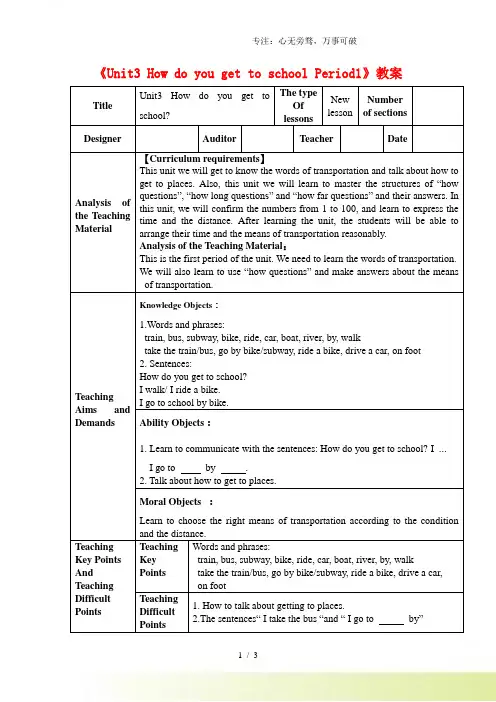
《Unit3 How do you get to school Period1》教案Title Unit3 How do you get toschool?The typeOflessonsNewlessonNumberof sectionsDesigner Auditor Teacher DateAnalysis of the Teaching Material 【Curriculum requirements】This unit we will get to know the words of transportation and talk about how to get to places. Also, this unit we will learn to master the structures of “how questions”, “how long questions” and “how far questions” and their answers. In this unit, we will confirm the numbers from 1 to 100, and learn to express the time and the distance. After learning the unit, the students will be able to arrange their time and the means of transportation reasonably.Analysis of the Teaching Material:This is the first period of the unit. We need to learn the words of transportation. We will also learn to use “how questions” and make answers about the means of transportation.Teaching Aims and Demands Knowledge Objects:1.Words and phrases:train, bus, subway, bike, ride, car, boat, river, by, walktake the train/bus, go by bike/subway, ride a bike, drive a car, on foot2. Sentences:How do you get to school?I walk/ I ride a bike.I go to school by bike.Ability Objects:1. Learn to communicate with the sentences: How do you get to school? I…I go to by .2. Talk about how to get to places.Moral Objects :Learn to choose the right means of transportation according to the condition and the distance.Teaching Key Points And Teaching Difficult Points TeachingKeyPointsWords and phrases:train, bus, subway, bike, ride, car, boat, river, by, walktake the train/bus, go by bike/subway, ride a bike, drive a car,on footTeachingDifficultPoints1. How to talk about getting to places.2.The sentences“ I take the bus “and “ I go to by”Teaching aid PPT (if needed) Textbook blackboard radioDesign ofperiodPeriod 1 Section A 1a-1cTeaching Procedures Teacher-studentInteractionRevise Step I Revision1.Invite some students to talk about the time.2.Ask some students write some phrases about thedaily activities.Step ⅡLearn the new wordstrain, bus, subway, bike, ride, car, boat, river, by, walk take the train/bus, go by bike/subway, ride a bike, drive a car, on footStep Ⅲ Learn the means of transportation.1. Ask students to read the pictures and the phrases, match the transportations and the pictures.2. Write down the phrases on the blackboard and make students read them.3. Finish the listening exercise of 1b.Step Ⅳ Learn to talk about how to get to places.1. Learn the dialogue on the textbook.A: How do you get to school?B: I walk. How about you?A: I ride my bike.2. Ask the students to role play the conversation according to the picture in 1a.3. Explain something about the dialogue.I walk. / I ride a bike. / I take the bus.I go to by .( by+交通工具, 中间不加任何冠词)若要表达乘坐某种交通方式去某地,注意两种表达方式之间的相互转换。
人教版英语七年级下册Unit3howdoyougettoschool单元整体说课稿
知识与技能:学生能够掌握描述不同交通方式的动词短语,并运用这些短语进行问答;学生能够使用地图和方向词描述路线;学生能够听懂并运用本单元的词汇和句型进行日常交流。
过程与方法:通过小组合作、任务驱动等方法,培养学生的合作意识和解决问题的能力;通过听力、口语、阅读等多种教学活动,提高学生的英语综合运用能力。
(二)学习障碍
在学习本节课之前,学生已经掌握了基本的英语语法和词汇,具备一定的听说读写能力。然而,他们可能在前置知识或技能方面存在以下不足:
1.对交通方式的相关词汇和表达不够熟悉,可能在表达时出现困难;
2.对地图和方向词的理解不够深入,容易在描述路线时产生混淆;
3.口语表达能力有待提高,部分学生在实际情境中可能无法流畅地进行英语交流。
2.角色扮演:学生模拟真实场景,扮演问路人和指路人,进行对话练习;
3.课堂游戏:设计“Transportation Matching”游戏,让学生在游戏中巩固新学的词汇;
4.口语练习:组织学生进行“Ask and Answer”活动,两人一组,互相询问对方的交通方式。
(四)总结反馈
在总结反馈阶段,我将采取以下方式引导学生自我评价,并提供有效的反馈和建议:
1.利用PPT展示一组与交通方式相关的图片,如公交车、自行车、地铁等,让学生猜测并说出这些交通方式的英文表达;
2.播放一段关于不同交通方式的短视频,引导学生关注并思考:“How do people get to school in different countries?”;
3.教师提出问题:“How do you get to school?”,邀请几名学生回答,借此引出本节课的主题。
情感态度与价值观:培养学生热爱生活、关心环境、遵守交通规则的良好品质;通过学习不同国家的交通方式,拓宽学生的国际视野。
【人教版七年级英语下】Unit 3 How do you get to school 知识点归纳
【人教版七年级英语下】U n i t3H o w d o y o u g e t t o s c h o o l知识点归纳-CAL-FENGHAI.-(YICAI)-Company One1Unit 3 How do you get to school?◆短语归纳1. get to school/home/there/here/ 到达学校/家/那里/这里2. take a/ the subway/ bike/bus/train 乘地铁/骑自行车/乘公交/乘火车3. ride a bike to school 骑自行车去上学/drive one’s car to school 开车去上学4. go to school by bus/train/bike/subway...乘公交/骑自行车/乘地铁去上学5. how far 多远6. think of 认为/ think about 思考、考虑7. one small village 一个小村庄8. from home to school 从家到学校9. run too quickly 流得太快10. go on a rope way 乘索道11. every school day /night 上学的每一天/每个晚上12. cross the river to school 过河去学校13. an/one 11-year-old boy 一个十一岁的男孩14. bus stop 公共汽车站15. play with my classmates 和我的同学一起玩16. between…and… 在…和…之间17. be like a father to me 对我来说像一个父亲18. come true 实现19. many/ most of the students 许多/大多数学生20. have to 不得不21. have a good day 祝一天愉快22. be (not) afraid of 很(不)害怕23. be sure of something 对....确定24. live about five kilometers from school 住在离学校约5公里远的地方25. dream of sb /sth 梦见某人/某物26. pen pal 笔友◆用法集萃1. take…to…= go to…by… 乘…去…2. How do/does sb get to… 某人是怎样到…的3. How far is it from…to… 从…到…有多远4. It takes sb. some time to do sth. 做某事花费某人多长时间。
七年级英语下册Unit3Howdoyougettoschool课件人教新目标
Section B & Self Check
1
2
3
4
1.For many students,it is easy to get to
school.(教材P17)对许多学生来说,到达学校是容
易的。
[解读] It’s+adj.+to do sth.句式结构中,it是形
式主语,后面的不定式 (短语) to do sth.是真正的主
—Can you come to my party next week? ——你下星期能来参加我的聚会吗? —I’m afraid not.——恐怕我不能来。
1
2
3
4
1
2
3
4
4.Can their dream come true?(教材P17)他们 的梦想能够实现吗?
[解读1] dream 是名词或动词,意思为“梦想;睡梦; 做梦”,构成的短语是dream of/about,意思为 “梦想, 幻想,向往”,of/about 是介词,后接名词或动词-ing 形式。
My dream is to be a teacher. 我的梦想是当一名教师。
He dreams of becoming an actor.
1
2
3
4
1
2
3
4
[解读2] come true 意思为“实现,成为现实”,主语通 常是表示梦想、愿望等的名词。
His dream came true at last. 他的梦想最终实现了。
His wish to become a doctor will come true. 他想当医生的愿望将会实现的。
1
2
3
人教版七年级英语下册《Unit 3 How do you get to school》课件
Aims and language points:
Teaching aims (教学目标) 1. 学习表示交通工具的单词。 2. 学会使用动词短语表示交通方式。
3. 能够熟练掌握How do you get to school?的句型。
4. 学习使用how far询问距离,how long 询问时间。
Bob Paul
Jim
Yang Lan
Mary
John
A: How does Mary get to school? B: She takes the subway.
2b Listen and complete the chart.
How? How long?How far?
Tom
walk
(2m0 imniuntuetess) (2kiklommet
a
e
c
b
d
1. take the train__a_ 2. take the bus__d___ 3. take the subway___e___ 4. ride a bike__b___ 5. walk__c____
1b Listen and write the numbers next to the correct students in the picture.
A Guessing Game
1 You use your legs and feet to do this.
walk
A Guessing Game
2 You can ride this to school or work. But it is not very fast.
ride a bike
人教版英语七年级下册Unit3Howdoyougettoschool第一课时优秀教学案例
2.创设真实的交流环境,如模拟学校门口的场景,让学生们扮演不同角色,进行角色扮演活动,练习描述交通方式。
3.设计一系列听力活动,如播放不同交通环境的音频,让学生在听的过程中熟悉并掌握交通方式的表达。
(二)问题导向
1.设计有针对性的问题,引导学生思考和讨论,如:“你们认为不同的交通方式有哪些优缺点?”、“在上下学过程中,你们遇到过哪些交通安全问题?”等。
3.强调交通安全的重要性,提醒学生们在日常生活中注意交通安全。
(五)作业小结
1.布置作业:让学生观察家人或朋友的上下学交通方式,并尝试用英语进行描述。
2.鼓励学生在课后与家人或朋友进行英语交流,巩固所学知识。
3.提醒学生按时完成作业,并鼓励他们主动向老师请教问题,提高自主学习能力。
整个教学内容与过程注重启发式教学,鼓励学生主动参与、积极思考,使他们在轻松愉快的氛围中学习英语。通过本课时的教学,学生们不仅能够掌握相关词汇和句型,还能够在实际情境中运用所学知识,提高英语口语表达能力和实际运用能力。
2.鼓励学生提出问题,培养他们的提问意识和解决问题的能力,如:“请同学们思考一下,还有哪些交通方式可以用来描述?”
3.引导学生通过观察、思考、总结等方法,自主探索并发现交通方式的相关规律,提高他们的自主学习能力和思维能力。
(三)小组合作
1.组织学生们进行小组讨论,让他们分享自己的上下学交通方式,并互相提问和回答,促进学生之间的交流与合作。
2.设计小组活动,如让学生们分组编写一个小短剧,展示不同交通方式的特点和优缺点,培养他们的合作和创新能力。
Unit 3 How do you get to school 英语教案人教版七年级英语下册
How do you get to school?Grade level: 7th gradeUnit: 3Time: 40 minutesObjectives:Students will be able to ask and answer questions about transportation.Students will learn vocabulary related to transportation.Students will be able to write a paragraph describing their own transportation.Materials:Textbook: New Target 7BWhiteboard and markersHandouts with a list of vocabulary wordsProcedure:Warm-upThe teacher greets the students and asks them if they have ever used public transportation.The teacher briefly explains the importance of transportation in our daily lives.VocabularyThe teacher introduces new vocabulary related to transportation by writing the words on the whiteboard and explaining their meanings.The teacher distributes handouts with the vocabulary list to the students.Listening and SpeakingThe teacher plays an audio recording of people talking about how they get to school.The teacher asks the students to listen carefully and take notes on how each person gets to school.After the recording is finished, the teacher asks students to share their notes and ask each other questions about their transportation.Reading and WritingThe teacher asks the students to read a short paragraph about a student's transportation to school from the textbook.The teacher then asks the students to write a paragraph about their own transportation to school, using the vocabulary words they have learned.The teacher reminds students to use complete sentences and proper grammar.Wrap-upThe teacher reviews the vocabulary words and asks the students if they have any questions.The teacher assigns the students to write a paragraph about their transportation to school as homework.Assessment:The teacher will assess students' comprehension of the vocabulary words, their listening and speaking skills during the audio recording activity, and their writing skills when they write a paragraph about their own transportation to school.。
初中英语人教版七年级下册《Unit 3 How do you get to school》课件
10 minutes/
10 km
30 minutes/
50km
35 minutes/ 80 km
50 minutes/
30km
Lead-in Traffic signs
train station
parking lot
bus stop
subway station
bus station
airport
Lead-in Traffic signs
Language points
(注意区分)
stop通常指只有公交站牌的暂时停 靠站,面积相对较小;
station通常指车辆的始发站或终点 站,可以转车的站点,面积相对较大。
New lesson
课文展现
1a Match the words with the picture.
1. b___ bus stop staation
sItchtaokoels? about 25
minutes.
Presentation
How does she get to school?
5 minutes
10 minutes
First, she walks to train station, and then she
takes a train to School.
Firmstin,uItetsake the bus to the subway station, and
then I take the subway to trfaiinnaslltya,tion. I take
the train
tHooswchlooonlg. does it take from home to
Unit3Howdoyougettoschool?单元背诵人教版七年级英语下册
Unit 3 How do you get to school?姓名:签名:①How +do/does+人称+get to…? 某人如何去某地,当get后面为home、here、there时,则需要省去toEg:How does she get to school?她如何去学校?How do you get home?你如何回家?①其回答为:①人称代词+交通工具+to…Eg: She takes the bus to school. 她乘公共汽车去学校(没有get!)①人称代词+get to…+by 交通工具(by放句尾)Eg:She gets to school by bus.(有get!)①take the bus=by bus take the subway=by subwaytake the train= by tarin ride a bike=by bike walk=on footdrive a car = by car①It takes sb.+时间+to do sth. 做某事花费某人多长时间It takes me 10 minutes to play games 玩游戏花费了我十分钟。
①How long does it take to get to school 需要花费多长时间去学校其回答为:It takes+时间①How far is it from A to B?A离B 有多远?其回答:It is +距离①100900:(基数)+hundred(不可数)101999:(基数)+hundred and (基数)如:500 five hundred 567:five hundred and sixtyseven①hundreds of… 数百(+s)①It is good exercise. 它是一个不错的运动。
①Think of 认为;What do you think of+doing?你认为…怎么样?①For many students 对于很多学生来说①In one small village in China. 在中国的一个小村庄①The river runs too quickly 水流太快了①11yearold =11 years old(an eleven)①Between A and B 在A与B之间between you and me 在你和我之间①Be like =look like 看起来像①Dream e ture 梦想实现①be afraid of doing sth. =be afraid to do sth. 害怕做某事①too+adj. 太… too fun 太有趣了!so+adj. 如此…. So fun 如此有趣②①go on ropeway 坐索道②②leave the village 离开村庄②③at the bus stop在公共汽车站。