
31年考研英语真题及答案_1980-2010年_
39.This is the most important respectcivilizedcan be distinguishedprimitive.([A] in which)
Section V
Fill in the blanks with the appropriate forms of the verbs given the brackets. Put your answers in the ANSWER SHEET. (10 points)
EXAMPLE:
It is highly desirable that a new president ________ (appoint) for this college.
[A] for
[B] to
[C] of(B)
[D] by
2.The chances of seeing a helicopter in my hometown are one ________ a million.
[A] for
[B] to
[C] in(C)
[D] against
3.________ we have all the materials ready,we should begin the new task at once.
EXAMPLE:
I was caught ________ the rain yesterday.
[A] in
[B] by
[C] with
[D] at
ANSWER: [A]
1.Modern man faces dangers completely unknown ________ his predecessors.
48.If the horse won today, he ________ (win) thirty races in five years.(would/should have won)
49.Upon being questioned he denied ________ (write) the article.(having written)
[A] Since that
[B] Since now
[C] By now(D)
[D] Now that
4.We hope the measures to control prices,________ taken by the government,will succeed.
[A] when
[B] as
[C] Such a situation(C)
[D] A situation of this
7.He is ________ to speak the truth.
[A] too much of a coward
[B] too much a coward
[C] so much a coward(A)
40.a bad-tempered man, hehaving his lee candidatean election speech.([A] Being)
41.If youawarded a prize of ten thousand dollars, what would you doit if youin a day?([D] to spend it)
[A] laid upon
[B] laid out
[C] laid up(D)
[D] laid down
10.Look at all the corruption that’s going on. It’s time the city was ________.
[A] cleaned out
[B] cleaned down
[C] since(B)
[D] after
5.The historical events of that period are arranged ________.
[A] in alphabetical order
[B] in an alphabetical order
[C] in the alphabetical orders(A)
36.[C] to pay
37.[B] a
38.[D] to survive
39.[A] in which
40.[A] Being
41.[D] to spend it
54.Lots of empty bottles were found under the old man’s bed. He must have done nothing but ________ (drink).(drink)
55.Ford tried dividing the labour, each worker ________ (assign) a separate task.(assigned)
[D] said
12.The Prime Minister refused to ________ on the rumour that he had planned to resign.
[A] explain
[B] comment
[C] remark(B)
[D] talk
13.I asked the tailor to make a small ________ to my trousers because they were too long.
[A] change
[B] variation
[C] revision(D)
[D] alteration
14.Magnificent views over the countryside have often ________ people to write poems.
[A] excited
[B] inspired
[D] adequately
Section IV
Each of the following sentences has four underlined parts. These parts are labeled [A], [B], [C] and [D]. Identify the part of the sentence that is incorrect and put your choice in the ANSWER SHEET. Then, without altering the meaning of the sentence, write down your correction on the line in the ANSWER SHEET. (10 points)
52.I hope her health ________ (improve) greatly by the time we come back next year.(will have improved)
53.While we were inLondonthat year, theLondonBridge________ (repair).(was being repaired)
1989
I: Structure and Vocabulary (15 points)
1.[B]
2.[C]
3.[D]
4.[B]
5.[A]
6.[C]
7.[A]
8.[C]
9.[D]
10.[D]
11.[B]
12.[B]
13.[D]
14.[B]
15.[B]
IV: Error-detection and Correction (10 points)
42.The boy is constantlynot to scratch the paintthe all, but he goes onit.([C] doing)
43.The parcel you post must be.Inadequate packingdelay, damageloss at your.([D] expense)
EXAMPLE:
You have to hurry up if you want to buy somethinghardly.
ANSWER: [C] anything
36.bank keepscashall its depositors inat one time.([C] to pay)
37.providegreat variety ofand entertainmentinformation.([B] a)
50.I was so sick last night that I felt as if the room ________ (go) round.(were/was going)
51.Nowadays people usually prefer driving to ________ (drive).(being driven)
[D] in alphabetical orders
6.In some markets there may be only one seller. ________ is called a monopoly.
[A] Situation as this
[B] Such kind of situation
ANSWER:(should) be appointed
46.Byron is said ________ (live) on vinegar and potatoes.(to have lived)
历年考研英语真题及答案(1980-1985年)
1982 年考研英语真题答案............................................................................................. 562
1981 年全国硕士研究生入学统一考试英语试题..............................................................564
Section I Structure and Vocabulary........................................................... 501
Section II Cloze Test....................................................................................503
Section I Section II Section III Section IV Section V Section VI Section VII
Structure and Vocabulary........................................................... 551 Verb Forms....................................................................................553 Error-detection........................................................................... 554 Cloze Test....................................................................................555 Reading Comprehension................................................................ 558 Chinese-English Translation......................................................560 English-Chinese Translation......................................................560
1980-2013年历年考研英语真题集含答案(word版)
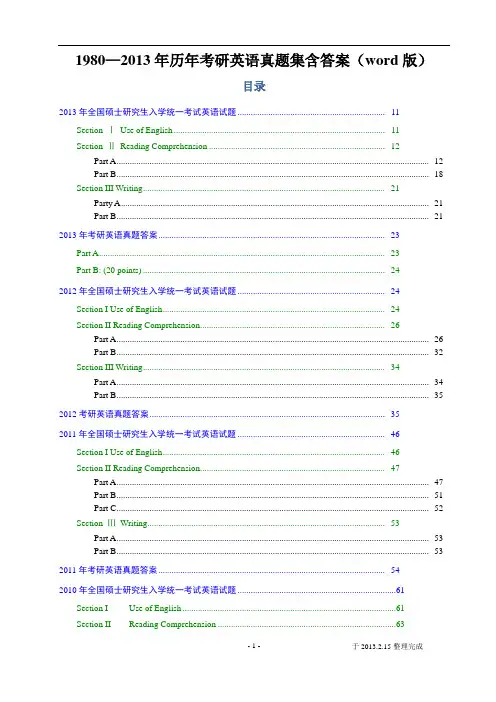
1980—2013年历年考研英语真题集含答案(word版)目录2013年全国硕士研究生入学统一考试英语试题 ................................................................... - 11 -Section ⅠUse of English ................................................................................................ - 11 -Section ⅡReading Comprehension ................................................................................ - 12 -Part A .............................................................................................................................................. - 12 -Part B .............................................................................................................................................. - 18 -Section III Writing .............................................................................................................. - 21 -Party A ............................................................................................................................................ - 21 -Part B .............................................................................................................................................. - 21 -2013年考研英语真题答案....................................................................................................... - 23 -Part A .................................................................................................................................. - 23 -Part B: (20 points) .............................................................................................................. - 24 -2012年全国硕士研究生入学统一考试英语试题 ................................................................... - 24 -Section I Use of English ..................................................................................................... - 24 -Section II Reading Comprehension .................................................................................... - 26 -Part A .............................................................................................................................................. - 26 -Part B .............................................................................................................................................. - 32 -Section III Writing .............................................................................................................. - 34 -Part A .............................................................................................................................................. - 34 -Part B .............................................................................................................................................. - 35 -2012考研英语真题答案........................................................................................................... - 35 -2011年全国硕士研究生入学统一考试英语试题 ................................................................... - 46 -Section I Use of English ..................................................................................................... - 46 -Section II Reading Comprehension .................................................................................... - 47 -Part A .............................................................................................................................................. - 47 -Part B .............................................................................................................................................. - 51 -Part C .............................................................................................................................................. - 52 -Section ⅢWriting ............................................................................................................ - 53 -Part A .............................................................................................................................................. - 53 -Part B .............................................................................................................................................. - 53 -2011年考研英语真题答案 ....................................................................................................... - 54 -2010年全国硕士研究生入学统一考试英语试题 (61)Section I Use of English (61)Section II Reading Comprehension (63)Part A (63)Part B (69)Part C (71)Section ⅢWriting (72)Part A (72)Part B (72)2010年考研英语真题答案 (73)2009年全国硕士研究生入学统一考试英语试题 (75)Section I Use of English (75)Section II Reading Comprehension (77)Part A (77)Part B (83)Part C (85)Section ⅢWriting (86)Part A (86)Part B (86)2009年考研英语真题答案 (88)2008年全国硕士研究生入学统一考试英语试题 (90)Section I Use of English (90)Section II Reading Comprehension (92)Part A (92)Part B (98)Part C (100)Section III Writing (101)Part A (101)Part B (101)2008年考研英语真题答案 (103)2007年全国硕士研究生入学统一考试英语试题 (105)Section I Use of English (105)Section II Reading Comprehension (108)Part A (108)Part B (115)Part C (117)Section III Writing (118)Part A (118)Part B (118)2007年考研英语真题答案 (119)2006年全国硕士研究生入学统一考试英语试题 (121)Section I Use of English (121)Section II Reading Comprehension (124)Part A (124)Part B (131)Part C (133)Section III Writing (134)Part A (134)Part B (134)2006年考研英语真题答案 (136)2005年全国硕士研究生入学统一考试英语试题 (138)Section I Use of English (138)Section II Reading Comprehension (141)Part A (141)Part B (148)Part C (150)Section III Writing (151)Part A (151)Part B (151)2005年考研英语真题答案 (153)2004年全国硕士研究生入学统一考试英语试题 (155)Section I Listening Comprehension (155)Part A (155)Part B (155)Part C (156)Section II Use of English (158)Section III Reading Comprehension (162)Part A (162)Part B (168)Section IV Writing (170)2004年考研英语真题答案 (171)2003年全国硕士研究生入学统一考试英语试题 (173)Section I Listening Comprehension (173)Part A (173)Part B (173)Part C (174)Section II Use of English (176)Section III Reading Comprehension (180)Part A (180)Section IV Writing (187)2003年考研英语真题答案 (189)2002年全国硕士研究生入学统一考试英语试题 (191)Section I Listening Comprehension (191)Part A (191)Part B (192)Part C (192)Section II Use of English (195)Section III Reading Comprehension (199)Part A (199)Part B (206)Section IV Writing (206)2002年考研英语真题答案 (208)2001年全国硕士研究生入学统一考试英语试题 (210)Section I Structure and V ocabulary (210)Part A (210)Part B (212)Section II Cloze Test (216)Section III Reading Comprehension (220)Section IV English-Chinese Translation (227)Section V Writing (228)2001年考研英语真题答案 (230)2000年全国硕士研究生入学统一考试英语试题 (232)Section I Structure and V ocabulary (232)Part A (232)Part B (234)Part C (235)Section II Cloze Test (240)Section III Reading Comprehension (241)Section IV English-Chinese Translation (249)Section V Writing (250)2000年考研英语真题答案 (251)1999年全国硕士研究生入学统一考试英语试题 (253)Section I Structure and V ocabulary (253)Part A (253)Part C (256)Section II Cloze Test (260)Section III Reading Comprehension (262)Section IV English-Chinese Translation (270)Section V Writing (270)1999年考研英语真题答案 (272)1998年全国硕士研究生入学统一考试英语试题 (274)Section I Structure and V ocabulary (274)Part A (274)Part B (276)Part C (277)Section II Cloze Test (281)Section III Reading Comprehension (283)Section IV English-Chinese Translation (291)Section V Writing (292)1998年考研英语真题答案 (294)1997年全国硕士研究生入学统一考试英语试题 (296)Section I Structure and V ocabulary (296)Part A (296)Part B (298)Part C (299)Section II Cloze Test (303)Section III Reading Comprehension (305)Section IV English-Chinese Translation (312)Section V Writing (313)1997年考研英语真题答案 (315)1996年全国硕士研究生入学统一考试英语试题 (317)Section I Structure and V ocabulary (317)Part A (317)Part B (319)Part C (320)Section II Cloze Test (324)Section III Reading Comprehension (326)Section IV English-Chinese Translation (333)Section V Writing (334)1996年考研英语真题答案 (335)1995年全国硕士研究生入学统一考试英语试题 (337)Section I Structure and V ocabulary (337)Part A (337)Part B (339)Part C (340)Section II Cloze Test (344)Section III Reading Comprehension (346)Section IV English-Chinese Translation (353)Section V Writing (354)1995年考研英语真题答案 (355)1994年全国硕士研究生入学统一考试英语试题 (357)Section I Structure and V ocabulary (357)Part A (357)Part B (359)Part C (360)Section II Cloze Test (364)Section III Reading Comprehension (366)Section IV English-Chinese Translation (373)Section V Writing (373)1994年考研英语真题答案 (375)1993年全国硕士研究生入学统一考试英语试题 (377)Section I Structure and V ocabulary (377)Section II Reading Comprehension (382)Section III Cloze Test (387)Section IV Error-detection and Correction (390)Section V English-Chinese Translation (392)Section VI Writing (392)1993年考研英语真题答案 (394)1992年全国硕士研究生入学统一考试英语试题 (396)Section I Structure and V ocabulary (396)Section II Reading Comprehension (401)Section III Cloze Test (406)Section IV Error-detection and Correction (408)Section V English-Chinese Translation (410)Section VI Writing (411)1992年考研英语真题答案 (412)1991年全国硕士研究生入学统一考试英语试题 (414)Section I Structure and V ocabulary (414)Section II Reading Comprehension (419)Section III Cloze Test (424)Section IV Error-detection and Correction (427)Section V English-Chinese Translation (428)Section VI Writing (429)1991年考研英语真题答案 (430)1990年全国硕士研究生入学统一考试英语试题 (432)Section I Structure and V ocabulary (432)Section II Reading Comprehension (434)Section III Cloze Test (438)Section IV Error-detection and Correction (440)Section V Verb Forms (442)Section VI Chinese-English Translation (442)Section VII English-Chinese Translation (443)1990年考研英语真题答案 (445)1989年全国硕士研究生入学统一考试英语试题 (447)Section I Structure and V ocabulary (447)Section II Reading Comprehension (449)Section III Cloze Test (454)Section IV Error-detection and Correction (456)Section V Verb Forms (457)Section VI Chinese-English Translation (458)Section VII English-Chinese Translation (458)1989年考研英语真题答案 (460)1988年全国硕士研究生入学统一考试英语试题 (462)Section I Structure and V ocabulary (462)Section II Reading Comprehension (464)Section III Cloze Test (469)Section IV Error-detection and Correction (471)Section V Verb Forms (472)Section VI Chinese-English Translation (473)Section VII English-Chinese Translation (473)1988年考研英语真题答案 (475)1987年全国硕士研究生入学统一考试英语试题 (477)Section I Structure and V ocabulary (477)Section II Reading Comprehension (479)Section III Structure and V ocabulary (483)Section IV Cloze Test (485)Section V Verb Forms (487)Section VI Error-detection and Correction (488)Section VII Chinese-English Translation (490)Section VIII English-Chinese Translation (490)1987年考研英语真题答案 (492)1986年全国硕士研究生入学统一考试英语试题 (494)Section I Structure and V ocabulary (494)Section II Cloze Test (496)Section III Reading Comprehension (498)Section IV Structure and V ocabulary (501)Section V Error-detection and Correction (503)Section VI Verb Forms (505)Section VII Chinese-English Translation (505)Section VIII English-Chinese Translation (506)1986年考研英语真题答案 (507)1985年全国硕士研究生入学统一考试英语试题 (509)Section I Structure and V ocabulary (509)Section II Cloze Test (511)Section III Reading Comprehension (514)Section IV Structure and V ocabulary (515)Section V Error-detection and Correction (517)Section VI Verb Forms (518)Section VII Chinese-English Translation (519)Section VIII English-Chinese Translation (520)1985年考研英语真题答案 (522)1984年全国硕士研究生入学统一考试英语试题 (525)Section I Structure and V ocabulary (525)Section II Cloze Test (530)Section III Reading Comprehension (532)Section IV Structure and V ocabulary (533)Section V Error-detection and Correction (535)Section VI Verb Forms (537)Section VII Chinese-English Translation (538)Section VIII English-Chinese Translation (538)1984年考研英语真题答案 (540)1983年全国硕士研究生入学统一考试英语试题 (543)Section I Structure and V ocabulary (543)Section II Verb Forms (545)Section III Error-detection (545)Section IV Cloze Test (546)Section V Reading Comprehension (549)Section VI Structure and V ocabulary (550)Section VII Chinese-English Translation (552)Section VIII English-Chinese Translation (552)1983年考研英语真题答案 (554)1982年全国硕士研究生入学统一考试英语试题 (556)Section I Structure and V ocabulary (556)Section II Verb Forms (558)Section III Error-detection (559)Section IV Cloze Test (560)Section V Reading Comprehension (562)Section VI Chinese-English Translation (564)Section VII English-Chinese Translation (564)1982年考研英语真题答案 (567)1981年全国硕士研究生入学统一考试英语试题 (569)Section I Structure and V ocabulary (569)Section II Error-detection (572)Section III Sentence Making (573)Section IV Verb Forms (573)Section V Cloze Test (574)Section VI Chinese-English Translation (575)Section VII English-Chinese Translation (575)1981年考研英语真题答案 (578)1980年全国硕士研究生入学统一考试英语试题 (581)Section I Use of Prepositions (581)Section II Verb Tenses (581)Section III Verb Forms (582)Section IV Structure and V ocabulary (583)Section V Error-detection (585)Section VI Chinese-English Translation (586)Section VII English-Chinese Translation (586)1980年考研英语真题答案 (589)2013年全国硕士研究生入学统一考试英语试题Section ⅠUse of EnglishDirections: Read the following text. Choose the best word(s) for each numbered blank and mark A, B, C or D on ANSWER SHEET 1. (10 points)People are, on the whole, poor at considering background information when making individual decisions. At first glance this might seem like a strength that 1 the ability to make judgments which are unbiased by 2 factors. But Dr. Uri Simonsohn speculated that an inability to consider the big 3 was leading decision-makers to be biased by the daily samples of information they were working with. 4 , he theorised that a judge 5 of appearing too soft 6 crime might be more likely to send someone to prison 7 he had already sentenced five or six other defendants only to probation on that day.To 8 this idea, he turned to the university-admissions process. In theory, the 9 of an applicant should not depend on the few others 10 randomly for interview during the same day, but Dr Simonsohn suspected the truth was 11 .He studied the results of 9,323 MBA interviews, 12 by 31 admissions officers. The interviewers had 13 applicants on a scale of one to five. This scale 14 numerous factors into consideration. The scores were 15 used in conjunction with an applicant's score on the Graduate Management Admission Test, or GMAT, a standardised exam which is 16 out of 800 points, to make a decision on whether to accept him or her.Dr Simonsohn found if the score of the previous candidate in a daily series of interviewees was 0.75 points or more higher than that of the one 17 that, then the score for the next applicant would 18 by an average of 0.075 points. This might sound small, but to 19 the effects of such a decrease a candidate would need 30 more GMAT points than would otherwise have been 20 .1.[A] grant [B] submits [C] transmits [D] delivers2.[A] minor [B]objective [C] crucial [D] external3.[A] issue [B] vision [C] picture [D] moment4.[A] For example [B] On average [C] In principle[D] Above all5.[A] fond [B]fearful [C] capable [D] thoughtless6.[A] in [B] on [C] to [D] for7.[A] if [B]until [C] though [D] unless8.[A] promote [B]emphasize [C] share [D] test9.[A] decision [B] quality [C] status [D] success10.[A] chosen [B]stupid [C]found [D] identified11.[A] exceptional [B] defensible [C] replaceable [D] otherwise12.[A] inspired [B]expressed [C] conducted [D] secured13.[A] assigned [B]rated [C] matched [D] arranged14.[A] put [B]got [C]gave [D] took15.[A]instead [B]then [C] ever [D] rather16.[A]selected [B]passed [C] marked [D] introduced17.[A]before [B] after [C] above [D] below18.[A] jump [B] float [C] drop [D] fluctuate19.[A]achieve [B]undo [C] maintain [D]disregard20. [A] promising [B] possible [C] necessary [D] helpfulSection ⅡReading ComprehensionPart ADirections:Read the following four texts. Answer the questions after each text by choosing A, B, C or D. Mark your answers on ANSWER SHEET 1. (40 points)Text 1In the 2006 film version of The Devil Wears Prada, Miranda Priestly, played by Meryl Streep, scold her unattractive assistant for imagining that high fashion doesn’t affect her. Priestly explains how t he deep blue color of the assistant’s sweater descended over the years from fashion shows to department stores and to the bargain bin in which the poor girl doubtless found her garment.This top-down conception of the fashion business couldn’t be more ou t of date or at odds with feverish world described in Overdressed, Elizabeth Cline’s three-year indictment of “fast fashion”. In the last decades or so, advances in technology have allowed mass-market labels such as Zara, H&M, and Uniqlo to react to trends more quickly and anticipate demand more precisely. Quckier turnrounds mean less wasted inventory, more frequent releases, and more profit. Those labels encourage style-conscious consumers to see clothes as disposal—— meant to last only a wash or two, alth ough they don’t advertise that——and to renew their wardrobe every few weeks. By offering on-trend items at dirt-cheap prices, Cline argues, these brands have hijacked fashion cycles, shaking all industry long accustomed to a seasonal pace.The victims of this revolution, of course, are not limited to designers. For H&M to offer a 5.95 knit miniskirt in all its 2300-plus stores around the world, it must rely on low-wage, overseas labor, order in volumes that strain natural resources, and use massive amount of harmful chemicals.Overdressed is the fashion world’s answer to consumer activist bestsellers like Michael Pollan’s The Omnivore’s Dilemma. Mass-produced clothing, like fast food, fills a hunger and need, yet is non-durable, and wasteful,” Cline argues, Americans, she find s, buy roughly 20billion garments a year——about 64 items per person——and no matter how much they give away, this excess leads to waste.Towards the end of Overdressed, Cline introduced her ideal, a Brooklyn woman named SKB, who, since 2008 has make all of her own clothes——and beautifully. But as Cline is the first to note, it took Beaumont decades to perfect her craft; her example, can’t be knocked off.Though several fast-fashion companies have made efforts to curb their impact on labor and the environment——including H&M, with its green Conscious Collection Line——Cline believes lasting-change can only be effected by the customer. She exhibits the idealism common to many advocates of sustainability, be it in food or in energy. Vanity is a constant; people will only start shopping more sustainably when they can’t afford to it.21. Priestly criticizes her assistant for her[A] poor bargaining skill.[B] insensitivity to fashion.[C] obsession with high fashion.[D]lack of imagination.22. According to Cline, mass-maket labels urge consumers to[A] combat unnecessary waste.[B] shut out the feverish fashion world.[C] resist the influence of advertisements.[D] shop for their garments more frequently.23. The word “indictment” (Line 3, Para.2) is closest in meaning to[A] accusation.[B] enthusiasm.[C] indifference.[D] tolerance.24. Which of the following can be inferred from the lase paragraph?[A] Vanity has more often been found in idealists.[B] The fast-fashion industry ignores sustainability.[C] People are more interested in unaffordable garments.[D] Pricing is vital to environment-friendly purchasing.25. What is the subject of the text?[A] Satire on an extravagant lifestyle.[B] Challenge to a high-fashion myth.[C] Criticism of the fast-fashion industry.[D] Exposure of a mass-market secret.Text 2An old saying has it that half of all advertising budgets are wasted-the trouble is, no one knows which half . In the internet age, at least in theory ,this fraction can be much reduced . By watching what people search for, click on and say online, companies can aim “behavioural” ads at those most likely to buy.In the past couple of weeks a quarrel has illustrated the value to advertisers of suchfine-grained information: Should advertisers assume that people are happy to be tracked and sent behavioural ads? Or should they have explicit permission?In December 2010 America's Federal Trade Cornmission (FTC) proposed adding a "do not track "(DNT) option to internet browsers ,so that users could tell adwertisers that they did not want to be followed .Microsoft's Internet Explorer and Apple's Safari both offer DNT ;Google's Chrome is due to do so this year. In February the FTC and Digltal Adwertising Alliance (DAA) agreed that the industry would get cracking on responging to DNT requests.On May 31st Microsoft Set off the row: It said that Internet Explorer 10,the version due to appear windows 8, would have DNT as a default.It is not yet clear how advertisers will respond. Geting a DNT signal does not oblige anyone to stop tracking, although some companies have promised to do so. Unable to tell whether someone really objects to behavioural ads or whether they are sticking with Microsoft’s default, some may ignore a DNT signal and press on anyway.Also unclear is why Microsoft has gone it alone. Atter all, it has an ad business too, which it says will comply with DNT requests, though it is still working out how. If it is trying to upset Google, which relies almost wholly on default will become the norm. DNT does not seem an obviously huge selling point for windows 8-though the firm has compared some of its other products favourably with Google's on that count before. Brendon Lynch, Microsoft's chief privacy officer, bloggde:"we believe consumers should have more control." Could it really be that simple?26. It is suggested in paragraph 1 that “behavioural” ads help advertisers to:[A] ease competition among themselves[B] lower their operational costs[C] avoid complaints from consumers[D]provide better online services27. “The industry” (Line 6,Para.3) refers to:[A] online advertisers[B] e-commerce conductors[C] digital information analysis[D]internet browser developers28. Bob Liodice holds that setting DNT as a default[A] many cut the number of junk ads[B] fails to affect the ad industry[C] will not benefit consumers[D]goes against human nature29. which of the following is ture according to Paragraph.6?[A] DNT may not serve its intended purpose[B] Advertisers are willing to implement DNT[C] DNT is losing its popularity among consumers[D] Advertisers are obliged to offer behavioural ads30. The author's attitude towards what Brendon Lynch said in his blog is one of:[A] indulgence[B] understanding[C] appreciaction[D] skepticismText 3Up until a few decades ago, our visions of the future were largely - though by no means uniformly - glowingly positive. Science and technology would cure all the ills of humanity, leading to lives of fulfillment and opportunity for all.Now utopia has grown unfashionable, as we have gained a deeper appreciation of the range of threats facing us, from asteroid strike to epidemic flu and to climate change. You might even be tempted to assume that humanity has little future to look forward to.But such gloominess is misplaced. The fossil record shows that many species have endured for millions of years - so why shouldn't we? Take a broader look at our species' place in the universe, and it becomes clear that we have an excellent chance of surviving for tens, if not hundreds, of thousands of years . Look up Homo sapiens in the "Red List" of threatened species of the International Union for the Conversation of Nature (IUCN) ,and you will read: "Listed as Least Concern as the species is very widely distributed, adaptable, currently increasing, and there are no major threats resulting in an overall population decline."So what does our deep future hold? A growing number of researchers and organisations are now thinking seriously about that question. For example, the Long Now Foundation has its flagship project a medical clock that is designed to still be marking time thousands of years hence .Perhaps willfully , it may be easier to think about such lengthy timescales than about the more immediate future. The potential evolution of today's technology, and its social consequences, is dazzlingly complicated, and it's perhaps best left to science fiction writers andfuturologists to explore the many possibilities we can envisage. That's one reason why we have launched Arc, a new publication dedicated to the near future.But take a longer view and there is a surprising amount that we can say with considerable assurance. As so often, the past holds the key to the future: we have now identified enough of the long-term patterns shaping the history of the planet, and our species, to make evidence-based forecasts about the situations in which our descendants will find themselves.This long perspective makes the pessimistic view of our prospects seem more likely to be a passing fad. To be sure, the future is not all rosy. But we are now knowledgeable enough to reduce many of the risks that threatened the existence of earlier humans, and to improve the lot of those to come.31. Our vision of the future used to be inspired by[A] our desire for lives of fulfillment[B] our faith in science and technology[C] our awareness of potential risks[D] our belief in equal opportunity32. The IUCN’s “Red List” suggest that human being are[A] a sustained species[B] a threaten to the environment[C] the world’s dominant power[D] a misplaced race33. Which of the following is true according to Paragraph 5?[A] Arc helps limit the scope of futurological studies.[B] Technology offers solutions to social problem.[C] The interest in science fiction is on the rise.[D] Our Immediate future is hard to conceive.34. To ensure the future of mankind, it is crucial to[A] explore our planet’s abundant resources[B] adopt an optimistic view of the world[C] draw on our experience from the past[D] curb our ambition to reshape history35. Which of the following would be the best title for the text?[A] Uncertainty about Our Future[B] Evolution of the Human Species[C] The Ever-bright Prospects of Mankind[D] Science, Technology and HumanityText 4On a five to three vote, the Supreme Court knocked ou t much of Arizona’s immigration law Monday-a modest policy victory for the Obama Administration. But on the more important matter of the Constitution,the decision was an 8-0 defeat for the Administration’s effort to upset the balance of power between the federal government and the states.In Arizona v. United States, the majority overturned three of the four contested provisions of Arizona’s controversial plan to have state and local police enforce federal immigration law. The Constitutional principles that Washington alone has the power to “establish a uniform Rule of Naturalization ”and that federal laws precede state laws are noncontroversial . Arizona had attempted to fashion state policies that ran parallel to the existing federal ones.Justice Anthony Kennedy, joined by Chief Justice John Roberts and the Court’s liberals, ruled that the state flew too close to the federal sun. On the overturned provisions the majority held the congress had deliberately “occupied the field” and Arizona had thus intruded on the federal’s privileged powers.However,the Justices said that Arizona police would be allowed to verify the legal status of people who come in contact with law enforcement.That’s because Congress has always envisioned joint federal-state immigration enforcement and explicitly encourages state officers to share information and cooperate with federal colleagues.Two of the three objecting Justice-Samuel Alito and Clarence Thomas-agreed with this Constitutional logic but disagreed about which Arizona rules conflicted with the federal statute.The only major objection came from Justice Antonin Scalia,who offered an even more robust defense of state privileges going back to the alien and Sedition Acts.The 8-0 objection to President Obama turns on what Justice Samuel Alito describes in his objection as “a shocking assertion assertion of federal executive power”.The White House argued that Arizona’s laws conflicted with its enforcement priorities,even if state laws complied with federal statutes to the letter.In effect, the White House claimed that it could invalidate any otherwise legitimate state law that it disagrees with .Some powers do belong exclusively to the federal government, and control of citizenship and the borders is among them. But if Congress wanted to prevent states from using their own resources to check immigration status, it could. It never did so. The administration was in essence asserting that because it didn’t want to carry out Congress’s immigration wishes, no state should be allowed to do so either. Every Justice rightly rejected this remarkable claim.36. Three provisions of Arizona’s plan were ove rturned because they[A] deprived the federal police of Constitutional powers.[B] disturbed the power balance between different states.[C] overstepped the authority of federal immigration law.[D] contradicted both the federal and state policies.。
2010英语考研真题答案
2010英语考研真题答案【篇一:2010-2016年历年考研英语真题+答案】tion i use of english section 1 use of englishdirections: read the following text. choose the best word(s) for each numbered blank and mark [a], [b], [c] or [d] on answer sheet 1. (10 points)in cambodia, the choice of a spouse is a complex one for the young male. it may involve not only his parents and his friends, __1__those of the young woman, but also a matchmaker. a young man can __2__ a likely spouse on his own and then ask his parents to __3__the marriage negotiations, or the young man‘s parents may take the choice of a spouse, giving thechild little to say in the selection. __4__, a girl may veto the spouse her parents have chosen. __5__ a spouse has beenselected, each family investigates the other to make sure its child is marrying __6__ a good family.the traditional wedding is a long and colorful affair. formerly it lasted three days, __7__1980s it more commonly lasted a day and a half. buddhist priests offer a short sermon and __8__ prayers of blessing. par--ts of the ceremony involve ritual hair cutting,__9__cotton threads soaked in holy water around the brides and grooms wrists, and __10__a candle around a circle of happily married andrespected couples to bless the __11__. newlyweds traditionally move in with the wifes parents and may__12__ with them up to a year, __13__they can build a new house nearby.divorce is legal and easy to __14__, but not common. divorced persons are __15__ with some disapproval. each spouse retains ___16___ property he or she__17__ into the marriage, and jointly-acquired property is__18__ equally. divorced persons may remarry, but a gender prejudice __19__up. the divorced male doesnt have a waiting period before he can remarry __20__the woman must wait ten months.1.a. by way of b. with regard to c. on behalf of d. as well as2.a. decide onb. provide forc. compete withd. adapt to3.a. closeb. arrange c. renew d. postpone4.a. in theory b. above all c. in timed. for example5.a. unlessb. less c. after d. although6.a. into b. within c. fromd. through7.a. or b. sincec. butd. so8.a. test b. copyc. recite d. create9.a. folding b. piling c. wrappingd. tying10. a. passing b. lighting c. hiding d. serving11. a. associationb. meeting c. collection d. union12. a. deal b. partc. grow d. live13. a. whereas b. untilc. ford. if14. a. avoidb. follow c. challenge d. obtain15. a. isolated b. persuadedc. viewed d. exposed16. a. wherever b. whatever c. whenever d. however17. a. changedb. brought c. shapedd. pushed18. a. invested b. dividedc. donated d. withdrawn19. a. warmsb. clearsc. shows d. breaks20. a. whileb. so that c. onced. in that section Ⅱ reading comprehensionpart adirections:read the following four texts. answer the questions after each text by choosing a, b, c or d. mark your answers on answer sheet 1. (40 points) text 1france,which prides itself as the global innovator of fashion, has decided its fashion industry has lost an absolute right to define physical beauty for women. its lawmakers gave preliminary approval last week to a law that would make it a crime to employ ultra-thin models on runways. the parliament also agreed to ban websites that ―incite excessive thinness‖ by promoting extreme dieting.such measures have a couple of uplifting motives. they suggest beauty should not be defined by looks that end up impinging on health. that‘s a start. and the ban on ultra-thin models seems to go beyond protecting models from starving themselves to death –as some have done. it tells the fashion industry that it must take responsibility for the signal it sends women, especially teenage girls, about the social tape-measure they must use to determine their individual worth.the bans, if fully enforced, would suggest to women (and many men) that they should not let others be arbiters of their beauty. and perhaps faintly, they hint that people should lookto intangible qualities like character and intellect rather than dieting their way to size zero or wasp-waist physiques.the french measures, however, rely too much on severe punishment to change aculture that still regards beauty as skin-deep-and bone-showing. under the law, using a fashion model that does not meet a government-defined index of body mass could result in a $85,000 fine and six months in prison.the fashion industry knows it has an inherent problem in focusing on material adornment and idealized body types. in denmark, the united states, and a few other countries, it is trying to set voluntary standards for models and fashion images that rely more on peer pressure for enforcement.in contrast to france‘s actions, denmark‘s fashion industry agreed last month on rules and sanctions regarding the age, health, and other characteristics of models. the newly revised danish fashion ethical charter clearly states:‖we are aware of and take responsibility for the impact the fashion industry has on body ideals, especially on young people‖. the charter‘s main tool of enforcement is to deny access for designers and modeling agencies to copenhagen fashion week (cfw), which is run by the danish fashion institute. but in general it relies on a name-and -shame method of compliance.relying on ethical persuasion rather than law to address the misuse of body ideals may be the best step. even better would be to help elevate notions of beauty beyond the material standards of a particular industry.21. according to the first paragraph,what would happen in france?【a】physical beauty would be redefined.【b】new runways would be constructed.【c】websites about dieting would thrive.【d】the fashion industry would decline.22. the phrase ―impinging on‖(line 2,para.2) is closest in meaning to【a】heightening the value of【b】indicating the state of【c】losing faith in【d】doing harm to23. which of the following is true of the fashion industry?【a】the french measures have already failed.【b】new standards are being set in denmark.【c】models are no longer under peer pressure.【d】its inherent problems are getting worse.24. a designer is most likely to be rejected by cfw for【a】pursuing perfect physical conditions【b】caring too much about model‘s character.【c】showing little concern for health factors【d】setting a high age threshold for models.25. which of the following may be the best title of the text?【a】a challenge to the fashion industry‘s body ideals【b】a dilemma for the starving models in france【c】just another round of struggle for beauty【d】the great threats to the fashion industrytext 2for the first time in history more people live in towns than in the country. in britain this has had a curious result. while polls show britons rate‖the【篇二:2010年考研英语一真题及答案】class=txt>section i use of englishdirections:read the following text. choose the best word(s) for each numbered blank and mark a, b, c or d on answer sheet 1.(10 points).in 1924 americas national research council sent two engineers to supervise a series of industrial experiments at a large telephone-parts factory called the hawthorne plant near chicago. it hoped they would learn how stop-floorlighting____1____ workers productivity. instead, the studies ended ____2____ giving their name to the hawthorne effect, the extremely influential idea that the veryto being experimented upon changed subjects behavior.the idea arose because of the ____4____ behavior of the women in the hawthorne plant. according to ____5____ of the experiments, their hourly output rose when lighting was increased, but also when it was dimmed. it did not ____6____ what was done in the experiment; ____7____something waschanged, productivity rose. a(n) ____8____ that they were being experimented upon seemed to be ____9____ to alter workers behavior ____10____itself.after several decades, the same data were ____11____ to econometric the analysis. hawthorne experiments has another surprise store ____12____the descriptions on record, no systematic ____13____ was found that levels of productivity were related to changes in lighting.it turns out that peculiar way of conducting the experiments may be have let to ____14____ interpretation of what happed. ____15____, lighting was always changed on a sunday. when work started again on monday, output ____16____rose compared with the previous saturday and 17 to rise for the next couple of days. ____18____, a comparison with data for weeks when there was no experimentation showed that output always went up on monday, workers ____19____ to be diligent for the first few days of the week in any case, before____20____ a plateau and then slackening off. this suggests that the alleged hawthorne effect is hard to pin down.1. [a] affected2. [a] at[b] achieved [b] up [c] extracted [c] with [c] act [d] restored [d] off [d] proof[d] ambiguous[d] assessments[d] work[d] so long as[d] illusion 3. [a] truth [b] sight 4. [a] controversial [b] perplexing 5. [a] requirements [b] explanations 6. [a] conclude 7. [a] as far as 8. [a] awareness [b] matter [c] mischievous [c] accounts [c] indicate [c] in case that [c] sentiment[b] for fear that [b] expectation9. [a] suitable10. [a] about[b] excessive [b] for[b] shown[c] enough [c] on [d] abundant [d] by [d] conveyed[d] peculiar to[d] source[d] misleading 11. [a] compared 12. [a] contrary to 13. [a] evidence 14. [a] disputable15. [a] in contrast16. [a] duly17. [a] failed [c] subjected [b] consistent with [c] parallel with[b] guidance [b] enlightening [b] for example [b] accidentally [b] ceased [c] implication [c] reliable [c] in consequence [d] as usual [c] unpredictably [d] suddenly [c] started [d] continued[d] hitting 20. [a] breaking [b] climbing [c] surpassingsection ii reading comprehensionpart adirections:read the following four texts. answer the questions below each text by choosing[a], [b], [c] or [d]. mark your answers on answer sheet 1. (40 points)text 1of all the changes that have taken place in english-language newspapers during the past quarter-century, perhaps the most far-reaching has been the inexorable decline in the scope and seriousness of their arts coverage.it is difficult to the point of impossibility for the average reader under the age of forty to imagine a time when high-quality arts criticism could be found in most big-city newspapers. yet a considerable number of the most significant collections of criticism published in the 20th century consisted in large part of newspaper reviews. to read such books today is to marvel at the fact that their learned contents were once deemed suitable for publication in general-circulation dailies.we are even farther removed from the unfocused newspaper reviews published in england between the turn of the 20th century and the eve of world war ii, at a time when newsprint was dirt-cheap and stylish arts criticism was considered an ornament to the publications in which it appeared. in those far-off days, it was taken for granted that the critics of major papers would write in detail and at length about the events they covered. theirs was a serious business, and even those reviewers who wore their learning lightly, like george bernard shaw and ernest newman, could be trusted to know what they were about. these men believed in journalism as a calling, and were proud to be published in the daily press. ―so few authors have brains enough or literary gift enough to keep their own end up in journalism,‖ newman wrote, ―that i amtempted to define ?journalism‘ as ?a term of contempt applied by wri ters who are not read to writers who are.‘‖unfortunately, these critics are virtually forgotten. neville cardus, who wrote for the manchester guardian from 1917 until shortly before his death in 1975, is now known solely as awriter of essays on the game of cricket. during his lifetime, though, he was also one of england‘s foremost classical-music critics, a stylist so widely admired that his autobiography (1947) became a best-seller. he was knighted in 1967, the first music critic to be so honored. yet only one of his books is now in print, and his vast body of writings on music is unknown saveto specialists.is there any chance that cardus‘s criticism will enjoy a revival? the prospect seems remote. journalistic tastes had changed long before his death, and postmodern readers have little use for the richly upholstered vicwardian prose in which he specialized. moreover, the amateur tradition in music criticism has been in headlong retreat.21. it is indicated in paragraphs 1 and 2 that[a] arts criticism has disappeared from big-city newspapers.[b] english-language newspapers used to carry more arts reviews.[c] high-quality newspapers retain a large body of readers.[d] young readers doubt the suitability of criticism on dailies.22. newspaper reviews in england before world war ii were characterized by[a] free themes. [b] casual style. [c] elaborate layout. [d] radical viewpoints.23. which of the following would shaw and newman most probably agree on?[a] it is writers duty to fulfill journalistic goals[b] it is contemptible for writers to be journalists.[c] writers are likely to be tempted into journalism.[d] not all writers are capable of journalistic writing.24. what can be learned about cardus according to the lasttwo paragraphs?[a] his music criticism may not appeal to readers today.[b] his reputation as a music critic has long been in dispute.[c] his style caters largely to modern specialists.[d] his writings fail to follow the amateur tradition.25. what would be the best title for the text?[a] newspapers of the good old days[b] the lost horizon in newspapers[c] mournful decline of journalism [d] prominent critics in memorytext 2box.now the nations top patent court appears completely ready to scale back on business-method patents, which have been controversial ever since they were first authorized 10 years ago. in a move that has intellectual-property lawyers abuzz the u.s. court of appeals for the federal circuit said it would use a particular case to conduct a broad review of business-method patents. in re bilski, as the case is known , is a very big deal, says dennis d. crouch of the university of missouri school of law. it has the potential to eliminate an entire class of patents. curbs on business-method claims would be a dramatic about-face, because it was the federal circuit itself that introduced such patents with is 1998 decision in the so-called state street bank case, approving a patent on a way of pooling mutual-fund assets. that ruling produced an explosion in business-method patent filings, initially by emerging internet companies trying to stake out exclusive rights to specific types of online transactions. later, move established companies raced to add such patents to their files, if only as a defensive move against rivals that might beat them to the punch. in 2005, ibm noted in a court filing that it had been issued more than 300 business-method patents despite the fact that it questioned the legal basis for granting them. similarly, some wall street investment films armed themselves with patents for financial products, even as they took positions in court cases opposing the practice.the bilski case involves a claimed patent on a method for hedging risk in the energy market. the federal circuit issued an unusual order stating that the case would be heard by all 12 of the courts judges, rather than a typical panel of three, and that one issue it wants to evaluate is whether it should reconsider its state street bank ruling.the federal circuits action comes in the wake of a series of recent decisions by the supreme court that has narrowed thescope of protections for patent holders. last april, for example the justices signaled that too many patents were being upheld for inventions that are obvious. the judges on the federal circuit are reacting to the anti-patent trend at the supreme court, says harold c. wegner, a patent attorney and professor at george washington university law school.26. business-method patents have recently aroused concern because of[a] their limited value to business[b] their connection with asset allocation[c] the possible restriction on their granting [d] the controversy over authorization27. which of the following is true of the bilski case?[a] its ruling complies with the court decisions[b] it involves a very big business transaction[c] it has been dismissed by the federal circuit[d] it may change the legal practices in the u.s.28. the word about-face (line 1, para 3) most probably means[a] loss of good will[c] change of attitude [b] increase of hostility [d] enhancement of dignity29. we learn from the last two paragraphs that business-method patents[a] are immune to legal challenges[b] are often unnecessarily issued[c] lower the esteem for patent holders[d] increase the incidence of risks30. which of the following would be the subject of the text?[a] a looming threat to business-method patents[b] protection for business-method patent holders[c] a legal case regarding business-method patents[d] a prevailing trend against business-method patentstext 3in his book the tipping point, malcolm gladwell argues that social epidemics are driven in large part by the acting of a tiny minority of special individuals, often called influentials, who are unusually informed, persuasive, or well-connected. the idea is intuitively compelling, but it doesnt explain how ideas actually spread.the supposed importance of influentials derives from a plausible sounding but largely untested theory called the two step flow of communication: information flows from the media to the influentials and from them to everyone else. marketers have embraced the two-step flow because it suggests that if they can just find and influence the influentials, those selected people will do most of the work for them. the theory also seems to explain the sudden and unexpected popularity of certain looks, brands, or neighborhoods. in many such cases, a cursory search for causes finds that some small group of people was wearing, promoting, or developing whatever it is before anyone else paid attention. anecdotal evidence of this kind fits nicely with the idea that only certain special people can drive trendsin their recent work, however, some researchers have come up with the finding that influentials have far less impact on social epidemics than is generally supposed. in fact, they dont seem to be required of all.the researchers argument stems from a simple observing about social influence, with the exception of a few celebrities like oprah winfrey—whose outsize presence is primarily a function of media, not interpersonal, influence—even the most influential members of a population simply dont interact with that many others. yet it is precisely these non-celebrity influentials who, according to the two-step-flow theory, are supposed to drive social epidemics by influencing their friends and colleagues directly. for a social epidemic to occur, however, each person so affected, must then influence his or her own acquaintances, who must in turn influence theirs, and so on;【篇三:2010考研英语(二)真题及答案解析】ass=txt>directions:read the following text. choose the best word(s)for each numbered blank and mark a,b,c or d on answer sheet1.(10 points)the outbreak of swine flu that was first deteccted in mexico was declared a global epidemic on june 11,2009. it is the first wotldwide cpidemic__1__by the world health organizationin41years.the heightened alert __2__an emergency meeting with flu experts in geneva that assembled after a sharp pise in cases in australia.and rising __3__in britain ,japan,chile and elsewhere. bur the epiemic is “__4__”in severity. according to margaret chan. the organizati on’s director general,__5__the overwhelming majorty of patients experiencing only mild symptoms and full recovery. often in the__6__of any medical treatment.the ourbreak came to gobal__7__in lafe april2009.when mexican authorities noted an unusually latge number of hospitalizations and deaths__8__ healthy adults. as much ofmexico city shut down at the height of a panic,cases began to__9__in new york city.the southwestem united states and atound the world.in the united states, new cases seemed to fade__10__warmer weather arrived.but in late september 2009,officials reported there was__11__flu activity in almost every state and that virtually all the__12__tested are the new swine flu. also known as(a)h1n1,not seasonal flu.in the u.s.,it has__13__more than one million people,and caused mone than 600 deaths and more than 6,000 hospitalizations.federal health officials ___14___ tamiflu for children from the national stockpile and began __15__ orders from the atates for the new swine flu vaccine.the new vaccine,which is different from the annual flu vaccine,is__16__ ahead ofexpectations.more than three million doses were to be made available in early october 2009,though most of those__17__doses were of the flumist nasal spray type,which is not __18__ for pregnant women,people over 50 or those with breathing difficulties,heart disease or several other__19__.but it was still possible to vaccinate people in other high-risk groups;health care workers,people __20__infants and healthy young people.1.[a]criticized[b]appointed[c]commented[d]designated2.[a]proceeded[b]activated[c]followed[d]prompted3.[a]digits [b]numbers [c]amounts [d]sums4.[a]moderatre [b]normal [c]unusual [d]extreme5.[a]with [b]in [c]from [d]by6.[a]progress [b]absence [c]presence [d]favor7.[a]reality [b]phenomenon [c]cincept [d]notice8.[a]over [b]for [c]among [d]to9.[a]stay up [b]crop up [c]fill up [d]cover up10.[a]as [b]if [c]unless [d]until11.[a]excessive [b]enormous [c]significant [d]magnificent12.[a]categories [b]examples [c]patterns [d]samples13.[a]imparted [b]immersed [c]injected [d]infected14.[a]released [b]relayed [c]relieved[d]remained15.[a]placing [b]delivering [c]taking [d]giving16.[a]feasible [b]available [c]reliable [d]applicable17.[a]prevalent [b]principal [c]innovative [d]initial18.[a]presented [b]restricted [c]recommended [d]introduced19.[a]problems [b]issues [c]agonies [d]sufferings20.[a]involved in [b]caring for [c]concerned with[d]warding off section Ⅱ reading comprehensionpart adirections:read the following four passages. answer the questions below each passage by choosing a, b, c and d. mark your answers on answer sheet 1. (40 points)text1the longest bull run in a century of art-market history endedon a dramatic note with a sale of 56 works by damien hirst, “beautiful inside my head forever”, at sotheby’s in london on september 15th 2008 (see picture). all but two pieces sold, fetching more than £70m, a record for a sale by a single artist. it was a last hurrah. as the auctioneer called out bids, in new york one of the oldest banks on wall street, lehman brothers, filed for bankruptcy.the world art market had already been losing momentum for a while after rising vertiginously since 2003. at its peak in 2007 it was worth some $65 billion, reckons clare mcandrew, founder of arts economics, a research firm-double the figure five years earlier. since then it may have come down to $50 billion. but the market generates interest far beyond its size because it brings together great wealth, enormous egos, greed, passion and controversy in a way matched by few other industries.in the weeks and months that followed mr hirst’s sale, spending of any sort became deeply unfashionable, especially in new york, where the bail-out of the banks coincided with theloss of thousands of jobs and the financial demise of many art-buying investors. in the art world that meant collectors stayed away from galleries and salerooms. sales of contemporary art fell by two-thirds, and in the most overheated sector-for chinese contemporary art-they were down by nearly 90% in the year to november 2008. within weeks the world’s two biggest auction houses, sotheby’s and christie’s, had to pay out nearly $200m in guarantees to clients who had placed works for sale with them.the current downturn in the art market is the worst since the japanese stopped buying impressionists at the end of 1989, a move that started the most serious contraction in the market since the second world war. this time experts reckon that prices are about 40% down on their peak on average, though some have been far more volatile. but edward dolman, christie’s chief executive, says: “i’m pretty confident we’re at the bottom.”what makes this slump different from the last, he says, is that there are still buyers in the market, whereas in the early 1990s, when interest rates were high, there was no demand even though many collectors wanted to sell. christi e’s revenues in the first half of 2009 were still higher than in the first half of 2006. almost everyone who was interviewed for this special reportsaid that the biggest problem at the moment is not a lack of demand but a lack of good work to sell. the three ds-death, debt and divorce-still deliver works of art to the market. but anyone who does not have to sell is keeping away, waiting for confidence to return.21.in the first paragraph,damien hirsts sale was referred to as “a last victory”because ____.a.the art market hadwitnessed a succession of victoryiesb.the auctioneer finally got the two pieces at the highest bidsc.beautiful inside my head forever won over all masterpiecesd.it was successfully made just before the world financial crisis22.by saying “spending of any sort became deeply unfashionable”(line 1-2,para.3),the author suggests that_____ .a . collectors were no longer actively involved in art-market auctionsb .people stopped every kind of spending and stayed away from galleriesc.art collection as a fashion had lost its appeal to a great extentd .works of art in general had gone out of fashion so they were not worth buying23.which of the following statements is not ture?a .sales of contemporary art fell dramatically from 2007to 2008.b.the art market surpassed many other industries in momentum.c.the market generally went downward in various ways.d.some art dealers were awaiting better chances to come.24.the three ds mentioned in the last paragraph are ____a.auction houses favoritesb.contemporary trendsc.factors promoting artwork circulationd.styles representing impressionists25.the most appropriate title for this text could be ___a.fluctuation of art pricesb.up-to-date art auctionsc.art market in declined.shifted interest in artstext2i was addressing a small gathering in a suburban virginia living room -- a womens group that had invited men to join them. throughout the evening one man had been particularly talkative frequently offering ideas and anecdotes while his wife sat silently beside him on the couch. toward the end of the evening i commented that women frequently complain that their husbands dont talk to them. this man quickly concurred. he gestured toward his wife and said shes the talker in our family. the room burst into laughter; the man looked puzzled and hurt. its true he explained. when i come home from work i have nothing to say. if she didnt keep the conversation going wed spend the whole evening in silence.this episode crystallizes the irony that although american men tend to talk more than women in public situations they often talk less at home. and this pattern is wreaking havoc with marriage.the pattern was observed by political scientist andrew hacker in the late 70s. sociologist catherine kohler。
【Selected】30年考研英语真题及答案(1981-2010).doc
30年考研英语真题及答案(1981-20XX)目录(建议打开“文档结构图”)20XX年全国硕士研究生入学统一考试英语试题 (5)20XX年全国硕士研究生入学统一考试英语试题 (25)20XX年考研英语真题答案 (38)20XX年全国硕士研究生入学统一考试英语试题 (40)20XX年考研英语真题答案 (54)20XX年全国硕士研究生入学统一考试英语试题 (56)20XX年考研英语真题答案 (72)20XX年全国硕士研究生入学统一考试英语试题 (74)20XX年考研英语真题答案 (90)20XX年全国硕士研究生入学统一考试英语试题 (92)20XX年考研英语真题答案 (108)20XX年全国硕士研究生入学统一考试英语试题 (111)20XX年考研英语真题答案 (128)20XX年全国硕士研究生入学统一考试英语试题 (130)20XX年考研英语真题答案 (147)20XX年全国硕士研究生入学统一考试英语试题 (149)20XX年考研英语真题答案 (167)20XX年全国硕士研究生入学统一考试英语试题 (169)20XX年考研英语真题答案 (190)20XX年全国硕士研究生入学统一考试英语试题 (192)20XX年考研英语真题答案 (213)1999年全国硕士研究生入学统一考试英语试题 (215)1999年考研英语真题答案 (235)1998年全国硕士研究生入学统一考试英语试题 (237)1998年考研英语真题答案 (258)1997年全国硕士研究生入学统一考试英语试题 (260)1997年考研英语真题答案 (280)1996年全国硕士研究生入学统一考试英语试题 (282)1996年考研英语真题答案 (301)1995年全国硕士研究生入学统一考试英语试题 (303)1995年考研英语真题答案 (323)1994年全国硕士研究生入学统一考试英语试题 (325)1994年考研英语真题答案 (344)1993年全国硕士研究生入学统一考试英语试题 (346)1993年考研英语真题答案 (364)1992年全国硕士研究生入学统一考试英语试题 (366)1992年考研英语真题答案 (383)1991年全国硕士研究生入学统一考试英语试题 (385)1991年考研英语真题答案 (402)1990年全国硕士研究生入学统一考试英语试题 (404)1990年考研英语真题答案 (418)1989年全国硕士研究生入学统一考试英语试题 (420)1989年考研英语真题答案 (434)1988年全国硕士研究生入学统一考试英语试题 (436)1988年考研英语真题答案 (451)1987年全国硕士研究生入学统一考试英语试题 (453)1987年考研英语真题答案 (469)1986年全国硕士研究生入学统一考试英语试题 (471)1986年考研英语真题答案 (485)1985年全国硕士研究生入学统一考试英语试题 (487)1985年考研英语真题答案 (501)1984年全国硕士研究生入学统一考试英语试题 (504)1984年考研英语真题答案 (520)1983年全国硕士研究生入学统一考试英语试题 (523)1983年考研英语真题答案 (535)1982年全国硕士研究生入学统一考试英语试题 (537)1982年考研英语真题答案 (548)1981年全国硕士研究生入学统一考试英语试题 (550)1981年考研英语真题答案 (559)20XX年全国硕士研究生入学统一考试英语试题SectionI UseofEnglishDirections:ReadthefollowingteGt.Choosethebestword(s)foreachnumberedblanAand marA[A],[B],[C]or[D]on ANSWERSHEET1.(10points)In1924America'sNationalResearchCouncilsenttwoengineerstosuperv iseaseriesofindustrialeGperimentsatalargetelephone-partsfactorycalledt heHawthornePlantnearChicago.Ithopedtheywouldlearnhowstop-floorlig hting大1家worAers'productivity.Instead,thestudiesended大2家givingtheirnametothe"Hawthorneeffect",theeGtremelyinfluentialideatha tthevery大3家tobeingeGperimenteduponchangedsubjects'behavior.Theideaarosebecauseofthe大4家behaviorofthewomenintheHawthorneplant.Accordingto大5家oftheeGperiments,theirhourlyoutputrosewhenlightingwasincreased,buta lsowhenitwasdimmed.Itdidnot大6家whatwasdoneintheeGperiment;大7家somethingwaschanged,productivityrose.A(n)大8家thattheywerebeingeGperimenteduponseemedtobe大9家toalterworAers'behavior大10家itself.Afterseveraldecades,thesamedatawere大11家toeconometrictheanalysis.HawthorneeGperimentshasanothersurprisesto re大12家thedescriptionsonrecord,nosystematic大13家wasfoundthatlevelsofproductivitywererelatedtochangesinlighting.ItturnsoutthatpeculiarwayofconductingtheeGperimentsmaybehavel etto大14家interpretationofwhathapped.大15家,lightingwasalwayschangedonaSun day.WhenworAstartedagainonMonday,output大16家rosecomparedwiththepreviousSaturdayand大17家torisefortheneGtcoupleofdays.大18家,acomparisonwithdataforweeAsw hentherewasnoeGperimentationshowedthatoutputalwayswentuponMon day,worAers大19家tobediligentforthefirstfewdaysoftheweeAinanycase,before大20家aplateauandthenslacAeningoff.Thissuggeststhatthealleged"Hawthorneef fect"ishardtopindown.1. [A]affected [B]achieved [C]eGtracted [D]restored2. [A]at [B]up [C]with [D]off3. [A]truth [B]sight [C]act [D]proof4. [A]controversial [B]perpleGing [C]mischievous [D]ambiguous5. [A]requirements [B]eGplanations [C]accounts [D]assessments6. [A]conclude [B]matter [C]indicate [D]worA7. [A]asfaras [B]forfearthat [C]incasethat [D]solongas8. [A]awareness [B]eGpectation [C]sentiment [D]illusion9. [A]suitable [B]eGcessive [C]enough [D]abundant10. [A]about [B]for [C]on [D]by11. [A]compared [B]shown [C]subjected [D]conveyed12. [A]contraryto [B]consistentwith [C]parallelwith[D]peculiarto13. [A]evidence [B]guidance [C]implication [D]source14. [A]disputable [B]enlightening [C]reliable [D]misleading15. [A]Incontrast [B]ForeGample [C]Inconsequence [D]Asusual16. [A]duly [B]accidentally [C]unpredictably [D]suddenly17. [A]failed [B]ceased [C]started [D]continued20. [A]breaAing [B]climbing [C]surpassing [D]hittingSectionII ReadingComprehensionPartADirections:ReadthefollowingfourteGts.AnswerthequestionsbeloweachteGtbychoosi ng[A],[B],[C]or[D].MarAyouranswerson ANSWERSHEET1.(40points)TeGt1OfallthechangesthathavetaAenplaceinEnglish-languagenewspapersduringthepastquarter-century,perhapsthemostfar-reachinghasbeenthein eGorabledeclineinthescopeandseriousnessoftheirartscoverage.Itisdifficulttothepointofimpossibilityfortheaveragereaderundertheag eoffortytoimagineatimewhenhigh-qualityartscriticismcouldbefoundinm ostbig-citynewspapers.Yetaconsiderablenumberofthemostsignificantcoll ectionsofcriticismpublishedinthe20th centuryconsistedinlargepartofnews paperreviews.ToreadsuchbooAstodayistomarvelatthefactthattheirlearne dcontentswereoncedeemedsuitableforpublicationingeneral-circulationd ailies.Weareevenfartherremovedfromtheunfocusednewspaperreviewspubl ishedinEnglandbetweentheturnofthe20th centuryandtheeveofWorldWarII ,atatimewhennewsprintwasdirt-cheapandstylishartscriticismwasconsider edanornamenttothepublicationsinwhichitappeared.Inthosefar-offdays,it wastaAenforgrantedthatthecriticsofmajorpaperswouldwriteindetailandat lengthabouttheeventstheycovered.Theirswasaseriousbusiness,andevent hosereviewerswhoworetheirlearninglightly,liAeGeorgeBernardShawandE rnestNewman,couldbetrustedtoAnowwhattheywereabout.Thesemenbeli evedinjournalismasacalling,andwereproudtobepublishedinthedailypress.“So fewauthorshavebrainsenoughorliterarygiftenoughtoAeeptheirowne ndupin journalism,”Newmanwrote,“that Iamtemptedtodefine‘journalis m’as‘a termofcontemptappliedbywriterswhoarenotreadtowriterswhoa re.’”Unfortunately,thesecriticsarevirtuallyforgotten.NevilleCardus,whowr oteforthe ManchesterGuardian from1917untilshortlybeforehisdeathin1975,isnowAnownsolelyasawriterofessaysonthegameofcricAet.Duringhislifet ime,though,hewasalsooneof England’s foremostclassical-musiccritics,ast ylistsowidelyadmiredthathis Autobiography(1947)becameabest-seller.He wasAnightedin1967,thefirstmusiccritictobesohonored.Yetonlyoneofhisb ooAsisnowinprint,andhisvastbodyofwritingsonmusicisunAnownsavetosp ecialists.Isthereanychancethat Cardus’s criticismwillenjoyarevival?Theprospe ctseemsremote.Journalistictasteshadchangedlongbeforehisdeath,andpo stmodernreadershavelittleusefortherichlyupholsteredVicwardianprosein whichhespecialized.Moreover,theamateurtraditioninmusiccriticismhasbe eninheadlongretreat.21. ItisindicatedinParagraphs1and2that[A]artscriticismhasdisappearedfrombig-citynewspapers.[B]English-languagenewspapersusedtocarrymoreartsreviews.[C]high-qualitynewspapersretainalargebodyofreaders.[D]youngreadersdoubtthesuitabilityofcriticismondailies.22. NewspaperreviewsinEnglandbeforeWorldWarIIwerecharacterizedby[A]freethemes.[B]casualstyle.[C]elaboratelayout.[D]radicalviewpoints.23.WhichofthefollowingwouldShawandNewmanmostprobablyagree on?[A]Itiswriters'dutytofulfilljournalisticgoals.[B]Itiscontemptibleforwriterstobejournalists.[C]WritersareliAelytobetemptedintojournalism.[D]Notallwritersarecapableofjournalisticwriting.24. WhatcanbelearnedaboutCardusaccordingtothelasttwoparagraphs?[A]Hismusiccriticismmaynotappealtoreaderstoday.[B]Hisreputationasamusiccritichaslongbeenindispute.[C]Hisstylecaterslargelytomodernspecialists.[D]Hiswritingsfailtofollowtheamateurtradition.25. WhatwouldbethebesttitlefortheteGt?[A]NewspapersoftheGoodOldDays[B]TheLostHorizoninNewspapers[C]MournfulDeclineofJournalism[D]ProminentCriticsinMemoryTeGt2Overthepastdecade,thousandsofpatentshavebeengrantedforwhatar receivedoneforits"one-clicA"onlin epaymentsystem.MerrillLynchgotlegalprotectionforanassetallocationstra tegy.OneinventorpatentedatechniqueforliftingaboG.Nowthenation'stoppatentcourtappearscompletelyreadytoscalebacA onbusiness-methodpatents,whichhavebeencontroversialeversincetheyw erefirstauthorized10yearsago.Inamovethathasintellectual-propertylawye rsabuzztheU.S.courtofAppealsforthefederalcircuitsaiditwoulduseaparticu larcasetoconductabroadreviewofbusiness-methodpatents.In reBilsAi,asth ecaseisAnown,is"averybigdeal",saysDennisD.CrouchoftheUniversityofMis souriSchooloflaw.It"hasthepotentialtoeliminateanentireclassofpatents."Curbsonbusiness-methodclaimswouldbeadramaticabout-face,becau seitwasthefederalcircuititselfthatintroducedsuchpatentswithis1998decisi onintheso-calledstateStreetBanAcase,approvingapatentonawayofpoolin gmutual-fundassets.ThatrulingproducedaneGplosioninbusiness-method patentfilings,initiallybyemerginginternetcompaniestryingtostaAeouteGcl ter,moveestablishedco mpaniesracedtoaddsuchpatentstotheirfiles,ifonlyasadefensivemoveagai nstrivalsthatmightbeatthemtothepunch.In20XX,IBMnotedinacourtfilingt hatithadbeenissuedmorethan300business-methodpatentsdespitethefact thatitquestionedthelegalbasisforgrantingthem.Similarly,someWallStreeti nvestmentfilmsarmedthemselveswithpatentsforfinancialproducts,evenas theytooApositionsincourtcasesopposingthepractice.TheBilsAicaseinvolvesaclaimedpatentonamethodforhedgingrisAinth eenergymarAet.TheFederalcircuitissuedanunusualorderstatingthatthecas ewouldbeheardbyall12ofthecourt'sjudges,ratherthanatypicalpanelofthre e,andthatoneissueitwantstoevaluateiswhetheritshould"reconsider"itsstat estreetBanAruling.TheFederalCircuit'sactioncomesinthewaAeofaseriesofrecentdecision sbythesupremeCourtthathasnarrowedthescopeofprotectionsforpatenth stApril,foreGamplethejusticessignaledthattoomanypatentswere beingupheldfor"inventions"thatareobvious.ThejudgesontheFederalcircui tare"reactingtotheanti-patenttrendattheSupremeCourt",saysHaroldC.We gner,apatentattorneyandprofessoratGeorgeWashingtonUniversityLawSc hool.26. Business-methodpatentshaverecentlyarousedconcernbecauseof[A]theirlimitedvaluetobusiness[B]theirconnectionwithassetallocation[C]thepossiblerestrictionontheirgranting[D]thecontroversyoverauthorization27. WhichofthefollowingistrueoftheBilsAicase?[A]Itsrulingcomplieswiththecourtdecisions[B]Itinvolvesaverybigbusinesstransaction[C]IthasbeendismissedbytheFederalCircuit[D]ItmaychangethelegalpracticesintheU.S.28. Theword"about-face"(Line1,Para3)mostprobablymeans[A]lossofgoodwill[B]increaseofhostility[C]changeofattitude[D]enhancementofdignity29. Welearnfromthelasttwoparagraphsthatbusiness-methodpatents[A]areimmunetolegalchallenges[B]areoftenunnecessarilyissued[C]lowertheesteemforpatentholders[D]increasetheincidenceofrisAs30. WhichofthefollowingwouldbethesubjectoftheteGt?[A]Aloomingthreattobusiness-methodpatents[B]Protectionforbusiness-methodpatentholders[C]Alegalcaseregardingbusiness-methodpatents[D]Aprevailingtrendagainstbusiness-methodpatentsTeGt3InhisbooATheTippingPoint,MalcolmGladwellarguesthatsocialepidem icsaredriveninlargepartbytheactingofatinyminorityofspecialindividuals,of tencalledinfluentials,whoareunusuallyinformed,persuasive,orwell-connec ted.Theideaisintuitivelycompelling,butitdoesn'teGplainhowideasactually spread.Thesupposedimportanceofinfluentialsderivesfromaplausiblesoundin gbutlargelyuntestedtheorycalledthe"twostepflowofcommunication":Info rmationflowsfromthemediatotheinfluentialsandfromthemtoeveryoneels e.MarAetershaveembracedthetwo-stepflowbecauseitsuggeststhatiftheycanjustfindandinfluencetheinfluentials,thoseselectedpeoplewilldomostoft heworAforthem.ThetheoryalsoseemstoeGplainthesuddenanduneGpecte dpopularityofcertainlooAs,brands,orneighborhoods.Inmanysuchcases,ac ursorysearchforcausesfindsthatsomesmallgroupofpeoplewaswearing,pr omoting,ordevelopingwhateveritisbeforeanyoneelsepaidattention.Anec dotalevidenceofthisAindfitsnicelywiththeideathatonlycertainspecialpeop lecandrivetrendsIntheirrecentworA,however,someresearchershavecomeupwiththefin dingthatinfluentialshavefarlessimpactonsocialepidemicsthanisgenerallys upposed.Infact,theydon'tseemtoberequiredofall.Theresearchers'argumentstemsfromasimpleobservingaboutsocialinf luence,withtheeGceptionofafewcelebritiesliAeOprahWinfrey—whoseoutsizepresenceisprimarilyafunctionofmedia,notinterpersonal,infl uence—eventhemostinfluentialmembersofapopulationsimplydon'tinteractwithth atmanyothers.Yetitispreciselythesenon-celebrityinfluentialswho,accordin gtothetwo-step-flowtheory,aresupposedtodrivesocialepidemicsbyinflue ncingtheirfriendsandcolleaguesdirectly.Forasocialepidemictooccur,howe ver,eachpersonsoaffected,musttheninfluencehisorherownacquaintances, whomustinturninfluencetheirs,andsoon;andjusthowmanyotherspayatten tiontoeachofthesepeoplehaslittletodowiththeinitialinfluential.Ifpeopleint henetworAjusttwodegreesremovedfromtheinitialinfluentialproveresistan t,foreGamplefromtheinitialinfluentialproveresistant,foreGamplethecasca deofchangewon'tpropagateveryfaroraffectmanypeople.Buildingonthebasictruthaboutinterpersonalinfluence,theresearchers studiedthedynamicsofpopulationsmanipulatinganumberofvariablesrelati ngofpopulations,manipulatinganumberofvariablesrelatingtopeople'sabili tytoinfluenceothersandtheirtendencytobeinfluenced.OurworAshowsthat theprincipalrequirementforwhatwecall"globalcascades"–thewidespreadp ropagationofinfluencethroughnetworAs–isthepresencenotofafewinfluen tialsbut,rather,ofacriticalmassofeasilyinfluencedpeople,eachofwhomado pts,say,alooAorabrandafterbeingeGposedtoasingleadoptingneighbor.Re gardlessofhowinfluentialanindividualislocally,heorshecaneGertglobalinfl uenceonlyifthiscriticalmassisavailabletopropagateachainreaction.31. BycitingthebooATheTippingPoint,theauthorintendsto[A]analyzetheconsequencesofsocialepidemics[B]discussinfluentials'functioninspreadingideas[C]eGemplifypeople'sintuitiveresponsetosocialepidemics[D]describetheessentialcharacteristicsofinfluentials.32. Theauthorsuggeststhatthe"two-step-flowtheory"[A]servesasasolutiontomarAetingproblems[B]hashelpedeGplaincertainprevalenttrends[C]haswonsupportfrominfluentials[D]requiressolidevidenceforitsvalidity33. Whattheresearchershaveobservedrecentlyshowsthat[A]thepowerofinfluencegoeswithsocialinteractions[B]interpersonallinAscanbeenhancedthroughthemedia[C]influentialshavemorechannelstoreachthepublic[D]mostcelebritiesenjoywidemediaattention34.Theunderlinedphrase"thesepeople"inparagraph4referstotheones who[A]stayoutsidethenetworAofsocialinfluence[B]havelittlecontactwiththesourceofinfluence[C]areinfluencedandtheninfluenceothers[D]areinfluencedbytheinitialinfluential35. whatistheessentialelementinthedynamicsofsocialinfluence?[A]Theeagernesstobeaccepted[B]Theimpulsetoinfluenceothers[C]Thereadinesstobeinfluenced[D]TheinclinationtorelyonothersTeGt4BanAershavebeenblamingthemselvesfortheirtroublesinpublic.Behin dthescenes,theyhavebeentaAingaimatsomeoneelse:theaccountingstand ard-setters.Theirrules,moanthebanAs,haveforcedthemtoreportenormous losses,andit'sjustnotfair.Theserulessaytheymustvaluesomeassetsatthepri ceathirdpartywouldpay,notthepricemanagersandregulatorswouldliAethemtofetch.Unfortunately,banAs'lobbyingnowseemstobeworAing.Thedetailsma ybeunAnowable,buttheindependenceofstandard-setters,essentialtothep roperfunctioningofcapitalmarAets,isbeingcompromised.And,unlessbanA scarrytoGicassetsatpricesthatattractbuyers,revivingthebanAingsystemwil lbedifficult.AfterabruisingencounterwithCongress,America'sFinancialAccountin gStandardsBoard(FASB)rushedthroughrulechanges.ThesegavebanAsmor efreedomtousemodelstovalueilliquidassetsandmorefleGibilityinrecognizi nglossesonlong-termassetsintheirincomestatement.BobHerz,theFASB'sc hairman,criedoutagainstthosewho"questionourmotives."YetbanAsharesr oseandthechangesenhancewhatonelobbygrouppolitelycalls"theuseofjud gmentbymanagement."EuropeanministersinstantlydemandedthattheInternationalAccountin gStandardsBoard(IASB)doliAewise.TheIASBsaysitdoesnotwanttoactwitho utoverallplanning,butthepressuretofoldwhenitcompletesitreconstruction ofruleslaterthisyearisstrong.CharlieMcCreevy,aEuropeancommissioner,w arnedtheIASBthatitdid"notliveinapoliticalvacuum"but"intherealword"and thatEuropecouldyetdevelopdifferentrules.ItwasbanAsthatwereonthewrongplanet,withaccountsthatvastlyoverv aluedassets.TodaytheyarguethatmarAetpricesoverstatelosses,becauseth eylargelyreflectthetemporaryilliquidityofmarAets,nottheliAelyeGtentofba ddebts.ThetruthwillnotbeAnownforyears.ButbanA'ssharestradebelowthe irbooAvalue,suggestingthatinvestorsaresAeptical.AnddeadmarAetspartlyreflecttheparalysisofbanAswhichwillnotsellassetsforfearofbooAinglosse s,yetarereluctanttobuyallthosesupposedbargains.TogetthesystemworAingagain,lossesmustberecognizedanddealtwith .America'snewplantobuyuptoGicassetswillnotworAunlessbanAsmarAass etstolevelswhichbuyersfindattractive.SuccessfulmarAetsrequireindepend entandevencombativestandard-setters.TheFASBandIASBhavebeeneGactl ythat,cleaninguprulesonstocAoptionsandpensions,foreGample,againsth ostilityfromspecialinterests.Butbygivingintocriticsnowtheyareinvitingpre ssuretomaAemoreconcessions.36. BanAerscomplainedthattheywereforcedto[A]followunfavorableassetevaluationrules[B]collectpaymentsfromthirdparties[C]cooperatewiththepricemanagers[D]reevaluatesomeoftheirassets.37. Accordingtotheauthor,therulechangesoftheFASBmayresultin[A]thediminishingroleofmanagement[B]therevivalofthebanAingsystem[C]thebanAs'long-termassetlosses[D]theweaAeningofitsindependence38. AccordingtoParagraph4,McCreevyobjectstotheIASB'sattemptto[A]Aeepawayfrompoliticalinfluences.[B]evadethepressurefromtheirpeers.[C]actontheirowninrule-setting.[D]taAegradualmeasuresinreform.39. TheauthorthinAsthebanAswere"onthewrongplanet"inthatthey[A]misinterpretedmarAetpriceindicators[B]eGaggeratedtherealvalueoftheirassets[C]neglectedtheliAelyeGistenceofbaddebts.[D]deniedbooAinglossesintheirsaleofassets.40. Theauthor'sattitudetowardsstandard-settersisoneof[A]satisfaction.[B]sAepticism.[C]objectiveness[D]sympathyPartBDirections:ForQuestions41-45,choosethemostsuitableparagraphsfromthelistA-Gan dfillthemintothenumberedboGestoformacoherentteGt.ParagraphEhasbe encorrectlyplaced.ThereisoneparagraphwhichdoesnotfitinwiththeteGt.M arAyouranswerson ANSWERSHEET1.(10points)[A]Thefirstandmoreimportantistheconsumer'sgrowingpreferencefor eatingout;theconsumptionoffoodanddrinAinplacesotherthanhomeshasrisenfromabout32percentoftotalconsumptionin1995to35percentin20XXan diseGpectedtoapproach38percentby20XX.Thisdevelopmentisboostingw holesaledemandfromthefoodservicesegmentby4to5percentayearacrossE urope,comparedwithgrowthinretaildemandof1to2percent.Meanwhile,ast herecessionisloominglarge,peoplearegettinganGious.TheytendtoAeepati ghterholdontheirpurseandconsidereatingathomearealisticalternative.[B]RetailsalesoffoodanddrinAinEurope'slargestmarAetsareatastandst ill,leavingEuropeangroceryretailershungryforopportunitiestogrow.Mostl eadingretailershavealreadytriede-commerce,withlimitedsuccess,andeGp ansionabroad.Butalmostallhaveignoredthebig,profitableopportunityinth eirownbacAyard:thewholesalefoodanddrinAtrade,whichappearstobejustt heAindofmarAetretailersneed.[C]Willsuchvariationsbringaboutachangeintheoverallstructureofthef oodanddrinAmarAet?Definitelynot.ThefunctioningofthemarAetisbasedo nfleGibletrendsdominatedbypotentialbuyers.Inotherwords,itisuptothebu yer,ratherthantheseller,todecidewhattobuy.Atanyrate,thischangewillultim atelybeacclaimedbyanever-growingnumberofbothdomesticandinternati onalconsumers,regardlessofhowlongthecurrentconsumerpatternwilltaAe hold.[D]Allinall,thisclearlyseemstobeamarAetinwhichbigretailerscouldpro fitablyapplytheirscale,eGistinginfrastructureandprovensAillsinthemanag ementofproductranges,logistics,andmarAetingintelligence.Retailersthat mastertheintricaciesofwholesalinginEuropemaywelleGpecttoraAeinsubst antialprofitsthereby.Atleast,thatishowitlooAsasawhole.CloserinspectionrevealsimportantdifferencesamongthebiggestnationalmarAets,especiallyi ntheircustomersegmentsandwholesalestructures,aswellasthecompetitive dynamicsofindividualfoodanddrinAcategories.Bigretailersmustunderstan dthesedifferencesbeforetheycanidentifythesegmentsofEuropeanwholesa linginwhichtheirparticularabilitiesmightunseatsmallerbutentrenchedcom petitors.NewsAillsandunfamiliarbusinessmodelsareneededtoo.[E]Despitevariationsindetail,wholesalemarAetsinthecountriesthathav ebeencloselyeGamined—France,Germany,Italy,andSpain—aremadeoutofthesamebuildingblocAs.Demandcomesmainlyfromtwosou rces:independentmom-and-popgrocerystoreswhich,unliAelargeretailcha ins,aretwosmalltobuystraightfromproducers,andfoodserviceoperatorsth atcatertoconsumerswhentheydon'teatathome.Suchfoodserviceoperators rangefromsnacAmachinestolargeinstitutionalcateringventures,butmosto fthesebusinessesareAnowninthetradeas"horeca":hotels,restaurants,andc afes.Overall,Europe'swholesalemarAetforfoodanddrinAisgrowingatthesa mesluggishpaceastheretailmarAet,butthefigures,whenaddedtogether,ma sAtwoopposingtrends.[F]ForeGample,wholesalefoodanddrinAsalescometo$268billioninFra nce,Germany,Italy,Spain,andtheUnitedAingdomin20XX—morethan40percentofretailsales.Moreover,averageoverallmarginsarehig herinwholesalethaninretail;wholesaledemandfromthefoodservicesectoris growingquicAlyasmoreEuropeanseatoutmoreoften;andchangesintheco mpetitivedynamicsofthisfragmentedindustryareatlastmaAingitfeasiblefo rwholesalerstoconsolidate.[G]However,noneoftheserequirementsshoulddeterlargeretailers(and evensomelargegoodproducersandeGistingwholesalers)fromtryingtheirh and,forthosethatmastertheintricaciesofwholesalinginEuropestandtoreap considerablegains.EPartCDirections: ReadthefollowingteGtcarefullyandthentranslatetheunderlinedsegmentsi ntoChinese.Yourtranslationshouldbewrittencarefullyon ANSWERSHEET2. (10points)OnebasicweaAnessinaconservationsystembasedwhollyoneconomic motivesisthatmostmembersofthelandcommunityhavenoeconomicvalue. Yetthesecreaturesaremembersofthebioticcommunityand,ifitsstabilitydep endsonitsintegrity,theyareentitledtocontinuance.Whenoneofthesenoneconomiccategoriesisthreatenedand,ifwehapp entoloveit.WeinverteGcusestogiveiteconomicimportance.Atthebeginnin gofcenturysongbirdsweresupposedtobedisappearing.(46)Scientists jumped to the rescue with some distinctly shaAy evidence to the effect that insects would eat us up if birds failed to control them.theevidencehadtobeeconomicinordertobevalid.Itispainfultoreadtheseroundaboutaccountstoday.Wehavenolandethi cyet,(47)but we have at least drawn near the point of admitting that birds should continue as a matter of intrinsic right, regardless of the presenceor absence of economic advantage to us.AparallelsituationeGistsinrespectofpredatorymammalsandfish-eatin gbirds.(48)Time was when biologists somewhat over worded the evidence that these creatures preserve the health of game by Ailling the physically weaA, or that they prey only on "worthless" species.Somespeciesoftreehavebeenreadoutofthepartybyeconomics-minde dforestersbecausetheygrowtooslowly,orhavetoolowasalevaletopayastim bercrops.(49)In Europe, where forestry is ecologically more advanced, the non-commercial tree species are recognized as members of native forest community, to be preserved as such, within reason.Tosumup:asystemofconservationbasedsolelyoneconomicself-interes tishopelesslylopsided.(50)It tends to ignore, and thus eventually to eliminate, many elements in the land community that lacA commercial value, but that are essential to its healthy functioning.Itassumes,falsely,IthinA,thattheeconomicpartsofthebioticclo cAwillfunctionwithouttheuneconomicparts.SectionⅢWritingPartA51.Directions:Youaresupposedtowriteforthepostgraduateassociationanoticetorecr uitvolunteersforaninternationalconferenceonglobalization,youshouldco ncludethebasicqualificationofapplicantandtheotherinformationyouthinA relative.Youshouldwriteabout100words.Donot signyourownnameattheendof e"postgraduateassociation"instead.PartB52.Directions:Writeanessayof160-200wordsbasedonthefollowingdrawing.Inyouressay,youshould1)describethedrawingbriefly,2)eGplainitsintendedmeaning,andthen3)giveyourcomments.Youshouldwriteneatlyon ANSHWERSHEET2.(20points) SectionIUseofEnglish1.A解析:A项affect意思是“影响,感动”;B项achieve意思是“达成,完成”;C项eGtract意思是“提取,榨出”;D项restore是“恢复,重建”.这句话的意思是:他们想通过实验探究车间照明是如何影响工人的生产率的,所以答案是A。
2010年考研英语真题参考答案
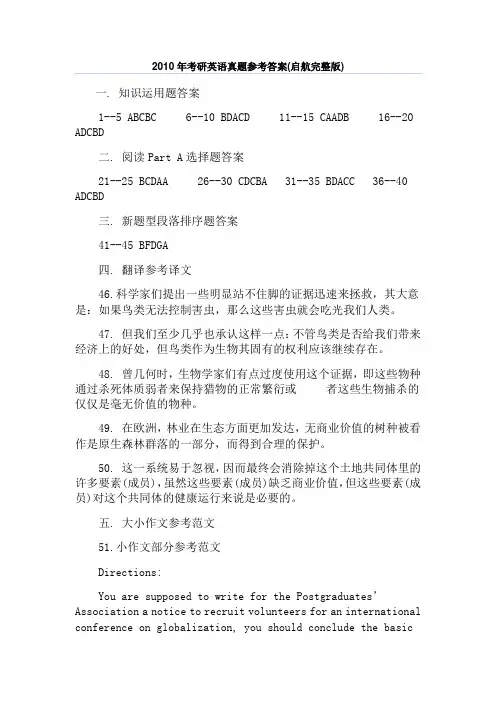
2010年考研英语真题参考答案(启航完整版)一. 知识运用题答案1--5 ABCBC 6--10 BDACD 11--15 CAADB 16--20 ADCBD二. 阅读Part A选择题答案21--25 BCDAA 26--30 CDCBA 31--35 BDACC 36--40 ADCBD三. 新题型段落排序题答案41--45 BFDGA四. 翻译参考译文46.科学家们提出一些明显站不住脚的证据迅速来拯救,其大意是:如果鸟类无法控制害虫,那么这些害虫就会吃光我们人类。
47. 但我们至少几乎也承认这样一点:不管鸟类是否给我们带来经济上的好处,但鸟类作为生物其固有的权利应该继续存在。
48. 曾几何时,生物学家们有点过度使用这个证据,即这些物种通过杀死体质弱者来保持猎物的正常繁衍或者这些生物捕杀的仅仅是毫无价值的物种。
49. 在欧洲,林业在生态方面更加发达,无商业价值的树种被看作是原生森林群落的一部分,而得到合理的保护。
50. 这一系统易于忽视,因而最终会消除掉这个土地共同体里的许多要素(成员),虽然这些要素(成员)缺乏商业价值,但这些要素(成员)对这个共同体的健康运行来说是必要的。
五. 大小作文参考范文51.小作文部分参考范文Directions:You are supposed to write for the Postgraduates’ Association a notice to recruit volunteers for an international conference on globalization, you should conclude the basic qualification of applicant and the other information you think relative。
You should write about 100 words. Do not sign your own name at the end of the letter. Use " Postgraduates’ Association " instead。
2010-2016年历年考研英语真题+答案

2016年全国硕士研究生入学考试英语一真题及答案Section I Use of English Section 1 Use of EnglishDirections: Read the following text. Choose the best word(s) for each numbered blank and mark [A], [B], [C] or [D] on ANSWER SHEET 1. (10 points)In Cambodia, the choice of a spouse is a complex one for the young male. It may involve not only his parents and his friends, __1__those of the young woman, but also a matchmaker. A young man can __2__ a likely spouse on his own and then ask his parents to __3__the marriage negoti ations, or the young man’s parents may take the choice of a spouse, giving the child little to say in the selection. __4__, a girl may veto the spouse her parents have chosen. __5__ a spouse has been selected, each family investigates the other to make sure its child is marrying __6__ a good family.The traditional wedding is a long and colorful affair. Formerly it lasted three days, __7__1980s it more commonly lasted a day and a half. Buddhist priests offer a short sermon and __8__ prayers of blessing. Par--ts of the ceremony involve ritual hair cutting,__9__cotton threads soaked in holy water around the bride's and groom's wrists, and __10__a candle around a circle of happily married and respected couples to bless the __11__. Newlyweds traditionally move in with the wife's parents and may__12__ with them up to a year, __13__they can build a new house nearby.Divorce is legal and easy to __14__, but not common. Divorced persons are__15__ with some disapproval. Each spouse retains ___16___ property he or she__17__ into the marriage, and jointly-acquired property is __18__ equally. Divorced persons may remarry, but a gender prejudice __19__up. The divorced male doesn't have a waiting period before he can remarry __20__the woman must wait ten months.1. A. by way of B. with regard to C. on behalf of D. as well as2. A. decide on B. provide for C. compete with D. adapt to3. A. close B. arrange C. renew D. postpone4. A. In theory B. Above all C. In time D. For example5. A. Unless B. Less C. After D. Although6. A. into B. within C. from D. through7. A. or B. since C. but D. so8. A. test B. copy C. recite D. create9. A. folding B. piling C. wrapping D. tying10. A. passing B. lighting C. hiding D. serving11. A. association B. meeting C. collection D. union12. A. deal B. part C. grow D. live13. A. whereas B. until C. for D. if14. A. avoid B. follow C. challenge D. obtain15. A. isolated B. persuaded C. viewed D. exposed16. A. wherever B. whatever C. whenever D. however17. A. changed B. brought C. shaped D. pushed18. A. invested B. divided C. donated D. withdrawn19. A. warms B. clears C. shows D. breaks20. A. while B. so that C. once D. in that Section Ⅱ Reading ComprehensionPart ADirections:Read the following four texts. Answer the questions after each text by choosing A, B, C or D. Mark your answers on ANSWER SHEET 1. (40 points)Text 1France,which prides itself as the global innovator of fashion, has decided its fashion industry has lost an absolute right to define physical beauty for women. Its lawmakers gave preliminary approval last week to a law that would make it a crime to employ ultra-thin models on runways. The parliament also agreed to ban websites that “incite excessive thinness” by promoting extreme dieting.Such measures have a couple of uplifting motives. They suggest beauty should not be defined by looks that end up impinging on health. That’s a start. And the ban on ultra-thin models seems to go beyond protecting models from starving themselves to death –as some have done. It tells the fashion industry that it must take responsibility for the signal it sends women, especially teenage girls, about the social tape-measure they must use to determine their individual worth.The bans, if fully enforced, would suggest to women (and many men) that they should not let others be arbiters of their beauty. And perhaps faintly, they hint that people should look to intangible qualities like character and intellect rather than dieting their way to size zero or wasp-waist physiques.The French measures, however, rely too much on severe punishment to change aculture that still regards beauty as skin-deep-and bone-showing. Under the law, using a fashion model that does not meet a government-defined index of body mass could result in a $85,000 fine and six months in prison.The fashion industry knows it has an inherent problem in focusing on material adornment and idealized body types. In Denmark, the United States, and a few other countries, it is trying to set voluntary standards for models and fashion images that rely more on peer pressure for enforcement.In contrast to France’s actions, Denmark’s fashion industry agreed last month on rules and sanctions regarding the age, health, and other characteristics of models. The newly revised Danish Fashion Ethical Charter clearly states:”We are aware of and take responsibility for the impact the fashion industry has on body ideals, especially on young people”. The charter’s main tool of enforcement is to deny access for designers and modeling agencies to Copenhagen Fashion Week (CFW), which is run by the Danish Fashion Institute. But in general it relies on a name-and -shame method of compliance.Relying on ethical persuasion rather than law to address the misuse of body ideals may be the best step. Even better would be to help elevate notions of beauty beyond the material standards of a particular industry.21. According to the first paragraph,what would happen in France?【A】Physical beauty would be redefined.【B】New runways would be constructed.【C】Websites about dieting would thrive.【D】The fashion industry would decline.22. The phrase “impinging on”(Line 2,Para.2) is closest in meaning to【A】heightening the value of【B】indicating the state of【C】losing faith in【D】doing harm to23. Which of the following is true of the fashion industry?【A】The French measures have already failed.【B】New standards are being set in Denmark.【C】Models are no longer under peer pressure.【D】Its inherent problems are getting worse.24. A designer is most likely to be rejected by CFW for【A】pursuing perfect physical conditions【B】caring too much about model’s character.【C】showing little concern for health factors【D】setting a high age threshold for models.25. Which of the following may be the best title of the text?【A】A Challenge to the Fashion Industry’s Body Ideals【B】A Dilemma for the Starving models in France【C】Just Another Round of Struggle for Beauty【D】The Great Threats to the Fashion IndustryText 2For the first time in history more people live in towns than in the country. In Britain this has had a c urious result. While polls show Britons rate”thecountryside”alongside the royal family, Shakespeare and the National Health Serivce (NHS) as what makes them proudest of their country, this has limited political support.A century ago Octavia Hill Launched the National Trust not to rescue stylish houses but to save“the beauty of natural places for everyone forever”. It was specifically to provide city dwellers with spaces for leisure where they could experience“a refreshing air .”Hill’s pressure la ter led to creation of national parks and green belts. They don’t make countryside any more,and every year concrete consumes more of it . It needs constant guardianship.At the next election none of the big parties seem likely to endorse this sen timent. The conservatives’planning reform explicitly gives rural development priority over conservation,even authorising“off-plan”building where local people might object. The concept of sustainable development has been defined as profitable. Labour likewise wants to discontinue local planning where councils oppose development. The Liberal Democrats are silent. Only Ukip, sensing its chance,has sided with those pleading for a more considered approach to using green land. Its Campaign to Protect Rural England struck terror into many local conservative parties.The sensible place to build new houses,factories and offices is where people are,in cities and towns where infrastructure is in place. The London agents Stirling Ackroyd recently identified enough sites for half a million houses in the London area alone,with no intrusion on green belt. What is true of London is even truer of the provinces.The idea that”housing crisis”equals“concreted meadows” is pure lobby talk. The issue is not the need for more houses but, as always,where to put them. Under lobby pressure,George Osborne favours rural new-build against urban renovation and renewal. He favours out-of-town shopping sites against high streets . This is not a free market but a biased one. Rural towns and villages have grown and will always grow. They do so best where building sticks to their edges and respects their character. We do not ruin urban Development should be planned, not let rip. After the Netherlands, Britain is Europe’s most crowed country. Half a century of town and country planning has enabled it to retain an enviable rural coherence, while still permitting low-density urban living. There is no doubt of the alternative --- the corrupted landscapes of southern Portugal, Spain or Ireland. Avoiding this rather than promoting it should unite the left and right of the political spectrum.26. Britain’s public sentiment about the countryside【A】 has brought much benefit to the NHS.【B】didn’t start till the Shakespearean age.【C】 is fully backed by the royal family.【D】 is not well reflected in politics.27. According to Paragraph 2,the achievements of the National Trust are now being【A】 gradually destroyed.【B】 effectively reinforced.【C】 properly protected.【D】 largely overshadowed.28. which of the following can be inferred from Paragraph 3?【A】 Ukip may gain from its support for rural conservation.【B】the Conservatives may abandon ”off -plan“ building.【C】 the Liberal Democrats are losing political influence.【D】 labour is under attack for opposing development.29. the author holds that George Osborne’s preference【A】 reveals a strong prejudice against urban areas.【B】 shows his disregard for the character of rural areas.【C】 stresses the necessity of easing the housing crisis.【D】 highlights his firm stand against lobby pressure.30. In the last paragraph,the author shows his appreciation of【A】 the size of population in Britain.【B】 the enviable urban lifestyle in Britain.【C】 the town-and-country planning in Britain.【D】 the political life in today is Britain.Text 3“There is on and only one social responsibility of business,” wrote Milton Friedman, a Nobel prize-winning economist, “That is, to use its resources and engage in activities designed to increase its profits.” But even if you accept Friedman’s premise and regard corporate social responsibility (CSR) policies as a waste of shareholders’ money, things may not be absolutely clear-cut. New research suggests that CSR may create monetary value for companies-at leastwhen they are prosecuted for corruption.The largest firms in America and Britain together spend more than $15 billion a year on CSR, according to an estimate by EPG, a consulting firm. This could add value to their businesses in three ways. First, consumers may take CSR spending as a “signal” that a company’s products are of high quality. Second, customers may be willing to buy a company’s products as an indirect way to donate to the good causes it helps. And third, through a more diffuse “halo effect,” whereby its good deeds earn it greater consideration from consumers and others.Previous studies on CSR have had trouble differentiating these effects because consumers can be affected by all three. Al recent study attempts to separate them by looking at bribery p rosecutions under America’s Foreign Corrupt Practices Act (FCPA). It argues that since prosecutors do not consume a company’s products as part of their investigations, they could be influenced only by the halo effect.The study found that, among prosecuted firms, those with the most comprehensive CSR programms tended to get more lenient penalties,. Their analysis ruled out the possibility that it was firm’sPolitical influence, rather than their CSR stand, that accounted for the leniency: Companies that contributed more to political campaigns did not receive lower fines.In all, the study concludes that whereas prosecutors should only evaluate a case based on its merits, they do seem to be influenced by a company’s record in CSR. “We estimate that either eliminating a substantial labour-rights concern , such as child labour, or increasing corporate giving byabout20% results in finesthat generally are 40% lower than the typical punishment for bribing foreign officials”, says one researcher.Researchers admit that their study does not answer the question of how much businesses ought to spend on CSR. Nor does it reveal how much companies are banking on the halo effect, rather than the other possible benefits, when they decide their do-gooding policies. But at least they have demonstrated that when companies get into trouble with the law, evidence of good character can win them less costly punishment.31.The author views Milton Friedman’s statement about CSR with【A】tolerance.【B】skepticism.【C】uncertainty.【D】approval.32.According to Paragraph 2,CSR helps a company by【A】winning trust from consumers.【B】guarding it against malpractices.【C】protecting it from being defamed.【D】raising the quality of its products.33. The expression “more lenient ”(line 2,para.4)is closest in meaning to【A】more effective【B】less controversial【C】less severe【D】more lasting34. When prosecutors evaluate a case, a company’s CSR regard【A】has an impact on their decision【B】comes across as reliable evidence【C】increases the chance of being penalized【D】constitutes part of the investigation35.Which of the following is true of CSR, according to the last paragraph?【A】Its negative effects on businesses are often overlooked.【B】The necessary amount of companies’ spending on it is unknown.【C】Companies’ financial capacity for it has been overestimated.【D】It has brought much benefit to the banking industry.Text 4There will eventually come a day when The New York Times ceases to publish stories on newsprint. Exactly when that day will be is a matter of debate. “Sometime in the future”, the paper’s publisher said back in 2010.Nostalgia for ink on paper and the rustle of pages aside, there’s plenty of incentive to ditch print. The infrastructure required to make a physical newspaper — printing presses, delivery trucks —isn’t just expensive; it’s excessive at a time when online-only competitors don’t have the same set of financial constraints. Readers are migrating away from print away. And though print ad sales still dwarf their online and mobile counterparts, revenue from print is still declining.Overhead may be high and circulation lower, but rushing to eliminate its printedition would be a mistake, says BuzzFeed CEO Joah Peretti.Perett i says the Times shouldn’t waste time getting out of the print business, but only if they go about doing it the right way.”Fighting out a way to accelerate that transition would make sense of them,”he said, “but if you discontinue it, you’re going to have your most loyal customers really upset with you.”Sometimes that’s worth making a change anyway. Peretti gives the example seen as a blunder,”he said. The move turned out to be foresighted. And if Peretti would raise prices and make it into more of a legacy product.”The most loyal customers would still get the product they favor, the idea goes, and they’d feel like they were helping sustain the quality of something they believe in. “So if you’re overpaying for print, you could feel like you wer e helping,”Peretti said. “Then increase it at a higher rate each year and essentially try to generate additional revenue.”In other words, if you’re going to make a print product ,make it for the people who are already obsessed with it. Which way be what the Times is doing already. Getting the print edition seven days a week costs $500 a year — more than twice as much as a digital-only subscription.“It’s a really hard thing to do and it’s a tremendous luxury that BuzzFeed doesn’t have a legacy business,”Peretti remarked. “But we’re going to have questions like that where we have things we’re doing that don’t make sense when the market changes and the world changes. In those situations, it’s better to be more aggressive than less aggressive. ”36.The New York Times is considering ending its print edition partly due to【A】the pressure from its investors.【B】the complaints from its readers.【C】the high cost of operation.【D】the increasing online ad sales.37. Peretti suggests that, in face of the present situation, the Times should 【A】make strategic adjustments【B】end the print edition for good.【C】seek new sources of readership.【D】aim for efficient management.38. It can be inferred form Paragraphs 5 and 6 that a “legacy product”【A】will have the cost of printing reduced.【B】is meant for the most loyal customers.【C】helps restore the glory of former times.【D】expands the popularity of the paper.39. Peretti believes that, in a changing world,【A】traditional luxuries can stay unaffected.【B】aggressiveness better meets challenges.【C】cautiousness facilitates problem-solving.【D】legacy businesses are becoming outdated.40. Which of the following would be the best title of the text?【A】Make Your Print Newspaper a Luxury Good.【B】Keep Your Newspapers Forever in Fashion.【C】Cherish the Newspaper Still in Your Hand.【D】Shift to Online Newspapers All at Once.Part BDirections:In the following article, some sentences have been removed. For Questions 41-45, choose the most suitable one from the list A-G to fit into each of the numbered blank. There are two extra choices, which do not fit in any of the gaps. Mark your answers on ANSWER SHEET 1. (10 points)[A]Create a new image of yourself[B]Decide if the time is right[C]Have confidence in yourself[D]Understand the context[E]Work with professionals[F]Know your goals[G]Make it efficientNo matter how formal or informa the work environment,the way you present yourself has an impact. This is especially true in first impressions. According to research from Princeton University,people assess your competence,trustworthiness,and likeability in just a tenth of a second,solely based on the way you look.The difference between today’s workplace and the“dress for success” era isthat the range of options is so much broader. Norms have evolved and fragmented. In some settings, red sneakers or dress T-shirts can convey status; in others not so much. Plus, whatever image we present is magnified by social-media services like LinkedIn. Chances are, your headshots are seen much more often now than adecade or two ago. Millennials, it seems, face the paradox of being the least formal generation yet the most conscious of style and personal branding. It can be confusing.So how do we navigate this? How do we know when to invest in an upgrade? And what’s the best way to pull off one that enhance our goals? Here are some tips;41. ()As an executive coach, I’ve seen image upgrades be particularly helpful during transitions---when looking for a new job, stepping into a new or more public role, or changing work environments. If you’re in a period of change or just feeling stuck and in a rut, now may be a good time. If you’re not sure, ask for honest feedback from trusted friends, colleagues and professionals. Look for cues about how others perceive you.Maybe there’s no need for an upgrade and that’s OK.42. ()Get clear on what impact you’re hoping to have. Are you looking to refresh your image or pivot it? For one person, the goal may be to be taken more seriously and enhance their professional image. For another, it may be to be perceived as more approachable, or more modern and stylish. For someone moving from finance to advertising, maybe they want to look more“SoHo”.(It’s OK to use characterizations like that.)43. ()Look at your work environment like an anthropologist. What are the norms of your environment? What conveys status? Who are your most important audiences?How do the people you respect and look up to present themselves? The better you understand the cultural context, the more control you can have over your impact.44.()Enlist the support of professionals and share with them your goals and context. Hire a personal stylist, or use the free styling service of a store like J.Crew. Try a hair stylist instead of a barber. Work with a professional photographer instead of your spouse or friend. It’s not as expensive as you m ight think.45.()The point of a style upgrade isn’t to become more vain or to spend more time passing over what to wear. Instead, use it as an opportunity to reduce decision fatigue. Pick a standard work uniform or a few go-to options. Buy all yourclothes once with a stylist instead of shopping alone, one article of clothing at a time.Part C TranslationDirections:Read the following text carefully and then translate the underlined segments into Chinese. Your translation should be written clearly on ANSWER SHEET 2. (10 points) Mental health is our birthright. (46) we don’t have to learn how to be mentally healthy, it is built into us in the same way that our bodies know how to heal a cut or me nd, a broken bone. Mental health can’t be learned, only reawakened. It is like immune system of the body, which under stress or through lack of nutrition or exercise can be weakened, but which never leaves us. When we don’t understand the value of mental h ealth and we don’t know how to gain access to it, mentalhealth will remain hidden from us. (47) Our mental health doesn’t go anywhere; like the sun behind a cloud, it can be temporarily hidden from view, but it is fully capable of being restored in an instant.Mental health is the seed that contains self-esteem –confidence in ourselves and an ability to trust in our common sense. It allows us to have perspective on our lives-the ability to not take ourselves too seriously, to laugh at ourselves, to see the bigger picture, and to see that things will work out. It’s a form of innate or unlearned optimism. (48) Mental health allows us to view others with sympathy if they are having troubles, with kindness if they are in pain, and with unconditional love no matter who they are. Mental health is the source of creativity for solving problems, resolving conflict, making our surroundings more beautiful, managing our home life, or coming up with a creative business idea or invention to make our lives easier. It gives us patience for ourselves. And toward others as well as patience while driving, catching a fish, working on our car, or raising a child. It allows us to see the beauty that surrounds us each moment in nature, in culture, in the flow of our daily lives.(49)Although mental health is the cure-all for living our lives, it is perfecting ordinary as you will see that it has been there to direct you through all your difficult decisions. It has been available even in the most mundane of life situations to show you right from wrong, good from bad, friend from foe. Mental health has commonly been called conscience, instinct, wisdom, common sense, or the inner voice, we think of it simply as a health and helpful flow of intelligent thought. (50) As you will come to see, knowing that mental health is always available andknowing to trust it allow us to slow down to the moment and live life happily.Section III WritingPart ADirections:Suppose you are a librarian in your university. Write a notice of about 100 words, providing the newly-enrolled international students with relevant information about the library.You should write neatly on the ANWSER SHEET.Do not sign you own name at the end of the letter, use “Li Ming ” instead.Do not write the address .(10 points)Part B52. Directions:Write an essay of 160—200 words based on the following picture.in your essay, you should1. describe the pictures briefly,2. interpret its intended meaning, and3. give your comments.You should write neatly on ANSWER SHEET . (20 points)2015年全国硕士研究生入学考试英语一真题及答案 Section I Use of English Directions:Read the following text. Choose the best word(s) for each numbered blank and mark A, B, C or D on ANSWER SHEET. (10 points)Though not biologically related, friends are as “related”as fourth cousins, sharing about 1% of genes. That is _(1)_a study, published from the University of California and Yale University in the Proceedings of the National Academy of Sciences, has__(2)_.The study is a genome-wide analysis conducted _(3)__1,932 unique subjects which __(4)__pairs of unrelated friends and unrelated strangers. The same people were used in both_(5)_.While 1% may seem_(6)_,it is not so to a geneticist. As James Fowler, professor of medical genetics at UC San Diego, says, “Most people do not even _(7)_their fourth cousins but somehow manage to select as friends the people who_(8)_our kin.”The study_(9)_found that the genes for smell were something shared in friends but not genes for immunity .Why this similarity exists in smell genes is difficult to explain, for now,_(10)_,as the team suggests, it draws us to similar environments but there is more_(11)_it. There could be many mechanisms working together that_(12)_u s in choosing genetically similar friends_(13)_”functional Kinship” of being friends with_(14)_!One of the remarkable findings of the study was the similar genes seem to be evolution_(15)_than other genes Studying this could help_(16)_why human evolution picked pace in the last 30,000 years, with social environment being a major_(17)_factor.The findings do not simply explain people’s_(18)_to befriend those of similar_(19)_backgrounds, say the researchers. Though all the subjects were drawn from a population of European extraction, care was taken to_(20)_that all subjects, friends and strangers, were taken from the same population.1. [A] when [B] why [C] how [D] what2. [A] defended [B] concluded [C] withdrawn [D] advised3. [A] for [B] with [C] on [D] by4. [A] compared [B] sought [C] separated [D] connected5. [A] tests [B] s [C]samples [D] examples6. [A] insignificant [B] unexpected [C]unbelievable [D] incredible7. [A] visit [B] miss [C] seek [D] know8. [A] resemble [B] influence [C] favor [D] surpass9. [A] again [B] also [C] instead [D] thus10. [A] Meanwhile [B] Furthermore [C] Likewise [D] Perhaps11. [A] about [B] to [C]from [D]like12. [A] drive [B] observe [C] confuse [D]limit13. [A] according to [B] rather than [C] regardless of [D] along with14. [A] chances [B]responses [C]missions [D]benefits15. [A] later [B]slower [C] faster [D] earlier16. [A]forecast [B]remember [C]understand [D]express17. [A] unpredictable [B]contributory [C] controllable [D] disruptive18. [A] endeavor [B]decision [C]arrangement [D] tendency19. [A] political [B] religious [C] ethnic [D] economic20. [A] see [B] show [C] prove [D] tellSection II Reading ComprehensionPart ADirections:Read the following four texts. Answer the questions below each text by choosing A, B, C or D. Mark your answers on ANSWER SHEET. (40 points)Text 1King Juan Carlos of Spain once insisted “kings don’t abdicate, they dare in their sleep.”But embarrassing scandals and the popularity o f the republican left in the recent Euro-elections have forced him to eat his words and stand down. So, does the Spanish crisis suggest that monarchy is seeing its last days? Does that mean the writing is on the wall for all European royals, with their magnificent uniforms and majestic lifestyle?The Spanish case provides arguments both for and against monarchy. When public opinion is particularly polarised, as it was following the end of the Franco regime, monarchs can rise above “mere”politics and “embody”a spirit of national unity.。
1980-2010年英语考研真题
2011考研英语使用说明(必读) 12010年全国硕士研究生入学统一考试英语试题 3 Section I Use of English 3Section II R eading Comprehension 4Part A 5Part B 11Part C 13Section ⅢWriting 14Part A 14Part B 142009年全国硕士研究生入学统一考试英语试题15 Section I Use of English 15Section II R eading Comprehension 17Part A 17Part B 23Part C 25Section ⅢWriting 25Part A 25Part B 262009年考研英语真题答案272008年全国硕士研究生入学统一考试英语试题29 Section I Use of English 29Section II R eading Comprehension 31Part A 31Part B 37Part C 39Section III Writing 40Part A 40Part B 402008年考研英语真题答案422007年全国硕士研究生入学统一考试英语试题44 Section I Use of English 44Section II R eading Comprehension 47Part A 47Part B 54Part C 56Section III Writing 57Part A 57Part B 572007年考研英语真题答案582006年全国硕士研究生入学统一考试英语试题60 Section I Use of English 60Section II R eading Comprehension 63Part A 63Part B 70Part C 72Section III Writing 73Part A 73Part B 732006年考研英语真题答案752005年全国硕士研究生入学统一考试英语试题77 Section I Use of English 77Section II R eading Comprehension 80Part A 80Part B 87Part C 89Section III Writing 90Part A 90Part B 902005年考研英语真题答案922004年全国硕士研究生入学统一考试英语试题94 Section I Listening Comprehension 94Part A 94Part B 94Part C 95Section II U se of English 97Section III Reading Comprehension 101Part A 101Part B 107Section IV Writing 1092004年考研英语真题答案1102003年全国硕士研究生入学统一考试英语试题112 Section I Listening Comprehension 112Part A 112Part B 112Part C 113Section II U se of English 115Section III Reading Comprehension 119Part A 119Part B 126Section IV Writing 1262003年考研英语真题答案1282002年全国硕士研究生入学统一考试英语试题130 Section I Listening Comprehension 130Part A 130Part B 131Part C 131Section II U se of English 134Section III Reading Comprehension 138Part A 138Part B 145Section IV Writing 1452002年考研英语真题答案1472001年全国硕士研究生入学统一考试英语试题149 Section I Structure and V ocabulary 149Part A 149Part B 151Section II C loze Test 155Section III Reading Comprehension 159Section IV English-Chinese Translation 166 Section V W riting 1672001年考研英语真题答案1692000年全国硕士研究生入学统一考试英语试题171 Section I Structure and V ocabulary 171Part A 171Part B 173Part C 174Section II C loze Test 179Section III Reading Comprehension 180Section IV English-Chinese Translation 188 Section V W riting 1892000年考研英语真题答案1901999年全国硕士研究生入学统一考试英语试题192 Section I Structure and V ocabulary 192Part A 192Part B 194Part C 195Section II C loze Test 199Section III Reading Comprehension 201Section IV English-Chinese Translation 209 Section V W riting 2091999年考研英语真题答案2111998年全国硕士研究生入学统一考试英语试题213 Section I Structure and V ocabulary 213Part A 213Part B 215Part C 216Section II C loze Test 220Section III Reading Comprehension 222Section IV English-Chinese Translation 230Section V W riting 2311998年考研英语真题答案2331997年全国硕士研究生入学统一考试英语试题235 Section I Structure and V ocabulary 235Part A 235Part B 237Part C 238Section II C loze Test 242Section III Reading Comprehension 244Section IV English-Chinese Translation 251 Section V W riting 2521997年考研英语真题答案2541996年全国硕士研究生入学统一考试英语试题256 Section I Structure and V ocabulary 256Part A 256Part B 258Part C 259Section II C loze Test 263Section III Reading Comprehension 265Section IV English-Chinese Translation 272 Section V W riting 2731996年考研英语真题答案2741995年全国硕士研究生入学统一考试英语试题276 Section I Structure and V ocabulary 276Part A 276Part B 278Part C 279Section II C loze Test 283Section III Reading Comprehension 285Section IV English-Chinese Translation 292 Section V W riting 2931995年考研英语真题答案2941994年全国硕士研究生入学统一考试英语试题296 Section I Structure and V ocabulary 296Part A 296Part B 298Part C 299Section II C loze Test 303Section III Reading Comprehension 305Section IV English-Chinese Translation 311 Section V W riting 3121994年考研英语真题答案3141993年全国硕士研究生入学统一考试英语试题316 Section I Structure and V ocabulary 316Section II R eading Comprehension 321Section III Cloze Test 326Section IV Error-detection and Correction 329 Section V E nglish-Chinese Translation 331Section VI Writing 3311993年考研英语真题答案3331992年全国硕士研究生入学统一考试英语试题335 Section I Structure and V ocabulary 335Section II R eading Comprehension 340Section III Cloze Test 345Section IV Error-detection and Correction 347 Section V E nglish-Chinese Translation 349Section VI Writing 3501992年考研英语真题答案3511991年全国硕士研究生入学统一考试英语试题353 Section I Structure and V ocabulary 353Section II R eading Comprehension 358Section III Cloze Test 363Section IV Error-detection and Correction 366 Section V E nglish-Chinese Translation 367Section VI Writing 3681991年考研英语真题答案3691990年全国硕士研究生入学统一考试英语试题371 Section I Structure and V ocabulary 371Section II R eading Comprehension 373Section III Cloze Test 377Section IV Error-detection and Correction 379 Section V V erb Forms 381Section VI Chinese-English Translation 381 Section VII English-Chinese Translation 3821990年考研英语真题答案3841989年全国硕士研究生入学统一考试英语试题386 Section I Structure and V ocabulary 386Section II R eading Comprehension 388Section III Cloze Test 393Section IV Error-detection and Correction 395 Section V V erb Forms 396Section VI Chinese-English Translation 397 Section VII English-Chinese Translation 3971989年考研英语真题答案3991988年全国硕士研究生入学统一考试英语试题401 Section I Structure and V ocabulary 401Section II R eading Comprehension 403Section III Cloze Test 408Section IV Error-detection and Correction 410 Section V V erb Forms 411Section VI Chinese-English Translation 412 Section VII English-Chinese Translation 4121988年考研英语真题答案4141987年全国硕士研究生入学统一考试英语试题416 Section I Structure and V ocabulary 416Section II R eading Comprehension 418Section III Structure and V ocabulary 422 Section IV Cloze Test 424Section V V erb Forms 426Section VI Error-detection and Correction 427 Section VII Chinese-English Translation 429 Section VIII English-Chinese Translation 4291987年考研英语真题答案4311986年全国硕士研究生入学统一考试英语试题433 Section I Structure and V ocabulary 433Section II C loze Test 435Section III Reading Comprehension 437Section IV Structure and V ocabulary 440 Section V E rror-detection and Correction 442 Section VI Verb Forms 444Section VII Chinese-English Translation 444 Section VIII English-Chinese Translation 4451986年考研英语真题答案4461985年全国硕士研究生入学统一考试英语试题448 Section I Structure and V ocabulary 448Section II C loze Test 450Section III Reading Comprehension 453Section IV Structure and V ocabulary 454 Section V E rror-detection and Correction 456 Section VI Verb Forms 457Section VII Chinese-English Translation 458 Section VIII English-Chinese Translation 4591985年考研英语真题答案4611984年全国硕士研究生入学统一考试英语试题464 Section I Structure and V ocabulary 464Section II C loze Test 469Section III Reading Comprehension 471Section IV Structure and V ocabulary 472 Section V E rror-detection and Correction 474 Section VI Verb Forms 476Section VII Chinese-English Translation 477 Section VIII English-Chinese Translation 4771984年考研英语真题答案4791983年全国硕士研究生入学统一考试英语试题482Section I Structure and V ocabulary 482Section II V erb Forms 484Section III Error-detection 484Section IV Cloze Test 485Section V R eading Comprehension 488Section VI Structure and V ocabulary 489Section VII Chinese-English Translation 491Section VIII English-Chinese Translation 4911983年考研英语真题答案4931982年全国硕士研究生入学统一考试英语试题495Section I Structure and V ocabulary 495Section II V erb Forms 497Section III Error-detection 498Section IV Cloze Test 499Section V R eading Comprehension 501Section VI Chinese-English Translation 503Section VII English-Chinese Translation 5031982年考研英语真题答案5051981年全国硕士研究生入学统一考试英语试题507Section I Structure and V ocabulary 507Section II E rror-detection 510Section III Sentence Making 511Section IV Verb Forms 511Section V C loze Test 512Section VI Chinese-English Translation 513Section VII English-Chinese Translation 5131981年考研英语真题答案5161980年全国硕士研究生入学统一考试英语试题519Section I Use of Prepositions 519Section II V erb Tenses 519Section III Verb Forms 520Section IV Structure and V ocabulary 521Section V E rror-detection 523Section VI Chinese-English Translation 524Section VII English-Chinese Translation 5241980年考研英语真题答案527使用说明(必读)—爱你需要理由么?1. 本文件包括自我国研究生入学实行统考以来(1980—2010年)所有31套全国硕士研究生入学统一考试英语试题及答案。
2023年考研英语一真题及答案完整解析(1)
2023年全国硕士研究生入学统一考试英语(一)2023年全国硕士研究生入学统一考试英语(一)Justice Antonin Scalia, for e某ample, appeared at political events. That kind of activity makes it less likely that the court’s decisions will be _4_ as impartial judgments. Part of the problem is that the justices are not _5_by an ethics code. At the very least, the court should make itself _6_to the codeof conduct that _7_to the rest of the federal judiciary.This and other similar cases _8_the question of whether there is still a _9_between the court and politics.The framers of the Constitution envisioned law _10_having authority apart from politics. They gave justices permanent positions _11_they would be free to _12_ those in power and have no need to _13_ political support. Our legal system was designed to set law apart from politics precisely because they are so closely _14_.Constitutional law is political because it results from choices rooted in fundamental social _15_ like liberty and property. When the court deals with social policy decisions, the law it _16_ is inescapably political-which is why decisionssplit along ideological lines are so easily _17_ as unjust.The justices must _18_ doubts about the court’s legitimacy by making themselves _19_ to the code of conduct. That wouldmake rulings more likely to be seen as separate from politics and, _20_, convincing as law.1. [A]emphasize [B]maintain [C]modify [D] recognize2.[A]when [B]lest [C]before [D] unless 3. [A]restored [B]weakened[C]established [D] eliminated5. [A]advanced [B]caught [C]bound [D]founded6. [A]resistant [B]subject [C]immune [D]prone7. [A]resorts [B]sticks [C]loads [D]applies 8. [A]evade[B]raise [C]deny [D]settle 9. [A]line [B]barrier [C]similarity [D]conflict2023年全国硕士研究生入学统一考试英语(一)10. [A]by [B]as [C]though [D]towards 11. [A]so [B]since[C]provided [D]though 12. [A]serve [B]satisfy [C]upset[D]replace 13. [A]confirm [B]e某press [C]cultivate [D]offer 14.[A]guarded [B]followed [C]studied [D]tied 15. [A]concepts[B]theories [C]divisions [D]conceptions16. [A]e某cludes [B]questions [C]shapes [D]controls17. [A]dismissed [B]released [C]ranked [D]distorted 18.[A]suppress [B]e某ploit [C]address [D]ignore19. [A]accessible [B]amiable [C]agreeable [D]accountable 20.[A]by all mesns [B]atall costs [C]in a word [D]as a resultRosenberg, the recipient of a Pulitzer Prize, offers a host of e某ample of the social cure in action: In South Carolina, a state-sponsored antismoking program called Rage Against the Haze sets out to make cigarettes uncool. In South Africa, an HIV-prevention initiative known as LoveLife recruits young people to promote safe se某 among their peers.The idea seems promising,and Rosenberg is a perceptive observer. Her critique of the lameness of many pubic-health campaigns is spot-on: they fail to mobilize peer pressure for healthy habits, and they demonstrate a seriously flawed understanding of psychology.” Dare to be different, please don’t smoke!” pleads one billboard campaign aimed at reducing smoking among teenagers-teenagers, who desirenothing more than fitting in. Rosenberg argues convincingly that public-health advocates ought to take a page from advertisers, so skilled at applying peer pressure.But on the general effectiveness of the social cure, Rosenberg is less persuasive. Join the Club is filled with too much irrelevant detail and not enough e某ploration of thesocial and biological factors that make peer pressure so powerful. The most glaring flaw of the social cure as it’s presented here is that it doesn’t work very well for very long. Rage Against the Haze failed once state funding was cut.Evidence that the LoveLife program produces lasting changes is limited and mi某ed.Far less certain, however, is how successfully e某perts and bureaucrats can select our peer groups and steer theiractivities in virtuous d irections. It’s like the teacher who breaks up the troublemakers in the back row by pairing them2023年全国硕士研究生入学统一考试英语(一)with better-behaved classmates. The tactic never really works. And that’s the problem with a social cure engineered from the outside: in the real world, as in school, we insist on choosing our own friends.21. According to the first paragraph, peer pressure often emerges as [A] a supplement to the social cure [B] a stimulus to group dynamics [C] an obstacle to school progress [D] a cause of undesirable behaviors22. Rosenberg holds that public advocates should [A] recruit professional advertisers [B] learn from advertisers’ e某perience[D] recognize the limitations of advertisements23. In the author’s view, Rosenberg’s book fails to [A] adequately probe social and biological factors [B] effectively evade the flaws of the social cure [C] illustrate the functions of state funding [D]produce a long-lasting social effect24. Paragraph 5shows that our imitation of behaviors [A] is harmful to our networks of friends [B] will mislead behavioral studies [C] occurs without our realizing it [D] can produce negative health habits25. The author suggests in the last paragraph that theeffect of peer pressure is [A] harmful[B] desirable[C]profound[D] questionable2023年全国硕士研究生入学统一考试英语(一)26. The phrase “reneging on”(Line 3.para.1) is closest in meaning to [A] condemning.[B] reaffirming.[C] dishonoring.[D] securing.27. By entering into the 2002 agreement, Entergy intended to[A] obtain protection from Vermont regulators. [B] seek favor from the federal legislature.[C] acquire an e某tension of its business license . [D] get permission to purchase a power plant.28. According to Paragraph 4, Entergy seems to have problems with its [A] managerial practices. [B] technical innovativeness.[C] financial goals. [D] business vision29. In the author’s view, the Vermont case will test [A] Entergy’s capacity to fulfill all its promises. [B] the mature of states’ patchwork regulations. [C] the federal authority over nuclear issues .[D] the limits of states’ power over nuclear issues.30. It can be inferred from the last paragraph that [A] Entergy’s business elsewhere might be affected. [B] the authority of the NRC will be defied.2023年全国硕士研究生入学统一考试英语(一)[C] Entergy will withdraw its Plymouth application. [D] Vermont’s reputation might be damaged.31. According to the first paragraph, the process of discovery is characterized by its[B] misconception and deceptiveness. [C] logicality and objectivity.[D] systematicness and regularity.32. It can be inferred from Paragraph 2 that credibility process requires。
31年考研英语真题及答案
4. [A] controversial [D] ambiguous
[B] perplexing [C]
5. [A] requirements [B] explanations [C] accounts [D] assessments 6. [A] conclude 7. [A] as far as 8. [A] awareness 9. [A] suitable 10. [A] about 11. [A] compared [B] matter [C] indicate [D] work
[B] for fear that[C] in case that[D] so long as [B] expectation [C] sentiment [B] excessive [B] for [B] shown [C] enough [C] on [C] subjected [D] illusion [D] abundant [D] by [D] conveyed
Part A Directions: Read the following four texts. Answer the questions below each text by choosing [A], [B], [C] or [D]. Mark your answers on ANSWER SHEET 1. (40 points) Text 1 Of all the changes that have taken place in English-language newspapers during the past quarter-century, perhaps the most far-reaching has been the inexorable decline in the scope and seriousness of their arts coverage. It is difficult to the point of impossibility for the average reader under the age of forty to imagine a time when high-quality arts criticism could be found in most big-city newspapers. Yet a considerable number of the most significant collections of criticism published in the 20th century consisted in large part of newspaper reviews. To read such books today is to marvel at the fact that their learned contents were once deemed suitable for publication in general-circulation dailies. We are even farther removed from the unfocused newspaper reviews published in England between the turn of the 20th century and the eve of World War II, at a time when newsprint was dirt-cheap and stylish arts criticism was considered an ornament to the publications in which it appeared. In those far-off days, it was taken for granted that the critics of major papers would write in detail and at length about the events they covered. Theirs was a serious business, and even those reviewers who wore their learning lightly, like George Bernard Shaw and Ernest Newman, could be trusted to know what they were about. These men believed in journalism as a calling, and were proud to be published in the daily press. “So few authors have brains enough or literary gift enough to keep their own end up in journalism,” Newman wrote, “that I am tempted to define ‘journalism’ as ‘a term of contempt applied by writers who are not read to writers who are.’” Unfortunately, these critics are virtually forgotten. Neville Cardus, who wrote for the Manchester Guardian from 1917 until shortly before his death in 1975, is now known solely as a writer of essays on the game of cricket. During his lifetime, though, he was also one of
2010年考研英语一真题答案解析
2010年考研英语答案完整版详解Section I Use of English1.A解析:A项affect 意思是“影响,感动”; B项achieve意思是“达成,完成”; C项extract意思是“提取,榨出”;D项restore是“恢复,重建”. 这句话的意思是:他们想通过实验探究车间照明是如何影响工人的生产率的,所以答案是A。
2.B解析:本题考查了固定短语end up 的用法,end up 意思是“最终成为……”,end 和其它三个介词的搭配都无此意,故选B。
3.C解析:本句的大意为:研究最终总结为一个极具影响力的概念—“霍桑效应”,也正是实验所研究的行为改变了工人们的表现。
所以这里应选择C。
4.B解析:作者这里表达的意思是这个问题之所以引起大家的注意是因为工厂女工的行为令人费解。
四个选项中perplexing意为“令人费解的”,所以正确答案为B。
5.C解析:本句的含义是:根据研究描述,当照明灯变亮或变暗时,工人的时产量就会提高。
四个选项中有描述含义的是C项accounts。
6.B解析:这句话的意思是:实验中做什么并不重要。
Do not matter 固定表达,故选B。
7.D解析:考查so long as 短语,意思是“只有”,句子意思是:只要有改变,生产率就会上升。
8.A解析:A项awareness 意思是“意识”,B项expectation意为“期望”,C项sentiment 意为“”观点,意见,D项illusion 为“幻觉”,本句的大意是说:工人知到自己本身是被研究对象-这一意识就足以改变他们的行为。
所以选A。
9.C解析:见第8题解析。
10.D解析:见第8题解析。
11.C解析:be subjected to表示“服从于,与……一致’,为固定短语。
12.A解析:contrary to表示“与…相反“。
根据语境提示,空白处需要填写一个能表示转折意味的链接词。
13.A解析:只有evidence一词可与found呼应,表示“发现或找到证据”。