
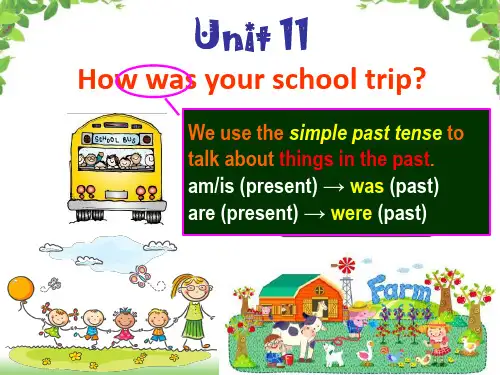
Unit 11 How was your school trip 人教版英语七年级下册易错题
七年级下册Unit 11 易错题单项选择1. It’s _____ book. ______ children enjoy reading it.A. a quite interesting; Quite a lotB. quite an interesting; Quite a lotC. a quite interesting; Quite a lot ofD. quite an interesting; Quite a lot of2. Your computer doesn’t work now. Is there _____ with it?A. wrong somethingB. something wrongC. anything wrongD. nothing wrong3. As long as you study hard enough, I believe things will _____ soon.A. pick atB. pick outC. pick upD. pick and choose4. - Will you see the film Cinderella with us tonight?- No, I _____ it last week.A. seeB. have seenC. sawD. will see5. Last night the big fire in Sunshine Shopping mall was started by the children playing with matches. _____ no one was hurt.A. LuckilyB. SuddenlyC. EasilyD. Sadly6. There was something wrong with the line. We couldn’t ______ each other clearly.A. listenB. soundC. hearD. speak7. The book won’t _______ until the end of the year.A. come outB. come overC. come trueD. come on8. We can hardly believe that you learn to dance so ______A. quickB. quicklyC. fastD. soon9. The price of the dress is too ______. I want a ______ one.A. expensive; cheapB. expensive; lowC. high; lowD. high; cheap10. - How ______ your school trip yesterday?- _______. We were all very happy.A. did; BadB. did; ExcitingC. was; TerribleD. was; Exciting11. We didn’t go ______ because it _______ heavily.A. fish; rainsB. fish; rainedC. fishing; rainingD. fishing; rained12. -Why are you driving so ______, Tony? I’m feeling sick.- Sorry, but the train is leaving in 20 minutes. We have to hurry.A. oftenB. fastC. hardD. slowly13. The small toy looks ______. I want to take it.A. lovingB. lovelyC. livelyD. lucky14. - Alice, you _____ the bird today, will you?- But I did it yesterday.A. keepB. catchC. feedD. feed on15. - Don’t you see the sign “No parking!” on the right?- Sorry, I _____. But now I know parking here is not right.A. don’tB. didn’tC. hadn’tD. doesn’t16.-Did you read the news _______ the newspapers that Yang Jiang passed away(去世) _____ the morning of May 25th .A. at; inB. on; inC. in; onD. at; on17. I didn’t like it.________ it was too expensive.A. HoweverB. AndC. AlsoD. So18. I want to be famous. I’m tired of being_________.A. somebodyB. nobodyC. anybodyD. everybody19. -The food_______ be delicious. You ate it up.-You bet. My mum cooked it for me.A. mustB. mayC. canD. need20. Tom came to school ______ and missed the first lesson.A. latelyB. laterC. lateD. latter21. -You look_______ in the dress. –Thanks.A. smartB. surprisedC. scaredD. strict22. After the failure(失败),there’s not much_______ left in him.A. surpriseB. wishC. liftD. fight23. Last month the price of pork______.A. movedB. cutC. relaxedD. jumped24. People in the country ________ free health care.A. enjoyB. liveC. keepD. take25. Young children _______ words they hear their elders use.A. put upB. pick upC. make upD. set up26.-A nice shirt. A present?-Yes. It is.My mum _____ it for my last birthday.A. buysB. boughtC. buyD. is buying.27. My physics teacher told me light_________ faster than sound.A. travelsB. traveledC. would travelD.is traveling28.-How is everything going at school, dear?-________.A. All right, thanksB. Not too bad, I guessC. That’s rightD. I’m glad to hear that.29.-I’m always a little nervous when I talk to Mr. Smith.-_______. He is strict, but he is kind to his students.A. It doesn’t matterB. What a pityC. Take it easyD. Take your time30. Can you describe____________?A. what the student look likeB. what does the student look likeC. what does the student looks likeD. what the student looks like二、完形填空Friends are important in our life. Most people __1__ friendship to last forever. __2__, even the best friendship can end.Many friendships end because of a(n) __3__ in personality(性格) or life. The friendship slowly loses importance and finally___4__.Tommy wrote, “I didn’t even know the friendship was over until I thought of Alan as a former(以前的) friend.”Peter said. “We __5__ seeing each other less and less. The friendship was just over.”Sometimes friendships __6__ suddenly from a disagreement or move to another place.Alice said,“The end of our friendship was a gradual(逐渐的) thing. I moved from one side of the city to the other. Since then we __7__ made a phone call. We met less and less. At last our friendship ended.”Jack said, “ When I moved to Seattle after college, our friendship was over. Both of us were always __8__ with new jobs, so we didn’t call __9__. Our friendship was so dead that I didn’t call him when I went home.”But the biggest __10__ to a friendship is change. Lillian Rubin in her book Just Friends says, “It’s__11__ that friendship may be lost if friends change or __12__ in different ways.”When friendships ends, there is always __13___ pain(疼痛).When you can ___14__ nothing to keep the friendship, it is important to forget the pain. Then move on __15___ new friendships.1. A. hope B. remember C. decide D. begin2. However B. Luckily C. Then D. So3. A. interest B. experience C. change D. suggestion4. A. forgets B. disappears C. appears(出现) D. lost5. A. finished B. practiced C. enjoyed D. started6. A. die B. come C. leave D. stay7. A. often B. seldom C. always D. never8. A. busy B. tired C. pleased D. fed9. A. others B. another C. other D. each other10. A. problem B. question C. key D. answer11. A. strange B. true C. important D. impossible12. A. become B. make C. grow D. feel13. A. little B. some C. any D. no14. A. write B. say C. take D. do14. A. to ask for B. forming C. to build D. beginning三、阅读理解“I’m fourteen years old and know how to do it,” Jessie said. “Besides, it would help Dad out, and he won’t have to worry about it over the weekend.”Mom thought for a while and then decided to let Jessie give it a try. After all, she was home and would keep an eye on her. Jessie already knew how to start the lawn mower(割草机) from watching her dad. Jessie checked the gas(汽油) to make sure it was full, and put on her gardening gloves to protect her hands. Mom watched from the kitchen window. Jessie really does know how to mow the lawn. She was very careful around the flowers and trees. When she finished, she felt so good, but she was so hot. Mom brought her some ice tea and said, “You sure did a great job. Dad will be very surprised.”Later that day, Dad came home and said to Jessie’s mom, “You didn’t have to mow the lawn. I was going to do it on Saturday. It looks great. Thanks.”“I didn’t mow it. Jessie did.”“Wow, our little girl is growing up!” Dad told Jessie what a great job she had done.“It was fun, and I will do it again next week,” said Jessie.The neighbor next door came by and asked Jessie if she wanted to mow his lawn and make some money. “Sure!” said Jessie. Jessie began mowing his lawn. Two other neighbors asked so, then another three. Jessie was now mowing lawns for them all and making some money. She was no longer bored! “I won’t have time to spend my money,” she laughed to herself.1. In order to do something different, Jessie decide to _______.A. read booksB. travelC. mow the lawnD. watch TV2. What does “keep an eye on” mean?A. 保护B. 留意C. 培养D. 瞄准3. Before Jessie mowed the lawn, she ______.A. washed her handsB. bought some gasC. read some instructionsD. put on her gloves4. How did Jessie’s father feel when he knew Jessie had mowed the lawn?A. Proud.B. Angry.C. Relaxed.D. Worried.5. What does the text mainly tell us?A. Neighbors should learn to help each other.B. Mowing the lawn is a good way to make money.C. Doing something helpful can make people happy.D. Children should help their parents at an early age.四、阅读理解填词The London Eye is a tourist attraction(旅游景点) in London, the UK. There you can get into a capsule(密封舱)to enjoy a great view of the city of London.I v__1__ the London Eye last summer with a friend. My friend didn’t know w__2__ to go. I just told him we w___3___ go somewhere very special. As we arrived at Waterloo Station, he w___4__ out where we were going. He smiled h___5__. When we reached the London Eye, there was a very long waiting line, so in order to s__6___ time, he stayed in the line while I went to buy the tickets.The capsule doesn’t completely(完全地)stop when people get on, so you h__7___ to get into quickly. Then the door of the capsule shuts. The view was wonderful. We took many photos of the view and of o___8__. It took about half an hour for the capsule to go round.If you are interested in g__9___ there, I’d like to give some advice. To enjoy the view, go in the daytime. There are night r__10___, but you won’t see a lot. Sometimes the top o f the wheel can be quite cool even though(即使)it’s sunny. So ladies don’t forget to take a scarf.1. visited2. where3. would4. worked5. happily6. save7. have8. ourselves9. going 10. ride五、根据汉语完成句子1. 大雨过后,太阳又出来了.After a ____ ______, the sun _____ _____ again.2. 你的叔叔昨天下午带你参观了他的农场吗?Did your uncle _____ _____ _____ his farm yesterday afternoon?3. Mr. Jackson told me a story. (改为一般疑问句)_____ Mr. Jackson ______ you a story?4. 沿途我们看到了一些农场和乡村。
人教版七年级英语下册Unit11Howwasyourschooltrip单元复习
2.__ta_k_e_____ 4.__h_a_d_____ 6._r_o_d_e_____ 8.__b_u_t_____ 10.__a_______
基础复现天天练 Work seriously
●难点释疑 ①go on a school trip意为“参加学校郊 游”。如: All the students went on a school trip last week. 上周所有学生都参加学校郊游活动。 ②worry是动词,意为“担心”。常见一般 搭配为 worry about。如: You don’t need to worry about me.
目录 contents
4 主要语法
主要语法
Work seriously
四、主要语法 用一般过去时询问或描述过去事 件及关感受
★询问对过去事件的感受: 1.—How was your school trip? —It was great. ——你的学校旅行怎么样?——很好。 2.—Were the strawberries good ? —Yes, they were. ——草莓好吃吗?——是的,好吃。
Life on the farm was so much 8 .We went fishing in the early morning, went 9 a walk after
基础复现天天练 Work seriously
supper and watched the 10 at night when the weather was fine.They were very beautiful.
Have 10 nice day! Write to me if you can.
Yours, Lily
初中英语七年级下册 Unit11How was your school trip
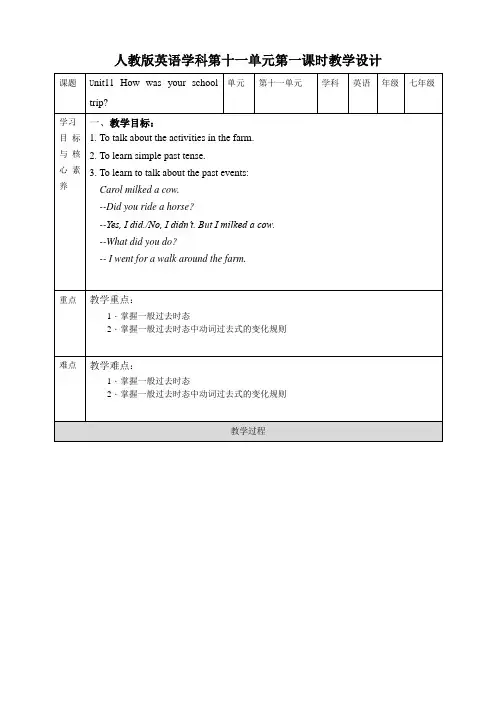
人教版英语学科第十一单元第一课时教学设计课题U nit11 How was your schooltrip?单元第十一单元学科英语年级七年级学习目标与核心素养一、教学目标:1. To talk about the activities in the farm.2. To learn simple past tense.3. To learn to talk about the past events: Carol milked a cow.--Did you ride a horse?--Yes, I did./No, I didn’t. But I milked a cow. --What did you do?-- I went for a walk around the farm.重点教学重点:1.掌握一般过去时态2.掌握一般过去时态中动词过去式的变化规则难点教学难点:1.掌握一般过去时态2.掌握一般过去时态中动词过去式的变化规则教学过程课堂小结Summary1.重点单词:milk,cow,horse,feed,farmer,quite2.重点短语:go for a walk, milk a cow, ride a horse, feed chickens, talk witha farmer, take some photos, quite a lot3.重点句式:—Did you see any cows?—Yes, I did. I saw quite a lot.—Did you ride a horse?—No, I didn't. But I milked a cow.板书go for a walk, milk a cow, ride a horse, feed chickens, talk with a farmer, take some photos, quite a lot。
初中英语 七年级下册 Unit11 How was your school trip
练习:判断下列句子是否用一般过去时。 I got up at six thirty yesterday morning. He had a good time last summer? He was there five minutes ago. The little girl was born in 2008. When Tony was young, his parents passed away. I saw him at the gate of the school just now.
reply on the right.
Dear Bill, How _w_a_s_ (is) your school trip yesterday? _D_i_d_ (Do) you _g_o_ (go) to the zoo? _D__id__ (do) you take any photos? _D_i_d_ (Do) you _s_e_e_ (see) any interesting animals? I _w_e_n_t_ (go) to the zoo last year and it _w_a_s_ (is) a lot of fun. Jim
类别 中间去e,词尾加t
词尾的d变成t 过去式以ought/ aught结尾 be动词的过去式
例词 keep→kept feel→felt sleep→slept spend→spent send→sent lend→lent think→thought teach→taught buy→bought
We _a_t_e_ (eat) our lunch under some trees and _p_la_y_e_d_ (play) some games after that. But at about two o’clock, it _g_o_t (get) very cloudy and we _w_o_r_r_ie_d_ (worry) it would rain. Luckily, it _d_id_n__’t_ (do not), and the sun _c_a_m__e_ (come) out again!
七年级英语下册Unit11Howwasyourschooltrip说课稿(人教新目标版)
七年级英语下册 Unit 11 How was your school trip说课稿(人教新目标版)一. 教材分析本次说课的教材为人教新目标版七年级英语下册Unit 11 How was your school trip。
本单元主要围绕学校旅行的话题展开,通过描述旅行的经历和感受,让学生学会使用一般过去时进行问答。
教材内容丰富,包括听力、口语、阅读和写作等方面,有助于学生全面提高英语水平。
二. 学情分析七年级的学生已经掌握了基本的英语语法和词汇,具有一定的听说读写能力。
但部分学生对一般过去时的运用还不够熟练,需要在课堂上进行针对性的训练。
此外,学生对学校旅行的经历和感受有较高的兴趣,可以激发他们学习英语的积极性。
三. 说教学目标1.知识目标:学生能够掌握一般过去时的问法和答法,正确运用动词过去式描述过去发生的事情。
2.能力目标:学生能够听懂、会说、会读、会写关于学校旅行的描述,提高英语综合运用能力。
3.情感目标:通过本节课的学习,学生能够表达对学校旅行的喜爱和回忆,培养对英语的兴趣。
四. 说教学重难点1.重点:学生能够熟练运用一般过去时进行问答,描述学校旅行的经历。
2.难点:学生能够正确运用动词过去式,表达过去发生的事情。
五. 说教学方法与手段1.教学方法:采用任务型教学法,让学生在实际语境中练习英语,提高运用能力。
2.教学手段:利用多媒体课件、图片、卡片等辅助教学,增加课堂趣味性。
六. 说教学过程1.热身(5分钟):播放一首关于旅行的英文歌曲,让学生谈论自己的旅行经历,激发学习兴趣。
2.导入(10分钟):通过展示一组学校旅行的照片,引导学生谈论旅行中的趣事,为新课的学习做好铺垫。
3.新课呈现(15分钟):讲解一般过去时的问法和答法,示例说明如何用动词过去式描述过去发生的事情。
让学生跟读、模仿,确保正确掌握。
4.实践环节(15分钟):学生分角色扮演,模拟学校旅行的场景,运用一般过去时进行问答。
人教版七年级下册英语课件:Unit 11 How was your school trip_Section A(1a-2d) (共39张PPT)
Eric: I weRntefaisdhitnhgeevceorny vdeary.sAatnidonI fed the chickens waigthaimny, tghraenndpfial.lI_it_nw_a_tsh_s_eo_m__u_c_h_f_u_n. Peter: Soubnldasngkosodb.He_lo_ow_w_w_.a_s_t_h_e_w__ea_t_h_e_r_th_e_r_e?
4. Did Eric watch the stars at night? Yes, he did.
2d P62
L1ine.tRg’rosoleusppeslea; ywthhe iccohnvegrrsoatuiopn 2. Rodleopelsaytthhee cboensvetr.sation
A: Did he _ri_d_e__a_h_o_r_s_e last weekend? B: Yes, he did.
2a Listen and check ( ) the questions you hear. P62
___ What did the farmer say? ___ Did you grow any apples? ___ What did you see? ___ Do they grow apples? ___ Did you learn anything? ___ Did you eat them? ___ Did you ask him any questions? ___ Were they good?
1. How was Eric’s trip last week? It was excellent.
Unit11单元知识点归纳总结及配套练习-人教版英语七年级下册
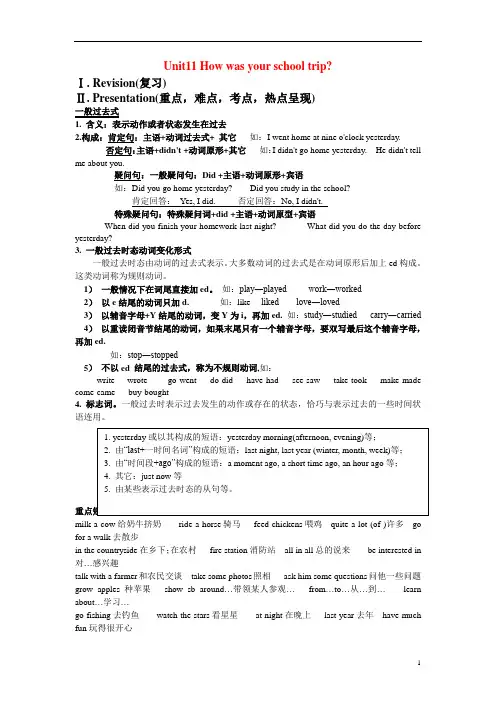
Unit11 How was your school trip?Ⅰ. Revision(复习)Ⅱ. Presentation(重点,难点,考点,热点呈现)一般过去式1. 含义:表示动作或者状态发生在过去2.构成:肯定句:主语+动词过去式+ 其它如:I went home at nine o'clock yesterday.否定句:主语+didn't +动词原形+其它如:I didn't go home yesterday. He didn't tell me about you.疑问句:一般疑问句:Did +主语+动词原形+宾语如:Did you go home yesterday?Did you study in the school?肯定回答:Yes, I did. 否定回答:No, I didn't.特殊疑问句:特殊疑问词+did +主语+动词原型+宾语When did you finish your homework last night? What did you do the day before yesterday?3. 一般过去时态动词变化形式一般过去时态由动词的过去式表示。
大多数动词的过去式是在动词原形后加上ed构成。
这类动词称为规则动词。
1)一般情况下在词尾直接加ed。
如:play―played work―worked2)以e结尾的动词只加d. 如:like--- liked love―loved3)以辅音字母+Y结尾的动词,变Y为i,再加ed. 如:study―studied carry―carried 4)以重读闭音节结尾的动词,如果末尾只有一个辅音字母,要双写最后这个辅音字母,再加ed.如:stop―stopped5)不以ed 结尾的过去式,称为不规则动词,如:write --wrote go-went do-did have-had see-saw take-took make-made come-came buy-bought4. 标志词。
2023年人教版七年级英语下册《Unit 11 How was your school trip》句
Unit 11 How was your school trip?句型设计Learning Objectives一、Topics(话题):School trips二、Functions (功能)Talk about past events三、Structures (结构)1. Simple past tense (I)2. How questions3. Yes/No questions and short answers4. Adjectives of description四、Target Language (目标语言)How was your school trip?It was great.Did you go to the zoo?No, I didn’t. I went to the farm.Were the strawberries good?Yes, they were.五、Vocabulary (词汇)countryside, cow, horse, farm, farmer, flower, sun, museum, fire, robot, guide, gift, feed, grow, pick, excellent, lovely, slow, fast, expensive, cheap, dark, exciting, interested, anything, everythinggo for a walk, milk a cow, ride a horse, feed chickens, take some photos, talk with a farmer, grow apples, be interested in …六、Skills (技能)Listening for key informationScanning in reading七、Recycling (复习巩固)great, terrible, interesting, boring, large, cool, hot, lucky, delicious八、教材分析本单元的话题是谈论学校郊游,要求学生学会使用一般过去式讲述过去发生的事情,学会用一般过去时写日记。
2020年人教版七年级英语下册Unit11 How was your school trip 要点详解
Unit11 How was your school trip 要点详解How was your school trip? 重点词汇1. beat, win(1)beat指在比赛或战斗中打败某人。
意为“蠃”,此时,其宾语只能是表示人或团队的词语,不能用表示比赛、奖品等内容的词语作其宾语。
beat的反义词为lose. lose to sb. 输给某人。
(2)win表示“赢”,其宾语是表示比赛、奖品等内容的词语,不能用表示人的词语作其宾语。
win还可以作不及物动词用,后面不接宾语,表示“获胜”。
其反义词也为lose. lose sth.. 输了某事(物)。
如:He won the tennis match. 他赢得了那场网球比赛。
We are sure that we can beat them. 我们相信能战胜他们。
2. gift 礼物(1) gift用作名词,表示“礼品,礼物”时,与present同义。
Thank you for your beautiful gift. 谢谢你送给我的漂亮礼物。
(2) gift用作名词,表示“天赋,天资,才能”时,常构成短语have a gift for意为“有某方面的天赋。
如:She has a gift for music. 她有音乐天赋。
(3) gifted用作形容词,意为“有天才的,有才华的”。
如:He is a very gift person. 他是一个很有才华的人。
3. visitor 访问者,参观者,游客Millions of visitors visit the Great Wall every year.每年有数百万游客游览长城。
visitor是由“动词visit+or”构成的名词,类似的词还有actor, inventor, translator等。
思维拓展:“动词+er”构成名词,如:worker, teacher, singer等。
The teacher teaches us very well. 这位老师教我们教得非常好。
人教版七年级下册英语Unit 11 How was your school trip? 知识点总结
七下Unit 11 How was your school trip一、Important Phrases:1.go for a walk 去散步=take a walkk a cow 给奶牛挤奶milk:牛奶(n.),挤牛奶(v.)3.ride a horse 骑马ride a bike骑自行车,go for a ride骑车兜风4.feed chickens 喂鸡feed sb sth=feed sth to sb喂某人某物,feed on...以...为食5.talk with sb与...谈论★talk about sth 谈论某事6.take some photos 拍照★photos=photographs7.quite a lot of...许多★形近词:quiet(adj.安静的)8.show sb around sp 带某人参观某地9.grow apples种苹果★=plant apples10.learn a lot about farming/robots 学到许多...知识★farm(农场)-farmer(农民)-farming(农业)11.pick some strawberries 摘些草莓★pick up sth 捡起某物,pick up sb 接某人12.take...home 带...回家★take sb to sp带某人去某地,take away 带走13.go fishing 去钓鱼★fisherman 渔夫14.in the countryside 在乡下★=in the country15.visit a science museum 参观科学博物馆16.visit a fire station 参观消防局★be on fire 着火,put out the fire 灭火17.go on a school trip 参加学校郊游★go on a business trip 出差18.climb mountains 爬山★climber登山者19.come out 出来c ome in进来,come on加油,快点,come and go来来往往20.get there fast 很快到那里★fast(adj.)---fast(adv.), slow(adj.)---slowly(adv.)21.a model robot机器人模型22.buy sth for sb 买东西给某人★反义词sell:sell sb sth=sell sth to sb23.lovely gifts 可爱的礼物★lovely=cute, gift=present24.all in all总而言之25.an exciting day 令人兴奋的一天26.be interested in...对...感兴趣interest(n.)兴趣(不可数),兴趣爱好(可数)27.be difficult to do sth 做...很难28.on the slow train 在慢车上★train:火车(n.),培训(v.)29.a boring day 无聊的一天★sb feel bored 人觉得无聊30.not..at all 根本不31.W o r r y a b o u t s t h担忧某事(v.)★b e w o r r i e d a b o u t为...担忧(a d j.)二、Key Language Points:1.---How was your school trip?=How did you feel about the trip?你的学校郊游怎么样?---It was great/excellent/terrible.很棒. ★be excellent in...在某方面极出色How+be+sth?=What+be+sth+like?询问某事情况怎么样。
人教新目标版英语七下Unit 11《How was your school trip》(Sectio
人教新目标版英语七下Unit 11《How was your school trip》(Section A 1a)教学设计一. 教材分析人教新目标版英语七下Unit 11《How was your school trip》主要介绍了关于学校旅行的相关话题。
通过本节课的学习,学生能够掌握一般过去时的疑问句和回答,以及描述过去事件的词汇和短语。
本节课的主要内容包括旅行前的准备、旅行中的活动以及旅行后的感受。
教材内容丰富,插图生动,有助于激发学生的学习兴趣。
二. 学情分析七年级的学生已经掌握了基本的英语语法知识,能够运用一般现在时进行交流。
但是,对于一般过去时的疑问句和回答,学生可能还不太熟悉。
因此,在教学过程中,需要加强对一般过去时的讲解和练习。
此外,学生对于描述过去事件的词汇和短语可能还不够熟练,需要通过大量的例子和练习来加以巩固。
三. 教学目标1.能够正确使用一般过去时进行疑问句和回答。
2.能够运用本节课学到的词汇和短语描述过去的事件。
3.能够听懂、会说、会写本节课的主要内容。
4.能够提高自己的合作能力和表达能力。
四. 教学重难点1.一般过去时的疑问句和回答。
2.描述过去事件的词汇和短语。
五. 教学方法采用任务型教学法,通过各种互动活动,让学生在实践中学习和掌握知识。
同时,运用情境教学法,创设真实的情景,使学生在具体的情境中学习英语。
此外,还采用分组合作学习的方式,培养学生的团队精神和沟通能力。
六. 教学准备1.教材、课件和教学资源。
2.录音机、磁带或音频文件。
3.教学卡片、图片等。
七. 教学过程1.导入(5分钟)通过展示一张美丽的旅行图片,引导学生谈论自己最喜欢的旅行。
同时,询问学生是否曾经去过某个地方,引导学生思考一般过去时的用法。
2.呈现(10分钟)展示本节课的主要内容,包括旅行前的准备、旅行中的活动以及旅行后的感受。
通过图片、卡片等形式,呈现本节课的重点词汇和短语。
3.操练(15分钟)采用分组合作的方式,让学生进行角色扮演,模拟旅行中的各种情景。