
牛津译林版英语七年级上册第一单元复习课件
nowhere______.
A. keep,to live in
B. will keep,to live in
C. C. keep, to live
D. will keep, to live
He often takve.s after dinner /
his dog Hale Waihona Puke upper.fora
wanl.k
5. 我不知道。
I don’t know. / I have no idea. 6. 你能告诉我这个问题的答案吗?
Can / Could you tell me the answer to the question? the answer/key/reply/entrance to… 7. 你的新朋友听起来棒极了。 Your new friends sound great!
7.----Mum, ___A___ shall we have lunch?
----We will have it when your dad ______.
A.when,returns
B.where, returns
C.where, will return
D.when,will return
8.Our teacher told us the earth __A____ around the sun.
per second. (2011无锡)
4.表示安排好或计划好的事。
The plane ___ta__k_e_s__ (take) off at 7:30.
5.在条件和时间状语从句中用一般现在时表示将来的动作。
If Simon __h_a_s___(have) time next weekend, he will go to the zoo.
5---Have you finished your fashion design?
---Not yet. I’ll finish it if I__A___ ten more minutes.(2011泰州)
A. am given B. give C. will give D. will be given
京)
well
3.Susan playsbotrrhoewspiano______(好).(2011徐
州)
4.He often ___s_a_y_____ (借) books from our
school library.
flying
5.How do you ______ (说) that in English?
17.向…借…
borrow …from…
18.12岁
12 years old
19.参加读书俱乐部 (be) in the Reading Club
20.用英语 21.在午饭时间 22.…的答案
in English
at lunchtime the answer to…
D.重要句型 1. 我爸爸是上海人。
A..good B.well C.nice D.ill
2.----Do you enjoy __C____ music? ---- Yes,I do.
A.listening B.hearing C.listening to D.listen to
3.Are you good at ___A___ ?
6.Look! Many children are __________ (放飞)
kites in the park.
really
7.----Our Chinese teacher will fly to
单项选择
1.----How are you today?
----I’m very __B____ ,thanks. (07 徐州 )
6.---- Tomorrow will be Father’s Day. What will you do for
your father?
----I will say “I love you, Daddy.” as soon as he __C__ up.
A.will wake B.is waking C.wakes D.woke
4. Many women like to _b_e__in__ white on their
wedding day. 选择填空
The boy was able to __A____ himself when he was very young.
A. dress B. wear C. put on D. take off
B.同义词辨析put on,wear,dress,be in
这四个词都表示“穿、戴”。
put on表“穿上、戴上”,强调动作,后接表 示衣服、鞋、帽子等。
wear表“穿着,戴着”,强调状态,还可表示 佩戴手表、首饰、徽章、留长发等,可用一 般时态或进行时态。
dress作及物动词时,后接人,指“给…穿衣 服”。作不及物动词,意思是“穿衣”。
My father is/comes from Shanghai. 2. 她每天走回家。 (2种)
He goes home on foot every day. He walks home every day. (on foot, by bike, car, bus, train,
underground, land, plane, air, boat, ship, river, sea…)
be in表“穿着、戴着”,强调状态,后面可 接颜色,表示穿着某种颜色的衣服。
用“穿”的适当形式填空 1.____P_u_t_o_n_______ more clothes, or you’ll
catch a cold.
2. Sandy __is__w_e_a_r_in_g___ a yellow dress today. 3.She ___d_r_e_s_s_e_s____ her son every morning.
12.去游泳/跑步 go swimming/running
13.步行回家
walk home/go home on foot
14.和某人交谈 talk to/with sb
15.遛狗
walk a dog/take a dog for a walk
16.乘坐公交
take the bus/go by bus
C.短语
1.照顾
2.交朋友 3.出生 4.来自 5.听音乐 6.学习/工作努力 7.擅长 8.戴眼镜 9.玩电脑游戏 10.打羽毛球/排球 11.吃早/中/晚饭
12.去游泳/跑步
13.步行回家 14.和某人交谈 15.遛狗 16.乘坐公交 17.向…借… 18.12岁 19.参加读书俱乐部 20.用英语 21.在午饭时间 22.…的答案
2019.11
A.词汇 用所给单词的适当形式或汉语提示填空。 1.No news __is____(be) good news.
2.It’si_m_p_o__lit_e__(polite) to ask a lady
about her age in western countries.(2011 南
A.turns B.turned C.turn
9.Our teacher said light ___D___ faster than sound.
A.traveled B.has traveled C.is traveling D.travels
话题简述
根据所给要点提示进行话题简述。
要点: 1.李平是九年级学生,将于今夏毕业;数学
and ___A____eats meat.(2011宿迁)
A. seldom B. always C. usually D. often
3.---- What __C____ your English teacher look like?
---- She is quite slim.
A. do B. is C. does D. was
E.语法:一般现在时
当动词是be时,第一人称单数用am,第三人称单数用is,其他人称用 are。疑问句将be动词提到主语之前。当动词是实义动词一般用动词原 形,但如果主语是第三人称单数,动词必须用第三人称单数形式。 一 般现在时的用法
1.表示经常性、习惯性的动作,常和 often,usually,always, sometimes,seldom,every day 等时间状语连用。
(2011徐州)
单项选择
1.----Is your school very big?
----Yes, There ___B___ more than 5,000 students in it.
A. is
B. are
C. has
D. have
2.----My cousin wants to keep slim. She does exercise every morning
3.西蒙擅长游泳。
Simon is good at swimming.
Simon does well in swimming.
Simon is a good swimmer.
Simon swims well.
4. 他晚饭后常遛狗。(2种)
He often walks his dog after dinner.
---No, they will go there by bike.(2011连云 港) 3.多好的消息啊!所以驾驶员5月1号起不允 许酒后驾驶了。(2011淮安) _W_h_a_t_g_o_o_d__ news! All drivers are not _a_l_lo_w_e_d__to drive after drinking from May 1.
牛津译林七年级英语上册Unit1-Grammar-课件(共28张PPT)
2. They are classmates. _A__re_ they classmates? No, they a_r_e_n_’_t.
3. Eddie is Hobo’s master. __I_s__ Eddie Hobo’s master? No, it _is_n_’_t.
Activity 8: Make a conclusion
句型转换
1. His cousin is good at swimming.(改为否定句)
_H__i_s_c_o_u_s_i_n__is_n__’t__g_o_o_d__a_t_s_w__im__m__i_n_g_._
2. Those boys are from Beijing.(改为一般疑问句, 并做否定回答) —A—re—th—os—e b—oy—s f—ro—m—Be—ij—ing—? —No—, t—he—y a—re—n’—t.
Are they classmates?
肯定:Yes, they are. 否定:No, they aren’t.
在一般疑问句的肯定回 答中不能用缩写形式
变疑问,be提前,句末问号莫丢弃。
Fill in the blanks
1. It is a reading room. __Is__ it a reading room? Yes, it __is__.
am
2019牛津译林版七年级英语上册复习课件: Unit1 Grammar教育精品.ppt
nice. His father ______ a doctor. They
_____ working hard.
用适当的be动词填空:
1. This book _i_s__ new. That one __is__ old. 2. These watches _a_r_e_ expensive. Those
It’s
She is a nurse.
She’s
He is a football player. He’s
You are singing. You’re We are dancers. We’re
They are players. They’re
Exercise1:Fill in the blanks with “be”
Millie: Hi, Sandy. Our school __is__ big. Sandy: Yes, it ___is__. The classrooms __a_r_e_ big too. Simon: Our teachers __a_r_e_ nice. Mr Wu ___is__ a good
He
is
It
is
The apple is
a student. short. red.
Is用于他,她,它, 单数名词用is
Footballs are round.
ቤተ መጻሕፍቲ ባይዱ
凡是复数全用are
Sandy and Amy are classmates
be动词的一般现在时
be动词是系动词的一种,表示“是” 。现在式 (The Present Forms)有am, is, are三种。
1. My name __is____ Mary. I _a_m___13 years oalmd. I _____tall and slim. I have a cousin. Hisisname _____ Petiser. He
牛津译林七年级英语上册Unit1 Grammar(be动词)课件(共20张PPT)
My hair is long.
things that we do regularly
We often do school activities after class. Kitty goes to a dance class twice a week .
Simon plays football What do you often do after after school.
We use the simple present tense when we talk about things that are true now, things that we do regularly and things that are always true.
things that we do regularly
school?
The moon goes around the earth .
There are seven days in a week .
Can you tell us things that are always true?
things that are always true
Cats eat fish.
N_o_,_t_he_y_d_o_n’_t .
5._D_o_e_s_ Simon like walking?
_Y_e_s,_h_e_d_oe_s_.
6._D_o___ Sandy and Daniel like drawing?
_Y_e_s_, t_h_e_y _do_.
Millie: Daniel, do you play volleyball after school? Daniel: No, I _d_o_n_o__t/_d_o_n_’t__p_la_y_ volleyball after school. Millie: Does Simon play football after school? Daniel: Yes, he always _p_l_a_y_s football after school. Millie: Does Amy walk home after school? Daniel; No, she _d_o_e_s_n_o__t/_d_o_e_s_n_’t_w__a_lk_ home after school. Millie: Does she take the bus? Daniel: Yes, she _t_a_k_e_s_ the bus every day. Millie: Do you like watching TV? Daniel: No, I _d_o__n_o_t_/d_o_n_’_t_li_k_e_ watching TV.
牛津译林版英语七年级上册Unit1 Reading 课件
Look at the pictures, the title and the sub-headings on P3. Then tick (√) the things that you may find in Anna's blog.
1 her country
□√
2 her age
□√
3 her parents' names □
Now try to introduce yourself to your partner from these aspects.
•Name: •Country: •Age: •What you look like: •Family members: •Hobbies:
1.Hello, everyone.
are
4.aaTlhlhevaseepCorfp1yatyrfhDereiomewnyybdoolrfuyadn.vksiocniuenorwaiintteatdhlhiekcosibmn?bdeFieaisnn.idngs
a thoinugtsthIemcuosrtredcot answers. (P 4)
Read Para. 3 and 4 and answer the questions.
1.How does she go to school? She goes to school by school bus.
2.What are her favourite subjects? Maths, Art and Science.
5.What does “e-friend” mean to Hi? It means a friend from the Internet.
初中英语牛津译林版七年级英语上册知识点第一单元
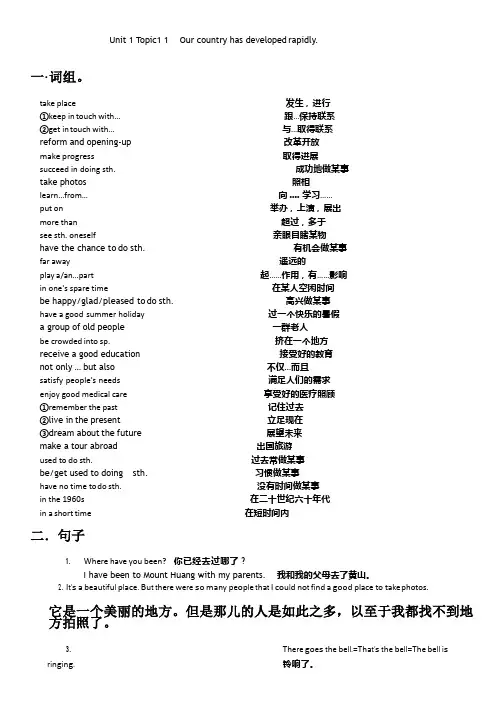
Unit 1 T opic1 1 Our country has developed rapidly.一·词组。
take place 发生,进行①keep in touch with…跟…保持联系②get in touch with…与…取得联系reform and opening-up 改革开放make progress 取得进展succeed in doing sth. 成功地做某事take photos 照相learn…from…向 .... 学习……put on 举办,上演,展出more than 超过,多于see sth. oneself 亲眼目睹某物have the chance to do sth. 有机会做某事far away 遥远的play a/an…part起……作用,有……影响in one's spare time 在某人空闲时间be happy/glad/pleased to do sth. 高兴做某事have a good summer holiday 过一个快乐的暑假a group of old people 一群老人be crowded into sp. 挤在一个地方receive a good education 接受好的教育not only … but also 不仅…而且satisfy people's needs 满足人们的需求enjoy good medical care 享受好的医疗照顾①remember the past 记住过去②live in the present 立足现在③dream about the future 展望未来make a tour abroad 出国旅游used to do sth. 过去常做某事be/get used to doing sth. 习惯做某事have no time to d o sth. 没有时间做某事in the 1960s 在二十世纪六十年代in a short time 在短时间内二.句子1.Where have you been? 你已经去过哪了?I have been to Mount Huang with my parents. 我和我的父母去了黄山。
牛津译林版七年级英语上册Unit1 Reading课件

Hello! My name is Simon. Name I'm tall.Looks(Appearance) I like sports. Hobby I often play football after school.
1. What does he look like? He is tall. 2. What does he like? He like sports. 3. What does he often do after school? He often plays football after school.
Hello! My name is Simon. I'm tall. 短的
I am Simon.
adj. slim 苗条的
I like sports.
like, love, enjoy + doing
I often play football after school. after school 放学后 after class play后接球类、棋牌类运动时,无定冠词 下课后
Name Birthplace(n.出生地) Looks(Appearance)
Speciality(n.特长)
1. Where is he from?He is from Nanjing.
2. What is he good at? He is good at Maths.
3. Look at Daniel's photo, is there any 3. He wears glasses./
love reading swimming
我的头发ru(n很ni)ng短。 My hair is short. love+doing喜爱做 某事
牛津译林版七年级英语上册Unit1课件
True or False (T/F):
1.Sandy has slohnogrt hair. F 2. Sandy is tall and slim. T 3. Sandy likes mreuadsicn.g. F
short
wear glasses tall/short no
yes
tall/slim
no
tall
yes
short
Let’s know the students better!
B1 Match the new students with the correct information
Millie
party. 4.What ___i_s___in the red box?
They __a_r_e____ sweets for you .
5. Two and six ____is_____eight. 6.There____is_____some milk in the fridge. 7. Millie ___is______ good at maths.
表示现在的状态或客观事实
一般现在时(to be)
be - am, is, are
I _____ you _____
我用am你用are, is连着他她它, 单数用is,复数要用are.
he _____ she _____ it _____ we _____ you _____ they _____ Amy_____ my parents_____ the cat _____ My sister _____
牛津译林版七年级英语上册Unit 1单元课件
2. Class 1, Grade 7.
在英语中,范围应该从小到大排列,与汉语正好 相反。先说班级,再说年级。班级与年级都为专 有名词,首字母需要大写。
我妹妹在一年级六班。 My sister is in Class 6, Grade 1.
你在三年级六班吗? Are you in Class 6, Grade 3?
Play + the + 乐器 西洋乐器,带“the”;中国乐器,拼音前,不加the 拉二胡:play Erhu / play Guzheng /play chess. 拉小提琴: play the violin/piano/violin/guitar/drums.
The young man plays______ piano very well, but he plays ________ basketball badly. A. the, the B a, a C. a, the D. the, /
Hi
Good morning
Hello
Good afternoon
Nice to meet you Good evening
Glad to meet you Good night
greetings
Greetings used to greet someone you are familiar with(对...熟悉)
7a_Unit1苏教版,译林版牛津英语7A,7a上,七年级上册Unit_1课件及习题
Yes,
I No, .you/ they .he/ she/ it
.do not. .do not. .don’t. .does not. .doesn’t.
How to add “s”, “es” to the verbs Most verb +s Verb ending in a consonant +y -y, +ies Verbs ending in ss, ch, sh or x Verbs ending in o Look → looks Play → plays Love → loves Fly → flies Study →studies Miss → misses Watch →watches Go → goes Do → does
Part two
动词 + ing
V+Ing
• 喜欢做某事
• 去做某事
• 擅长做某事
目前我们所学的动词+ing 的用法 一. 喜欢做某事 like/ love/ enjoy doing sth
e.g. 1.Daniel likes playing computer games Daniel 喜欢打电脑游戏 2.Simon doesn’t love swimming 西门不酷爱游泳 3.Does Mille enjoy listening to music? Mille 喜欢听音乐吗?
+es +es
Practice makes perfect
Model : I like fish. (meat) I don’t like meat. 1. His brother plays football after school (basketball) _______________________________________ It looks like a cat. (hat) _______________________________________ She has a dog at home. (cat) _______________________________________
牛津译林版英语七年级上册Unit 1 复习课课件
A. but
B. so
C. and
根据汉语提示完成句子
1.莉莉12岁了,她擅长英语。 Lily is 12_ye_a_r_s __o_l_d_ and she _i_s_ g_o_o_d_ __a_t English. 2.你能帮我照顾我的狗吗? Can you_h_e_lp_ me _lo_o_k_ __a_ft_e_r my dog?
短语呈现
1.照顾 2. 认识 3. 在第一天 4. 踢足球
look after get to know on the first day play football
5. 放学后 6 来自 7. 擅长 8. 放风筝
after school be/come from
be good at fly kites
---Yes, I __a_m_. 5.--- What _a_r_e_ those?
----They _a_re_ his notebooks. 6.My hair__is__ very short and I wear glasses.
按要求改写句子。
1. I am good at dancing. (改为否定句) __I’_m_ __n_o_t _ good at dancing.
或者主语当前的性质、特征等。 2.连系动词be的一般现在时有三种形式:_a_m_,_is__ ,_a_re__. 3.句型结构: (1).肯定句:__主__语_+_b__e_+_其_他
eg: It is a football. (2).否定句:___主__语__+_b_e_+_n_o_t+其他 eg: They are not at school today. (3).一般疑问句:_B_e_+_主__语__+_其__他_?______ eg:Is your mother a teacher?