
外研社新标准小学英语一起四下课文文本Module01
Module 1第一模块
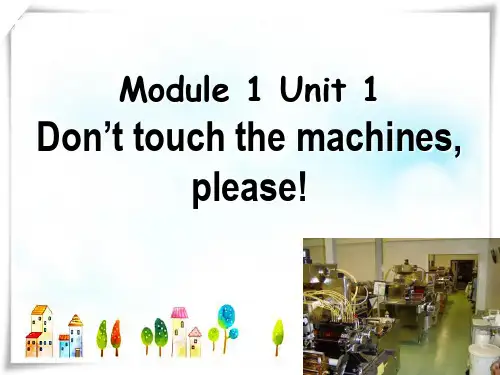
Unit 1 Don't touch the machines, please!第一单元请不要碰触那些机器!
Activity 1 Listen, point and say. 活动1 听录音,看图说话。
Don't sing here! Don't dance here! 不要在这里唱歌!不要在这里跳舞!
Don't talk here! Don't play here! 不要在这里聊天!不要在这里玩!
The baby is sleeping. 小宝宝在睡觉。
Activity 2 Listen, point and find "don't".活动2 听录音,看图片找到“don't”。
Welcome to our factory, children! 孩子们,欢迎来到我们的工厂!
These machines make crisps. 这些机器是做薯片的。
What does this machine do, sir? 叔叔,这台机器是用来做什么的?
It washes the potatoes. 这是用来洗土豆的。
Look! This machine cuts the potatoes. 看!这台机器是切土豆片的。
Don't touch the machines, please! They are dangerous.请不要触碰那些机器!危险!
Sorry, sir. 对不起,叔叔。
This machine puts the crisps in the bags. 这台机器把薯片装进包装袋。
Wait! You are a very good class. 等等!你们是一个很好的班级,
You can each have a bag of crisps. 送你们每人一包薯片。
Oh, thank you, sir! 哦,谢谢叔叔!
Activity 3 Listen and say. 活动3 听录音,并说话。
Don't touch the machines, please! 请不要碰触那些机器!
Wait! You can each have a bag of crisps. 等等!送你们每人一包薯片。
Unit 2 Don't feed the fish! 第二单元请勿喂鱼!
Activity 1 Listen, point and say. 活动1 听录音,看图说话。
Activity 2 Listen and say. 活动2 听录音,并说话。
Don't feed the fish! Dont walk on the grass! 请勿喂鱼!请勿践踏草地!
Don't play ball games here! 此地请勿踢球!
Don't talk! Don't write on the books! 请勿喧哗!请勿在书上随意涂写!
Activity 3 Listen, point and say. 活动3 听录音,看图说话。
Activity 4 Listen and say. Then chant. 活动4 听录音说一说,并说唱。
Sam, Mike and John, now come along! 萨姆,迈克还有约翰,现在跟我来!
Don't play ball, I tell you all! Don't shout or run!我告诉你们,别玩球了!别大喊大叫,别乱跑!Come and do your homework, one by one! 你们一个个下来,快做家庭作业!(歌曲)。
外研社新标准小学英语2015春新版一起四下课文文本Module10_Unit1
Module 10第十模块Unit 1 I'll send you a postcard.第一单元我会给你寄明信片。
Activity 1 Listen and chant.活动1 听录音唱歌谣。
She's going to visit Australia.She will see a kangaroo.她准备去澳大利亚。
她打算去看看袋鼠。
He's going to visit the UK. He will go to London Zoo.他准备去英国玩。
他打算去伦敦动物园。
(歌曲)Activity 2 Listen, point and find "will, going to".活动2 听录音,找到“will, going to”。
Where will you go this summer?这个夏天你们打算去哪里啊?I will go back to the UK.我打算回英国。
I will go there, too.我也准备去那里。
I'm going to speak English every day.我将要每天都说英语。
That's great!那太棒了!What about you, Daming?大明,你呢?I haven't got any plan now. 我现在还没有什么计划。
Maybe I'll visit my grandpa's farm.我可能去我爷爷的农场看看。
We'll send you a postcard from the UK.我们会从英国给你寄明信片。
And I'll send you a postcard from China.我会从中国给你们寄明信片。
Will you send us a postcard, too. Tweet-tweet?你也会给我们寄明信片吗,啾啾?Ha ha ...哈哈……Activity 3 Listen and say.活动3 听录音并说一说。
小学新标准英语一年级起点四年级课文
Module1UNIT 1[01:42.61]Lucy lives in London.[01:46.16]1. Listen, point and find “does, lives”.[01:59.43]Hi, Amy. What are you doing?[02:03.79]I’m reading a letter. It’s from my friend Lucy.[02:07.61]Where does she live?[02:10.38]She lives in London.[02:12.73]Dear Amy ,[02:15.47]How are you ?[02:16.72]I’m very well .[02:18.40]London is very cold now .[02:21.74]Is it cold in Beijing too?[02:24.69]It was my birthday on Saturday.[02:27.75]Now I’m nine .[02:30.10]Here is a photo of me on my birthday.[02:33.65]This is my new friend, Zara. She’s got long, black hair. [02:39.22]She’s very nice. This is a picture of Zara and me . [02:44.39]We were at Buckingham Palace.[02:47.00]Write to me soon. Tell me about China.[02:50.48]From, Lucy[02:52.33]2. Listen and say.[03:03.56]Where does she live?[03:06.33]She lives in London.[03:07.98]It was my birthday on Saturday.[03:11.92]We were at Buckingham Palace.[03:15.68]UNIT 2[03:20.15]I’ve got a new friend.[03:23.81]1. Listen and repeat.[03:32.24]Dear Lucy,[03:34.39]Thank you for your letter.[03:36.42]Happy birthday to you . I am still eight.[03:40.16]I will be nine in April.[03:42.41]The weather in Beijing isn’t cold .It’s warm.[03:46.06]I’ve got a new friend too. Her name is Lingling.[03:50.30]She’s got short , black hair.[03:52.54]She’s very nice.[03:54.89]Here is a photo of Lingling and me .[03:57.74]From,Amy[03:59.26]2.Listen and match the letters and photos.[04:12.24]Dear friends,[04:14.80]I am from Mexico.[04:17.52]My name is Anita.[04:19.87]I liketraditionalMexican food and traditional dancing. [04:25.64]I also like football and watching TV.[04:28.80]What about you?[04:30.84]From,Anita[04:34.00]Hi friends,[04:37.52]I am from India.[04:39.88]I am wearing traditional Indian clothes. [04:43.04]I am nine years old.[04:45.60]I like music and dolls.[04:47.45]From,Indrani[04:50.61]Dear Chinese friends,[04:54.87]I like basketball.[04:53.87]I love computer games too .[04:56.51]My favourite food is hamburgers.[05:00.35]I am American. I am ten.[05:04.01]From,John[05:05.76]3. Listen and say .Then sing.Module2 UNIT1[00:08.49]I helped my mum.[00:10.84]1. listen, point and find words ending in “-ed”. [00:24.71]Yesterday, I cleaned my room.[00:27.77]I finished my homework.[00:31.22]I washed my trousers.[00:34.98]They were very dirty.[00:37.12]Then I helped my mum.[00:40.49]Mum was very happy.[00:43.83]Your are a very good boy, Daming.[00:46.79]Thank you, Mum.[00:48.35]2. Listen and say.[01:00.11]Yesterday, I cleaned my room.[01:03.56]I washed my trousers.[01:08.00]Then I helped my mum.[01:12.44]UNIT 2[01:18.60]Amy painted a picture.[01:22.16]1. Listen and repeat.[01:21.16]Yesterday, Mr Smart cooked noodles.[01:26.20]Tom helped him.[01:29.44]Ms Smart phoned Grandma.[01:34.40]Sam watched TV.[01:38.66]Amy painted a picture.[01:42.81]3. Listen and say. Then chant.[01:57.07]She painted a picture.[01:59.11]She watched TV.[02:00.97]She played the flute.[02:03.32]She played with me.[02:04.57]He listened to music.[02:07.21]He played football.[02:09.17]He helped his mother.[02:10.63]There were biscuits for all.Module3UNIT 1[00:05.80]She didn’t walk to school yesterday.[00:12.36]1. Listen, point and find “didn’t”.[00:24.71]Lingling usually gets up at half past six on Mondays.[00:30.35]But she didn’t get up at half past six yesterday.[00:34.19]She usually walks to school.[00:37.96]But she didn’t walk to school yesterday.[00:41.59]She usually learns English and Maths.[00:45.64]But she didn’t learn these th ings yesterday.[00:48.80]Yesterday was National Day![00:53.55]Lingling watched TV and played with her toys.[01:02.62]2. Listen and say.[01:15.96]Lingling didn’t get up at half past six.And she didn’t walk to school.[01:23.80]She didn’t learn English a nd Maths.[01:28.24]UNIT 2[01:34.62]I didn’t play football.[01:36.86]1. Listen and repeat.[01:46.61]On Sundays, I usually paly footall in the park .[01:50.73]But I didn’t play football yesterday.[01:54.08]And I usually ride my bike .[01:57.55]But I d idn’t ride it yesterday.[02:00.61]It was raining ![02:02.54]I stayed at home.[02:04.21]3. Listen and say .Then sing.Module4UNIT 1[00:08.10]Chinese people invented paper.[00:12.25]1. Listen, Point and find “invented”.[00:25.29]Chinese people invented important things.[00:28.73]Yes that’s right.[00:31.97]Chinese people are very clever, you know.[00:35.42]Chinese people invented pager.[00:39.58]Paper? Like this?[00:41.93]Yes.[00:42.97]Chinese people invented printing too.[00:48.22]We print books and newspapers.[00:50.49]That’s right.[00:54.73]Look, I printed this newspaper.[00:56.69]Ha, ha ,ha.[00:59.04]2. Listen and say .[01:11.50]Chinese people invented paper.[01:16.46]Chinese people invented printing.[01:20.82]I printed this newspaper.[01:25.50]UNIT 2 He invented this bicycle in 1839.[01:37.36]1. Listen and repeat.[01:46.29]Look at this picture.[01:49.04]It’s a bicycle.[01:51.49]Look at the man on the bicycle.[01:54.96]He was English.[01:57.00]He invented the bicycle in 1839.[02:04.37]3. Listen and say. Then sing.Module5 UNIT 1[00:09.69]We went to the Great Wall.[00:12.54]1. Listen, point and find “went, saw, ate, had, bought”. [00:29.91]Was it a school trip yesterday?[00:33.75]Yes. We went to the Great Wall.[00:36.62]We climbed to the top.[00:40.46]And we saw lots of mountains.[00:44.23]We ate biscuits.[00:47.99]And we ate apples.[00:50.34]So, you had a good time ,boys![00:55.04]Yes. And we bought you a present.[00:57.86]It’s a picture of the Great Wall .[01:02.22]Thank you,boys.[01:04.57]2. Listen and say.[01:14.92]We went to the Great Wall.[01:17.58]We saw lots of mountains.[01:22.44]We ate apples.[01:26.57]We had a good time.[01:31.61]UNIT 2[01:38.46]I wore warm clothes.[01:41.93]1. Listen and repeat.[01:51.60]Dear Amy,[01:53.14]Yesterday, we went on a school trip.[01:57.37]We went ice-skating.[02:00.19]I wore warm clothes-trousers and a sweater.[02:05.52]The ice was very cold.[02:08.16]First, I fell over.[02:11.11]But it didn’t hurt .[02:13.25]Then I learnt to skate .[02:15.39]It was easy![02:17.35]And I didn’t fall over again![02:20.02]It was really fun.[02:22.26]From,Lucy[02:24.93]3. Listen and say. Then sing.Modale6 UNIT 1[00:31.69]It didn’t make gold.[00:34.27]1. Listen, point and find “didn’t”.[00:48.82]Ma Liang was a good boy .[00:51.38]He helped people.[00:53.13]He had a paintbrush .[00:56.29]It was magic.[00:58.33]This old woman didn’t have food.[01:02.46]So Ma Liang painted food .[01:04.91]Then the food was real.[01:07.55]There was a bad man.[01:10.61]He didn’t help people.[01:12.96]He took Ma Liang’s magic paintbrush.[01:16.20]The bad man didn’t have gold.[01:19.86]So he painted gold with the magic paintbrush. [01:22.49]But it didn’t make gold .[01:25.68]It made a snake[01:27.17]2. Listen and say.[01:43.84]This old woman didn’t have food.[01:47.57]The bad man didn’t help people.[01:52.54]The magic paintbrush didn’t make gold.[01:57.81]It made a snake.[01:59.67]UNIT 2[02:06.15]He didn’t come back.[02:08.71]1. Listen and repeat.[02:17.56]The and man was engry.[02:21.11]The magic paintbrush didn’t help him.[02:24.27]It only helped Ma Liang.[02:27.72]He took Ma Liang away.[02:31.48]“I want a big ship,”said the bad man.[02:33.00]“You paint it !”[02:35.53]so Ma Liang painted the ship.[02:39.19]Then the ship was real.[02:42.35]The bad man went to sea in his ship.[02:41.35]But he didn’t come back.[02:43.99]3. Listen and say . Then chant.[02:58.95]Georgy Porgy Was a naughty boy.[03:01.38]He was bad to the girls And broke their toys.[03:05.64]But when the boys Came out to play,Georgy Porgy Ran a way.Module7 UNIT 1[00:08.20]Did you break your toy?[00:10.92]1. Listen, point and find “did, didn’t”.[00:24.56]Mum, Tom is crying![00:36.10]Did you fall, Tom?[00:41.46]No, I didn’t.[00:44.62]Did you break your toy?[00:48.38]No, I didn’t.[00:51.02]Did you see a scary thing ?[00:56.29]Yes, I did.[00:59.01]I saw a monster on the TV![01:03.92]Don’t worry, Tom.[01:06.14]2. Listen and say.[01:21.40]Did you fall?[01:23.83]No, I didn’t.[01:26.86]Did you see a scary thing?[01:29.89]Yes, I did.[01:32.21]UNIT 2[01:39.08]There were three children.[01:42.61]1. Listen and repeat.[01:51.26]There was a big monster. It had three heads.[01:56.72]There were three children.[02:00.66]The monster wanted to eat the children.[02:05.39]The children ran away .[02:08.34]Then I cried![02:10.51]Look , Tom . The monster didn’t eat the children.[02:16.25]Oh, good![02:19.21]3. Listen and say . Then chant.[02:34.25]There was an old woman.[02:35.79]She lived in a shoe.[02:38.25]She had lots of children.In face , twenty-two.[02:42.38]She gave them soup and she gave them bread.[02:46.82]She kissed them good night and put them to bed.Module8 UNIT 1[00:08.88]What did she play?[00:11.94]1. Listen, point and find “what, when”.[00:25.81]Look, Amy. Some English children came to China last wee k.[00:31.40]Did they come for the music competition?[00:33.85]Yes, they did.[00:35.71]When did they come ?[00:38.64]They came last Wednesday. Look, this girl won a gold cup. [00:44.28]What did she play?[00:47.52]She played the flute.[00:48.98]I can play the flute too![00:53.00]So practise a lot. Then you will win a competition too! [01:09.56]2. Listen and say.[01:20.33]When did they come?[01:22.68]They came last Wednesday.[01:24.92]What did she play ?[01:28.37]She played the flute.[01:29.94]UNIT 2[01:36.76]Where did you go ?[01:39.40]1. Listen and repeat.[01:49.11]Yesterday was a holiday. Where did you go ?[01:53.76]I went to the zoo.[01:55.72]What did you see ?[01:58.86]I saw lions and tigers.[02:01.50]Where did you go , Tingting?[02:05.47]I didn’t go out . I stayed at home.[02:09.12]3. Listen and say . Then chant.[02:23.88]What did you do yesterday,[02:26.44]Where did you go,[02:28.19]And where did you play ,[02:29.84]What did you see,[02:31.69]And what did you hear,[02:33.55]When I was out at work, my dear?Module9 UNIT 1[00:08.49] What happened to you?[00:10.63]1. Listen, point and find “happened, went, bought, put , fell”. [00:26.88]What happened to you, Daming ?[00:31.45]Yesterday Sam and I went for a bike ride.[00:35.27]We were hungry and thirsty.So we bought a watermelon. [00:41.48]Sam put the watermelon on his bike.[00:45.58]And what happened?[00:47.73]Then Sam fell off his bike. And I fell on the watermelon![00:53.45]Ha ,ha ,ha.[00:56.45]2. Listen and say .[01:09.88]We were hungry and thirsty. So we bought a watermelon. [01:14.55]What happened?[01:16.51]Sam fell off his bike. And I fell on the watermelon.[01:21.19]UNIT2[01:27.35]I bumped my head.[01:30.51]1. Listen and repeat.[01:40.47]What happened to you?[01:43.00]I bumped my head.[01:44.67]I feel over . I hurt my knee.[01:48.62]I cut my finger.[01:50.65]3. Listen and say .Then sing.Module10 UNIT 1[00:07.60]I’ve got a stomach ache.[00:10.66]1. Listen, point and find “I’ve got”.[00:23.01]At the Doctor’s[00:25.97]Sam Smart. Come in , please![00:31.22]What’s the matter?[00:34.09]I’ve got a stomach ache.[00:36.73]What did you eat yesterday?[00:40.25]I ate chocolate biscuits.[00:43.02]How many biscuits did you eat?[00:47.10]…I ate thirty biscuits.[00:49.55]Thirty biscuits! That’s too many ! Go home and take this medicine.[00:58.51]OK. Thank you, doctor.[01:00.63]2. Listen and say .[01:14.89]What’s the matter?[01:16.85]I’ve got a stomach ache.[01:19.02]What did you eat yesterday?[01:18.02]I ate chocolate biscuits.[01:20.48]UNIT 2[01:26.64]Wang Fei’s got a cold.[01:29.80]1. Listen and repeat.[01:39.55]Li Jie is at home . He’s got a head ache.[01:45.50]Wang Fei’s got a cold . He didn’t go to school.[01:53.26]Shanshan isn’t at school. She’s got a toothache.[02:00.99]And Mingming’s got a fever. She stayed at home.[02:07.81]3. Listen and say . Then sing.。
四年级下册外研版英语第一模块课文
四年级下册外研版英语第一模块课文段落一:中文:新学期的第一天,阳光明媚。
小朋友们兴奋地背着书包,踏进熟悉的校园。
他们互相打招呼,分享着寒假里的趣事。
英文:On the first day of the new semester, the sun shines brightly. The children excitedly carry their backpacks, stepping into the familiar schoolyard. They greet each other and share amusing stories from their winter vacation.段落二:中文:走进教室,桌椅整洁如新,黑板上写着“欢迎回来”的字样。
老师微笑着站在讲台前,期待着与同学们开启新的学习之旅。
英文:Entering the classroom, they find desks and chairs neatly arranged, as if brand new. On the blackboard, the words "Welcome Back" are written in bold letters. The teacher stands smiling at the front, eagerly anticipating embarking on a new learning journey with the students.段落三:中文:这学期,我们将学习一系列有趣且富有挑战性的课程。
英语课上,我们将探索世界各地的文化,学习实用的日常对话,并通过阅读和写作提升语言技能。
英文:This semester, we will delve into a range of interesting and challenging subjects. In English class, we will explore cultures from around the globe, learn practical everyday conversations, and enhance our language skills through reading and writing.段落四:中文:数学课将引导我们深入理解数字与图形的奥秘,掌握解决问题的策略。
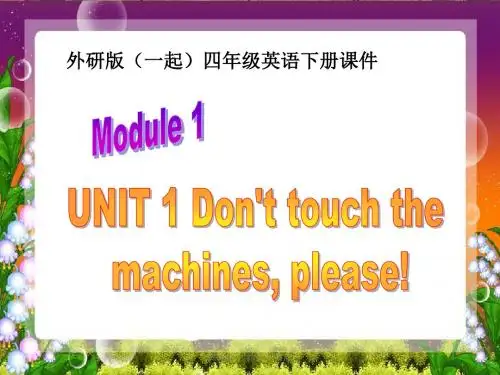
外研版一起小学英语四下《Module 1Unit 1 Don’t touch the machines ,please!》PPT课件
课件设计与制作—周洁
课件设计与制作—周洁
machine
课件设计与制作—周洁
crisps
课件设计与制作—周洁
potatoes
课件设计与制作—周洁
•Donห้องสมุดไป่ตู้t touch the _m_a_c_hi_n_e_s ,please!
课件设计与制作—周洁
Wear these_g_la_s_s_e_s ,please! And don’t touch _a_ny_t_h_in_g_.
课件设计与制作—周洁
dangerous
课件设计与制作—周洁
It _w_a_s_h_es_ the potatoes.
课件设计与制作—周洁
It c_u__t_s_ the potatoes.
课件设计与制作—周洁
It p_u__t_s the crisps in the bags.
课件设计与制作—周洁
课件设计与制作—周洁
课件设计与制作—周洁
课件设计与制作—周洁
`
课件设计与制作—周洁
课件设计与制作—周洁
课件设计与制作—周洁
Wear…
课件设计与制作—周洁
Wear…
课件设计与制作—周洁
课件设计与制作—周洁
外研版(一起)四下Module 1 Unit 1《Don’t touch the machines,
2
3
4
5
6
Don’t sing here!
1 Don't touch the machines, please!
Memory game
1
2
3
4
5
Wash your hands!
6
1 Don't touch the machines, please!
Memory game
1
3
4
5
6
Wear this hat!
How to make crisps?
1 Don't touch the machines, please!
1) Where is it?
It’s a factory.
2) What do the machines make?
They make crisps.
1 Don't touch the machines, please!
Memory game
1
2
3
4
6
Don’t talk here!
1 Don't touch the machines, please!
Memory game
1
2
4
5
6
Don’t write here!
1 Don't touch the machines, please!
Memory game
5) What does this machine do?
It puts the crisps in the bags.
1 Don't touch the machines, please!
外研版四年级英语下册Module1 Unit1 课件(一起点)
Don’t write here!
Don’t talk here! Stop!
Wear this hat!
Complete sentences. Welcome to our factory, children. 1. ________ machine 2. Don’t touch the _______. potatoes 3. It washes the _______.
4. What does the machine do, ___? sir
Read sentences. Don’t touch the machines, please! Wait! You can each have a bag of crisps. Don’t sing here!
Don’t dance here!
Words.
sir
Role play.
注意语音 语调哟!
Listen and say. Don’t touch the machines ,please!
Wait !You can each have a bag of crisps..
Let’s try.
Don’t …, please!
eat ice cream talk sing
Don’t talk here!
Summary
本单元我们学的单词有: welcome, machine, sir, potato。 本单元我们学的句型有: Don’t touch the machines, please!
Don’t touch the machines, please! They’re dangerous.
Sorry, sir..
Listen, point and say. This machine puts the crisps in the bags.
小学外研版四年级英语下册Module1 Unit1 She’s a nice teacher.
小学外研版四年级英语下册Module1 Unit1 She’s a nice teacher.一、学习目标确定的依据:1.课程标准相关要求:依据小学英语新课程标准的要求,四年级学生应该完成一级目标;能根据教师的简单指令做出动作;能做简单的角色表演(介绍自己的朋友或家人);能交流个人的信息,表达简单的感觉和情感;能模仿范例书写词句。
2.教材分析:《She’s a nice teacher.》是外研版新标准英语三年级起点第四册第一模块第一单元的教学内容。
本课通过卡通盼盼对朋友的介绍,学习表示人物特点的词语及描述他人性格特征的句型。
鼓励学生在介绍事物时使用适当的副词,如a bit, very。
3.学情分析:四年级的学生,已掌握一定的词汇、句型知识,有一定的口语水平。
本篇课文是四年级下册第一课,本节课的内容相对简单,需要把新旧知识有机结合起来,循序渐进,化难为易。
二、学习目标:1、能够正确听说认读单词:nice,clever,naughty,shy,answer2、能够掌握句型:This is... .She/He... .重点难点:重点:掌握单词nice,clever,naughty,shy,answer难点:掌握句型:This is... .She/He... .教学准备:多媒体,单词卡三、评价任务:1.通过检查学生对单词的掌握来完成学习目标一。
2.通过自学指导三来完成学习目标二。
四、教学过程:Step1自学指导一(5min)(1)读单词并说出其汉语意思。
1 .nice(友好的,亲切的)2. clever(聪明的)3 .naughty(淘气的)4 .shy(害羞的)5. answer(接电话)(2)Listen,point and say.(3min)(3)听力之后找同学试读(注意clever和naughty 的意思)Step2自学指导2(15min)1.听录音Listen point and find "She’s/He’s..."部分。
四年级英语下册 外研版一年级起点
四年级英语下册外研版一年级起点Module 1: Nice to meet you!Unit 1: Hello, everyone!In this unit, we learn how to introduce ourselves and greet others. We start by learning some common greetings such as "Hello," "Hi," and "Good morning." We also learn how to respond to these greetings and some polite ways to say goodbye.Unit 2: My schoolbagIn this unit, we talk about our schoolbags and the things we usually carry in them. We learn the names of school supplies such as pencils, rulers, erasers, and books. We also learn how to use phrases like "I have a ___" and "I don't have a ___" to talk about the objects we have or don't have.Unit 3: My classroomIn this unit, we learn how to describe our classroom and different objects in it. We learn the names of furniture items like desks, chairs, and blackboards. We also learn how to ask questions such as "What's this?" and "Where is the___?" and how to answer them using phrases like "It's a ___" and "It's on/under/near the ___."Unit 4: My familyIn this unit, we talk about our families and learn the names of different family members. We learn how to use possessive pronouns like "my," "your," and "his/her" to describe our family members. We also learn how to use sentences like "This is my ___" and "That is his/her ___" to introduce our family members to others.Module 2: In the parkUnit 1: What's your favorite season?In this unit, we learn how to talk about differentseasons and the weather associated with them. We learn the names of the four seasons: spring, summer, autumn, and winter. We also learn how to use sentences like "My favorite seasonis ___" to express our preferences.Unit 2: At the zooIn this unit, we talk about zoo animals and their characteristics. We learn the names of different animals such as elephants, lions, monkeys, and pandas. We also learn howto describe animals using adjectives like big, small, tall, and short. We can even compare them by using sentences like "An elephant is bigger than a monkey."Unit 3: Let's play!In this unit, we learn how to talk about different sports and activities. We learn the names of popular sports such as football, basketball, swimming, and running. We also learnhow to use verbs like "play," "do," and "go" to talk aboutdifferent activities. For example, "I like to play football"or "She likes to go swimming."Unit 4: At the amusement parkIn this unit, we talk about amusement parks and the fun activities we can do there. We learn the names of different rides and attractions such as roller coasters, merry-go-rounds, and Ferris wheels. We also learn how to use sentences like "I want to go on the ___" and "I don't want to go on the ___" to express our preferences.Module 3: My dayUnit 1: What time do you get up?In this unit, we learn how to talk about daily routines and tell the time. We learn the names of different activities we do throughout the day, such as waking up, eating breakfast, going to school, and doing homework. We also learn how to askand answer questions about time using sentences like "What time is it?" and "I get up at ___ o'clock."Unit 2: What's for lunch?In this unit, we talk about different meals and types of food. We learn the names of common foods such as rice, noodles, vegetables, fruits, and desserts. We also learn how to express our preferences using sentences like "I like ___" and "I don't like ___." We can even talk about our favorite foods using sentences like "My favorite food is ___."Unit 3: At the supermarketIn this unit, we learn how to talk about shopping and different items we can buy at a supermarket. We learn the names of commonly purchased things like milk, bread, eggs, and snacks. We also learn how to use sentences like "Do you have ___?" and "How much is ___?" to ask questions and make purchases.Unit 4: In the gardenIn this unit, we talk about plants and gardening. We learn the names of different flowers, trees, and vegetables. We also learn how to explain the process of growing plants using sentences like "First, you plant the seed. Then, you water it every day." We can even talk about our favorite flowers using sentences like "My favorite flower is ___."Module 4: Seasons and clothesUnit 1: What's the weather like today?In this unit, we learn how to describe the weather and different types of clothing suitable for different seasons. We learn the names of weather conditions like sunny, rainy, windy, and cloudy. We also learn the names of clothing items such as T-shirts, jackets, hats, and boots. We can use sentences like "I wear a T-shirt in summer" or "I need an umbrella in the rain."Unit 2: What are you wearing?In this unit, we learn how to describe our outfits andthe clothes we are currently wearing. We learn the names of clothing accessories such as scarves, gloves, and sunglasses. We also learn how to use sentences like "I'm wearing a red dress" or "He's wearing blue jeans" to describe our clothing.Unit 3: Going to a partyIn this unit, we talk about parties and special occasions. We learn how to express our excitement using sentences like"I'm excited about the party" or "It's going to be fun!" We also learn how to use sentences like "What should I wear tothe party?" and "I can bring a gift for the birthdaygirl/boy."Unit 4: What's the date today?In this unit, we learn how to talk about dates andspecial events in our lives. We learn the names of the daysof the week and the months of the year. We also learn how to use sentences like "Today is ___" and "My birthday is on ___" to talk about specific dates.This is a brief outline of the contents covered in the Grade 4 English textbook (外研版一年级起点). Each unitexplores different themes and vocabulary related to everyday life, allowing students to practice their speaking, listening, reading, and writing skills in a fun and interactive way.。
外研版英语四下(一起)《Module1 Unit2》PPT课件2
In the park
In the park
Don’t climb the trees. Don’t walk on the grass.
Don’t pick the flowers. Don’t feed the birds.
In the classroom
In the classroom
No eating or drinking No running
THE END
Signs
A sign tells us to do something or not to do something. For example: No littering
Keep quiet.
Don’t eat in the classroom.
Signs
We often use imperatives in signs.
We use Don’t to tell people not to do something. After Don’t, we use the base form of the verb.
For example:
Keep quiet
Don’t litter.
Don’t pick the flowers. Don’t walk on the grass.
must = have to / need to For example:
Keep quiet.
You must keep quiet.
No littering
You must not litter.
Don’t run in the classroom.
You must not run in the classroom.
外研社新标准四年级下Module1精品PPT课件
Talk about your friends
This is …
He’s/ she’s…
beautiful nice a bit shy clever fat cool tall thin naughty
结束语
当你尽了自己的最大努力时,失败也是伟大的, 所以不要放弃,坚持就是正确的。
This is Mrs Smart. She’s a nice teacher.
This is Xiaoyong.
pupil
He’s a clever pupil. 学生,
A: This is Parrot. B: Can you answer the call now?
answer the call
1. Maomao is a
girl.
A. nice
B. naughty
2. They
my friends .
A. is
B. are
3. Parrot is a naughty !
He’s not a bad bird.
A. and
B. but
连词成句。
They, my, friends, are. They are my friends. a , nice, She, teacher, is .
This is Yixiu. He is clever. He’s a cleverboy.
This is Ma Xiaotiao. He is naught.y He’s a naughty boy.
This is a bear. It is
It’s a shy bear.
shy .
shy 害羞的
When You Do Your Best, Failure Is Great, So Don'T Give Up, Stick To The End