
新版人教版-小学英语五年级上册第二单元
I often ___ do homework ________
watch ____ TV ______ I o____ ften ____ read ______ books I like my weekends.
and
星期六
on ________ Saturdays. on _______s. Sunday
What do you do on Sat__days?
I often and .
What __you ___on S__days?
I o____ .
That’s great! /cool!
Zhang Peng’s Weekend Hello,I’m Zhang Peng .
I have no classes on the weekends.
一般现在时、第三人称、可数名词、不可数名词
• 一般现在时:表示通常性、规律性、习惯性的状 态或者动作(有时间规律发生的事件)的一种时 间状态
1、He said the sun ____in the east and ____in the west. A rose; set B rises; sets C rises, set D rise; sets 2、We ____Tuesdays and Fridays. A.have B.like C.likes
Pair work:
What day is it today? It’s _________
What do you do on________ ?
I often ________________
Do you often ________ ?
Yes, I do./ No, I don’t.
单词表(会说、读、写)
单词
(星期一到
两个句式
What do we
What day is it today?
have on (星
星期五)英
语单词
期一、二…) We have (课程…)
It’s (星 期几)…
我 的 一 周(第2课时)
Part B
1、What day is it today? It is ..... 2、What do you have on Monday? I have.... Do you like Monday? Why? I like.......
不可数名词
• 2、如果普通名词所表示的事物是 不能按个数来计算的,这类名词就 叫不可数名词。不可数名词分为物 质名词(表示无法分为个体的物质, 如meat, rice, water, milk, orange 等)和抽象名词(表示动作、 状态、情况、品质等抽象概念,如 work, homework, time, health, friendship等)。
do homework watch TV
做作业 看电视 读书
read books
play computer games 玩电脑游戏 do housework what about
做家务
........怎么样?
• clean the rooms • cook the meals
打扫房间 做菜
• wash the clothes 洗衣服 • go shopping
It’s Sunday.
Sun.
音乐课
美术课 科学课
体育课
1
math
2
english
3
chinese
4
music
5
PE
6 computer
Monday(Mon)?
What do we have on + Thursday(Thu)……?
我们星期(一、四…)有什么课程?
We have +
computer/english/math/ PE/chinese/………
how many、how much的区别
• 对可数名词前的修饰语提问用how many; 对不 可数名词前的修饰语提问用how much。 如: • • • • How many apples are there in the box? 盒子里有多少个苹果? How much tea is there in the cup?杯里有 多少茶水? 注意:对不可数名词前的"单位词"的修饰 语提问时,疑问词用how many。 如: How many pieces of bread are there on the plate?盘子里有多少片面包?
Do you often…?
Yes, I do./No, I don’t.
Let’s talk:
A:What do you often do on Saturdays ?
B:I often do my homework.
A: Do you often wash your clothes on the weekend? B: Yes, I do./No, I don’t.
我 的 一 周(第5课时)
观看整个单元视频,对学过的知 识进行巩固。
没有课程
A week
(完全形式) (缩写) Monday Mon. Tuesday Tue. Wednesday Wed. Thursday Thu. Friday Fri. Saturday Sat. Sunday Sun. (中文意思) 星期一 星期二 星期三 星期四 星期五 星期六 星期日
Sun. Mon. Tue. Wed. Thu. Fri.
我 的 一 周(第1课时)
Monday(Mon)
星期一
Friday(Fri)
星期五
Tuesday(Tue)
weekday
星期二
Thursday(Thu)
星期四
Wednesday(wed)
星期三
Saturday(Sat)
星期六
weekend
周末
Sunday(Sun)
星期日
We have no classes on the weekend.
有三种不同的人称形式:
• 第一人称(First Person)指说话人 自己;第二人称(Second Person)指 说话的对象;第三人称(Third Person)指说话人谈论的对象。三种 人称又各有单、复数形式,第三人称 单数有阳性、阴性、中性的区别。这 样,人称代词就具有下列诸种形式:
1、第一人称 单数:I,me,my,mine 复数:we,us,our,ours
星期日
---What do you do on Saturdays?
---I often…
---What … Sundays? ---I ….
…
Monday, Monday, I often play compter games on Mondays. Tuesday, Tuesday, I often listen to music on Tuesdays. Wednesday, Wednesday, I often read and write on Wednesdays. Thursday, Thursday, I often read English on Thursdays. Friday, Friday, I often do sports on Fridays.
cook the meals
I often watch TV on Saturdays,too.
Saturday is fun(乐趣) for me.
I often read books and go shopping on Sundays.
Sunday is sweet (甜蜜)for me .
2、第二人称 单数:you,you,your,yours 复数: you,you,your,yours 3、第三人称 单数:he,him,his,his(阳性) she,her,her,hers(阴性) it,it,its(中性) 复数:they,them,their, theirs
可数名词
1、普通名词所表示的人或事物是可以按个数 计算的,这类名词叫可数名词。可数名词分为 个体名词(表示某类人或事物中的个体,如 worker, farmer, desk, factory 等)和集体名 词(表示作为一个整体来看的一群人或一些事物, 如people, family 等)。
课堂小结(会说,会写,会读)
单词
(上课讲过
两个句式 What do you do on.......? I often do ......on…
What about you? I do ........
的)时)
like? likes? • 1. 在一般现在时中,主语是第三人称单 数时,like 后加s例如:He likes playing football very much. he 是第三人称单数, 动词用likes。第三人称单数,he, she, it, Jack( 人名)等都是。 • 2. like 后接可数名词的复数形式,表示 喜欢某一类事物例如:I like apples.我 喜欢苹果。 苹果是一类事物,这里用 apples。
我们有(计算机、英语、数学、体育、语文……)
Let’s spell:
ee
feet 脚 beef 牛肉
ea
tea 茶 read 读
Meet 遇见 eat 吃
Let’s try:
试读这些词:
week need
bee feel
pea repeat peach sea meat meal
课堂小结(会说,会写,会读)
Sat.
日 一 二 三 四 五 六
7 days= a week
我发现:
人教版-五年级上 英语Unit2知识点梳理
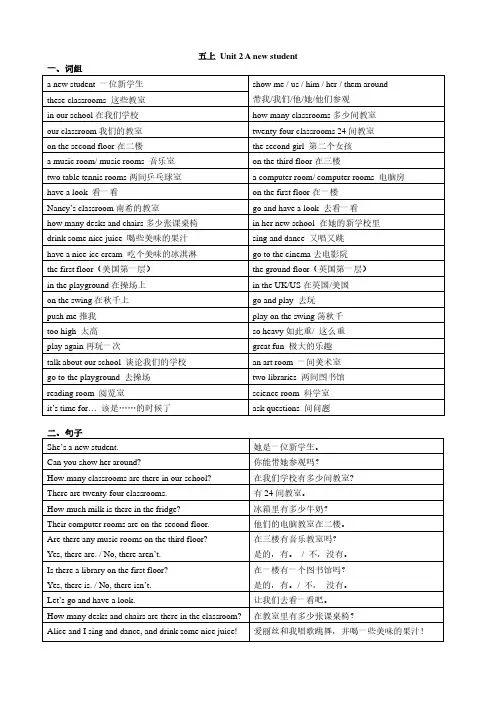
五上Unit 2 A new student 一、词组三、词性1. new(反义词)old2. student(复数) students3. these(单数)this4. this(对应词)that5. these(对应词) those6. those(单数)that7. she(宾格)her8. they(宾格) them9. we(物主代词)our 10. we(宾格)us11. one(序数词)first12. two(序数词)second 13. three(序数词)third14. four(序数词)fourth15. library(复数) libraries 16. Nancy(名词所有格)Nancy’s17. picture(同义词)photo18. push(三单)pushes 19. heavy(反义词)light20. stop(反义词)begin/start21. high(反义词)low22. fun(形容词) funny23. two(同音词)too,to24. let’s(完整形式)let us四、语音字母c/k/cake,cat,call,can,coat,cold,come,cup,doctor,clock, music字母c/s/dance, ice, juice, nice,cinema,city字母s /s/say,desk,student,sit,swim,skate字母组合ss /s/class,glass,guess字母组合se /s/else,house,horse,mouse五、语法点1.There be句型提问数量的特殊疑问句:(1)名词可数时结构:How many+复数+are there+地点?回答“可单可复”:如:问:How many books are there on the desk?答:There are forty (books)./There is (only) one.(2)不可数时问数量,用How much,如:How much milk is there in the glass?2.序数词前必加the,the third girl第三个女孩3.别人问某个房间在哪里时,回答会用到在第几层,表达在第几层时用介词on.(例)Our classroom is on the second floor.我们教室在二楼。
新版人教版小学英语五年级上册第二单元(2024版)

• wash the clothes 洗衣服
• go shopping
购物
at do you often do on the weekend?
你周末通常做什么呢? I often do .....on the weekend。
我通常做....在周末。
第二十三页,共47页。
I often do housework on Saturdays.
clean the rooms
wash the clothes
cook the meals
第二十四页,共47页。
I often watch TV on Saturdays,too.
Saturday is fun(乐趣) for me.
---What do you do on Saturdays?
---I often… ---What … Sundays?
---I ….
第三十一页,共47页。
…
Monday, Monday,
I often play compter games on Mondays.
Tuesday, Tuesday,
第二十五页,共47页。
I often read books and go shopping on Sundays.
Sunday is sweet (甜蜜)for me .
第二十六页,共47页。
第二十七页,共47页。
第二十八页,共47页。
What do you do on Sat__days?
多少茶水?
•
注意:对不可数名词前的"单位词"的修饰语提
问时,疑问词用how many。 如:
•
How many pieces of bread are there on the plate?
人教版五年级英语上册第二单元ppt课件
添加标题
在此录入上述图表的综合描述说明,在此录入上述图表的综合描述说明。
添加标题
在此录入上述图表的综合描述说明,在此录入上述图表的综合描述说明。
单击此处添加标题
01
02
03
添加标题
在此录入上述图表的描述明,在此录入上述图表的描述说。
添加标题
在此录入上述图表的描述说明,在此录入上述图表的描述说明。
单击此处添加文字内容 单击此处添加文字内容 单击此处添加文字内容 单击此处添加文字内容
单击此处添加文字内容 单击此处添加文字内容 单击此处添加文字内容 单击此处添加文字内容
单击此处添加文字内容 单击此处添加文字内容 单击此处添加文字内容 单击此处添加文字内容
单击此处添加文字内容 单击此处添加文字内容 单击此处添加文字内容 单击此处添加文字内容
ቤተ መጻሕፍቲ ባይዱ
单击此处添加标题
点击添加 文字
添加标题
点击添加 文字点击添加 文字
添加标题
点击添加 文字
添加标题
点击添加 文字点击添加 文字
添加标题
您的内容打在这里,或者通过复制您的文本后,在此框中选择粘贴,并选择只保留文字。
单击此处添加标题
单击添加段落文字单击添加段落文字
单击添加段落文字单击添加段落文字
What do you do on________ ?
I often ________________
It’s____today. I…… On Sundays , I……
保留文字的格式和动画效果不变,请不要删除文本框,直接把文本框中的文字替换即可
教学分析
Part 1
添加标题
在此录入上述图表的综合描述说明,在此录入上述图表的综合描述说明。
PEP人教版五年级英语上册第二单元课件PPT

返回首页
Let’s try
It is Saturday morning. Zhang Peng calls Oliver. Listen and tick.
返回首页
Read and write
Robin’s advice Robin: You look tired. What do you have on Fridays? Wu Yifan: I have PE. Robin: Do you often play sports? Wu Yifan: No, I don’t. I don’t like sports. Robin: What do you often do on the weekend? Wu Yifan: I often watch TV. Sometimes I read books.
Unit Two My week
Part A
Let’s learn Let’s talk
Let’s try
Let’s spell
Part B
Let’s learn Let’s talk
Let’s try
Read and write
欢乐记单词 轻松学语法
Let’s learn
Monday
Tuesday
3.A: Do you often play football? B: No, I do.
返回首页
(一) 一个星期有七天,小朋友们记心间, Monday星期一,猴子花钱坐飞机, Tuesday星期二,猴子屁股摔两半, Wednesday星期三,猴子爬上花果山, Thursday星期四,猴子马上去考试,
art
Wednesday Chinese maths art English
人教版五年级上册第二单元英语
人教版五年级上册第二单元英语一、重点单词。
1. 星期类。
- Monday(星期一),Tuesday(星期二),Wednesday(星期三),Thursday (星期四),Friday(星期五),Saturday(星期六),Sunday(星期日)。
- 记忆方法:可以采用联想法,例如Monday可以想象成“忙day”,因为周一是一周开始工作或学习比较忙的时候;Saturday和Sunday可以联想成休息日,“Sat”和“Sun”开头字母比较好记。
2. 课程类。
- Chinese(语文),English(英语),maths(数学),music(音乐),art (美术),PE(体育),science(科学)。
- 注意“maths”这个单词的拼写,不要写成“math”。
对于这些课程类单词,可以结合自己的学习生活来记忆,比如每天上的课。
3. 其他单词。
- do homework(做作业),read books(看书),watch TV(看电视),wash my clothes(洗我的衣服)。
- 这些短语都是日常活动相关的,其中“wash my clothes”要注意“clothes”这个单词的复数形式,它没有单数形式的意义,总是以复数形式出现。
二、重点句型。
1. 询问星期几及回答。
- 问句:What day is it today?(今天星期几?)- 回答:It's + 星期单词. 例如:It's Monday.(今天星期一。
)2. 询问有什么课程及回答。
- 问句:What do you have on + 星期单词?(你星期……有什么课?)- 回答:I have + 课程单词(s). 例如:I have Chinese, English and maths on Monday.(我星期一有语文、英语和数学课。
)3. 描述日常活动。
- 句型:I often + 日常活动短语. 例如:I often read books on the weekend.(我经常在周末看书。
五年级上册英语第二单元单词及知识点

五年级上册英语第二单元单词及知识点(经典版)编制人:__________________审核人:__________________审批人:__________________编制单位:__________________编制时间:____年____月____日序言下载提示:该文档是本店铺精心编制而成的,希望大家下载后,能够帮助大家解决实际问题。
文档下载后可定制修改,请根据实际需要进行调整和使用,谢谢!并且,本店铺为大家提供各种类型的经典范文,如工作报告、致辞讲话、条据书信、合同范本、规章制度、应急预案、心得体会、教学资料、作文大全、其他范文等等,想了解不同范文格式和写法,敬请关注!Download tips: This document is carefully compiled by this editor. I hope that after you download it, it can help you solve practical problems. The document can be customized and modified after downloading, please adjust and use it according to actual needs, thank you!Moreover, our store provides various types of classic sample essays, such as work reports, speeches, policy letters, contract templates, rules and regulations, emergency plans, insights, teaching materials, essay encyclopedias, and other sample essays. If you want to learn about different sample formats and writing methods, please pay attention!五年级上册英语第二单元单词及知识点人教版五年级上册英语第二单元单词及知识点英语最早由中世纪的英国使用。
人教版五年级上册英语第二单元教案
人教版五年级上册英语第二单元教案教案标题:Exploring My School教学目标:1. 学习并掌握有关学校设施和活动的词汇。
2. 学习并能正确使用描述学校设施和活动的句型。
3. 能够运用所学知识进行简单的口头交流。
教学重点:1. 学习并掌握有关学校设施和活动的词汇。
2. 学习并能正确使用描述学校设施和活动的句型。
教学难点:1. 能够运用所学知识进行简单的口头交流。
教学准备:教学课件、图片或实物、单词卡片、录音机或多媒体设备、课堂实例活动材料。
教学过程:Step 1: Warm-up1. Greet the students and review the previous lesson briefly.2. Show some pictures of different school facilities and ask students to name them. For example, "What's this? It's a library."3. Introduce the topic of the lesson: "Today, we are going to explore our school and learn about different facilities and activities."Step 2: Presentation1. Present the new vocabulary words related to school facilities and activitiesusing flashcards, pictures, or real objects. Repeat the words several times and have the students repeat after you.2. Play an audio recording or show a video clip that introduces the vocabulary words in context. Pause after each word or phrase to allow students to repeat.3. Use sentence patterns to describe the facilities and activities. For example, "We have a library in our school." "We have a basketball court." Model the sentences and have the students repeat.Step 3: Practice1. Divide the class into small groups or pairs. Give each group a set of word cards with different school facilities and activities.2. Ask the students to take turns picking a card and using it to make a sentence. For example, "I have a computer room in my school." Encourage them to be creative and use different sentence patterns.3. Monitor the groups and provide assistance as needed. Encourage students to ask questions and help each other.Step 4: Production1. Have the students work in pairs or small groups to create a poster or a short skit about their school facilities and activities. Provide them with materials such as colored paper, markers, and glue.2. Give them some guiding questions to help them organize their ideas, such as "What facilities does your school have? What activities do you enjoy in your school?"3. Allow time for students to prepare and practice their presentations.4. Have each group present their poster or skit to the class. Encourage the other students to ask questions or make comments after each presentation.Step 5: Wrap-up1. Review the new vocabulary words and sentence patterns with the whole class.2. Summarize the lesson by asking students to share one thing they learned about their school facilities or activities.扩展活动:1. 让学生用英语写一篇关于自己学校的短文,描述学校的设施和活动。
五年级上册英语第二单元人教版
人教版五年级上册英语第二单元单词1.Monday [ˈmʌndeɪ]-解析:“星期一”,一周中的第二天,常用来表示时间,如:“We have English class on Monday.”(我们星期一有英语课。
)2.Tuesday [ˈtjuːzdeɪ]-解析:“星期二”,例句:“I have a math test on Tuesday.”(我星期二有一场数学考试。
)3.Wednesday [ˈwenzdeɪ]-解析:“星期三”,例如:“We usually play basketball on Wednesday afternoon.”(我们通常在星期三下午打篮球。
)4.Thursday [ˈθɜːzdeɪ]-解析:“星期四”,“There is a meeting on Thursday.”(星期四有一个会议。
)5.Friday [ˈfraɪdeɪ]-解析:“星期五”,如:“I'm looking forward to Friday because we have a party.”(我期待星期五,因为我们有一个派对。
)6.Saturday [ˈsætədeɪ]-解析:“星期六”,是周末的一天,“I often go shopping on Saturday.”(我经常在星期六去购物。
)7.Sunday [ˈsʌndeɪ]-解析:“星期日”,例句:“On Sunday, I usually stay at home and rest.”(在星期日,我通常待在家里休息。
)8.weekend [ˌwiːkˈend]-解析:“周末”,包括星期六和星期日,“What do you usually do on the weekend?”(你周末通常做什么?)9.wash [wɒʃ]-解析:作动词,“洗”,可用于洗衣服、洗手等,“Wash your hands before dinner.”(饭前洗手。
人教版PEP五年级英语上册第二单元课件PPT
It ’s
What have
do homework
What do you do on Saturdays
read watch Saturdays
我们不能经常在家看电视。
do homework 做作业
让我们一起做作业吧。
Let’s do homework together.
Pratice 练习
1. is it today? Tuesday.2. do you on Sundays? I often my . 3. ? I often do my homework on Sundays. 4. I often __________ books and _ _____ _ __ TV on __________ (星期六).
C
c
Homework:Design your favorite class schedule..
Unit2 My Week
(人教PEP)五年级英语上册
第四课时
It is Saturday moring.Zhang Peng calls Oliver,Listen and tick.
Let’s learn
Monday
Tuesday
Wednesday
Thursday
Friday
Saturday
Sunday
Chinese
maths
Chinese
maths
P.E.
English
science
maths
Chinese
music
maths
Chinese
art
English
science
Satur-
人教版新PEP小学五年级上册英语第二单元Unit2 My week教案教学设计
人教版新PEP小学五年级上册英语第二单元Unit2 My week教案教学设计人教版新PEP小学五年级上册英语第二单元Unit2 My week教案教学设计Unit 2My week 第一课时教学目标及要求1、能听懂问句:What day is it today? What do we have on Mondays? 并能作出正确回答;2、四会单词,周一至周五,并能熟练运用;3、完成相关练习;4、学习歌曲“My days of the week”。
教学重点本课时的教学重点是Let’s learn 部分的五个四会单词:Monday, Tuesday, Wednesday, Thursday, Friday,要求学生开动脑筋巧记单词,并结合所给句型灵活运用这几个单词。
教学难点本课时的教学难点是正确拼写从星期一至星期五这五个英语单词。
理解和使用各科目的名称来表述课程安排。
理解汉语中“上课”这一动作的正确表述方法,We have…。
教学准备1、教师准备教学过程中所需要的图片、声音、课件,以及本课时的单词卡;2、教师和学生分别准备做游戏用的标有星期的圆盘,以及单词卡;3.教师应准备相关媒体的播放设备,如录音机、投影仪、幻灯片等。
教学方法情景教学法,小组合作法教学过程设计1、Warm-up(热身)(1)教师播放Start部分的歌谣Let’s chant,学生感知星期一至星期五的表述。
还可选择播放前几册学生用书中与本单元内容有关的Let’s chant、Let’s sing、Let’s do 部分的录音,学生听音,有节奏地吟唱,并做出相应动作。
如四年级上册复习一中有关星期的歌谣,让学生温故知新,以减轻教与学的难度。
(2)教师使用四年级下册第二单元中的句型:“It’s 8 o’clock.It’s time for Chinese.”引出句型:We have Chinese, English…on Mondays.结合课程表,进行日常口语练习,内容可参考如下:A: Hello, B.What time is it? B: Hello, A.It’s8:20.It’s time for English class.…2、Presentation(新课呈现)(1)教师结合Let’s start 的图片和情景,提问:“What classes do you like?”引导学生复习有关课程的词汇。