
人教版(2019)英语第二册:Unit 1 Cultural Heritage-Period 2 Reading and Thinking From Problems
From Problems to Solutions
Look at the two photos and the title, guess what the text is mainly about.
Divide the passage into three parts and then fill in the blanks.
Title: From problems to solutions
Part 1 (paragraph 1) The introduction of the topic
Keeping the right balance between progress and
The global community can sometimes (8)p_r_o_v_i_d_e_ a solution to a difficult problem for a single (9)_n_a_t_io_n_.
1. How to deal with the construction and the protection of cultural relics?
water to more farmers in the area.
2.Why did the building of the dam lead to protests?
It will damage the cultural relics.
3.How did the government save the cultural relics?
I think although the construction is important, the government should also make an effort to protect the cultural relics. When they disappear, they won’t come back and will lose their value. The government should keep the right balance between the construction and the protection of them.
2. As students, what should we do to protect our cultural relics?
We should know more about cultural relics in our country and do something we can to protect the cultural relics. For example, we can spread the knowledge of cultural relics and promote the awareness of the protection of them.
Read again and answer the following questions:
1.Why did the Egyptian government want to build a new dam in the 1950s?
To benefit the area by control floods, producing electricity, and supplying
The outline of the passage
Introduce the topic:
A big challenge—the balance between progress and the protection of cultural sites.
List the evidence:
Conclusion
Problems: locals’ protests against building a new dam across the Nile.
Solutions: limit damage to the Egyptian buildings and prevent the loss of cultural relics.
Title: From problems to solutions
Keys: The text is about some problems about some cultural relics and the solutions to tackle the problems.
Read quickly and figure out the key words of each paragraph. Paragraph 1: challenge Paragraph 2: proposal led to protests Paragraph 3: committee established Paragraph 4: brought together Paragraph 5: success Paragraph 6: spirit
In the 1950s the government wanted to build a new dam. In 1959, the government asked the UN for help . In 1960, the project started/began. In 1961 the first temple was moved . Over the next twenty years, the temples and cultural relics were being rescued. In 1980, the project was completed/ended.
2. Find out the numbers in paragraph four and explain why the author used exact numbers instead of expressions like many.
Numbers: 1961; 20; 22; fifty; 80
Mary countries participated in the rescue and it is their team work that has saved the temples.
5. Before the building of the dam, what problems did the Nile river bring to the Egyptians? Floods and droughts; not enough electricity. 6. What words can you think of to describe the working process of the project? Hard, tough, complicated, amazing, excellent.
the (1)_p_r_o_te_c_t_io_n_ of cultural sites is a big challenge.
Part 2 (paragraphs 2-5) The process of (1)_s_a_v_in_g_ cultural relics
Part 3 (paragraph 6) The summary of the text
The project is so hard that it takes 20 years to finish it.
4. What can you infer from “Fifty countries donated nearly 80 million to the project”?
The project cost a operation can solve difficult problems.
D. Doubtful.
Read more carefully and answer the following questions.
1. What do “problems” refer to and what do “solutions” refer to?
Title: From problems to solutions
·Big challenges can sometimes lead to great (2)_s_o_lu_t_i_o_n_s. ·The Egyptian government wanted to build a new dam, which would (3)_d_a_m_a_g_e_ many cultural relics. ·The government (4) _tu_r_n_e_d_t_o_the UN for help. ·Experts made a (5)p_r_o_p_o_s_a_l_ for how to save cultural relics after a lot of efforts and the work began. ·Cultural relics were (6) _ta_k_e_n_d_o_w__n_and moved to a safe place. ·Countless cultural relics were rescued. ·The project was a (7)_s_u_c_ce_s_s_.
By moving them to a safe place.
4.Which one can describe the project?
A.Successful.
B. Negative. C. Useless.
5.What can be learned from the Aswan Dam project?
The spirit of the Aswan Dam project is still alive today.
Unit 1 Cultural Heritage课件-高中英语人教版(2019)必修第二册

Tour guide:That's Saint Basil Cathedral. People all over the world think of Russia when they see it. lts like the Eiffel Tower in France or the Great Wall in China, a symbol of the country
tell right from wrong 分辨是非 tell ...from...辨别……和……
Talking Work in groups and role play. Make a conversation between some tourists and their tour guide.
2. What are they doing? A. Drawing a map. B. Sightseeing. C. Studying culture.
Listen again and complete the fact sheet.
World Cultural Heritage Site Fact Sheet
The Kremlin which dates back to 1156, was the center of the Russian. With nearly a dozen palaces and churches, the Kremlin is a symbol of eight centuries of Russia’s history and culture, not to mention its power. Over the years the Kremlin is a command center(指挥中心), and today a home for the Russian president.
Unit1 Cultural Heritage(单元解读课件)-高一英语(人教版2019必修第二册)

Reading and Thinking 过程的叙事文 的大量寺庙和文化古迹保护所面临的挑战
本
与问题,以及解决过程和办法。
文化遗产保护面临的挑战和问 题,以及解决过程和办法,关 注国际合作在问题解决过程中
的关键作用。
Discovering Useful Structures
句子
Listening and Talking
“关注主题意义,制定 指向核心素养发展的
单元整体教学目标” (教育部,2020)
3
主题意义探究是课堂 教学设计与教学活动 组织的灵魂。探究主 题内容是学生学习的 主要兴趣点与动力来 源,这有助于提高学 生的学习积极性和课 堂参与度(程晓4堂, 2018)
4
单元整体教学设计是教师基于课程标准,围绕特定主题, 对教材等教材资源进行深入解读、分析、整合和重组后, 结合学习主体的需求,搭建起一个由单元大主题统领、 各语篇次主题相互关联、逻辑清晰的完整学习单元,使 教学能够围绕一个完整的主题设定单元目标,引导学生 基于对各单独语篇小观念的学习和提炼,逐步建构基于 该单元主题的大观念。(王蔷,2021)
information about the Kremlin and Red Square as well as related expressions(学习理解) 3.两个学生一组,扮演游客和导游,游客就在参观过 程中想要问导游的问题与之进行对话,需运用获取到 到的内容和习得的语言表达以及模仿书上对话结构, 自编口头对话(应用实践)
1. Reading and Thinking:From Problems to Solutions
第4、 2. Discovering 5、6 Useful Structures 课时 3.Workbook
人教版2019必修第二册Unit1CulturalHeritage单词讲解课件16张ppt
apply for a position/visa/passport
申请一个职位/签证/护照
apply to
apply 应用;运用
申请(v.)
apply
涂;抹;敷
application apply oneself to doing sth.
申请;运用(n.) 专心做某事
applicant
申请人(n.)
give way to让步屈服 give in 屈服 give up放弃 give out分发 give away捐赠;泄露
The hero would rather die than_g_iv_e__in__ to the enemies.
2. We should preserve our eyes _f_ro_m__ bright sunlight in summer.
promote语义网络图
向前发展 (基本义)
promote
使某事 “向前发展”
使职位 “向前发展”
使产品销售 “向前发展”
促进;推动 晋升
促销;推广
promote sb. to 提升/晋升某人到……(职位) sb. be promoted to +职位 get a promotion 得到晋升
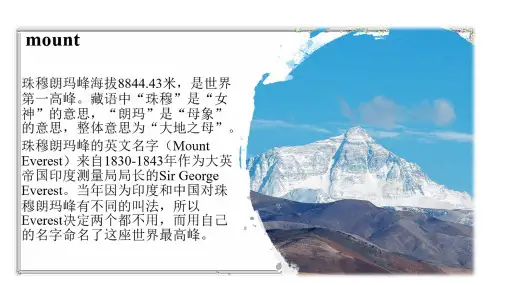
mount
mount的词源义是 “to get on a horse” ,攀上马背,引申为“上 升”,也是其基本义。
■ n (缩写为Mt) [用于山名前,其前不用冠词] 山;峰: Mount Everest / Mount Tai ■v vt & vi [正式用语] 爬 (上);骑 (上): I mounted the steps and looked around me slowly. vt 组织;安排 (arrange): mount a protest / an exhibition vi 逐步增加
unit 1 Cultural Heritage(课件)高一英语课件(人教版2019必修第二册)
☞ apply v.运用,应用
5. balance n.平衡;均匀 vt. 使平衡
《1》保持平衡 keep balance 《2》保持均衡的饮食 keep a balanced diet 《3》失去平衡: lose one’s balance / out of balance 《5》使A和B平衡 keep a balance between A and B 《6》总的来说 On balance
2. preserve vt.保存;保护;维持; n.保护区
《1》保护....免受....
preserve… from/against doing sth 《2》保存完好的 well-preserved
☞ preservaton n.保护
3. promote vt.促进;提升;推销;晋级
《1》促进和平 promote peace 《2》得到晋升 get promoted ★由于缺乏专业知识,他没有得到提升。 He failed to get promoted for lack of professional knowledge.
新人教版必修二
单词讲解
Unit 1
1. former adj 以前的;(两者中)前者的
前者......后者......the former … the latter… ★ 我赞成前一个观点而他支持后一个。 I’m in favor of the former opinion while he is in support of the latter one.
Unit 1 Cultural Heritage (教学设计)-高一英语(人教版2019必修第二册)
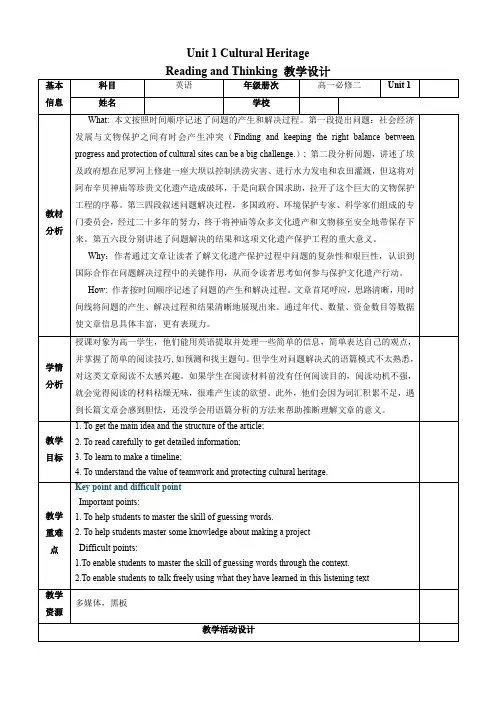
Unit 1 Cultural HeritageStep1. Lead-in1.Show pictures about tourist attractions in Egypt?2.Do you know other tourist attractions in Egypt? Is there any link between the two pictures?Step 3. While-ReadingPrediction: read the title and look at the pictures.What do you think the text is about?The title suggests that the text is about how people solved problems.1.Read and match the main ideas with each paragraph.2.Scan the text to find the Structure of the passage .Reading for detailsPara 1: Raise a problemPara 2: Analyze the problem1.Why did the Egyptian government want to build a new dam?To control floods, produce electricity, and supply water to more farmers in the area.2. Why did the Egyptian people protest (抗议) the government’s decision? Water from the dam would likely damage a number of temples and destroy cultural relics that were an important part of Egypt’s heritage.Read para 3 and fill in the blanks.How did UN deal with this problem of building Aswan Dam?Suggested answersRead para 4 and fill in the blanks.How were the temples and other cultural sites saved?Para 5: The results of the solution of the problem.Para 6: The spirit and lessons.教学反思1.撰写本课时目标时,为了和英语学科核心素养提到的文化意识对接,设置了第四条“通过学习阿斯旺大坝的精神加强国际合作意识、树立人类共同体意识”,这样的目标可操作性是不是欠缺,文化意识类的目标怎么体现可操作性?2.怎样对本语篇更好地进行文本赏析?Blackboard designHomework:。
Unit 1 Cultural Heritage(教学设计)高一英语(人教版2019必修第二册)
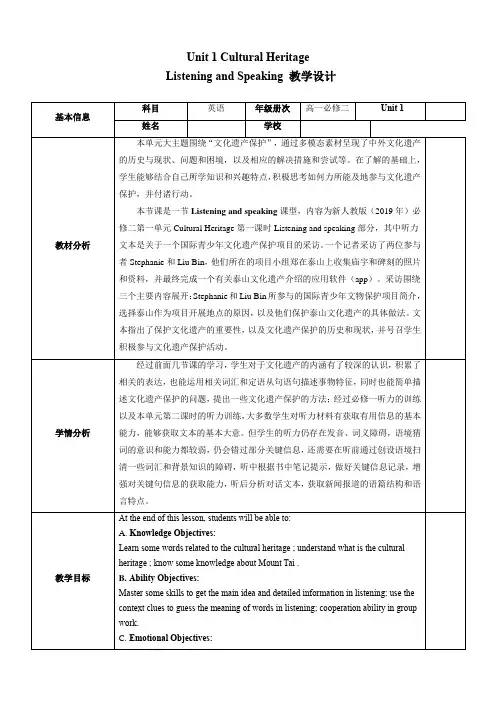
Unit 1 Cultural Heritage Listening and Speaking 教学设计Activity 1 Pre-listening1. look at the pictures below. What are the students doing?Suggested answers:1.The two girls are looking for information about Mount Tai in books and on the Internet. The two boys are taking pictures of the rock carving at Mount Tai and taking notes.2.In the classroom, the students are discussing Mount Tai. The girl is working on her computer.Activity 2 While-listening3.Listen to the conversation and choose the main idea.A.Students from different countries are working creatively to protect a temple in China.B.Youths from seven countries are working together to protect cultural relics on Mount Tai.C.Doing a project on cultural heritage protection in China is interesting and exciting.Suggested answers:B3.Listen again and help the reporter to complete the interview notes. International youth project, high school students from 7 countriesMount Tai, one of the most mountains in ChinaIt has been for more than 3,000 years22 temples, around 1,800 with writing on themDai Temple on ; over 6,000 .4.Listen again and use the context to guess the meaning of the words below. Tick the reason why you were able to guess the words.听力材料:Reporter: Hello. What are you guys doing?Stephanie: We’re creating an app about Mount Tai. We’re part of an international youth project.Reporter: That's interesting. How many students are taking part in the project?Stephanie: There are 23 senior high school students from seven countries. Reporter: Why is the project here at Mount Tai?Liu Bin: Well, as you know, Mount Tai is one of the most famous mountains in China. The mountain and the temples have been protected for over 3,000 years, so it's a great example of how people preserve their cultural heritage.We feel so proud to have chance to do something.Reporter: Tell me about the app you're making.Make a report of a cultural heritage.Choose a cultural heritage which you are familiar with and discuss with your partner how to introduce it.Example:Today, I will introduce you to the Great Wall located in Beijing. It's one of our cultural heritage, which is very magnificent(雄伟的)... But now it is facing some problems. There is too much rubbish left on the steps. We should ...板书设计Homework:Search for more information about the Kremlin and Red Square and the Forbidden City through the library, Internet or other sources. Talk about their history and culture with your classmates.课后反思通过学习:1,学生学习英语的信心增强;2,学生学会抓住听力中的答案;3,锻炼学生的口语能力!通过本节内容学习,理解并讨论主题图,预测单元的主题和内容,通过问题链引导学生谈论单元内容,该板块以听为本,学生通过听取信息和选择依据来学习语言知识,同时内化所学关于本单元的内容。
Unit 1 Cultural Heritage (教学设计)高一英语(人教版2019必修第二册)
Unit 1 Cultural Heritage Listening and Speaking 教学设计II.Student will be asked to look at the picture of Mount Tai and say something more they know about Mount Tai.To these relics, what should we do?Taking our responsibility for preserving them from being damaged.定一定基础。
通过课前提问唤起学生对文化遗产的记忆,并且通过图片介绍学生能有一个更直观深刻的认识。
2.让学生预测即将听到的内容;3.了解中国的壮美河山,增强民族自豪感。
While–Listening Step 3: Listen for the gistStudents will be asked to listen to the complete listening material andchoose the main idea. While listening, they are asked to write down somekey words to help them get the main idea.Step 4: Listen for details1.Students will be asked to listen and fill in blanks.Students will be asked to listen again and answer questions:1). Why do they choose Mount Tai?2). What are they going to do then?1.锻炼学生根据关键词句判断听力主旨大意的能力;2.让学生关注更多有意义的细节(关注词性、数字、地名)辅助其听取正确答案。
英语人教版(2019)必修第二册Unit 1 Cultural Heritage (共26张ppt)
num.
Mount Tai, one of the most f_a_m__o_u_s mountains in China
It has been _p_r_o_t_ec_t_e_d_ for more tahdaj.n 3,000 years.
Listen to the conversation again and use the context to guess the meaning of the words below. Tick the reason why you were able to guess the words.
Reason
22
temples,
v.-ed
around
1,800
_s_to_n_e_s_
with
writing
on
them
Dai
Temple
on
n. pl.
_M__o_u_n_t_T_a_i_; over
6,00. pl.
While-listening
Activity2: Listen for the main idea
A. Students from different countries are working creatively to protect a temple in China.
B. Youths from seven countries are working together to protect cultural relics on Mount Tai.
photos of the former palace, they have made the new one look exactly like the old one.
英语人教版(2019)必修第二册Unit1 Cultural heritage (共40张ppt)
(2)先行词被特定缠,that抢先把位占。
当先行词被the only, the very, the same, the right 等修饰时,关系代词用that 而不用which
This is the only thing that we can do now. (3)当先行词有序数词或形容词最高级修饰时
构成:名词或代词 + 关系词 + 从句 分类:限制性:说明正在谈论的人、物或事
非限制性: 给出额外的补充信息
; ;
关系词
关系代词:who :指人,作主语或宾语;
whom :指人,作宾语;
特殊:as
which :指事、物,作主语或宾语;
that :指人或事、物,作主语或宾语;
whose :与所修饰的名词为所属关系,作定语;
---- World Heritage Centre
1.Guide students to know how to use The Attributive Clause.
2.Design specific situations for students to make small conversitions.
7. Their child is at the stage __w_h_e_r_e__ she can say individual words but not full sentences. (2019年天津高考改) 8. As the smallest child of his family, Alex is always longing for the time __w__h_e_n__ he should be able to be independent. 9. Students should involve themselves in community activities __w_h_e_r_e__ they can gain experience for growth. 10. The reason __w_h_y____ he resigned is known to us.
Unit1 Cultural Heritage高中英语人教版(2019)必修第二册
Rewrite the sentences using relative clauses.
Enrich your life today,yesterday is ow is mystery
He showed me a photo in his room. It was a photo of a famous cultural relic in Egypt. The photo that/which he showed me in his room was a photo of a famous cultural relic in Egypt.
The documents about the cultural relics from overseas are under the desk. I found them yesterday.
adj.海外的adv.在海外
The place where I found the documents about the cultural relics from overseas yesterday are under the desk.
Rewrite the sentences using relative clauses.
Enrich your life today,yesterday is ow is mystery
2. This temple was first built during the Qin Dynasty. The time when this temple was first built is Qin Dynasty.
6. This is the reason _t_h_a_t_/_w_h_i_c_h_ he gave.