
安徒生童话故事全集(5篇)(精选)
1.安徒生童话故事全集:衬衫领子从前有一位漂亮的绅士;他所有的动产只是一个脱靴器和一把梳子。
但他有一个世界上的衬衫领子。
我们现在所要听到的就是关于这个领子的故事。
衬衫领子的年纪已经很大,足够考虑结婚的问题。
事又凑巧,他和袜带在一块儿混在水里洗。
“我的天!”衬衫领子说,“我从来没有看到过这么苗条和细一嫩、这么迷人和温柔的人儿。
请问你尊姓大名?”“这个我可不能告诉你!”袜带说。
“你府上在什么地方?”衬衫领子问。
不过袜带是非常害羞的。
要回答这样一个问题,她觉得非常困难。
“我想你是一根腰带吧?”衬衫领子说,“一种内一衣的腰带!亲爱的小一姐,我可以看出,你既有用,又可以做装饰品!”“你不应该跟我讲话!”袜带说。
“我想,我没有给你任何理由这样做!”“咳,一个长得像你这样美丽的人儿,”衬衫领子说,“就是足够的理由了。
”“请不要走得离我太近!”袜带说,“你很像一个男人!”“我还是一个漂亮的绅士呢!”衬衫领子说。
“我有一个脱靴器和一把梳子!”这完全不是真话,因为这两件东西是属于他的主人的。
他不过是在吹牛罢了。
“请不要走得离我太近!”袜带说,“我不习惯于这种行为。
”“这简直是在装腔作势!”衬衫领子说。
这时他们就从水里被取出来,上了浆,挂在一张椅子上晒,最后就被拿到一个熨斗板上。
现在一个滚一热的熨斗来了。
“太太!”衬衫领子说,“亲爱的寡一妇太太,我现在颇感到有些热了。
我现在变成了另外一个人;我的皱纹全没有了。
你烫穿了我的身体,噢,我要向你求婚!”“你这个老破烂!”熨斗说。
同时很骄傲地在衬衫领子上走过去,因为她想象自己是一架火车头,拖着一长串列车,在铁轨上驰过去——“你这个老破烂!”衬衫领子的边缘上有些破损。
因此有一把剪纸的剪刀就来把这些破损的地方剪平。
“哎哟!”衬衫领子说,“你一定是一个芭蕾舞舞蹈家!你的腿子伸得那么直啊!我从来没有看见过这样美丽的姿态!世界上没有任何人能模仿你!”“这一点我知道!”剪刀说。
“你配得上做一个伯爵夫人!”衬衫领子说。
“我全部的财产是一位漂亮绅士,一个脱靴器和一把梳子。
我只是希望再有一个伯爵的头衔!”“难道他还想求婚不成?”剪刀说。
她生气起来,结结实实地把他剪了一下,弄得他一直复元不了。
“我还是向梳子求婚的好!”衬衫领子说。
“亲爱的姑娘!你看你把牙齿①保护得多么好,这真了不起。
你从来没有想过订婚的问题吗?”①即梳子齿。
“当然想到过,你已经知道,”梳子说,“我已经跟脱靴器订婚了!”“订婚了!”衬衫领子说。
现在他再也没有求婚的机会了。
因此他瞧不起爱情这种东西。
很久一段时间过去了。
衬衫领子来到一个造纸厂的箱子里。
周围是一堆烂布朋友:细致的跟细致的人在一起,粗一鲁的跟粗一鲁的人在一起,真是物以类聚。
他们要讲的事情可真多,但是衬衫领子要讲的事情最多,因为他是一个可怕的牛皮大王。
“我曾经有过一大堆情一人!”衬衫领子说。
“我连半点钟的安静都没有!我又是一个漂亮绅士,一个上了浆的人。
我既有脱靴器,又有梳子,但是我从来不用!你们应该看看我那时的样子,看看我那时不理人的神情!我永远也不能忘记我的初恋——那是一根腰带。
她是那么细一嫩,那么温柔,那么迷人!她为了我,自己投到一个水盆里去!后来又有一个寡一妇,她变得火热起来,不过我没有理她,直到她变得满脸青黑为止!接着来了芭蕾舞舞蹈家。
她给了我一个创伤,至今还没有好——她的脾气真坏!我的那把梳子倒是钟情于我,她因为失恋把牙齿都弄得脱落了。
是的,像这类的事儿,我真是一个过来人!不过那根袜带子使我感到最难过——我的意思是说那根腰带,她为我跳进水盆里去,我的良心上感到非常不安。
我情愿变成一张白纸!”事实也是如此,所有的烂布都变成了白纸,而衬衫领子却成了我们所看到的这张纸——这个故事就是在这张纸上被印出来的。
事情要这么办,完全是因为他喜欢把从来没有过的事情瞎吹一通的缘故。
这一点我们必须记清楚,免得我们干出同样的事情,因为我们不知道,有一天我们也会来到一个烂布箱里,被制成白纸,在这纸上,我们全部的历史,甚至最秘密的事情也会被印出来,结果我们就不得不像这衬衫领子一样,到处讲这个故事。
2.安徒生童话故事全集:小小的绿东西窗子上有一株绿玫瑰花。
不久以前它还是一副青春焕发的样子,但是现在它却现出了病容,在害某种病。
它身上有一批客人在一口一口地把它吃掉。
要不是因为这个缘故,这一群穿着绿制一服的朋友们倒是蛮好看的。
我和这些客人中的一位谈过话。
他的年纪还不过三天,但是已经是一个老爷爷了。
你知道他讲过什么话吗?他讲的全是真话。
他讲着关于他自己和这一群朋友的事情。
“我们是世界生物中一个最了不起的队伍。
在温暖的季节里,我们生出活泼的小孩子。
天气非常好;我们立刻就订了婚,马上举行婚礼。
天气冷的时候,我们就生起蛋来。
小家伙在那里面睡得才舒服哩。
最聪明的动物是蚂蚁。
我们非常尊敬他们。
他们研究和打量我们,但是并不马上把我们吃掉,而是把我们的蛋搬走,放在他们家族的共同蚁窟里的最低的一层楼上,同时在我们身上打下标记和号数,把我们一个挨着一个地、一层堆上一层地排好,以便每天能有一个新的生物从蛋里孵出来;然后就把我们关进栅栏里,捏着我们的后腿,挤出我们的奶,直到我们死去为止。
这可是痛快啦!他们送我们一个听的称号:“甜蜜的小奶牛!”一切具有蚂蚁这种知识的动物都叫我们这个名字。
只有人是例外——这对我们是一种极大的侮辱,气得我们完全失去了“甜蜜性。
”你能不能写点文章来反对这事儿,叫这些人能懂得一点道理呢?他们那样傻气地望着我们,绷着脸,用那样生气的眼光望着我们,而这只不过是因为我们把玫瑰叶子吃掉了;但是他们自己却吃掉一切活的东西,一切绿色*的和会生长的东西。
他们替一我们起些最下贱的、最丑恶的名字。
噢,那真使我作呕!我说不出口,最低限度在穿着制一服时说不出口,而我是永远穿着制一服的。
“我是在一个玫瑰树的叶子上出生的。
我和整个队伍全靠玫瑰叶子过活,但是玫瑰叶子却在我们身体里面活着——我们属于高一等的动物。
人类憎恨我们,他们拿肥皂泡来歼灭我们;这种东西的味道真难受!我想我闻到过它!你并不是为洗涤而生下来的,因此被洗涤一番真是可怕!“人啊!你用严厉和肥皂泡的眼光来看我们;请你想想我们在大自然中的地位,以及我们生蛋和养孩子的天才的机能吧!我们得到祝福:‘愿你们生长和繁殖!’我们生在玫瑰花里,我们死在玫瑰花里;我们整个一生是一首诗。
请你不要把那种最可怕的、最丑恶的名字加到我们身上来吧——我们说不出口,也叫不出来的那种名字!请把我们叫做蚂蚁的奶牛、玫瑰树的队伍、小小的绿东西吧!”我作为一个人站在一旁,望着这株玫瑰,望着这些小小的绿东西——他们的名字我不愿意喊出来;也不愿意侮辱一个玫瑰中的公民,一个有许多卵子和小孩的大家族。
本来我是带着肥皂水和恶意来的,打算喷他们一通。
现在我打算把这肥皂水吹成泡,然后凝望着它们的美,可能每个泡里面会有一篇童话的。
泡越长越大,泛出各种颜色*。
泡里好像都藏着珍珠。
泡浮起来,翱翔着,飞到一扇门上,于是爆裂了。
但是这扇门忽然开了!童话妈妈站在门口。
“是的,那些小小的绿东西——我不说出他们的名字!关于他们的事情,童话妈妈讲的要比我好得多。
”“蚜虫!”童话妈妈说。
“我们对任何东西应该叫出它正确的名字。
如果在一般场合下不敢叫,我们至少可以在童话中叫的。
”3.安徒生童话故事全集:豌豆上的公主从前有一位王子,他想找一位公主结婚,但她必须是一位真正的公主。
他走遍了全世界,想要寻到这样的一位公主。
可是无论他到什么地方,他总是碰到一些障碍。
公主倒有的是,不过他没有办法断定她们究竟是不是真正的公主。
她们总是有些地方不大对头。
结果,他只好回家来,心中很不快活,因为他是那么渴望着得到一位真正的公主。
有一天晚上,忽然起了一阵可怕的暴风雨。
天空在掣电,在打雷,在下着大雨。
这真有点使人害怕!这时,有人在敲门,老国王就走过去开门。
站在城外的是一位公主。
可是,天哪!经过了风吹雨打之后,她的样子是多么难看啊!水沿着她的头发和衣服向下面流,流进鞋尖,又从脚跟流一出来。
她说她是一个真正的公主。
“是的,这点我们马上就可以考查出来。
”老皇后心里想,可是她什么也没说。
她走进卧房,把所有的被褥都搬开,在床榻上放了一粒豌豆。
于是她取出二十床垫子,把它们压在豌豆上。
随后,她又在这些垫子上放了二十床鸭绒被。
这位公主夜里就睡在这些东西上面。
早晨大家问她昨晚睡得怎样。
“啊,不舒服极了!”公主说,“我差不多整夜没合上眼!天晓得我床上有件什么东西?我睡到一块很硬的东西上面,弄得我全身发青发紫,这真怕人!”现在大家就看出来了。
她是一位真正的公主,因为压在这二十床垫子和二十床鸭绒被下面的一粒豌豆,她居然还能感觉得出来。
除了真正的公主以外,任何人都不会有这么嫩的皮肤的。
因此那位王子就选她为妻子了,因为现在他知道他得到了一位真正的公主。
这粒豌豆因此也就被送进了博物馆,如果没有人把它拿走的话,人们现在还可以在那儿看到它呢。
4.安徒生童话故事全集:穷女人和她的小金丝鸟她是一个穷得出奇的女人,老是垂头丧气。
她的丈夫死了,当然得埋掉,但她是那么穷困,连买一口棺材的钱都没有。
谁也不帮助她,连一个影儿也没有。
她只有哭,祈求上帝帮助她——因为上帝对我们所有的人总是仁慈的。
窗子是开着,一只小鸟飞进屋里来了。
这是一只从笼子里逃出来的金丝鸟。
它在一些屋顶上飞了一阵子,现在它钻进这个穷女人的窗子里来了。
它栖在死人的头上,唱起美丽的歌来。
它似乎想对女人说:“你不要这样悲哀,瞧,我多快乐!”穷女人在手掌上放了一撮面包屑,叫它飞过来。
它向她跳过来。
把面包屑啄着吃了。
这景象真逗人。
可是,门上响起了敲门声。
一个妇女走进来了。
当她看见了从窗子钻进来的这只小金丝鸟时,她说:“它一定是今天报纸上谈到的那只小鸟。
它是从街道上的一户人家飞出来的。
”这样,这个穷女人就拿着这只小鸟到那户人家去。
那家人很高兴,又获得了它。
他们问她从哪里找到它的。
她告诉他们,它是从窗外飞进来的。
曾经栖在她死去了的丈夫身边,唱出了一串那么美丽的歌,使得她不再哭了——尽管她是那么穷困,既没有钱为她的丈夫买一口棺材,也弄不到东西吃。
这一家人为她感到很难过。
他们非常善良。
他们现在既然又找回了小鸟,也就很乐意为穷女人的丈夫买一口棺材。
他们对这个穷女人说,她可以每天到他们家里来吃饭。
她变得快乐起来,感谢上帝在她最悲哀的时候给她送来了这只小金丝鸟。
5.安徒生童话故事全集:跳高者有一次,跳蚤、蚱蜢和跳鹅①想要知道它们之中谁跳得。
它们把所有的人和任何愿意来的人都请来参观这个伟大的场面。
它们这三位的跳高者就在一个房间里集合起来。
①这是丹麦一种旧式的玩具,它是用一根鹅的胸骨做成的;加上一根木栓和一根线,再擦上一点蜡油,就可以使它跳跃。
“对啦,谁跳得,我就把我的女儿嫁给谁!”国王说,“因为,假如让这些朋友白白地跳一阵子,那就未免太不像话了!”跳蚤第一个出场。
经典安徒生童话故事精选合集(最新)
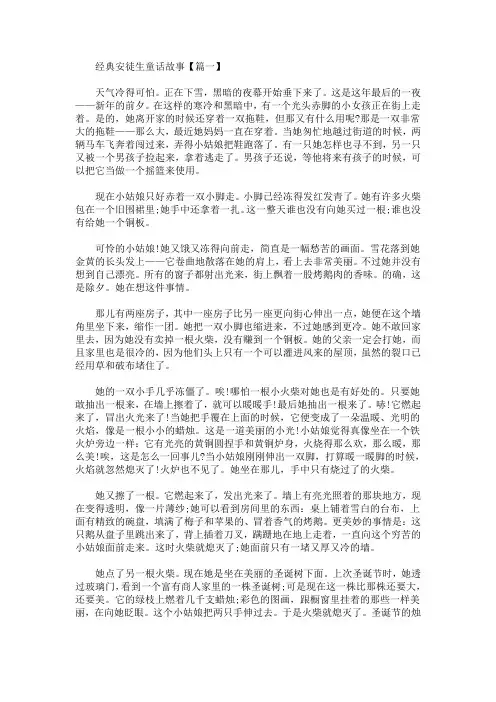
经典安徒生童话故事【篇一】天气冷得可怕。
正在下雪,黑暗的夜幕开始垂下来了。
这是这年最后的一夜——新年的前夕。
在这样的寒冷和黑暗中,有一个光头赤脚的小女孩正在街上走着。
是的,她离开家的时候还穿着一双拖鞋,但那又有什么用呢?那是一双非常大的拖鞋——那么大,最近她妈妈一直在穿着。
当她匆忙地越过街道的时候,两辆马车飞奔着闯过来,弄得小姑娘把鞋跑落了。
有一只她怎样也寻不到,另一只又被一个男孩子捡起来,拿着逃走了。
男孩子还说,等他将来有孩子的时候,可以把它当做一个摇篮来使用。
现在小姑娘只好赤着一双小脚走。
小脚已经冻得发红发青了。
她有许多火柴包在一个旧围裙里;她手中还拿着一扎。
这一整天谁也没有向她买过一根;谁也没有给她一个铜板。
可怜的小姑娘!她又饿又冻得向前走,简直是一幅愁苦的画面。
雪花落到她金黄的长头发上——它卷曲地散落在她的肩上,看上去非常美丽。
不过她并没有想到自己漂亮。
所有的窗子都射出光来,街上飘着一股烤鹅肉的香味。
的确,这是除夕。
她在想这件事情。
那儿有两座房子,其中一座房子比另一座更向街心伸出一点,她便在这个墙角里坐下来,缩作一团。
她把一双小脚也缩进来,不过她感到更冷。
她不敢回家里去,因为她没有卖掉一根火柴,没有赚到一个铜板。
她的父亲一定会打她,而且家里也是很冷的,因为他们头上只有一个可以灌进风来的屋顶,虽然的裂口已经用草和破布堵住了。
她的一双小手几乎冻僵了。
唉!哪怕一根小火柴对她也是有好处的。
只要她敢抽出一根来,在墙上擦着了,就可以暖暖手!最后她抽出一根来了。
哧!它燃起来了,冒出火光来了!当她把手覆在上面的时候,它便变成了一朵温暖、光明的火焰,像是一根小小的蜡烛。
这是一道美丽的小光!小姑娘觉得真像坐在一个铁火炉旁边一样:它有光亮的黄铜圆捏手和黄铜炉身,火烧得那么欢,那么暖,那么美!唉,这是怎么一回事儿?当小姑娘刚刚伸出一双脚,打算暖一暖脚的时候,火焰就忽然熄灭了!火炉也不见了。
她坐在那儿,手中只有烧过了的火柴。
安徒生童话故事(精选9篇)
安徒生童话故事(精选9篇)安徒生童话故事(精选9篇)故事:在现实认知观的基础上,对其描写成非常态性现象。
是文学体裁的一种,侧重于事件发展过程的描述。
下面跟着小编来看看吧!希望对你有所帮助。
下面跟着小编来看看安徒生童话故事(精选9篇)吧!希望对你有所帮助。
安徒生童话故事篇1红鞋红鞋真漂亮。
这是当地流传的一首歌词中的一句。
艾丽雅喜欢跳舞,她很早加入了马戏团,跟着一群人到处旅行。
那天休息了,她跟着婆婆到街上玩,她看到了红彤彤的红鞋,她很想买。
婆婆就去问红鞋多少钱?老板娘说:“那位女孩那么喜欢我就送你吧。
”婆婆听到后很不好意思收下了,婆婆得到了红鞋给艾丽雅穿。
艾丽雅不知道怎么的,就跳起来舞来。
艾丽雅跳得很棒,路人都施舍给她了,可是艾丽雅说:“没有卖艺,穿上红鞋后自动跳舞了!”到了三十分钟后,艾丽雅不想跳舞了,可是红鞋还在动啊,不知道怎么办?她想去找婆婆,婆婆已回到帐篷去了。
艾丽雅不知道怎么办?她跟着红鞋来到树林,看到了一位老巫婆,她求求老巫婆救救她。
老巫婆提出了两个选择,一个是把腿砍了才得救,第二个就是需要油和咒语。
艾丽雅舍不得两条腿,她选择了第二条,老巫婆说只要等两天,不方便就跳累两天,到了两天后,油泼到两只鞋上,老巫婆念起了咒语,红鞋停止了舞蹈。
艾雅丽脱下红鞋后,把红鞋丢进了大湖里,休息了两天后,艾丽雅回到了马戏团,不再跳舞了。
而那双鞋子,在某一天又穿到了另一个人的脚上。
安徒生童话故事篇2乡下有一幢古老的房子,里面住着一位年老的乡绅。
他有两个儿子。
这两个人是那么聪明,他们只须用一半聪明就够了,还剩下一半是多余的。
他们想去向国王的女儿求婚,而也敢于这样做,因为她宣布过,说她要找一个她认为最能表现自己的人做丈夫。
这两个人做了整整一星期的准备——这是他们所能花的最长的时间。
但是这也够了。
因为他们有许多学问,而这些学问都是有用的。
一位已经把整个拉丁文字典和这个城市出的三年的报纸,从头到尾和从尾到头,都背得烂熟。
儿童睡前故事 安徒生童话故事全集8篇

安徒生童话故事全集安徒生童话故事全集1在一株老树的裂缝里有好几只蜥蜴在活泼地跑着。
它们彼此都很了解,因为它们讲着同样的蜥蜴语。
“嗨,住在老妖精山上的那些家伙号叫得才厉害呢!”一只蜥蜴说,“他们的闹声把我弄得两整夜合不上眼睛。
这简直跟躺在床上害牙痛差不多,因为我横竖是睡不着的!”“那儿一定有什么事情!”另一只蜥蜴说。
“他们把那座山用四根红柱子支起来,一直支到鸡叫为止。
这座山算是痛痛快快地通了一次风;那些女妖还学会了像跺脚这类的新舞步呢。
那儿一定有什么事情!”“对,我刚才还跟我认识的一位蚯蚓谈起过这件事,”第二只蜥蜴说。
“这位蚯蚓是直接从山里来的——他昼夜都在那山里翻土。
他听到了许多事情。
可怜的东西,他的眼睛看不见东西,可是他却知道怎样摸路和听别人谈话。
妖山上的人正在等待一些客人到来——一些有名望的客人。
不过这些客人究竟是谁,蚯蚓可不愿意说出来——也许他真的不知道。
所有的鬼火都得到了通知,要举行一个他们所谓的火炬游行。
他们已经把金银器皿——这些东西他们山里有的是——擦得焕然一新,并且在月光下摆出来啦!”“那些客人可能是谁呢?”所有的蜥蜴一齐问。
“那儿在发生什么事情呢!听呀,多么闹!多么吵!”正在这时候,妖山开了。
一位老妖小姐①急急忙忙地走出来。
她的衣服穿得倒蛮整齐,可就是没有背。
她是老妖王的管家娘娘,也是他的一个远房亲戚。
她的额角上戴着一颗心形的琥珀。
她的一双腿动得真够快:得!得!嗨,她才会走呢!她一口气走到住在沼泽地上的夜乌鸦那儿去。
①原文是Elverpige,据丹麦的传说,老妖小姐像一个假面具,前面很好看,后面则是空的。
“请你到妖山上去,今晚就去,”她说。
“不过先请你帮帮忙,把这些请帖送出去好吗?您自己既然无家可管,你总得做点事情呀!我们今天有几个非常了不起的客人——很重要的魔法师。
老国王也希望借这个机会排场一下!”“究竟要请一些什么客人呢?”夜乌鸦问。
“嗳,谁都可以来参加这个盛大的跳舞会,甚至人都可以来——只要他们能在睡梦中讲话,或者能懂一点我们所做的事情。
安徒生《拇指姑娘》童话故事(精选18篇)
安徒生《拇指姑娘》童话故事(精选18篇)安徒生《拇指姑娘》童话故事(精选18篇)在平平淡淡的日常中,大家总少不了接触一些耳熟能详的故事吧,下面是小编整理的安徒生《拇指姑娘》童话故事,希望能够帮助到大家。
安徒生《拇指姑娘》童话故事篇1从前有一个妇人,她很想要一个小巧又可爱的孩子。
她便去请教女巫,女巫说非常容易,便给她一粒麦粒,让她种在花盆里。
当这朵花绽开时,拇指姑娘便出生了。
她生活得非常幸福,可是有一天,一只丑陋的癞蛤蟆把她抱走了,让她当小癞蛤蟆的妻子。
水里的鱼儿很同情小小的拇指姑娘,便把荷叶的一根茎咬断。
拇指姑娘顺着荷叶飘到了外国。
被金龟子抛弃在了一片森林。
清晨,以露珠为饮料,以花蜜为食物,生活还算过得去。
夏天和秋天过去了,但又寒冷又漫长的冬天来临了,拇指姑娘来到了田鼠家生活。
过了几天,田鼠说:“我们这儿最富有的先生——鼹鼠就要来了,如果你和他结婚,就有享不尽的荣华富贵。
第二天,鼹鼠穿着黑天鹅的绒毛大衣来了,因为他是一个瞎子,看不清拇指姑娘的容貌,田鼠便请拇指姑娘唱了一首歌曲,鼹鼠很快就爱上了她。
不过,鼹鼠并没有表现出来,因为他很谨慎。
过了几天,鼹鼠正式提婚了。
秋天来到了,鼹鼠让拇指姑娘缝嫁衣。
其实,拇指姑娘并不喜欢鼹鼠,因为他喜欢阳光和鲜花,而且对他们有反感。
拇指姑娘曾经在地道救过一只燕子,现在,燕子要飞去另外一个国家,他便问拇指姑娘:“你愿意和我一起到另外一个国家去吗?” 拇指姑娘爽快地答应了。
燕子背着拇指姑娘飞呀飞呀,飞到了那个国度,把拇指姑娘放到了一朵最美丽的花上,那里有位英俊的王子在等她,他就是所有花朵的王,于是,他们就结婚了,拇指姑娘便成了这儿的公主。
安徒生《拇指姑娘》童话故事篇2据说从前有位妇人,她非常想拥有一个自己的孩子,哪怕是丁点儿大的,但是她一直没有身孕。
于是她就去询问一位著名的巫婆。
她对巫婆说:“我非常想要个小小的孩子,您能告诉我怎样才能得到一个吗?”“嗨!这个很简单啊!”巫婆说。
经典安徒生童话故事(通用6篇)
经典安徒生童话故事经典安徒生童话故事(通用6篇)童话故事是指儿童文学的一种体裁,童话中丰富的想象和夸张可以活跃你的思维;那生动的形象、美妙的故事可以帮你认识社会、理解人生,引导你做一个通达事理、明辨是非的人。
下面是小编帮大家整理的经典安徒生童话故事,供大家参考借鉴,希望可以帮助到有需要的朋友。
经典安徒生童话故事篇1Yes, in a thousand years people will fly on the wings of steam through the air, over the ocean! The young inhabitants of America will become visitors of old Europe. They will come over to see the monuments and the great cities, which will then be in ruins, just as we in our time make pilgrimages to the tottering splendors of Southern Asia. In a thousand years they will come!The Thames, the Danube, and the Rhine still roll their course, Mont Blanc stands firm with its snow-capped summit, and the Northern Lights gleam over the land of the North; but generation after generation has become dust, whole rows of the mighty of the moment are forgotten, like those who already slumber under the hill on which the rich trader, whose ground it is, has built a bench, on which he can sit and look out across his waving corn fields.“To Europe!” cry the young sons of America; “to the land of our ancestors, the glorious land of monuments and fancy—to Europe!”The ship of the air comes. It is crowded with passengers, for the transit is quicker than by sea. The electro-magnetic wire under the ocean has already telegraphed the number of the aerial caravan. Europe is in sight. It is the coast of Ireland thatthey see, but the passengers are still asleep; they will not be called till they are exactly over England. There they will first step on European shore, in the land of Shakespeare, as the educated call it; in the land of politics, the land of machines, as it is called by others.Here they stay a whole day. That is all the time the busy race can devote to the whole of England and Scotland. Then the journey is continued through the tunnel under the English Channel, to France, the land of Charlemagne and Napoleon. Moliere is named, the learned men talk of the classic school of remote antiquity. There is rejoicing and shouting for the names of heroes, poets, and men of science, whom our time does not know, but who will be born after our time in Paris, the centre of Europe, and elsewhere.The air steamboat flies over the country whence Columbus went forth, where Cortez was born, and where Calderon sang dramas in sounding verse. Beautiful black-eyed women live still in the blooming valleys, and the oldest songs speak of the Cid and the Alhambra.Then through the air, over the sea, to Italy, where once lay old, everlasting Rome. It has vanished! The Campagna lies desert.A single ruined wall is shown as the remains of St. Peter’s, but there is a doubt if this ruin be genuine.Next to Greece, to sleep a night in the grand hotel at the top of Mount Olympus, to say that they have been there; and the journey is continued to the Bosphorus, to rest there a few hours, and see the place where Byzantium lay; and where the legend tells that the harem stood in the time of the Turks, poor fishermen are now spreading their nets.Over the remains of mighty cities on the broad Danube, citieswhich we in our time know not, the travellers pass; but here and there, on the rich sites of those that time shall bring forth, the caravan sometimes descends, and departs thence again.Down below lies Germany, that was once covered with a close net of railway and canals, the region where Luther spoke, where Goethe sang, and Mozart once held the sceptre of harmony. Great names shine there, in science and in art, names that are unknown to us. One day devoted to seeing Germany, and one for the North, the country of Oersted and Linnaeus, and for Norway, the land of the old heroes and the young Normans. Iceland is visited on the journey home. The geysers burn no more, Hecla is an extinct volcano, but the rocky island is still fixed in the midst of the foaming sea, a continual monument of legend and poetry.“There is really a great deal to be seen in Europe,” says the young American, “and we have seen it in a week, according to the directions o f the great traveller” (and here he mentions the name of one of his contemporaries) “in his celebrated work, ‘How to See All Europe in a Week.’”经典安徒生童话故事篇2The country around the town of Kjge is very bare. The town itself lies by the seashore, which is always beautiful, although it might be more beautiful than it is, because all around are flat fields, and a forest a long way off. But one always finds something beautiful in the spot that is one's own home, something for which one longs, even when one is in the most wonderful spot in the world.And we must admit that the outer edge of Kjge, where small, humble gardens line the little stream that flows into the sea, could be very pretty in the summertime. This was the opinion ofthe two small children, Knud and Johanne, who were playing there, crawling under the gooseberry bushes to reach each other.In one of the gardens there stood an elder tree, in the other an old willow, and under the latter the children were especially fond of playing. Although the tree stood close beside the stream and they might easily have fallen into the water, they were allowed to play there, for the eye of God watches over little ones. Otherwise they would be very badly off indeed. Besides, these two were careful about the water; in fact, the boy was so afraid of it that in the summer he could not be lured into the sea, where the other children were fond of splashing about. As a result, he had to bear the teasing of the others as best he could.But once Johanne, the little girl, dreamed she was out in a boat, and Knud waded out to join her, with the water rising until it closed over his head. And from the moment little Knud heard of this dream he could no longer bear to be called a coward. He might really go into the water now, he said, since Johanne had dreamed it. He never carried that idea into practice, but for all that the dream remained his great pride.Their poor parents often came together, while Knud and Johanne played in the gardens or on the highroad, where a long row of willows had been planted along the ditch. These trees with their polled tops certainly did not look very beautiful, but they were there for use rather than for ornament. The old willow tree in the garden was much lovelier, which was why the children took most delight in sitting under it.In Kjge itself was a great market place, and at fair time this plaza was gay with whole streets of tents, filled with silk ribbons, boots, and everything a person might desire. There were great crowds then, and generally the weather was rainy. One couldeasily smell the odor of peasants' clothes, but this could not destroy the fragrance that streamed from a booth full of honey cakes. And best of all, the man who kept this particular booth came every year during fair time to lodge in the house of little Knud's parents. Consequently, every now and then there was a present of a bit of honey cake, and of course Johanne always received her share.But the best thing of all was that this gingerbread dealer knew all sorts of charming stories and could even tell tales about his own gingerbread cakes. One evening he told a story about them which made such a deep impression on the two children that they never forgot it. For that reason perhaps we should hear it, too, especially since it is not very long."On the shop counter," he said, "there once lay two gingerbread cakes. One was in the shape of a man with a hat on, the other of a maiden with no bonnet but with a blot of yellow on top of her head. Both their faces were on the upper side, for that was the side that was supposed to be looked at, and not the other. Indeed, most people have one side from which they should be viewed. On his left side the man wore a bitter almond for a heart; but the maiden, on the other hand, was honey cake all through. They were placed on the counter as samples, so they remained there for a long time, until at last they fell in love with each other. But neither told the other, which they should have done if they had expected anything to come of it." 'He is a man, so he must speak first,' thought the maiden. But she was quite contented, for she knew in her heart that her love was returned. His thoughts were far more extravagant, which is just like a man. He dreamed that he was a street urchin, and that he had four pennies all his own, and that he bought themaiden and ate her up."So they lay on the counter for days and weeks, and grew dry, but the thoughts of the maiden remained still gentle and womanly." 'It's enough for me that I have lived on the same table with him, ' thought the maiden, and then she broke in two." 'If only she had known of my love she would have held together a little longer,' thought he."So that's the story, and here they are, both of them," said the baker. "They're remarkable for their strange history and for their silent love, which never came to anything. And now they're both for you!" With that he gave Johanne the man, who was still in one piece, and Knud got the broken maiden; but the children had been so touched by the story that they couldn't be so bold as to eat up the lovers.Next day they took them out to the Kjge churchyard, where, winter and summer, lovely ivy covers the church wall like a rich carpet. They stood the two cake figures up among the green leaves in the bright sunshine and told a group of other children the story of the silent love that was useless; that is to say, the love was, for the story was charming, they all found.But when they looked again at the gingerbread couple they found that a mischievous big boy had eaten up the broken maiden. The children cried about that and later - probably so that the poor lover might not be left alone in the world - they ate him up, too. But they never forgot the story. The two children were always together by the elder tree or under the willow, and little Johanne sang the most beautiful songs in a voice as clear as a silver bell. Knud had not a note of music in him, but at least he knew the words of the songs, and that was something. But thepeople of Kjge, even the wife of the hardware merchant, stopped and listened when Johanne sang. "She has a very sweet voice, that little girl," she said.Those were glorious days; but glorious days do not last forever, and finally the neighbors separated. Johanne's mother died, and her father planned to marry again in Copenhagen, where he had been promised a position as messenger, a job supposed to be very profitable. While the neighbors parted with regrets, the children wept bitterly, but the parents promised to write to each other at least once a year.And Knud was made apprentice to a shoemaker, for such a big boy was too old to run around wild any longer; and, furthermore, he was confirmed.Oh, how he would have liked to see little Johanne in Copenhagen on that day of celebration! But he didn't go; and he had never been there, although Kjge is only five Danish miles away. On a clear day Knud could see the distant towers of the city across the bay, and on the day of his confirmation he could even see the golden cross on the tower of the Church of Our Lady glitter in the sun.Ah, how often his thoughts turned toward Johanne! And did she remember him? Yes! At Christmastime a letter came from her father to Knud's parents, saying that they were doing very well in Copenhagen, and Johanne could look forward to a brilliant career on the strength of her lovely voice. She already had a position in the opera house and was already earning a little money, out of which she sent her dear neighbors of Kjge a dollar for a merry Christmas Eve. Johanne herself added a postscript, asking them to drink to her health, and in the same postscript was also written, "Friendly greetings to Knud!"They all wept; but this was all very pleasant, for they were tears of joy that they shed. Knud's thoughts had been with Johanne every day, and now he knew that she also thought of him. The nearer came the end of his apprenticeship, the more clearly did he realize that he was in love with Johanne and that she must be his little wife.When he thought of this a smile brightened his face, and he drew the thread faster than before and pressed his foot against the knee strap. He didn't even pay any attention when he ran the awl deep into one of his fingers. He was determined that he would not play the silent lover, like the two gingerbread cakes. The story had taught him a lesson.Now he was a journeyman, and his knapsack was packed ready for his trip. At last, for the first time in his life, he was to go to Copenhagen, where a master was already expecting him. How surprised and happy Johanne would be to see him! She was just seventeen now, and he nineteen.He wanted to buy a gold ring for her before he left Kjge, but then decided he could get a much nicer one in Copenhagen. And so he took leave of his parents, and on a rainy, windy day in autumn set forth on foot from the town of his birth. The damp leaves were dropping from the trees, and he was wet to the skin when he arrived at his new master's home in the big city of Copenhagen. The following Sunday he would pay a visit to Johanne's father!So, on Sunday he put on the new journeyman's clothes, and the new hat from Kjge that became him very well, for till then he had only worn a cap. He easily found the house he was seeking, and mounted flight after flight of stairs until he became almost dizzy. It seemed terrible to him for people to live piled up on topof each other in this intricate city.Everything in the parlor looked prosperous, and Johanne's father received him in kindly friendship. Knud was a stranger to the new wife, but she too shook hands with him and gave him a cup of coffee."Johanne will be glad to see you," said the father. "You've grown into a nice-looking young man. Yes, wait till you see her. There is a girl who rejoices my heart, and please God she will rejoice it still more. She has her own room now and pays us rent regularly for it!"Then he knocked quite politely at his daughter's door, as if he were a stranger, and they went in.Oh, how pretty it was! he was certain there wasn't such a lovely room in all Kjge; the Queen herself could not be more charmingly lodged. There were carpets, and window curtains that hung quite to the floor, and flowers and pictures, and a velvet chair, and even a mirror as large as a door and so clear there was a danger of walking into it.A glance showed all this to Knud, and yet he could look at nothing but Johanne. She was a full-grown maiden now, quite different from Knud's memories of her, and much more beautiful. There wasn't a girl in Kjge like her. How graceful she was, and with what a strange, unsure gaze she looked at Knud! But that was only for a moment, and then she rushed toward him as if it kiss him. she did not actually do so, but she very nearly did.Yes, she was really happy to see her childhood friend again! There were tears in Johanne's eyes; she had so much to say, and so many questions to ask about everything, from Knud's parents to the elder tree and the willow, which she called Elder Mother and Willow Father just as if they had been human beings; andindeed they might be called so, just as much as the gingerbread cakes. She spoke of them too, and their silent love, and how they had lain on the shop counter and broken in two - and at this she laughed heartily, while the blood rushed to Knud's cheeks and his heart beat faster and faster. No, she had not grown haughty at all.And Knud noticed quite well that it was because of her that her parents invited him to spend the evening. With her won hands she poured out the tea and gave him a cup; and afterward she read aloud to them from a book, and it seemed to Knud that what she read was all about himself and his love, for it matched with his thoughts. Then she sang a simple little song, but her singing made it a real story that seemed to be the outpouring of her very heart.Yes, Knud knew she cared for him. He could not keep tears of joy from rolling down his cheeks, nor could he speak a single word - he seemed struck dumb. But she pressed his hand and murmured, "You have a good heart, Knud. Stay always the way you are now!"That was a magnificent evening; it was impossible to sleep afterward, and accordingly Knud did not sleep.When he had left, Johanne's father had said, "Now, don't forget us altogether. Don't let the whole winter go by before you come to us again!" Knud felt that gave him permission to repeat the call the following Sunday, and determined to do so.But every evening after work - and the working hours lasted until candlelight there - Knud went out into the town. He returned to the street in which Johanne lived, and looked up at her window. It was almost always lighted, and one evening he could even see the shadow of her face quite plainly on the curtain.That was an evening he would never forget. His master's wife did not like his "gallivanting abroad every evening," as she put it, and shook her head ruefully over him; but the master only smiled."He's just a young fellow," he said."On Sunday we shall see each other," Knud thought, "and I shall tell her how she is always in my thoughts and that she must be my little wife. I know I'm only a poor journeyman shoemaker, but I can become a master, and I'll work and save - yes, I'll tell her that! No good comes from a silent love; I've learned that much from the gingerbread!"Sunday came at last, and Knud set out, but to his great disappointment they had to tell him they were all invited out that evening. But as he left Johanne pressed his hand and said, "Have you ever been to the theater? You must go there sometime. I shall be singing on Wednesday, and if you have time that evening I'll send you a ticket. My father knows where you are living."How kind it was of her! And at noon on Wednesday he received a sealed envelope. There were no words inside, but the ticket was there, and that evening Knud went to the theater for the first time in his life. And what did he see? He saw Johanne, looking more charming and beautiful than he ever could have believed possible! To be sure, she was married to a stranger, but that was just in the play; it was only make-believe, as Knud understood very well. If it had been true, he thought, she would never have had the heart to send him a ticket so that he could go and see it. And everybody shouted and applauded, and Knud cried out, "Hurrah!"Even the King was there, smiling at Johanne, and he seemed to delight in her loveliness. How small Knud felt then! Still he loved her dearly, and felt that she loved him, too; but he knew itwas up to the man to speak the first word, as the gingerbread maiden in the story had taught him. Indeed, there was a great deal of truth in that story.So, as soon as Sunday came, he went to see her again, feeling as solemn as if he were going into a church. Johanne was at home alone; it could not have happened more fortunately."I'm glad you came," she said. "I almost sent Father after you, but I felt in my heart that you would be here this evening. I have to tell you that I am leaving for France on Friday; I must study there if I am to become a great artiste!"At those words it seemed to Knud as if the whole room were whirling round and round with him. He felt as if his heart would break; there were no tears in his eyes, but Johanne could not fail to see how stricken he was ."You honest, faithful soul!" she said.And her tenderness loosened his tongue. He told her how much he loved her and begged her to become his little wife. Then he saw Johanne turn pale as she dropped his hand and said seriously and sadly, "Dear Knud, don't make us both unhappy. I shall always be a loving sister to you, one in whom you may trust, but I shall never be anything more."Gently she placed her soft hand on his hot forehead. "God gives us the strength for much," she said, "if only we try to do our best." At that moment her stepmother entered the room, and Johanne said, "Knud is quite heartbroken because I'm going away! Come, be a man," and she laid her hand on his shoulder; it seemed as if they had been talking only of her journey. "You're a child," she laughed, "but now you must be good and reasonable, as you used to be under the willow tree when we were both children!"Knud felt as if the whole world were out of joint, and his thoughts were like a loose thread fluttering in the wind. He remained for tea, though he hardly knew if they had asked him to; and they were kind and gentle, and Johanne poured out his tea and sang to him. Her voice did not have its old tone, but still it was wonderfully beautiful and nearly broke his heart. And then they parted. Knud could not bear to offer his hand, but she took it and said, "Surely you'll shake hands with your sister at parting, old playmate!"She smiled through the tears that were in her own eyes, and repeated the word "brother". Yes, that was supposed to be a great consolation! Such was their parting.She sailed for France, and Knud wandered about the muddy streets of Copenhagen. His comrades in the workshop asked why he was so gloomy and urged him to join them and amuse himself, for he was still a young fellow.So they took him to a dance hall. He saw many pretty girls there, but there was not one to compare with Johanne; here, where he had hoped to forget her, she was more vivid than ever before the eyes of his soul. "God gives us the strength for much," she had said, "if only we try to do our best." Then a devotion came to his mind, and he folded his hands quietly. The violins played, and the girls danced gaily, and suddenly it seemed to him that he should never have brought Johanne into a place like this - for she was there with him, in his heart.Knud ran out and wandered aimlessly through the streets. He passed by the house where she had lived; it was dark there - everywhere were darkness and emptiness and loneliness. The world went in its way, and Knud went his.Winter set in, and the waters froze over; it was as ifeverything were preparing itself for burial. But when spring returned, and the first steamer was to start, an intense longing seized him to go away, far into the world, anywhere - but not too close to France. So he packed his knapsack and wandered deep into Germany, from town to town, finding rest and peace nowhere. It was not until he came to the glorious old city of Nuremberg that he could quiet his restless spirit, and there he decided to stay.Nuremberg is a strange old city, looking as if it had been cut out of an old-fashioned picture book. The streets seem to wander along just as they please. The houses did not like to stand in regular rows. Gables with little towers, arabesques, and pillars lean out over the walks, and from the queer peaked roofs water-spouts, shaped like dragons or long, slim dogs, push out far over the streets.There in the Nuremberg market place stood Knud, his knapsack, on his back. He was beside one of the old fountains, where splendid bronze figures, scriptural and historical, rose up between the gushing jets of water. A pretty little servant girl was just filling her pails, and she gave Knud a refreshing drink; and as her hand was full of roses she gave him one of them, too, and he accepted that as a good sign.From the church near by came the strains of an organ; they rang as familiar to him as the tones of the organ at home in Kjge church, and he entered the great cathedral. The sunlight streamed in through the high stained-glass windows and down between the lofty, slender pillars. His spirit found rest.And Knud found a good master in Nuremberg, and he lived in his house, and there learned to speak German.The old moat around the town of Nuremberg has beenconverted into little kitchen gardens, but the high walls with their heavy towers are standing yet. The ropemaker twists his cords on a wooden gallery along the inside of the town wall, where elderbushes grow out of the cracks and clefts, spreading their green branches over the small, lowly houses below. In one of these houses Knud lived with his master; and over the little garret window where he slept the elder tree waved its branches.Here he lived for a summer and winter. But when spring returned he could bear it no longer, for the elder was blooming and the fragrance of its blossoms carried him back to home and the garden at Kjge. So Knud left that master and found another farther in town, over whose house no elderbush blossomed.His new workshop was close to one of the old stone bridges, by an ever-foaming, low water mill. The stream roared past it, hemmed in by the houses, whose decayed old balconies looked about to topple into the water. No elder grew here - there was not even a little green plant in a flowerpot - but just opposite stood a grand old willow tree that seemed to cling fast to the house, as if it feared being carried away by the stream. It stretched its branches out over the river, just as the willow at Kjge spread its arms across the stream by the gardens of home.Yes, Knud had gone from the Elder Mother to the Willow Father. This tree had something, especially on moonlit evenings, that went straight to his heart, and that something was not of the moonlight but of the old willow tree itself.He could not remain there. Why not? Ask the willow tree; ask the blossoming elder! And so he bade farewell to his kind master and to Nuremberg and traveled on further.To no one did he speak of Johanne, but hid his sorrow in his innermost heart; and he thought of the deep meaning of the oldstory of the gingerbread. Now he understood why the man had a bitter almond for a heart - he himself had felt the bitterness of it. And Johanne, who was always so gentle and smiling, she was only like the honey cake.The strap of Knud's knapsack seemed so tight across his chest that he could scarcely breathe, but even when he loosened it he was not relieved. He saw only half the world around him; the other half he carried within him. That's how it was!Not until he was in sight of the high mountains did the world appear freer to him; now his thoughts were turned outward again, and the tears came into his eyes.The Alps seemed to him like the folded wings of the earth; what if they were to unfold themselves and display their varied pictures of black woods, foaming waters, clouds, and great masses of snow! On the last day, he thought, the world will lift up its mighty wings and mount upward to God, to burst like a soap bubble before the glance of the Highest."Ah," he sighed, "that that last day were here now!"Silently he wandered through a country that seemed to him like an orchard covered with soft turf. From the wooden balconies of the houses girls, busy with their lacemaking, nodded down at him. The summits of the mountains glowed in the red evening sun; and when he saw the blue lakes gleaming through the dark trees, he thought of the seacoast near Kjge, and there was a sadness in his heart - but it was pain no longer.There where the Rhine rolls onward like a great wave, and then bursts into snow-white, gleaming, cloudlike masses, as if clouds were being created there, with the rainbow fluttering like a loose band above them - it was there that he thought of the mill at Kjge, with its rushing, foaming stream.。
安徒生童话故事全集精选5篇

安徒生童话故事全集精选5篇安徒生是丹麦19世纪著名童话作家,世界文学童话创始人。
下面小编给大家介绍关于安徒生童话故事全,方便大家学习。
安徒生童话故事全集1安徒生(HansChristianAndersen1805-1875)丹麦作家。
1805年4月2日生于丹麦菲英岛欧登塞的贫民区。
父亲是个穷鞋匠,曾志愿服役,抗击拿破仑的侵略,退伍后于1816年病故。
当洗衣工的母亲不久即改嫁。
安徒生从小就为贫困所折磨,先后在几家店铺里做学徒,没有受过正规教育。
少年时代即对舞台发生兴趣,幻想当一名歌唱家、演员或剧作家。
1819年在哥本哈根皇家剧院当了一名小配角。
后因嗓子失润被解雇。
从此开始学习写作,但写的剧本完全不适宜于演出,没有为剧院所采用。
1822年得到剧院导演约纳斯·科林的资助,就读于斯莱厄尔瑟的一所文法学校。
这一年他写了《青年的尝试》一书,以威廉·克里斯蒂安·瓦尔特的笔名发表。
这个笔名包括了莎士比亚、安徒生自己和司各特的名字。
1827年发表第一首诗《垂死的小孩》,1829年,他进入哥本哈根大学学习。
他的第一部重要作品《1828和1829年从霍尔门运河至阿迈厄岛东角步行记》于1829年问世。
这是一部富于幽默感的游记,颇有德国作家霍夫曼的文风。
这部游记的出版使安徒生得到了社会的初步承认。
此后他继续从事戏剧创作。
1831年他去德国旅行,归途中写了旅游札记。
1833年去意大利,创作了一部诗剧《埃格内特和美人鱼》和一部以意大利为背景的长篇小说《即兴诗人》(1835)。
小说出版后不久,就被翻译成德文和英文,标志着作者开始享有国际声誉。
他的第一部《讲给孩子们听的故事集》包括《打火匣》、《小克劳斯和大克劳斯》、《豌豆上的公主》和《小意达的花儿》,于1835年春出版。
1837年,在这个集子的基础上增加了两个故事,编成童话集第1卷。
第2卷于1842年完成。
1847年又写了一部《没有画的画册》。
1840至1857年,安徒生访问了挪威、瑞典、德国、法国、意大利、西班牙、葡萄牙、希腊、小亚细亚和非洲,在旅途中写了不少游记,如:《一个诗人的市场》(1842)、《瑞典风光》(1851)、《西班牙纪行》(1863)、《访问葡萄牙》(1866)等。
2023年安徒生童话故事全集
2023年安徒生童话故事全集2023年安徒生童话故事全集:《卖火柴的小女孩》内容简介:它讲述的是一个在圣诞夜卖火柴的小女孩的悲惨命运。
因为没有卖掉一根火柴,小女孩一天没有吃东西。
她又冷又饿,她擦亮了第一根火柴,看见了喷香的烤鹅;她擦亮第二根火柴,看见了美丽的圣诞树;她擦亮了第三根火柴,看见了久违的外婆,她想让外婆留在自己身边,擦亮了一整把火柴。
然而当火柴熄灭的时候,这所有的一切都不见了,小女孩就是这样在圣诞之夜悲惨地死去,没有人知道她在生前最后一刻看到的美好情景。
《海的女儿》内容简介:美人鱼为了能和自己所爱的陆地上的王子在一起,用自己美妙的嗓音和生命的三百年换来了巫婆的药酒,于是,她有了一双美丽的脚,每走一步就像走在碎玻璃上一样疼痛。
可是只要王子对她微笑,她就忘记了脚上的疼痛,眼看着王子和别人结婚,她宁可牺牲自己的生命,也要为王子祝福。
小人鱼的行为让我们见证了什么才是真正的爱情、什么是纯洁的爱情、什么是美丽的爱情。
是愿为爱情献出生命的典范。
《丑小鸭》内容简介:丑小鸭历经千辛万苦、重重磨难之后变成了白天鹅,那是因为它心中有着梦想。
命运其实没有轨迹,关键在于对美好境界、美好理想的追求。
人生中的挫折和痛苦是不可避免的,要学会把它们踩在脚下,每个孩子都会有一份属于自己的梦想,只要他们学会树立生活目标,在自信、自强、自立中成长,通过拼搏他们会真正的认识到自己原来也可以变成“白天鹅”,也可以像丑小鸭一样实现心中的梦想。
内容简介:一只皇宫马厩的屎壳郎竟然要求和皇帝的战马一样的待遇:钉上金掌。
为此,他不惜游历一番,证明自己和那匹马一样,是个不可小看的人物。
在他最为得意,认为梦想成真的那刻,却被皇帝压在马鞍底下。
是啊,大人物的上面还有更大的人物。
不能骄傲自大,目空一切。
《野天鹅》内容简介:这是一场善与恶的斗争,艾丽莎是个柔弱的女子,但她却战胜了比她强大得多、有权有势的王后和主教,救出了被王后的魔法变成天鹅的11位哥哥。
安徒生童话故事全集(5篇)
【导语】幻想是童话的基本特征,也是童话反映⽣活的特殊艺术⼿段,安徒⽣童话故事既有幻想的特征,也有反映⽣活的艺术形式。
下⾯是整理分享的安徒⽣童话故事全集,欢迎阅读与借鉴,希望对你们有帮助!1.安徒⽣童话故事全集:衬衫领⼦ 从前有⼀位漂亮的绅⼠;他所有的动产只是⼀个脱靴器和⼀把梳⼦。
但他有⼀个世界上的衬衫领⼦。
我们现在所要听到的就是关于这个领⼦的故事。
衬衫领⼦的年纪已经很⼤,⾜够考虑结婚的问题。
事⼜凑巧,他和袜带在⼀块⼉混在⽔⾥洗。
“我的天!”衬衫领⼦说,“我从来没有看到过这么苗条和细⼀嫩、这么迷⼈和温柔的⼈⼉。
请问你尊姓⼤名?” “这个我可不能告诉你!”袜带说。
“你府上在什么地⽅?”衬衫领⼦问。
不过袜带是⾮常害羞的。
要回答这样⼀个问题,她觉得⾮常困难。
“我想你是⼀根腰带吧?”衬衫领⼦说,“⼀种内⼀⾐的腰带!亲爱的⼩⼀姐,我可以看出,你既有⽤,⼜可以做装饰品!” “你不应该跟我讲话!”袜带说。
“我想,我没有给你任何理由这样做!” “咳,⼀个长得像你这样美丽的⼈⼉,”衬衫领⼦说,“就是⾜够的理由了。
” “请不要⾛得离我太近!”袜带说,“你很像⼀个男⼈!” “我还是⼀个漂亮的绅⼠呢!”衬衫领⼦说。
“我有⼀个脱靴器和⼀把梳⼦!” 这完全不是真话,因为这两件东西是属于他的主⼈的。
他不过是在吹⽜罢了。
“请不要⾛得离我太近!”袜带说,“我不习惯于这种⾏为。
” “这简直是在装腔作势!”衬衫领⼦说。
这时他们就从⽔⾥被取出来,上了浆,挂在⼀张椅⼦上晒,最后就被拿到⼀个熨⽃板上。
现在⼀个滚⼀热的熨⽃来了。
“太太!”衬衫领⼦说,“亲爱的寡⼀妇太太,我现在颇感到有些热了。
我现在变成了另外⼀个⼈;我的皱纹全没有了。
你烫穿了我的⾝体,噢,我要向你求婚!” “你这个⽼破烂!”熨⽃说。
同时很骄傲地在衬衫领⼦上⾛过去,因为她想象⾃⼰是⼀架⽕车头,拖着⼀长串列车,在铁轨上驰过去——“你这个⽼破烂!” 衬衫领⼦的边缘上有些破损。
安徒生童话故事大全(5篇)(精选)
1.安徒生童话故事:顽皮的孩子从前有一位老诗人——一位非常和善的老诗人。
有一天晚上,他坐在家里,外面起了一阵可怕的风暴。
雨在倾盆地下着;不过这位老诗人坐在炉旁,又温暖,又舒适。
火在熊熊地燎着,苹果烤得咝咝地发响。
“这样的天气,外面的穷苦人身上恐怕没有一根纱是干的了。
”他说,因为他是一位心肠非常好的老诗人。
“啊,请开门!我非常冷,衣服也全湿一透了。
”外面有一个小孩子在叫。
他哭起来,敲着门。
这时雨正在倾盆地下着,风把所有的窗扉吹得呼一呼地响。
“你这个可怜的小家伙!”老诗人说;他走过去把门开了。
门口站着一个小小的孩子。
他全身没有穿衣服,雨水从他长长的金发上滚下来。
他冻得发一抖;如果他没有走进来的话,一定会在这样的暴风雨中冻死的。
“你这个可怜的小家伙!”老诗人说,同时拉着他的手。
“到我这儿来吧,我可以使你温暖起来。
我可以给你喝一点酒,吃一个苹果,因为你是一个美丽的孩子。
”他的确是很美丽的。
他的眼睛亮得像两颗明亮的星星,他的金发虽然有水滴下来,可是卷卷曲曲的,非常好看。
他像一个小小的天使,不过他冻得惨白,全身发一抖。
他手里拿着一把漂亮的弓,但是雨水已经把它弄坏了。
涂在那些美丽箭上的色*彩全都被雨淋得模糊不清了。
老诗人坐在炉边,把这小孩子抱到膝上,把雨水从他的卷发里挤出来,把他的手放到自己的手里暖着,同时为他热了一些甜酒。
这孩子马上就恢复过来了。
他的双颊也变得红一润起来了。
他跳到地上来,围着这位老诗人跳舞。
“你是一个快乐的孩子!”老诗人说。
“你叫什么名字?”“我叫阿穆尔①,”他回答说;“你不认识我吗?我的弓就在这儿。
你知道,我就是用这把弓射箭哪!看啊,外面天晴了,月亮也出来了。
”①阿穆尔(Amor)即希腊神话中的丘比特,是罗马神话中爱情之神。
他是一个顽皮和快乐的孩子,经常带着弓和箭。
当他的箭射一到一个人的心里去的时候,这支箭就燃起爱情的火焰。
“不过你的弓已经坏了。
”老诗人说。
“这倒是很可惜的,”小孩子回答说,同时把弓拿起来,看了一看。
安徒生童话故事全集(精选5篇)(最新)
【#童话故事# 导语】童话故事中有生动的情节、丰富的情感,同时也蕴含着一定的语言知识。
童话故事不仅能吸引学生进入学习情境,也符合学生以形象思维为主的心理特点和学生学习语言的认知特点。
孩子的世界纯白无暇,他们对未来世界充满憧憬和幻想,喜欢小故事,也爱经典童话故事阅读。
下面是?无忧考网整理分享的安徒生童话故事,欢迎阅读与借鉴,如果你觉得不错的话可以分享给更多小伙伴哦!1.安徒生童话故事:穷女人和她的小金丝鸟她是一个穷得出奇的女人,老是垂头丧气。
她的丈夫死了,当然得埋掉,但她是那么穷困,连买一口棺材的钱都没有。
谁也不帮助她,连一个影儿也没有。
她只有哭,祈求上帝帮助她——因为上帝对我们所有的人总是仁慈的。
窗子是开着,一只小鸟飞进屋里来了。
这是一只从笼子里逃出来的金丝鸟。
它在一些屋顶上飞了一阵子,现在它钻进这个穷女人的窗子里来了。
它栖在死人的头上,唱起美丽的歌来。
它似乎想对女人说:“你不要这样悲哀,瞧,我多快乐!”穷女人在手掌上放了一撮面包屑,叫它飞过来。
它向她跳过来。
把面包屑啄着吃了。
这景象真逗人。
可是,门上响起了敲门声。
一个妇女走进来了。
当她看见了从窗子钻进来的这只小金丝鸟时,她说:“它一定是今天报纸上谈到的那只小鸟。
它是从街道上的一户人家飞出来的。
”这样,这个穷女人就拿着这只小鸟到那户人家去。
那家人很高兴,又获得了它。
他们问她从哪里找到它的。
她告诉他们,它是从窗外飞进来的。
曾经栖在她死去了的丈夫身边,唱出了一串那么美丽的歌,使得她不再哭了——尽管她是那么穷困,既没有钱为她的丈夫买一口棺材,也弄不到东西吃。
这一家人为她感到很难过。
他们非常善良。
他们现在既然又找回了小鸟,也就很乐意为穷女人的丈夫买一口棺材。
他们对这个穷女人说,她可以每天到他们家里来吃饭。
她变得快乐起来,感谢上帝在她最悲哀的时候给她送来了这只小金丝鸟。
2.安徒生童话故事:创造从前有一个年轻人,他研究怎样做一个诗人。
他想在复一活节就成为一个诗人,而且要讨一个太太,靠写诗来生活。