
人教版九年级英语unit13 SectionB(2a--2d)
动词,
Ⅱ.Reading
comprehension
(阅 读 理 解)
Reading skills
(阅读技巧)
Understanding prefixes and suffixes
(前缀和后缀)
Recognize how prefixes and suffixes may change the meanings of words and how they are used
1.Did she win an award? What was it from?
2. Where did her windows and doors come from? 3. What does the sentence “she lives in a house in the UK that she built herself out of rubbish” mean?
Ⅱ阅读理解-Read paragraph 4 and answer the questions. 1. What does Wang Tao hope to set up? Why? A “metal art” theme park.
Because he wants to show people the importance of environmental protection.
Bags
beautiful art pieces.
你知道他们的用法吗
(友情提示:记得完善笔记哦)
Rethink, Reuse, Recycle
重新思考,重新使用,重新利用
You have probably never heard of Amy Hayes, but she is a most unusual woman. She lives in a house in the UK that she built herself out of rubbish.
※throw away扔掉 ※ think about思考 ※ be put to good use 被好好利用
你经常扔掉你不再需要的东西吗?你是否曾经 想过这些东西还能很好地重新利用?如果你有 一个充满创新的头脑,没有什么东西是废品。
Ⅱ阅读理解--
Fast reading: Predicting预测 Read the passage and answer the questions.
※heard of 听说 ※ most=very\quite很 ※ built … out of 用…建造
你可能从来没有听说过艾米.海斯,但她是一个 非常不寻常的女性。她住在英国,房子是她自 己用废弃物建造而成。
Rethink, Reuse, Recycle 重新思考,重新使用,重新利用
先行词
The windows and doors come from old buildings around her town that were pulled down. The top of the house is an old boat turned upside down.
1. Who is Amy Hayes? She is an unusual woman in the UK. 2. How many people are mentioned in the passage? Who are they? Three. They are Amy Hayes, Jessica Wong and Wang Tao.
2b
Read the passage and complete chart below.
What did they make?
What materials did they Names use?
Jessica Old clothes, Wong especially jeans Wang iron and other Tao materials from old cars
(友情提示:先自主完成再互助交流)
Ⅱ阅读理解-2. Translate the sentence “Not only can the art bring happiness to others, but it also shows that even cold, hard iron can be brought back to life with a little creativity.” into Chinese.
情感态度:培养学生的环保意识 ,使学生养成保护环境的好习惯。 重点难点:1.To improve students’ reading skills. 2.How to protect environment. 3.读懂用现在进行时,现在完成时,被动语态和情态
used to 写成的关于循环再利用的短文。
(友情提示:先自主完成再互助交流)
Read paragraph 4 and answer the questions.
1. What does Wang Tao hope to set up? Why?
2. Translate the sentence “Not only can the art bring happiness to others, but it also shows that even cold, hard iron can be brought back to life with a little creativity.” into Chinese.
Ⅰ.Leading in
(情 境 导 入)
Ⅰ情境导入1
president n. 负责 人;主席;总统
work n. (音乐、 艺术)作品 metal n. 金属
知识目标:
Ⅰ情境导入--2.教师导入
1.熟练掌握词汇:gate, bottle, president , work, metal 2.熟练掌握以下短语:1)throw away 2)put sth. to good use 3)pull down 4)upside down 5)bring back 6)build out of 7)set up 8)not only ….but also… 3.口笔头掌握以下句型: 1) And the gate in front of her house is made of rocks and old glass bottles. 2) Not only can the art bring happiness to others, but it also shows that even cold, hard iron can be brought back to life with a little creativity. 技能目标:通过阅读短文,复习短文中的语言点,学写环保建议等。
(友情提示:先自主完成再小组互助交流,时间2分钟)
Ⅱ阅读理解--教师点拨
paragraph 2
Listen to the tape.
Pay attention to your pronunciation and intonation.
(友情提示:注意纠正语音语调。)
Read paragraph 2 and answer the questions.
Ⅱ阅读理解--
Careful reading Read paragraph 2 and answer the questions. 1. Did she win an award? What was it from? Yes, she did. It was from the Help Save Our Planet Society. 2. Where did her windows and doors come from? They came from old buildings around her town that were pulled down.
(友情提示:先自主完成再互助交流)
Ⅱ阅读理解-3. What does the sentence “she lives
in a house in the UK that she built
herself out of rubbish” mean? 她住在英国,房子是她自己用废
弃物建造而成。
(友情提示:先自主完成再互助交流)
Ⅱ阅读理解--教师点拨
Read aloud after the tape
(大声跟读)
paragraph 3 Pay attention to your pronunciation and intonation.
(友情提示:注意纠正语音语调。)
Ⅱ阅读理解-Read paragraph 3 and answer the questions. 1. Is Jessica Wong good at recycling? What does she do? Yes, she is. She uses old clothes that people don’t wear anymore to make bags. 2. Where does she sell her bags? Her shop and website. 3. What will she write in her book? New ways to use old clothes.
Rethink, Reuse, RecycБайду номын сангаасe
重新思考, 重新使用, 重新利用
Rethink, Reuse, Recycle
重新思考,重新使用,重新利用 Do you often throw away things you don’t need anymore?Have you ever thought about how these things can actually be put to good use? Nothing is a waste if you have a creative mind.
英语九年级 全一册第13单元2b知识点

英语九年级全一册第13单元2b知识点The knowledge points covered in Unit 13, Lesson 2b of the English textbook for the ninth grade are important for students' overall language proficiency. In this unit, students will learn about different ways to express future actions and plans, as well as how to use the simple future tense correctly. Let's delve deeper into these key concepts.To begin with, it's crucial to understand the various forms of expressing future actions and plans. The textbook introduces students to different expressions, such as "be going to," "will," and using the present continuous tense with future meaning. These expressions allow students to convey their intentions for the future clearly. For instance, the phrase "be going to" is commonly used to talk about plans and intentions that have already been decided upon. On the other hand, "will" is used to talk about spontaneous decisions or predictions.Moving on to the simple future tense, it is essential for students to understand its structure and usage. The simple future tense is typically formed by using the auxiliary verb "will" followed by the base form of the verb. This tense is employed when talking about actions or events that will occur in the future, without any influence or uncertainty. For example, "I will visit my grandparents next weekend." By using thesimple future tense, students can effectively express their future plans and expectations.Moreover, it's important for students to differentiate between using "will" and "be going to" in certain contexts. While both expressions convey the future tense, they possess subtle differences. "Will" is often used when making predictions or promises, whereas "be going to" indicates premeditated plans or intentions. For instance, "I think it will rain tomorrow" implies a prediction based on the speaker's judgment, whereas "I am going to study tonight" indicates a pre-planned activity.Furthermore, the textbook emphasizes the importance of using time expressions when discussing future actions. Time expressions provide clarity and precision, enabling effective communication. Some common time expressions associated with the future tense include "tomorrow," "next week," "in a few days," and "in the future." By incorporating these expressions into their speech and writing, students can enhance the accuracy and fluency of their communication.In addition to the grammatical aspects of the lesson, the textbook also provides students with opportunities to practice their listening and speaking skills. By engaging in various speaking activities, such as role-plays, interviews, and discussions, students can consolidate theirunderstanding of the future tense and related expressions. These activities promote both fluency and accuracy, as students apply their knowledge in real-life situations.To sum up, Unit 13, Lesson 2b of the English textbook for ninth graders introduces important knowledge points related to expressing future actions and plans. The lesson covers different expressions like "be going to," "will," and the use of present continuous tense with future meaning. Furthermore, the lesson delves into the structure and usage of the simple future tense, including the proper application of time expressions. By mastering these knowledge points and engaging in various speaking activities, students can enhance their English language skills and effectively communicate about future events and plans.。
人教版九年级英语Unit 13 We're trying to save the earth! 全单元教案
Unit 13We're trying to save the earth!本单元围绕环境保护的话题,并用主题图片表现噪音污染、空气污染、水污染等内容,目的是为了让学生对环境的破坏有一个直观的认识,从而激发学生强烈的社会责任感和对未来发展的思考。
Section A的重点是让学生掌握与环境污染和环境保护相关的词汇和句型,同时引导学生关爱动物、保护环境。
教学难点是让学生学会正确使用连词和结合生活实际讲述如何保护环境。
Section B在Section A所学的基础上,进一步谈论如何保护环境。
教学重点是让学生了解环境保护的方式,并落实到积极的行动当中,同时还有阅读策略和写作技巧的训练。
教学难点是让学生在阅读2a文章之后,根据所给词根找出衍生出的不同词汇,并理解前缀和后缀的不同用法。
The First Period—Section A(1a-2d)Teaching Important Points【教学重点】Key words & phrases:litter,bottom,fisherman,coal,ugly,advantage,cost,wooden,plasticnoise pollution,air pollution,water pollution,be full of,play a part in,turn…into,cut down air pollutionKey sentences:1.Even the bottom of the river was full of rubbish.2.It used to be so clean.3.Everyone in this town should play a part in cleaning it up.4.The air is badly polluted because there are more cars on the road these days.5.The air has become really polluted around here.6.We're trying to save the earth.Key structure:should+do;used to+do;have/has+done;be+done;be+doinge.g.Everyone should help to clean up the river.The air has become really polluted.I used to be able to see stars in the sky.The air is badly polluted.Teaching Difficult Points【教学难点】★Practice the structures to talk about pollution and environmental protection.Teaching Aids【教学工具】A tape recorder,CAI or multimedia courseware.Teaching Steps【教学过程】★Step 1Leading in【新课导入】1.Greeting2.Discussion and reviewDiscuss with the students,like this:T:What kinds of pollution are there these days?S:…T:What causes the pollution?S:…3.Review the words and expressions about the topic.★Step 2Cooperative inquiry【合作探究】1.Finish the task in 1a①Show pictures or play videos about pollution and talk about the pollution.②Read these phrases in 1a.Look at the pictures in 1a and say what they see in the pictures.Write down the words and add more words.③Ask students to say out their words in each kind of pollution.2.Finish the task in 1b①Read the instructions.Get the students to read the contents in the chart and think of what they will fill in the blanks.②Play the recording for the first time.Students listen and fill in the words.③Play the recording a second time.Ask them to check the answers.Then ask the questions.Students answer with full sentences.④Ask more questions to help students learn more details.Then play the recording for the students to role-pay the conversation.3.Finish the task in 1c①Show the key words of the conversation.Ask students to retell the contents in the chart.Like this:What:dirty;bottom,rubbish;fishWhy:littering,putting wasteHow:write to,close down;help to clean up②Read aloud the model dialogue in 1c.Then in pairs,do the oral practice with more words.③Ask two pairs to perform in class.4.Finish the tasks in 2a-2b①Use PPT or pictures to show the four kinds of pollution.Get the groups of students to havea competition to say words about the pollution one by one.land pollution:…air pollution:…noise pollution:…water pollution:…②Get the students to write down these words in their notebooks.③Play the recording for the first time.Students listen and circle the kinds of pollution.Check answers with the class.④Read the sentences in 2b.Predict the contents they will fill in.Play the recording.Students listen and complete the sentences.⑤Play the recording again.Check the answers with the whole class.5.Finish the task in 2c①Read the sample conversation in 2c.Then Read the listening materials and discuss in pairs what causes the two kinds of pollution.②Students work in pairs,making dialogues.③Ask three pairs to role-play their conversations to the class.6.Finish the task in 2d①Talk about the picture in 2d.Ask:What are your ideas for solving the air pollution/waste pollution problem?Present the new words in the conversation.Such as,coal,advantage,wooden,plastic,takeaway,bin,…②Read the conversation in 2d quickly.Find out the problems about environmental pollution in the dialogue.③Read the conversation again.Ask the students to find the ways to solve the problems of air and waste pollution.④Read aloud the conversation by the recording.⑤Learn the useful expressions:What are your ideas for doing…To cut down air pollution,we should…So together,our actions can make a difference and…⑥Role-play or read the conversation in pairs until fluently.★Step 3Homework1.What are your ideas for solving the waste pollution problem?2.Write the words about the four kinds of pollution.3.Translate the following sentences into English.(1)我们正在想办法拯救地球。
Unit 13 (SectionB 2a-2e )(教学设计)九年级英语全一册(人教新目标)
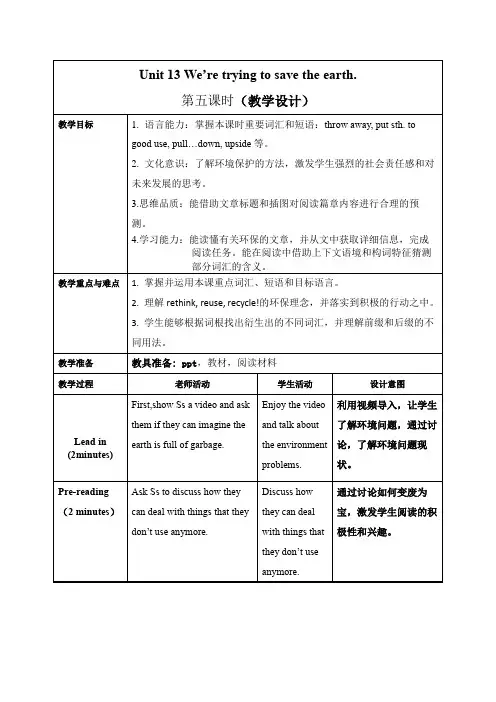
Fast readingTask 1From the pictures and title,the main idea of this passage is ___.A. We shoud use everything to protect our environment.B. Our enviornment is badly polluted.C. Everyone should take part in saving the earth in a green way.D. We should think again to use again and cycle again. Task 2How many many people are mentioned in the passage ? Who are they ?Task 3A. Bags made from old clothesB. Art pieces made of iron and other materials from old carsC. House built of rubbish Task 4Read the article quickly and choose the correct structure.Careful readingTask 1Read Para.2 and fill in the chart .Task 2Do you know how the house was built ?The top of the house is_______________________. The doors and windows_______________________. The gate is________________________ ___________________. Task 3What do we learn about Amy from Para 2.________________________ ________________________ Is Amy the only one who is good at recycling ?Task 4Read Para.3 and fill in the chart .Task 5Read Para.3 and answer the questions.1.Is Jessica Wong good at recycling? What does she do? ________________________ ________________________2. Where does she sell her bags?________________________ ________________________ 3. What will she write in her book?________________________ ________________________ Task 6Can you think of an ad. For Jessica’s shop ?Task 7Read Para.4 and fill in the chart.Task 8Read Para.4 and answer the questions.1.What does Wang Tao hope to set up? Why ?________________________ _____________________ 2.What can those beautiful art pieces bring to us?________________________ _____________________ Task 9Task 10What do Amy, Jessica and Wang Tao have in common?2c Fill in the blanks with the correct forms of the phrases in the box.1. Amy Hayes lives in the UK. Many of the old buildings in her neighborhood were___________.2. All the rubbish and old things in Amy’s neighborhood were then____________when Amy built her house.3. Amy is very creative. She _______ her front gate______ rocks and old glass bottles. She put an old boat on top of her house.4. Jessica Wong sells her bags in a small shop, but she has also ______ an online business to sell them.5. Though Jessica’s bags are made from old clothes, her bags are __________being cute and useful.6. Wang Tao _______ makes large pieces of metal art that look like animals or humans, ________ makes smaller pieces for the home.2d Underline the words in the passage based on the words below. What are the differences?2e Make a list of things that need to be done to save the environment. Which things can be done by common people every day? Which things have to be done by governments and organizations? Discuss these with your group.Find ways of putting wastes to good use. Make an art work, bring it toschool and introduce it based on the chart below.板书设计Unit 13 We’re trying to save the earth.Section B (2a-2e)。
九年级英语新目标Unit13全单元课件
别往地上乱丢纸屑。
It is antisocial to leave one's litter in public place.
在公共场所遗弃杂物是妨害公共利益的。
Language points
litter 还可作不及物动词,意为“ 乱扔废弃物”。
So together, our actions can make a difference and lead to a better future!
And remember to throw rubbish in the bins and keep public places clean and beautiful for everyone.
2c
Use the information in 2a and 2b to role-play conversations between Jason and Susan.
The air has become really polluted around here. I’m getting very worried. Yes, I used to be able to see stars in the sky.
1b
Listen and complete the sentences.
The river was ________. Even What was the bottom of the river was full of ________. These were no the problem? more ________ for fishermen to catch. What People are throwing _______ into the river. caused the Factories are putting _______ problem? into the river. We should write to the
英语人教版九年级全册unit13 sectionb

Teaching designTeacher’s information: Zhang yiming from No.8 Middle School in Chaoyang, Liaoning ProvinceTeaching material: Go for it, Book 5Teaching object: students in Grade 9Title:Unit 13 We’re trying to save the earth!Teaching period: Section B Period 1Teaching objectives:1. Language objectives: to grasp some new words such as recycle and napkin; to review the key structures such as when, while, non-finite verbs and verb phrases.2. Ability objectives: to talk about the pollution and environmental protection; to encourage students speak out and communicate with each other in English; to cultivate students’ listening and speaking skills.3. Emotional objectives: to make students focus on the environmental problems; to realize the importance of environmental protection; to take actions to save the earth.The analysis of students:Students in Grade 9 who are going to graduate have certain language foundation, they can use simple sentences to express their ideas. However, they may forget some language points, and some of students can’t make a clear mind map of language points. As a result of that, students may have problems in speaking and listening freely. According to this period, the teacher designs some activities to help students recall the language points they have learned before, and make students talk about a certain topic(environmental protection) with the key structures they’ve learned. At the same time, the teacher guides students to pay attention to the environmental problems and find out some solutions to the serious problems.Teaching key and difficult points:1. to grasp new words and review some key structures.2. to come up with some problems or solutions on environmental protection.3. to be brave to speak out and communicate with others with target language.Teaching methods:Communicative Language Teaching; Cooperative Learning; Task-based TeachingTeaching Equipment: multimedia and blackboardTeaching procedures:Leading-in:Some students act a short play to show some behavior about environment in our daily lives.Purpose: according to the students’ performance, the teacher can lean in to the topic of this period---some small things we can do to help save the earth.PresentationThe teacher presents some small things students can do to save the earth in our daily lives, let students read these statements and pay more attention to the new words “recycle”, “napkin” and recall the usages of the key structures“when”and “while”. The teacher gives students some real examples to lead students to explain the new words and structures themselves.Purpose: to guide students to grasp new words with real items can give students deep impressions of words; to help students review the key structure can help them do the oral practice.PracticeThe teacher makes students list the small behavior that can help the environment, “which is easy to do? Which is hard...?” . According to talking about the questions, students can practice the dialogue with the target language.e.g. A: Recycling paper is really easy.B: I agree. But it’s hard to stop riding in cars.Purpose: to make students use the key structures to make a dialogue and practice their speaking skills.Listening1. Pre-listening.The teacher leads students to search for other ways to save the earth in the listening part., make them read1c,1d and listen,then guess the general idea of the conversation.Purpose:the teacher arouses students’interests of finding out the answers,make students kno w what to listen to.2.While-listening.Students Listen to the audio material twice and finish1c and1d.Before they fill in the blanks,they are given some time to discuss their answers one another.Purpose: after practicing the conversation, students can be familiar to the sentences in the listening part. For listening this part twice, they can catch the right answers more easily. Their listening skills should be cultivated.3.Past-listening.(consolidation)After talking about 1a, 1b and listening to what happened in 1c, 1d, students need to think about some other serious problems about environment and write down on the blackboard. One group, one sentence. Then the teacher shows a short video about serious pollution on the earth in order to make students know the emergency of environmental protection.Purpose: to open students mind and practice oral English.ProductionStudents need to discuss how to solve the environmental problems, then choose one of two the topics to give a speech with their group members.Purpose: to make the students use target language to say something about environmental protection, to practice more can make them more confident, and speak out English bravely. They can solve the problems around them by themselves.Summary1. New words: recycle, napkin2. Review the key structures3. Talk about pollution and environmental protectionPurpose: to summarize this period.Homework1. Write a short passage about “how to save the earth” or “How to protect the environment”.2. Talk about what we must do for the environment with your friends.Purpose: to cultivate students’ writing skills and think further about protecting the earth.Blackboard-writing。
人教版九年级英语Unit13 sectionB

2b Read the passage and complete the chart below. Names What materials did they use? What did they make?
Amy Hayes
• windows and doors of old buildings that have been
pulled down
• an old boat • rocks
• old glass bottles(n.瓶子)
a house
Jessica old clothes;
Wong
especially old jeans
bring back [ˈmetl]
n.金属;
creativity 恢复,使想起,归还
[ˌkri:eɪ'tɪvətɪ]n.创造性,创造力
2a Look at the title and the pictures in 2b. Can you guess what the passage is about?
Amy isn't the only one who is good at recycling. Jessica Wong from Hong Kong uses old clothes that people don't wear anymore to make bags.She has been doing this for a few years now.She opened a small shop where she sells her bags,and she has also set up(建立) a website to sell them online.She especially likes to use old jeans to make handbags.Her bags are cute and useful.“I plan to write a book about new ways to use old clothes,”she said.“I hope people can read my book and enjoy it!”
九年级英语人教版13单元2d知识点
九年级英语人教版13单元2d知识点Unit 13 Lesson 2D: Academic Knowledge and SkillsEnglish language learning is an essential part of a student's academic journey, and in the ninth grade, students delve deeper into a wide range of knowledge and skills. The 13th unit of the 9th-grade English textbook, published by People's Education Press, focuses on developing students' academic abilities. This article will discuss the key points in this lesson, highlighting the significance of the curriculum and the importance of these skills in the students' future academic endeavors.1. Effective Note-Taking:One of the fundamental skills emphasized in this unit is note-taking. In high school and beyond, students are exposed to a considerable amount of information through lectures, presentations, and discussions. Efficient note-taking ensures that students capture essential details and key concepts, allowing them to review and revise the material effectively. It is crucial to emphasize proper note-taking techniques, such as developing abbreviations, using bullet points, and organizing information in a structured manner.2. Critical Thinking Skills:Critical thinking, another key focus of this lesson, plays a vital role in academic success. It involves analyzing, evaluating, and interpreting information to form judgements or make decisions. Encouraging students to think critically fosters independent thought and helps them develop the ability to analyze arguments, detect biases, and propose convincing evidence. By honing their critical thinking skills, students become better equipped to handle complex academic tasks and challenges.3. Research Skills:The 9th-grade English curriculum aims to equip students with research skills that are necessary for academic work. In this unit, students learn research techniques, including conducting library and online research, evaluating sources' credibility, and citing references accurately. These skills empower them to gather relevant information, critically assess its reliability, and support their ideas with evidence. Such research skills provide a solid foundation for future academic projects, including research papers and scientific inquiries.4. Effective Presentation:Another vital component of this lesson is effective presentation skills. In today's interconnected world, the ability to present ideas concisely and confidently is crucial. Students learn the art of structuring their thoughts, using visual aids effectively, and engaging their audience through effective communication techniques. These skills not only benefit academic presentations but also contribute to the students' personal and professional growth as they navigate through various stages of life.5. Collaborative Learning:Students are encouraged to engage in collaborative learning, fostering a cooperative and supportive environment. This approach promotes active participation, teamwork, and the exchange of diverse ideas. Collaborative learning boosts communication skills, enhances creativity, and strengthens critical thinking abilities. Students can harness the collective wisdom of the group, learn from their peers, and develop social skills essential for future academic and professional settings.In conclusion, the 13th unit of the 9th-grade English textbook from People's Education Press focuses on fostering academic knowledge and skills. The curriculum emphasizes the importance of effective note-taking, critical thinking, research skills, effective presentation, and collaborative learning. These skills not only enhance students' academic performance but also equip them with essential tools for success in higher education and future careers. By cultivating these abilities, students are better prepared to navigate the challenges and opportunities that lie ahead.。
人教版新目标初中英语九年级unit13 Section B 2a-2e课件
Rethink, Reuse, Recycle!
an unusual house piece
Read the passage fast and silently to find the answers 1. What's the passage about? A. how Amy Hayes make her house . B. some beautiful art pieces made of rubbish. C. how people create ways to use things that are √ no longer wanted. 2. How many people are mentioned in the passage? Who are they? Three. They are Amy Hayes, Jessica Wong and Wang Tao. 3.Who is Amy Hayes? She is a most unusual woman in the UK.
Read the passage and 2b complete the chart below.
Names What materials did they use? Amy Hayes • windows and doors of old buildings that have been pulled down • an old boat • rocks • old glass bottles What did they make? a house
How can we do to help save the earth?
don’t use paper napkins
turn off the lights when you leave a room
九年级下册英语第13单元Section B-2
2. Have you ever thought about how these things can actually be put to good use?
put sth. to good use 好好利用
e.g. Your creative talents can also be put to good use, if you can work up the energy. 如果你能让自己精力充沛起来,你 的创作才能也能得到很好的发挥。
Read paragraph 3 and answer the questions.
1. Is Jessica Wong good at recycling? What does she do? Yes, she is. She uses old clothes that people don’t wear anymore to make bags.
2c
Fill in the blanks with the correct forms of the phrases in the box.
put to good use build… out of
pull down (拆下)
set up
known for
not only… but also
1. Amy Hayes lives in the UK. Many of the old buildings in her neighborhood were ____p_u_l_le_d__d_o_w_n____.
• rocks •old glass bottles(n.瓶 子)
a house
Names
What materials What did they did they use? make?
九年级英语人教版全一册_Unit13_SectionA(2a-2d)优质课课件
noise pollution
Causes: loud music, airplanes, cars , mobile phones …: factories, rubbish …
Look and say
land pollution
Causes: littering, all kinds of human activities …
bring a bag to go shopping use chopsticks or forks at home
throw rubbish in the bins
wooden chopsticks or plastic forks rubbish
Discussion: What can we do to save the
in our school
throw the rubbish in the bins
Don’t smoke in public.
save water / turn off the tap
Don’t waste food.
What can we do to save the earth?
• • • • • • • • •
2a Listen to the interview. Circle the kinds of pollution that Jason and Susan talk about.
A. B. C. D.
land pollution air pollution noise pollution water pollution
Help save the earth
We must think of better ways to treat the earth.