
新版深圳广州沈阳版牛津英语七年级下Unit6Electricity知识点,语法及练习
新版深圳广州沈阳版牛津英语七年级下Unit 6 ElectricityⅠ. 短语(词组)moment 可数名词, 意为”瞬间;片刻”如:I’d like to talk to you for a moment.与moment 相关的短语:a moment ago 刚刚;刚才如:He was here a moment ago.at the moment 现在;此刻如:He is at home at the moment.wait a moment 等一会儿如:Wait a moment, please.later 副词,意为”后来;以后”at the moment 此时此刻;for the moment 暂时;in a moment 过一会儿;at any moment 任何时刻a packet of 一袋不可数名词没有复数形式,在表示数量时,常用“a+单位量词+of+不可数名词”结构。
如:a piece of meat; a piece of paper;a glass of apple juice; a bag of milk数词+单位量词+of+不可数名词\可数名词复数如:two glasses of water; three cups of tea;two packets of sweets ; three bags of pencilsin a way 在某种程度上on the way 在路上;in the way 挡道;in this way这边走;by the way 顺便问下connect 连接…常用结构: be connected to sth. 连接到……connect sth. to/with…把…和…连接起来.如:Turn on your computer and connect it to the Internet.The railway line connects Wuhan to Shanghai.power station 发电站washing machine 洗衣机switch off=turn off 关掉tidy up 收拾整理=put awayair condition空调come into 进入……之内provide sb. with sth. 供应给某人某物如:The sun provides us with light and heat.“为某人提供某物”还可以用provide sth. for sb.“as many + 复数名词+as ”意为”和……一样多的…”如:I have as many books as you. 我和你有一样多的书.“as much +不可数名词+as”意为”和…一样多的…”如:My brother drinks as much milk as I every day.share sth. with sb. 与某人合用/分享某物(1 )“keep + sb. / sth. + 形容词”意为“让某人/某物保持某种状态”。
(2) keep doing sth. 连续不断地做某事,一直做。
强调不断重复的动作。
如:Li Lei keeps buying books about cars. 李雷不断地买有关车的书。
(3) keep sb./ sth. doing sth. 让某人不断地做某事(4) keep sb. from doing sth. 阻止某人做某事如:We must keep them from getting to know our plans. 我们必须防止他们知道我们的计划。
at least 至少make sure 务必,确信Ⅱ. 语法:情态动词一、情态动词的定义情态动词是一类用于表示说话人的语气和情态的助动词。
常表示命令、请求、拒绝、义务、可能、需要等。
二、情态动词的特点1. 情态动词无人称和数的变化,2. 情态动词后面跟的动词需用原形,否定式构成是在情态动词后面加"not"。
3. 个别情态动词有过去式, 过去式用来表达更客气, 委婉的语气, 时态性不强, 可用于过去,现在。
三、情态动词的用法1. can/could;can’t/couldn’t (否定)1) 表示能力, 意为“能、会”, 例如:如:I can speak a little English. -- Can you ride a bike?I can’t swim. -- Yes, I can. / No, I can’t.2) 表示请求或允许,多用于口语中,意为“可以、能”等如:You can go home now. 现在你可以回家了-- Can I borrow your bike?You can’t stop your car here. -- Yes, you can. / No, you can’t.3) 用于否定句、疑问句中,表示猜测、怀疑或不肯定.如:Lucy can’t be at home now, she went to the park just now.Where can it be? I can’t find my football.【注意:】1)could 是can的过去式, 有两种用法, 一种表示过去式;一种用来表达更加客气, 委婉的语气, 时态性不强, 可用于过去,现在。
2)be able to 意为“有能力,能够做...”, 相当于can/could, 但它有人称,数和时态的变化。
2. may; may not (否定)1) 表示“请求,许可”,此时与can 同义,可以互换使用如:May I borrow your bike? Can I borrow your bike?Yes, you may. / No, you may not. Yes, you can. / No, you can’t.2) may/might表示不太肯定的猜测,意为“有可能”如:Lucy may come to school late today.It might rain today.【注意】:might 是may 的过去式, 有两种用法, 一种表示过去式,一种表示更加委婉, 客气的语气或对可能性的怀疑。
3. must; mustn’t (否定)1) must(“必须”, 表示命令),mustn’t(“一定不能”, 表示强烈禁止...)如:You must go to bed before 22:00pm.You mustn’t play with fire. It’s dangerous!--Must I write down the sentences?--No,you needn’t. (--No,you don’t have to)注意:在回答must的疑问句中,否定回答用needn’t或don’t have to表示“不必”,不用mustn’t2) must 还可以表示非常肯定的猜测,意为“一定”如:The girl in a red skirt must be Lucy.3) must/ have to 的区别:①. must表示必须,强调主观上的愿望;have to表示“不得不”,强调客观需要如:You must go be bed before 22:00pm.My bike is broken, so I have to go to school on foot.②. have to 有人称、数、时态的变化;must则没有。
如:I have to clean the classroom today.She has to finish her homework first. It was late, he had to go to school without breakfast.一,选择填空:( )1. Mum makes me eat an apple every day ______ the doctor away.A.keepsB. is keptC. to keepD. kept( )2. I’m getting fatter and fatter now. What should I do, doctor?--You’d better eat food and take exercise.A.less;lessB.more;moreC.more;lessD.less;more( )3. ---What can I do for you? ---I’d like two _______.A.packet of teaB. packets of appleC. packets of teaD. packet of apples( )4.Water comes to our flats__________pipes under the streets.A.acrossB.alongC. throughD.over( )5.Andy Wang looks_________today.He is laughing all the way.A.happyB.happilyC.sadD.sadly( )6. The computer is connected _______ a machine.A.atB. toC. onD. in( )7.Our head teacher is kind to us and she is like our mother, _____.A.on the wayB. by the wayC. in a wayD. in the way( )8.________you show me the way to the nearest underground station?A.mayB.mustC.can D should( )9.Electricity__________our life easier,We must save it.A.makeB.makesC.is makingD.made( )10.Jason put some rice in the pot and__________the rice cooker.A.openedB.switched onC.closedD.turned off( )11. I washed a lot of clothes. Who can _______?A.tidy up themB. tidy them upC. tidy it upD. tidy up it( )12.I asked him twice. But he didn’t ______ my questions.A.answersB. answer toC. replyD. reply to( )13.There are_________syllables in the word“chemical”.A.twoB.threeC.fourD.eight( )14. —Jon:May I have a packet of sweets?—Shop assistant:________________A.No,it is not yoursB.OK,here you areC.That’s a good ideaD.Why not? ( )15.Earth Hour started in2007in________.A.the USAB.ChinaC.the UKD.Australia二,用同义词(组)替代句中的划线部分。
新版深圳牛津七年级英语下Unit_6_Electricity_语法及练习 2
深圳牛津版七年级英语下Unit 6 Electricity语法及练习情态动词1、情态动词的定义: 情态动词是一种本身有一定的词义,表示说话人的情绪,态度或语气的动词,但不能单独作谓语, 只能和其他动词原形构成谓语。
情态动词无人称和数词的变化,后接动词原形。
We can be there on time tomorrow. 我们明天能按时去那儿。
______________________________我能知道你的名字吗?______________________________我们现在就开始吗?______________________________你必须遵守校规。
2、can的用法1) can “能,会”,表示某种能力。
过去式为:could.I can dance , he can swim.I can’t swim, he can’t dance.Can you swim? Yes, I can. /No, I can’t.Tom could swim at the age of 5.2) can 和be able to的区别: be able to 有人称数和时态的变化。
Be able to 可以用于过去、现在、将来等多种时态。
Tom was able to swim at the age of 5.I can come tomorrow .=I will be able to come tomorrow.3) can “可以”,表示请求,准许,同意。
Can you pass me the books? 你能给我递一下书吗?Could you help me, please? 请问,你能帮助我吗?could 可以表示委婉的语气。
回答时用can.Could I borrow you car?Of course you can. / Yes, you can.I’m afraid you can’t. /I’m sorry you can’t.3、may的用法1) may (might) 可以, 表示说话人同意,许可或请求对方许可。
Unit6ElectricityVocabulary单词讲解课件 牛津深圳版七年级英语下册
2. 一切皆有可能。
E__v_e_r_y_t_h_i_n_g_ ___i_s___ possible.
3. 有谁来过这里?
Did _a_n__y_o_n_e_ come here?
B C C
A
B
reply
/rɪ'plaɪ/
v./cn. 回答
reply to sth 回复…
1. 他从来没给我回过信。
anyone
pron. 任何人
/'eniˌwʌn/
不定代词的用法:
不定代词:
1. 不定代词做主语,谓语动词用三单
any-: anyone, anybody, anything
2. 不定代词+ adj. (即adj.放后面)
some-: someone, somebody, something 3. some- 与any- 的用法分别与some
switch off
/swɪtʃ/
反: switch on switch v. 开/关
n. 开关
关(电器、开关) = turn off
identify
v. 确认,认出
/aɪˈdentɪfaɪ/
她能够认出袭击她的人。(能够be able to)
She _w_a_s_ a__b_le_ _t_o__ _i_d_e_n_t_i_fy_ her attacker.
cable cn. 电缆
/'keɪbl/
conversation
cn. 谈话
/ˌkɒnvə(r)ˈseɪʃ(ə)n/
have a conversation with sb 和某人谈话
昨天班主任和我谈话了。
Yesterday the head teacher h__a_d_ __a__ _c_o_n_v_e_rs_a_t_io_n__ _w_i_t_h_ __m_e__.
牛津深圳版七年级下Unit6 Electricity课件

Listen carefully the words after but. They usually introduce a different idea.
Write down the relevant (相关的) information quickly.
Presentation
√
学.科.网
Presentation
3. She’ll look foolish.
学.科.网
foolish 愚蠢的,笨的
He was sad for making such a foolish
mistake.
因为犯了一个很愚蠢的错,他感到
很难过。
Presentation
4. It flow through wires. flow 流动,流通 The melted snow flowed from the
The work is well done in a way.
从某种程度上说, 这工作做得不错。
Exercises
I. 单项选择. 1. — Can you tell me what electricity is like? — Surely, electricity is like water ______. It flows through a wire.
________ electricity
5. They’re connected to a power station.
(line 16) ______ wires
Presentation
D2. The pictures below shows electricity gets to Benny’s flat. Fill in theb lanks with the correct words from the box.
牛津译林英语(深圳沈阳)版七年级下册Unit6-Electricity-重点词汇短语句型讲解课件
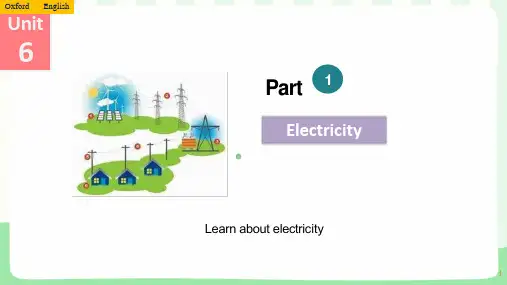
electrical : _a_d . 有___关__电的____;
e.g.: The keyboard was connected to my computer.
【考题链接】
请打开电脑并连接因特网。
Pl__e_ase____t_u_r_n_o__n__th__e_c__o_m__
Words
12. A moment later, Daisy came back.
moment: n.___瞬__间;___片刻_____;
e.g.: Water, in a way, is people’s most important need. e.g.: In a way, he is right. in a way 可放句首,句中,句末
【拓展】
in many ways
在___很多___方__面
in some ways
___;
on one’s/the way to ...在___去…在_一__些的方___路_面__上
Words
4. Talk about safety rules at home.
rule: n.__规__则____;(可数名词) e.g.: Everyone must obey the rules.
【拓展】 obey the rule(s)
遵守规则 __ __ __ _____;
break the rule(s) 违__反__规__则_____;
Unit 6 Electricity-语法讲义 牛津深圳版英语七年级下册
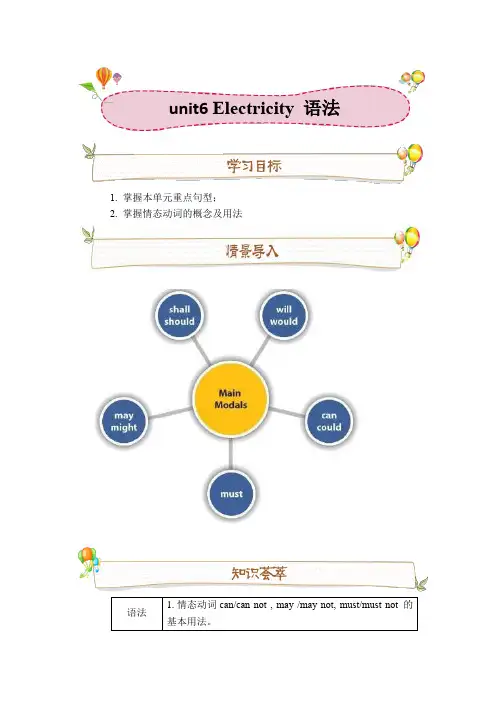
1. 掌握本单元重点句型;2. 掌握情态动词的概念及用法语法1.情态动词can/can not , may /may not, must/must not 的基本用法。
unit6 Electricity 语法1.can的用法。
1)表能力We can do our homework by ourselves. 我们可以自己完成作业。
He can swim well. 他游泳很好。
I can play football but I can’t play the piano. 我会踢足球但是我不会弹钢琴。
2)表许可You can watch TV after supper. 晚饭后你可以看电视。
You can’t play basketball in the street. 你不能在街上打篮球。
3)表请求Can you help me with my math? 你能帮我学数学吗?Could you lend your book to me? 你能把你的书借给我吗?注意:could 是can的过去式,但是这里并不表示过去时,而是表示委婉语气。
拓展:can 和be able to的区别(1)情态动词can只有两种时态形式,现在式can和过去式could,而be able to有多种时态形式。
在一般过去时中都表示能够时,两者可以互换。
例如:Mary can play the piano. (一般现在时)玛丽会弹钢琴。
She could / was able to play the piano when she was five.(一般过去时)她五岁时就会弹琴。
She has been able to play it since she was five. (现在完成时)她自从五岁起就会弹琴了。
(2)用在过去时中,could经常表示能够做某事,事实上不一定去做,而was ⁄were able to则表示“过去设法做成了某事”。
牛津深圳初中七年级英语下册 Unit 6 Electricity Period 1 words课件
touch v.触摸;碰
keep in touch 保持联系 touching adj.动人的 touched adj.受感动的 touchable adj. 可触的 toucher n.触摸者
n electricity 电 cooker 厨灶;炉具 conversation 谈话 fridge 冰箱
adj foolish
a packet of in a way (be) connected to power station washing machine swith off tidy up air conditioner
electricity n.电
Water, food, and electricity are hard to get. The electricity is off.
fool n.傻瓜 v.愚弄 愚蠢的:foolish; stupid; silly 聪明的:clever; smart; bright; wise
wire n.电线
The headphones
have no wires.
wired a. 连线的 wireless a.无线的
connect v.(使)连接
The wires connect under the floor. connected a.连接的 connection n.连接 be connected to 与...相连
These wires are connected to cables under the street.
cable n.电缆
electric a.电动的, 电的 electrical a.用电的;电学的 electronic a.电子的 electrify v.使充电;使通电
牛津深圳7下Unit 6 Electricity语法讲解及练习
(三)语法讲解情态动词一、情态动词的定义情态动词是一类用于表示说话人的情绪,态度或语气的动词,但不能单独作谓语, 只能和其他动词原形构成谓语。
情态动词无人称和数词的变化,后接动词原形。
二、情态动词的特点1. 情态动词无人称和数的变化,2. 情态动词后面跟的动词需用原形,否定式构成是在情态动词后面加 "not"。
3. 个别情态动词有过去式, 过去式用来表达更客气, 委婉的语气, 时态性不强, 可用于过去,现在。
三、情态动词的用法1. can/could; can't/couldn't (否定)1) 表示能力, 意为“能、会”, 例如:如:I can speak a little English. (肯定句) I can't swim. (否定句)-- Can you ride a bike?(一般疑问句) -- Yes, I can. / No, I can't. (肯定、否定回答)2) 表示请求或允许,多用于口语中,意为“可以、能”等 , 如:You can go home now. (肯定句) You can't stop your car here. (否定句)-- Can I borrow your bike?(一般疑问句)-- Yes, you can. / No, you can't. (肯定/否定回答)3) 用于否定句、疑问句中,表示猜测、怀疑或不肯定, 如:Lucy can't be at home now, she went to the park just now.Lucy肯定现在不在家,她刚刚去了公园。
Where can it be? I can't find my football. 我的球有可能在哪里呢?我找不到。
◆◆【注意:】1) could 是can的过去式, 有两种用法, 一种表示过去式;一种用来表达更加客气, 委婉的语气, 时态性不强, 可用于过去,现在。
英语7年级下册牛津版Unit 6 Electricity
3
3
7.moment:a very short period of time 瞬间,片刻 n. 8.battery:a device that is placed inside and that produces the
electricity that makes it work 电池 n. 9.cooker:a machine used to cook food 炉具 n. 10.fridge:a electric machine in which food is kept cold so as to
5.The chemicals inside batteries produce electricity. 电池里的化学物质生产电。
6.Electricity makes our lives easier. 电让我们的生活变得更容易。
14
14
7.What do you know about electricity? How can we use them safely? 关于电你知道什么? 我们能怎么去安全地使用它们呢?
8.Don’t put your hand in the washing machine when it is on. 当洗衣机在工作的时候,不要把你的手放进去。
stay fresh 冰箱 n.
4
4
11.lock:to fasten something, usually with a key, so that other people can’t open it 锁上 v.
12.test:take an exam 测试 v. 13.tidy:make sth. in order 使整洁,使整齐 v. 14.touch:put your hands or fingers onto sb./sth. 触摸,碰 v.
最新新版深圳牛津版七年级英语下Unit-6-Electricity课文知识点解析及练习
深圳牛津版七年级英语下Unit 6 Electricity课文部分知识点解析及练习一、词组归纳1. 转化,变成change into2. 戏弄某人trick sb3. 最后at last4. 看上去很傻look foolish5. 流经flow through6. 某种程度上in a way7. 被连接到电缆上be connected to cables8. 电灯泡 a light bulb9. 挠头scratch one’s head10. 不同形式的能量different forms of energy11. 发电站 a power station12. 一包 a packet of13. 成/几包的in packets14. 整理好tidy up=clean up15. 关(灯,电器等)switch off=turn off16. 开(灯,电器等)switch on=turn on17. 与某人分享某物share sth with sb18. 准时on time19. 由……组成be made up of20.为……提供……provide sth for sb=provide sb with sth21. 在乎,关心care about二、words精讲1. electricity, n.电力;电流,静电;高涨的情绪;紧张如:At night these streets are brilliant with a pearly radiance of electricity.Electric adj. 电的;电动的;electrical adj. 有关电的;电气科学的2. foolish,adj.愚蠢的;鲁莽的;荒谬的,可笑的如:He was angry with himself for having made such a foolish mistake.Fool vi. 欺骗;开玩笑;戏弄n. 傻瓜;愚人;受骗者vt. 欺骗,愚弄adj. 傻的Art dealers fool a lot of people.艺术品经销商会愚弄许多人。
牛津深圳版英语七下Unit6ElectricityGrammarppt复习课件
with her. Read their conversation below. Fill the
blanks with may or can.
P78
Benny: How are you feeling, Daisy? Daisy: Not very well.
Benny: M___a_y__/C__a__n__ I get you a chair?
• ---No. It ____ be her. She is at school now.
Benny: Yes. I _c_a_n_. _M__a__yI carry your bag for you?
Daisy: Yes, you may. That’s so kind of you,
Benny. I’m ready to go. C__a__n_ you open the door for me?
小结:
• can/may/must 共同点:
• 1._后__面__动_词__都__用__原_形__。___________________
• 2._否__认__句__都_是__后__面__加_n_o_t_________________
• 3._一_般__疑__问__句_都__是__将__其_提__前________________ • 不同之处: • 1. can表示_有__能__力__做__某事/请求、允许 • may表示请:求__/允__许____ • must 表示:命_令__、制__止_____ • 2. can/may 提问遵循:_什__么__问__,__什么答 • must 提问,否认答复:ne_e_d_n_'t_/_d_o_n_'t__h_a_v_e_t_o_