
小学英语外研版(三起)四年级下册m6U2教案
年级
四年级
备教者
教学内容
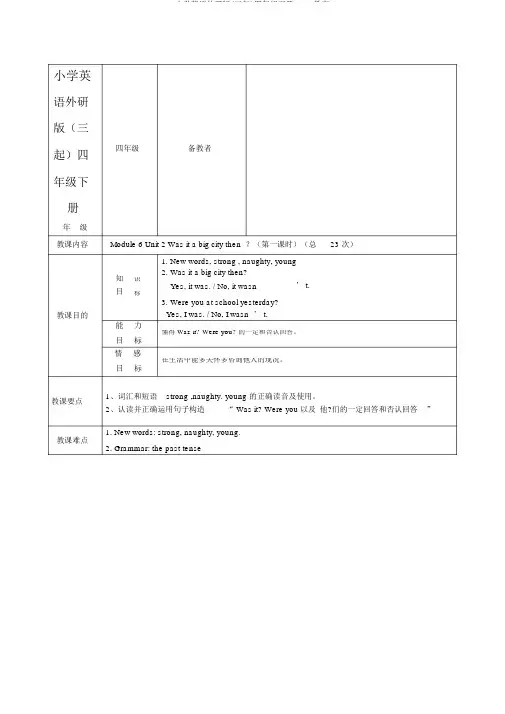
Module 6 Unit 2 Was it a big city then?(第一课时)(总23次)
教学目标
知识
目标
1. New words, strong , naughty, young
2. Was it a big city then?
教
学
过
程:
Step1 Warming up
Step1 Warm up
T: Hello, boys and girls. Today we are going to learn Module 9 Unit2 Was it a big city then? First, let’s look a pictures. OK?
4. Write down the new words and sentences:” Was/Were …? ”on the blackboard.
5. Learn the new words and sentences.
6. The teacher explains the text.
Step4练习
( ) 1. ______ you strong then?
A. Were B. Was C. Are
( ) 2.______________ it a big city then?
A. Were B. Was C. Are
Step5巩固
Step6总结:在教师的帮助下,学生尝试总结。
Step7作业
完成快乐课堂第3.4题。
Yes, it was. / No, it wasn’t.
3. Were you at school yesterday?能力
目标
懂得Was it……? Were you……?的肯定和否定回答。
情感
目标
在生活中能多关心多询问别人的近况。
教学重点
备注
,培养学生分析问题,解决问题的能力。
教后
反思
Step3 New Teaching
1. Students listen to the tape and answer the follow questions:
a.看图片说说这男人的变化。
b.看图片说说祖父所去过的深圳有什么变化?
2. Find out new words
3. Find out the sentences: “Was/Were …?”
Step 2 Leading
T: Today, we will go on learning the past tense in Module 9 Unit2. Now, please look at 1 listen, point and say .First, listen to the tape and read after the radio. Second, all the students read together.
1、词汇和短语strong ,naughty. young的正确读音及使用。
2、认读并正确运用句子结构“Was it …? Were you …?以及他们的肯定回答和否定回答”
教学难点
1. New words: strong, naughty, young.
2. Grammar: the past tense
小学英语外研版(三起)四年级下册m6U2教案
小学英语外研版(三起)四年级下册年级教课内容教课目的四年级备教者Module 6 Unit 2 Was it a big city then ?(第一课时)(总23 次)1. New words, strong , naughty, young知2. Was it a big city then?识’ t.目Yes, it was. / No, it wasn标3. Were you at school yesterday?Yes, I was. / No, I wasn ’ t.能力目懂得 Was it? Were you? 的一定和否认回答。
标情感目在生活中能多关怀多咨询他人的现况。
标教课要点1、词汇和短语strong ,naughty. young 的正确读音及使用。
2、认读并正确运用句子构造“ Was it? Were you 以及他?们的一定回答和否认回答”1. New words: strong, naughty, young.教课难点2. Grammar: the past tense教学过程:教后反思Step1 Warming up备注Step1 Warm upT: Hello, boys and girls. Today we are going to learn Module 9 Unit2 Was it a bigcity then? First, let’ s look a pictures. OK?Step 2 LeadingT:Today, we will go on learning the past tense in Module 9 Unit2. Now,please look at 1 listen, point and say .First, listen to the tape and read after theradio. Second, all the students read together.Step3 New Teaching,培育学生1. Students listen to the tape and answer the follow questions: 分析问a. 看图片谈谈这男人的变化。
小学英语外研版(三起)四年级下册m6U22教案
(4). All the students read the text in roles.
(5). Listen together, all the class read the sentences: “Was it sunny yesterday?/ Were you at home yesterday?” The teacher writes it down on the blackboard and then explains its answer: “Yes, it was. / No, it wasn’t. Yes, I was. / No, I wasn’t.”
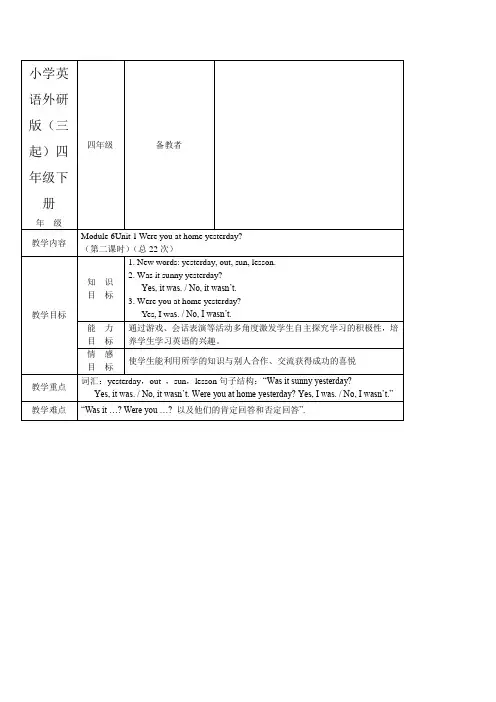
教学重点
词汇:yesterday,out,sun,lesson句子结构:“Was it sunny yesterday?
Yes, it was. / No, it wasn’t. Were you at home yesterday? Yes, I was. / No, I wasn’t.”
教学难点
( ) 4. Is it hot in Shenzhen?
( ) 5. Are you at home now?
A. Yes, I’m.
B. Yes, it was.
C. Hello, Sam.
D. No, it isn’t.
E. No, I wasn’t. I was at home.
备注
设计意图:学生带着问题听录音并寻找答案,培养学生分析问题,解决问题的能力。
( ) 3. I was out with Grandpa _________ a lesson.
外研版英语四年级下册Module 6 Unit 2单元教案与反思
教师讲授新单词
学生自学重点句型,小组内互相学习
Step4:Practice
在练习部分设计一个游戏环节,Letmeguess.可以让学生互相猜自己过去拥有的物品或者家里曾经养过的动物
Ste:
Was+第三人称单数(it/ework
在PPT上呈现堂清习题。
Module 6
物以类聚,人以群分。《易经》
原创不容易,【关注】店铺,不迷路!
Unit2Wasitabigcitythen
课题
Module6Unit2Wasitabigcitythen?
授课时间
教学目标
掌握重点词汇:college
学习重点句型:Wasitabigcitythen?Yes,itwas./No,itwasn’t.
教学过程
教师活动
学生活动
我的个性化修改
Step1:Greetings
T:Classbegins
T:Goodmorning,boysandgirls
Step2Review
Reviewtainknowledgeoflastlesson
Step3:Newlesson
(1)leadinandnewwords
Syetown.It’sasmallvillage.(讲授village)
(2)newsentences
Lookatteguess,wasitabigcitythen?
Yes,itis.
LookatanotherpictureaboutShenzhen.(展示出一张过去深圳的照片)
师生共同问候,导入新课
学生进行游戏和训练
学生自主总结,其他同学进行补充
教学反思
【素材积累】
四年级下册英语教案-M6U 2 was it a big city then 外研版三起
四年级下册英语教案-M6U 2 was it a big city then 外研版三起教学目标•拓展学生的词汇量,学习关于城市的单词和短语;•让学生了解北京的变化,并能够简述过去和现在北京的差别;•培养学生的听、说、读、写能力,提高学生的语言表达能力。
教学重点•学习关于城市的单词和短语;•理解过去北京的情况,并能够简述过去和现在北京的差别;•让学生通过听、说、读、写训练提高语言表达能力。
教学难点•帮助学生练习语言表达能力,让他们能够用英语简述过去和现在北京的差别。
教学准备•多媒体教学设备;•教师准备PPT、教案、学生练习册。
教学过程Step 1 Revision通过PPT介绍上一课的单词和短语,并通过简单的互动活动确认学生对上一课所学内容的掌握情况。
Step 2 Presentation教师通过PPT将单词和短语一一呈现,并解释每个词的含义,确保学生理解。
然后通过图片、视频等介绍北京的变化,使学生得出过去和现在北京的差别。
Step 3 Practice教师分组发放材料,让学生用所学内容和所了解的事实,编写一段话描述过去和现在北京的差别。
教师可以通过小组合作促进学生之间的交流与互动。
Step 4 Production让学生向全班展示自己所写的短文,并提供必要的评价。
鼓励学生尽可能地使用所学的单词和短语。
Step 5 Reflection教师可以让学生在学生练习册中或工作纸上做简单的评价。
评价的方式可以有“票选”,“写评论”,“画心情图”等,以鼓励学生之间的交流与互动。
教学拓展为了更好的拓展学生的知识面,教师可以在教学过程中引导学生去了解其他城市的历史变迁,同时让学生了解城市变迁对人们生活的影响。
总结与反思教师应注意教学过程中的反馈,了解学生的学习情况,对学生的错题或疑惑做出解释和澄清。
同时,教师也应在教学后做好自我总结,改进教学策略,让学生更好地理解知识、提高语言表达能力。
小学英语四年级(下)-外研版(三年级起点)-Module 6教案(2个课时)
小学英语四年级(下)-外研版(三年级起点)-Module 6教案(2个课时)课程概述本教案是针对小学四年级学生的英语课教案,属于外研版英语教材的Module 6教案,共分为两个课时。
本教案旨在帮助学生学习有关“吃饭”的单词、短语和句子,通过阅读材料并参与交流活动,提高学生的英语口语和阅读能力。
同时,本教案也包含了一些与生活相关的内容,帮助学生更好地了解英语国家文化。
第一课时教学目标•学习有关“吃饭”的单词、短语和句子。
•学会询问和回答有关“吃饭”的问题。
•提高学生的英语口语和阅读能力。
教学重点•学习有关“吃饭”的单词、短语和句子。
•学会询问和回答有关“吃饭”的问题。
教学难点•学习有关“吃饭”的短语和句子。
•学会运用所学知识进行交流。
教学过程Step 1 自我介绍(5分钟)老师与学生进行自我介绍,然后与学生谈论吃饭的习惯。
Step 2 讲解(15分钟)老师通过幻灯片和短片,向学生介绍有关“吃饭”的单词、短语和句子,让学生理解并记忆。
Step 3 读物(20分钟)老师向学生发放读物,让学生自行阅读。
在阅读过程中,学生可以在书的旁边标注自己不理解的单词并在阅读结束后与同桌讨论。
老师向学生播放“英国的家庭饮食习惯”有关的视频,并与学生一起观看和解析。
Step 5 交流(20分钟)老师与学生进行口语交流和互动练习,学生可以与同桌或老师进行对话,之后在班级中展示一下交流内容。
Step 6 总结(10分钟)总结本堂课所学习的内容,让学生归纳并记忆。
课后作业•复习本节课所学习的内容并记忆有关“吃饭”的单词、短语和句子。
•与家人谈论英国和中国的饮食文化差异,并写一篇50字左右的小作文,阐述你的观点。
第二课时教学目标•学习有关“吃饭”的单词、短语和句子。
•学会询问和回答有关食品品质和文化的问题。
•提高学生的英语口语和阅读能力。
教学重点•学习有关食品品质和文化的单词、短语和句子。
•学会询问和回答有关食品品质和文化的问题。
(外研版)四年级英语下册教案Module6Unit2(1)
(外研版)四年级英语下册说课稿Module6 MusicUnit 2 Lingling is better than Daming.一、说教材:本课是第四册第六模块的第二单元,根据教学目标的要求,这个单元主要操练一些单词和句型,进一步巩固不规则形容词的比较级“…better than…, …worse than…”,并在此基础上巩固复习动词like和情态动词can的用法,学习一些乐器的名称和一首歌曲。
通过使用多媒体课件及创设真实情景的方法,有效地操练句型,做到句型操练与情境相结合。
本课在本模块中起着承上启下的作用。
二、说教学目标(根据英语课程标准的总体教学目标和一级的目标要求以及本课在本模块中的地位和作用,本节课我确立了以下三方面的教学目标:)1. 知识目标a. Lingling is better /worse than Daming.b. Sam and Amy like the guitar.c. They can play the erhu.2. 能力目标能运用“…better /worse than…”对事物进行比较。
能运用“like”表达喜爱的乐器。
能运用“can”表达有能力弹奏某一乐器。
培养学生在真实环境下综合运用英语的能力。
3. 情感目标a. 培养学生学习英语的兴趣和爱好。
b. 培养学生欣赏美、评价美的能力。
c. 通过创设情境,培养学生大胆开口说英语的能力。
d. 通过小组合作,培养学生的团结协作能力和团队精神。
(根据以上教学目标,本教学内容对于四年级学生来说,重点难点是:)三、说教学重点和难点1. 重点:能听懂会说4种乐器的英语名称并能用熟练的语言来比较事物的好与坏。
2. 难点:能综合运用所学单词和句子熟练地比较事物的好与坏。
四、说教法和学法1. 依据新课标“采用活动途径,倡导体验参与”和“关注学生情感,营造宽松、民主、和谐的教学氛围”的原则,根据小学生的年龄、心理、生理等特点,本课中,我主要采用了直观教学、听说教学、游戏、TRP教学、任务型教学以及小组合作探究等多种教学方法,让学生通过视、听、说、演、唱等多种渠道来感知语言,理解语言,从而达到运用语言的目的。
(三起点)外研版四年级英语下册《Module6 Unit2__教案》
Unit2 参考教案一、教材版本:外研版(三年级起点)四年级下册。
二、教学目标:1、能听、说、认、读单词: collage.2、学习重点句型:Was it a big city then? /Yes ,it was./No, it wasn’t.三、教学重点:会说句子:Was it a big city then? /Yes ,it was./No, it wasn’t.四、教学难点:能够在生活中灵活运用运用由Was/were 引导的一般疑问句及其回答。
五、课前准备:1、教师准备与本节课相关的的单词卡片和图片;2、教师准备上课所用的课件;3、教师准备本节课所需的音频;4、教师准备本节课所需的动画。
六、教学过程:Step1: Warming up(热身)建议用时:2—3分钟活动一:唱一唱老师播放动画歌曲学生看动画跟唱。
活动二:口语练习教师就所学过的内容,让学生进行交际练习,目的是巩固学生对语言的运用。
Step2: Presentation(呈现新课)1.新课导入建议用时:3—4分钟活动三:听一听老师播放本课配套的第一部分的课文录音,听完一遍之后再次播放让学生跟读。
最后,教师让学生自设话题模仿本部分句子。
2.课文学习建议用时:3—4分钟教师播放课文第二部分Listen and say的课文录音,学生先跟读后由教师领读并讲解。
最后播放一遍录音让学生完成PPT上面的填空练习。
给学生一定时间自由朗读,之后教师挑选学生站起来自由设立情景,按照课文内容编造对话。
3. 学习新单词建议用时:2—3分钟教师给学生讲解第二部分文中出现的新单词,接着播放单词录音,让学生跟读单词。
同时给学生展示单词卡片。
Step3:Let’s play (趣味操练)活动四:看一看,答一答建议用时:3—4 分钟教师播放PPT课件上关于课文第三部分Point ask and answer的图片内容,教师讲解图中所给例句的问答,让学生自己按照例句,以后面三幅画为情景,进行对话问答练习。
外研版英语四年级下册Module 6 Unit 2 Was it a big city then教案
最新外研版英语四年级下册Module 6Unit 2《Was it a big city then》精美教学设计一、学习目标1)基本能够听懂,会说,会读词汇:village2)学会用“Was +主语+…then?””及相应答语。
3)复习词汇:big, small, old, young2技能目标:学会用一般过去式描述发生过的事情。
3情感目标:培养孩子们主动帮助家人、朋友和需要帮助的人,助人为乐的美德。
二、教学重点:能够对过去发生的事情进行提问并回答。
三、教学难点:灵活、正确运用本课的句子。
四、教学准备:教学卡片、磁带、录音机,挂图。
五、教学方法:直观教学法、游戏法、听说法。
Teaching StepsStep1. Warmer1.GreetingsT: Good morning , boys and girls.Ss: Good morning .T: How are you today?Ss: I’m fine, thank you. And you?T: I’m great. Thanks a lot. Are you happy today?Ss: Yes.T: Sounds good. Let’s chant, ok?Ss: OK!T&Ss: Fat, fat, fat. I was fat.Thin, thin, thin. Now I’m thin.Short, short, short. I was short.Tall, tall, tall. Now I’m tall.T: Wow. You are singing very well. Look these words. Read loud.2.(出示图片)T: Look, were you…?复习上节课内容。
3.(出示图片)Look, this is Shenzhen. It is a big city now. 引出课题Module 6 Unit 1 Was it a big city then?Step2: Presentation1.呈现新单词:T: Look, this is Shenzhen. It is Shenzhen. It was a small village then.2. 活动:认识深圳,并进行描述。
外研版四年级英语下册M6 Unit 2 Was it a big city then教案
Unit 2 Was it a big city then?【教学目标】1.全体学生能理解词汇village。
2.全体学生能运用词汇village。
3.全体学生能运用Was it a big city then ?这类语句并介绍自己喜欢的地方过去与现在的不同。
4.感知一般疑问句的语音语调特征。
【重点难点】Words:villageSentences:Was it a big city then?Yes, it was. /No, it wasn’t.【教学过程】Step 1: Warm up and lead-in1.play the video and make all the students say and act with the video.2.词汇练习。
你写对了吗?3.复习句型,并进行句型转换。
I was young then.Step 2: Presentation1.学习第一部分内容。
(1)看图片。
(先让学生整体感知活动1 )(2)听录音,跟读课文。
(3)小组演读课文。
2.学习第二部分内容。
(1)Shows a group of pictures to the students,and talk them.(2)Where have you been to ?Do you like it ?Play the videoPlay the video again, answer then questions.①Where is Ling ling’s grandpa?②Was it a big city then? (write the title on the blackboard.)(4)Learn new words.(5)听录音,跟读课文。
(7)指导朗读。
(8)小组合作读文,演读课文。
Step3: listen and say. Then sing.Step4:SummaryStep5:Homework1. Read the text fluently.2. Write a short composition about one of your favourite city by using the main sentences we have learned in this class.【板书设计】M6 U2 Was it a big city then?Was it a big city then?Yes, it was. /No, it wasn’t.。
外研版 三起四年级英语下册Module 6MusicUnit 2 教案
Module 6 MusicUnit 2 Lingling is better than Daming.一、教学目标1.熟练运用句子:Lingling is better than Daming.Amy is worse than Sam.2.每人抄写一段对话,小组内进行比较,然后评出书写冠军。
二、教学程序(一)、热身A. Songs: London Bridge is falling down.B. Free talk: let 2 students sing songs, and talk about them. (二)、导入Ask students: “Do you like music?” Today we will learn about music. Write the title “Unit 2 Lingling is better than Daming.”on the blackboard.(三)、课文教学1、Write“Chinese music and pop music” on the blackboard.Talk about “ wha t is Chinese music and what is pop music.”2、Write them on the blackboard. (erhu zither and piano guitar drums violin)3、Let Ss make sentences and act. For example: I can play the erhu. (The student do the actions and say.) (Must write “the”before th e instrument) Then ask Ss: “What music do you like?”“What can you play?”“Can you play the zither?”4、Choose two Ss whom can play the same instrument, Let them play or act and then we talk about “who is better? and who is worse?”5、Listen to the tape and practise reading this lesson.6、Listen to the tape and learn to sing the new song.Listen to music more times, and then try to sing the song together. (四)、练习)1、Free talk. Let Ss sing the song in groups, and we talk which group is better.Let Ss do the actions for the song, and we talk which group is better or worse.2、完成运用任务1:SB第二单元活动33、完成运用任务2:SB第二单元活动51、完成运用任务3:每人抄写一段对话,小组内进行比较,然后评出书写冠军。