
人教PEP版英语五年级上Unit 3 What would you like? 单元教案(英文)
每一个人的成功之路或许都不尽相同,但我相信,成功都需要每一位想成功的人去努力、去奋斗,而每一条成功之路,都是充满坎坷的,只有那些坚信自己目标,不断努力、不断奋斗的人,才能取得最终的成功。但有一点我始终坚信,那就是,当你能把自己感动得哭了的时候,你就成功了!
Unit 3 What would you like? B Read and write Robin will cook today. Ⅰ.The analysis of teaching contents: This topic is from the third unit of PEP English book 5. Wu Yifan and his grandpa left 2 notes to Robin. Ss will know how to describe What they like and what they don’t like on the basis of the knowledge they have learned before. And they will learn more about how to write a note. Ⅱ.The analysis of Students: The Ss are in grade 5.They have learned English for 2 years, and they are active and interested in learning English. Food is one of the most interesting topic for them, and they are interested in some other delicious food. They want to express the food what they like and what they don’t like, So they will have more interested in this class. Ⅲ. Teaching aims: A. Knowledge aims: Ss will understand and say the words of food. Ss will understand and say the sentences : I don’t like …but …is OK./ I like …but not… B. Skill aims: To develop Ss’ abilities of reading ,cooperations and communications with others. 每一个人的成功之路或许都不尽相同,但我相信,成功都需要每一位想成功的人去努力、去奋斗,而每一条成功之路,都是充满坎坷的,只有那些坚信自己目标,不断努力、不断奋斗的人,才能取得最终的成功。但有一点我始终坚信,那就是,当你能把自己感动得哭了的时候,你就成功了!
C. Emotion aims: Ss will love their life and get more interests in learning English. Ⅳ.Teaching points: A. Important points: The understanding of the words about food and the sentences: My favourite food is. It’s/they’re…; I don’t like beef but chicken is OK; I like vegetables but not carrots. B. Difficult points: The writing of a note about what they like or don’t like. Ⅴ. Teaching aims: CAI, PPT and some pictures of food. Ⅵ. Teaching methods: TPR, situational teaching method, reading teaching methods. Ⅶ. Teaching procedures:
Teaching procedures Teacher’s activities Ss’ activities purpose
Step 1 Pre-reading 1. Greetings. 2. Show Teacher’s pictures and free talk: My favourite food is… It’s /They’re… 3. Watch video: having a picnic. 1. Say the words about food quickly 2. Talk about their favourite food. 3. Watch the video. 用老师吃汉堡的照片复习食物类单词和句子。激活学生对于food的相关名词和味觉相关形容词 的印象。并通过孩子 每一个人的成功之路或许都不尽相同,但我相信,成功都需要每一位想成功的人去努力、去奋斗,而每一条成功之路,都是充满坎坷的,只有那些坚信自己目标,不断努力、不断奋斗的人,才能取得最终的成功。但有一点我始终坚信,那就是,当你能把自己感动得哭了的时候,你就成功了!
们野餐的视频吸引学生兴趣,营造良好的英语学习氛围。
Step 2 While- reading 1.Lead-in 介绍人物,导入情境:Wu Yifan and grandpa left 2 notes to Robin. Can you help him cook? 2. Present the whole text. Task1:Read and choose the right answer. a. What’s Wu Yifan’s favourite food? Why? b. What’s Grandpa’s favourite food? Why? c.Let’s check. 3. Present the important and difficult sentences. Task2: What else do they like and don’t they like? (1) What does Wu Yifan like and doesn’t like? a. Lead Ss to read the note and show the questions. b. Lead Ss to stick the food Wu likes on the blackboard. c. Put the picture of beef out of the blank that Wu likes. d. Present the sentence: I don’t like …but the…is OK. e. Lead Ss to do the activities. f. Discuss the answers. (2) What does grandpa like 1. Watch the flash. 2. Do the activities of answering: a. What’s Wu Yifan’s favourite food? Why? b. What’s Grandpa’s favourite food? Why 3.Read in groups . a. Choose the pictures what Wu Yifan likes and stick them on the blackboard. b. Learn to say the sentences: I don’t like…but … is OK. c. Finish the activities to tick or cross. d. Discuss the answers. 3. Read and choose the right picture. 通过设置帮助Robin做饭的情境,逐步了解Wu Yifan 和 Grandpa喜欢以及不喜欢的食物。在完成任务的过程中逐步体会主要意思,并理解难点句。通过合作、交流、体验等方式培养孩子们的合作能力和交流、感知能力。 每一个人的成功之路或许都不尽相同,但我相信,成功都需要每一位想成功的人去努力、去奋斗,而每一条成功之路,都是充满坎坷的,只有那些坚信自己目标,不断努力、不断奋斗的人,才能取得最终的成功。但有一点我始终坚信,那就是,当你能把自己感动得哭了的时候,你就成功了!
and doesn’t like? a. Lead Ss to read grandpa’s note and choose the right picture about what he likes. b. Discuss the answers. 4. Discuss what Robin can cook? a. Lead Ss to help Robin choose the food what Wu Yifan and his grandpa can both eat. 4. Think what Robin can cook?
Step 3 Post-reading
1. Lead Ss to talk about “cooking is not easy” 2. Watch video: interesting cooking. 3. Lead Ss to know “cooking is interesting.” 4. Lead Ss to learn to write a note to Robin. T: Robin likes cooking. And today, he will cook for us to thank for our helping. Let’s write a note to Robin. 5. Show Ss’ notes and discuss them. 1. Discuss about “cooking” 2. Watch the video and enjoy cooking. 3. Write a note to Robin. 4. Show their notes. 通过之前的泛读和细读,学生了解cooking是不容易的,此时播放趣味cooking培养学生感知美好生活。在此基础上,学习书写note。
五年级上册英语教案Unit 3 What would you like 人教
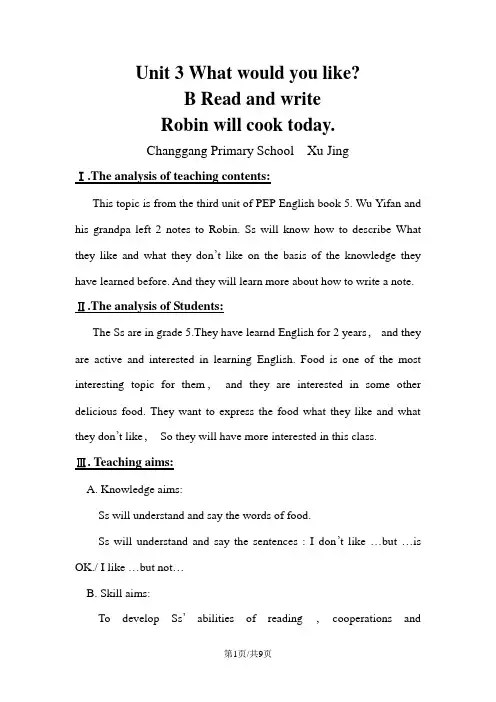
Unit 3 What would you like?B Read and writeRobin will cook today.Changgang Primary School Xu JingⅠ.The analysis of teaching contents:This topic is from the third unit of PEP English book 5. Wu Yifan and his grandpa left 2 notes to Robin. Ss will know how to describe What they like and what they don’t like on the basis of the knowledge they have learned before. And they will learn more about how to write a note. Ⅱ.The analysis of Students:The Ss are in grade 5.They have learnd English for 2 years,and they are active and interested in learning English. Food is one of the most interesting topic for them,and they are interested in some other delicious food. They want to express the food what they like and what they don’t like,So they will have more interested in this class.Ⅲ. Teaching aims:A. Knowledge aims:Ss will understand and say the words of food.Ss will understand and say the sentences : I don’t like …but …is OK./ I like …but not…B. Skill aims:To develop Ss’abilities of reading ,cooperations andcommunications with others.C. Emotion aims:Ss will love their life and get more interests in learning English. Ⅳ.Teaching points:A. Important points:The understanding of the words about food and the sentences: My favourite food is. It’s/they’re…;I don’t like beef but chicken is OK;I like vegetables but not carrots.B. Difficult points:The writing of a note about what they like or don’t like.Ⅴ. Teaching aims:CAI,PPT and some pictures of food.Ⅵ. Teaching methods:TPR,situational teaching method,reading teaching methods. Ⅶ. Teaching procedures:Step4:Assessment1. Say goodbye.2.Homework1.Read p. 29.2.Try to write about yourfather or mother’s note toRobin.Read and interviewtheir fathers andmothers.Write a note toconsolidate.通过了解父母的喜好培养学生的分享意识,令他们更加期待下节英语课的到来。
Unit 3 What would you like?教学教案-小学英语五年级上册-人教PEP版
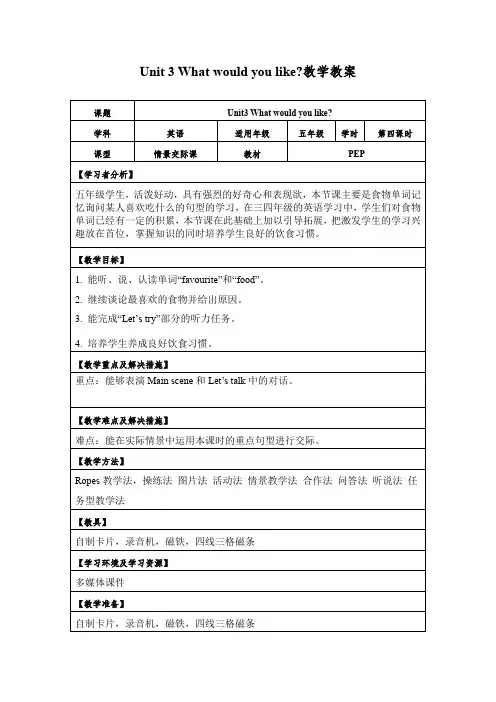
Unit 3 What would you like?教学教案to have a party on Christmas Day .Ask your friends about their faourite food and drink.为了引出新知师设计了一个情景,假装自己口渴了,想喝水:I’m thirsthy,Can I have some water?Water is my favourite drink.How about Zhang Peng?What is his favourtie drink?Let’s listen.从而引出Let’s try的内容,再完成练习。
教学Let’s talk 部分时,由Let’s try部分过渡,师是这样过渡的T:We know Zhang Peng’s favourite drink is grape juice.What’s his favourite food? Let’s listen.然后播放听力录音,听录音回答问题。
1.What’s Zhang Peng’s favourite food?2.What’s Sarah’s favourite food?听读课文之后,为了提升学生的语言运用及表达能力,我设计了Choose your buffet的活动。
Choose your buffet 选择你的自助餐( A or B or C )A餐. Read the dialogue correctly and fluently.准确流利的朗读对话★B餐. Recite your dialogue 背诵对话★ ★C餐. Make a dialogue and act out 编对话并表演★ ★ ★让学生两人一组,选择自助餐,分层教学。
学生根据自己的认知水平自主选择,表演非常积极,收到了预期的效果。
并且很多学生都愿意尝试自己编对话并表演。
在最后的拓展,完成任务环节,孩子们以四人小组谈论自己喜欢的食物和饮料。
五年级上册英语教案Unit 3 What would you like? B Read and write 人教PEP
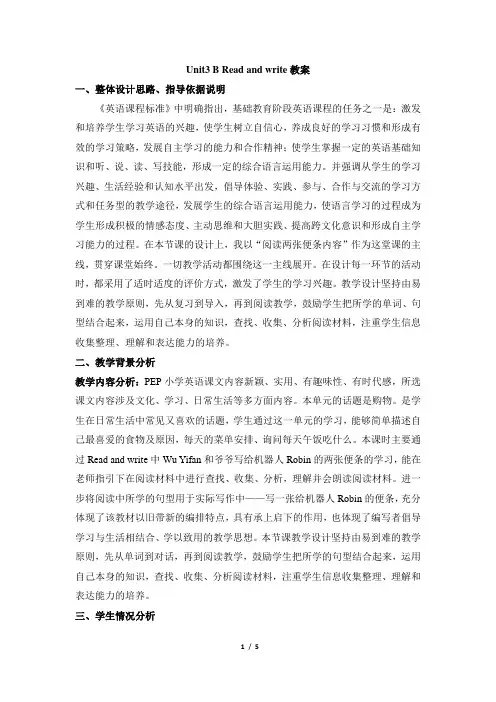
Unit3 B Read and write教案一、整体设计思路、指导依据说明《英语课程标准》中明确指出,基础教育阶段英语课程的任务之一是:激发和培养学生学习英语的兴趣,使学生树立自信心,养成良好的学习习惯和形成有效的学习策略,发展自主学习的能力和合作精神;使学生掌握一定的英语基础知识和听、说、读、写技能,形成一定的综合语言运用能力。
并强调从学生的学习兴趣、生活经验和认知水平出发,倡导体验、实践、参与、合作与交流的学习方式和任务型的教学途径,发展学生的综合语言运用能力,使语言学习的过程成为学生形成积极的情感态度、主动思维和大胆实践、提高跨文化意识和形成自主学习能力的过程。
在本节课的设计上,我以“阅读两张便条内容”作为这堂课的主线,贯穿课堂始终。
一切教学活动都围绕这一主线展开。
在设计每一环节的活动时,都采用了适时适度的评价方式,激发了学生的学习兴趣。
教学设计坚持由易到难的教学原则,先从复习到导入,再到阅读教学,鼓励学生把所学的单词、句型结合起来,运用自己本身的知识,查找、收集、分析阅读材料,注重学生信息收集整理、理解和表达能力的培养。
二、教学背景分析教学内容分析:PEP小学英语课文内容新颖、实用、有趣味性、有时代感,所选课文内容涉及文化、学习、日常生活等多方面内容。
本单元的话题是购物。
是学生在日常生活中常见又喜欢的话题,学生通过这一单元的学习,能够简单描述自己最喜爱的食物及原因,每天的菜单安排、询问每天午饭吃什么。
本课时主要通过Read and write中Wu Yifan和爷爷写给机器人Robin的两张便条的学习,能在老师指引下在阅读材料中进行查找、收集、分析,理解并会朗读阅读材料。
进一步将阅读中所学的句型用于实际写作中——写一张给机器人Robin的便条,充分体现了该教材以旧带新的编排特点,具有承上启下的作用,也体现了编写者倡导学习与生活相结合、学以致用的教学思想。
本节课教学设计坚持由易到难的教学原则,先从单词到对话,再到阅读教学,鼓励学生把所学的句型结合起来,运用自己本身的知识,查找、收集、分析阅读材料,注重学生信息收集整理、理解和表达能力的培养。
人教pep五年级上册英语 《Unit3 What would you like》 教案 (1)

Unit3 What would you like?教学目标:1.能听、说、读、写新单词tea、salad、sandwich、hamburger、ice cream2.能灵活运用句型What would you like to eat / drink? I’d like a/an/some.....询问与回答。
3.能够完成role-play部分的内容。
教学重难点:学习新单词并且灵活运用句型。
教学准备:单词图片、PPT、视频教法讲授法、情景教学法、活动教学法教学过程Step1:Warming-upHave a free talk and enjoy a video---What would you like to eat?Fruit song.T: OK ,class begin.Good morning ,class!Ss: Good morning,Miss Y uan!T: Ok, sit down,please.Ss: Thank you.T: Today,we’ll learn Unit3 what would you like?Part A,let’s learn. So,a re you ready?Ok, let’s go! First, let’s enjoy a video--What would youlike to eat?Fruit song. You can sing after it.T: Ok, the song is very interesting,right?What would you like to eat?Who can tell me? (Invite two students to share the answers)Step 2: PresentationNow, look at the screen, there are many delicious food. Do you know them?Oh,I’m hungry,are you hungry? (欣赏一些美食的图片)Step3:New lesson1、T: Look at the picture in my hands. What’s this in English? Do you know?(然后用PPT呈现茶的单词和图片,教读单词,把茶的卡片贴到黑板上,老师板书单词,学生伸出手指和老师一起拼写单词)T:There are two common kinds:red tea and green tea.(给学生讲解茶在日常生活中主要有两种类型)2、用以上卡片和PPT的形式教学salad,并且告诉学生salad主要有两种:vegetable salad and fruit salad.3、T: Look at this one,who can speak it in English?(拿着三明治的图片请知道的同学起来说出它的英语名称)然后教学sandwich4、T:Now, let’s enjoy a video. (播放汉堡包的动画视频,让学生观看,从而引出hamburger的学习)5、T:OK,the last one. It’s my favourite, It’s sweet. I like sweet food. Can you guess?(引出ice cream的学习,并告诉学生我们不能吃太多甜食)6、观看教材同步的视频动画,第一遍让学生认真听,第二遍让学生小声跟读。
人教版(PEP)英语五年级上册《Unit3whatwouldyoulike》教学设计2

人教版(PEP)英语五年级上册《Unit 3 what would you like》教学设计2一. 教材分析人教版(PEP)英语五年级上册《Unit 3 What would you like》主要围绕着日常饮食和喜好展开,通过学习本单元,学生能够掌握一些关于食物和饮料的词汇,如:chicken, rice, noodles, vegetable, juice等,同时学会用“What would you like?”和“I would like …”进行日常交流。
本节课为单元第二课时,教材内容丰富,贴近学生生活,有利于激发学生的学习兴趣和参与欲望。
二. 学情分析五年级的学生已经掌握了基本的英语语法和单词,具备一定的听说读写能力。
他们在生活中对饮食和喜好有了一定的认知,因此在学习本单元时能够较快地理解和掌握相关词汇和句型。
但部分学生对英语学习的兴趣有待提高,因此教师需要设计有趣的教学活动来吸引他们的注意力。
三. 教学目标1.知识目标:学生能够听懂、会说、会读本节课的重点词汇和句型,如:chicken, rice, noodles, vegetable, juice等,以及能够用“What would you like?”和“I would like …”进行日常交流。
2.能力目标:通过小组合作、角色扮演等活动,提高学生的口语表达能力和团队协作能力。
3.情感目标:培养学生对英语学习的兴趣,激发他们积极参与课堂活动的热情。
四. 教学重难点1.重点:本节课的重点是让学生掌握关于食物和饮料的词汇,以及能够用“What would you like?”和“I would like …”进行日常交流。
2.难点:学生需要能够在实际情境中正确运用所学词汇和句型进行交流。
五. 教学方法1.任务型教学法:通过设计各种实际情境,让学生在完成任务的过程中运用所学知识。
2.情境教学法:创设生活情境,让学生在真实的环境中学习英语。
五年级上册英语教案Unit3 What would you like A let’s talk∣人教版(PEP)

Unit 3What would you like? Part ALet’s talk我国古代的读书人,从上学之日起,就日诵不辍,一般在几年内就能识记几千个汉字,熟记几百篇文章,写出的诗文也是字斟句酌,琅琅上口,成为满腹经纶的文人。
为什么在现代化教学的今天,我们念了十几年书的高中毕业生甚至大学生,竟提起作文就头疼,写不出像样的文章呢?吕叔湘先生早在1978年就尖锐地提出:“中小学语文教学效果差,中学语文毕业生语文水平低,……十几年上课总时数是9160课时,语文是2749课时,恰好是30%,十年的时间,二千七百多课时,用来学本国语文,却是大多数不过关,岂非咄咄怪事!”寻根究底,其主要原因就是腹中无物。
特别是写议论文,初中水平以上的学生都知道议论文的“三要素”是论点、论据、论证,也通晓议论文的基本结构:提出问题――分析问题――解决问题,但真正动起笔来就犯难了。
知道“是这样”,就是讲不出“为什么”。
根本原因还是无“米”下“锅”。
于是便翻开作文集锦之类的书大段抄起来,抄人家的名言警句,抄人家的事例,不参考作文书就很难写出像样的文章。
所以,词汇贫乏、内容空洞、千篇一律便成了中学生作文的通病。
要解决这个问题,不能单在布局谋篇等写作技方面下功夫,必须认识到“死记硬背”的重要性,让学生积累足够的“米”。
教学目标与要求教师范读的是阅读教学中不可缺少的部分,我常采用范读,让幼儿学习、模仿。
如领读,我读一句,让幼儿读一句,边读边记;第二通读,我大声读,我大声读,幼儿小声读,边学边仿;第三赏读,我借用录好配朗读磁带,一边放录音,一边幼儿反复倾听,在反复倾听中体验、品味。
1.能理解Let’s try部分的听力内容,完成填空语文课本中的文章都是精选的比较优秀的文章,还有不少名家名篇。
如果有选择循序渐进地让学生背诵一些优秀篇目、精彩段落,对提高学生的水平会大有裨益。
现在,不少语文教师在分析课文时,把文章解体的支离破碎,总在文章的技巧方面下功夫。
人教版(PEP)五年级上册英语 第三单元Unit3 What would you like Part
Unit 3 What would you like Part B Read and write教案教学目标:1.能够用My favourite drink is…I don’t like…but…is OK.I like vegetables but not…以及…are my favourite vegetables谈论自己对各种食物的喜好.2.能够在图片的帮助下读懂两张便条,完成读后选图活动。
3.能够在语境中填充单词完成一张留给Robin的便条。
4.学生能够进一步提高从阅读中提取信息的能力。
教学重点:学生能够理解便条的内容,完成课后选图活动,并在情境中完成个性化书写活动。
教学难点:学生能够进行个性化书写活动并按能意群阅读。
Warm-up1.Greeting2.Enjoy a song < Do you like broccoli ice cream?>Pre-reading1.My favourite food is…句型操练利用歌曲末尾图片T:Do you like broccoli ice cream/donut juice/banana soup/pop corn pizza?Ss:yucky Do you like these food(呈现食物模型)What’s your favourite food?it is/They are…OK let’s eat.1.VegetableI like vegetables but not…句型操练Lead-in:T:Which one is healthy Ss: Salad T:What’s in it? Ss: vegetable. T: Do you like vegetables? Ss: I like vegetables but not…(facial expression)How about you?学生练习句型I like vegetables but not…PPT(carrots, tomatoes, potatoes, green beans, onions)…are my favourite vegetables过渡:I know you don’t like…but what’s you favourite food?引导学生说出…are my favorite vegetable. T: Why?Ss: They are…2.MeatI don’t like__________ but ________ is OK.过渡:Vegetable is healthy fresh and delicious. What about meat?Do you like fish/chicken/fish/pork/mutton?PPT I don’t like mutton but chicken is OK.提醒学生用手的动作来表示不喜欢和OK。
人教PEP小学英语五年级上册Unit3 What would you like?教案
Unit3 B Read and write教案一、目标解读《英语课程标准》中明确指出,基础教育阶段英语课程的任务之一是:激发和培养学生学习英语的兴趣,使学生树立自信心,养成良好的学习习惯和形成有效的学习策略,发展自主学习的能力和合作精神;使学生掌握一定的英语基础知识和听、说、读、写技能,形成一定的综合语言运用能力。
并强调从学生的学习兴趣、生活经验和认知水平出发,倡导体验、实践、参与、合作与交流的学习方式和任务型的教学途径,发展学生的综合语言运用能力,使语言学习的过程成为学生形成积极的情感态度、主动思维和大胆实践、提高跨文化意识和形成自主学习能力的过程。
在本节课的设计上,我以“阅读两张便条内容”作为这堂课的主线,贯穿课堂始终。
一切教学活动都围绕这一主线展开。
在设计每一环节的活动时,都采用了适时适度的评价方式,激发了学生的学习兴趣。
教学设计坚持由易到难的教学原则,先从复习到导入,再到阅读教学,鼓励学生把所学的单词、句型结合起来,运用自己本身的知识,查找、收集、分析阅读材料,注重学生信息收集整理、理解和表达能力的培养。
二、单元分析本单元的话题是购物。
是学生在日常生活中常见又喜欢的话题,学生通过这一单元的学习,能够简单描述自己最喜爱的食物及原因,每天的菜单安排、询问每天午饭吃什么。
本课时主要通过Read and write中Wu Yifan和爷爷写给机器人Robin的两张便条的学习,能在老师指引下在阅读材料中进行查找、收集、分析,理解并会朗读阅读材料。
进一步将阅读中所学的句型用于实际写作中——写一张给机器人Robin的便条,充分体现了该教材以旧带新的编排特点,具有承上启下的作用,也体现了编写者倡导学习与生活相结合、学以致用的教学思想。
本节课教学设计坚持由易到难的教学原则,先从单词到对话,再到阅读教学,鼓励学生把所学的句型结合起来,运用自己本身的知识,查找、收集、分析阅读材料,注重学生信息收集整理、理解和表达能力的培养。
Unit 3 What would you like单元整体教学设计表格式人教PEP版英语五年级上册
项目内容主题语境人与自我人与社会人与自然单元话题What would you like修改后单元话题Choose h ealthy food,en j oy healthy life功能意念交往情感态度其他如:询问与介绍育人价值通过本单元的学习,能够运用所学单词和短语描述自己喜欢吃的食物及口味,学会点餐,了解中西方饮食方面的文化差异。
在学习过程中培养学生健康的饮食习惯,坚持绿色生活,合理点餐,杜绝浪费。
通过单元学习,树立健康、均衡的饮食意识;体验中华饮食文化。
What would you like?—小学英语单元整体设计英语PEP 五年级(上)板块性质板块功能页码名称具体内容核心板块呈现核心句型P. 24 A L et’s talk核心句型:What would you like to eat/drin k?I’d like...呈现核心词汇P.25 A L et’s l earn 核心词汇:tea,ice cream,hamb urger,salad,sandwich呈现字母组合发音P. 26A L et’s spel l字母组合ow 的发音规则,即ow 在单词中发/aʊ/或/əʊ/。
呈现核心句型P. 27 B L et’s talk核心句型:What’s your favourite food/ drin k? Ilove...呈现核心词汇P.28 B L et’s l earn 核心词汇:fresh,healthy,delicious,hot,sweet 读写技能训练P.29B Read andwrite阅读语篇:Robin will cook today完成个性化的书写活动。
次核心板块听说技能训练P. 24 A L et’s t ry 听音填空。
听说技能训练P. 27 B L et’s try听音连线。
语法技能小结P.30 B L et’swrap i t up名词单复数的用法。
阅读技能训练P.31 C Story t ime 选学故事:Zoom 和Zip在农场摘菜做菜。
五年级上册英语教案- Unit3 What would you like_ A1 人教pep
能询问别人想吃(喝)些什么并作出相应的回答。
难点
能灵活运用所学句型聊关于“饮食”的话题。
教学过程
教学环节
教师活动
学生活动
设计意图
导入新课
1.Let’s chant:What would you like to eat?
2.What’s in the fridge?
教师请学生猜猜看冰箱里有什么,帮助学生复习之前学过的食物类图片.
3.看中文,快速说出英文!
4.Review
What would you like to eat/drink?
边听边唱
说单词
对话练习
利用游戏,刺激学生回顾所学的有关食物和饮品的单词,复习旧知,为新课的学生做铺垫。
讲授新课
Let’s try
(1)明确听力任务
T:Sarah is hungry. What would she like to eat? Listen and fill in the blanks.
S1:I'd like beef noodles, hamburgers, hot dogs and ice cream.
听音
正音
对话练习
创编对话
看视频
完成活动
表演汇报
训练学生的听,让学生去听地道的英语发音,在听与模仿这个输入过程后,让学生去自己读,查漏补缺,正确输出。
课堂小结
What have you learned today?
1>What would Sarah’s father like to eat?
2> What
2.Watch and answer
核对答案。
3.Listen again and answer: