
人教版八年级下册英语语法解析知识重点总结
新目标英语八年级(下)重点短语及句型总Unit 1 Will people have robots?1. fewer people 更少的人(fewer 修饰名词复数,表示否定)2. less free time 更少的空闲时间(less 修饰不可数名词,表示否定)3. in ten years 10年后(in 的时间短语用于将来时,提问用 How soon)4. fall in love with … 爱上……例:When I met Mr. Xu for the first time, I fell inlove with him at once.当我第一次见到许老师,我立刻爱上他。
5. live alone 单独居住6. feel lonely 感到孤独(比较:live alone/ go alone 等)The girl walked alone along the street, but shedidn't feel lonely.那女孩独自沿着街道走,但她并不感到孤独。
7. keep/ feed a pet pig 养一头宠物猪8. fly to the moon 飞上月球9. hundreds of + 复数数百/几百(概数,类似还有 thousands of;millions of)10. the same as 和……相同11. A be different from B A与B不同(= There is a difference/ Thgere are differences between A and B)12. wake up 醒来 (wake sb. up 表示“唤醒某人”)13. get bored 变得厌倦(get/ become 是连系动词,后跟形容词如 tired/angry/ excited 等)14. go skating 去滑冰(类似还有 gohiking/ fishing /skating/ bike riding 等)15. lots of/ a lot of 许多(修饰可数名词、不可数名词都可以)16. at the weekends 在周末17. study at home on computers 在家通过电脑学习18. agree with sb. 同意某人(的意见)19. I don't agree. = I disagree. 我不同意。
20. on a piece of paper 在一张纸上(注意 paper/ information/ news/ work/ homework/housework 等常考到的不可数名词)21. on vacation 度假22. help sb with sth/help sb do sth. 帮助某人做某事23. many different kinds of goldfish 许多不同种金鱼24. live in an apartment 住在公寓里;live on the twelfthfloor 住在12楼25. live at NO.332,Shanghai Street 住在上海路332号26. as a reporter 作为一名记者27. look smart 显得精神/看起来聪明28. Are you kidding? 你在骗我吗?29. in the future 在将来/在未来30. no more = not … anymore 不再(强调多次发生的动作不再发生)31. no longer = not … any longer 不再(强调状态不再发生)32. besides(除……之外还,包括)与except = but(除……之外,不包括)33. be able to 与 can 能;会(be able to 用于各种时态,而 can只能用于一般现在时态和一般过去时态中;have to 用于各种时态,而 must只能用于一般现在时态)例如:① I have been able to/ will be able to speaktwo languages. (不可以用 can)② had to stay at home/ will have to (不可以用 must)34. be big and crowded 大而且拥挤34. be in college 在上大学35. live on a space station 住在空间站36. dress casually 穿得很随意;casual clothing 休闲服饰37. win the next World Cup 赢得世界杯;win award 获奖38. come true 变成现实39. take hundreds of years 花几百年的时间40. be fun to watch 看起来有趣41. over and over again 一次又一次42. be in different shapes 形状不同43. twenty years from now 今后20年本单元目标句型:1. What do you think life will be like in 1000years?2. There will be fewer trees、more buildings andless pollution in the future.fewer;less 表示否定之意,分别修饰可数名词和不可数名词;more 二者都可以修饰。
3. Will kids go to school? No, they won't/ Yes,they will。
4. Predicting the future can be difficult.5. I need to look smart for my job interview.6. I will be able to dress more casually.7. I think I'll go to Hong Kong on vacation, andone day I might even visit Australia.8. What will teenagers do for fun twenty yearsfrom now?9. That may not seem possible now, but computers,space rockets and even electrictoothbrushes seemed impossible a hundred yearsago.本单元语法讲解:一般将来时1. 表示将要发生的动作或存在的状态。
本时态标志词:①含 tomorrow; next 短语;② in + 段时间;③ how soon;④ by + 将来时间;⑤by the time sb. do …;⑥祈使句句型中:or/and sb. will do;⑦在时间/条件状语从句中,如果从句用一般现在时,主句用将来时;⑧ another day比较 be going to 与 will:be going to 表示近期、眼下就要发生的事情,will 表示的将来时间则较远一些。
如:He is going to write a letter tonight. He willwrite a book one day.2. be going to 表示根据主观判断将来肯定发生的事情,will表示客观上将来势必发生的事情。
He is seriously ill. He is going to die. Hewill be twenty years old.3. be going to 含有“计划,准备”的意思,而 will 则没有这个意思,如:She is going to lend us her book. He will behere in half an hour.4. 在有条件从句的主句中,一般不用 be going to, 而多用 will。
如:If any beasts comes at you, I'll stay with you and help you.掌握了它们的这些不同,你就能很好的区分 be going to 与 will 了。
一般将来时常见的标志词①含 tomorrow; next 短语;② in + 段时间;③ how soon;④ by + 将来时间;5. 祈使句句型中:or/ and sb. will do例:Be quick, or you will be late = If you don't be quick, you will be late6. 在时间/条件状语从句中,如果从句用一般现在时,主句用将来时Unit 2 What should I do?1. too loud 太大声2. out of style 过时的3. in style 流行的4. call sb. up = ring sb. up = call/ ring/ phonesb. 给……打电话5. enough money 足够的钱(enough 修饰名词时不必后置)6. busy enough 够忙 (enough 修饰形容词或副词时必须后置)7. a ticket to/ for a ball game 一张球赛的门票注意:the key to the lock/ the key (answer) to thequestion)/ the solution to the problem.此处几个短语不能用 of 表示所有格8. talk about 谈论9. on the phone 用电话10. pay for 付款11. spend … on +sth. = spend … ( in) doing sth. 在……花钱12. It takes sb. sometime to do sth. 某人做某事花……的时间13. borrow … fr om 从……借( 借进来)14. lend … to 把……借给(借出去)15. You can keep the book for a week 你可以借这本书一周。
(不用 borrow 或 lend)16. buy sth. for sb. 为……买东西17. tell sb. to do/ not to do sth. 告诉某人做某事18. want sb. to do sth. = would like sb. to do 想某人做某事19. find out 发现;查清楚;弄明白20. play one's stereo 放录象21. fail the test = not pass the test 考试不及格22. fail in (doing) sth. …在……上失败,变弱23. succeed in (doing) sth. 在……方面成功24. write sb a letter/write to sb. 给某人写信25. surprise sb. 使某人吃惊(类似有:surprise/ interest/please/ amaze + 某人)26. to one's surprise 使某人吃惊的是……27. to one's joy 使某人高兴的是……28. look for a part-time job 找一份兼职的工作(不一定有结果)29. get/ find a part-time job 找到一份兼职的工作(有结果)30. ask sb. for … 寻求/向某人要某物31. have a bake sale 卖烧烤32. argue with sb = have an argument with sb.与某人争吵33. have a fight with sb. = fight with 与某人打架34. drop off 离去;散去;逐渐减少;死去35. prepar e for … = get ready for … 为……做准备36. after-school clubs (activities) 课外俱乐部(活动)be/ get used to doing 习惯做某事used to do 过去经常/常常做某事be used for doing = be used to do sth. 被用于做某事37. fill … up 填补;装满……;be full of 装满38. return sth. to sb. = give sth. back to sb. 把某物归还给某人39. get on/ along well with 与…相处很好40. all kinds of 各种各样41. as much as possible = as much as you can 尽可能多42. take part in = join in 参加(某种活动/集会)43. a bit = a little 一点儿(当修饰形容词或比较级时)44. a bit of = a little 一点儿/一些(当修饰不可数名词时)45. be angry with … 生……的气46. by oneself = on one's own 某人自己/独自地47. on the one hand 一方面48. on the other hand 另一方面49. I find/ feel/ think it difficult to do …我发现/感到/认为做某事很难。
人教版八年级下册英语Unit 10 知识点语法归纳总结
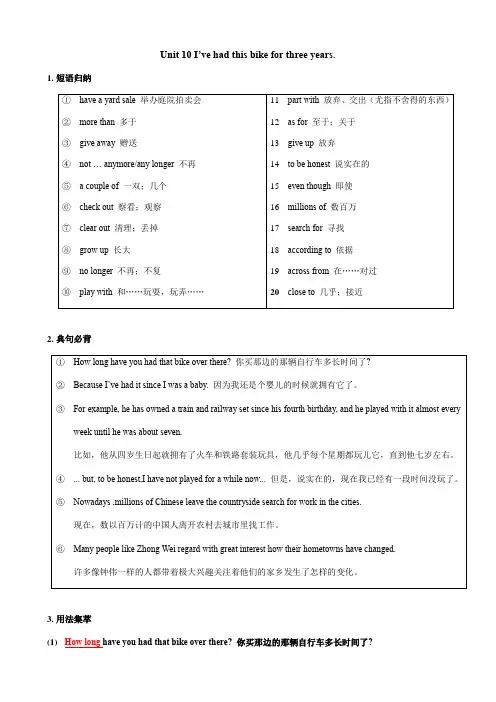
Unit 10 I’ve had this bike for three years.1.短语归纳2.典句必背3.用法集萃(1)How long have you had that bike over there? 你买那边的那辆自行车多长时间了?❖本句是how long引导的特殊疑问句,时态是现在完成时,结构是“How long+have/has+主语+过去分词+其他?”。
how long表示“多长时间”,对时间段进行提问。
例:—How long have you lived in Beijing?—For ten years. 十年了。
辨析:how often, how soon, how long, how far(2)Because I’ve had it since I was a baby. 因为我还是个婴儿的时候就拥有它了。
❖since是连词,意为“自从;...以来”,引导时间状语从句,从句多用一般过去时,主句多用现在完成时。
例:He has skated for quite some time since we came here. 自从我们来到这儿,他已经滑冰很长时间了。
She has been living a hard life since her husband died. 自从她丈夫死后,她一直过着艰苦的生活。
❖拓展since还可以用作介词,后接名词或名词短语。
例:He’s been off work since Tuesday. 自星期二以来他一直没上班。
(3)For example, he has owned a train and railway set since his fourth birthday, and he played with italmost every week until he was about seven.比如,他从四岁生日起就拥有了火车和铁路套装玩具,他几乎每个星期都玩儿它,直到他七岁左右。
英语八下人教版重点语法
英语八下人教版重点语法
英语八下人教版的重点语法包括:
1.过去完成时(Past Perfect Tense):用来表示在过去某个时间或动作之前已经发生或完成的动作。
例如:I had already
finished my homework before my mom came back.
2.时间状语从句(Time clauses):用来表示时间关系的从句,一般以when,as soon as,until,before,after等引导。
例如:We will go to the park when it stops raining.
3.条件状语从句(Conditional clauses):用来表示假设条件的从句,一般以if引导。
例如:If it rains tomorrow, we will stay at home.
4.动词不定式(Infinitives):用来表示目的、原因、建议等。
例如:I went to the store to buy some groceries.
5.被动语态(Passive voice):用来强调动作的承受者而不是执行者。
例如:The cake was made by my mom.
6.定语从句(Relative clauses):用来修饰名词或代词的从句,一般由关系代词who,which,that引导。
例如:The boy who won
the competition is my neighbor.
这些语法结构在英语八下人教版教材中经常出现,需要学生掌握
和应用。
希望以上回答能对您有帮助。
(完整版)人教版英语八年级下册重点词组、句型及语法点汇总,推荐文档

13.be back 回来14.be angry with sb 生某人的气15.throw down 扔下16.the minute=as soon as 一…就…e over 过来18.sit down 坐下19.take sb. for a walk 带某人去散步20.all the time 频繁;反复21.all day / evening 整日/夜22.shout back 大声回应23.walk away 走开24.in surprise 惊讶地25.share the housework 分担家务26.hang out 闲逛27.do chores 做杂务28.go to the store 去商店29.buy drinks and snacks 买饮料和点心30.make sb. do sth. 使某人做某事31.have enough stress from 有来自…足够的压力32.a waste of time 浪费时间33.in order to 为了34.get good grades 取得好成绩35.depend on 依赖;依靠36.have no idea 不知道37.develop children’s independence 发展孩子独立性38.look after=take care of 照顾;照看39.as a result 结果40.agree with sb 同意某人的观点/意见disagree with sb 不同意某人的观点/意见二、常见搭配1.finish doing sth. 完成做某事2.a few “几个”,后接可数名词复数few “很少,几乎没有”,后接可数名词复数a little “一点儿”,后接不可数名词little “很少,几乎没有”,后接不可数名词3.1> question “问题”,需要回答的问题,与ask或answer 搭配2> problem “问题”,需要解决的问题,与solve 搭配in the front of “在…前面”,在所说范围之内5.as…as… “与…一样…”,中间加形容词或副词原级,。
新版人教版八年级下英语语法重点归纳(全)
新版人教版八年级下英语语法重点归纳(全)一、名词名词是指用来表示人、事物、地方、动物等的名称的词语。
名词分为可数名词和不可数名词。
可数名词有单数和复数两种形式,而不可数名词只有单数形式。
- 可数名词:表示单数时,名词前面通常有冠词a/an或者其它数量词进行修饰;表示复数时,名词通常要在词尾加“s”。
- 不可数名词:不可数名词表示的是无法分为个体的物体、概念、抽象事物等,通常不能用于复数形式。
二、动词动词表示人或物的动作、行为、状态或存在的词语。
动词分为及物动词和不及物动词。
- 及物动词:及物动词后面可以直接接宾语,表示动作的承受者或影响对象。
- 不及物动词:不及物动词不能直接接宾语,它可以后面接副词或介词短语,表示动作发生的方式、状态等。
三、形容词形容词是用来描述名词性词语的词语。
它可以表示人或物的性质、状态、特征、颜色等。
- 形容词可以修饰名词,放在名词的前面。
- 形容词还可以通过加后缀“-er”和“-est”来比较级和最高级。
四、副词副词是用来修饰动词、形容词和其他副词的词语。
副词可以表示时间、地点、方式、程度、频率等。
- 副词在句中通常位于动词、形容词或者其他副词的前面。
- 副词的比较级和最高级可以通过在前面加上more和most来表示。
五、代词代词是用来代替名词或名词性的词语的词语。
代词可以分为人称代词、指示代词、疑问代词、不定代词等。
- 人称代词表示人的身份或人称,包括主格和宾格两种形式。
- 指示代词用来指示特定的人或物,可以表示近处的、远处的或已提到的事物。
- 疑问代词用于提问,通常用来询问人或事物的身份、性质、数量等信息。
- 不定代词用来指代不特定或泛指的人或物,表示数量或程度。
六、冠词冠词是位于名词前面用来修饰名词的词语。
冠词分为定冠词和不定冠词。
- 定冠词指特指某一具体的人或事物,有两种形式:定冠词“The”用于表示特定的人或物,而不定冠词“A/An”用于泛指任意的人或物。
七、介词介词是用来表示人或物之间关系的词语。
人教版八年级下册英语重点语法知识全汇总
人教版|八年级下册英语重点语法知识全汇总重点语法:一般将来时态的应用do/does 的一般将来时态形式:(shall/will) dodo/does 的一般将来时态的被动语态:(shall/will) be done 一般将来时态的肯定句、否定句、疑问句形式:肯定句例句:People will have robots in a few years. 否定句例句:People (will not/won't) have robots in a few years. 一般疑问句例句:Will people have robots in a few years? 特殊疑问句例句:What will people have in a few years?重点语法:过去将来时一、过去将来时的结构should/would+ 动词原形do/does 的过去将来时态形式:(should/would) do do/does 的过去将来时态的被动语态:(should/would) be done 过去将来时态的肯定句、否定句、疑问句形式:You should write a letter to him.肯定句例句:否定句例句:You shouldn't write a letter to him.一般疑问句例句:Should I write a letter to him?特殊疑问句例句:What should I do?重点语法:过去进行时do/does 的过去进行时态形式:(was/were) doingdo/does 的过去进行时态的被动语态:(was/were) being done 过去将来时态的肯定句、否定句和疑问句形式:I was walking down the street when a UFO landed.肯定句例句:否定句例句:I wasn't walking down the street when a UFO landed.一般疑问句例句:Were you walking down the street when a UFO landed?特殊疑问句例句:What were you doing when a UFO landed?动词when 和while 的选择:when 后加瞬间动词,while 后加延续性动词。
人教版八年级英语下册各知识点归纳总结(最新最全)
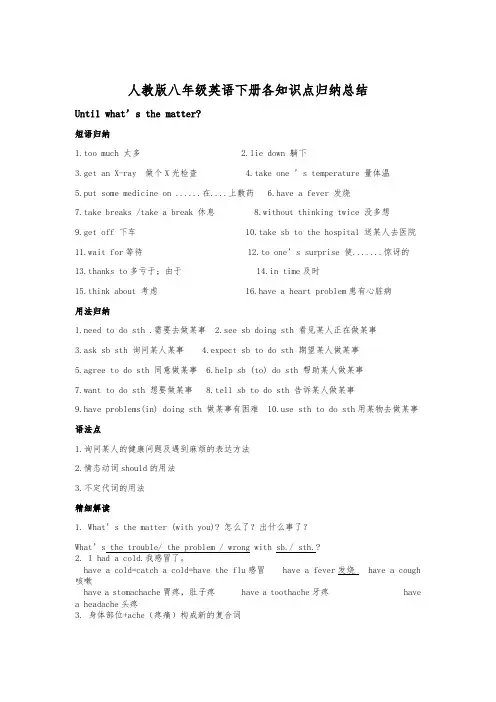
人教版八年级英语下册各知识点归纳总结Unti1 what’s the matter?短语归纳1.too much 太多2.lie down 躺下3.get an X-ray 做个X光检查4.take one ’s temperature 量体温5.put some medicine on ......在....上敷药6.have a fever 发烧7.take breaks /take a break 休息 8.without thinking twice 没多想9.get off 下车 10.take sb to the hospital 送某人去医院11.wait for等待 12.to one’s surprise 使.......惊讶的13.thanks to多亏于;由于 14.in time及时15.think about 考虑 16.have a heart problem患有心脏病用法归纳1.need to do sth .需要去做某事2.see sb doing sth 看见某人正在做某事3.ask sb sth 询问某人某事4.expect sb to do sth 期望某人做某事5.agree to do sth 同意做某事6.help sb (to) do sth 帮助某人做某事7.want to do sth 想要做某事 8.tell sb to do sth 告诉某人做某事9.have problems(in) doing sth 做某事有困难 e sth to do sth用某物去做某事语法点1.询问某人的健康问题及遇到麻烦的表达方法2.情态动词should的用法3.不定代词的用法精细解读1. What’s the matter (with you)? 怎么了?出什么事了?What’s the trouble/ the problem / wrong with sb./ sth.?2. I had a cold.我感冒了。
人教版英语八年级下册第五单元语法重点
人教版英语八年级下册第五单元语法重点本文档将重点介绍人教版英语八年级下册第五单元的语法知识。
以下是本单元的主要语法重点:一. 一般过去时一般过去时用来描述过去发生的动作或状态。
一般过去时的构成如下:1. 肯定句结构主语 + 动词过去式 + 其他例如:- I played basketball yesterday.- He watched a movie last night.2. 否定句结构主语 + did not + 动词原形 + 其他例如:- I did not play basketball yesterday. - He did not watch a movie last night.3. 疑问句结构Did + 主语 + 动词原形 + 其他?例如:- Did you play basketball yesterday? - Did he watch a movie last night?二. 现在进行时现在进行时用来描述目前正在发生的动作。
现在进行时的构成如下:1. 肯定句结构主语 + am/is/are + 动词-ing + 其他例如:- She is reading a book now.- We are playing soccer at the moment.2. 否定句结构主语 + am not/is not/are not + 动词-ing + 其他例如:- She is not reading a book now.- We are not playing soccer at the moment.3. 疑问句结构Am/is/are + 主语 + 动词-ing + 其他?例如:- Is she reading a book now?- Are we playing soccer at the moment?三. 过去进行时过去进行时用来描述过去某一时刻正在进行的动作。
过去进行时的构成如下:1. 肯定句结构主语 + was/were + 动词-ing + 其他例如:- They were studying English at 8 p.m. yesterday.- He was playing video games when I called him.2. 否定句结构主语 + was not/were not + 动词-ing + 其他例如:- They were not studying English at 8 p.m. yesterday. - He was not playing video games when I called him.3. 疑问句结构Was/were + 主语 + 动词-ing + 其他?例如:- Were they studying English at 8 p.m. yesterday?- Was he playing video games when I called him?以上是人教版英语八年级下册第五单元的语法重点。
英语八下语法知识点人教版
以下是一些人教版八年级下册的英语语法知识点:
1. 情态动词的使用:如“will,can,should,may”等。
2. 现在完成时的理解与运用:表示过去发生的动作对现
在造成的结果。
3. 现在进行时的理解与运用:表示正在进行的动作或存
在的状态。
4. 动词不定式的理解与运用:表示未来的动作或存在的
状态。
5. 形容词和副词的比较级和最高级:如“more,less,least,most”等。
6. 被动语态的理解与运用:表示主语是动作的承受者。
7. 宾语从句的理解与运用:在句子中充当宾语的成分。
8. 状语从句的理解与运用:修饰动词、形容词、副词等。
9. 祈使句的理解与运用:表示请求、命令、建议等。
10. 反意疑问句的理解与运用:表示对陈述部分的肯定或
否定。
这些知识点都是学习英语语法的基础,需要同学们在学习
中不断练习和巩固。
如果有任何不理解的地方,可以向老师
或同学寻求帮助。
英语八下人教版重点语法
英语八下人教版重点语法英语学习中,语法是非常重要的一部分。
掌握好语法规则,不仅能够提高学生的语言表达能力,还能够帮助学生更好地理解和应用英语。
下面是英语八下人教版教材中的一些重点语法知识,希望对大家的学习有所帮助。
1. 一般现在时一般现在时是最基础的时态之一,表示经常性的、习惯性的或普遍性的动作或状态。
其构成形式是主语 + 动词原形(单三形式加-s或-es)。
例如:- We play football every Sunday.- He often brushes his teeth after meals.- The sun rises in the east.2. 一般过去时一般过去时用来表示在过去某个时间发生的或者惯常发生的动作或状态,其构成形式是主语 + 动词过去式。
例如:- I went to the park yesterday.- They studied English last night.- She visited her grandparents last summer.3. 一般将来时形式是主语 + will + 动词原形。
例如:- I will go to Beijing next month.- They will have a party on Saturday.- She will buy a new car in the future.4. 现在进行时现在进行时表示此时此刻正在进行的动作,其构成形式是主语 + am/is/are + 现在分词。
例如:- We are watching a movie now.- He is having lunch at the moment.- They are playing games in the park.5. 过去进行时过去进行时表示过去某个时间点正在进行的动作,其构成形式是主语 + was/were + 现在分词。
人教版八年级下册英语——知识点语法归纳总结
人教版八年级下册英语——知识点语法归纳总结Unit 1 What’s the matter?1. 短语归纳①have a cold/ fever/ stomachache…感冒、发烧、胃疼……②lie down 躺下③too much 太多④get an X-ray 拍片⑤take one’s temperature量体温⑥sound like 听起来像……⑦take breaks (take a break) 休息⑧go to a doctor 看医生⑨get off 下车⑩on the side of…在……边上have a heart problem 患心脏病wait for 等待to one’s surprise 使……惊讶的;出乎意料? thanks to 多亏;由于in time 及时think about 考虑,认为right away 立刻,马上get into trouble 陷入麻烦fall down 摔倒a few 几个,一些21 have problems breathing 呼吸困难22 get sunburned 晒伤23 look up 查阅24 be interested in…对……感兴趣25 be used to doing…习惯于做某事26 take risks (take a risk) 冒险27 lose one’s life 丧生28 became of 因为29 run out (of) 用尽,耗尽30 be ready to do sth. 准备做某事31 cut off 切除32 climb down 爬下33 get out of 离开;从……出来34 tell of 讲述35 the importance of (doing sth.) (做某事的)重要性36 be in control of 掌管,管理37 make a decision 做决定38 keep on doing sth. 坚持做某事39 give up 放弃40 cut/ hurt oneself 使自己受伤2. 典句必背①What’s the matter?②I have a stomachache.③What should I do?④Should I take my temperature?⑤I think you should lie down and rest.⑥If your head and neck still hurt tomorrow, then go to a doctor.⑦His love for mountain climbing is so great that he kept on climbing mountains even after this experience.3. 用法集萃(1) 当别人心情不好,身体不适或遇到麻烦时,我们可以用如下表达表示关心:What’s the matter?What’s the matter with you?What’s wrong with …?What’s the trouble\problem with …?(2) 英语中常用have描述身体的不适,此时have意为“患有”,常用结构:①have a + 疾病例:have a cold 感冒;have a fever 发烧;have a cough 咳嗽②have a + 身体部位-ache例:have a headache 头痛;have a toothache 牙痛③have a sore + 身体部位例:have a sore throat 咽喉痛;have a sore back 背痛(3) lie down躺下;tell lies/a lie 说谎含义过去式过去分词躺;平躺lay lain位于撒谎;说谎lied lied(4) maybe & may be①maybe,“或许”,常用于句首,表示可能性,后加句子。