
2012年12月英语四级考试真题及答案(第2套)
2012年12月英语四级考试真题及答案(第2套)Part I Writing (30 minutes)Directions: For this part, you are allowed 30 minutes to write a short essay. You should start your essay with a brief account of the increasing use of the mobile phone in people's life and then explain the consequences of overusing it. You should write at least 120 words but no more than 180 words.Part II Reading Comprehension (Skimming and Scanning) (15 minutes)Directions: In this part, you will have 15 minutes to go over the passage quickly and answer the questions on Answer Sheet 1. For questions 1-7, choose the best answer from the four choices marked A), B), C) and D). For questions 8-10, complete the sentences with the information given in the passage.Should Sugar Be Regulated like Alcohol and Tobacco?Sugar poses enough health risks that it should be considered a controlled substance just like alcohol and tobacco, argue a team of researchers from the University of California, San Francisco (UCSF).In an opinion piece called "The Toxic (毒性的) Truth About Sugar" published Feb. 1 in Nature, Robert Lustig, Laura Schmidt and Claire Brindis argue that it's wrong to consider sugar just "empty calories." They write: "There is nothing empty about these calories. A growing body of scientific evidence is showing that fructose (果糖) can trigger processes that lead to liver toxicity and a host of other chronic diseases. A little is not a problem, but a lot kills-slowly."Almost everyone's heard of-or personally experienced-the well-known sugar high, so perhaps the comparison between sugar and alcohol or tobacco shouldn't come as a surprise. But it's doubtfulthat Americans will look favorably upon regulating their favorite vice. We're a nation that's sweet on sugar: the average US adult downs 22 teaspoons of sugar a day, according to the American Heart Association, and surveys have found that teens swallow 34 teaspoons.To counter our consumption, the authors advocate taxing sugary foods and controlling sales to kids under 17. Already, 17% of US children and teens are obese (肥胖的), and across the world the sugar intake (摄入) has increased three times in the past 50 years. The increase has helped create a global obesity plague that contributes to 35 million annual deaths worldwide from noninfectious diseases including cancer, heart disease and diabetes. Linda Matzigkeit, a senior vice president at Children's Healthcare, said "We have to do something about this or our country is in danger. It's not good if your state has the second-highest obesity rate. Obese children turn into obese adults. ""There are good calories and bad calories, just as there are good fats and bad fats, good amino acids (氨基酸) and bad amino acids," Lustig, director of the Weight Assessment for Teen and Child Health program at UCSF, said in a statement. "But sugar is toxic beyond its calories."The food industry tries to imply that "a calorie is a calorie," says Kelly Brownell, director of the Rudd Center for Food Policy and Obesity at Yale University. "But this and other research suggests there is something different about sugar," says Brownell.The UCSF report emphasizes the metabolic (新陈代谢的) effects of sugar. Excess sugar can alter metabolism, raise blood pressure, affect the signaling of hormones and damage the liver-outcomes that sound suspiciously similar to what can happen after a person drinks too much alcohol. Schmidt, co-chair of UCSF's Community Engagement and Health Policy program, noted on CNN: "When you think about it, this actually makes a lot of sense. Alcohol, after all, is simply made from sugar. Where does vodka come from? Sugar. "But there are also other areas of impact that researchers have investigated: the effect of sugar on the brain and how liquid calories are interpreted differently by the body than solids. Research has suggested that sugar activates the same reward pathways in the brain as traditional drugs of abuse like morphine or heroin. No one is claiming the effect of sugar is quite that strong, but, says Brownell, "it helps confirm what people tell you sometimes, that they hunger for sugar and have withdrawal symptoms when they stop eating it."There's also something particularly tricky about sugary drinks. "When calories come in liquids, the body doesn't feel as full," says Brownell. "People are getting more of their calories than ever before from sugared drinks."Other countries, including France, Greece and Denmark, impose soda taxes, and the concept is being considered in at least 20 US cities and states. Last summer, Philadelphia came close to passing a 2-cents-per-ounce soda tax. The Rudd Center has been a strong advocate of a more modest 1-cent-per-ounce tax. But at least one study, from 2010, has raised doubts that soda taxes would result in significant weight loss: apparently people who are determined to eat- anddrink-unhealthily will find ways to do it. Teens-no surprise-are good at finding ways to get the things they can't have, so state policies banning all sugar-sweetened drinks from public schools and providing only water, milk or 100% fruit juices haven't had the intended effect of steering kids away from drinking sugared drinks: the average teen consumes about 300 calories per day-that's nearly 15% of his daily calories-in sweetened drinks, and the food and drink industry is only too happy to feed this need.Ultimately, regulating sugar will prove particularly tricky because it goes beyond health concerns; sugar, for so many people, is love. A plate of cut-up vegetables just doesn't pack the same emotional punch as a tin of home-made chocolate chip cookies (饼干), which is why I took my daughter out for a cupcake and not an apple as an after-school treat today. We don't do that regularly-it's the first time this school year, actually-and that's what made it special. As a society, could we ever reach the point where we'd think apples-not a cupcake-are something to get excited over? Says Brindis, one of the report's authors and director of UCSF's Philip R. Lee Institute for Health Policy Studies: "We recognize that there are cultural and celebratory aspects of sugar. Changing these patterns is very complicated."For inroads (进展) to be made, say the authors in their statement, people have to be better educated about the hazards of sugar and agree that something's got to change:Many of the interventions (干预) that have reduced alcohol and tobacco consumption can be models for addressing the sugar problem, such as imposing special sales taxes, controlling access, and tightening licensing requirements on vending machine (自动售货机) and snack-bars that sell high sugar products in schools and workplaces."We're not talking prohibition," Schmidt said. "We're not advocating a major imposition of the government into people's lives. We're talking about gentle ways to make sugar consumption slightly less convenient, thereby moving people away from the concentrated dose. What we want is to actually increase people's choices by making foods that aren't loaded with sugar comparatively easier and cheaper to get."注意:此部分试题请在答题卡1上作答。
2023年12月英语四级真题及答案第二套(网络整理版)

2023年12月英语四级真题及答案第二套(网络整理版)As an AI language model, I am unable to provide you with an exact English version of the "2023年12月英语四级真题及答案第二套(网络整理版)" as mentioned in the prompt. However, I can provide you with a sample article as an example. Please note that the following article is fictional and unrelated to the actual test:2023年12月英语四级真题及答案第二套(网络整理版)Introduction:The 2023 December edition of the English four-level test aims to assess students' language proficiency. This article provides a summary of the test questions and their corresponding answers. Please note that this article is a fictional representation and not an actual representation of the test.Reading Comprehension:The reading comprehension section of the test consists of five passages. Each passage is followed by several questions.Passage 1: "The Importance of Education"The passage emphasizes the vital role of education in shaping individuals and societies. It discusses the benefits of education, ranging from personal growth to economic development. The questions test students' understanding of the main idea, supporting details, and vocabulary usage.Passage 2: "Climate Change and Its Effects"This passage explores the impact of climate change on the environment and human life. It discusses the causes, consequences, and possible solutions. The questions assess students' ability to infer information, understand complex scientific terms, and analyze data.Passage 3: "The Benefits of Exercise"Focusing on physical health, this passage highlights the positive effects of regular exercise on individuals' well-being. It discusses the benefits of exercise, such as reducing the risk of chronic diseases and improving mental health. The questions challenge students' comprehension, vocabulary, and ability to identify cause-effect relationships.Passage 4: "The Influence of Social Media"Addressing the rise of social media platforms, this passage explores their impact on society, relationships, and personal privacy. It presents both positive and negative aspects of social media usage. The questions evaluate students' ability to distinguish between fact and opinion, understand figurative language, and draw conclusions.Passage 5: "The Power of Artificial Intelligence"This passage discusses the growth and influence of artificial intelligence in various fields, such as healthcare, transportation, and entertainment. It debates the ethical concerns and potential consequences of AI advancement. The questions test students' comprehension, critical thinking, and ability to interpret information.Listening Comprehension:The listening comprehension section consists of multiple audio recordings, including conversations, lectures, and interviews. Students are required to answer questions based on the content of the recordings.Listening Section 1: Conversation between two friends planning a trip.Listening Section 2: Lecture on the history of cinema.Listening Section 3: Interview with a renowned scientist.Listening Section 4: Academic discussion on the impact of technology on society.Writing Section:The writing section of the test requires students to compose an essay on a given topic within a specified time frame. The prompt and essay topic are not provided in this article.Conclusion:This article provides an overview of the 2023 December English four-level test. It includes a summary of the reading comprehension passages, listening comprehension recordings, and mentions the writing section. Please note that the content presented here is entirely fictional and bears no resemblance to the actual test.Please remember to consult official sources for the most accurate and up-to-date information regarding the 2023 December English four-level test. Good luck with your preparation!。
12月大学英语四级第二套真题和答案解析

201612月大学英语四级第二套真题和答案解析(总16页)--本页仅作为文档封面,使用时请直接删除即可----内页可以根据需求调整合适字体及大小--2016年12月大学英语四级试题(第二套)Part I Writing (30minutes)(请于正式开考后半小时内完成该部分,之后将进行听力考试)Directions:For this part, you are allowed 30 minutes to write an essay. Suppose you have two options upon graduation: one is to take a job in a company and the other to go to a graduate school. You are to make a choice between the two. Write an essay to explain the reasons for your choice. You should write at least 120 words but no more than 180 words.Part II Listening Comprehension (25 minutes)Section ADirections:In this section, you will hear three news reports. At the end of each news report, you will hear two or three questions. Both the news report and the questions will be spoken only once. After you hear a question, you must choose the best answer from the four choices marked A), B), C). Then mark the corresponding letter on the Answer sheet1with a single line through the centre.Questions 1 and 2 are based on the news report you have just heard.1. A) To satisfy the curiosity of tourists. C) To enable tourists to visit GoatIsland.B) To replace two old stone bridges. D) To improve utility services in the state2. A) Countless tree limbs. C) Lots of wrecked boats and ships.B) A few skeletons. D) Millions of coins on the bottom. Questions 3 and 4 are based on the news report you have just heard3. A)It suspended diplomatic relations with Libya.B)It urged tourists to leave Tunisia immediately.C)It shut down two border crossings with Libya.D)It launched a fierce attack against Islamic State.4. A) Advise Tunisian civilians on how to take safety precautions.B)Track down the organization responsible for the terrorist attack.C)Train qualified security personnel for the Tunisian government.D)Devise a monitoring system on the Tunisian border with Libya.Questions 5 to 7 are based on the news report you have just heard.5. A) An environment-friendly battery. C) A plant-powered mobile phone charger.B) An energy-saving mobile phone. D) A device to help plants absorb sunlight.6. A) While sitting in their school's courtyard. C) While solving a mathematical problem.B) While playing games on their phones. D) While doing a chemical experiment.7. A)It increases the applications of mobile phonesB)It speeds up the process of photosynthesis.C)It improves the reception of mobile phones.D)It collects the energy released by plants.Section BDirections: In this section,you will hear two long conversations. At the end of each conversation,you will hear four questions. Both the conversation and the questions will be spoken only once. After you hear a question, you must choose the best answer from four choice marked A),B),C) and D).Then mark the corresponding letter an Answer sheet1 with a single line though the centre.Question8 to 11 are based on the conversation you have just heard.8. A) He visited the workshops in the Grimsby plant.B) He called the woman and left her a message.C)He used stand-ins as replacements on all lines.D)He asked a technician to fix the broken production line.9. A)Itis the most modern production line. C)It has stopped working completelyB)It assembles super-intelligent robots. D)It is going to be upgraded soon.10. A) To seek her permission. C) To request her to return at once.B) To place an order for robots. D) To ask for Tom's phone number.11. A) She is on duty. C) She is on sick leave.B) She is having her day off. D) She is abroad on business.Question12 to 15 are based on the conversation you have just heard.12. A) He saved a baby boy's life. C) He prevented a train crash.B) He wanted to be a superhero. D) He was a witness to an accident13. A) He has a 9-month-old boy. C) He enjoys the interview.B) He is currently unemployed. D) He commutes by subway.14. A) A rock on the tracks. C) A strong wind.B) A misplaced pushchair. D) A speeding car.15. A) She stood motionless in shock. C) She called the police at once.B) She cried bitterly. D) She shouted for help.Section CDirections:In this section,you will hear three passages. At the end of each passage,you will hear three or four questions. Both the passage and the questions will be spoken only once. After you hear a question,you must choose the best answer from the four choices marked A),B),C) and D).Then mark the corresponding letter on Answer Sheet 1 with a single line through the centre.Questions 16 to 18 are based on the passage you have just heard.16. A) She inherited her family ice-cream business in Billings.B)She loved the ice-cream business more than teaching primary school.C)She started an ice-cream business to finance her daughter's education.D)She wanted to have an ice-cream truck when she was a little girl.17. A)To preserve a tradition. C)To help local education.B)To amuse her daughter. D)To make some extra money.18. A)To raise money for business expansion. C)To allow poor kids to have ice-cream too.B)To make her truck attractive to children. D)To teach kids the value of mutual supportQuestions 19 to 21 are based on the passage you have just heard.19. A)The reasons for imposing taxes. C)The various burdens on ordinary citizens.B)The various serious money can buy.D)The function of money in the modern world.20. A)Educating and training citizens. C)Protecting people’s life and property.C)Improving public translation. D)Building hospitals and public libraries.21. A)By asking for donations. C)By selling government bonds.B)By selling public lands. D)By exploiting natural resources.Questions 22 to 25 are based on the passage you have just heard.22. A)It is located at the center of the European continent.B)It relies on tourism as its chief source of revenues.C)It contains less than a square mile of land.D)It is surrounded by France on three sides.23. A)Its beauty is frequently mentioned in American media.B)Its ruler Prince Rainier married an American actress.C)It is where many American movies are shot.D)It is a favorite place Americans like to visit.24. A) Tobacco. B) Potatoes. C) Machinery. D) Clothing25. A)European history. C) Small countries in Europe.B)European geography. D) Tourist attractions in Europe.PARTⅢ Reading Comprehension (40 minutes)Section ADirections:In this section, there is a passage with ten blanks. You are required to select one word for each blank from a list of choices given in a word bank following the passage. Read the passage through carefully before making your choices. Each choice in the bank is identified by a letter. Please mark the corresponding letter for each item on Answer Sheet 2 with a single line through the centre. You may not use any of the words in the bank more than once.The ocean is heating up. That's the conclusion of a new study that finds that Earth's oceans now (26)heat at twice the rate they did 18 years ago. Around half of ocean heat intake since 1865 has taken place since 1997, researchers report online in Nature Climate Change.Warming waters are known to (27)to coral bleaching(珊瑚白化) and they take up more space than cooler waters, raising sea (28). While the top of the ocean is studied, its depths are more difficult to (29)The researchers gathered 150 years of ocean temperature data in order to get better (30)of heat absorption from surface to seabed. They gathered together temperature readings collected by everything from a 19th century (31)of British naval ships to modern automated ocean probes. The extensive data sources, (32)with computer simulations(计算机模拟), created a timeline of oceantemperature changes, including cooling from volcanic outbreaks and warming from fossil fuel (33).About 35 percent of the heat taken in by the oceans during the industrial era now residents at a (34)of more than 700 meters, the researchers found. They say they're (35)whether the deep-sea warming canceled out warming at the sea's surface.Section BDirections:In this section, you are gonging to read a passage with ten statements attached to it. Each statement contains information given in one of the paragraphs. Identify the paragraph from which the information is derived. You may choose a paragraph more than once. Each paragraph is marked with a letter. Answer the questions by marking the corresponding letter on Answer sheet 2.The Secret to Raising Smart Kids[A] I first began to investigate the basis of human motivation-and how people persevere after setbacks-as a psychology graduate student at Yale University in the 1960s. Animal experiments by psychologists at the University of Pennsylvania had shown that after repeated failures, most animals conclude that a situation is hopeless and beyond their control. After such an experience an animal often remains passive even when it can effect change-a state they called learned helplessness.[B]People can learn to be helpless, too. Why do some students give up when encounter difficulty, whereas others who are no more skilled continue to strive and learnOne answer, I soon discovered, lay in people’s beliefs about why they had failed.[C] In particular, attributing poor performance to a lack of ability depresses motivation more than does the belief that lack of effort is to blame. When I told a group of school children who displayed helpless behavior that a lack of effort led to their mistakes in math, they learned to keep trying when the problems got tough. Another group of helpless children who were simply rewarded for their success on easier problems did not improve their ability to solve harm math problems. These experiments indicated that a focus on effort can help resolve helplessness and generate success.[D] Later, I developed a broader theory of what separates the two general classes of learners-helpless versus mastery-oriented. I realized these different types of students not only explain their failures differently, but they also hold different “theories” of intelligence. The helpless ones believe intelligence is a fixed characteristic: you have only a certain amount, and that's that. I call this a "fixed mind-set(思维模式)."Mistakes crack their self-confidence because they attribute errors to a lack of ability, which they feel powerless to change. They avoid challenges because challenges make mistakes more likely. The mastery-orient children, on the other hand, think intelligence is not fixed and can be developed through education and hard work. Such children believe challenges are energizing rather than intimidating (令人生畏);they offer opportunities to learn. Students with such a growth mind-set were destined(注定)for great academic success and were quite likely to outperform their counterparts.[E] We validated these expectations in a study in which two other psychologists and I monitored 373 student for two years during the transition to junior high school, when the work gets more difficult and the grading more strict, to determine how their mind-sets might affect their math grades. At the beginning of seventh grade, we assessed the students' mind-sets by asking them to agree or disagree with statements such as "Your intelligence is something very basic about you that you can't really change." We then assessed their beliefs about other aspects of learning and looked to see what happened to their grades.[F] As predicted, the students with a growth mind-set felt that learning was more important goal than getting good grades. In addition, they held hard work in high regard, They understood that even geniuses have to work hard. Confronted by a setback such as a disappointing test grade, students with a growth mind-set said they would study harder or try a different strategy. The students who held a fixed mind-set, however, were concerned about looking smart with less regard for learning. They had negative views of effort, believing that having to work hard was a sign of low ability. They thought that a person with talent or intelligence did not need to work hard to do well. Attributing a bad grade to their own lack of ability, those with a fixed mind-set said that would study less in the future, try never to take that subject again and consider cheating on future tests.[G] Such different outlook had a dramatic impact on performance. At the start of junior high, the math achievement test scores of the students with a growth mind-set were comparable to the those of students who displayed a fixed mind-set. But as the workbecame more difficult, the students with a growth mind-set showed greater persistence. As a result, their math grades overtook those of the other students by the end of the first semester-and the gap between the two groups continued to widen during the two years we followed them.[H] A fixed mind-set can also hinder communication and progress in the workplace and discourage or ignore constructive criticism and advice. Research shows that managers who have a fixed mind-set are less likely to seek or welcome feedback from their employees than are managers with a growth mind-set.[I] How do we transmit a growth mind-set to our children One way is by telling stories about achievements that result from hard work. For instance, talking about mathematical geniusesWho were more or less born that way puts students in a fixed mind-set, but mathematicians who fell in love with math and developed amazing skills produce a growth mind-set.[J] In addition, parents and teachers can help children by providing explicit instruction regarding the mind as a learning machine, I designed an eight-session workshop for 91 students whose math grades were declining in their first year of junior high. Forty-eight of the students received instruction in study skills only, whereas the others attended a combination of study skills sessions and classes in which they learned about the growth mind-set and how to apply it to schoolwork. In the growth mind-set classes, students read and discussed an article entitled “You Can Grow Your Brain.” They were taught that the brain is like a muscle that gets stronger with use and that learning prompts thebrain to grow new connections. From such instruction, many students began to see themselves as agents of their own brain development. Despite being unaware that there were two types of instruction, teachers reported significant motivational changes in 27% of the children in the growth mind-set workshop as compared with only 9% of students in the control group.[K]Research is converging(汇聚)on the conclusion that great accomplishment and even genius is typically the result of years of passion and dedication and not something that flows naturally from a gift.author's experiment shows that students with a fixed mind-set believe having to work hard is an indication of low ability.on effort is effective in helping children overcome frustration and achieve success.can cultivate a growth mind-set in children by telling success stories that emphasize hard work love of learning.’ belief about the cause of their failure explains their attitude toward setbacks.t he author’s experiment, student with a growth mind-set showed greater perseverance in solving difficult math problems.author conducted an experiment to find out about the influence of students’ mind-sets on math learning.failing again and again, most animals give up hope.students about the brain as a learning machine is a good strategy to enhance their motivation for learning.with a fixed mind-set believe that one’s intelligence is unchangeable.the workplace, feedback may not be so welcome to managers with a fixed mind-set. Section CDirections:There are 2 passages in this section .Each passage is followed by some questions or unfinished statements. For each of them there are four choices maked A),B),C)and D).You should decide on the best choice and mark the corresponding letter on Answer Sheet2 with a single line through the centre. Passage OneQuestions 46 to 50 are based on the following passage."Sugar, alcohol and tobacco," economist Adam Smith once wrote, "are commodities which are nowhere necessaries of life, which have become objects of almost universal consumption, and which are, therefore, extremely popular subjects of taxation."Two and a half centuries on, most countries impose some sort of tax on alcohol and tobacco. With surging obesity levels putting increasing strain on public health systems, governments around the world have begun to toy with the idea of taxing sugar as well.Whether such taxes work is a matter of debate. A preliminary review of Mexico's taxation found a fall in purchases of taxed drinks as well as a rise in sales if untaxed and healthier drinks. By contrast, a Danish tax on foods high in fats was abandoned a year after its introduction, amid claims that consumers were avoiding it by crossing the border to Germany to satisfy their desire for cheaper, fattier fare.The food industry has, in general, been firmly opposed to such direct government action. Nonetheless, the renewed focus on waistlines means that industry groups are under pressure to demonstrate their products are healthy as well as tasty.Over the past three decades, the industry has made some efforts to improve the quality of its offerings. For example, some drink manufactures have cut the amount of sugar in their beverages.Many of the reductions over the past 30 years have been achieved either by reducing the amount of sugar, salt or fat in a product, or by finding an alternative ingredient. More recently, however.Some companies have been investing money in a more ambitious undertaking: learning how to adjust the fundamental make-up of the food they sell. For example, having salt on the outside, but none on the inside, reduces the salt content without changing the taste.While reformulating recipes(配方)is one way to improve public health, it should be part of a multi-sided approach. The key is to remember thatthere is not just one solution. To deal with obesity, a mixture of approaches-including reformulation, taxation and adjusting portion sizes-will be needed. There is no silver bullet.46. What did Adam Smith say about sugar, alcohol and tobacco?A)They were profitable to manufacture.B)They were in ever-increasing demand.C)They were subject to taxation almost everywhere.D)They were no longer considered necessities of life.have many countries started to consider taxing sugar?A)They are under growing pressures to balance their national budgets.B)They find it ever harder to cope with sugar-induced health problems.C)They practice of taxing alcohol and tobacco has proved both popular and profitable.D)The sugar industry is overtaking alcohol and tobacco business in generating profits.do we learn about Danish taxation on fat-rich foods?A)It did not work out as well as was expected.B)It gave rise to a lot of problems on the border.C)It could not succeed without German cooperation.D)It met with firm opposition from the food industry.is the more recent effort by food companies to make foods and drinks both healthy and tasty?A)Replacing sugar or salt with alternative ingredients.B)Setting a limit on the amount of sugar or salt in their products.C)Investing in research to find ways to adapt to consumers' needs.D)Adjusting the physical composition of their products.does the author mean by saying, at the end of the passage, "There is no silver bullet"(Line 4, Para 7)A)There is no single easy quick solution to the problem.B)There is no hope of success without public cooperation.C)There is on hurry in finding ways to solve the obesity problem.D)There is no effective way to reduce people's sugar consumption.Passage TwoQuestions 51 to 55 are based on the following passage.You may have heard some of the fashion industry horror stories: models eating tissues or cotton balls to hold off hunger, and models collapsing from hunger-induced heart attacks just seconds after they step off the runway.Excessively skinny models have been a point of controversy for decades, and two researchers say a model's body mass should be a workspace health and safety issue. In an editorial released Monday in the American Journal of Public Health, Katherine Record and Bryn Austin made their case for government regulation of the fashion industry.The average international runway model has a body mass index (BMI) under 16-low enough to indicate starvation by the World Health Organization's standard. And Record and Austin are worried not just about the models themselves, but about the vast number of girls and women their images influence."Especially girls and tens", says Record. "Seventy percent of girls aged 10 to 18 report that they define perfect body image based on what they see in magazines." That's especially worrying, she says, given that anorexia(厌食症)results in more deaths than does any other mental illness, according to the National Institute of Mental Health.It's commonly known that certain diseases are linked with occupations like lung disease in coal miners. Professional fashion models are particularly vulnerable to eating disorders resulting from occupational demands to maintain extreme thinness.Record's suggestion is to prohibit agents from hiring models with a BMI below 18.In April, France passed a law setting lower limits for a model's weight. Agents and fashion houses who hire models with BMI under 18 could pay $82,000 in fines and spend up to 6 months in jail. Regulating the fashion industry in the United States won't be easy, Record says. But with the new rules in France, . support could make a difference. "A designer can't survive without participating in Paris Fashion Week", she says, adding, "Our argument is that the same would be true of New York Fashion Week."do Record and Austin say about fashion models' body mass?A)It has caused needless controversy.B)It is focus of the modeling business.C)It is but a matter of personal taste.D)It affects models' health and safety.are Record and Austin advocating in the Monday editorial?A)A change in the public's view of female beauty.B)Government legislation about models' weight.C)Elimination of forced weight loss by models.D)Prohibition of models eating non-food stuff.are Record and Austin worried about the low body mass index of models?A)It contributes to many mental illnesses.B)It defines the future of the fashion industry.C)It has great influence on numerous girls and women.D)It keeps many otherwise qualified women off the runaway.54. What do we learn about France's fashion industry?A)It has difficulty hiring models.B)It has now a new law to follow.C)It allows girls under 18 on the runway.D)It has overtaken that of the United States.55. What does Record expect of New York Fashion Week?A)It will create a completely new set of rules.B)It will do better than Paris Fashion Week.C)It will differ from Paris Fashion Week.D)It will have models with a higher BMI.Part IV Translation (30 minutes)Directions:For this part, you are allowed 30minutes to translate a passage from Chinese into English .You should write your answer on Answer Sheet 2.在中国文化中,黄颜色是一种很重要的颜色,因为它具有独特的象征意义。
2012年英语四级答案 全部答案 完美

范文:Education Pays, published every three years, presents detailed evidence of the private an d public benefits of higher education. It also sheds light on the distribution of these benefi ts by examining both the increases and the persistent disparities in college participation a nd completion. In the three years between the publication of Education Pays 2007 and Ed ucation Pays 2010, median earnings for four-year college graduates increased more rapidl y than those of high school graduates and the gap between the unemployment rates of th e two groups grew. In addition to earnings comparisons, the report documents differences in lifestyles, health, and other outcomes for people with and without college education. Dif ferences in enrollment and completion patterns across demographic groups highlight the r eality that gaps in educational attainment are explained by a combination of money and ot her factors.快速阅读卷一题目The Magician 这篇1.showman2.she started3.he keen4.one5.an inspire6.he command7.many8.closed and inflexiblebined 10.putting a diny in the universe快速阅读二1、soil erosion2、The protection3、plant and animal.4、Because they can help5、Because of human6、the conservation of7、increase species8、the likelihood of soil erosion, landslides and floods9、the forest is key to many of the planet's natural cycle, such as carbon and water cycles快速阅读三1, a, ensuring no child is left behind。
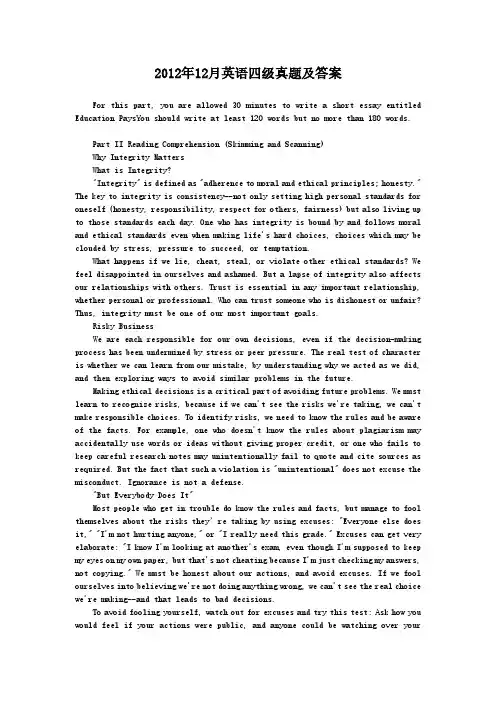
2012年12月英语四级真题及答案
2012年12月英语四级真题及答案For this part, you are allowed 30 minutes to write a short essay entitled Education PaysYou should write at least 120 words but no more than 180 words. Part II Reading Comprehension (Skimming and Scanning) Why Integrity Matters What is Integrity? "Integrity" is defined as "adherence to moral and ethical principles; honesty." The key to integrity is consistency--not only setting high personal standards for oneself (honesty, responsibility, respect for others, fairness) but also living up to those standards each day. One who has integrity is bound by and follows moral and ethical standards even when making life's hard choices, choices which may be clouded by stress, pressure to succeed, or temptation. What happens if we lie, cheat, steal, or violate other ethical standards? We feel disappointed in ourselves and ashamed. But a lapse of integrity also affects our relationships with others. Trust is essential in any important relationship, whether personal or professional. Who can trust someone who is dishonest or unfair? Thus, integrity must be one of our most important goals. Risky Business We are each responsible for our own decisions, even if the decision-making process has been undermined by stress or peer pressure. The real test of character is whether we can learn from our mistake, by understanding why we acted as we did, and then exploring ways to avoid similar problems in the future. Making ethical decisions is a critical part of avoiding future problems. We must learn to recognize risks, because if we can't see the risks we're taking, we can't make responsible choices. To identify risks, we need to know the rules and be aware of the facts. For example, one who doesn't know the rules about plagiarism may accidentally use words or ideas without giving proper credit, or one who fails to keep careful research notes may unintentionally fail to quote and cite sources as required. But the fact that such a violation is "unintentional" does not excuse the misconduct. Ignorance is not a defense. "But Everybody Does It" Most people who get in trouble do know the rules and facts, but manage to fool themselves about the risks they’re taking by using excuses: "Everyone else does it," "I'm not hurting anyone," or "I really need this grade." Excuses can get very elaborate: "I know I'm looking at another's exam, even though I'm supposed to keep my eyes on my own paper, but that's not cheating because I'm just checking my answers, not copying." We must be honest about our actions, and avoid excuses. If we fool ourselves into believing we're not doing anything wrong, we can't see the real choice we're making--and that leads to bad decisions. To avoid fooling yourself, watch out for excuses and try this test: Ask how you would feel if your actions were public, and anyone could be watching over yourshoulder. Would you feel proud or ashamed of your actions? If you'd rather hide your actions, that's a good indication that you're taking a risk and rationalizing it to yourself. Evaluating Risks To decide whether a risk is worth taking, you must examine the consequences, in the future as well as right now, negative as well as positive, and to others as well as to yourself. Those who take risks they later regret usually focus on immediate benefits ("what's in it for me"), and simply haven't considered what might go wrong. The consequences of getting caught are serious, and may include a "0" on a test or assignment; an "F" in the class; Suspension or Dismissal from school; transcript notation; and a tarnished reputation. In fact, when you break a rule or law, you lose control over your life, and give others the power to impose punishment: you have no control over what that punishment might be. This is an extremely precarious and vulnerable position. There may be some matters of life and death, or highest principle, which might justify such a risk, but there aren't many things that fall in this category. Getting Away With It--Or Not Those who don't get caught pay an even higher price. A cheater doesn't learn from the test, depriving him/herself of an education. Cheating undermines confidence and independence: the cheater is a fraud, and knows that without dishonesty, he/she would have failed. Cheating destroys self-esteem and integrity, leaving the cheater ashamed, guilty, and afraid of getting caught. Worst of all, a cheater who doesn't get caught the first time usually cheats again, not only because he/she is farther behind, but also because it seems "easier." This slippery slope of eroding ethics and bigger risks leads only to disaster. Eventually, the cheater gets caught, and the later he/she gets caught, the worse the consequences. Students have been dismissed from school because they didn't get this simple message: Honesty is the ONLY policy that works. Cheating Hurts Others, Too Cheaters often feel invisible, as if their actions "don't count" and don't really hurt anyone. But individual choices have a profound cumulative effect. Cheating can spread like a disease, and a cheater can encourage others just by being seen from across the room. Recent statistics suggest 30% or more of college students cheat. If a class is graded on a curve, cheating hurts others' grades. Even if there is no curve, cheating "poisons" the classroom, and others may feel pressured to join in. ("If I don't cheat, I can't compete with those who do.") Cheating also has a destructive impact on teachers. The real reward of good teaching is seeing students learn, but a cheater says, "I'm not interested in what you're trying to teach; all I care about is stealing a grade, regardless of the effect on others." The end result is a blatant and destructive attack on the quality of your education. Finally, cheating can hurt the reputation of the University, and harm those who worked hard for their degree. Why Integrity Matters If cheating becomes the norm, then we are in big trouble. We must rely on thehonesty and good faith of others every day. If not, we couldn't put money in the bank, buy food, clothing, or medicine from others, drive across a bridge, get on a plane, go to the dentist--the list is endless. There are many examples of the vast harm that is caused when individuals forget or ignore the effect their dishonesty can have. The savings and loan scandal, the stock market and junk bond swindles, and, of course, Watergate, have undermined the faith of many Americans in the integrity of political and economic leaders and society as a whole. Such incidents take a tremendous toll on our nation's economy and our individual well-being. For example, but for the savings and loan debacle, there might be funds available to reduce the national debt and pay for education. In sum, we all have a common stake in our school, our community, and our society. Our actions do matter. It is essential that we act with integrity in order to build the kind of world in which we want to live. 1. A person of integrity not only sets high moral and ethical standards but also _______. A) sticks to them in their daily life B) makes them known to others C) understands their true values D)sees that others also follow them 2. What role does integrity play in personal and professional relationships? A) It helps to create team spirit B) It facilitates communication C) It is the basis of mutual trust D) It inspires mutual respect 3. why must we learn to identify the risks we are going to take? A. To ensure we make responsible choices. B. To avoid being overwhelmed by stress. C. so that we don’t break any rules. D. so that we don’t run into trouble. 4. Violation of a rule is misconduct even if _______? A. it has caused no harm. B. it is claimed to be unintentional. C. it has gone unnoticed. D. it is committed with good intentions. 5. What should one do if he doesn’t wish to fool himself? A. Avoid making excuses. B. Listen to other people’s advice. C. Make his intensions public. D. Have others watch over his shoulder. 6. Those who take risks they regret later on _______. A. will often become more cautious B. are usually very aggressive C. value immediate benefits most. D. may lose everything in the end 7. According to the author, a cheater who doesn’t get caught right away will _______. A) pay more dearly B) become more confident C) be widely admired D) feel somewhat lucky 8. Cheaters at exam don’t care about their education, all they care about is how to _______ 9. Integrity matters in that all social activities rely on people’s _______ 10. Many Americans lost faith in the integrity of their political leaders asa result of _______. Part III Listening Comprehension Section A Directions: In this section, you will hear 8 short conversations and 2 long conversations. At the end of each conversation, one or more questions will be asked about what was said. Both the conversation and the questions will be spoken only once. After each question there will be a pause. During the pause, you must read the four choices marked A), B), C) and D), and decide which is the best answer. Then mark the corresponding letter on Answer Sheet 2 with a single line through the centre. 11. W: I just heard about a really beautiful park in the east end of the town. There are a lot of roses in bloom. M: Why don’t we walk over there and see for ourselves? Q: What will the speakers probably do? 12. M: My presentation is scheduled for 9:30 tomorrow morning at the lecture hall.I hope to see you there. W: Oh, sorry. I was about to tell you that I have an appointment with my dentist at 9:00 o’clock tomorrow. Q: What do we learn about the woman? 13. W: How long have you been running this company? M: Twenty years if you can believe that. I brought it from a small operation to what it is today. Q: What do we learn about the man? 14. M: Have you read the news on the campus net? Susan has won the scholarship for next year. W: I knew she would from the very beginning. Such a brilliant and diligent girl! She certainly deserves it. Q: What does the woman mean? 15. W: Taking a bus to Miami, it’s cheaper than going by train. M: That’s true. But I’d rather pay a little more for the added comfort andconvenience. Q: What does the man mean? 16. M: I think it’s time we got rid of all this old furniture. W: You’re right. We need to promote our image besides it’s not a real antique. Q: What do the speakers mean? 17. M: That was some storm yesterday. How was I afraid I couldn’t make it home. W: Yeah, most of the roads to my house were flooded. I didn’t get home from the lab until midnight. Q: What do we learn from the conversation? 18. W: My boys are always complaining that they’re bored. M: Why don’t you get them into some team sports? My son and daughter play soccer every Saturday. And they both look forward to it all week. Q: What does the man mean? Questions 19 to 21 are based on the conversation you have just heard. W: I don’t know what to do. I can’t seem to get anyone in the hospital to listen to my complaints and this outdated equipment is dangerous. Just look at it. M: Hmm, uh, are you trying to say that it presents a health hazard? W: Yes, I am. The head technician in the lab tried to persuade the hospital administration to replace it, but they are trying to cut costs. M: You are pregnant, aren’t you? W: Yes, I am. I made an effort to get my supervisor to transfer me to another department, but he urged me not to complain too loudly. Because the administration is more likely to replace me than an X-ray equipment, I’m afraid to refuse to work. But I’m more afraid to expose my unborn child to the radiation. M: I see what you mean. Well, as your union representative, I have to warn you that it would take quite a while to force management to replace the old machines and attempt to get you transferred may or may not be successful. W: Oh, what am I supposed to do then? M: Workers have the legal right to refuse certain unsafe work assignments under two federal laws, the Occupation or Safety and Health Act and the National Labor Relations Act. But the requirements of either of the Acts may be difficult to meet. W: Do you think I have a good case? M: If you do lose your job, the union will fight to get it back for you along with back pay, your lost income. But you have to be prepared for a long wait, maybe after two years. Q19. What does the woman complain about? Q20. What has the woman asked her supervisor to do? Q21. What does the man say about the two federal laws? Q22. What will the union do if the woman loses her job Questions 22 to 25 are based on the conversation you have just heard. W: Mr. Green, is it fair to say that negotiation is an art? M: Well, I think it’s both an art and science. You can prepare for a negotiation quite scientifically, but the execution of the negotiation has quite a lot to do with one’s artistic quality. The scientific part of a negotiation is in determining your strategy. What do you want out of it? What can you give? Then of course there are tactics. How do you go about it? Do you take an opening position in a negotiation which differs from the eventual goal you are heading for? And then of course there are the behavioral aspects. W: What do you mean by the behavioral aspects? M: Well, that’s I think where the art comes in. In your behavior, you can either be an actor. You can pretend that you don’t like things which you are actually quite pleased about. Or you can pretend to like things which you are quite happy to do without. Or you can be the honest type negotiator who’s known to his partners in negotiation and always plays everything straight. But the artistic part of negotiation I think has to do with responding immediately to cues one gets in the process of negotiation. These can be verbal cues or even body language. This is where the artistic quality comes in. W: So really, you see two types of negotiator then, the actor or the honest one. M: That’ right. And both can work. I would say the honest negotiator can be quite effective in some circumstances. In other circumstances you need an actor. Q23. When is a scientific approach best embodied in a negotiation according to the man? Q24. In what way is a negotiator like an actor according to the man? Q25. What does the man say about the two types of negotiator? Section B Directions: In this section, you will hear 3 short passages. At the end of each passage, you will hear some questions. Both the passage and the questions will be spoken only once. After you hear a question, you must choose the best answer from the four choices marked A), B), C) and D). Then mark the corresponding letter on Answer Sheet 2 with a single line through the center. Passage 1 Questions 26 to 28 are based on the passage you have just heard. Since I started working part-time at a grocery store, I have learned that a customer is more than someone who buys something. To me, a customer is a person whose memory fails entirely once he or she starts to push a shopping cart. One of the first things customers forget is how to count. There is no other way to explain how so many people get in their express line, which is clearly marked 15 items or less, with 20, 25 or even a cart load of items. Customers also forget why they came to the store in the first place. Just as I finish ringing up an order, a customer will say, “Oops, I forgot to pick up a fresh loaf of bread. I hope you don’t mind waiting while I go get it.” Five minutes later, he is back with the bread, a bottle of milk, and three rolls of paper towels. Strange as it seems, customers also seem to forget that they have to pay for their groceries. Instead of writing a check or looking for a credit card while I am ringing up the groceries, my customers will wait until I announce the total. Then, in surprise, she says, “Oh no, what did I do with mycheck book?” After 5 minutes of digging through her purse, she borrows my pen because she’s forgotten hers. But I have to be tolerant of customers because they pay my salary, and that’s something I can’t afford to forget. Q26. What does the speaker say about customers’ entering the grocery store? Q27. Which customers are supposed to be in the express line? Q28. What does the speaker say some customers do when they arrive at the check-out counter? Q29. What does the speaker say about his job at the end of the talk? Passage 2 Questions 29 to 31 are based on the passage you have just heard. The speech delivery style of Europeans and Asians tends to be very formal. Speakers of these cultures often read oral presentations from carefully written manuscripts. On the other hand, American speakers are generally more informal relative to speakers in other cultures. American audiences prefer natural, spontaneous delivery that conveys a lively sense of communication. They don’t relate well to speakers who read from a manuscript. If you use an outline of your ideas instead of a prepared text, your speech will not only sound more natural, but you will also be able to establish better relationship with your listeners and keep their attention. The language and style you use when making an oral presentation should not be the same as the language and style you use when writing. Well-written information, that is meant to be read, does not work as well when it is heard. It is, therefore, important for you to adapt written texts or outlines for presentations. Good speakers are much more informal when speaking than when writing. They also use their own words and develop their own speaking styles. Whenever possible, they use short words. Listeners appreciate it when speakers use simple, everyday words in a presentation. One advantage is that it’s much easier for speakers to pronounce short words correctly. Another is that long and sophisticated vocabulary choices make listening more difficult. Question 30 to 32 30. What does the speaker say American audiences prefer? 31. What should one pay attention to when making an oral presentation? 32. What does the speaker focus on in the talk? Passage 3 Questions 32 to 35 are based on the passage you have just heard. Let children learn to judge their own work. A child learning to talk does not learn by being corrected all the time. If corrected too much, he will stop talking. He compares a thousand times a day the difference between language as he uses it and language as those around him use it. Bit by bit, he makes the necessary changes to make his language like other people’s. In the same way, kids learning to do all the other things they learn without adult teachers, to walk, run, climb, ride a bike, play games, compare their own performance with what more skilled people do, and slowly make the needed changes. But in school we never give a child a chance to detect his mistakes. We do it all for him. We act as if we thought he would never notice a mistake unless it was pointed out to him. Soon he becomes dependent on the expert.We should let him do it himself. Let him figure out, with the help of other children if he wants it, what this word says, what is the answer to that problem, whether this is a good way of saying or doing this or that. If right answers need to be given, as in mathematics or science, give him the answer book. Let him correct his own papers. Why should we teachers waste time on such tedious work? Our job should be to help children when they tell us that they can’t find a way to get the right answer. Question 33 to 35 33. How does a child learn to do something according to the speaker? 34. What belief do teachers commonly hold according to the speaker? 35. What does the speaker imply about the current way of teaching? Section C Directions: In this section, you will hear a passage three times. When the passage is read for the first time, you should listen carefully for its general idea. When the passage is read for the second time, you are required to fill in the blanks numbered from 36 to43 with the exact words you have just heard. For blanks numbered from 44 to 46 you are required to fill in the missing information. For these blanks, you can either use the exact words you have just heard or write down the main points in your own words. Finally, when the passage is read for the third time, you should check what you have written. (听力原文)Time is, for the average American, of utmost importance. To the foreign visitor, Americans seem to be more concerned with getting things accomplished on time (according to a predetermined schedule) than they are with developing deep interpersonal relations. Schedules, for the American, are meant to be planned and then followed in the smallest detail. It may seem to you that most Americans are completely controlled by the little machines they wear on their wrists, cutting their discussions off abruptly to make it to their next appointment on time. Americans’ language is filled with references to time, giving a clear indication of how much it is valued. Time is something to be “on,” to be “kept,” “filled,” “saved,” “wasted,” “gained,” “planned,” “given,” “made the most of,” even “killed.” The international visitor soon learns that it is considered very rude to be late -- even by 10 minutes -- for an appointment in America. Time is so valued in America, because by considering time to be important one can clearly achieve more than if one “wastes” time and doesn’t keep busy. This philosophy has proven its worth. It has enabled Americans to be extremely productive, and productivity itself is highly valued in America. Many American proverbs stress the value of guarding time, using it wisely, and setting and working toward specific goals. Americans believe in spending their time and energy today so that the fruits of their labor may be enjoyed at a later time. Part IV Reading Comprehension (Reading in Depth) Section A Directions: In this section, there is a passage with ten blanks. You are required to select one word for each blank from a list of choices given in a word bank following the passage. Read the passage through carefully before making your choices. Each choice in the bank is identified by a letter. Please mark the corresponding letterfor each item on Answer Sheet 2 with a single line through the centre. You may not use any of the words in the bank more than once. Questions 47 to 56 is based on the following passage. So many people use the cell phone so frequantly every day,But ___47__little is certain adout he health effects of its use.Macufacturers___48___that cell phones meet government standards for safe radio- frequency radiation omission,but enough studies are beginning to document a possible ___49___in rare brain tumour(肿瘤):bendaches and behavioral disorders in children to cause coneem.So far,the avidence isn't___50___on whether the use of cell phones __51__to any uncased risk of cancer.In a new trial,researchers asked 47 yolunteers to ___52__in a project to measure glucose(葡萄糖)consurnption in the brain by scanning the brain to see how cells use energy.For both 50- minute scans,the volunteers had a cell phone __53__to each ear.During be first scan,the devices were turned off,but for the second scan,the phone on the right ear as___54____on and received a recorded- message call,although the yolume was muted(消毒) so the dise wouldn't bias the results.The results of the second scan abowed that the__55__of the brain rarest to the device had higher rales of glucose consumption than the rest of the brain.The study ows that cell phones can change brain activity,and __56__a whole new avenue for scientific quiry,tuough it doesn't say anything about whether cell-phone radiation can cause cancer. 注意:此部分试题请在答题卡2上作答。
12月英语四级考试第2套真题试卷及答案

12月英语四级考试第2套真题试卷及答案大学英语四级考试涉及的语法知识点多、涉及面宽,对不少考生来说都是一个难题。
考生要多刷真题巩固练习考点内容,下面小编就跟大家聊聊关于12月英语四级考试第2套真题试卷及答案吧,希望能帮助到大家。
12月英语四级考试真题试卷(完整版第2套)Part I Writing (30 minutes)Directions: For this part, you are allowed 30 minutes to write a short easy on how to besthandle the relationship between teachers and students. You should write at least 120 words but no more than 180 words.________________________________________________________________ ________________________________________________________________________ ________________________________________________________________________ ________Part II Listening Comprehension (25 minutes)听力音频MP3文件,点击进入听力真题页面Section ADirections: In this section, you will hear three news reports. At the end of each newsreport, you will hear two or three questions. Both the news report and the questions willbe spoken only once. After you hear a question, you must choose the best answer fromthe four choices marked A), B), C) and D). Then mark the corresponding letter onAnswer Sheet 1 with a single line through the centre.Questions 1 and 2 are based on the news report you have just heard.1. A) It tries entertain its audience.B) It tries to look into the distance.C) It wants to catch people's attention.D) It has got one of its limbs injured.2. A) It was spotted by animal protection officials.B) It was filmed by a local television reporter.C) Its videos Were posted on social media.D) Its picture won a photography prize.Questions 3 and 4 are based on the news report you have just heard.3. A) The distance travelled.B) The incidence of road accidents.C) The spending on gas.D) The number of people travelling.4. A) Fewer people are commuting.B) Gas consumption is soaring.C) Job growth is slowing down.D) Rush-hour traffic is worsening.Questions 5 to 7 are based on the news report you have just heard.5. A) He told a stranger the sad story about himself.B) He helped a stranger to carry groceries to his car.C) He went up to a stranger and pulled at his sleeves.D) He washed a stranger's car in return for some food.6. A) He ordered a lot of food for his family.B) He gave him a job at his own company.C) He raised a large sum of money for him.D) He offered him a scholarship for college.7. A) He works hard to support his family.B) He is an excellent student at school.C) He is very good at making up stories.D) He has been disabled since boyhood.Section BDirections: In this section, you will hear two long conversations. At the end of eachconversation, you will hear four questions. Both the conversation and the questionswill be spoken only once. After you hear a question, you must choose the best answerfrom the four choices marked A), B), C) and D). Then mark the corresponding letter onAnswer Sheet 1 with a single line through the centre.Questions 8 to 11 are based on the conversation you have just heard.8. A) Attended an economics lecture.B) Taken a walk on Charles Street.C) Had a drink at Queen Victoria.D) Had dinner at a new restaurant.9. A) Treat a college friend to dinner.B) Make preparations for a seminar.C) Attend his brothers birthday party.D) Visit some of his high school friends.10. A) Gather statistics for his lecture.B) Throw a surprise birthday party.C) Meet with Jonathan's friends on the weekend.D) Join him in his brother's birthday celebration.11. A) By car.B) By train.C) By taxi.D) By bus.Questions 12 to 15 are based on the conversation you have just heard.12. A) Taking a vacation abroad.B) Reviewing for his last exam.C) Saving enough money for a rainy day.D) Finding a better way to earn money.13. A) Preparing for his final exams.B) Negotiating with his boss for a raise.C) Working part time as a waiter.D) Helping the woman with her courses.14. A) Finish her term paper.B) Save enough money.C) Learn a little bit of Spanish.D) Ask her parent's permission.15. A) He has rich sailing experience.B) He speaks Spanish fluently.C) He is also eager to go to Spain.D) He is easy to get along with.Section CDirections: In this section, you will hear three passages. At the end of each passage, you will hear three or four questions. Both the passage and the questions will be spokenonly once. After you hear a question, you must choose the best answer from the fourchoices marked A), B), C) and D). Then mark the corresponding letter on Answer Sheet 1 with a single line through the centre.Questions 16 to 18 are based on the passage you have just heard.16. A) She went to the same university as her mother.B) She worked as a nurse in the First World War.C) She won the Nobel Prize two times.D) She was also a Nobel Prize winner.17. A) She fought bravely in a series of military operations.B) She developed X-ray facilities for military hospitals.C) She helped to set up several military hospitals.D) She made donations to save wounded soldiers.18. A) Both died of blood cancer.B) Both fought in World War I.C) Both won military medals.D) Both married their assistants.Questions 19 to 21 are based on the passage you have just heard.19. A) They were the first settlers in Europe.B) They were the conquerors of Norway.C) They discovered Iceland in the ninth century.D) They settled on a small island north of England.20. A) It was some five hundred miles west of Norway.B) It was covered with green most time of the year.C) It was the Vikings' most important discovery.D) It was a rocky mass of land covered with ice.21. A) The Vikings' ocean explorations.B) The making of European nations.C) The Vikings' everyday life.D) The Europeans' Arctic discoveries.Questions 22 to 25 are based on the passage you have just heard.22. A) Work hard for a better life.B) Make mistakes now and then.C) Dream about the future.D) Save against a rainy day.23. A) Teach foreign languages for the rest of his life.B) Change what he has for his past imaginary world.C) Exchange his two-story house for a beach cottage.D) Dwell on the dreams he had dreamed when young.24. A) Criminal law.B) City planning.C) Oriental architecture.D) International business.25. A) Dream and make plans.B) Take things easy in life.C) Be content with what you have.D) Enjoy whatever you are doing.Part Ⅲ Reading Comprehension (40 minutes)Section ADirections: In this section, there is a passagewith ten blanks. You are required to select one word for each blank from a list of choicesgiven in a word bank following the passage. Read the passage through carefully beforemaking your choices. Each choice in the bank is identified by a letter. Please mark thecorresponding letter for each item on Answer Sheet 2 with a single line through thecentre. You may not use any of the words in the bank more than once.Technological changes brought dramatic new options to Americans living in the 1990s. During this decade new forms of entertainment, commerce, research, andcommunication became commonplace in the U.S. The driving force behind much ofthis change was a(n) 26 popularly known as the Internet.The Internet was developed during the 1970s by the Department of Defense. In the caseof an attack, military advisers suggested the 27 of being able to operate one computerfrom another terminal. In the early days, the Internet was used mainly by scientists tocommunicate with other scientists. The Internet28 under government control until1984.One early problem faced by Internet users was speed. Phone lines could only transmitinformation at a 29 rate. The development of fiber-optic (光纤) cables allowed for billionsof bits of information to be received every minute. Companies like Intel developed fastermicroprocessors, so personal computers could process the 30 signals at a more rapidrate.In the early 1990s, the World Wide Web was developed, in large part, for 31 purposes.Corporations created home pages where they could place text and graphics tosell products. Soon airline tickets, hotel 32 , and even cars and homes could bepurchased online. Universities 33 research data on the Internet, so students could find 34 information without leaving their dormitories. Companies soon discovered that workcould be done at home and 35 online, so a whole new class of telecommuters began toearn a living from home offices unshaven and wearing pajamas (睡衣).A) advantage B) commercial C) conservation D) equipped E) incoming F) innovationG) limited H) local I) maintained J) occupations K) posted L) remained M) reservationsN) submitted O) valuableSection BDirections: In this section, you are going to read a passage with ten statementsattached to it. Each statement contains information given in one of the paragraphs. Identify the paragraph from which the information is derived. You may choose aparagraph more than once. Each paragraph is marked with a letter. Answer the questionsby marking the corresponding letter on Answer Sheet 2.The Health Benefits of KnittingA) About 15 years ago, I was invited to join a knitting group.I agreed to give it a try.B) My mother had taught me to knit at 15, and I knitted in class throughout college andfor a few years thereafter. Then decades passed without my touching a knitting needle. But within two Mondays in the group, I was hooked, not only on knitting but also oncrocheting (钩织), and I was on my way to becoming a highly productive crafter.C) I've made countless baby blankets, sweaters, scarves, hats, caps for newborns. I takea knitting project with me everywhere, especially when I have to sit still and listen. As Idiscovered in college, when my hands are busy, my mind stays focused on the here andnow.D) It seems, too, that I'm part of a national renewal of interest in needle and otherhandicrafts (手工艺). The Craft Yarn Council reports that a third of women ages 25-35 now knit or crochet. Even men and schoolchildren are swelling the ranks, among themmy friend's three small grandsons. Last April, the council created a "Stitch Away Stress" campaign in honor of National Stress Awareness Month. Dr. Herbert Benson, a pioneerin mind/body medicine and author of The Relaxation Response, says that the repetitiveaction of needlework can induce a relaxed state like that associated with meditation(沉思) and yoga. Once you get beyond the initial learning curve, knitting and crochetingcan lower heart rate and blood pressure.E) But unlike meditation, craft activities result in tangible and often useful productsthat can enhance self-esteem. I keep photos of my singular accomplishments on mycellphone to boost my spirits when needed.F) Since the 1990s, the council has surveyed hundreds ofthousands of knitters andcrocheters, who routinely list stress relief and creative fulfillment as the activities'main benefits. Among them is the father of a prematurely born daughter who reportedthat during the baby's five weeks in the intensive care unit, "learning how to knit infanthats gave me a sense of purpose during a time that I felt very helpless. It's a hobbythat I've stuck with, and it continues to help me cope with stress at work, provide asense of order in hectic (忙乱的) days, and allow my brain time to solve problems."G) A recent email from the yarn (纺纱) company Red Heart titled "Health Benefits ofCrocheting and Knitting" prompted me to explore what else might be known about thehealth value of activities like knitting. My research revealed that the rewards go wellbeyond replacing stress and anxiety with the satisfaction of creation.H) For example, Karen Hayes, a life coach in Toronto, conducts knitting therapyprograms, including Knit to Quit to help smokers give up the habit, and Knit to Heal forpeople coping with health crises, like a cancer diagnosis or serious illness of a familymember. Schools and prisons with craft programs report that they have a calmingeffect and enhance social skills. And having to follow instructions on complex craftprojects can improve children's math skills.I) Some people find that craftwork helps them control their weight. Just as it'schallenging to smoke while knitting, when hands are holding needles and hooks, there'sless snacking and mindless eating out of boredom.J) I've found that my handiwork with yarn has helped my arthritic (患关节炎的) fingersremain more dexterous (灵巧的) as I age. A woman encouraged to try knitting andcrocheting afterdeveloping an autoimmune disease that caused a lot of hand painreported on the Craft Yarn Council site that her hands are now less stiff and painful.K) A 2009 University of British Columbia study of 38 women with an eating disorder whowere taught to knit found that learning the craft led to significant improvements. Seventy-four percent of the women said the activity lessened their fears and kept themfrom thinking about their problem.L) Betsan Corkhill, a wellness coach in Bath, England, and author of the book Knit forHealth & Wellness, established a website, Stitchlinks, to explore the value of whatshe calls therapeutic knitting. Among her respondents, 54 percent of those who wereclinically depressed said that knitting made them feel happy or very happy. In a studyof 60 self-selected people with persistent pain, Ms. Corkhill and colleagues reported thatknitting enabled them to redirect their focus, reducing their awareness of pain. Shesuggested that the brain can process just so much at once, and that activities likeknitting and crocheting make it harder for the brain to register pain signals. Perhapsmost exciting is research that suggests that crafts like knitting and crocheting may helpto keep off a decline in brain function with age. In a 2011 study, researchers led by Dr. Yonas Geda at the Mayo Clinic in Rochester interviewed a random (随机的) sample of1,321 people ages 70-89, most of whom were cognitively (在认知方面) normal, about thecognitive activities they engaged in late in life. The study, published in the Journal ofNeuropsychiatry & Clinical Neurosciences, found that those who engaged in craftslike knitting and crocheting had a diminished chance of developing mild cognitivedisorder and memory loss.M) Although it is possible that only people who arecognitively healthy would pursuesuch activities, those who read newspapers or magazines or played music did not showsimilar benefits. The researchers speculate that craft activities promote thedevelopment of nerve pathways in the brain that help to maintain cognitive health.N) In support of that suggestion, a 2014 study by Denise C. Park of the University ofTexas at Dallas and colleagues demonstrated that learning to knit or do digitalphotography enhanced memory function in older adults. Those who engaged inactivities that were not intellectually challenging, either in a social group or alone, did not show such improvements.O) Given that sustained social contacts have been shown to support health and a longlife, those wishing to maximize the health value of crafts might consider joining a groupof like-minded folks. I for one try not to miss a single weekly meeting of my knittinggroup.36. When the author was a college student, she found that knitting helped herconcentrate.37. Knitting can help people stay away from tobacco.38. Even men and children are now joining the army of knitters.39. Being a member of a crafts group enhances one's health and prolongs one's life.40. Knitting diverts people's attention from their pain.41. The author learnt to knit as a teenager, but it was not until she was much older thatshe became keenly interested.42. When people are knitting, they tend to eat fewer snacks.43. Survey findings show that knitting can help people relieve stress.44. According to a study, knitters and crocheters are lesslikely to suffer mild cognitivedamage.45. The products of knitting can increase one's sense of self-respect.Section CDirections: There are 2 passages in this section. Each passage is followed by somequestions or unfinished statements. For each of them there are four choices marked A), B), C) and D). You should decide on the best choice and mark the corresponding letter onAnswer Sheet 2 with a single line through the centre.Passage OneQuestions 46 and 50 are based on the following passage.Nobody really knows how big Lagos is. What's indisputable is that it's growing veryquickly. Between now and 2050, the urban population of Africa could triple. Yet cities insub-Saharan Africa are not getting richer the way cities in the rest of the world have. Most urban Africans live in slums (贫民窟); migrants are often not much better off thanthey were in the countryside. Why?The immediate problem is poverty. Most of Africa is urbanising at a lower level ofincome than other regions of the world did. That means there's little money around forinvestment that would make cities liveable and more productive. Without upgrades andnew capacity, bridges, roads and power systems are unable to cope with expandingpopulations. With the exception of South Africa, the only light rail metro system in sub-Saharan Africa is in Addis Ababa, Ethiopia. Traffic jam leads to expense andunpredictability, things that keep investors away.In other parts of the world, increasing agricultural productivity and industrialisationwent together. More productive farmers meant there was a surplus that could feedcities; in turn, that created a pool of labour for factories. But African cities aredifferent. They are too often built around consuming natural resources. Government isconcentrated in capitals, so is the money. Most urban Africans work for a smallminority of the rich, who tend to be involved in either cronyish (有裙带关系的) businesses or politics. Since African agriculture is still broadly unproductive, food isimported, consuming a portion of revenue.So what can be done? Though African countries are poor, not all African cities are. InLagos, foreign oil workers can pay as much as $65,000 per year in rent for a modestapartment in a safe part of town. If that income were better taxed, it might provide therevenue for better infrastructure. If city leaders were more accountable to their residents, they might favour projects designed to help them more. Yet even as new roads are built, new people arrive. When a city's population grows by 5% a year, it is difficult to keepup.46. What do we learn from the passage about cities in sub-Saharan Africa?A) They have more slums than other cities in the world.B) They are growing fast without becoming richer.C) They are as modernised as many cities elsewhere.D) They attract migrants who want to be better off.47. What does the author imply about urbanisation in other parts of the world?A) It benefited from the contribution of immigrants.B) It started when people's income was relatively high.C) It benefited from the accelerated rise in productivity.D) It started with the improvement of peopled livelihood.48. Why is sub-Saharan Africa unappealing to investors?A) It lacks adequate transport facilities.B) The living expenses there are too high.C) It is on the whole too densely populated.D) The local governments are corrupted.49. In what way does the author say African cities are different?A) They have attracted huge numbers of farm labourers.B) They still rely heavily on agricultural productivity.C) They have developed at the expense of nature.D) They depend far more on foreign investment.50. What might be a solution to the problems facing African cities?A) Lowering of apartment rent.B) Better education for residents.C) More rational overall planning.D) A more responsible government.Passage TwoQuestions 51 to 55 are based on the following passage.For the past several decades, it seems there's been a general consensus on how to getahead in America: Get a college education, find a reliable job, and buy your own home. But do Americans still believe in that path, and if they do, is it attainable?The most recent National Journal poll asked respondents about the American dream, what it takes to achieve their goals, and whether or not they felt a significant amount ofcontrol over their ability to be successful. Overwhelmingly, the results show that today, the idea of the American dream—and what it takes to achieve it—looks quite differentthan it did in the late 20th century.By and large, people felt that their actions and hard work—not outside forces—were thedeciding factor in how their lives turned out. But respondents had decidedly mixedfeelings aboutwhat actions make for a better life in the current economy.In the last seven years, Americans have grown more pessimistic about the power ofeducation to lead to success. Even though they see going to college as a fairly achievablegoal, a majority—52 percent—think that young people do not need a four-year collegeeducation in order to be successful.Miguel Maeda, 42, who has a master's degree and works in public health, was the first inhis family to go to college, which has allowed him to achieve a sense of financialstability his parents and grandparents never did.While some, like Maeda, emphasized the value of the degree rather than the educationitself, others still see college as a way to gain new perspectives and life experiences. Sixty-year-old Will Fendley, who had a successful career in the military and neverearned a college degree, thinks "personal drive" is far more important than just going tocollege. To Fendley, a sense of drive and purpose, as well as an effective high-schooleducation, and basic life skills, like balancing a checkbook, are the necessaryingredients for a successful life in America.51. It used to be commonly acknowledged that to succeed in America, one had to have .A) an advanced academic degreeB) an ambition to get aheadC) a firm belief in their dreamD) a sense of drive and purpose52. What is the finding of the latest National Journal poll concerning the Americandream?A) More and more Americans are finding it hard to realize.B) It remains alive among the majority of American people.C) Americans' idea of it has changed over the past fewdecades.D) An increasing number of young Americans are abandoning it.53. What do Americans now think of the role of college education in achieving success?A) It still remains open to debate.B) It has proved to be beyond doubt.C) It is no longer as important as it used to be.D) It is much better understood now than ever.54. How do some people view college education these days?A) It promotes gender equality.B) It needs to be strengthened.C) It adds to cultural diversity.D) It helps broaden their minds.55. What is one factor essential to success in America, according to Will Fendley?A) A desire to learn and to adapt.B) A strong sense of responsibility.C) A willingness to commit oneself.D) A clear aim and high motivation.Part IV Translation (30 minutes)Directions: For this part, you are allowed 30 minutes to translate a passage from Chineseinto English. You should write your answer onAnswer Sheet 2.华山位于华阴市,据西安120公里。
2012年12月四级考试真题(第二套)作文及听力试题

2012年12月四级考试真题(第二套)作文及听力试题Part I Writing (30 minutes)Directions:For this part, you are allowed 30 minutes to write a short essay entitled Education Pays based on the statistics provided in the chart below (Unemployment rate in 2010). Please give a brief description of the chart first and then make comments on it. You should write at least 120 words but no more than 180 words.Education PaysPart III Listening Comprehension (35 minutes) Section ADirections:In this section, you will hear 8 short conversations and 2 long conversations. At the end of each conversation, one or more questions will be asked about what was said. Both the conversation and the questions will be spoken only once. After each question there will be a pause. During the pause, you must read the four choices marked [A], [B], [C] and [D], and decide which is the best answer. Then mark the corresponding letter on Answer Sheet 2 with a single line through the centre.11. [A] Find a shortcut to the park.[B] Buy some roses from the market.[C] Plant trees in the east end of town.[D] Go to the park to enjoy the flowers.12. [A] She has been invited to give a talk.[B] She is going to meet the man at 9:30.[C] She cannot attend the presentation.[D] She cannot work because of her toothache.13. [A] He is a very successful businessman.[B] He has changed his business strategy.[C] He is making plans to expand his operation.[D] He was twenty when he took over the company.14. [A] She has every confidence in Susan.[B] She has not read the news on the Net.[C] She is a little bit surprised at the news.[D] She is not as bright and diligent as Susan.15. [A] It is more comfortable and convenient to take a bus.[B] It is worth the money taking a train to Miami.[C] It is not always cheaper going by bus.[D] It is faster to go to Miami by train.16. [A] Antiques can improve their image.[B] Preservation of antiques is important.[C] The old furniture should be replaced.[D] They should move into a new office.17. [A] All roads were closed because of the flood.[B] The man stayed at the lab the whole night.[C] The man got home late due to the storm.[D] The storm continued until midnight.18. [A] Many children feel bored when left alone.[B] The woman‟s sons might enjoy team sports.[C] The woman‟s kids can play soccer with his son.[D] Children should play sports at least once a week.Questions 19 to 21 are based on the conversation you have just heard.19. [A] Make phone calls to promote sales.[B] Arrange business negotiations.[C] Handle complaints from customers.[D] Take orders over the phone.20. [A] They had different business strategies.[B] Customers often mistook one for the other.[C] Conflicts between them could not be properly solved.[D] Customers‟ questions could not be answered on the same day.21. [A] They each take a week.[B] They like to spend it together.[C] They have to take it by turns.[D] They are given two weeks each.Questions 22 to 25 are based on the conversation you have just heard.22. [A] At a road crossing.[B] Outside a police station.[C] Near a school.[D] In front of a kindergarten.23. [A] He drove too fast to read it.[B] He did not notice it.[C] It says 45 miles an hour.[D] It is not clearly visible.24. [A] It should have been renewed two months ago.[B] It actually belongs to somebody else.[C] It is no longer valid.[D] It is not genuine.25. [A] He got a ticket.[B] He was fined $ 35.[C] He had his driver‟s license canceled.[D] He had to do two weeks‟ community service.Section BDirections:In this section, you will hear 3 short passages. At the end of each passage, you will hear some questions. Both the passage and the questions will be spoken only once. After you hear a question, you must choose the best answer from the four choices marked [A], [B], [C] and [D]. Then mark the corresponding letter on Answer Sheet 2 with a single line through the centre.Passage OneQuestions 26 to 29 are based on the passage you have just heard.26. [A] They care more about an item‟s price than its use.[B] They grab whatever they think is a good bargain.[C] They become excited as if they had never been there.[D] They behave as if their memories have failed totally.27. [A] Those with a VIP card.[B] Those with 15 items or less.[C] Those needing assistance.[D] Those paying in cash.28. [A] Go back and pick up more items.[B] Take out some unwanted purchases.[C] Change the items they have picked up.[D] Calculate the total cost of the groceries.29. [A] It calls for carefulness.[B] It requires tolerance.[C] It needs a good knowledge of math.[D] It involves communication skills.Passage TwoQuestions 30 to 32 are based on the passage you have just heard.30. [A] A package of ideas formally presented.[B] A short presentation clearly delivered.[C] A natural and spontaneous style of speech.[D] A clever use of visual aids in presentation.31. [A] The skillful use of gestures and facial expressions.[B] Differences in style between writing and speaking.[C] Different preferences of audiences.[D] The importance of preparation.32. [A] The differences between American and Asian cultures.[B] The significance of cross-cultural communication.[C] The increasing importance of public speaking.[D] The key to becoming a good speaker.Passage ThreeQuestions 33 to 35 are based on the passage you have just heard.33. [A] By comparing his performance with others‟.[B] By being repeatedly corrected by adults.[C] By observing what their teachers do.[D] By being given constant praise.34. [A] The best students are usually smart by nature.[B] It is only natural for children to make errors.[C] Children cannot detect their own mistakes.[D] All children should have equal opportunities.35. [A] It is favorable to knowledge accumulation.[B] It is beneficial to independent children.[C] It is unhealthy to students‟ upbringing.[D] It is unhelpful to students‟ learning.Section CDirections:In this section, you will hear a passage three times. When the passage is read for the first time, you should listen carefully for its general idea. When the passage is read for the second time, you are required to fill in the blanks numbered from 36 to 43 with the exact words you have just heard. For blanks numbered from 44 to 46 you are required to fill in the missing information. For these blanks, you can either use the exact words you have just heard or write down the main points in your own words. Finally, when the passage is read for the third time, you should check what you have written.Time is, for the average American, of utmost importance. To the (36) _______ visitor, Americans seem to be more concerned with getting things (37) _______ on time (according to a predetermined schedule) than they are with developing deep (38) _______ relations. Schedules, for the American, are meant to be planned and then followed in the smallest (39) _______.It may seem to you that most Americans are completely (40) _______ by the little machines they wear on their wrists, cutting their discussions off (41) _______ to make it to their next appointment on time.Americans‟ language is filled with (42) _______ to time, giving a clear (43) _______ of how much it is valued. Time is something to be “on,” to be “kept,”“filled,”“saved,”“wasted,”…gained,”“planned,”“given,”“made the most of,” even …killed. “The international visitor soon learns that (44) ____________________________________________________________________________________.Time is so valued in America because by considering time to be important one can clearly achieve more than if one “wastes”time and doesn‟t keep busy. This philosophy has proven its worth. (45) ____________________________________________________________________________________. Many American proverbs (谚语) stress the value of guarding time, using it wisely and setting and working toward specific goals. (46) ____________________________________________________________________________________.。
2012年12月四级考试听力真题、原题、及答案
2012年12月四级考试真题(第二套)作文及听力试题Part III Listening Comprehension (35 minutes)Section ADirections:In this section, you will hear 8 short conversations and 2 long conversations. At the end of each conversation, one or more questions will be asked about what was said. Both the conversation and the questions will be spoken only once. After each question there will be a pause. During the pause, you must read the four choices marked [A], [B], [C] and [D], and decide which is the best answer. Then mark the corresponding letter on AnswerSheet 2 with a single line through the centre.11. [A] Find a shortcut to the park. [B] Buy some roses from the market.[C] Plant trees in the east end of town. [D] Go to the park to enjoy the flowers.12. [A] She has been invited to give a talk. [B] She is going to meet the man at 9:30.[C] She cannot attend the presentation. [D] She cannot work because of her toothache.13. [A] He is a very successful businessman. [B] He has changed his business strategy.[C] He is making plans to expand his operation. [D] He was twenty when he took over the company.14. [A] She has every confidence in Susan. [B] She has not read the news on the Net.[C] She is a little bit surprised at the news. [D] She is not as bright and diligent as Susan.15. [A] It is more comfortable and convenient to take a bus. [B] It is worth the money taking a train to Miami.[C] It is not always cheaper going by bus. [D] It is faster to go to Miami by train.16. [A] Antiques can improve their image. [B] Preservation of antiques is important.[C] The old furniture should be replaced. [D] They should move into a new office.17. [A] All roads were closed because of the flood. [B] The man stayed at the lab the whole night.[C] The man got home late due to the storm. [D] The storm continued until midnight.18. [A] Many children feel bored when left alone. [B] The woman’s sons might enjoy team sports.[C] The woman’s kids can play soccer with his son.[D] Children should play sports at least once a week. Questions 19 to 21 are based on the conversation you have just heard.19. [A] Make phone calls to promote sales. [B] Arrange business negotiations.[C] Handle complaints from customers. [D] Take orders over the phone.20. [A] They had different business strategies. [B] Customers often mistook one for the other.[C] Conflicts between them could not be properly solved.[D] Customers’ questions could not be answered on the same day.21. [A] They each take a week. [B] They like to spend it together.[C] They have to take it by turns. [D] They are given two weeks each.Questions 22 to 25 are based on the conversation you have just heard.22. [A] At a road crossing. [B] Outside a police station.[C] Near a school. [D] In front of a kindergarten.23. [A] He drove too fast to read it. [B] He did not notice it.[C] It says 45 miles an hour. [D] It is not clearly visible.24. [A] It should have been renewed two months ago. [B] It actually belongs to somebody else.[C] It is no longer valid. [D] It is not genuine.25. [A] He got a ticket. [B] He was fined $ 35.[C] He had his driver’s license canc eled [D] He had to do two weeks’ community service.Section BDirections:In this section, you will hear 3 short passages. At the end of each passage, you will hear some questions. Both the passage and the questions will be spoken only once. After you hear a question, you must choose the best answer from the four choices marked [A], [B], [C] and [D]. Then mark the corresponding letter on Answer Sheet 2 with a single line through the centre.Passage OneQuestions 26 to 29 are based on the passage you have just heard.26. [A] They care more about an item’s price than its use. [B] They grab whatever they think is a good bargain.[C] They become excited as if they had never been there. [D] They behave as if their memories have failed totally.27. [A] Those with a VIP card. [B] Those with 15 items or less.[C] Those needing assistance. [D] Those paying in cash.28. [A] Go back and pick up more items. [B] Take out some unwanted purchases.[C] Change the items they have picked up. [D] Calculate the total cost of the groceries.29. [A] It calls for carefulness. [B] It requires tolerance.[C] It needs a good knowledge of math. [D] It involves communication skills.Passage TwoQuestions 30 to 32 are based on the passage you have just heard.30. [A] A package of ideas formally presented. [B] A short presentation clearly delivered.[C] A natural and spontaneous style of speech. [D] A clever use of visual aids in presentation.31. [A] The skillful use of gestures and facial expressions.[B] Differences in style between writing and speaking.[C] Different preferences of audiences. [D] The importance of preparation.32. [A] The differences between American and Asian cultures.[B] The significance of cross-cultural communication.[C] The increasing importance of public speaking. [D] The key to becoming a good speaker.Passage ThreeQuestions 33 to 35 are based on the passage you have just heard.33. [A] By compari ng his performance with others’.[B] By being repeatedly corrected by adults.[C] By observing what their teachers do. [D] By being given constant praise.34. [A] The best students are usually smart by nature. [ B] It is only natural for children to make errors.[C] Children cannot detect their own mistakes. [D] All children should have equal opportunities.35. [A] It is favorable to knowledge accumulation. [B] It is beneficial to independent children.[C] It is unhealthy to stude nts’ upbringing.[D] It is unhelpful to students’ learning.Section CDirections:In this section, you will hear a passage three times. When the passage is read for the first time, you should listen carefully for its general idea. When the passage is read for the second time, you are required to fill in the blanks numbered from 36 to 43 with the exact words you have just heard. For blanks numbered from 44 to 46you are required to fill in the missing information. For these blanks, you can either use the exact words you have just heard or write down the main points in your own words. Finally, when the passage is read for the third time, you should check what you have written.Time is, for the average American, of utmost importance. To the (36) _______ visitor, Americans seem to be more concerned with getting things (37) _______ on time (according to a predetermined schedule) than they are with developing deep (38) _______ relations. Schedules, for the American, are meant to be planned and then followed in the smallest (39) _______.It may seem to you that most Americans are completely (40) _______ by the little machines they wear on their wrists, cutting their discussions off (41) _______ to make it to their next appointment on time.Americans’ language i s filled with (42) _______ to time, giving a clear (43) _______ of how much it is valued. Time is something to be “on,” to be “kept,” “filled,” “saved,” “wasted,” ‘gained,” “planned,” “given,” “made the most of,” even ‘killed. “The international visitor soon learns that (44) ____________________________________________________________________________________.Time is so valued in America because by considering time to be important one can clearly achieve more than if one “wastes” time and doesn’t keep bus y. This philosophy has proven its worth. (45) ____________________________________________________________________________________. Many American proverbs (谚语) stress the value of guarding time, using it wisely and setting and working toward specific goals. (46) ____________________________________________________________________________________.Part III Listening ComprehensionSection A11. W: I just heard about a really beautiful park in theeast end of the town. There are a lot of rosesin bloom.M: Why don’t we walk over there and see for ourselves?Q: What will the speakers probably do? 11.【听前预测】选项描述的都是人的行为动作,由重复出现的to the park推测,本题可能考查去公园做某事。
2012年12月英语四级真题及答案(完整版)
2012年12月英语四级真题及答案(完整版)2012年下半年英语四级考试作文真题及答案From the bar chart given above, we can observe that it reflects the statistics of income among people of different educational background. Those who possess a doctoral degree earn 1,551dollars median weekly, ranking first among people of other education level. The median weekly earnings of people with associate degree and below cannot reach the average of 797 dollars, ranking from 768 dollars to 451 dollars. As for the unemployment rate, 2.5 % of people with doctoral degree will suffer form unemployment. However, the unemployment rate of people with some college, no degree and lower degree surpass the mean value of 7.6%, ranking from 8.7% to 14.1%.The bar chart of Education Pays reveals a phenomenon that there exits some difference in incomes and unemployment rate among people with different educational level. Quite a few reasons can account for this phenomenon: for one thing, with the advancement of technology and the adjustment of industrial structure, quite a few high-tech industries emerge overnight, which leads to a soar demand of workforces with high educational degree, thus, it is natural that graduates with bachelor’ and higher degree get a high pay-packet and enjoy a stable job. Additionally, those with educational background under associate degree are easily dismissed and paid by low salary. They can be replaced any time due to the fact that their jobs are easy and can be finished by average people.Definitely, the higher education degree you get, the more likely you are to enjoy a competitive edge in the employment market. Thus, the authorities should enforce some policies to ensure the equity of education. Only in this way can more people lead a stable and comfortable life. 2012年英语四级答案:12月四级快速阅读答案第一套英语四级快速阅读答案1. A.soil erosion, landslides and floods。
2012年12月英语四级完整版真题
2012年12月英语四级完整版真题2012年12月英语四级完整版真题:第二套Questions 19 to 21 are based on the conversation you have just heard.19. A) Make phone calls to promote sales.B) Arrange business negotiations.C) Handle complaints from customers.D) Take orders over the phone.20. A) They had different business strategies.B) Customers often mistook one for the other.C) Conflicts between them could not be properly solved.D) Customers' questions could not be answered on the same day.21. A) They each take a week.B) They like to spend it together.C) They have to take it by turns.D) They are given two weeks each.Questions 22 to 25 are based on the conversation you have just heard.22. A) At a road crossing.B) Outside a police station.C)D) In front of a kindergarten.23. A) He drove too fast to read it.B) He did not notice it.C) It says 45 miles an hour.D) It is not clearly visible. 24. A) It should have been renewed two months ago.B) It actually belongs to somebody else.C) It is no longer valid.D) It is not genuine.25. A) He got a ticket.B) He was fined $35.C) He had his driver's license canceled.D) He had to do two weeks' community service.Section BPassage OneQuestions 26 to 29 are based on the conversation you have just heard.26. A) They care more about an item's price than its use.B) They grab whatever they think is a good bargain.C) They become excited as if they had never been there.D) They behave as if their memories have failed totally.27. A) Those with a VIP card. C) Those needing assistance.B) Those with 15 items or less. D) Those paying in cash.28. A) Go back and pick up more items. C) Change the items they have picked up.B) Take out some unwanted purchases. D) Calculate the total cost of the groceries.29. A) It calls for carefulness. C) It needs a good knowledge of math.B) It requires tolerance. D) It involves communication skills.Passage TwoQuestions 30 to 32 are based on the passage you have just heard.30. A) A package of ideas formally presented.B) A short presentation clearly delivered.C) A natural and spontaneous style ot speech.D) A clever use of visual aids in presentation.31. A) The skillful use of gestures and facial expressions.B) Differences in style between writing and speaking.C) Different preferences of audiences.D) The importance of preparation.32. A) The differences between American and Asian cultures.B) The significance of cross-cultural communication.C) The increasing importance of public speaking.D) The key to becoming a good speaker.Passage ThreeQuestions 33 to 35 are based on the passage you have just heard.33. A) By comparing his performance with others'.B) By being repeatedly .C) By observing what their teachers do. D) By being given constant praise.34. A) The best students are usually smart by nature.B) It is only natural for children to make errors.C) Children cannot detect their own mistakes.D) All children should have equal opportunities.35. A) It is favorable to knowledge accumulation.B) It is beneficial to independent children.C) It is unhealthy to students' upbringing.D) It is unhelpful to students' learning.Passage OneQuestions 57 to 61 are based on the following passage.I've worked in the factories surrounding my hometown every summer since I graduated from high school. but making the transition(转变)between school and full-time blue-collar work during the break never gets any easier. For a student like me who considers any class before noon to be uncivilized, getting to afactory by 6 o'clock each morning is torture. My friends never seem to understand why I'm so relieved to be back at school or that my summer vacation has been anything but a vacation.There're few people as self-confident as a college student who has never been out in the real world. People my age always seem to overestimate the value of their time and knowledge. In fact, all the classes did not prepare me for my battles with the machine 1 ran in the plant, which would jam whenever I absent-mindedly put in a part backward .The most stressful thing about blue-collar life is knowing your jobcould disappear overnight. Issues like downsizing(裁员)and overseas relocation had always seemed distant to me until my co-workers told methat the unit I was working in would shut down within six months and move to Mexico, where people would work for 60 cents an hour.After working 12-hour shifts in a factory, the other options have become only too clear. When I'm back at the university, skipping classes and turning in lazy re-writes seems too irresponsible after seeing what I would be doing without school. All the advice and public-service announcements about the value of an education that used to sound stale now ring true.These lessons I'm learning, however valuable, are always tinged(带有)with a sense of guilt. Many people pass their lives in the places I briefly work, spending 30 years where I spend only two months at a time. "Thisjob pays well, but it's hell on the body," said one co-worker. "Study hardand keep reading," she added.My experiences in the factories have inspired me to make the most of my college years before I enter the real world for good.57. How did the author look back on his summer days while at college?A) They brought him nothing but torture.B) They were no holiday for him at all.C) They were a relief from his hard work at school.D) They offered him a chance to know more people.58. What does the author say about college students?A) They expect too much from the real world.B) They have little interest in blue-collar life.C) They think too highly of themselves. D) They are confident of their future.59. What, according to the author, is most frustrating for blue-collar workers?A) They do not get decent pay.B) They do not have job security.C) They have to work 12-hour shifts.D) They have to move from place to place.60. In what important way has the author's work experience changed him?A) He learned to be more practical.B) He acquired a sense of urgency.C) He came to respect blue-collar workers.D) He came to appreciate his college education61. Why does the author feel somewhat guilty?A) He realizes there is a great divide between his life and that of blue-collar workers.B) He looks down upon the mechanical work at the assemblyline.C) He has not done much to help his co-workers at the factory.D) He has stayed at school just for the purpose of escaping from the real world.Passage TwoQuestions 62 to 66 are based on the following passage.Are people suffering from gadget(小器具)overload? Are theyexhausted by the consumer equivalent of the brain fatigue-information overload that is caused by constant updates of devices and online media?Underwriters Laboratories issued a report last week that found 48%of consumers "feel high-tech manufacturers bring new products to market faster than people need them."There are two possible explanations. The first, obvious one is that the pace of innovation(创新)is too fast for consumers. The second less obvious one is that, in fact, innovation is too slow. That is, the new offerings companies are pushing out the door every six months or so areme-too products or ones with just a couple of new features. Marketing schedules, not product innovation, are driving the corporate(公司的)train. Manufacturers in America valued "speed to market" more than in other countries, the report found.Sara Greenstein, Underwriters Laboratories' chief strategy officer, offered her interpretation of the survey results. "Innovation is too fast onlyif corners are cut."For the high-tech sector, there are a few other interestingfindings. Consumers are less concerned about safety in high-tech products than categories like fresh and processed food. But their top safety concerns are emissions and wireless radio waves. Many people, it seems, are uneasy living in a thickening cloud of radio waves from mobile phone towers andthe gadgets they communicate with.A finding that was a hit surprising is that to consumers, the inner parts of high-tech devices do apparently matter. Some 55% of consumers, according to the report, said they are "more concerned about where high-tech components come from than where the product was assembled."The report doesn't really say how that information would affect consumer buying decisions. It could be complicated. Manufacturing companies on average rely on more than 35 contract suppliers around the world to create a single product. That number would be higher for a laptop.But maybe some sort of supply-chain labeling showing where parts come from in a product? "We're working on it," Ms. Greenstein said.注意:此部分试题请在答题卡2上作答。
2012年12月英语四级真题及答案(二)
201212Part Writing(30minutes)11上作答。
Direction:For this part,you are allowed30minutes to write a composition entitled E ducation Pays based on the statistics provided in the chart below(Weekly earnings of2010).Please write at least120words but no more than180words.Education:A Worthy InvestmentWeekly earnings in2010($)Doctoral degree 1,550Master’s degree 1,272Bachelor’s degree 1,038 Some college, no degree 712High school diploma 626Less than high school degree 444Source: U.S. Bureau of Labor StatisticsEducation PaysPartIn this part,you will have15minutes to go over the passage quickly and answer thequestions on Answer sheet1.For questions1-7,choose the best answer from the four choices marked A),B),C)and D).For questions8-10,complete the sentences with the information given in the passage.The MagicianThe revolution that Steve Jobs led is onlyjust beginningWhen it came to putting on a show,nobody else in the computer industry,or any other industry for that matter,could match Steve Jobs.His product launches,at which he would stand alone on a black stage and produce as if by magic an “incredible” new electronic gadget (小器具) in front of an amazed crowd,were the performances of a master showman.All computers do is fetch and work with numbers,he once explained,but do it fast enough and “the results appear tobe magic” . Mr Jobs, who died recently aged 56, spent his life packaging that magic into elegantly designed, easy-to-use products.The reaction to his death,with people leaving candles and flowers outside Apple stores and politicians singing praises on the internet,is proof that Mr Jobs had become something much more significant than just a clever money-maker.He stood out in three ways-as a technologist,as a corporate ( 公司的) leader and as somebody who was able to make people love what had previously been impersonal,functional gadgets.Strangely,it is this last quality that may have the deepest effect on the way people live. The era of personal technology is in many ways just beginning.As a technologist,Mr Jobs was different because he was not an engineer-and that was his great strength.Instead he was keenly interested in product design and aesthetics(美学),and in making advanced technology simple to use. He repeatedly took an existing but half-formed idea-the mouse-driven computer,the digital music player,the smartphone,the tablet computer(平板电脑) —and showed the rest of the industry how to do it properly. Rival firms competed with each other to follow where he led.In the process he brought about great changes in computing, music,telecoms and the news business that were painful for existing firms but welcomed by millions of consumers.Within the wider business world,a man who liked to see himself as a hippy(嬉皮士), permanently in revolt against big companies,ended up being hailed by many of those corporate giants as one of the greatest chief executives of his time.That was partly due to his talents: showmanship,strategic vision,an astonishing attention to detail and a dictatorial management style which many bosses must have envied.But most of all it was the extraordinary trajectory(轨迹)of his life.His fall from grace in the 1980s,followed by his return to Apple in 1996after a period in the wilderness,is an inspiration to any businessperson whose career has taken a turn for the worse. The way in which Mr Jobs revived the failing company he had co-founded and turned it into the world’s biggest tech firm (bigger even than Bill Gates’s Microsoft,the company that had outsmarted Apple so dramatically in the 1980s), sounds like something from a Hollywood movie.But what was perhaps most astonishing about Mr Jobs was the absolute loyalty he managed to inspire in customers.Many Apple users feel themselves to be part of a community,with Mr Jobs as its leader.And there was indeed a personal link.Apple’s products were designed to accord with the boss’s tastes and to meet his extremely high standards.Every iPhone or MacBook has his fingerprints all over it.His great achievement was to combine an emotional spark with computer technology,and make the resulting product feel personal.And that is what put Mr Jobs on the right side of history,as technological innovation(创新)has moved into consumer electronics over the past decade.As our special report in this issue (printed before Mr Jobs’s death)explains,innovation used to spill over from military and corporate laboratories to the consumer market, but lately this process has gone into reverse.Many people’s homes now have more powerful,and more flexible, devices than their offices do;consumer gadgets and online services are smarter and easier to use than most companies’ systems. Familiar consumer products are being adopted by businesses, government and the armed panies are employing in-house versions of Facebook and creating their own “app stores”to deliver software to employees.Doctors use tablet computers for their work in hospitals.Meanwhile,the number of consumers hungry for such gadgets continues to swell.Apple’s products are now being snapped up in Delhi and Dalian just as in Dublin andDallas.Mr Jobs had a reputation as a control freak(怪人),and his critics complained that the products and systems he designed were closed and inflexible,in the name of greater ease of use. Yet he also empowered millions of people by giving them access to cutting-edge technology.His insistence on putting users first,and focusing on elegance and simplicity,has become deep-rooted in his own company,and is spreading to rival firms too. It is no longer just at Apple that designers ask: “What would Steve Jobs do?”The gap between Apple and other tech firms is now likely to narrow. This week’s announcement of a new iPhone by a management team led by Tim Cook,who replaced Mr Jobs as chief executive in August,was generally regarded as competent but uninspiring.Without Mr Jobs to shower his star dust on the event,it felt like just another product launch from just another technology firm.At the recent unveiling of a tablet computer by Jeff Bezos of Amazon,whose company is doing the best job of following Apple’s lead in combining hardware,software,content and services in an easy-to-use bundle, there were several attacks at Apple. But by doing his best to imitate Mr Jobs, Mr Bezos also flattered (抬举)him. With Mr Jobs gone, Apple is just one of many technology firms trying to arouse his uncontrollable spirit in new products.Mr Jobs was said by an engineer in the early years of Apple to emit a “reality distortion(扭曲)field”,such were his powers of persuasion.But in the end he created a reality of his own, channeling the magic of computing into products that reshaped entire industries.The man who said in his youth that he wanted to “put a ding in the universe” did just that.注意: 1上作答。