
高中英语 Unit 3 Computers Reading Who am I课件 新人教版必修2
1940s The computer had grown as large as a room
1960s Family of computers was connected to each other. 1970s PC & laptop were used in offices and homes.
mobile phone
trade medical operations
APP Finance
robots
space rockets
Supporting details
communication memory finance calculating machine tubes trade analytical machine transistors robots universal machine chips space rockets PC network mobile phone laptop WWW medical operations
Topic sentence
Main idea
• 1. Over time I have been changed quite a development lot. uses • 2. These changes only became possible as my memory improved. • 3. Since the 1970s many new applications have been found This for me. history text told us the _______
Now Computers connect people all over the world together
These
changes
only became
possible
as my
memory network improved chips
transistors tubes
World Wide Web
Unit3 Computers WHO AM I? Reading
How to find the topic sentence?
Exposition 说明文
Topic sentence
thinking?
What is topic sentence?
How to find it?
Over time I have been
• I have a memory like an elephant. • = I have a good memory and will never forget things.
Since the
APP
1970s
many
new applications
have been found
for me
histor y
main idea of the text
and the development ______________ of computers , mainly to express its widely _______. uses
Exercises time
Homework
Reading material Find out the topic sentence for each paragraph. Write down the main idea of the text.
changed
quite a lot
1642 The computer began as a calculating machine.
1822 The analytical machine was made by Charles Babbage.
1936 Alan Turing’s universal machine
(完整版)《英语教学法》Unit3_Computers_Reading_Who_Am_I (1)
Ø1970s:
ØNow: Computers__people all over the world together.
Task 3: Listen to the tape carefully and fill in the blanks.
Task 2: Skim the text and finish the timeline below.
Ø1642:
Ø1822: The analytical machine was madeபைடு நூலகம்by Charles Babbage.
Ø: The computer grew rapidly
Ø1940s:
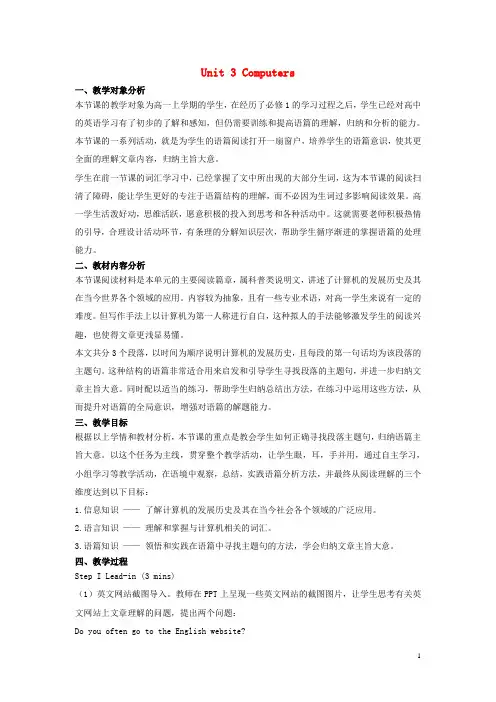
2) Do you know in what ways computers are used today? (Ss discuss and then give the answers)
2.Reading:
Task 1: Scan the text and find out the answers to the following questions.
教学方法
scanning, skimming, detailed reading, discussion and speaking
教具
a computer and a projector
课时安排
1period
教学步骤及内容
1.Lead-in:
1) What are they? (Ss look at the pictures of some electronic products and give the names)
高中英语-Unit-3-Computers-Reading-Who-am-I教学设计-新人教版必修2
Unit 3 Computers一、教学对象分析本节课的教学对象为高一上学期的学生,在经历了必修1的学习过程之后,学生已经对高中的英语学习有了初步的了解和感知,但仍需要训练和提高语篇的理解,归纳和分析的能力。
本节课的一系列活动,就是为学生的语篇阅读打开一扇窗户,培养学生的语篇意识,使其更全面的理解文章内容,归纳主旨大意。
学生在前一节课的词汇学习中,已经掌握了文中所出现的大部分生词,这为本节课的阅读扫清了障碍,能让学生更好的专注于语篇结构的理解,而不必因为生词过多影响阅读效果。
高一学生活泼好动,思维活跃,愿意积极的投入到思考和各种活动中。
这就需要老师积极热情的引导,合理设计活动环节,有条理的分解知识层次,帮助学生循序渐进的掌握语篇的处理能力。
二、教材内容分析本节课阅读材料是本单元的主要阅读篇章,属科普类说明文,讲述了计算机的发展历史及其在当今世界各个领域的应用。
内容较为抽象,且有一些专业术语,对高一学生来说有一定的难度。
但写作手法上以计算机为第一人称进行自白,这种拟人的手法能够激发学生的阅读兴趣,也使得文章更浅显易懂。
本文共分3个段落,以时间为顺序说明计算机的发展历史,且每段的第一句话均为该段落的主题句。
这种结构的语篇非常适合用来启发和引导学生寻找段落的主题句,并进一步归纳文章主旨大意。
同时配以适当的练习,帮助学生归纳总结出方法,在练习中运用这些方法,从而提升对语篇的全局意识,增强对语篇的解题能力。
三、教学目标根据以上学情和教材分析,本节课的重点是教会学生如何正确寻找段落主题句,归纳语篇主旨大意。
以这个任务为主线,贯穿整个教学活动,让学生眼,耳,手并用,通过自主学习,小组学习等教学活动,在语境中观察,总结,实践语篇分析方法,并最终从阅读理解的三个维度达到以下目标:1.信息知识——了解计算机的发展历史及其在当今社会各个领域的广泛应用。
2.语言知识——理解和掌握与计算机相关的词汇。
3.语篇知识——领悟和实践在语篇中寻找主题句的方法,学会归纳文章主旨大意。
人教版Unit3Computers之Reading

人教版必修二U nit 3 Computers之Reading:Who am I?T eaching aims:1. Let the Ss talk about the history and the new applications of the computer.2. Improve the Ss’ reading skills by reading a first-person passage.3. Learn something about the development of the computer.Teaching difficult and important points:1. Let the Ss understand the development of the computer.2. Train the Ss’ ability of summarizing the passage.T eaching method:Q uestion-and-answer method, task-based method and discussion methodT eaching procedures:Step one: Lead-inT: Good morning, boys and girls. First, let’s enjoy a wonderful match.( After watching a match)T: Who are they? Ss: …T: What are they dong? Ss: …T: What do you think of them? Ss: …T: Yes, after all, they are robots, they are computers. B ut is the first co mputer like robots?Ss: No, …T: Now, let’s look at the development of the computer. (Show several pictures a nd learn the words)T: So with the development of the science and technology, the computer plays a more and more important role in our daily life. T oday, let’s go into the comp uter.S tep two: Pre-readingN ow, turn to page 18, look at the title and the two pictures, can you pred ict what the text will tell us?( let the Ss answer)W ho is right? L et’s check your answers.Step three: Fast-readingR ead the text as quickly as possible, and find out the topic sentence of ea ch paragraph (2 mins)( After two minutes, check the Ss’ answer)T: So from the topic sentences, can you tell me whose prediction is right?S tep four: Detailed-readingA: Read para1 and find out the changes of the computer. T he key words I give yo u can help you understand para1. Let the Ss finish the first form.B: Read para2 and find out the changes of the computer’s memory. T he key wordsI give you can help you understand para2. Let the Ss finish the second form.C: Read para3 and find out the new applications of the computer. T he key wordsI give you can help you understand para3. Let the Ss finish the third form. D: Up to now, we have gone through the text. I t’s my turn to check your memory.B efore class, I had given you some yellow cards. N ow, I divide you into two groups, group A write down the five changes of the computer. G roup B write s down the five changes of the computer’s memory. (Bb: The changes of the co mputer The changes of the memory)(after two minutes) Each group sends five Ss to come to the front and put yo ur cards on the blackboard.T: From the information you have got, do you know who I am?Ss: Computers.(Draw a computer)Step five: SummaryN ow, let’s have a summary of the text. F ill in the form according to the time.(3 mins)Step six: InterviewG roup A acts as computers, group B acts as reporters. G roup B ask groupA and group A answers groupB one by one.Step seven: DebateW e have had a understanding of the development of the computer. N ow discus s with your partner about the usage of the computer.G roup A agrees that what the computer brings us is advantages.G roup B agrees that what the computer brings us is disadvantages.L et’s have a debate.( After the debate, the teacher has a summary)E very coin has two sides, we can’t just look at its goods sides or bad sides. A s to the computer, we should use it at the right time and at the righ t place. I hope in the future, the computer can be your best assistant and y ou can use it to make great contribution to our country.Step eight: HomeworkTask 1: Use your imagination to draw your own robots.T ask 2: Write a passage about your own robotsN ext class, we’ll learn the word and expressions of the text. Y ou can have a p review.教学反思:本节课是学生比较感兴趣的电脑,通过观看机器人足球比赛,激起学生对计算机的兴趣,从而想了解计算机的发展史。
人教版高中英语Book 2 Unit3 computersPeriod 1 warming up and reading (WHO AM I) (教案)
开州中学高中英语组张小英Unit3 computersPeriod 1: warming up and reading (WHO AM I?) (教案)Teaching aims1 To talk about computers and know about the history of computers2 Get students to think about the advantages and dis advantages of computersImportant points1 Let students know about the history of computers2 Try to improve students’reading ability ---- Let students understand the relationship between main idea and supporting details.Difficulty points1 Let students know how to learn by conclusion.2 Try to improve students’intergrating skills.ProceduresStep 1. Warming up1 Review some basic words related to the topic”computer”.2 Know some scientific words .Ask students “What do you know about computers?”Guess ”who am I?“according to the pictures.(abacus,calculator,huge computer, pc, lantop,PDA,and robot)3 Predic t the content according to the time and find the key word about the passage.(the history of computers)If you want to know more about computers,open the book to P18 and read the text “Who Am I?”Step2. skimming1.who is the speaker ? a computer2. In what order is this passage arranged(安排)? in order of time.Step3. ScanningChoose the main idea of this passage.A The computer wants to find “who he is”.B. The function(功能) of the computer.C. The computer becomes popular around the world.D. The history and the applications of the computer.Step4.The topic sentence of each paragraph.Para 1. Over time I have been changed a lot.Para 2.Those changes only became possible as memory improved.Para 3.Since 1970s many new applications have been found out for me.T:How did you find the topic sentence of each paragraph?one example: (Para3 )The supporting details of the topic sentenceWhat are the new applications of the computer? Teacher guides students to conclude:Summary:A topic sentence sets out the main idea of a paragraph. A topic sentence is usually the first or last sentence of a paragraph, sometimes it also appears in the middle of a paragraph,especially in scientific passage. Step5:What can you infer from the text?A. The computer has artificial intelligence.B. The computer changes a lot over the years.C. The computer was not connected by a network until in the early 1960s.D. Now the computer can only be used to deal with informationStrp6 Informal Discussion.(the students get into two groups ,choose a group leader who is allowed to organize their members to debate )What are advantages and disadvantages of computers?which are more?Advantages: our life has changed in school work, games, emails,music,films,communication,information ,photos ,shopping,etc.Disadvantages: 1.Bad for our eyes and health2.A waste of time and money3.Make people isolate from their friends4.Some people especially the teenagers are addicted to the computer games and chatting on the Internet. As a result, they have little time to study .5.Some people use the computer wrongly.……Step 7 Homework1.write a passage about the advantages or disadvantages of computers.2. Read the text more and find out the difficult key words and phrases。
高中英语人教版必修二Unit3ComputersReading课件
6) medical operations 7) space rockets
Comprehension
1. Who really invented the computer ?
A. Charles Babbage B. Bill Gates C. XXX Turing D. Thomas Edison
Do you know how computers developed?
5
abacus
calculator
analytical machine分析机
7
universal machine 通用机器
personal computer 个人电脑
laptop 手提电脑
Reading: Who am I ?
in the 1960s connected by a network
new applications
now
computers connect people all
over the world
in the
Careful-reading
Please find the topic sentence of each paragraph .
skimming
1)Who is the speaker?
It is a computer. 2)What is the main idea of the text? The text is about the _h_is_to_r_y_/_d_e_v_el_o_p_m__ent and the a_p_p_l_ic_a_t_io_n_s__of computers.
scanning
Time
What happened
Unit 3 Computers Who Am I阅读
2) What can you infer from the text? A. The computer has artificial intelligence. B. The computer changes a lot over the years. C. The computer was not connected by a network until in the early 1960s. D. Now the computer can only be used to deal with information.
Comprehending:
1. Choose the best answers
1) What’s the main idea of the text? A. The computer wants to find “who he is”. B. The functional change of the computer. C. The computer becomes popular around the world. D. The history of the computer.
Guess!
A handbag?
A toy?
Guess more:
I am very old now. I was born in China. Many people used me for calculating in the past, but now I am a bit lonely because they don’t like me now.
2. Questions
Q1: How did the computer work as an Analytical Machine? The computer followed instructions from cards with holes.
人教版高中英语Module 2 Unit 3 Computers Reading
in 1642. although I was young I could simplify ______(simple) difficult sums. I developed very slowly and it took nearly two hundred years before was built as analytical machine by ______I programmed Charles Babbages. After I was _________ (program) by an operator ____used cards with who holes, I could “think” _______(logical) and logically quicker produce an answer _______(quick) than any person. At that time it ____________(consider) was considered a technological evolution and the start of my
Topic sentence ( paragraph 3)
Since the 1970s many new applications have been found for me.
Supporting details
communications finance trade robots providing a life of high quality space rockets
A PC
laptop
These changes only became possible ______my as memory improved. First it was stored in tubes, later _____on very small chips. then transistors and _____on totally ____a changed my shape. As result, I _______(total) smaller As I have grown older I have also grow _____ (small). Over time my memory has developed so became ____large that even I couldn’t believe it ! But I was always so lonely standing there by myself ________(I), until in _____early 1960s they gave me the a family ___________(connect) by a network. I was connected through able to share my knowledge with others _______ the World Wide Web.
who,am,i,教案
【 - 高中作文】【篇一】who,am,i,教案人教版必修二第三单元阅读教学设计BOOK2 Unit3 Who am I? 阅读教学设计(第一课时)宁夏育才中学秦芹一.教材分析本课为人教版教材高一第一学期必修二第三单元第一课。
文章以第一人称的形式按时间先后顺序讲述了computers的产生、发展和现在,并以拟人化的口吻表达了computers乐于为人类服务的精神。
这个题材贴近学生生活,学生比较熟悉也很感兴趣,但与电脑相关的的专业术语过多。
1.文本特征:文章体裁是科普说明文,文本特征十分明显。
Reading中以别致的标题WHO AM I?引起学生的好奇心,使学生迫不及待地阅读这篇文章,并努力猜出“I”是computer,从而对文章的内容印象深刻。
文章分为三个自然段。
第一段按照时间顺利讲述了电脑在不同时期的发展状况。
第二段从电脑的记忆储存和外形上讲述了电脑的变化。
第三段描述电脑的作用。
另外,文章还配有两幅插图,提示了相关部分的主要内容。
在阅读过程中,注意引导学生利用这些文本特征进行速读和略读。
2.文本特点:从文本的语言来看,文章内容与生活紧密联系,但语言要求较高。
文中出现的........专业术语、短语较多,因此要通过实物图片解释或在上下文中理解,引导学生理解词汇的意思,从而提高阅读速度。
在文章中尤其是在第一段描述电脑在不同时期的发展的时候,专业术语较多。
从文本的结构来看,文章有三个自然段,每一段的开头一句话就是本段的主题........句。
脉络清晰。
从文本的内容来看,文章是一篇关于电脑及其用途的文章,要注意对学生正确........使用电脑的引导。
二任务分析1.学习本篇阅读所需要的基础知识(1)了解和电脑部件相关的基本词汇(2)了解基本的科普说明文结构及相应的阅读技巧2.学情分析:知识基础:这是学生在高中阶段首次接触科普说明文这一体裁,对科普说明文的特点和语言表达不太熟悉。
对电脑的专业术语不了解。
Unit 3computers reading
Do you know who I am?
abacus
I am very small. I can be used for calculating. In China, a lot of students use me when solving mathematical problems.
Do you know who I am?
suggested answers:
1. use computer for school work 2. play games on the computer 3. send emails to friends 4. surf the net for fun 5. download music and films 6. chat online 7. search for information 8. look at photographs 9. do shopping online
The first family of computers was connected to 1960s each other. 1970s Computers were used in offices and homes.
now
Computers connect people all over the world together.
How useful computers are!
Fill in the blanks with the new words. implify 1. A calculating machine could s________difficult s_____. ums ogically 2. An analytical machine could think l________after it was rogrammed p____________by an o_________. It was considered a perator rtificial t__________ the start of its a________ echnological r____________and evolution i___________. ntelligence olve athematical 3.A universal machine could s______any difficult m________ problem. From on it worked hard to get into offices and homes. 4._____then ___ eality 5.His hope has become a r__________. ersonal 6. PC stands for p________computer. ransistors puters’ memory was stored in t____, ubes then on t________ and later on very small c______. As a result the computer hips t______changed its shape. otally
Unit 3 Computers(reading)教学设计
Unit 3 ComputersReading: Who Am I?I. Lesson typePeriod 1 ReadingII. The analysis of teaching materialThe title of the reading part is Who Am I? The reading mainly talks about the quick development of computers and the wide application in every different aspect by using the first person. Six types of the computer technology, which are a calculating machine、an analytical machine、an artificial intelligence、a universal machine、a PC(personal computer)/ a laptop and the Internet, were introduced in this passage. With the development of the technology, computers have changed frequently. It is widely used in varies aspects in our life. From the reading part, students will obtain more knowledge about computers, get the writing ideas clearly, and master the reading strategies in order to understand the whole passage in three aspects of information knowledge、language knowledge and discourse knowledge. III. The analysis of learning conditionStudents have collected some information about computers. They have learned new words in this unit. They also have mastered some reading strategies such as skimming and scanning.But sometimes they could not use these strategies correctly and efficiently. Besides, they also have the trouble in predicting the meaning of words、expressions or sentences.IV. Teaching aims1.Knowledge1)Students are able to master new words and expressions.2)Students are able to get the development and the basicknowledge of computers.2.Ability1)Students are able to learn how to describe different kinds ofcomputers in English.2)Students are able to improve their reading strategies, suchas skimming、scanning.3.Emotion1)Students are able to inspire their strong interests incomputers.2)Students are able to strengthen their imagination andcreativity.3)Students are able to manage their time to use computerscorrectly.V. Teaching key and difficult pointsKey points: remember new words and expressions;get the basic knowledge of computers;master and use different reading strategies. Difficult points: get the basic knowledge of computers;master and use different reading strategies.VI. Teaching methodsTask-based Language Teaching (TBLT); Cooperative learning; DiscussionVII. Teaching aidsA multimedia; a laser presenter; a box of colorful chalks VIII. Teaching proceduresStep1. Warming upT: Good morning, boys and girls. Today we are going to talk about Unit 3 Computers.T: Are you familiar with the computer? What do you know about it? Now let’s play a quick-question game.Present 10 questions on the PPT.T: Do you know in what ways computers are used today? Step 2 Pre-readingPresent a video about the development of computers. Ask students to put these inventions in time order in pairs. After reading the passage, check to see if they were right.T: What do you think will be the next development?Present a short news about the robot in our daily life.T: let’s move to our reading part. After reading, you may have more ideas about the development of computers in the future. Step 3 While-readingTask1 SkimmingAsk students to skim the passage quickly to answer the question Who Am I? with the help of these two pictures in reading part, and then choose the main idea of this passage.Ask students why the passage is introduced by the first person. Task 2 ScanningAsk students to read the passage again to finish the timeline in Comprehending 1.1642:_____________________________________________1822: The analytical machine was made by Charles Babbage._____: __________________________________________________: The first family of computers was connected to each other.1970s: _____________________________________________Now: ______________________________________________ Task 3 Careful readingAsk students to read the passage carefully to complete the chart in Comprehending 2.IX. Post-readingAsk students to finish True or False questions on the PPT.(If false, ask students to find out the mistakes and correct them.) Put the inventions in order, and ask students to check they were right.X. DiscussionAsk students to discuss advantages and disadvantages of computers with their group members. After 5 minutes to ask some groups to share their ideas.XI. SummaryToday we have learned about the development of computers. Every coin has two sides. As students, we should make the best use of computers to help us study.XII. Homework1.Write down your opinion about advantages anddisadvantages of computers no less than three points for each one.2.Translate the passage into Chinese.3.Preview The Present Perfect Passive V oice.XIII. BlackboardUnit 3 ComputersReading: Who Am I ? first person。