
人教版英语七年级下册Unit 6 I’m watching TV
龙源期刊网 http://www.qikan.com.cn 人教版英语七年级下册Unit 6 I’m watching TV 作者:曾芷曦 来源:《校园英语·月末》2019年第05期
I. Teaching objectives: A. Knowledge objectives: 1. To familiarize students with the form, meaning and use of present progressive tense. 2. To guide students to figure out the differences between the simple present tense and the present progressive tense. 3. To help students master how to change an original verb to its present participle. B. Ability objectives: To enable students to talk about what they are doing using the present progressive tense. C. Affective objectives To encourage students to talk about the things they are doing in English.
II. Teaching focal points: A.To guide students to summarize the form, use and meaning of the present progressive tense. B.To lead students to distinguish differences between the simple present tense and the present progressive tense.
III. Teaching difficult points: To encourage them to express themselves in exchange using the present progressive tense.
IV. Teaching methodology: PPP model. VI. Teaching procedures: Step 1. Lead in (5’) Activity: The teacher plays a song named Sailing to students and asks them to answer the following questions:⑴How do you feel like the song?⑵In the song, what is he doing? What are they doing?(Purpose of design: Music plays an important role in lowering affective filter. Besides, the song contains many sentences using the present progressive tense, which aims to activate their prior knowledge and lead in the grammar focus.)
Step 2. Presentation (15’) The teacher guides students to figure out the form, meaning, use of the present progressive tense.
Activity 1: Look at the picture and answer questions.(5’) T: Show a picture on the slide and ask what persons in the picture are doing now. Then write important sentences on the blackboard until responded with a correct answer. 龙源期刊网 http://www.qikan.com.cn Ss: Answer the teacher’s question at random.(Purpose of design: The Q&A activity aims to elicit the form of the present progressive tense and attracts students attention on the grammar.)
Activity 2: ;Study the differences between the simple present tense and the present progressive tense. (5’)
T: Introduce the information of Jenny using the simple present tense and the present progressive tense and at the same time shows ;sentences on the slide.
Ss: Work in group of four to discuss the differences between the sentences on the left and the ones on the right. (Purpose of design: This activity aims to practice students cognitive strategy of contrast analysis and learning strategy of cooperative learning.)
Activity 3: Study the negation and question form of the present progressive tense. (5’)(Purpose of design: This activity aims to enhance students’ interest in studying grammar and introduce the negation and question form of the present progressive tense naturally.)
Step 3. Practice(10’)The teacher provide students with specific situations to do controlled drills.
Activity 1: Listen and Guess(5’) T: Play the record of several kinds of sound for students to guess what he(she/it/they) is (are) doing. Then present sentences with relevant pictures on the screen ;once students give a correct answer.
Ss: Listen carefully and answer quickly.(Purpose of design: This activity aims to offer specific situations for students to practice the use of the present progressive tense. Meanwhile, this activity can also help to arouse their attention and interest.)
Activity 2: Summarize the rule of changing an original verb to its present participle.(3’) T: Show the verbs in one slide and ask students to figure out the rule of changing an original verb to its present participle.
Ss: Work in group of four to discuss the rule and report to the whole class.(Purpose of design: This activity aims to practice students’ learning strategy on cooperative learning and to teach grammar inductively.)
Activity 3: Describe what people are doing in the given picture.(2’) 龙源期刊网 http://www.qikan.com.cn T: Show a picture on the screen and ask students to make up conversations to talk about what people are doing in the picture in pairs.
Ss: Do the job.(Purpose of design: This activity aims to offer more practice for students to internalize the use of the present progressive tense.)
Step 4. Production(12’) The teacher offer students more chances to speak out, meanwhile to internalize the grammar. Activity 1: Talk about what you are doing with the reference pictures. T: Hand four different pictures out to each group and ask students to inquire of each other about what they are “doing” now.
七年级英语下册Unit6I’mwatchingTV知识点总结+导学案(无答案)(新版)人教

七年级英语下册Unit6I’mwatchingTV知识点总结+导学案(无答案)(新版)人教Unit 6 I’m watching TV.知识点总结归纳一、短语归纳1.read a newspaper = read newspapers 看报纸2.talk on the phone 打电话3. want to do sth. 想做某事/doc/0e7697213.html,e the computer 用电脑6.wash the dishes = do the dishes 洗盘子7.Not much=Nothing much 没什么事8.go to the movies 看电影9.eat out 出去吃饭10.drink tea 喝茶11.Dragon Boat Festival 端午节12.join sb for sth 与某人一起做某事13.any other 任何一个14.host family 寄住家庭15.wish to do 希望做某事16.the United States 美国17. boat races 龙舟比赛18.listen to a CD = listen to CDs听CD19.make soup 做汤 20. eat dinner吃晚饭21. wash the dishes 洗餐具=do the dishes22.read a story to sb. 读故事给某人听 23.in the pool 在游泳池24.be at home 在家 25. in the shop=in the store 在商店26.live with sb. in... 和某人一起住在27.would love to do =would like to do 乐意做…28.clean the house=do some cleaning 打扫房子29.make dinner做晚饭 30.go shopping 去购物31.go to the movies=go to see a film去看电影32.in the living room 在客厅 33.the Dragon Boat Festival 端午节34.in the supermarket 在超市35.in the library 在图书馆36. on the playground 在操场37. in the United States=in the US 在美国38. watch the boat race on TV 在电视上看龙舟比赛39.write a letter写一封信 40. thanks for sth. 为... ...而感谢41.a picture of my family 一张我家的照片42.host family 房东家43. read ... sb.读... ...给某人听44. want to do sth. 想做某事45.see you tomorrow 明天见46.swim in a pool 在游泳池里游泳47.make zongzi 包粽子 48. the night before 前一天夜里49. watch... on TV 在电视上看 ... ... 50. talk show 脱口秀二、用法集萃1. --What +be+主语+doing? ... ...正在做什么?--主语+be+doing sth. ... ... 正在做某事。
人教版英语七年级下册Unit6I’mwatchingTV.知识点及课后作业
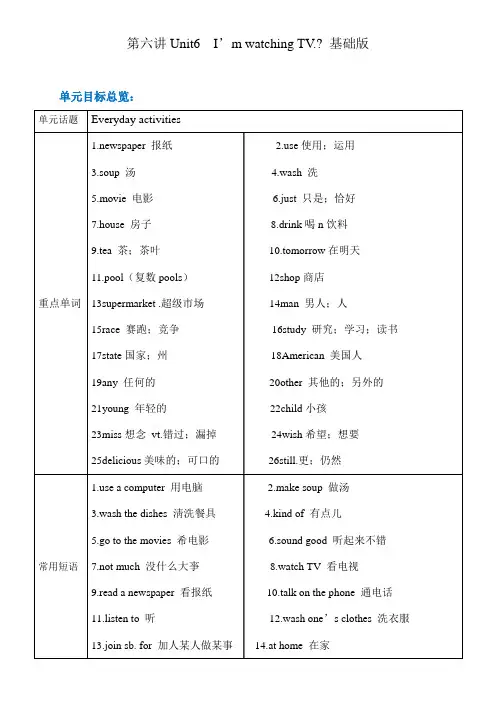
第六讲Unit6 I’m watching TV.? 基础版单元目标总览:【知识点详解】1、What are you doing? 你在做什么?这是一个现在进行时的特殊疑问句,询问别人正在做什么。
它的结构是“特殊疑问词+be+主语+doing+其他+?”。
对于特殊疑问句的回答,要根据实际情况来定。
例如:◆-What is your mother doing? 你妈妈在做什么?-She is watering the flowers. 她在浇花。
◆-Who is playing the piano? 谁在弹钢琴?-My sister. 我姐姐/妹妹。
◆-What’s she doing? 她正在什么?-She is washing her clothes. 她正在洗衣服。
2、reading a newspaper看报纸(1)newspaper意为“报纸”,是可数名词。
“在报纸上”用英语表示为“in the/a newspaper”,不能用介词on。
我们日常所说的晨报/晚报是morning / evening newspapers。
◆She likes collecting old newspapers. 她喜欢收集旧报纸。
(2)newspaper是由news和paper构成的合成词,合成词是一种重要的构词法,对我们记忆单词很有帮助。
例如:bed + room→ bedroom 卧室class + room →classroom 教室head + phone →headphone 耳机police + man→ policeman 警察basket + ball→basketball 篮球3、talking on the phone通过电话交谈On the phone意为“通过电话”,其中on为介词,意为“通过;以......的方式”。
◆The boy is talking on the phone with his friends.这个男孩和朋友在打电话。
PEP人教版英语七年级下册 Unit 6 I’m watching TV

Exercis
Number the sentences in ordeer to make a telephone conversation.
Then practice it with a partner.
/təˈmɒrəʊ/adv. 在明天 n. 明天;未来
_5__ Do you want to go tomorrow then?
Bob feels a little bored so he calls Jenny. Listen to the conversation and find out what these people are doing.
a. Jenny
b. John
c. Dave and Mary
watching TV washing the dishes listening to a CD
Today we have read so many telephone conversations. Can you try to make a telephone call with your partner in English after school. Then write down your conversation and share in the next class. You can talk about the following things on the phone.
Unit 6 I’m watching TV.
Section A (1a-2d)
Learning Objectives
By the end of the class, we will be able to: 1. identify what people are doing from listening; 2. have a preliminary (初步的) understanding of the Present
人教版七年级英语下册Unit6I'mwatchingTV.Reading优秀教学案例

2.问题导向的探究学习
本案例以问题为导向,引导学生进行探究学习。教师设计了一系列有针对性的问题,让学生在解决问题的过程中掌握现在进行时态的知识点。这种教学方法有助于培养学生的思维能力和自主学习能力,使学生成为课堂的主体,提高学习效果。
(五)作业小结
1.教师布置课后作业,要求学生运用现在进行时态写一篇小短文,描述自己或家人在某个时间正在进行的动作。
2.教师提醒学生注意作业要求,如:时态、词汇、语法等,鼓励学生认真完成作业,巩固所学知识。
3.教师告知学生下次课将进行作业展示和评价,激发学生的学习积极性。
五、案例亮点
1.真实情景的创设
(一)知识与技能
1.知识方面:通过本章节的学习,学生能够理解并掌握现在进行时态的构成和用法,掌握描述正在进行的动作的词汇和句型。此外,学生能够理解并运用目标词汇描述日常生活中的活动,如watching TV, doing homework, playing games等。
2.技能方面:学生能够运用现在进行时态进行口语表达和书面表达,提高英语实际运用能力。通过阅读练习,学生能够获取文章中的关键信息,提高阅读理解能力。同时,学生能够在小组合作中,运用所学知识进行交流,提高沟通能力。
5.内容与生活实际紧密结合
本案例的教学内容与学生的生活实际紧密结合。通过学习现在进行时态,学生能够描述自己或家人在日常生活中正在进行的动作,使英语学习具有实际意义。这种教学方法有助于提高学生的学习兴趣,使其认识到英语学习的价值,从而更加主动地投入到学习中。
人教版PEP英语七年级下册 Unit 6 I'm watching TV
on the Internet 在互联网上
➢Susan is talking with Jenny on the phone. 苏珊正在和珍妮通电话。
3. What are you doing? 你正在做什么? 现在进行时的特殊疑问句
【用法详解】本句为现在进行时的特殊疑问句,询问目前正 在发生什么事情或正在进行什么动作,其结构为“What + be + 主语 + 动词-ing形式?”。 ➢What are they doing? 他们正在做什么? ➢What is Lily doing? 莉莉正在做什么?
1. Preview the conversation in 2d. 2. Do the exercises in students’ book.
Unit 6 I'm watching TV.
Section A (2a-2d)
➢ Key words & phrases:
学习目标
movie; go to the movies; just; eat out; not much; join me for dinner.
___C___an important exam.
A. have
B. had
C. are having D. has
二、根据首字母提示填空 1.My father often reads a n_e_w_s_p_a_p_e_r_ in the morning. 2.It’s a good habit to w_a_s_h_____ hands before meals. 3.The Russian s_o_u_p_____ smells very nice. I can’t wait to eat it. 4.My brother is u_si_n_g_____ my computer.
人教版七年级英语下册Unit 6 I'm watching TV 公开课课件

2b Listen again. Fill in the blanks.
Jack: Hello, Steve. Steve: Hi, Jack. Jack: What ___a_r_e___ you __d_o_i_n_g__, Steve? Steve: I’m __w_a_t_c_h_in_g__T_V___. What about you? Jack: I’m _l_is_t_e_n_in_g__to__a_C__D__, but it’s kind of __b_o_r_in_g__. Steve: Yeah, my TV show is also not very _in_t_e_r_es_t_in__g. Do you want to _g_o__to__ the movies? Jack: That sounds good.
▪ 10、阅读一切好书如同和过去最杰出的人谈话。2021/7/202021/7/202021/7/207/20/2021 7:01:41 PM
▪ 11、一个好的教师,是一个懂得心理学和教育学的人。2021/7/202021/7/202021/7/20Jul-2120-Jul-21
▪ 12、要记住,你不仅是教课的教师,也是学生的教育者,生活的导师和道德的引路人。2021/7/202021/7/202021/7/20Tuesday, July 20, 2021
A: What’s he doing? B: He’s using the computer. A: What are they doing? B: They’re listening to a CD.
季七年级英语下册 Unit 6 I’m watching TV课文重难点讲解(无答案)(新版)新人教版
Unit 6 I'm watching TV课文重难点讲解【教师寄语】:A friend in need is a friend indeed. 患难见真情。
Section A1. reading a newspaper读报纸【解析】Newspaper “报纸”(可数名词)( ) — Do you know who won the high jump?—Sorry, I don’t . Here’s a _____ for sports . You can read it.A. newspaperB. mapC. pictureD. camera2.wait for +人或物等待某人或某物We __________(wait ) for the bus at the moment.3. I’m watching TV.我正在看电视【解析】⑴此句为现在进行时的陈述句形式,其结构为“主语+be(not)+v.ing形式+其他”,表示目前正在进行或发生的动作。
I am cleaning my room.我正在打扫我的房间。
Tom isn’t doing his homework.汤姆没在写作业。
⑵watch TV 为固定短语,意为“看电视”。
例如:My grandmother often watches TV in the day.Do you like watching TV?你喜欢看电视吗?He is watching TV.他正在看电视。
⑶watch /read/see/look 的辨析(1) watch v “观看,注视“看电视、看比赛用Watch。
watch TV 看电视 watch football match 看足球比赛(2) read 看 ----读书看报用readread the book 看书 read magazines 看杂志(3) see v “看见,看到” ---指看电影、看病,强调看的结果用seesee the film =go to the movies 看电影 see the doctor 看医生(4) look at 看强调看到具体动作 ---看黑板,看地图用look atlook at the blackboard 看黑板4. That sounds good. 那听起来不错。
人教版七年级下册英语Unit6 I'm watching TV Section B 2a-2c教案
七年级下册第6单元《I’m watching TV》Section B 2a-2c教案一、教学目标(一)知识与能力:1.Key vocabulary: realize, by the side of, make one’s way, point out sth.2.Target language: Kate saw a dog by the side of the road.When the school basketball competition started, Kate was still making her way to school.3. Be able to talk about past events and tell stories using the target language.4. Train students’ listening and speaking skills.(二)过程与方法:1.我通过给出8个词组作为挑战1,让学生浏览文章,达到预习检测的目的。
同时拓展“East or west, home is the best”,j激发同学们热爱家乡的情怀。
2.给出挑战2的任务——3道问答题,让学生快速阅读,达到整体认知的目的。
3.挑战3通过略读的方式,再读课文。
先自主学习再合作交流,进行连线。
进一步熟悉文章。
4.挑战4再让学生阅读,把握文章的细节,然后进行判断正误。
5.挑战5通过完成表格,让学生以小组合作的方式,再次感受现在进行时,达到深层理解文章的目的。
6.挑战6通过改编文章的对话使学生达到身临其境的目的。
7.挑战7写作则是一个精炼提升的环节。
让学生把所学知识能正确运用到写作当中。
(三)情感态度与价值观:Encourage students to write and speak by using the present progressive.二、教学重难点(一)教学重点:教学重点:1. 理解2b中的短语及文章的意思。
人教版七年级英语下册《unit6 I'm watching TV》单元课件 (Section A)
1b
Tapescript
Bob: Hello, Jenny? Jenny: Hi, Bob. Bob: Jenny, what are you doing? Jenny: I’m watching TV. Bob: Do you want to play tennis? Jenny: No, this TV show is interesting.
What’s Mary doing? Mary
She is playing tennis.
It’s 4 o’clock now.
What are they doing?
They are swimming.
They are running.
swim--swimming
run--running
It’s 10 o’clock.
CD.
2b Listen again. Fill in the blanks.
Jack: Hello, Steve. Steve: Hi, Jack. Jack: What _a_r_e__ you _d_o_in_g__, Steve? Steve: I’m _w_a_t_c_h_in__g_T_V_. What about you? Jack: I’m _li_s_te_n_i_n_g_t_o__a_C__D_, but it’s kind of
3. Do you want to join me for dinner? 你想和我一起吃饭吗? join somebody for something表示“与某人 一起做某事; 参与或加入到某人的行列中一 起做某事”。例如:
Would you come and join us for a cup of coffee? We need to talk to you. 你来跟我们喝杯咖啡好吗?我们有事要跟 你谈。
人教新目标版英语七下Unit 6《I’m watching TV》课后练习
Unit6 I'm watching TV题一:用动词的适当形式填空。
read; watch; play; go; write; shop; cleanLily is __________ a story book.My brother is ___________ football.I’m ____________ to buy some fruit .Tom is __________ a film.The children are _____________ the room.She is _____________ with her friends in the supermarket. I’m __________ a letter to my friend.题二:用动词的适当形式填空。
take; sing; play; have; write; go; talkTina is ______ a letter now.The students are _____ an English class.The boys are ____ games in the park.Let’s ____ about the movie.I usually ____ to bed at nine o’clock.She is _____ songs in English.Can you _____ a walk with me ?题三:首字母填空。
The Greens w_________ TV every night.The cake is so d_______________.People eat zongzi on the D____________ Boat Festival.W_________ is she doing now?She got the f____________ place in the exam.题四:首字母填空。