
外研版九年级英语上册M5u2教案
11. [trʌk] 12. [wiːl]
13.比较……与……14.所有年龄段的15. [həʊl]
任务二:根据M5U2课文,完成阅读表达题目,注意认真书写,规范答题。
阅读表达,每题2分。请根据课文内容回答问题。
1.What can you learn about on the fourth and fifth floors?
A.ifB.soC.so thatD.until
15.______ him if he is in trouble.( )
A.HelpingB.HelpsC.HelpD.To help
课后反思
1.If you want to fill a bag with sand, you have to control a kind of truck on wheels and move it into the correct place…
如果你想将袋子装满沙子,你得操控一种带轮子的运输车,并把车移动到正确的位置
任务五:巩固监测:
1.完成习学卷子。
M5U2习学卷子
一.选择题(共15小题)
1.﹣__________ on the TV,Jim.I'd like to watch the evening news.
﹣OK,Dad.( )
A.TurnB.TurnsC.TurningD.To turn
2.﹣What do you think of the Science Museum?
任务四:核对答案,教师点拨。
1.as well也2.the answer o+n ...的答案
3.on the first floor在第一楼4. learn about...了解...
5.as well as和,还有
6.for example例如(后接例子)such as例如(后接列举的事物)7.find out弄清楚,查明白
A.takeB.tookC.have takenD.will take
10.Come and see the exhibition if you _____ free tomorrow.( )
A.will beB.areC.haveD.were
11.﹣﹣﹣Keep quiet! Can't you see the sign "_____" on the wall?
______________________________________________________
2.将下列句子翻译成汉语。
It’s open every day from10am to 6pm. So if you ever go to London,make sure you visit the Science Museum.
8.fill sth with sth用...装满... be filled with...装满...的
be full of...装满...
9.in the past在过去10.next time下一次pare A with B把A和B做比较compare A to B把A比作B 12.of all ages各个年龄段的13. be free免费的14.dig the coal挖煤
﹣﹣﹣Oh,sorry.( )
A.No shoutingB.Not shouting
C.Not shoutD.No shout
12.The little boy is filling his schoolbag ________ lots of books.( )
A.inB.byC.forD.with
﹣I think it is the top one in ________ world.( )
A.all theB.whole theC.the allD.the whole
3.﹣Must I write the report of the experiment right now?
﹣No,you________.You can do it after dinner.( )
A.will goB.wentC.goD.going
8.______ wake up your sister,Ben.She needs a good sleep.( )
A.Don'tB.Doesn'tC.Aren'tD.Can't
9.I _______ a vacation to relax if I am unhappy.( )
You can learn about not only communications and the environment but also maths ,physics and chemistry.
______________________________________________________
5.填空
It’s open every day _____10am_____ 6pm.
任务三:完成语法填空题目,认真思索,标画线索。
The most unusual museum in London __1__(be) the Science Museum.In most museums,there’s no shouting and no running,and you must not touch ___2___(something). But the Science Museum is different…because it’s noisy ! People talk about what they they can see and do there, and some of the machines are noisy as well ._____3___(visit)the Science Museum is fun and it’s a great way to learn ___4____(介词)science because you can work things out and try out ideas.
15.talk about sth/sb谈论某事/某人talk with/to sb与某人谈论
16.from A to B从A到B 17.make sure确保
18. in the whole world/around the world/all over the world全世界
all the year=the whole year全年
教学难点
if引导的条件状语从句
教学过程
学生活动
教师活动
任务一:根据音标拼读下列单词,然后熟记下列单词。
1. [kəmju:ni'keiʃnz] 2.['fɪzɪks]
1.['kemɪstrɪ] 4.[dɪg]
5. [kəʊl] 6.['enədʒɪ]
7. ['eks'reɪ] 8.[ɪk'sperɪmənt]
13.________ you return to our home town,don't forget to call me.( )
A.IfB.AsC.BecauseD.Although
14.You can't take good photos ______ the light is bad.( )
When I visit the Science Museum,I go to the Launch Pad.This is my favourite room because you can do physics ____5____(experiment) .For example ,if you want to __6__(fill)a bag with falling sand,you have to move a kind of truck on wheels into the correct position.I also go to the Rocket Show. There are also rooms on transport,__7___(冠词)environment and space technology,as well as maths,physics and chemistry. For example, you mustn’t take photos of the exhibits in the museum. ___8____(连词)you can buy postcards of them in the museum shops. ,the Science Museum is free.That means you can go in for a few ___9____(minute) or you can stay all day . it’s open every day from10am to 6pm.So if you ever go to London,make sure you visit the Science Museum.It’s ___10______(人称代词)favourite museum in the whole world.
2.If you compare the medicine of the past with the medicine of today。
如果你比较一下过去的药物与现在的药物……
3.The Science Museum is interesting for people of all ages.
科学博物馆非常有趣,可以说老少皆宜。
A.shouldn'tB.needn'tC.mustn'tD.couldn't
Module 5 Unit 2 外研版英语九年级上册单元教案
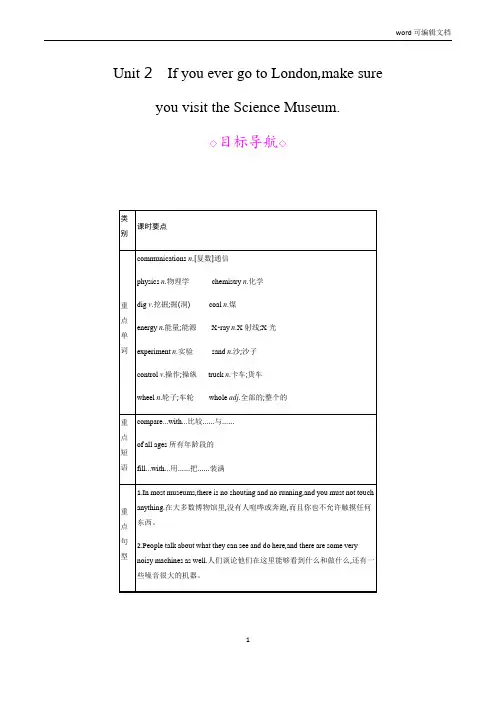
Unit2If you ever go to London,make sure you visit the Science Museum.◇目标导航◇◇教学过程◇预习指导一、方法指导阅读短文,在文中找出it,he,her,this,there等代词分别指代什么,并尝试使用这些代词造句。
二、预习检测Ⅰ.根据首字母及汉语提示补全单词1.Physics(物理)is more interesting than maths,I think.2.We made a(n)experiment(实验)to explain air pressure.3.—How much money did you pay for the drink?—None,it was free(免费的).4.Don’t worry.Let’s forget the whole(整件的)thing.5.The room is always noisy(喧闹的)because it’s near the main street.Ⅱ.根据括号内的英语提示翻译句子1.如果你想要所有科学问题的答案,这对你来说是个正确的去处。
(if)If you want answers to all your questions about science,this is the right place for you.2.如果你想用沙子装满袋子的话,你不得不操作一种带轮子的卡车并把它移到正确的位置。
(fill...with) If you want to fill a bag with sand,you have to control a kind of truck on wheels and move it into the correct place.3.如果你比较一下过去的药物与现在的药物,你将感到非常幸运。
(compare...with)If you compare the medicine of the past with the medicine of today,you will feel very lucky.4.科学博物馆对于所有年龄段的人来说都是有趣的。
外研版九年级英语上册教案 M5 Unit 2

Book 5 Module 5 Museums一、教学内容:Unit 2 If you ever go to London, make sure you visit the Science Museum.二、课型:Reading and writing三、教学目标:1、能够听懂并正确地朗读下列单词:communications,physics,chemistry,Dig coal,energy,X-ray,experiment,sand,control,truck,wheel,compare…wit h,of all ages,whole2、语法:能掌握用if引导的条件状语从句。
3、能够读懂介绍博物馆的短文,理解公开场所的常用标语。
4、能描写自己喜爱的博物馆,并能正确使用代词it, they, there四、教学重难点:1、能够理解介绍博物馆的短文。
2、能够正确运用if等词引导的状语从句于写作之中。
五、教学准备:课堂整体运用任务型教学模式以及阅读课“四个阶段”教学模式。
本课指导学生通过阅读获取信息,培养学生阅读技能。
在教学过程中,采用多媒体手段辅助教学,利用各种图片和习题任务贯穿整个教学过程。
因此,本节课需准备:PPT课件。
六、教学过程:达标训练题QuizⅠ. 用方框里的词的适当形式完成句子。
sand control energy truck chemistry1. With growth, demand for ________ continues to rise.2. Look over there! The kids are playing with ________ on the beach.3. I’m afraid that the ________ isn’t large enough to carry all the things.4. __________ was her favorite subject at school.5. It’s difficult to _______ an aircraft a t high school.Ⅱ. 根据要求完成下列句子。
外研版英语九年级上册Module 5 Unit 2 教学设计

教学文档如有疑问,请联系网站底部工作人员,将第—时间为您解决问题!文件预览:Module 5 MuseumsUnit 2 If you ever go to London, make sure you visitthe Science Museum.教学目标(知识目标)能够正确使用以下单词和词组:sand, wheel , try out , work out , experiment, physics, obey, above all ,speed, drop in .as……as , human . travel , rocket , position, unusual,communication.(能力目标)1. 能够读懂简单介绍伦敦博物馆的短文。
2. 能够对自己所熟悉的博物馆进行简单的描述。
(感情态度目标)培养对博物馆的兴趣,通过了解伦敦博物馆,,强化对西方文化的了解。
教学重难点(教学重点)能够读懂介绍伦敦博物馆的短文,并能在阅读中找出参观展馆时的一些考前须知以及遵守的规则。
(教学难点)if从句及表示禁止的祈使句教学过程Step1 Warming up1. Ask thestudents to look at the pictures in Activity 1.2. Talk about thepictures. 3. Look at thepictures and talk about the differences between the two museumsStep 2 Readingand vocabulary1. Introduce the ScienceMuseum in London and show some picture and videos.2. Ask the students to read through the passage andanswer the question.Howis the Science Museum different from other museums3. Learn some new words.Step3 Complete the table.1. Read the passageagain.2. Complete theTony’s favourite museum column in the table.Module 5 Unit 2 教案2021-4-25 21:28全部教学资源,免费、延续更新。
九年级英语外研版上Module5 Unit2 教案

There’s no shouting and no running.Unit 2 , Module 5 (Book I, Junior III)第一课时Language goals:Knowing a guide to a museum on the internet教学目标:知识目标:To get information about the Science Museum in LondonTo understand passages involving Compound word能力目标:To talk about the signs with “ mustn’t, can’t, Don’t… No….”Word Formation --Compound word重点: Word Formation --Compound word难点: Describe the museums课型: Saying and readingTeaching Procedures:Step 1: RevisionT: There are many sorts of museums in the world .look at the picture, can you guess what museum is it?S:……T:It’s the British Museum. What can you see in it?S:……T:Many exhibits like sculptures and old cars with wheels. The things in it are costful(珍贵的)We must obey the rules.Which rules are there in this museum? Ss:No shouting Don’t touch No photographT: Please use the words in the box to describe it.Boring exhibit not allowed to quiet serious设计意图:复习规则表达法,引出新授内容。
外研版九年级上册英语《Module5Museums,Unit2》说课稿

外研版九年级上册英语《Module 5 Museums,Unit 2》说课稿一. 教材分析外研版九年级上册英语《Module 5 Museums, Unit 2》的话题是关于博物馆。
本节课的主要内容是学习参观博物馆的相关词汇和表达方式,以及如何介绍博物馆中的展品。
通过本节课的学习,学生将能够掌握与博物馆相关的词汇和表达,提高他们的口语表达能力。
二. 学情分析九年级的学生已经具备了一定的英语基础,他们能够理解和运用一些基本的英语表达。
但是,对于一些与博物馆相关的专业词汇和表达,他们可能还比较陌生。
因此,在教学过程中,我需要帮助他们掌握这些词汇和表达,并能够灵活运用。
三. 说教学目标1.知识目标:学生能够掌握与博物馆相关的词汇和表达,如exhibition,artifact, gallery等。
2.能力目标:学生能够用英语介绍博物馆中的展品,提高他们的口语表达能力。
3.情感目标:通过本节课的学习,学生能够增强对博物馆的兴趣,提高他们对文化艺术的热爱。
四. 说教学重难点1.重点:学生能够掌握与博物馆相关的词汇和表达。
2.难点:学生能够用英语介绍博物馆中的展品,并能够灵活运用。
五. 说教学方法与手段1.教学方法:采用任务型教学法,让学生在实际操作中学习和运用语言。
2.教学手段:使用多媒体课件,展示博物馆的图片和视频,帮助学生更好地理解和运用语言。
六. 说教学过程1.导入:通过展示一些著名的博物馆图片,引导学生谈论他们对博物馆的印象和经历。
2.新课呈现:介绍博物馆的相关词汇和表达,如exhibition, artifact,gallery等。
3.实践环节:学生分组,每组选择一个博物馆,用英语介绍博物馆中的展品。
4.总结环节:教师引导学生总结本节课所学的词汇和表达,并进行复习。
七. 说板书设计板书设计包括博物馆相关的词汇和表达,以及如何介绍博物馆中的展品。
通过板书,帮助学生巩固所学内容。
八. 说教学评价教学评价包括对学生的口头表达和书面表达的评估。
外研版初中英语九年级上册module5unit2教学设计新部编版

教师学科教案[ 20 – 20 学年度第__学期]任教学科:_____________任教年级:_____________任教老师:_____________xx市实验学校外研版初中英语九年级上册Module 5 MueseumsUnit2 There’s no shouting and no running教学设计一、教案背景1,面向学生:□中学□小学 2,学科:英语2,课时:13,学生课前准备:一、预习单词和词汇。
二、能够根据自己的情况预习教材并进行拓展。
三、能够借助图片、生活情境介绍公共场合规则问题。
四、让学生提出自学中遇到的问题。
二、教学课题Module 5 MueseumsUnit2 There’s no shouting and no running三、教材分析本课是本模块的第二课时,在整个模块中起主导作用,侧重训练学生的听说能力。
本模块的主题是“博物馆”(Museums), 全部对话都是围绕参观展馆时的一些注意事项以及应遵守的规则进行编排的。
另外,本节课时的教学内容与设计预测可以使学生基本掌握整个模块的中心任务“能发出指令,提示某人不要做某事”。
此外,“There’s no shouting and no running ”是一篇有关礼节的阅读,是对整个单元的升华,在前几节课中,学生运用了Let’s go to the Science and Technology room. No shouting ! No entry. No photography等有礼貌地对别人发出请求和命令,本节课通过文章进一步加深对有礼貌请求句式的理解和在生活中的具体运用,同时通过对中西方礼节的对比和描述,使学生可以感受到在这个由“人”组成的社会中,每个人只有规范好自己的言行,讲究礼节,才能使整个社会处于一个“有序、和谐”的社会状态里,由此进一步提高学生的听、说、读写的综合能力。
学情分析:1. 大部分学生来自附近的农村,由于学生对英语很有兴趣,学习热情较高,乐于参与各种英语实践活动,能在小组活动中积极与他人合作,互相帮助,共同完成学习任务。
外研版九年级英语上册教案Module 5 Unit 2(外研)
Module 5 MuseumsUnit 2 If you ever go to London, makesure you visit the Science Museum同步练习The reading material mainly introduce Tony’s favourite museum—the Science Museum in London. People can not only talk about what they can do but also do many kinds of experiments there. Students can learn about the differences among museums and different cultures. And they are expected to write about their favourite museums.1.To understand the passage involving new words: experiment\chemistry\physics\control\X-ray2.To read for the main idea and specific information.能力目标:1、T o activate students’ imagination step by step and open their minds.2、To lead students to write creatively by PWP approach.情感目标:1.To help students cooperate in pair or group work.2.To enhance students’ awareness of obeying public rules and morals.drop in .as……as , human, travel, rocket, position, unusual, communication.2、能够读懂介绍伦敦博物馆的短文,并能在阅读中找出参观展馆时的一些注意事项以及遵守的规则阅读获取信息,培养学生阅读技能。
外研版九年级英语上册教案 Module5 Unit2 (4)
Module 5 MuseumsUnit 2 If you ever go to London, make sure you visit the ScienceMuseum.学习目标:1.找出两个博物馆的不同。
2.阅读短文找到信息。
3.重点单词和短语的学习能力目标:掌握短文信息及细节,重点单词和短语的正确运用情感目标:了解他国文化,接受公共道德教育。
学习重点: 1. 重点单词和短语的正确运用。
2.If从句+祈使句学习难点: 1.本课所学单词,短语以及它们的用法2.If从句+祈使句学习过程:一.复习检测阅读理解(建议用时4分钟)What is a museum? A museum is a good place to keep old and beautiful things. A museum may be a place to learn about science and a place to find out about art or people or animals.What is inside a museum? Some museums have old cars and airplanes. Many museums have pictures and statues. Others have rocks and old bones. One museum even has a real old street inside. It has shops and people’s statues doing business. It looks so real that one might feel that he was back to the old times.Many cities have museums. Some very small towns have museums, too. Indianapolis has a children’s museum. Children do not have to pay toget in. Children often go to the museum. They like to look at the dinosaur bones. They can see a white bear ten feet tall.On Saturdays, Indianapolis children can hear talks about animals and trees. They see movies. They even learn to make things there.1. What is NOT true about a museum?A. It’s a good place to do some shopping..B. People can learn about science there.C. People can learn about the history of a place there.D. It’s a good place to learn about art.2. People cannot in a museum.A. see moviesB. listen to talksC. make thingsD. play with bears3. In Indianapolis, .A. there is only one museum for childrenB. it’s free for children to visit the children’s museumC. people do not have to pay to visit the children’s museumD. museums are all the same4. In the children’s museum in Indianapolis, children like to see .A. the dinosaur bonesB. all old bonesC. old streetsD. airplanes5. The main idea of the passage is that .A. old cars and airplanes are kept in museumsB. children like museumsC. there are all kinds of museumsD. animals and trees are found in museums二.自主探究:(先独学、再对学然后群学,小组讨论核对答案并找出对应信息)1. Reading (Read the passageP36 in many different ways.)相信你是最棒的2.完成下列各题1) His brother is not only a singer, but also an actor. (改为同义句)His brother is a singer _________ _________ _______ an actor.2) You mustn’t tell it to anyone. (改为祈使句)Please _________ _________ it to anyone.3) Susan, please lay the table for five. Tommy is coming too.(改为同义句Susan, please lay the table for five. Tommy is coming _________ _________4) If you _________ (not feel) well, _________ (stop) to have a rest5) Li Lei advised me to put up a “No _________(litter)” sign on the wall.三.展示提升1.细读课文解决文章中的重点,难点(小组合作,教师点拨)2. 看谁是翻译高手1)放风筝在所有年龄段的人中都受欢迎。
Module5Unit2教案九年级英语上册
外研版九年级上册Module 5 Unit 2 If you ever go to London, make sure you visit the Science Museum. 教案I. Teaching Objectives:By the end of this lesson, students will be able to:1. Understand and use conditional sentences (first and second conditional) for talking about real and hypothetical situations.2. Identify and use verbs in the present continuous and simple future tenses to describe future plans and intentions.3. Use appropriate modal verbs for making remendations and suggestions.4. Expand vocabulary related to travel, tourism, and famous landmarks.5. Develop reading skills by analyzing a text that provides information about visiting London and its attractions.6. Enhance speaking skills through discussing travel plans and making remendations for places to visit.7. Write a guidebook entry or a travel itinerary for a trip to London.8. Reflect on cultural differences and the importance of planning when traveling to new places.II. Key Vocabulary:Adjectives describing tourist destinations (e.g., historic, beautiful, fascinating)Nouns related to travel, landmarks, and tourist activities (e.g., museum,tour, attraction)Verbs associated with traveling and remending (e.g., visit, explore, see, remend)Adverbs indicating frequency and possibility (e.g., always, never, possibly)III. Target Language Structures:First conditional sentences ("If ..., then ...") for predicting outes based on conditions.Second conditional sentences ("If ... were to ..., then ... would ...") for talking about unlikely or imaginary situations.Use of the present continuous tense for current travel plans or arrangements.Simple future tense for predicting future actions and events related to travel.Modal verbs (should, must, might) for giving advice or expressing likelihood in a travel context.IV. Teaching Aids:Maps of London highlighting major landmarks and attractions. Whiteboard and markers for grammar explanation and writing key sentences.Audio material featuring dialogues or narratives about travel experiences in London.Handouts with exercises on conditional sentences, future tenses, modal verbs, new vocabulary, and a writing prompt for a travel guide or itinerary.V. Teaching Procedures:Step 1: Warmup (5 minutes)Begin with a discussion about previous travel experiences and dream destinations.Elicit key vocabulary from students and write it on the board.Step 2: Listening (10 minutes)Play an audio track that presents a conversation about planning a trip to London.After listening, ask prehension questions to check understanding of the content.Step 3: Speaking Practice (15 minutes)Students work in pairs or small groups to discuss their own hypothetical trips to London and plan what they would like to do and see. Conduct a class activity where each group shares their travel plans and gives remendations using conditional sentences and future tenses. Step 4: Grammar Focus (10 minutes)Review the usage of first and second conditional sentences for talking about real and hypothetical situations.Introduce and practice the present continuous and simple future tensesin the context of travel planning.Review the use of modal verbs for giving advice and expressing possibility in a travel context.Step 5: Reading (10 minutes)Distribute a text about London's attractions, guiding students through it to identify target language structures and new vocabulary.Ask students to summarize the main points and the remendations given in the text.Step 6: Writing Task (10 minutes)Hand out worksheets with exercises on constructing sentences using conditional sentences, future tenses, and modal verbs.Assign a written task where students create a guidebook entry or a travel itinerary for a trip to London, based on their own research or imagination.Step 7: Homework & Review (5 minutes)Assign homework for students to plete their guidebook entry or travel itinerary, incorporating feedback from the writing task.Review key points from the lesson through a quick quiz or verbal questioning.VI. Assessment:Evaluate students based on their participation in speaking activities, correct usage of conditional sentences, future tenses, and modal verbs inoral and written assignments, and pletion of homework tasks.Assess listening skills through prehension questions related to the audio content about planning a trip to London.Assess reading prehension through a short quiz targeting the main points and details of the provided text about London's attractions. Review the ability to express future plans, make remendations, and talk about hypothetical travel scenarios using the learned language structures and vocabulary.。
新外研版九年级上册英语 Module 5 Unit 2 教案(教学设计)
Module5 MuseumsUnit 2 If you ever go to London, make sure you visitthe Science Museum.单词communications,physics,chemistry,if 引导的条件状语从句。
if 引导的条件状语从句主从句的时态问题。
Step 1 情景导入(一)T:Have you travelled any museum?S1:Yes.T:How many kinds of museums are there?S2:I don’t know.T:What kind of museum do you know?S2:History museum, science museum, space museum…T:Good!Do you know the toilet museum?S:Toilet museum? How interesting!T:Different kinds of museums are different.Today we will learn science museum.Do you want to learn about it?S:Yes, of course.T:OK.Let’s look at the pictures…(二)T:Do you remember the differences between the Science Museum and other museums?Tell us.Some students answer the question.Step 2 完成教材 Activities 1,2的任务1.Work in pairs. Look at the pictures and talk about the differences between the two museums.(Activity 1)(1)教师引导学生预习与图片相关的新词汇。