
外研版初中英语七年级下册教案 全册
外研版初中英语七年级下册精品教案 全册 Module 1 School Life Unit 1 There are fifty students in the class. Preparation 在黑板上写出单词Festival,要求学生回忆并说出已学过的节日名称,如:New Year, Christmas Day等,并板书。 组织两人小组活动,内容是在节日时的对话。如下例: Happy New Year... Happy New Year... Do you...? Yes/No. We... 两人小组活动后,请几对学生上台演示,然后要求大家评价。对演示认真又基本无语言错误的学生给予奖励。 介绍短语Spring Festival, 带读后转入第1小节的学习 1.Look and listen. Then repeat. 1)先不打开书,问学生:春节后,一些同学又见面了,他们很高兴地在一起交谈,他们谈了些什么呢(What are they talking about ?)? 2)要求学生听一遍录音后,回答上面的问题,然后将答案School Life 写在黑板正上方。 3)写出以下问题,要求学生听第二遍录音后回答: How many students are there in the class? How long are the lessons? How does Feifei go to school? How long does the bus take to get to school ? 学生回答上述问题后翻开书,跟录音读一遍对话。 组织四人小组操练本段对话,然后要求他们演示和评价。 第2、3、4小节的教学可参考“教师用书”的建议进行。 Unit 2 What’s your favourite lesson? Preparation 1)教师先简单用英语介绍本班的一些情况,然后要求学生分两人小组就School life话题进行对话,也可以给出以下问题要求学生对话: Do you like your school? How many lessons do you have each day? How do you get to school? 两人小组活动后,叫几对学生上台演示,然后要求大家评价。对演示认真又基本无语言错误的学生给予奖励。 2)教师说:下面有几位同学,他们也就School life 进行了交谈。他们谈了什么呢? 1.Look and listen. Then repeat. 1)教师说:请同学们听第一段对话,然后回答:How many lessons does Gu Ming have each day? 以下三段对话的教学方式与上相同,教学中使用的参考用题如下: What time is the recess? What’s Gu Ming’s favourite lesson? What does Ms Wang teach? 2)学生答完问题后,要求他们跟读四段对话的录音。 3)学生跟读完对话后,教师组织两人小组操练这些对话,然后要求他们演示和评价。 第2、3小节的教学可参考“教师用书”的建议进行。 Unit 3 I love basketball! Preparation 教师指出,前两个单元主要学习了School life这一话题的语言,现在要求学生两人一组就这一话题对话,并给出例子: A: Hello, B. B: Hello, A. A: Can I ask you some questions about school? B: Sure. A: How many...? B: ... 两人小组回答后,叫几对学生上台演示,然后要求大家评价。 教师说:有一位学生Susan 也对她的朋友谈了她的学校生活。他们谈了些什么呢? 1.Listen and say. Susan talks to her friend. Listen to what they say and repeat. 1)教师说:请同学们听下面的对话,然后回答:Is Susan’s class big? How many students are there in her class? 2)学生听一遍对话录音,然后回答上列问题。 3)学生带着以下问题听第二遍对话录音: Does Susan like her class? Are Susan’s teachers nice? How does Susan go to school? Is it a long journey from Susan’s home to her school? 学生回答完以上问题后,跟读对话录音一遍。 学生跟读完对话后,教师组织两人小组操练这些对话,然后要求他们演示和评价。 2.Listen to what Sam (a student in America) says and fill in the gaps. 教师说:有一位学生叫Sam ,他介绍了自己的情况。他说了些什么呢?请学生们听下面一段独白并回答问题:What is Sam’s favourite lesson? 学生回答问题后,要求他们听第二遍独白并填空。 3.Write sentences about your school life and Sam’s school life. 在教这一小节时,教师可以先要求学生口头造句,然后再笔头造句。 第4小节的教学可参考“教师用书”的建议进行。 Unit 4 It’s nice to meet you. Preparation 教师在教本单元第1小节前,可先组织学生齐唱、分组唱Unit 3中所学过的歌。 1.Read and find. Feifei introduces Susan to her friends. 本节的教学可分两步进行:先阅读对话并要求学生说对话大意,然后阅读第 二遍并根据其意思填词。 2.Match the countries on the left with the nationalities on the right. 本节由于与上、下两节无联系,可将其移至本单元第5小节后进行。 第3、4小节的教学可参考“教师用书”的建议进行。 5.Around the World: Class Sizes 1)教师在教这一小节时,可先给出以下范例,然后要求学生分两人小组,按表格所列内容对话: A: Are the classes big in China? B: Yes, they are. A: How many students are there in a class in China? B: There are fifty. 2)两人小组活动造句后,请几对学生上台演示,然后要求大家评价。 第2小节教学可参考“教师用书”的建议进行。 Module 2 On the Telephone Unit 1 Can I speak to Gu Ming, please? Preparation 1)教师在黑板上画一台电话或在讲台上放一台电话机,问学生:What’s this ? 问一些学生:What’s your telephone number ? 回答后,教师说明,本模块是学习打电话情景中的常用语,并在黑板中心上方写出本模块和本单元标题。 1.Look and listen. Then repeat. 1)教师边做一些动作边向学生说明: I’m doing... 然后解释 “am (is , are ) + v-ing ” 形式表示的意思。 教师对学生说:A和B 在交谈。他们在谈什么呢?请听下面一段对话并回答下面的问题: What is Gu Ming doing? 以下三段对话的教学方式与上相同。教学中使用的参考用题如下: What is Wei Gang doing? What is Feifei doing? What is A’s mother doing ? 学生答完问题后,要求他们跟读四段对话的录音。 学生跟读完对话后,教师组织两人小组活动操练这些对话,然后要求他们演示和评价。 本节学完后,接学第4小节内容。 第4小节内容的教学可参考“教师用书”的建议进行。 第2、3小节的教学可参考“教师用书”的建议进行。 Unit 2 We’re Skipping! Preparation 教师进教室后问几个学生:What are you doing? 教师组织两人小组活动,按以下范例对话: A: What are you doing? B: I’m... A: What is... doing? B: He/She is... 两人小组活动后,叫几对学生上台演示,然后要求大家评价。 评价后接学本单元第2小节。 2.Pronunciation. 1)教师边做动作或画简笔画边教词语skip, long jump, swim, exercise, draw, run; 2)让学生跟读本小节B部分内容学音标。 3)让学生跟读本小节A部分内容并小幅度地做相应的动作。 4)接教第1小节内容。 第3小节的教学可参考“教师用书”的建议进行。 Unit 3 My sister is reading a book. Preparation 教师设置打电话情景,与几个学生打电话交谈。 教师组织两人小组活动,按以下范例对话: A: Hello, 6382318. B: Hello. This is... Is...there? A: No, he’s / she’s not. He’s / She’s doing ... B: I see. Can I leave a message? A: Yes. B: Can you... ? A: ... 两人活动后,请几对学生上台演示,然后要求大家评价。 教师说: Susan和Sarah在打电话, 电话的内容是什么呢? 由此导入到本单元第1小节的学习。 1.Read and find. 1)教师要求学生翻开书,阅读本节材料, 并回答下列问题: Is Susan busy? What is Susan’s father/mother/brother doing? What is Susan doing? 要求学生按阅读材料内容, 从方框内的词中选择合适的词填空。 教师组织两人小组活动操练对话。 两人小组活动后,请几对学生上台演示,然后要求大家评价。 第3小节的教学可参考“教师用书”的建议进行。 Unit 4 Liu Hong is running after her cat. Preparation 1)教师进教室后问几个学生:What are you doing? 2)教师自己做动作或请几个学生做动作,同时问学生: What am I doing? What is... doing? What are... doing? 3)教师介绍:Hu Shan is sick. His friend is with him. What are they talking about?由此引入到本单元第1小节的学习。 Listen and write. Hu Shan is sick. His friend is with him. 1)教师要求学生听两遍本节内容录音并回答:
外研版七年级英语下册公开课优质教案全册合集
第一模块:(5课时)
Module 1 Lost and found
Unit 1 Whose bag is this?
I.课时1课时
II. Type of lesson: Listening and speaking
III. Teaching aims:
i.Knowledge aim:学习和掌握名词性物主代词
ii.Ability aim:能听懂有关失物招领的对话并表演在失物招领处发生的事情
iii.Emotion aim:学会与他人交流时言行举止大方得体,对他人提供的帮助表示感谢
IV. Teaching important and difficult points
i. Teaching important points: Make the students understand and use the dialogue
Ⅰ.Type of lesson: Listening and speaking
Ⅱ.Teaching aims:
1.To understand conversations about joining school clubs
2.To talk about one's abilities
Ⅲ.Teaching aids:Tape recorder,videos,OHP
vi.Emotion aim:学会与他人交流时言行举止大方得体,对他人提供的帮助表示感谢
IV. Teaching important and difficult points
i. Teaching important points: Make the students understand the passage
外研版七年级下册课本英语教案

外研版七年级下册课本英语教案教学目标1. Get the students learn the new words :guitar, sing, swim, dance, chess, play chess, draw, speak, speak English, join, club2. Get the students learn the sentence patterns :① —Can you play the guitar? —Yes, I can./ No, I can't. ② —What can you do? —I can dance.③ —What club do you want to join? —I want to join the chess club.3. Learn the grammar focus :modal verb “ can” and “want to do sth ”4. Raises student's group consciousness教学重点难点 1. Learn to talk about the abilities.2. The usage of modal verb “can”教学方法Task-based, grading method 、audio-visual instruction 、demonstration 、Situational Teaching Method.教学过程I .Lead in1. Ss look at the picture in 1a. Then read the words and phrases. Let Ss match the activities with the people.2. Then Check the answers with the class together.H . PresentationShow the pictures about the abilities and say :He/She can dance /swim/sing /"But I can 't dance /swim/sing /...皿.Game (What can I do?)T:Tell your partners what you can do. For example :I can play the guitar. I can sing and dance.Ss work in groups. The let some Ss talk to their classmates in front of the class.IV.L istening1. T :Now let 's listen to the tape, find out the right conversation, and number them 1-3.2. Check the answers :(3, 2, 1 )V.Pair work1. Ask the Ss to practice the conversations in 1b with a partner. Then make their own conversations.W. Listening1. Work on 2a;T:Now, look at the pictures on P2, listen to the four conversations. Just listen.(Play the recording for the first time, students only listen carefully.)Then, listen to the recording again, and circle the clubs you hear.Check the answers with the class.2. Work on 2b;3. Check the answers with the Ss.W. Pair work1. Look at 2b and talk about what the people can do and the clubs they want to join.T:What club does Lisa want to join?S1 :She wants to join the chess club.T:Can she play chess ?S1 :No, she can't.2. Ss work in pairs to practice asking and answer about Lisa, Bob and Mary.3. Ask some pairs to act out their conversations.忸.Homework1. Remember the new words and expressions after class.2. Recite the conversation after class.3. Write English names as many as possible in the exercises book.IX .Blackboard desig nSection A 1 (1a-2d)Drills :1. —Can you sing? —Yes, I can./No, I can't.。
外研版初中英语七年级下册(WY)教案 Module 12 Unit 3 教案 2

Module 5 Western musicUnit 3 Language in use.Ⅰ.根据句意及汉语提示,写出相应的单词。
1. What do you think of the house of my ________ (自己的)?2. Lucy, here is a ________ (电话) for you.3. My cousin likes playing different kinds of ________ (乐器).4. We will see two new ________ (唱片) of the famous singer in two months.5. No one know what our life will be like in the next ________ (世纪).Ⅱ. 用方框中所给单词或短语的适当形式填空。
1. ________ they will come here next week.2. I heard there was a ________ laugh in the classroom.3. —Do you like rock music?—________ . Cui Jian is my favourite composer.4. She likes collecting (收集) toys, so you can see ________ toys in her house.5. The book ________ Mike, because there is his name in it. Ⅲ. 按要求改写下列句子,每空一词。
1. When my mother sees the movie, she always cry. (合并为一句) The movie always ________ my mother ________ .2. The woman in black may be Jim’s mother. (改为同义句表达方式) ________ the woman in black ________ Jim’s mother.3. She has to make money for her family. (改为反意疑问句)She has to make money for her family, ________ ________ ?4. Don’t laugh at others when they are in trouble. (改为反意疑问句)Don’t laugh at others when they are in trouble, ________ ________ ?5. Zhang Di began to learn English when he was four years old. (改为同义句表达方式)Zhang Di began to learn English ________ ________ ________ ________ four.Ⅳ. 从方框中选择适当的句子完成对话。
英语外研版七年级下册教案
英语外研版七年级下册教案教案标题:Unit 1: Hello! (Module 1-3)教学目标:1. 学习并掌握本单元的词汇和短语,如:hello, hi, goodbye, thank you, bye, see you later, etc.2. 学习并能正确使用一些日常交际用语,如:Greetings and Farewells, Introducing oneself and others, etc.3. 通过听、说、读、写的综合训练,提高学生的英语听说能力。
4. 培养学生的合作意识和团队精神,通过小组活动促进学生的互动交流。
教学重点:1. 学习和掌握本单元的词汇和短语。
2. 学习和运用日常交际用语。
3. 提高学生的听说能力。
教学难点:1. 学生能够正确运用日常交际用语进行简单的自我介绍和问候。
2. 学生能够听懂和理解简短的英语对话。
教学准备:1. 多媒体设备2. 教材:英语外研版七年级下册3. 单词卡片、图片、小组活动材料等教学过程:Step 1: Warm-up (5 minutes)- Greet the students and introduce the topic of the lesson.- Play a "Greetings Charades" game where students act out different greetings and the class guesses what they are.Step 2: Presentation (15 minutes)- Introduce the new vocabulary words and phrases through flashcards and pictures.- Use real-life examples and gestures to help students understand the meanings. - Practice pronunciation and repeat the words and phrases together as a class. Step 3: Listening and Speaking (20 minutes)- Play an audio recording of different greetings and farewells.- Have students listen and repeat the phrases after the recording.- Conduct a pair work activity where students practice using the greetings and farewells in different scenarios.Step 4: Reading and Writing (15 minutes)- Have students read the dialogues in the textbook and answer comprehension questions.- Ask students to write a short paragraph introducing themselves using the phrases they have learned.Step 5: Group Activity (15 minutes)- Divide the class into small groups and give each group a set of role-play cards. - Each group will take turns performing a short role-play using the greetings and farewells they have learned.- Encourage students to use their creativity and act out different scenarios.Step 6: Wrap-up (5 minutes)- Summarize the key points of the lesson and review the vocabulary and phrases learned.- Assign homework, such as practicing the greetings and farewells with family members or friends.教学延伸:1. 鼓励学生在课后继续练习和使用所学的日常交际用语。
外研七年级下册英语教案

外研七年级下册英语教案教案标题:Unit 1 My School Life教学目标:1. 学习并掌握与学校生活相关的词汇和短语。
2. 能够描述自己和他人的学校生活。
3. 发展学生的听、说、读、写能力。
4. 培养学生的团队合作和交流能力。
教学重点:1. 学习并掌握与学校生活相关的词汇和短语。
2. 能够用英语描述自己和他人的学校生活。
教学难点:1. 能够用英语描述自己和他人的学校生活。
2. 培养学生的团队合作和交流能力。
教学准备:1. 多媒体设备2. 单词和短语卡片3. 学生练习册和教材教学过程:Step 1: 导入(5分钟)1. 引入课题,与学生分享自己的学校生活经历,激发学生的学习兴趣。
2. 师生互动,询问学生对学校生活的看法和喜好。
Step 2: 单词和短语学习(15分钟)1. 使用多媒体展示学校生活相关的图片,呈现并教授新单词和短语。
2. 学生跟读、拼读并进行词义解释。
Step 3: 对话练习(20分钟)1. 将学生分成小组,每个小组由4-5名学生组成。
2. 分发对话卡片给每个小组,让学生在小组内练习对话。
3. 鼓励学生根据对话内容进行角色扮演,提高口语表达能力。
4. 部分小组展示对话,其他小组进行评价和提出改进建议。
Step 4: 阅读理解(15分钟)1. 分发阅读材料给学生,让学生阅读并回答相关问题。
2. 引导学生理解文章的主要内容和细节,提高阅读理解能力。
Step 5: 书面表达(15分钟)1. 提供一个写作任务,要求学生描述自己的学校生活。
2. 引导学生运用所学的词汇和短语,写出一个简短的学校生活日记。
3. 学生可以在小组内互相交流、修改和提出改进建议。
Step 6: 总结和延伸(5分钟)1. 总结本节课的学习内容和重点。
2. 鼓励学生分享学习心得和感受。
3. 提供一些延伸阅读和学习资源,供学生自主学习。
教学反思:本节课通过多种教学方法,如图片展示、对话练习、阅读理解和书面表达,帮助学生全面提高英语的听、说、读、写能力。
外研版初中英语七年级下册(WY)教案 Module 7 Unit2教案 1
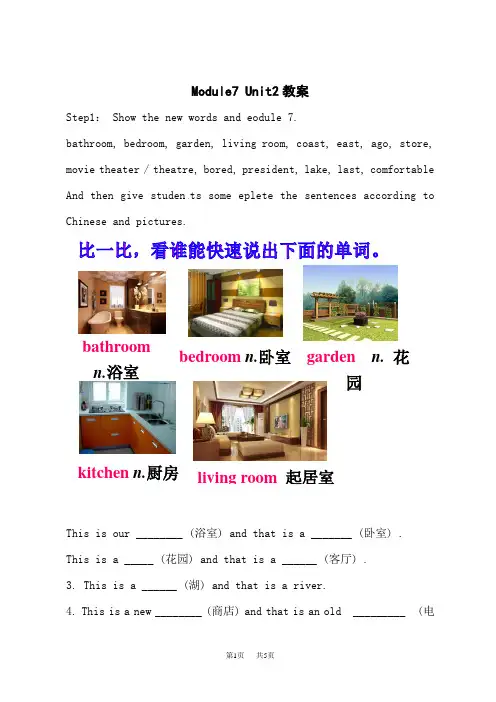
Module7 Unit2教案Step1: Show the new words and eodule 7.bathroom, bedroom, garden, living room, coast, east, ago, store, movie theater / theatre, bored, president, lake, last, comfortable And then give studen ts some eplete the sentences according to Chinese and pictures.This is our ________ (浴室) and that is a _______ (卧室) . This is a _____ (花园) and that is a ______ (客厅) .3. This is a ______ (湖) and that is a river.4. This is a new ________ (商店) and that is an old _________ (电bathroomn.浴室 living room 起居室garden n. 花园kitchen n.厨房 bedroom n.卧室影院) .5. I lived at the _____ _____ (东部海岸) ten years _____ (以前).6. Did their _____ (总统) live there _____ (最近过去的) year?7. Was your bed _____ (舒服的) , Lingling?8. The man was _____ (厌倦的) the computer games.\S tep2:Warming-up and Lead inTo give some pictures and videos about Quincy to students. Let them watch and describe them.Step3:Work in pairs. Label the picture with the words from the bo bedroom garden kitchen living roomStep4:Read the passage of Activity 2 and choose the correct answer.1. Betty was/wasn’t happy when she was in Quincy.2. Two/Three US presidents were born in Quincy.3. There were/ weren’t pictures o n Betty’s bedroom walls.4. There was/ wasn’t a small lake in the garden.5. Betty was/ wasn’t in Quincy last year.Step5:Answer these questions.1. Were there a lot of things to do?2. Was anyone famous born there?3. Who were they?4. What was Betty’s house like?5. How many rooms were there?6. What was Betty’s bedroom like?7. Was ther e a garden?8. Were there lots of children?keys: 1. Yes, there were.2. Two presidents of the US were born there.3. John Adams and John Quincy Adams.4. It was big and comfortable.5. Five.6. On her bedroom walls there were pictures of herfavourite movie stars.7. Yes, there was.8. Yes, there were.Step6:Study some different usages of British English and American English.单词不同Step7:Complete the passage of Activity 4 with the correct form ofStep8:Look at these sentences.There were lots of things to do in Quincy.There were many stores…→There were lots of things to do in Quincy, with many stores... And then join the sentences with “with”.1. There was a big living room. There was a TV. →There was a big living room w ith a TV.2. There was a big garden. There were lots of trees.→There was a big garden with lots of trees.3. There was a small lake. There were fish in it.→There was a small lake with fish in it.Look at the passage in Activity 2 again and check.Step9:Answer the questions.When and where were you born?Were you happy there?What was your house like?What was your bedroom like?Were there lots of things to do?Step10:Describe your past life with the answers from Activity 6.I was born in ...Step11:Eportant and difficult points.the usage of expression “ with ……. “.1. China is a country with a population of 1.3 billion.2. I have a house with a swimming pool.3. Our teachers is a woman with brown eyes.Step12:HomeworkReview and recite the important points of Unit 2.。
外研版初中英语七年级下册:M10U2教学设计
Module 10 A holiday journeyUnit2 This morning we took a walk【课前朗读】arrive, relax, world-famous, French, sell, top till, light, on, wonderful, palace【学习目标】知识目标:1.掌握单元的单词和短语2.掌握并运用过去时介绍自己的游览经历过程与方法:掌握理解总分总的阅读方法,以及以时间为主线的写作方法情感目标:学生们可以领略世界各地风景名胜的魅力,开拓视野,陶冶情操【学习重难点】一般过去时的特殊疑问句及其答语【学习过程】Step1 Review and Leading-inReview: review the worldLeading-in: Free talk Show pictures1.Which countries or which cities did you visit on your holiday?2.Where do you want to visit on your summer holiday?Then show some pictures of places of interest in the world.Step2 Pre-reading1.Show pictures about Paris and tell students something aboutthe city.2. Read the information below, then ask students to tell me what they can remember.Paris is a beautiful old city and is the capital of France. There is a beautiful palace called the Palace of Versailles where the lastKing of France lived. It has a big underground called the Metro. There is a huge tower called the Eiffel Tower in the centre of Paris. The Louvre Museum is an art gallery where there is a famous painting of a woman with a lovely smile, called the Mona Lisa. French food is delicious because the French love to cook.Say something you remember about Paris.Step3 While-readingⅠ.Fast reading1.Read the passage quickly and answer the questionWhat is the passage about?________________________________________2.Read again and check the true sentences.(1). Betty arrived in Pairs two days ago. ( )(2). She took a tour in the city the day before yesterday.( )(3). They took the Paris underground today. ( )(4). They waited for three hours to go to the top of the Eiffel Tower. ( )(5).Tomorrow they are going to take a boat tour on the River Seine. ( )Check the answers in group and correct the false sentences. Ⅱ.Careful readingCheck the answers in groupsStudents ask and answer about what Betty did at different times.2.Read again and answer the questions.(1)Who met Betty at the airport?_________________________(2)What did she go this morning?________________________(3)What did she see in the Louvre Museum?_______________(4)When did they go to the Eiffel Tower?__________________(5)How did they get to the Eiffel Tower?___________________ Step 4 Post-reading1. Language points (work in groups)☆Find out the difficulties (难点)that you don ’t understand.☆Underline(划出)and write down the difficulties.______________________________________________________________________________________________________________2. Retell thepassage using Activity 1 and Activity 2 in Careful reading.plete the passage with the correct form of the words The_____ today is 1st June. We_______ in the _______capital, Paris, on 30th May, and we’re going to stay _____ 3rd June. On 30th May we were tired so we ________. But on 31st May we went to the Louvre Museum and had dinner in a restaurant. And today we went to the street markets. We also went to the _______of the Eiffel Tower.Step 6 Summary(总结)What have we learned in this class?(我们这节课学习了什么?) ___________________________________________________ ___________________________________________________ Step 7. WritingLook at the pictures. Talk about them in groups and Write sentences about Miss Chen’s holiday.___________________________________________________ ___________________________________________________ ___________________________________________________ ___________________________________________________ ___________________________________________________ ___________________________________________________ ___________________________________________________ ___________________________________________________ ___________________________________________________ Step 8 Homework1.R emember the words and expressions we have learned today.2.W rite a new passage about your trip3.。
外研版初中英语七年级下册(WY)教案 Module 4 Unit
外研七下Module 4 Life in the futureUnit 1 Everyone will study at home.课堂跟踪I. 根据句意和图片提示,写出单词,补全句子。
1.This maths problem is very difficult. You can use a ____to work it out.2.Everyone in my family has a cell ____.3.Do you have a long ____? I want to draw a box. Mine is too short.4.Please write down your answer on the _____.5.Does your teacher often write on the blackboard with ____in class?II.用括号内所给单词的适当形式填空。
1.There ____(be) no one in the classroom.2.Everyone ____(study) English hard in our class.3.Can you give me some ____(piece) of paper?4.I will live there all my ____(life).5.I ____(send) my homework to my teacher by email tomorrow. III. 请选用方框中所给单词填空,每个词限用一次。
1. People in the city can watch ____.2. He is writing on the ____at the moment.3. Look! There is a short ____ on the desk.4. Jack wants to call his father with my _____.5. I think doctors will save the girl’s _____.6. In the test the teacher asks us not to use ____.7. What do you think our ___life will be like?8. Her daughter often writes on the floor with ____.9. I think there ___ be more tall buildings in our city.10. He has ___ pen, so he wants to buy one this afternoon. IV.根据汉语提示,完成下列句子。
外研版初中英语七年级下册(WY)教案 Module 10 Unit2教案 1
3. --What do you think of the 3D film Titanic last
night? --It’s_______.
A. boring B.
wonderful C. strange
D. terrible
4. I hope you can ________ the airport on time. A.
第2页 共6页
partners. Step4 Answer the questions. Read the questions with the students first. Tell students to read the passage again to find the answers. Step5 Complete the passage with the correct form of the words from the box. Tell students to read the passage and the words in the box first. Then ask students to fill in the missing words on their own, and then check with a partner by reading each other’s answers, picking up and correcting any mistakes. Step6 Look at the pictures. Write sentences about Daming and Lingling’s holiday. Ask students to look at the pictures and say where they went on each day.
外研版七年级英语下册教案
外研版七年级英语下册教案教案标题:Unit 1 My School Life教案目标:1. 学生能够掌握本单元的词汇和短语,如classroom, library, playground, teacher, student等。
2. 学生能够运用所学知识描述学校的不同场所和人物。
3. 学生能够用英语交流自己的学校生活,包括日常活动和喜好。
教学重点:1. 学习并掌握本单元的词汇和短语。
2. 学会用英语描述不同的学校场所和人物。
3. 运用所学知识进行口语表达。
教学难点:1. 学会用英语描述学校生活中的日常活动和喜好。
2. 能够流利地用英语进行简单的对话交流。
教学准备:1. 多媒体设备和课件。
2. 单词卡片和图片。
3. 学生练习册和教材。
教学过程:Step 1: Warm-up (5 minutes)1. Greet the students and ask them about their school life.2. Show some pictures of different school places and ask students to name themin English.Step 2: Presentation (10 minutes)1. Introduce new vocabulary words and phrases related to school places and people using flashcards and pictures.2. Use the words and phrases in sentences to help students understand their meanings and usage.Step 3: Practice (15 minutes)1. Divide the class into small groups and ask them to discuss their favorite school places and why.2. Have students write short descriptions of their favorite school places and share them with the class.3. Conduct a role-play activity where students act out a conversation between a student and a teacher, using the new vocabulary and phrases.Step 4: Listening (10 minutes)1. Play an audio recording of a conversation between two students talking about their school life.2. Ask students to listen and answer questions about the conversation.Step 5: Speaking (15 minutes)1. Have students work in pairs and ask each other questions about their school life using the new vocabulary and phrases.2. Encourage students to use complete sentences and provide reasons for their answers.Step 6: Consolidation (5 minutes)1. Review the key vocabulary words and phrases from the lesson.2. Summarize the main points of the lesson and ask students if they have any questions.Step 7: Homework (5 minutes)1. Assign exercises from the textbook or workbook for students to complete as homework.2. Encourage students to review the vocabulary words and phrases learned in class.教学延伸:1. 可以组织学生进行小组讨论,分享他们在学校生活中的喜好和日常活动。