
人教版高中英语必修一unit3 travel journal课件分析
人教版高中英语必修一 unit 3 Travel journal PPT课件

Transport
Advantages
Disadvantages
Very cheap, efficient Takes longer than the for short journeys, train or plane, no meals, door-to door-- go the uncomfortable small towns and cities, Cheaper than the airplane, Takes longer than the Views along the road airplane arrive at the centre of the No meals, crowded cities Cheaper than plane More expensive than Comfortable, the train or bus Accommodation and Not convenient for meals visiting inland places Entertainment Expensive, Quick, time-saving, Airports are far from Comfortable the centre of the cities. Meals
determined determine→(adj.) ___________ →(n.) determination ___________ reliable→(v.) ___________ rely organization organize→(n.) . ___________ experience →(n.) ___________ experience →(adj.) ___________ experienced detail→(adj.) ___________ detailed final finally→(adj.) ___________ boil →(adj.) ___________ boiling →(adj.) ___________ boiled
人教版高中英语必修一Unit3 Travel journal+ Reading +PPT课件 ppt.
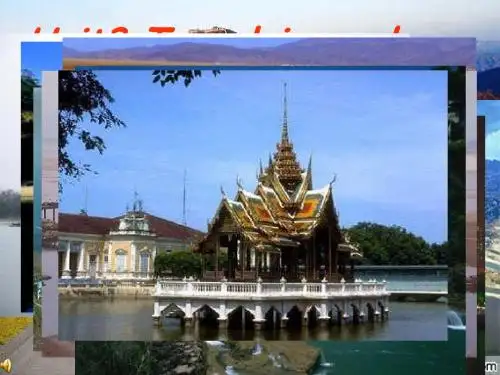
1.Expensive 2.Journey ends far from the city.
ng
How do people who live along a river use it?
irrigate their fields
make electricity go swimming go fishing travel along the river ……
Unit3 Travel journal
Lead-in
Q1. Do you like traveling? Q2. Why do you like traveling ? Q3. If you have a chance to travel ,how will you go there?
Relax ourselves Increase our knowledge
2.Who Planned the trip to the Mekong?
Wang Wei planned the trip.
3.Where is the source of the Mekong and which
sea does it enter?
Qinghai Province
the South China Sea
Takes longer than the plane.
1.Cheaper than plane
ship
1.More expensive than train 2.Not convenient for visiting inland places
airplane
1.Quick 2.Efficient 3.Provides meals
1.Very cheap
人教版高中英语必修一Unit 3《Travel journal》ppt课件
Group A Group C
Group B Group D
Disneyland
the Potala Palace Tibet
Sahara Desert (Africa) □
The Great Wall
Arch of Triumph['traiAmf] , France
Nile River (Egypt) □
LiZhengyang Destination:
s’ Travel plan
The Mekong
Transport:
Budget: Length of stay: Preparation:
On foot
500Rmb One month Money,a bottle of water
Mekong River The Source:
China
LiZhengyang is traveling on foot
happily !
Rapids
Waterfall
Plain Delta
Glacier
Valley
□
Here is a useful website about the beautiful and famous places. Log on it and learn more by yourselves /newtravel/
Speaking and Pre-reading
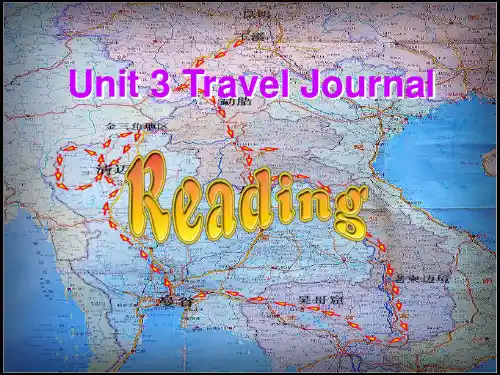
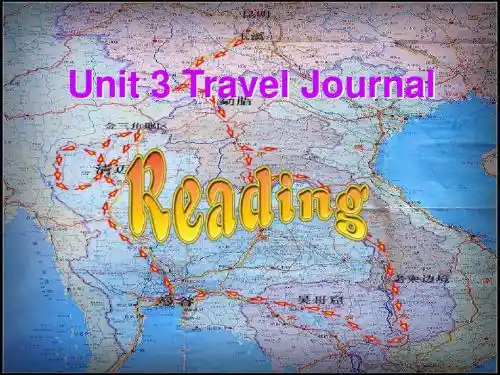
Unit 3 Travel Journal
Budget (预算)/fare
time
Preparation(what to take)
Plan
travel
transportation places of interest (destinations目的地)
人教版高中英语 必修一 Unit3 《Travel journal---Reading》 课件 (共43张PPT)
train
1. cheaper than the airplane
2. journey ends in the center of the town/city
1. takes longer than the airplane
2. does not provide meals
When are you leaving? How are you going to …? When are you arriving in/at …? Where are you staying? How long are you staying in …? When are you coming back?
Read the passage again and answer the following questions.
1. What can you see when you travel along the Mekong? You can see the source glacier, rapids, hills, valleys, waterfalls and plains.
3. It makes wide bends or meanders through low valleys to the plains where rice grows. The sentence means that the Mekong River flows slowly and gently through the valleys and reaches the farming plains.
on foot by bike by bus by train by ship/sea by plane/air
人教版高中英语 必修一 Unit3 《Travel journal---Reading》 课件 (共43张PPT)
Wang Kun and _h_is_ _s_is_t_er_ Wang Wei are dreaming about _ta_k_i_n_g__a_g_r_e_a_t_b_i_k_e_t_r_ip_.
They have the idea to _c_y_c_le_ _a_l_o_n_g_ the Mekong River from _w_h_e_r_e_ it _b_e_g_in__s to _w_h_e_r_e_ it _e_n_d_s_.
1. cheaper than 1. more expensive
the airplane
than the train or
ship 2. provides
bus
accommodation 2. not convenient for
and meals
visiting inland
places
1. quick
5. Wang Kun proposed the idea of cycling along the Mekong River.
Read Paragraph 2 and match Wang Kun’s opinions with Wang Wei’s reactions. Try to understand how stubborn Wang Wei is.
Transport Advantages disadvantages
1. very cheap 1. takes longer
bus 2. efficient for
than the train
short journeys or airplane
3. goes to small 2. does not
高中英语必修1Unit3 Travel journal(人教新课标4份)英语课件PPT
Para 3. the river Pay attention to theses words
glacier…a slowly moving mass of ice valleys… a long depression in the land rapids fast moving water / river waterfall steep descent of water… bends/meanders move sinuously Plains extensive open land river delta long triangular area
Words to choose from
positive
careful
I think Wangkun
thoughtful
active cautious (谨慎的)
/Wangwei is… because…
careless
enthusiastic (热心的)
sensible (明智的)
risk-taking (冒险的)/ brave
How has she been planning it?
Key words: bought / persuaded/ visited / grew up/ got…interested in/ graduating/ finally got the chance/ had the idea / is planning
Para.2
…proper way is always her way.
She gave me a determined look. …she seemed to be excited about it.
..it would be an interesting experience. …made up her mind / not change her mind
人教版高中英语 必修一 Unit3 《Travel journal---Reading》课件 (共24张ppt)
A. The author and his sister’s plan about their winter holiday.
B. The experience during the author and his sister’s trip in Qinghai.
C. The author and his sister’s plan and preparations for their trip. D. anecdotes(轶事)that happened during their trip.
Complete Form 1
Their dream
Taking a great bike trip.
They bought _e_x_p_e_n_si_v_e_b__ik_e_s_,
Their got their cousins preparations _in_t_e_r_es_t_e_d_i_n__tr_a_v_e_l_li_n_g_and
Skimming:
1.Who are Wang Kun and Wang Wei?
They are brother and sister,
and both are college students.
(line1,2,11)
2. What was their dream?
Their dream was to take a great bike trip.
xlj
glacier
waterfall
plain
valley
rapids
delta
1
2 valley
glacier 3 waterfall
plain
4
人教版高中英语必修1上学期+Unit+3+Travel+journal+PPT说课稿
Lesson Plan InterpretationNSEFC Book1 Unit3 Travel JournalHello, everyone. It’s an honor for me to stand here and interpret my lesson. The lesson plan I am going to talk about is fro m NSEFC Book 1 Unit 3 Travel Journal. I’ll explain how to teach and why do so from the following 5 aspects: the theoretical basis, understanding of the teaching material, teaching methods and studying ways, teaching procedure, blackboard design.Ⅰ. The theoretical basisFirst, I’d like to show my theoretical basis--schema theory and top-down model (Goodman, 1971). Journey down the Mekong is a reading course. According to schema theory, reading comprehension is an interactive process between the reader’s bac kground knowledge and the text (Carrel and Eisterhold, 1983), or between the new information and the old knowledge store (Anderson and Pearson, 1984). So in order to improve the students’ reading speed and reading comprehension, language teachers should tr y to activate the Ss’ old knowledge store and add more relevant background knowledge before they get the students to read. According to the top-down model, general idea of the text will be got first, and then come the details.II. Understanding of the teaching materialMy understanding of the teaching material includes 3 parts: the status and the function, teaching objectives, the important and difficult points.At the beginning, let’s focus on the first part. Journey down the Mekong is a piece of travel j ournal written by Wang Kun. It’s mainly about Wang Kun and his sister’s dream of taking a great bike trip down the Mekong River, their preparation for the trip and some more details of the Mekong River. General speaking, it is not difficult for the students to understand the text, but there are some new phrases and sentences that may be a little bit difficult. So before the students’ first reading, I will explain the new words and phrases briefly and after reading the whole passage, I will embody the usage of the news words and phrases, and get the student understand the difficult sentences. As it is a piece of journal, besides learning the new words and phrases, students can get the general idea of how to write a journal.That’s all for the first part, now let’s move to the second part. According to the teaching material and the new curriculum of English, in order to fulfill the learning task of this lesson, I establish the following objectives:a) Knowledge objectivesBy the end of the lesson, Ss will have a better understanding of the meaning and structure of the text. Then Ss will grasp some useful words and expressions such as determined, make up one’s mind, give in, be fond of …, care about…, stubborn, etc.b) Ability objectivesActually students should be encouraged to do speed reading in the first period of reading lesson. But the students in my class are lack of independent readingability. In this class, I will encourage and help them to read, think and find out information by themselves most time. Since the main objective of reading course is to improve the Ss’ reading ability, I’ll train their ability of identifying the general idea in the fast reading. And in intensive reading their ability ofinformation-gathering and summarizing is developed. And the whole class is for Ss to develop their reading skills as scanning, skimming, information-gathering, summarizing and guessing the new words from the text.c) Moral objectivesThough Journey down the Mekong is mainly about the trip down the river, it also talks about the scenery and life along the river. So before learning the text, we will have a short discussion about the importance of the river. I want the Ss to have the awareness of protecting the river and protecting our environment.Well, so much for the teaching objectives, let's come to deal with the third part: the important points and the difficult points. According to the national curriculum of English and language learning theory, when teaching reading, we should encourage the Ss to do speed reading for the first time, that’s to say, we should encourage our Ss to read as fast as they can when they do the first reading. So much emphasis should be put on reading skills and reading comprehension as well. So the important points are that how to make Ss grasp the new words and phrases and how to improve their reading skills as scanning, skimming, information-gathering and summarizing. As to the difficult points, they are the same as the important ones.III. Teaching methods and studying waysThat’s all for my understanding of the teaching material. Now let’s focus on the ways of teaching and learning.Generally speaking, I adopt task-based language teaching and communicative approach in my class. As for learning, Ss will learn through independent reading, discussing and cooperating.I will use computer and blackboard as my teaching aids.Ⅳ. Teaching procedureHere comes the most important part, the teaching procedure. It includes 5 steps: Step I: Lead-in and pre-reading, Step II: While-reading, Step III: Consolidation, Step IV: Post-reading, Step V: Homework.Step I: Lead-in and pre-reading (7mins)Now let’s come to the first step. There are three activities in this step and I will spend 7mins on them.In activity one, I will ask Ss two questions "Do you know some great rivers in China?" and "Why they are great?” Here, as the Ss get famili ar with the Chinese great rivers, I choose to ask them some great rivers in China. And the answer to the second question can lead in the next activity--brainstorming.In activity two, I will ask the Ss to discuss in pairs and answer the question "How do pe ople who live along a river use it?” My purpose of this activity is to remind the Ss the importance of the river, thus stimulate the Ss' awareness of protecting the rivers.In the last activity, I will show the Ss a picture of the Mekong River and ask them to list the countries that it flows through. This activity leads in the while-reading. Step II: While-reading (21mins)While-reading is the main part and it will take 21mins. Here I adopt the top-down reading model. This step is divided into 2 parts: fast reading and careful reading. Before reading, I will ask the Ss to predict what will talk in the text according to the title. It can exert the Ss' imagination.1) Fast readingDuring fast reading, I will ask the Ss to reading the whole passage quickly and get the main idea of each paragraph. Usually, the main idea of each paragraph is the first sentence or the last sentence, but this text is not. So the main idea of each paragraph will be matched because the Ss are lack of the skill of summarizing the main idea by themselves.2) Careful readingAfter getting the general idea of each Para., I will deal with the details Para. by Para..In paragraph one, I will ask the Ss to read quickly and do the exercises T or F. And if it is F, I will ask them to correct it. This exercise can help the Ss get the key information of the first paragraph in a short time and can deepen the Ss’ understanding of the first paragraph.In paragraph two, I will ask Ss one question “Is it a difficult journey to cycle along the Mekong? W hy?” This can help the Ss develop their ability of summarizing. If theSs can’t answer the question briefly, I will encourage them to find the key sentences and try to join them together.And in the last paragraph, I will ask Ss two questions “How does th e water of Mekong River change?” and “What can you see when you travel along the Mekong River?” Both questions are required to answer in keys word. In order to lower the difficulty of the questions, I will show them the examples. After that, I will present some pictures to deepen the Ss’ impression on the new words. And these two questions can help the Ss gain a deeper understanding on the Mekong River. Step III: Consolidation (6mins)After dealing with the detailed information of each paragraph, I will ask the Ss to read the whole passage again and answer two questions to consolidate what they’ve learnt. It will take 6 minutes. The two questions are “Where is the source of the Mekong River and which sea does it enter?” and “How do Wang Kun and Wang Wei prep are for the trip?” It is easy for the Ss to find the answer to the first question in the text. As to the second question, it may be a little difficult, so I will list some tips for the Ss to find the answer more easily.Step IV: Post-reading (10mins)That’s all for the while-reading. Now let’s move to the fourth step. In this step, I will design two activities and I will spend 10 minutes on them.The first activity is filling in the blanks. In this activity, Ss are required to find the different attitudes of Wang Kun and Wang Wei to the trip, and then the teacher will express her attitude to this trip. After demonstrating, Ss are encouraged toexpress their attitudes. It can help the Ss train their ability ofinformation-gathering and expression.The second activity is thinking. In this activity, I will ask the Ss to discuss in groups of four and try to use some words to describe the characteristics of Wang Kun and Wang Wei according to their attitudes. It is really difficult, but it can not only train their ability of analysis and comprehension, but also cultivate their spirit of cooperationStep V: Homework (1min)Finally it comes to the homework. Ss are required to review the learnt lesson and underline the useful words and phrases in the text. This one is for them to consolidate what they’ve learnt and make preparation for the next lesson—Learning about the Language..Ⅴ. Blackboard designOn the top, there is the title of this lesson. On the left, it lists some important roles that the river plays. On the right, there are some useful words and expressions. That’s all for my interpretation. Thank you for your att ention。
高一英语必修一unit-3-Travel-Journal公开课ppt课件
where
cycle along
begins
where
ends
可编辑课件PPT
12
Para. 2 Could you choose some words or
phrases to describe the characteristics of Wang Wei?
14
Task 3: Fill in the blanks
Wang Kun and Wang Wei have d_d_r_e_a_m__e_d_
about taking a great bike trip after _g_r_a_d_u_a_t_in_g_
from college. They d_d_e_c_id__ed_ to c__cy_c_l_e___ along
可编辑课件PPT
7
Example
you may follow:
• A: Tom, where are you going on holiday?
• B: I’m going to Laos. • A: When are you leaving? • B: Next Sunday. • A: How are you going to Laos? • B: I’m taking a plane. • A: How long are you staying
You may say: I prefer to travel by plane , because It’s more comfortable than other ways.
可编辑课件PPT
6ቤተ መጻሕፍቲ ባይዱ
Task 2:Make a Dialogue
英语:Unit3《Travel-journal》课件-Reading(新人教版必修1)ppt
Choose suitable words below in their proper forms to complete the short passage.
Source, persuade, topic, stubborn, insist, altitude, Vietnam (Vietnam’s), Tibet (Tibetan), attitude,
valley
a long ,low, wide place between hills
waterfall
a high place from which a river suddenly goes down
plain
a large flat place
delta
the low place where a river enters the sea
• 5. Is it a difficult journey to cycle along the Mekong? Why? Yes. The journey begins at an altitude of more than 5,000 metres, where it is hard to breathe and very cold.
Wang Wei believes 1.they must start in Qinghai where the river begins/see all of the Mekong. 2.that they don’t need to prepare much
Wang Kun believes
1.it is too cold and high to start in Qinghai 2.that using an atlas is very important