
【外研版(一起)】小学英语三年级下册全册教案
教案Module1 Unit 1 She’s Very Nice 教案设计一、教学目标与要求1、知识与能力目标x k b 1 .c o m能够运用句型:This is … He’s / She’s….She’s very … But she’s a bit…能够掌握单词:nice , shy, clever, naughty, talkative, quiet, a bit. 能够介绍人物,说出人物的特点.2、情感态度目标培养学生对同伴友善的态度,了解朋友的特点和能力.二、教学重点及难点用本课句型描述自己和周围朋友的特点和能力.自我描述;介绍自己的家人.三、课前准备教学卡片、人物头像、教学课件四、教学过程Step 1 Warm up1 GreetingHello, boys and girls.Nice to meet you.Step 2 Presentations and practice1新授clever(1)由做算数题引出clever(2)进行发音教学 v /v/(3)引导学生不断用I’m clever.进行自我评价以巩固此单词的学习.2 复习 naughty(1) 由卡通人物Jerry的一段录像引出单词naughty(2) 用句子He’s very naughty. 练习单词.并板书句型This is … He’s very …(3)出示5幅卡通图片,请学生用新学句型进行描述.3 复习nice新授a bit(1)由 Snow White 引出nice(2 )T: Who’s nice in our class?Ss show their opinins.eg Wang Hong is nice. etcT: Snow W hite is nice ,but she’s a bit shy. 引出单词shy,两人进行操练.在此基础上进一步学习短语“bit shy”操练.(3)课件出示词组,引导学生自主练说a biteg a bit shy , a bit nice , a bit clever, a bit naughty4 新授talkative和quiet(1)运用句型She’s very …But she’s a bit…描述Snow White.(2)给出3幅卡通图片,小组运用所学句型练习描述卡通人物的性格特征.(3)出示影视人物的图片,学生自由谈论其特点,教师自然引出单词loud,(4)谈论影视人物引出单词quiet,并进行发音教学qu /kw/ …T: Who’s quiet in our class?S: XX is quiet.Step 3 Consolidation and extension1 Game(1)课件出示6幅卡通人物的图片及性格特征,师领读,复习单词(2)再此出示课件,一幅一幅图片出示,请学生根据记忆,说出卡通人物的特征以次练习描述人物的特征.2 Watch a dialogue(1) 让学生看教学光盘对话并且教师提出一个问题:Panpan has got 3 friends. Who are they?(2) 用单词卡片nice , shy, clever, naughty, talkative, quiet, a bit复习单词,同时给六个学生.(3) 再观看教学对话,并让学生将单词卡片放到相应的人物头像下面.(4) 学生根据单词卡片的内容,描述每个人物的特点.(5) 学生分组集体描述每个人物的特点..通过这种方式,使学生学会怎样描述一个人物的特点.3 Introduce a friend(1) 教师介绍自己的一个朋友做示范.(2) 学生在小组内介绍自己的朋友.(3) 反馈.Step 4 SummaryT: I’m very glad to be your teacher. Some of you are a bit quiet. Some of you are a bit naughty. Some of you are a bit talkative. Some of you are a bit shy. But all of you are very nice and clever.Step 5 Homework1 Listen to the dialogue and try to read it .2 Finish the activity book on page 1 and page 2.Step 6 Blackboard designModule 1 People Unit 1 She’s niceThis is … He’s very …She’s very … But she’s a bit…Maomao Xiaoyong Parrotnice clever louda bit shy a bit quiet naughtyTeaching Notes:Module1 Unit 2 I’m going to help her. 教案设计一、教学目标与要求1、知识与能力目标学会helpful, plus, twenty, more等词语,能够运用本课所学介绍自己,描述他人的性格.2、情感态度目标通过学习,让学生知道“金无足赤,人无完人.所有的人都是既有不足,也有很多优点.”二、教学重点与难点简单叙述他人的困难和自己打算提供的帮助.三、课前准备单词卡片、课件.四、教学过程Step 1 Warm up1. Enjoy a poem P5. What are these children like?2. Revision: Teacher do the actions and let the Ss say the words. ( clever, nice shy, quiet…) x k b 1. c o mStep 2 Presentation and practice1.Describe a student in the class. Let the students guess who she is. Then let the students to describe their friend in the class.2.出示parrotT: What is parrot like?Ss: He’s loud and he’s very very naughty.T: What’s he like in our story? Let’s watch the video.引出课文.3.教授helpfulWho is helpful in our class?4. What’s the matter with the little girl, let’s watch again.Ss: Because this little girl can’t do her Maths.T: Yes, so parrot is going to help her.板书句子I have some math problems. Who can answer.课件呈现数学题:T:What is ten plus ten?What is 7 plus 7?And one more?教授more.5.Let the students ask some math questions, and practice in pairs.6.Sum.Although parrot is loud and naughty, he is helpful.金无足赤,人无完人.7. Listen and repeat.Step 3 Consolidation and extension1. Parrot is going to help other people. Who are they? Let’s take a look. Practice in pairs and then show the performance.2. Play a memory gameFirst, teacher do a demo for children. Then let the students practice in groups.Step 4 SummaryAll of you are nice and help. 所有的人既有不足,也有优点,用放大镜看别人的优点,用望远镜看别人的缺点,取人之长,补己之短.Step 5 Homework1. Listen to the dialogue and try to read it .2. Finish the activity book on page 3 and page 4Step 6 Blackboard designUnit 2 I’m going to help her.This little girl can’t do her Maths.I’m going to help her.helpful moreTeaching Notes:Module2 Unit 1 It’s very long. 教案设计一、教学目标与要求1、知识与能力目标Describing things and places. 重点学习一些形容词,如wide, old, high, new, round.学习用这些形容词来描述一些景物或场景如描述River Thames, Big Ben, London Eye等.2、情感态度目标通过让学生使用形容词描述国外景物,学生不仅学习了如何使用形容词,更开阔了眼界,增长了知识.同时通过介绍英国重要景点如River Thames, Big Ben, London Eye等,让同学们对国外景物形成一个初步的认识,调动同学们的学习兴趣和热情,达到良好的学习效果.二、教学重点与难点1、重点单词:wide, old, high, new, round2、重点句型:This river is very wide. And it’s very long.This is Big Ben. It’s very long.3、难点:有关英国重要景点如River Thames, Big Ben, London Eye等知识的了解.三、课前准备1、课本及活动手册.2、一些与形容词相关(如:电视塔、长城)的图片及实物(如:新旧玩具、衣服).3、一些有关英国伦敦的资料和地图.4、一个导游用的小喇叭,一顶遮阳帽5、有关英国重要景点的录像展示课件.6、录音机及配套的磁带.四、教学过程 (中英文相结合)Step 1 Warm up1、教师热情地和学生打招呼,并带领全班做TRP活动“Say as I do, not as I say”.例如:教师说:“I’m tall.”同时俯身用手比着地面以上不高的位置.学生要迅速说出:“You’re not tall. You’re short.”2、通过一些与形容词相关(如:电视塔、长城、)的图片及实物(如:新旧玩具、衣服).带领学生回忆相关词语:big/ small, long/ short, tall/ short old/ new.Step 2 Presentation and practice老师先问中国的首都是哪里?再来引出英国的首都.并向学生出示英国的地图,请学生观察英国和伦敦的位置关系.向学生讲述有关英国重要景点的大概知识.老师拿着喇叭并戴上遮阳帽,扮成导游的样子开始讲课.Good morning! Today we’re going to go to London.It’s the captial of England.请同学们跟随老师看一看伦敦重要的三个景点.1.The frist one is River Thames.(展示课间图片).老师问:What can you see in the picture?学生可用I can see…句型回答.老师用肢体语言引导学生说出This river is very wide .And it’s very long.并教授wide这个单词.2.Amy和Lingling正在谈论接下来我们要去的两景点,快来听一听.听第一遍录音后,学生回答出Big Ben /London Eye 这两个景点.教师使用两个景点的课间讲授他们的特点:Big Ben /It’s very old clock. And it’s very tall.London Eye / It’s a big wheel. It’s very high ,round and new.同时讲授old /clock/high/wheel/round 3. 打开书听第二遍录音,要求学生圈出录音中提及的景物名称和用于描述他们的形容词.之后,教师把学生的回答写在黑板上,把景物名称再次和相关的形容词关联起来.4.播放第三遍录音,请同学们逐句模仿跟读.并让学生完成AB Unit1练习.之后,老师问“What is this house like? What is this river like? 等问题 .提示学生用“tall ,old ,long , wide, new, round”来描述5.完成SB Unit1活动2.首先请学生两人一组看图说话,再请学生听录音,并对课本的这几个重点句子进行操练.6.完成SB Unit1活动3,请两人一组使用刚学过的重点句型说句子,描述书上图片.Step 3 Consolidation and extension1. 学生分脚色朗读课文.并请几组学生到教室前面表演课文.2. 让学生观看有关英国重要景点的录像展示课件.3. 教师提供的图片(电视塔、长城),学生刚学的句型和形容词造句.Step 4 Summary1. 复习本课重点句型及单词.2. 请学生在黑板上,将River Thames, Big Ben, London Eye及相应的形容词配对.Step 5 Homework1. 听并读Module2 Unit1 课文三次.2. 用P7第三部分的三个图造句子.3. 做AB P7.4. 自愿完成找一张自己游览过的景点照片,试着用学的句型单词向家人或同学描述.Step 6 Blackboard designModule2 Unit 1 It’s very long.River Thames This river is very wide .And it’s very long.Big Ben It’s very old clock. And it’s very tall.London Eye It’s a big wheel. It’s very high , round and new. Teaching Notes:Unit 2 You’ll see Tower Bridge. 教案设计一、教学目标与要求1、知识与能力目标Talking about possible future actions. 重点学习将来时,讲述将来可能发生的事情.2、情感态度目标通过将来时的初步学习,使学生能用英文来描述可能发生的事情.这样可以拓宽学生说英语的范围,增强学习的兴趣. wwW.x k B 1.c Om二、教学重点与难点1、重点单词:Tower Bridge, of course ,will, visit2、重点句型:You’ll see Tower Bridge. And we’ll go on the London Eye.3、难点:对will的理解.课前准备1、课本及活动手册.2、描写景物的表格.3、著名景点的照片及课件.4、录音机及配套的磁带.三、教学过程Step 1 Warm upSing a song. “The London Eye.”Step 2 Presentation and practice1、“Beijing is the capital of China. We love China.” 教师向学生出示北京的照片,“In Beijing, we’ll see the Great Wall.”教师再请学生观看长城的课件.此时在黑板上板书上“We’ll see the Great Wall.”重点讲述will 用于一般将来时.用来表示将来可能发生的事情,它的缩写形式是‘’ll’.2、请同学带着问题听第一遍录音,“What will Amy see in London?”带着学生回答出She’ll see Tower Bridge.讲授新单词Tower Bridge.3、请同学们听第二遍录音,并且跟读.了解课文内容基础上先让同桌之间分角朗读再请学生上台表演课文对话.4、请学生四人为一小组,完成课本第二部分.I’ll see…造句子.5、完成活动手册第一、二两部分.Step 3 Consolidation and extension1、Game “Which picture?”依据课本第四部分完成此游戏.之后同桌之间用第四部分的图相互问答如A :“In this park, you’ll see a wide river.” B : “It’s Green Park.”2、请同学根据教师提供的著名景点的照片及课件,说一说You’ll see…Step 4 Summary1、复习本课重点句型及单词.2、再次讲解will 用于一般将来时.用来表示将来可能发生的事情,它的缩写形式是‘’ll’.并且板书“I’ll see…/You’ll see…/She’ll see/He’ll see…/We’ll see…”Step 5 Homework5. 听并读Module2 Unit2课文三次.6. 用P8第二部分的四个图造句子.7. 自愿完成试着用学的句型单词,向家人或同学描述自己将要看到的景物. Step 6 Blackboard designModule2 Unit 2 You’ll see Tower Bridge.In Beijing, we’ll see the Great Wall. I’ll=I willI’ll see…/ You’ll see…/She’ll see/He’ll see…/We’ll see…”Teaching Notes:Module 3 Unit 1 Maybe I’ll go to the zoo. 教案设计一、教学目标与要求1、知识与能力目标能够听说读写下列句子:★We’ll see lions and tigers.★Will Sam go, too? Yes, he will.★Will you go too, Daming?★No, I won’t.能听说读写的词语:will, won’t, tiger, lion, school, zoo, park能听说读下列句子△I /she/he won’t …Who will…Where dose …live?Is there …there? 并能用学过的句子进行询问、交流各自将要做的事情,例如到哪去,干什么?用于表达将要上的课程等.2、情感态度目标培养学生的表达及交际能力.使学生在英语学习中获得快乐的学习体验.二、教学重点与难点一般将来时态的一般疑问句的使用及回答:Will …? Yes,…will./No,…won’t.三、课前准备TAPE\TV\HEADDRESS\CARDS TEXTBOOK/ACTIVITYBOOK四、教学过程Step 1 Warm upGood morning, boys and girls.Do you want to visit London?(computer)What will you see? I’ll see…(学生说出伦敦的著名城市景点课件)Boys and girls, this weekend, I will go to the supermarket to buy lots of things. Could you tell us what you will do this weekend? S:I’ll go to …T:What will you see at the zoo? T:I’ll see…(zoo)(板书)Step 2 Presentation and practiceBoys and girls, Let look at the video:?“What will Amy, Sam and Daming do this weekend?”Now, watch the video,please.Then Think it over. (课件)1.What will Amy do this weekend?2.What will Amy see? 新课标第一网Are you ready?Let’s see(go).(课件全课) (Watch TV) Headdress. The student will be Amy.Show a picture.(仅一屏)Hello…Amy. What will you do this weekend?(为什么用we’ll,请记住这个问题).(Who wants to be Amy?) Listen carefully. S:I don’t know. S: Maybe I’ll(we’ll) go to the zoo. Let’s go on. What will you see? S: We’ll see lions and tigers.(板书)(为什么用we’ll?) (read the tiger)Look at the picture:(Listen)Who is he? Daming, how do you ask about Sam? S:Will ___go too?(板书) S:Yes,___will.(板书)(卡片)反复读,跟读,齐读.Pay attention ,please.Amy and Sam are two children. what will you See? I’ll or We’ll?(头像Amy and Sam) S: We’ll see lions and tigers.(有节奏的读)Show the computer.T:Will Daming go too?(Listen carefully.)S:No, I won’t.(板书)(卡) (Read it one by one.)Now, Daming won’t go to the zoo. How does Amy ask? Please listen carefully. Who will be Amy?How do you ask? S:Will you go too,Daming?(板书)(卡)(Try to say.)S: No, I won’t.T:What will you do Daming? s:I will visit my grandpa in the countryside.(板书) countryside(读几遍) T: Will you see tigers/lions there? S:No.I won’t tigers/lions.T: What will you see?S: I’ll see ducks…lots of pigs. Boys and girls, please look at the blackboard. This weekend, Amy will go to the zoo. Sam will go too .Sam and Amy (They)will see lions and tigers.But Daming won’t go to the zoo. He will go to the countryside. He will visit his grandpa. He won’t see lions and tigers. But he will see lots of pigs.Now ,by this way please watch the video again. 根据老师讲的再看一遍录像Now open your book and turn to page 10.Let’s listen and say.O.k? Listen and say.Step 3 Consolidation and extension1. Listen to the tape recorder then say.Boys and girls,please open your book,and turn to page 10. Listen and say.2.let’s do exercises to check up what you have learned.Now open the activity book .(Part 1)Have you finished?No.1 Who wants to tell us your answer?If you are all right, please raise your hands.3.Do you like games?Let’s play a guessing gam e.书P114. Boys and girls,what will you do this weekend? Let’s talk about it with your partner in your groups. Then come to the front and act out.Ok. (找2、3名学生演示)5.Boys and girls, Pay attention. Ms. Smart’s family will have a good weekend. Are you interesti ng in this story? I’ll give you some questions. Please find out the answer.(让学生听录音)Questions: What will they do? What will they see?Step 4 Summary同学们,今天我们学习了一般将来时态的句子的表达方法.如果我们要谈论将来发生的事情,比如:周末的打算、想法,我们就可以使用这种表达的方式.Step 5 Homework1. Listen to the tape recorder then remember these new sentences.2.Free talk with your parents.What will you do this weekend?Step 6 Blackboard designModule3 Unit 1 Maybe we’ll go to the zoo.zoo We’ll see lions and tigers. countryside(图片) Will Sam go, too? lots of pigstiger Yes, he will.lots of Will you go too, Daming?(单词卡) No, I won’t.Teaching Notes:Module3 Unit 2 Will you phone me? 教案设计一、教学目标与要求1、知识与能力目标学会使用下列句子:Will you play with me this weekend? Yes, I will. /No, I won’t.能听说读下列句子△Will … phone …? Yes,…will./No,…won’t.并能用学过的句子谈论将来发生的事情.2、情感态度目标培养学生的表达及交际能力.使学生了解并掌握英语表达上的一些语言特点,以及英语表达语言顺序(时间、地点状语)与中文表达的简单区别.二、教学重点与难点一般将来时态的一般疑问句的使用及回答:Will …? Yes,…will./No,…won’t.三、课前准备TAPE\TV\HEADDRESS\ TEXTBOOK/ACTIVITYBOOK四、教学过程Step 1 Warm upGood morning, boys and girls.What will you do with your parents this weekend? Let’s free talk.Step 2 Presentation and practiceBoys and girls, Daming will visit his grandpa in the countryside. Will Sam go to the countryside this weekend? Let look at the video:Now, watch the video,please.Are you ready? Let’s see.(课件全课) (Watch TV) Headdress. The student will be Sam and Daming.呈现SB Unit 2活动1.教师一课件的形势向学生以下问题,帮助学生理解课文第一部分.Will Daming play with Sam?Will Daming phone Sam?( phone 一次教师可以通过打电话的动作演示缴获学生,重点注意ph的发音,可与elephone作比较,发音一样.)通过看课件,使学生找出答案.给学生适当的提示,让两名学生一组根据答案表演这一部分.在给出另外一些问题,让学生带着问题再看课件并找出答案.Who will Daming visit?Where does Daming’s grandpa live ?Is there a phone there?在学习的过程中,穿插复习有关助动词do\does 的一些用法及特点.以及There be…句式的用法及特点.因为上一课时已经学习过有关visit,countryside有关的句子,因此上述问题的答案学生基本上能后比较流利的表达.根据学生的学习情况播放几遍课文录音,请学生跟读.随后可以同位分角色表演. 学习诗歌.可先让学生找出自己不理解或不会的部分,由教师或同学们讲解,然后播放录音让学生跟读.鼓励学生模仿动作,使学生情景交融,更有助于学生对诗歌的理解和掌握.Step 3 Consolidation and extension1. Look and say about your weekend. Then talk about your friend.(书P13) 通过学生的掌握情况,可以考虑是否增加同样形式的练习内容.2.let’s do exercises to check up what you have learned.Now open the activity book .(Part 1)教师首先播放一遍录音,让学生完整的听一边对华录音.再次有间隔的播放录音,让学生有比较充足时间填写答案.可以让学生先互对一遍答案,在以实物投影或直接在课件上直接完成答案.3.语音教学完成课堂活动用书语音题部分.在这一部分首先尽量鼓励学生自己去听、分辩黑体字母及字母组合的发音,但应注意,如果有问题一定要马上纠正,教师可以重点、突出的慢慢读出要纠正黑体部分的发音,以使学生能够清楚、明了地听出发音.经过不断地、多次地练习,学生就会比较准确地确定出字母及字母组合的发音.Step 4 Summary同学们,今天我们学习了一般将来时态的句子的表达方法.如果我们要谈论将来发生的事情,比如:周末的打算、想法,我们就可以使用这种表达的方式.Step 5 Homework1. Listen to the tape recorder.2.Let’s talk about what you will be.The teacher: I’m a teacher now. What will you be in the future? Let’s think.让学生想一想,自己将来希望从事的职业.从而复习teacher,doctor,nurse,pupil,driver等单词.还可拓展学习新的单词.Step 6 Blackboard designModule3 Unit 2 Will you phone me?Will you play with me this weekend?No,I won’t.Wi ll …phone…?No,…won’t./Yes,…will.Teaching Notes:Module 4 Unit 1 Maybe I’ll be a writer.教案设计一、教学目标与要求1、知识与能力目标学会writer, footballer, film star等职业单词,能用What will you be in the future?询问并作回答,谈论未来可能从事的职业.2、情感态度目标无论将来我们要从事什么样的职业,都应该从现在起好好学习,打好基础.二、教学重点与难点如何询问将来要从事的职业,以及表达现在从事的职业与将要从事职业的时态的对比.三、课前准备职业调查表格,职业单词卡片.四、教学过程Step 1 Warm up1. Sing a song about occupation. And find out the occupation in the song.2. Free talk. Talk about our parents’ jobs and their hobbies.Step 2 Presentation and practice1. Ask a student that will you be a teacher in the future? Why?And what will you be in the future?相机板书:What will you be in the future?出示picture——future 指导学生自己拼读future一词,在领读句子.Ask 2-3 students to answer the question.3. Amy and Lingling are talking about the jobs. What will they be? Guess.4. Enjoy the story and find out what they will be in the future.学生通过听音看故事找到writer, film star, footballer, policeman等词.5. 通过问题进一步巩固理解这些职业单词:Let the students find more words like “write——writer”drive——driver, farm——farmer, work——workerWhich film star do you know?Ss: Cheng Long is a film star. Zhang Ziyi is a film star.6.Watch the video again, and find out why Amy will be a writer and why Lingling will be a film star.Ss: Lingling likes writing. She loves books. She will be a writer. 7. Why Sam ask them to come to the police station with him?Is he a policeman now?Sam isn’t a policeman, but one day he will be.Step 3 Consolidation and extension1. Listen and repeat.2. Read and fill in the blanks.What will Lingling be in the future? Maybe she will be a ______. And Amy will be a ______. ______ will be a footballer. And Sam will be a ______.3. According to the passage above, try to retell the story.4. Guessing game.What will he/ she be in the future?出示人物照片,让学生猜职业.(成龙小时候照片)What will he be in the future? He will be ______. (成龙照片)Now, he is a film star.5. Survey. What will you be in the future? Ask and answer in groups, andfill in the form.A: What will you be in the future?B: Maybe I’ll be _________.Name Will be友情提示:① writer ② film star ③ footballer④ policeman ⑤ dancer ⑥ singer⑦ doctor ⑧ nurse ⑨ businessman⑩ engineerMake a short dialog with partners.A: What will you be in the future?B: I will be a ….Step 4 SummaryWhat kind of occupation is popular?Whatever we will be in the future, we should work hard from now on.Step 5 HomeworkAsk your friends, what they will be, and find out 5 the most popular occupation.Step 6 Blackboard design新课标第一网Module 4 Unit 1 Maybe I’ll be a writer.What will you be in the future?Maybe I will be ….Amy film starLingling writer love booksDaming footballerModule 4 Unit 2 He’ll be an astronaut. 教案设计一、教学目标与要求1、知识与能力目标学会astronaut, spaceship, moon, fly a kite, fly a plane, fly an astronaut 等词语,能够运用本课所学He/ She will be …. 谈论他人将要从事的职业.2、情感态度目标通过学习,让学生知道无论从事什么职业都应受到尊重.二、教学重点与难点能用want to be和will be谈论将要从事的职业.三、课前准备阅读材料,职业单词卡片.四、教学过程Step 1 Warm up1. Sing a song. I’ll be a pilot.2. Revision: a. Jobs. (play a bomb game)b. Perform the M4 u1c. Free talk: What will you be?板书I’ll be a …Step 2 Presentation and practice1.出示重点句.T: Do you remember what will she be?S1: She’ll be a teacher. 板书将I改成She. He.T: So this time you should say She’ll be a…or He’ll be a …2. 引出课文.T: Everyone has his dream. So does Xiaoyong. Do you remember him? What’s he like? S2: He’s very clever. But he’s a bit quiet. T: Yes. He’s gota great dream. What will he be in the future? Guess.3. Watch the video and answer the questions.4. 学习生词astronaut. T: Who can tell me? What will he be? S3: He’ll be an astronaut. T: Great! Look. (出示pp)Who’s he? Ss: 杨利伟. T: What does he do? 学习astronaut.(强调 an astronaut)5.学习spaceship. T: What will astronaut fly? Will he fly a kite? No. He’ll fly a spaceship. (pp) Look. This is spaceship. 学习spaceship.6.学习moon. T: Will the spaceship go to the moon? 学习moon. T: Yes, it can. But our Chinese people haven’t been to the moon by the spaceship. But I believe we will one day.7.Listen and repeat the text twice.8. Read it by yourself.9. Short summery. Look at the screen and answer the questions.Step 3 Consolidation and extension1. Point and say P162. T: One asks: What will she/he be in the future? One answer: He/She’ll be a…2. A game: Who has good memory? 教师示范: S1: I’ll be teacher. S2: She’ll be teacher. I’ll be a doctor. S3: She’ll be a teacher. He’ll be a doctor. I’ll be a writer. …3. Reading Time. Read the short passage and answer the questions below. Write them on the paper. Then check together.I’m Lingling. Jack, Lucy and Tom are my good friends. Jack will be a footballer in the future. He loves football. Lucy will be a film star. She likes films very much! Tom will be an astronaut. He wants to go to the moon. Maybe I’ll be a writer. I love books!1. What will Jack be in the future? _________________________2. What will Lucy be? _____________________________3. What will Tom be? _____________________________4. Will Lingling be a teacher? ______________________4. Ask your partners what they will be in the future and tellStep 4 SummaryWhat we have learned today? 新课标第一网当我们想表达将来想要从事的职业时,可以用want to be和will be来表达.Step 5 Homework1. Read the text till fluently.2. Write a short passage about your friends dreams.格式: Hello. I’m… I have 4 friends. A will be a … B will be a…Step 6 Blackboard designHe’ll be an astr onaut.What will she/ he be?She/He will be an astronaut.(wants to be)Sam policeman。
新版外研版(一起)小学英语三年级下册全册教案
新版外研版(一起)小学英语三年级下册全册教案目录一、教材介绍(25课时)二、言语交际能力(15课时)三、语音、字母和拼读训练(15课时)四、听力训练(15课时)五、语法和阅读训练(10课时)六、综合能力训练(10课时)一、教材介绍1.课程简介及研究要求解读本学期的英语研究目标及教学内容,并提出对学生的研究要求。
2.教学计划明确每课时的教学目标、重点和难点,合理分配教学时间,确保教学质量。
3.教学资源调查收集各类优质教育资源,选择适合本学期教学内容的内容和素材,对其进行评估、筛选。
4.教师角色确认教师的角色定位和职责,不仅要是知识和技能的传授者,更要激发孩子的研究兴趣,引导他们自主探究和合作研究。
二、言语交际能力显著提升课程1.简单问候与介绍透过分享照片的方式,鼓励孩子们在应用场景中研究基本的英文表达,例如问候和简单自我介绍等。
2.购物和交通有针对性地设计实用化场景,教授基本的询价和购买技巧,以及如何在不同的交通工具中表达自己的需求。
3.在食堂点餐让孩子们通过模拟餐厅点餐和结账的过程,体验英语在实际生活中的应用。
三、语音、字母和拼读训练的优化1.语音准确性的训练与学生们进行声音辨别、发音练。
2.字母和单词发音的教学设计游戏教学方法,通过字母猜谜、谁最先读出单词等方式,加强孩子们对字母发音和单词记忆的练。
3.拼音的教学融入拼音教学,不仅帮助孩子们提高听说读写的综合能力,同时也树立对汉语研究的兴趣和信心。
四、听力训练1.基本语音训练按照难度递进原则,对学生进行基本语音训练,如单个字母、单词、句子等。
2.基础听力技巧的教学重复开口训练,提高对语言的敏感度。
3.适时启蒙辅助利用音乐、乐器、歌曲等工具,对孩子们进行英语启蒙。
五、语法和阅读训练1.语法规则的讲解以课文中的句型和用法为例,介绍规则、用法和常见的错误。
2.语境的创设创设语境和情境,让学生根据情境理解句子含义,从而提升阅读能力。
3.渐进式的教学法由简到难逐渐提升难度,让学生逐步掌握英文的阅读和表达能力。
三年级英语下册全册教案外研版一年级起点
三年级英语下册全册教案(外研版一年级起点)Unit 2 She’s quite good at English.一.教学目标与要求1、知识与能力目标⑴ 学生会谈论学习成绩和表现等。
⑵ 认读单词:quite, good at, saa⑶ 初步认读句子:She’s good at…’s quite good at…ard at…doesn’t work hard at…2、情感态度目标通过学生的自我评价,以及互相评价,给每一位学生找到自己的优点,树立其自信心,提高学习热情和主动性。
二.教学重点及难点⑴ 重点:掌握新单词,了解新句型,在此基础上理解课文内容。
并能简单的利用句型描述他人各个科目的成绩。
⑵ 难点:try 的第三人称单数;quite和quiet的区别。
三.课前准备本课单词卡片,VCD。
a)教学过程Warm uReview the adjective words wardFree talk:S1: I’m very naughty. But I’m very clevT: Is S1 naugty in class?Ss:T:Is he quiet?Ss: N’t.……2 Presentation and pra出示一张成绩单,数学是100分。
T:This student is very good at Ma板书good at. 帮助学生理解意思。
2. T: Are you good at Maths?: Yes, I a2: No, I’T: How about Lingling? Is she good at Maths? Let’s wavidPlay the video and havudents answer the quT: Is she good at Maths?:good at Mad) T: Look at your paper. What abouglish? What abou? Now let’s ladio and教师发给学生一份表格,引导学生通过挺对话,把表格中的信息补充完整。
外研社小学英语三年级起点三年级下册教学设计(教案)全篇

1、What are they? They are ...
①板书句子,打节奏教念What are they? They are monkeys,
②出示单词卡片,学说单词lion, elephant, tiger
③小组任务:把刚学会的词套入句子中去,边说句子边编动作。
④检查小组完成任务情况.
②生模仿动物并用上句子形容:It's/They're ...
③操练:对口说句子练习,一个有口型一个配声音。
学生达成效果
环节四
教师引导学生要干什么(简述)
课文学习
1、听并理解。
2、听,跟读。
3、自由、课文。
4、生说出觉得有难度的地方一起解决。
5、齐读课文。
6、课文角色模仿。
学生达成效果
环节五
小结
环节六
1、Sing "ABC song"
2、Ask and answer:What's your name?
——My name is ...
目的或作用
环节二
教师引导学生要干什么(简述)
引入:出示玩具car, doll, ship, computer game, kite,让学生说说其中自己最喜欢的玩具(中文)。
3、Now say.
4、Ask and answer, then match.
环节六
课堂作业
课后跟同学相互用英语交流,说说自己喜欢的玩具。
完成作业
评估反思
结合学习目标任务,是否达成效果.
课题
Module 2 Unit 1They’re monkeys.
时间
节次
1
课型
年级
外研版英语三年级下册【三篇】优质教案
【导语】英语教案设计是改善课堂教学的⼀种更⾼层次的探索,是提⾼课堂教学质量和效率的⼀项必要⼯作,它可以促进教学的系统化,使⽼师掌握讲课节奏。
以下是⽆忧考为您准备的与(外研版英语三年级下册【三篇】优质教案)相关的资料,希望可以帮助到您!【篇⼀】 Teaching points: Grasp the important words and phrases. ⼀、Warming up: 1. Greeting: T: Hello, boys and girls. Let us recite the seasons. Ok? Ss: Ok. T and Ss: spring, summer, autumn and winter. T: What day is it today? Ss: Today is …… 2. Saying a chant: Hello, Meg, hello, Ted. What’s his name? He is Ben. What’s her name? She is Pat. How old is she? She is eight. How old is he? He is nine. 3. Singing “Head, shoulders, knees and toes. ⼆、New concept. T: Oh, you are great .Today let us learn Module 6Activities Unit 1 What do you do at the weekend? (Writing and reading) 1. T: Do you like playing football? Ss: Yes, I do. T: What do you do at the weekend? (explain in Chinese ) Ss: I play basketball. T: I like reading at the weekend .What about you? Ss: I like swimming. T: You are great. T: And what do you have at school? You can say: I have …… Ss: I have English and Chinese. T: Do you like maths? Ss: Yes, I do. / (No, I don’t.) T: What do you do at 5 o’clock in the morning? I sleep in the morning. What about you? Ss: I sleep too. 2. Do exercises: On the board write the following list 1) What do you do at the weekend? I……….. 2) What do you have at school? I have …… and …… 3. Listen and say. Play the tape, pause it after each utterance and let the Ss repeat the sentences. 4. Show the Ss some books .For example “Maths” “Chinese” “Science” Show the Ss some pictures “football” “sleep” “swimming 5. Text 1) Listen and look. 2) Answer questions: What do you do at ……o’clock in the morning? What do you have at school? 三、Homework: 1) Read the text frequently and recite the text. 2) Copy the following sentences 2 times. What do you do at the weekend? What do you have at school?【篇⼆】 教学重点:words and phrases: half, past, have breakfast / dinner 教学难点: What’s the time,please? It’s half past six. I have breakfast at half past six. 热⾝复习: ⽼师出⽰6个动词词组,学⽣读,并说出每个词组的意思。
外研社小学英语三年级下册全册教案_
Module 1 Unit 1 It’s the ABC Song教学目标:知识目标:学会英语歌曲及26个字母的发音。
能力目标:1.能听说读26个英文字母。
2.能正确识别印刷体、手写体大小写字母。
情感目标:对学生进行爱国主义教育,培养学生养成良好的学习习惯。
教学重点:1、听说读写26个英文字母。
教学难点:1、掌握字母书写规范,正确辨认大小写及印刷体与手写体。
教学用具:Word cards, PPT, CD-ROM and headwear, etc.教学过程:Step 1、Warm up and revision1.GreetingSing songs: “Good morning, Sam” and“ How are you?”2.自由会话(D—David,让学生做小先生,以下为David与同学们的对话)Dialogue 1:T:Good morning, what’s your name ?D:Hello,my name is David.D-a-v-i-d.(同时书写)I'm 12.Nice to meet you.Ss:Nice to meet you, too.D:This is Miss Wu,my English teacher.T:Nice to meet you.Ss:Nice to meet you, too.Dialogue 2:D:Look,What's this in English?(Show pictures of a cat on the PPT)S1:A cat.D:Spell it,please.S1:Yes,c-a-t,cat.D:What colour is it?S2:Black.Dialogue 4:D:Let's count from 1 to 20,OK?Ss:OK.(Boys 1,3,5…Girls 2,4,6… Clap hands from 1 to 10.Stamp feet from 11 to 20.)(拍拍手跺跺脚)Step2: Lead inHave the students sing one or two songs they’ve learned before .Then ask”What’s yourfavourite song?” Expla in the meaning and pronunciation of the word favourite.Step 3、Learn new knowledge1.T: Look at the 26 letters on the blackboard, let’s read them together!(在黑板上写Module 1,挂上字母表,让学生逐个跟读字母。
外研版小学英语(新标准一起)三年级下册全册教案
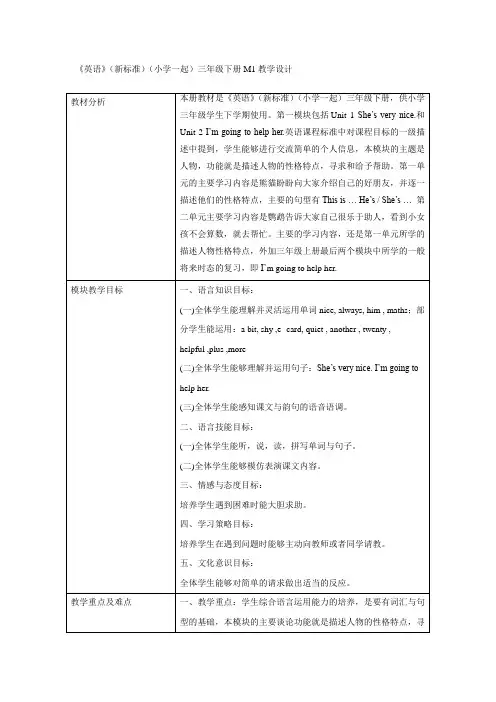
《英语》(新标准)(小学一起)三年级下册M1教学设计《英语》(新标准)(小学一起)三年级下册M2教学设计Module 2 教学设计家庭作业:1. 听录音,模仿跟读课文10分钟。
2.学唱歌曲The London Eye第三课时教学设计教材分析本模块是描述一座城市,一处景点或者是一件物品。
Unit 1 Amy向Lingling介绍了伦敦的泰晤士河、大本钟和伦敦眼。
Unit 2 的课文是Lingling通过读了伦敦的书之后,想去伦敦旅游。
Amy继续给她介绍了塔桥。
本节课主要对两个模块的学习内容加以复习巩固。
课时教学目标语言知识目标:一、全体学生能运用:It’s very long. You’ll see Tower Bridge二、全体学生能理解:about, river, wide ,old, clock, wheel, round,you’ll=you will, tower, bridge, will三、全体学生能运用:about, river, old, clock部分学生能运用:wide ,old, clock,wheel, ro und, you’ll=you will,tower, bridge, will语言技能目标:一、全体学生能听懂会说:It is very long. You'll seeTower Bridge.二、全体学生能认读:about, river, wide ,old, clock部分学生能认读:wide ,old, clock,wheel, round, you’ll=you will,tower, bridge, will三、全体学生能拼写3-4个自选单词教学重点与难点重点:一、运用wide ,old, clock,wheel, round, tower, bridge 来描述一处景点或者一件物品二.用will 来描述自己或者他人的行为难点:用will 来描述自己或者他人的行为《英语》(新标准)(小学一起)三年级下册M3教学设计(小学一起)三年级下册M4教学设计《英语》(新标准)(小学一起)三年级下册M5教学设计《英语》(新标准)(小学一起)三年级下册M6 教学设计课时教学案学校:青岛沧口学校情感态度能体会到英语学习的乐趣任务展示并介绍自己设计的怪物板书Module 6 Unit 1 Here are his hands. head headsarm armshand handsleg leagsfoot feet教学任务学生活动教师活动设计意图I.激趣引学,循标感知II. 活动导学,自主建标一、活动热身1.听一遍说唱,学习新单词。
精编外研版一起三年级英语下册全册教案
Module1 Unit 1 She’s very nice.一、教学目标及要求1.知识及能力目标能够运用句型: This is … He’s / She’s….She’s very …But she’s a bit…能够掌握单词: nice , shy, clever, naughty, talkative, quiet, a bit.能够介绍人物, 说出人物的特点。
2.情感态度目标培养学生对同伴友善的态度, 了解朋友的特点和能力。
二、教学重点及难点用本课句型描述自己和周围朋友的特点和能力。
自我描述;介绍自己的家人。
三、课前准备教学卡片、人物头像、教学课件四、教学过程Step 1 Warm up1 GreetingHello, boys and girls.Nice to meet you.(用这句话来复习学过的nice这个单词, 为后面再次出现这个单词做好铺垫。
)Step 2 Presentations and practice1新授clever(1)由做算数题引出clever(2)进行发音教学 v /v/(3)引导学生不断用I’m clever.进行自我评价以巩固此单词的学习。
2 复习 naughty(1) 由卡通人物Jerry的一段录像引出单词naughty(2) 用句子 He’s very naughty.练习单词。
并板书句型This is …He’s very …(3)出示5幅卡通图片, 请学生用新学句型进行描述。
3 复习nice新授a bit(1)由 Snow White 引出nice(2 )T: Who’s nice in our class?Ss show their opinins.eg Wang Hong is nice.etcT: Snow White is nice ,but she’s a bit shy.引出单词shy,两人进行操练。
在此基础上进一步学习短语“bit shy”操练。
(完整)外研社小学英语三年级下册全册教案详案,推荐文档
Module 1 Unit 1 It’s the ABC Song教学目标:知识目标:学会英语歌曲及26 个字母的发音。
能力目标:1.能听说读26 个英文字母。
2.能正确识别印刷体、手写体大小写字母。
情感目标:对学生进行爱国主义教育,培养学生养成良好的学习习惯。
教学重点:1、听说读写26 个英文字母。
教学难点:1、掌握字母书写规范,正确辨认大小写及印刷体与手写体。
教学用具:Word cards, PPT, CD-ROM and headwear, etc.教学过程:Step 1、Warm up and revision1.GreetingSing songs: “Good morning, Sam” and“ How are you?”2.自由会话(D—David,让学生做小先生,以下为David 与同学们的对话)Dialogue 1:T:Good morning, what’s your name?D:Hello,my name is David.D-a-v-i-d.(同时书写)I'm 12.Nice to meet you.Ss:Nice to meet you, too.D:This is Miss Wu,my Englishteacher.T:Nice to meet you.Ss:Nice to meet you, too.Dialogue 2:D:Look,What's this in English?(Show pictures of a cat on the PPT)S1:A cat.D:Spell it,please.S1:Yes,c-a-t,cat.D:Whatcolour is it?S2:Black.Dialogue 4:D:Let's count from 1 to 20,OK?Ss:OK.(Boys 1,3,5…Girls 2,4,6… Clap hands from 1 to 10.Stamp feet from 11 to 20.)(拍拍手跺跺脚)Step2: Lead inHave the students sing one or two songs they’ve learned before .Then ask”What’s yourfavourite song?” Explain the meaning and pronunciation of the word favourite.Step 3、Learn new knowledge1.T: Look at the 26 letters on the blackboard, let’s read them together!( 在黑板上写Module 1,挂上字母表,让学生逐个跟读字母。
最新外研版一起英语三年级下册全册教案.docx
教案Module1 Unit 1 She’s Very Nice 教案设计一、教学目标与要求1、知识与能力目标x k b 1 .c o m能够运用句型:This is … He’s / She’s….She’s very … But she’s a bit…能够掌握单词:nice , shy, clever, naughty, talkative, quiet, a bit. 能够介绍人物,说出人物的特点。
2、情感态度目标培养学生对同伴友善的态度,了解朋友的特点和能力。
二、教学重点及难点用本课句型描述自己和周围朋友的特点和能力。
自我描述;介绍自己的家人。
三、课前准备教学卡片、人物头像、教学课件四、教学过程Step 1 Warm up1 GreetingHello, boys and girls.Nice to meet you.Step 2 Presentations and practice1新授clever(1)由做算数题引出clever(2)进行发音教学 v /v/(3)引导学生不断用 I’m clever.进行自我评价以巩固此单词的学习。
2 复习 naughty(1) 由卡通人物Jerry的一段录像引出单词naughty(2) 用句子 He’s very naughty. 练习单词。
并板书句型This is … He’s very …(3)出示5幅卡通图片,请学生用新学句型进行描述。
3 复习nice新授a bit(1)由 Snow White 引出nice(2 )T: Who’s nice in our class?Ss show their opinins.eg Wang Hong is nice. etcT: Snow White is nice ,but she’s a bit shy. 引出单词shy,两人进行操练。
在此基础上进一步学习短语“bit shy”操练。
(3)课件出示词组,引导学生自主练说a biteg a bit shy , a bit nice , a bit clever, a bit naughty4 新授talkative和quiet(1)运用句型She’s very …But she’s a bit…描述Snow White.(2)给出3幅卡通图片,小组运用所学句型练习描述卡通人物的性格特征。
(完整版)外研版三年级下册英语教案
组内练习,大声唱出字母歌。
7.比一比:小组内快速按照字母歌的顺序排列26个字母。
8. 将全班分为4组,再放歌曲,让每组依次唱其中的一行。
第二课时
Qw e r t y uIo p a s d f g h j k l z x c v b n m
3、我有慧眼 说出它们的区别
C(G) O(Q) P(R B) N(W M) E(F) N(V)
板
书
设
计
Unit1 It’s the ABC Song.
What’s your favourite…?
My favourite…is….
板
书
设
计
Unit1
What’s this ? It’s…
What are they? They’re…
教学
内容
Module 2 Unit 2 Thatmanisshort.
教学
课时
3课时
教学
目标
(1)能听、说、读、写本节课的词语。
(2)能听、说、读本节课的课文内容。
(3)学习新单词:tall short small thin big fat
2、齐读课题:Module 2 /Unit 1 They’re monkeys
3、出示一张有着很多动物的动物园照片,问生都知道他们分别是谁?然后展示动物是如何介绍自己的,让生学会注意倾听,学会动物名称。
4、让生自学单词,师范读,教读,学生个别读,小组读,掌握其读音。
5、Guessing game
(1)孩子们把自己的毛绒玩具都摆到讲台桌上,请一个孩子描述自己的玩具,大家猜一猜。