
M10U1教案1-新标准(三起)小学英语四年级下册
M10U1教案1-新标准(三起)小学英语四年级下册
Module10 Unit1 Sam fell off his bike Function: preparing for a visit abroad.
Target Langue: Question words: who ,what, where ,when .
Main Point :
Where are you going to go ?
What are you going to do ?
When are you going to go ?
Who’s going to go with you ?
Teaching aids : Recorder , cards picture
Teaching steps:
Warm up
1 Tell the students to get into groups of four or five.Imagine that they are going to take their bag to go to New York. Get them to imagine all the things that they would take .
2 One student in each grope needs to make the list of the suggestions that the rest of the group make.
3 After a while get one student in each group to call out the ideas. And the teacher should write them on the board.
二、Learn in
1.On the board write the following sentences:
Where are you going to go ?
What are you going to do ?
When are you going to go ?
Who’s going to go with you ?
2.New tell the students to copy down the sentences ,.Then read the dialogue. At last complete the answers.
3.Now ask the students to close their books. Tell them that you are going to play the dialogue one part a time and they have to tell you who is speaking .
4.Divide the class into three groups .listen the dialogue againe .One group should each take a piece of paper and write down the word New York. The second group should each take a piece of paper and write down the words ‘clothes, shoes ,present ,ticket, passport, toothbrush. The third group should take a piece of paper and write down ‘seven o’clock’.
5 Now tell the students that you are going to start say the sentence and the correct group should stand up and say the end the sentence. They must listen to the sentence very carefully.
三、Practice
Open your AB, turn to page 38,complete the exercise 1,Read and answer the question.
四、Play a game :Discussion
Student A: If we are going to live in a desert for several days. What are we going to take? Are we going to take …?
Student B/C/D : Yes , we are ./No, we aren’t. We are going
to take ….
五、Homework
Read the dialogue to your parents .。
外研版四年级英语下册M10U1

And then …? 然后呢……?
Important sentence
What happed to your head, Daming? 大明,你的头怎么了?
句中happened为动词happen的过去式,happen (发生)多指事先无计划,偶然发生(的事情)。 当问某人或某人身体状态发生了什么事情时,常用此 句型:“What happed to+名词(短语)/代词?”,意 为“……怎么了?”。
And then…?然后呢?
这是一个省略句,用于承接上文的内容,询问 “然后发生了什么事情?”
例:— I got up early and went to school yesterday. 我昨天起的很早去上学。
— And then…?然后呢?
Did you buy some water? 你们买水了吗?
Then he took me and the
Ha ha … 哈哈……
watermelon to the hospital. 我撞到了头!然后他带着我和
西瓜去医院了!
Watch the video and read again
3 Listen and say.
Did you fall off your bike?你从自行车
No, Sam fell off his bike. 不,萨姆从自行车 上摔下来了。
Sam carried the watermelon on the bike. 萨姆用自行车带着西瓜。
bump one’s head撞到某人的头
take … to the hospital带……去医院
And I bumped my head!
Module 10
M10U1 Did you fall off your bike 教案
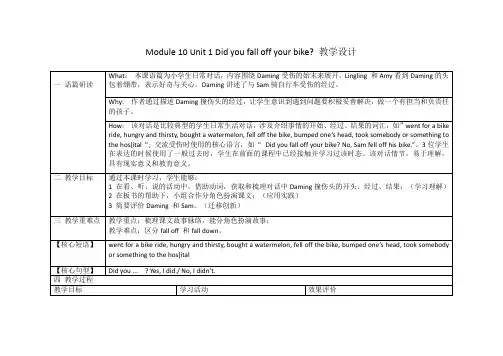
Module 10 Unit 1 Did you fall off your bike? 教学设计
3 简要评价Daming 和Sam。
(迁移创新)7.学生尝试评价Daming 和Sam,说说
他们能从Daming 和Sam身上学到什么
品质。
(Daming遭受意外,撞伤了头,我们应
该同情和帮助他。
Sam与Daming一起
出游,在Daming受伤后带他去医院。
说明Sam是有责任和担当的好孩子,值
得信赖。
倾听学生对Daming 和Sam的评价内容,引导
他们发现Daming 和Sam身上值得学习和思
考的点。
设计意图:本阶段的学习活动旨在引导学生进行情感和价值观的输出与升华,提升他们的思想品格和思考能力。
五家庭作业 1 If you were Sam, you would take Daming to the hospital. But you didn't have enough money. You phoned your mum for help. What should you say? Write it down.(如果你是萨姆,你带大明去医院,但是钱不够。
你打电话
向妈妈求助,该怎么说?写下你的话语。
)
2 Read a picture book named "The Rat and the Tiger".(补充阅读《小老鼠和大老虎》。
)
六板书设计
七教学反思。
小学英语外研版(三起)四年级下册m10U11教案
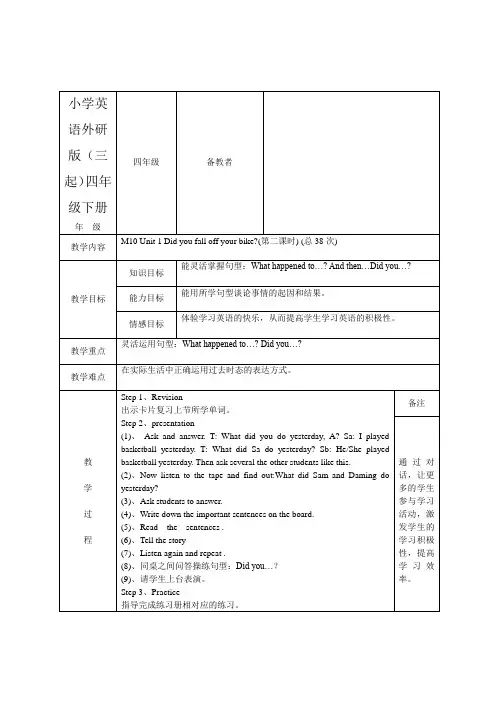
年级
四年级
备教者
教学内容
M10 Unit 1 Did you fall off your bike?(第二课时) (总38次)
教学目标
知识目标
能灵活掌握句型:What happened to…? And then…Did you…?
能力目标
能用所学句型谈论事情的起因和结果。
情感目标
体验学习英语的快乐,从而提高学生学习英语的积极性。
教学重点
灵活运用句型:What happened to…? Did you…?
教学难点
在实际生活中正确运用过去时态的表达方式。
教
学
过
程
Step 1、Revision
出示卡片复习上节所学单词。
Step 2、presentation
(1)、Ask and answer. T: What did you do yesterday, A? Sa: I played basketball yesterday. T: What did Sa do yesterday? Sb: He/She played basketball yesterday. Then ask several the other students like this.
(2)、Now listhat did Sam and Daming do yesterday?
(3)、Ask students to answer.
(4)、Write down the important sentences on the board.
教后反思
(5)、Read the sentences .
(6)、Tell the story
四年级下册英语课件-M10U1 Did you fa off your bike_外研社(三起)
Unit 1
Did you fall off your bike?
四、写出下列动词的过去式。 1.findfound 2.fallfell 3.buybought 4.havehad 5.carrycarried 6.happenhappened 五、英汉互译。 1.hungry and thirsty 又饿又渴 2.去骑自行车 go for a bike ride 3.fall off 跌落 4.在自行车上 on the bike 5.What happened to...? ……发生了什么事? 6.跌倒 fall down 7.go up the hill 上山 8.买一个西瓜 buy a watermelon
九、阅读短文,按要求做题。 I’m Sam.Yesterday I came to visit my grandma by bike.On the way to my grandma’s house.I saw two dogs were fighting.I was very scared( 害怕的 ) and I fell off my bike.And then I bumped my head.Finally( 最后 ) I came to my grandma’s house.She took me to the hospital. 根据短文用1,2,3,4将下列句子排序。 ( 3 )I was very scared and I fell off my bike. ( 1 )Yesterday I came to visit my grandma by bike. ( 4 )I bumped my head. ( 2 )I saw two dogs were fighting.
四年级下册英语教案Unit 10 Lesson 1 Can I hep you 北师大版三起
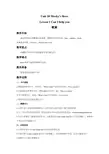
Unit 10 Mocky's StoreLesson 1 Can I help you教案教学目标通过多种练习理解课文的意思。
能够初步认读单词:hats,camera,clock。
掌握重点句型:I want a… Do you have one?教学重点理解教学内容中句型的意思并会正确运用。
教学难点have的两个意思的理解与运用。
教具准备需要本单元的教学卡片教学过程一、卡片活动1.拿起照相机的卡片,问学生:“What’s this?”引导学生回答:“It’s a camera.”2.呈现本单元的教学卡片,拿起clock的卡片,说:“This is a clock.”让学生重复句子。
再问:“What’s this?”引导回答:“It’s a clock.”3.用同样的方法完成其余的卡片。
二、情景引入1.让学生讲一讲他们购物的经历。
问学生进入商店他们一般与售货员说什么。
学生可以用汉语回答,然后试着引导学生说出英语表达法:Good morning/afternoon.2.问学生售货员一般会问他们什么。
呈现表达法Can I help you?把句子写在黑板上,指着每个单词让学生跟读句子。
三、示范对话1.引导学生说出与 Can I help you?对应的汉语表达法。
2.呈现句型I want a camera.把句子写在黑板上,依次指着每个单词,让学生跟读句子。
3.用教学卡片进行替换练习。
4.全班分成两组。
每次举起一张卡片,让一组说:“Good morning. Can I help you?”另一组回答:“I want a (camera).”5.每次举起新的卡片的时候让学生互换角色。
6.呈现句型Do you have a camera?告诉学生这是比I want a camera?更礼貌的说法。
7.重复上述步骤,拿起一张卡片,让一组学生说:“Do you have a (camera)?”另一组学生应该回答:“Yes, I do.”8.全班一起复习颜色的词汇。
教案M10U1 Microsoft Word 文档
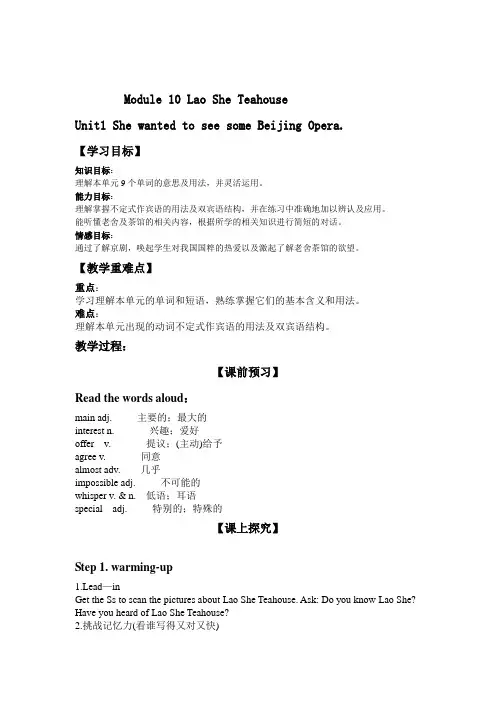
Module 10 Lao She TeahouseUnit1 She wanted to see some Beijing Opera.【学习目标】知识目标:理解本单元9个单词的意思及用法,并灵活运用。
能力目标:理解掌握不定式作宾语的用法及双宾语结构,并在练习中准确地加以辨认及应用。
能听懂老舍及茶馆的相关内容,根据所学的相关知识进行简短的对话。
情感目标:通过了解京剧,唤起学生对我国国粹的热爱以及激起了解老舍茶馆的欲望。
【教学重难点】重点:学习理解本单元的单词和短语,熟练掌握它们的基本含义和用法。
难点:理解本单元出现的动词不定式作宾语的用法及双宾语结构。
教学过程:【课前预习】Read the words aloud:main adj. 主要的;最大的interest n. 兴趣;爱好offer v. 提议;(主动)给予agree v. 同意almost adv. 几乎impossible adj. 不可能的whisper v. & n. 低语;耳语special adj. 特别的;特殊的【课上探究】Step 1. warming-up1.Lead—inGet the Ss to scan the pictures about Lao She Teahouse. Ask: Do you know Lao She? Have you heard of Lao She Teahouse?2.挑战记忆力(看谁写得又对又快)主要的;最大的adj.____________ 兴趣;爱好n. ______________提议;(主动)给予v. ____________ 同意v. ______________________几乎adv. ____________________ 不可能的adj. ________________低语;耳语v. & n. ____________ 特别的;特殊的adj.___________ Step 2 Pre-listeningGet the Ss to talk about these questions:1. Who is Lao She?2. What do you know about Lao She?3. What works(著作)of Lao She have you read?4. Have you ever heard about his play Teahouse?5. What do you think people can do in Lao She Teahouse?Step 3 While-listeningⅠ.Listen and number the sentences as you hear them.a. “All right, you can come with us.”b. “ Would you like us to take you to Lao She Teahouse?”c. “I’d like to go to the teahouse again one day.”d. “Can we come and see the teahouse?”e. “Let’s stay longer.” “OK.”f. “We’re only going to stay for some tea.”Ⅱ.Match the sentences in Activity 2 with these sentences.1. She offered to take us there. a. “All right, you can come with us.”2. They planned to stay for some tea. b. “ Would you like us to take you to Lao SheTeahouse?”3. They decided to stay longer. c. “I’d li ke to go to the teahouse again oneday.”4. We wanted to see the teahouse. d. “Can we come and see the teahouse?”5. I hope to go there again one day. e. “Let’s stay longer.” “OK.”6. My parents agreed to take us. f. “We’re only going to stay for some tea.”Ⅲ.Listen to the conversation in Activity 3 and check True (T) or False (F).1. Sally wanted to see some Beijing Opera so her parentstook her there.2. Lingling likes Beijing Opera, too.3. Sally understood Beijing Opera very well.4. Teahouse is Lao She’s play.Step 3 Post-listeningⅠ.Read the conversation and check True (T) or False (F).1.Sally, her parents and Lingling went to Lao She Teahouse last night.2.Sally didn’t want to see Beijing Opera.3. Lingling wanted to see the teahouse.4. Sally understood Beijing Opera well.5. They had a good time.6. Betty knows Lao She very well.Ⅱ.Read the conversation again and choose the best answer for each sentence.1.Sally and _____ went to Lao She Teahouse last night.A. TonyB. LinglingC. Betty2. Sally’s main interest is _______.A. musicB. mathsC. English3. Sally _____ understand Beijing Opera.A. didn’tB. couldC. almost didn’t4. — How long did they stay?— They stayed for _____.A. 3 hoursB. 2 hoursC. 1 hour5. Lao She was a(n) ________.A. actorB. waiterC. writerⅢ. Get the Ss read the conversation aloud and find out the difficult knowledge ,then discuss them in groups.Finally learn the following knowledge:1. Sally’s main interest is music.萨莉的主要兴趣是音乐。
四年级下英语教学设计-M1 U1 She’s a nice teacher-外研社(三起)
四年级下英语教学设计-M1 U1 She’s a nice teacher-外研社(三起)一、教学目标1.知识与能力:•学生能听、说、读、写本单元中的词汇和句型。
•能够运用所学词汇和句型描述自己的老师。
2.情感态度和价值观:•学生了解教师在课堂中的重要性,尊重老师及其工作。
•延续情感性学习,培养学生对英语学习的兴趣,提高学生的自信心。
3.学习策略与思维方式:•学生掌握简单的英语听、说、读、写能力,能够运用所学知识进行运用和创新。
•通过英语教学,促进学生思维的多元化发展,能够用语言表达想法和观点。
二、教学重点1.词汇: teacher,nice,fun,smart。
2.句子:She’s a nice teacher. She’s fun. She’s smart.三、教学难点学生能够将所学词汇运用到简短的句子中表达自己的看法。
四、教学过程1. 创设情境,导入新知识即将老师介绍的场景:在一个新的学期开始后,学生们迫不及待地想了解他们的班主任,老师是什么样的人。
老师也会展示他们的照片并介绍自己。
### 2. 输入新词汇 1. 应用图片、展示单词卡片、播放配有单词的电子课件,帮助学生尽快了解新单词。
2. 手势动作、肢体语言等方式辅助理解新单词。
3. 教师示范朗读单词,孩子们跟读练习。
3. 练习句型1.展示包括所学单词和句型的照片,安排学生在小组内掌握照片上单词及句型的意义。
2.整齐、清晰地朗读句子。
3.形成问答模式,请求学生使用句型进行回答。
4. 合作学习1.可以将所有老师的名字写在黑板上,让学生分享自己班的老师的特点,并在合作中协商、讨论达成一致。
2.可以以小组竞赛形式,让学生进行小组内合作活动,模拟教师的工作,以便加深学生对所学内容的印象和体验。
5. 评估效果1.采用询问法进行初步评估。
询问的对象是个别学生,这将有助于教师了解每个孩子的学习效果。
2.进一步评估可以采用写作的方式,到达巩固学习的目的。
英语外研新标准(三起)四年级下册-Unit 1 I helped Mum教案
T:The children were very happy.because they…
S1:They rowed a boat on the lake.
T:Amy is happy too.because she helped Mum at home.
Step 2 Presentation
2. Finish Activity 3&4.
Step4 Homework
1. Listen to the tape and try to act this unit.以小组为单位分角色表演课文。
2. 制作一套单词卡片,一面为动词原形,一面为动词过去式。
热身:
Free talk.
通过师生问答,快速拉近师生之间的距离,营造出一定的英语氛围。
Step3.Consolidation
1. Listen and repeat, try to imitate the pronunciation.
1) Listen and point.
2) Listen and repeat.
3) Try to imitate the pronunciation
T: I’m great, thanks.
2.Review. (ask&answer)
T:What’s the weather like today?\Were it sunny yesterday?\Were you at school yesterday?\Were you at home yesterday?
Step 1: Freetalk
多元反思:
课堂教学是教育教学的主渠道,是教学质量的生命线,备课不仅要备教学内容,还要备教学活动;不仅要备知识,还要备学生;不仅要备过程,还要备评价。在本节课教学过程中我做到了尽量使词、句不分离;语言、情景不分离;新、旧知识不分离;知识、情感不分离。精心设计和组织课堂教学活动,注重创设较为真实的语言情景.不足之处在于学生的主体地位还没有充分地凸显出来,只有充分激发学生的学习兴趣,才能真正做到有效教学.最后,让学生自己写自己五一计划的环节,是在新知识的基本上有所提高,但大多数学生已能初步掌握。在个别环节的设计上还存在不足。
英语外研新标准(三起)四年级下册-Unit 1 I helped Mum课件
cooked noodles
/t/
helped mum
/t/
washed clothes
/t/
Read and answer: What did Sam and Tom do?
Grandma: Hello? Amy: Hello, Grandma! Grandma: Oh, hi, Amy! Amy: I cooked noodles yesterday. Grandma: Oh,really? Amy: Yes,I helped Mum and I washed clothes? Grandma: You are a good girl. Grandma: What about Sam? Amy: He didn’t help Mum. He played on the computer and he watched TV. Grandma: What about Tom? Amy: Tom helped Mum too. Grandma: Oh,he is a good boy. I love him..
Module 7
Unit 1 I helped mum.
外研版新标准英语三年级起点四年级下册
01
02
I played in the park.
03
04
I skipped.
I cooked delicious food.
Watch the video and answer:
What did Amy do yesterday?
helped
what about
phoned washed
helped cooked
played
watched
外研社(三起)四年级英语下册教案:M1U1She's a nice teacher (2)
外研社(三起)四年级英语下册教案:M1U1 She’s a niceteacher (2)一、教学目标1.能听懂、认读并运用本课单词和日常交际用语。
2.能流利朗读对话,表演对话情景。
3.能模仿对话并制作自己的对话。
4.能用正确语音、语调朗读本课文。
5.培养学生团队合作意识和语言表达能力。
二、教学重难点1.教学重点:单词及词组的听说认读和运用。
2.教学难点:本课对话的流利朗读和情景表演。
三、教学准备1.教学PPT。
2.教学录音及视频。
3.教材和教具。
四、教学过程1. Warm-up1.Greeting:打招呼。
2.Song:学唱《Hello,Hello》。
2. Presention1.师生交流:通过图片呈现老师样貌,呈现新单词teach、“用手指指”、翻转卡片呈现新单词student、“仔细听”、老师提问学生“Who’s she?” “What’s she?” 联系上节课内容进行学习。
2.视频播放:观看关于学生与老师互动的视频,了解新课主题。
3.教材呈现:学生跟读课文,重点教授单词及词组,如:classroom, good morning/afternoon, too等。
3. Practice1.模仿对话:通过视频展示学生与老师的互动。
请学生模仿并进行练习。
2.情景表演:把学生分成小组,并让他们进行情景表演。
4. Production1.制作对话:鼓励小组学生进行自编对话的活动。
2.分享并演出:请每个小组展示他们制作好的对话,并进行演出。
5. Homework1.练习单词拼写、朗读及情景表演。
2.完成相关练习题。
五、教学评价1.学生能流利朗读本课文。
2.学生能运用本课程单词和表达法进行日常会话。
3.学生能够进行团队合作活动。
4.学生能够理解并完成相关练习。
六、教学延伸1.观看其他关于学生与老师对话的视频。
2.进一步拓展学生的情景表演能力,例如演出小品或手语。
3.告诉学生为什么要尊重老师,并拓宽尊重的范畴,如其他行业的专业人员等。