
新外研版高一英语必修1:Unit5 Into the wild Period5 Presenting ideas 教案
教学设计
课 题 Unit5 Into the wild --Presenting ideas 学 科 英语 班 级
Class 授课教师
教 学目 标 1 引导学生通过本单元的学习,能够推荐与单元主题相关的一部优秀电影或一则动人故事,从而对人与动物这一话题有更深入的理解; 2 引导学生熟悉故事的内容要素,并恰当地运用本单元所学,讲述人与动物相处的
故事;
3 引导学生更深刻地认识人与动物的关系,树立爱护动物、尊重动物、与动物和谐
相处的正确价值观。
重 点
根据笔记内容讲述人与动物相关的故事
难 点
如何根据故事的主要内容要素记录关键信息。
教 学
方 法
Cooperative learning.
Brainstorming.
教 学 内 容 与 过 程 Step1 Brainstorming 教师将本板块的活动进行整合,引导学生综合运用单元所学并结合自身实际,讲述以“人与动物”为主题的故事,正确理解单元主题意义。 第一步:学生以小组为单位,展开头脑风暴,回忆曾经看过的讲述人与动物关系的电影作品或故事,确定介绍的对象。 第二步:各小组讨论故事的具体内容,根据故事的主要内容要素记录关键信
息,并按照学生用书的格式整理笔记,为完整、有条理地讲故事做好准备。
Work in groups. Think of a film or story you know about relationships between
humans and animals and complete the notes.
• Time
• Place
• Main character(s)
• Relationship between characters
• Main plot
• Message behind the story
备注
Step2 Group work
各小组根据笔记内容讲述故事,并选出组内最佳故事。教师提醒学生使用学
生用书中提供的实用表达。
Practise telling your story in the group. Use your notes in Activity 1 and the
expressions in the box to help you.
• The story is about…
• The main characters are…
• It takes place in…
• It starts with…
• It ends with…
• It’s written for…
• It’s told through the eyes of…
• It’s based on…
Step3 Presentation
第一步:共同制定出好故事的评判标准,如故事的完整性、故事表述的逻辑
性、故事所传递的情感等;
第二步: 教师要引导学生在故事中深入挖掘人与动物关系的主题,升华学
生对单元主题语境的理解,树立爱护动物、尊重动物、与动物和谐相处的正
确价值观。
第三步:各小组选出代表在班级内分享组内最佳故事。
Tell the story to the class. Vote for the best story
Step4 Reflection of this unit
After completing this unit, I can rate my performance 1 (excellent), 2 (good) or 3
(in need of improvement).
___understand and use animal idioms
___express agreement and disagreement
___write an animal fact file
___identify cause and effect in a text
___have a better understanding of relationships
___between humans and animals and respect nature
Step5 Homework
课后练习
高中英语1UNIT5Intothewild外研版必修一Writing教学设计

外研版必修一UNIT 5 Into the wildM3 My First Ride on A Train四川省渠县中学周兴斌The last one WritingTeaching design教学设计Aims and requirements● To revise the vehcles and feelings in the wild.●To let students speak as much as possible using the vocabulary and expressions in this unit.●To write a passage about your first experience.Teaching proceduresStep 1. Warming upWarming up by discussing, do the exercises.the sentences from the passage and answer the questions.r ecently… a lo ng time ago…d uring the day… a hundred and fifty years ago…o ne night… u ntil the 1920s…a t (about) midnight… i n 1925…Use similar time expressions to complete these sentences.1). People first started traveling by train _________.2). We had a nice holiday last year. ________ , we visited museums. ________, we went to a music club.3). There are a lot of cars in cities nowadays. ______, you could see a lot more bicycles in the streets.4)._________ , I traveled by bus to meet a friend of mine who now lives in another city.5). _________, there was a huge railway station in the middle of the city, but it isn’t there any more.6). I am sorry , but I didn’t see you here ______ .2. If you have a chance to travel, where do you want to go? Why?a book about a couple who like travelling in the wild around the world.Step 2. Talking1).Firstly let students make a conversation with their partner, accordinging to Chaeles Chaplin’s photo , talking about Chaeles Chaplin’s experience.2).Then let stuengts talk about him from his information.Step talkWhy do more and more people like to travel?People travel for different purposes:➢learn about the outside world➢get excitement or relax oneself➢do some research➢enjoy the beauty of nature➢study wildlife or plants➢be interested in delicious food➢do business or make friends …StepSay something about your travel.Answer:WhenWhereWith whomHow you went thereWhat you did and sawWhat was your feelingStep 5: HomeworkChoose one of the two topics. Try to share experiences with your group members according to the topic. Put down anything you think are useful in your writing.Write a paragraph about one of these topics to describe one of your experiences.☆My first family holiday☆My first train ride☆My winter holidayStep 6. Exercises for consolidationPossible samples:(GIVEN OUT TO STUDENTS)My winter holidayIt was my winter holiday. I was very happy. I read my favourite books which were very moving. But I could not read these books too much. I also had a lot of homework to do. I like playing computer games, too. It’s very interesting. But I could not play it too much. I wear glasses, I’m very sad. It’s not good for my eyes to play computer games too much.Oh! It was the Spring Festival. It is Chinese traditional festival. People were very happy. They went shopping, cleaned their houses, and had supper together……I went to my grandparents’home with my parents. My grandparents were very happy to see us. They prepared many kinds of nice food, such as fish, meat, vegetables and fruit. In the evening, we watched TV and lighted fireworks. We also knocked on people’s doors and gave some presents to them.. After the Spring Festival, we went to Shanghai to go shopping. We bought clothes, shoes and some delicious food.I had a good holiday, I think. I also have very nice school life now.。
外研版2019高一必修一 Into the wild Developing ideas 教学设计
2.Ssshare their answerswith theclass.
1.To help Ss understand the details of the passage by careful reading.
Activity 5
1.T asks Ss to look at the pictures and describe them,and choose one jobabout whichthey would like to give a talk to the class.
2.Tasks Ss who choose the same job to form a group and read the table to figure out what they need to know to introduce a job.
2.T divides Ss into several groups and asks Ss to discuss the meaning of the words in bold in groups.
3.T asks representatives of eachgroup to share their answers with theclass.Others can add what they want.
1.Ss work in groupsandchoose an animal they want to write about.
2.Ssdiscussthe related informationofthe animals they have chosenand make notes in groups.
新外研版高一英语必修1:Unit5 Into the wild Period4 Developing ideas 教案
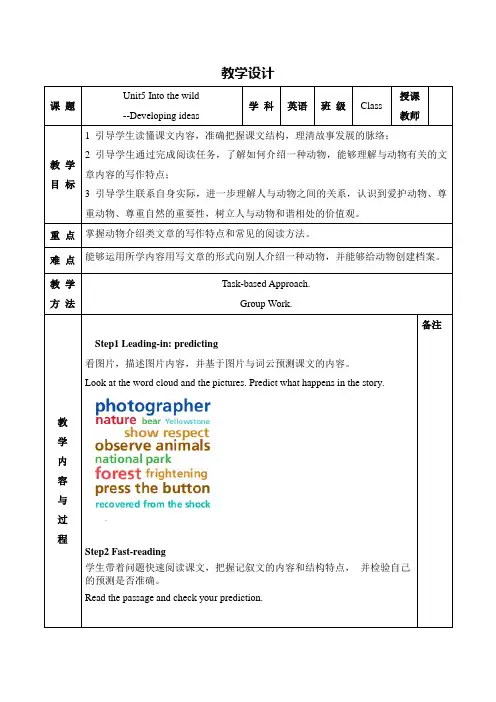
教学设计课题Unit5 Into the wild--Developing ideas学科英语班级Class授课教师教学目标1 引导学生读懂课文内容,准确把握课文结构,理清故事发展的脉络;2 引导学生通过完成阅读任务,了解如何介绍一种动物,能够理解与动物有关的文章内容的写作特点;3 引导学生联系自身实际,进一步理解人与动物之间的关系,认识到爱护动物、尊重动物、尊重自然的重要性,树立人与动物和谐相处的价值观。
重点掌握动物介绍类文章的写作特点和常见的阅读方法。
难点能够运用所学内容用写文章的形式向别人介绍一种动物,并能够给动物创建档案。
教学方法Task-based Approach.Group Work.教学内容与过程Step1 Leading-in: predicting看图片,描述图片内容,并基于图片与词云预测课文的内容。
Look at the word cloud and the pictures. Predict what happens in the story.Step2 Fast-reading学生带着问题快速阅读课文,把握记叙文的内容和结构特点,并检验自己的预测是否准确。
Read the passage and check your prediction.备注a surprising way.2 “Reflected”means that images can be seen on the surface of the mirror, glass or water.3 “Frightening”means that something is making people feel afraid, anxious or nervous.Step4 Group Work教师利用此活动,结合文本内容,引导学生了解其他与动物相关的职业,感知人与动物的和谐相处,帮助学生树立关爱动物、尊重动物的意识。
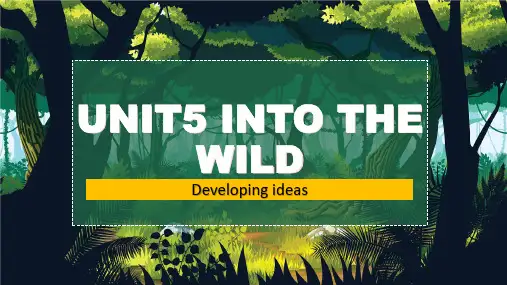
Unit 5 Into the Wild Developing ideas课件-高一上学期英语外研版
cause & process
Para.3
walked through; stepped out of;concentrating on; be watched; took a photo
time last spring place Yellowstone National Park character photographer
What’s the theme of this passage?
harmony
human beings
animals
Group work: Retell the story.
1
2
3
4
5
6
walked through; admired; being watched; saw; took a photo; run away
Live in harmony with nature and animals.
Homework
1. Use the six elements to write your “an unexpected meeting”。 2. Review the words and phrases of the passage.
Developing ideas
Review words and phrases
element shock
recover encounter freeze concentrate variety capture
偶遇 恢复 专注 突然停止;冻僵
震惊 基本要素
捕捉 多样化
An Encounter with Nature
THANKS FOR WATCHING
【课件】新外研版 必修一 Unit 5 Into the wild- W
Giant Panda The giant panda is a bear native to central western and south western China. It is easily recognized by its large, distinctive black patches (斑点) around its eyes, over the ears, and across its round body. Diet Though it belongs to the order Carnivore, the giant panda's diet is over 99% bamboo. Giant pandas in the wild will occasionally eat other grass, wild tubers (块茎), or even meat in the form of birds, rodents or carrion. Conservation The giant panda is among the world's most adored and protected rare animals, and is one of the few in the world whose natural inhabitant status was able to gain a UNESCO World Heritage Site designation (指定).
Appearance
Habitat Migration Diet Other information
How to write an animal fact file
1. First, look for interesting facts when you are doing research. 2. Use sub-headings to help readers quickly find what they are looking for. Sub-headings in the form of questions are also helpful. Wh-questions make great sub-headings. 3. After you have collected all the information you need, you can then make some notes, but this is not necessary. 4. Write out your animal fact file. An animal fact file comes in many styles. It can be a short passage. It can be in any form as you like, as long as it can demonstrate what you want to tell the readers.
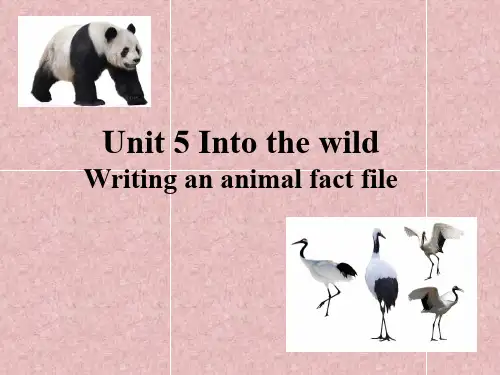
Unit 5 Into the wild writing课件-高一英语(外研版2019必修第一册)
□ Useful expressions
· It is… tall. · It gets its name from… · Its unique feature is… · Its food includes… · It is a symbol of…
While-writing:
根据要求写一篇濒危动物西伯利亚鹤(又名“雪鹤”)的短文。
Choose an animal you want to write about and make notes.
Animal: ____________ Appearance _________________________________ Habitat _________________________________ Migration _________________________________ Diet _________________________________ Other information _________________________________
1.外貌特征:140cm高;羽毛几乎雪白;没有羽毛的脸 是淡红色的。 2.栖息地:通常在东亚;冬天大多数迁徙到中国,极少 数迁徙到伊朗。 3.饮食习惯:胃口好,种类多,食鱼、食虫、食水草 根茎等。 4.象征意义:在中国文化中,代表优雅、纯洁、好运 和长寿。
思路指引
动物资料档案
文章主要介绍一种动物,可以从外貌 (appearance)、体型(tall、small、tiny等)、 栖息地(habitat)、是否为迁徙(migration) 动物、以什么为主食(food)以及其他信息 (other information) (是否濒危,是否为国家 保护动物……等方面来介绍。
新外研社(19)高中英语必修一Unit5Into the wild-Using Language教案
新外研社(19)高中英语必修一Unit 5 Into the wild-Using Language教案Teaching objectives:1.Enable the students to learn more about the structures and functions of the attributive clauses and master the usage of relative adverbs as well as their applications in real contexts.2.Guide the students to deepen the understanding of English and stimulate their interest in learning English.Meanwhile,they will learn to observe,research and summarize in English thinking models.3.Lead the students to learn more about the attributive clauses by observing,analyzing and illustrating.Thus,they will deepen their own understanding of the attributive clauses.4.Help the students to explore more usage of the attributive clauses,especially that of the relative adverbs through self-study and cooperation.Evaluation objectives:1.Ask the students whether they could recognize the attributive clauses and whether they have mastered the usage of relative adverbs as well as their applications in real contexts.2.Ask the students whether they could properly use the idioms related to animals and whether they know some other common idioms.3.Check students’ ability to understand the conversations about animals and let them debate on the topics about protecting animals and express their opinions.Teaching key and difficult points:1.Enable the students learn more about the structures and functions of the attributive clauses and master the usage of relative adverbs as well as their applications in real contexts.2.Help the students master and properly use the idioms related to animals, and learn the meanings of some common idioms.3.Improve students’ ability to understand the conversations about animalsand encourage them to debate on the topics and express their agreements and disagreements.4.Lead the students to think about the relationship between human beings and animals, realize the importance of harmony between us and set up the ecological view of sustainable development.Teaching methods:Task-based Approach; Cooperative Teaching MethodTeaching procedures:Step1: Lead-inThe teacher leads the students to review the reading passage on Page50-51 and underline all the attributive clauses in the passage. Then, the teacher will introduce the main topic of this class.(Intention:Introduce the grammar item of this class; the attributive clauses introduced by relative adverbs)Step2: Teach a new class1.Autonomic LearningThe teacher requires the students to discuss the similarities of the underlined attributive clauses in the passage and then summarize the law of the application of their conjunctions, such as where, when and why.(Intention:Summarize the usage of the relative adverbs in the attributive clauses)2.Achievement displayWhen the relative words function as adverbials of time, place and reason in the attributive clauses, we should use relative adverbs, such as when, where and why.(Intention:It will be much more effective to let the students summarize the law of application of the relative adverbs on their own.)3.Cooperative researchStudents are required to discuss why the author uses the attributive clauses rather than two simple sentences in the passage and then they should complete the Activities 1,2 and 3 on Page 53.(Intention:Let students realize the importance of the attributive clauses in the composition and lead the students to try to use the attributive clauses in their following writing.)4.Break through the difficulties(1)Students are required to analyze the usage of relative adverbs again and compare their usage with those of relative pronouns.①The usage of the relative adverb:whenWhen the antecedents are nouns representing time, such as time, day, year, month, week etc. And the relative words function as an adverb of time in the attributive clauses, we will use“when”to introduce the attributive clauses.Eg. I still remember the time when I was in college.I have forgotten the exact date when this country became independent.②The usage of the relative adverb:whereWhen the antecedents are nouns representing place, such as place, room, mountain, airport, etc. and the relative words function as an adverb of place in the attributive clauses, we will use“where”to introduce the attributive clause.Eg. This is the hotel where they stayed.When the antecedents are nouns, such as situation, case, stage, point etc. And meanwhile the relative words function as an adverb of place in the attributive clauses, we will use“where”to introduce the attributive clauses, too.Eg. They have reached the point where they have to separate with each other.③The usage of the relative adverb:whyWhen the antecedent are nouns representing reason, such as reason, and the relative words function as an adverb of reason in the attributive clauses, we will use“why”to introduce the attributive clauses.Eg. This is the reason why he left in a hurry.(Intention:Let the students learn more about the usage of relative adverbs by showing them some typical sentences.)Step3:Explanation当关系词在定语从句中作时间、地点、原因状语时,应使用关系副词,,。
外研版(2019)必修第一册Unit5IntotheWildUsinglanguage教学设计
教师提问学生关于课文内容的问题,如“What is the main idea of the text?”, “What is the author's attitude towards survival in the wild?”等,检查学生对课文内Байду номын сангаас的理解和分析能力。
学生回答问题,教师给予评价和反馈,鼓励学生积极参与课堂讨论。
4.听力作业:要求学生观看一部关于野外生存的电影或纪录片,并完成相关的听力练习。电影或纪录片可以选择《荒野求生》、《荒野挑战》等。
5.实践作业:要求学生结合本节课所学内容,与家人或朋友共同设计一个野外生存的短途旅行计划。计划中应包括目的地选择、食物准备、水源获取、住宿安排等方面的考虑。学生可以将计划实施并记录下实际生存过程中的经验和感受,以便在课堂上与同学分享。
本节课的教学重点为:1.掌握本单元的生词和短语;2.理解课文内容,概括文章大意;3.运用所学知识进行口语交流和写作训练。教学难点为:1.正确运用本单元的语法知识;2.在实际情境中运用所学词汇和短语。
教学过程中,教师应注重启发式教学,引导学生主动探究、积极参与,通过小组合作、讨论等方式,提高学生的语言运用能力。同时,注重情感教育,培养学生的环保意识和团队合作精神。
(三)改进措施
1.关注学生个体差异:针对不同学生的特点,制定个性化的教学计划和辅导措施,鼓励内向学生积极参与课堂活动,提高他们的自信心和口语表达能力。
2.加强实践环节:增加户外实践活动,如野外生存体验营、实地考察等,让学生在实际环境中运用所学知识,提高他们的实际应用能力。
3.丰富教学资源:充分利用网络资源和校内外资源,引入更多的文化背景知识,拓展学生的知识视野,提高他们的文化意识和跨文化交际能力。
高一【英语(外研版)】必修一 Unit 5 Into the wild (5)-课件
必修一 Unit 5 Into the wild (5)
高一年级 英语
Writing an animal fact file Writing
Objectives
At the end of the class, you will be able to:
1. get the main idea and specific information of the red-crowned crane; 2. find out the useful expressions to describe features of animals; 3. write an animal fact file; 4. revise your writing.
Warming up
Do you remember the story of the photographer who encountered a bear in Yellowstone National Park?
How does the author describe bears?
Warming up
Appearance Habitat Migration Diet Other information
Useful expressions
aspects
description
新教材高中英语Unit5Intothewild单元要点回扣教案外研版必修第一册
Unit 5 Into the wildⅠ重点单词重点词汇夯实练1.①It is hard to measure(measure) his ability when we haven’t seen his work.②It is high time that we should take some measures to control(control) the spread of this disease.③The new bridge under construction, measuring(measure) twice as long as the old one, will be completed next month.2.We are now in a good position where all is in our hands.3.①He is a determined man and he believes determination and effort can lead to success.(determine)②He left home without saying a word and determined never to come(come) back before he could make a big fortune.4.①This country has found the effective solution to poverty.②We have to solve(solution) the problem from the root.5.①—How do you like the new film?—Well, it’s quite amazing and I am really amazed at it.(amaze)②From his amazed(amaze)look, I could see that he didn’t believe what I said.③Much to my amazement(amaze), he was able to recite the whole poem from memory.6.①NotreDame de Paris(巴黎圣母院)was destroyed(destroy) by fire in 2019.②The flood caused serious destruction(destroy) to the railway.7.Only two passengers survived the air crash.When the two survivors were interviewed, they said their survival was a wonder.(survive)8.①The police observed him driving(drive) at 90 miles per hour.②The policeman observed the man open(open) the window and enter(enter) the house.③So far, the villagers have been observing/have observed(observe) the traditional custom.9.①Everyone arrived late at the party for various (vary)reasons.②There are a variety of/varieties of(各种各样的) flowers on sale in the market.10.①(2019·四川成都期末)When you begin to work, you should be able to concentrate on your subject.②There is too much noise.I can’t concentrate my attention on(集中我的注意力) the work.11.I stared at the girl, trying to remember who she was.Ⅱ重点短语会书写会应用1.manage to do 设法做成某事2.cut down 砍倒;缩减;降价3.lead to 导致;造成(后果);通向……4.add...to 把……添加到……5.up to 达到,多达……6.after all 毕竟,终究,归根结底(句首); 别忘了(句尾或句中)1.We firmly believe that war never settles anything.It only leads to violence.2.Lots of woods have been cut down in order to make great profits.3.Don’t worry too much.After all, it’s not your problem.4.Some new sports games include Karate, rock climbing, etc.will be added to the 2020 Olympic Games.Ⅲ重点句型1.the+比较级, the+比较级,意为“越……就越……”The more we know about this lovely creature, the greater the chance it will survive and keep its place in the natural world for a long time to come.[仿写] 你看的书越多,你理解的越好。