
英语人教版八年级下册unit1 (1a-2d)课件
What’s the matter with him? Does he have a fever? Does he have a toothache? Does he have a sore throat? Does he have a stomachache? What should he do?
Lisa: Yeah, I think I sat in the same way for
too long without moving.
Mandy: I think you should lie down and
rest. If your head and neck still hurt
tomorrow, then go to a doctor.
___ i eye ___ b foot ___ c mouth ___ f tooth
Listening
1b Listen and look at the picture. Then number the names 1-5. Nancy ____ Sarah ____ David ____ 4 2 1 Ben ____ Judy ____ 3 5
Lisa: OK. Thanks, Mandy.
1. What’s the matter? 这是人们特别是医生和护士询问病人 病情时常用问句, 意思是“怎么了?” 其后常与with连用。类似的有: What’s wrong? 怎么啦? What’s wrong with you? 你怎么了? What’s your trouble? 你怎么了? What’s the trouble with you? 你怎么了? What’s up? 你怎么了?
What’s the matter with him? Does he have a fever? Does he have a toothache? What should he do?
What’s the matter with him? Does he have a fever? Does he have a toothache? What should he do?
Can you name the parts of the body?
matter n. 问题;事情 sore adj. 疼痛的;酸痛的 have a cold 感冒 stomachache n. 胃痛;腹痛 (stomach) have a stomachache 胃痛 foot n. 脚;足 neck n. 脖子 throat n. 咽喉;喉咙
Pairwork
2c Make conversations using the information in 2a and 2b.
A: What’s the matter? B: My head feels very hot. A: Maybe you have a fever. B: What should I do? A: You should take your temperature.
Make up a conversation between a doctor and a patient.
翻译下列句子。
1. 你怎么了?我头痛。 What is the matter with you? I have a headache. 2. 他怎么了?他发烧。 What’s the matter with him? He has a fever.
3. 李雷怎么了?他喉咙痛。他应该多喝 水。 What’s the matter with Li Lei ? He has a sore throat. He should drink lots of water. 4. 如果你的头和脖子明天仍然疼的话, 请去看医生。 If your head and neck still hurt tomorrow, then go to a doctor.
fever n. 发烧 lie (lay) v. 躺;平躺 lie down 躺下 rest n.&v. 放松;休息 cough n.&v. 咳嗽 toothache n. 牙痛 take one’s temperature 量体温 headache n. 头痛 have a fever 发烧 break n. 间歇;休息 hurt (hurt) v. (使)疼痛;受伤
Role play
Imagine you are the school doctor. A few students have health problems. Role-play a conversation between the doctor and the students.
2d Role-play the conversation.
2. have a cold伤风, 感冒, 是固定词组 表示身体不适的常用词组还有: have a bad cold 重感冒 have a fever 发烧 have a headache 头痛 have a stomachache 肚子痛, 胃痛 have a toothache 牙痛
Summary 1. 牙疼
Pairwork
1c Look at the picture. What are the students’ problems? Make conversations.
What’s the matter with Judy?
She talked too much yesterday and didn’t drink enough water. She has a very sore throat now.
What’s the matter with Sarah?
She didn’t take care of herself on the weekend. She was playing with her friends at the park yesterday. Then it got windy, but she didn’t put on her jacket. Now she has a cold.
Mandy: That’s probably why. You need to take breaks away ____ from the computer. Lisa: Yeah, I think I sat in the ____ sameway for too long without moving. Mandy: I think you should ___ lie down and rest. If your head and neck still hurt tomorrow, then go to a doctor ______. Lisa: OK. Thanks, Mandy.
2. 胃疼 3. 背疼 4. 头疼 5. 喉咙疼 6. 发烧 7. 感冒 have a toothache have a stomachache have a backache have a headache have a sore throat have a fever have a cold
8. 躺下并且休息 9. 喝热蜂蜜茶 lie down and rest 10. 喝大量水 drink hot tea with honey 11. 看牙医 drink lots of water 12. 量体温 see a dentist 13. 看医生 take one’s temperature go to a doctor
Pairwork
What’s the matter with him/her? He /she _________. has a cold
have a cold
have a fever
have a toothache
have a sore throat have a stomachache
Guessing
Listen to the conversations again and fill in the blanks.
Conversation 1 Nurse: What’s the matter, Sarah? Girl: I __________. have a cold Conversation 2 Nurse: What’s the matter, David? Boy: I ________________. got a stomachache Conversation 3 Nurse: What’s the matter, Ben? Boy: I _______________. have a sore back
Conversation 4 Nurse: What’s the matter, Nancy? Girl: I _______________. have a toothache Conversation 5 Betty: What’s the matter, Judy? Ann: She ________________. has a sore throat
Exercise
根据上下文意思填空。
Mandy: Lisa, are you OK? Lisa: I ____ have a headache and I can’t move my neck. What should ______ I do? Should I ____ take my temperature? Mandy: No, it doesn’t sound like you have a fever. What ___ did you do on the weekend? Lisa: I played computer games _____ all weekend.
Listening
2a Listen and number the pictures [1-5] in the order you hear them.
Unit1+what’s+the+matter+Section课件22-23学年人教版英语八年级下册

1b Listen to the school nurse. Check (√)
the problems you hear.
Problems
Treatments
Someone felt sick.
√
Someone cut his kne√e.
√
Someone had a fever.
Someone had a nosebleed. √
What should they do?
First, ... Next, ... Then, ...
_2_ Clean your face. _1_ Put your head back. _3_ Put on a clean T-shirt.
_3_ Put a bandage on it.
_1_ Run it under water. _2_ Put some medicine on it.
2 Aron had a serious
True False Don’t know
accident in April 2003.
3 Aron ran out of water after three days.
True False Don’t know
4 Aron wrote his book
True False Don’t know
2e Put the sentences in the correct order. Then
use them to tell Aron’s story to your partner. Try to add other details from the reading.
1. On April 26, 2003, he had a serious mountain
新人教版初中英语八年级下册精品课件Unit 2 I will help to clean u Period 1 Section A (1a-2d) (1)

12.凯特好像咽喉痛。 It seems that Kate ______h_a_s _______a_ ______so_r_e _____th_r_o_a. t 13.医生刚才量过你的体温了吗? Did the doctor _____ta_k_e____y_ou_r___t_e_m_p__er_a_t_uare moment ago?
【2019•铜仁】
【A.】ol句d e意n为ou“gh—; h—er我se们lf 不应该B担. b心ig玛en丽ou。gh—; —he你rse说lf得对! C她. e已no经u足gh够ol大d;了he,r 能照顾自己D.了en”ou。gh形b容ig词; h需er要放在
enough的前面,即形容词+enough,故排除C、D。这 里的足够大,指的是年龄大,应该用old,故排除B。 herself是反身代词,指她自己。故选A。
6.Michael's grandfather is too old to drive a car. (改为同义句)
Michael's grandfather isn't ___y_o_u_n_g___e_n_o_u_g_hto drive a car.
7.—Would you like something to drink, Mum?
2.—You don't look well. What's the matter with you?
—_____B___.
【2019•岳阳】
A.I won the game
B. Maybe I have a fever
C. That's too bad
【 】句意为“—看起来不太好。你怎么啦?— —或许我发烧了”—你。 I won the game我赢 得了比赛;Maybe I have a fever或许我发烧了; That's too bad那太糟糕了。故选B。
2023人教版八年级英语下册精品课件-【第1课时(A 1a-2d)】 (4)
1c
Look at the problems in 1a and make conversations.
What’s wrong?
பைடு நூலகம்
I’m really tired because I studied until midnight last night.
Why don’t you go to sleep earlier this evening?
I’m just not very good at writing letters. Boy 1: Maybe you should call him up.
Boy 2: No, I don’t want to talk about it on the phone. Boy 1: But you really should talk to him so that you
allow wderoanl g guess
Phrases review
重要的事 哪儿不舒服? 快速查看;浏览 成功地发展;解决
big deal What’s wrong? look through work out
Lead-in
Do you have any problems in your daily life?
you’re sorry. 4. You __c_o_u_ld__ go to his house. 5. You __c_o_u_l_d_ take him to the ball game.
Listen again. Why doesn’t Peter like his friend’s
2b advice? Write the letters (a-e) next to the advice in
人教版英语八年级下册Unit 1 Section A 1a-2d 课件
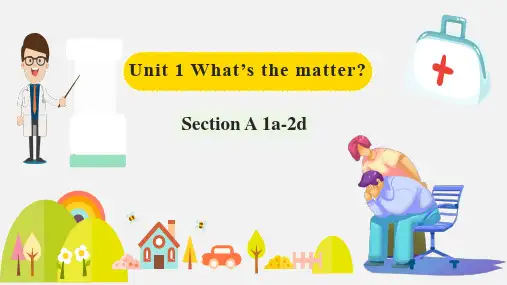
/eɪk/ have a headachehave a stomachache
v. /n. 疼痛
have a toothache
Look at the picture, and tell me what’s the trouble with them?
have/catch a cold
/fi:və(r)/
A: What’s the matter with Judy? B: She talked too much yesterday
and didn’t drink enough water. She has a very sore throat now.
Post-listening
1c Look at the picture. What are the students’ problems?
the first time. 8. If you agree, you can nod yohuera_d_____.
Look at the picture, and tell me what’s the matter with them?
Her eyes ached from lack of sleep. She felt an ache in her back.
Make conversations.
What’s the matter with Judy?
She talked too much yesterday and didn’t drink enough water. She has a very sore throat now.
Pre-listening
1. We look with our e_y__e_s___. 2. We listen with oure_a_r_s____. 3. We smell with ourn_o__s_e___. 4. We walk with our f_e_e_t____. 5. He carries a big bag on hbias_c_k____. 6. We doe_y_e__ exercises to protect our sight. 7. People sometimes shahkaen_d_s____ when they meet for
英语人教版八年级下册Unit-1-What's-the-matter
重点
Have,hurtfor talking about health problems; Modalshould/shouldn’t
难点
Words referring to health problems and expressions in 2d
Step3. Listening
Before listening practice, the following questions can be used to communicate with students:
How many people can you see in the picture?
T: What problems do others in the pictures have? What should they do.
List the solutions to the problems on the blackboard and guide students to read the advice in 2b.
Name
Problem
Reason
Sarah
David
Nancy
Step k in pairs to make up conversations according to the model in 2c and the chart above.
A: What’s the matter with Judy?
How many of them are students?
How many students are not feeling well?
人教版 八年级英语 下册 Unit1_what's_the_matter课件(完整)
Conversation 4 Girl :What’s wrong with your face? Boy: It’s not my face.It’s my tooth.I have a toothache. Girl:You should see a dentist and get an X-ray. Boy:But will it hurt? Girl:No,and if you don’t go to the dentist now,it’ll hurt even more later!
night,I got a stomachache. I almost couldn’t get myself out of bed this morning.
Conversation 3 Nurse:What’s the matter,Ben?Can you move? Ben:Not really.I was playing soccer the other day and I hurt myself.It
foot n. 脚;足 neck n. 颈;脖子
Words and expressions
stomach n. 胃;腹部 throat n. 咽喉;喉咙 fever n. 发烧 lie v.躺;平躺
lie down 躺下 rest v. 放松;休息
cough v. 咳嗽 X-ray n. X射线;X光
Lisa: OK. Thanks, Mandy.
3b Read the passage again and check the things that happened in the story.
人教版英语八年级下册-Unit 1 Section A (1a—2d)教案
Unit 1 What’s the matter?Section A (1a—2d)一、教学目标1. 能够熟练掌握本课重点词汇:matter, sore, stomachache, foot, neck, stomach, throat, fever, lie, rest, cough, X-ray, toothache, break, hurt,have a cold, have a stomachache, have a sore back, havea sore throat, lie down, cut oneself, take one’s temperature, have a fever, take breaks等。
2. 熟练运用本课重点句型:(1) —What’s the matter?—I have a…(2) —What should I do?—I think you should lie down and rest.3. 能够听懂谈论健康问题的对话,并能从中提取关键信息。
4. 能够使用“have+(a)+疾病”结构描述健康问题,并能就健康问题提出简单的建议。
5. 学会关心自己和他人,通过询问他人的健康情况并给予帮助,从而增进人与人之间的感情。
二、教学重点及难点重点:1. 能够听懂谈论健康问题的对话,并能从中提取关键信息。
2. 能够使用“have+(a)+疾病”结构描述健康问题,并能就健康问题提出简单的建议。
难点:能够使用“have+(a)+疾病”结构描述健康问题,并能就健康问题提出简单的建议。
三、教学过程四、板书设计Unit 1What’s the matter?第1课时Section A (1a—2d)Key words and phrases: matter, sore, stomachache, foot, neck, stomach, throat, fever, lie, rest, cough, X-ray, toothache, break, hurt,have a cold, have a stomachache, have a sore back, have a sore throat, lie down, cut oneself, take one’s temperature, have a fever, take breaksKey sentences:1. —What’s the matter?—I have a…2. —What should I do?—I think you should lie down and rest.。
八下英语第一单元课件人教版
八下英语第一单元课件人教版The problem is that I am unable to provide the specific English language courseware for the 8th grade, Unit 1, from the People's Education Press. However, I can discuss the general requirements and objectives of an English language course for 8th graders and the potential challenges that students may face in learning English at this level.In an 8th-grade English language course, students are typically expected to build on the foundational skills they have acquired in previous years and to further developtheir proficiency in reading, writing, speaking, and listening. The course may focus on expanding vocabulary, improving grammar and syntax, and enhancing comprehension and communication skills. Additionally, students may be introduced to more complex literary texts and be encouraged to analyze and interpret them critically.One potential challenge for students at this level is the increasing complexity of the English language. As theyprogress through their studies, students are likely to encounter more advanced vocabulary, intricate grammatical structures, and nuanced literary themes. This can be overwhelming for some students, especially those who may struggle with language acquisition or have learning differences.Furthermore, the demands of the course may require students to engage with English language materials that are culturally and contextually unfamiliar to them. This can present a barrier to comprehension and may require additional support and guidance from teachers.Another challenge for 8th-grade English language learners is the development of effective communication skills. As they navigate the complexities of the English language, students may find it challenging to express themselves clearly and coherently, particularly in spoken communication. Additionally, they may struggle with understanding and interpreting the perspectives and intentions of others in English-language interactions.In addition to the academic challenges, 8th-grade students may also face social and emotional obstacles in their English language learning. They may feel self-conscious about making mistakes or speaking in front of their peers, which can hinder their confidence and willingness to participate actively in class activities.Despite these challenges, 8th-grade English language learners have the potential to make significant strides in their language proficiency and to develop a deeper appreciation for the English language and its cultural significance. With the support of dedicated teachers, engaging course materials, and a supportive learning environment, students can overcome these obstacles and achieve success in their English language studies.。
人教版英语八年级下册Unit 1 SectionA (1a-2d)教案
Unit 1 What’s the matter?Section A (1a-2d)一、教学目标1. 听懂并掌握下列词汇及常用表达:matter, sore, stomachache, foot, neck, stomach, throat, fever, lie, rest, cough, X-ray, toothache, headache, break, hurthave a cold, have a stomachache, have a sore back, have a sore throat, lie down, cut oneself, take one’s temperature, have a fever, take breaks2. 听懂谈论健康问题的对话材料。
3. 能简单谈论健康问题,并使用“have + (a) + 病症”结构做出回答或表述。
What’s the matter with …?I have a …4.掌握听力技巧之利用生活常识听前预测。
5. 能够运用所学的语言简单地描述自己的健康状况并询问对方的身体健康状况。
6. 学会关心他人,通过询问他人的健康情况并能给予帮助,增进人与人之间的感情。
二、教学重点及难点重点:1. 掌握核心词汇及常用表达。
2. 能简单谈论健康问题,并使用“have + (a) + 病症”结构做出回答或表述。
难点:掌握听力技巧之利用生活常识听前预测。
三、教学准备1. 教学课件、词汇图片。
2. 学生课前预习。
四、教学过程Task 1(1a-1c)Step 1 Warming-upLook and sayT: Welcome to our new class. Today we’ll learn Unit 1. First you will see some pictures of body parts. You can look at the pictures and say the corresponding words.设计意图:复习已学的单词,为本单元“健康与急救”话题的学习奠定基础。
人教版八年级英语下册Unit1 What's the matter全单元课件
3. Do you think it comes from a newspaper or a book?
你认为它是来自报纸还是书呢?
4. I think I sat in the same way for too long without
moving. 我想我以同样的姿势一动不动地坐得太久了。
44. be used to doing sth. 习惯做某事 45. run out (of) 用完;用尽 46. so that 以便 47. so. . . that 如此… …以至于… 48. be in control of 掌管;管理 49. in a d iffic u lt situation 在闲境屮 50. keep on doing sth. 继续或坚持做某事 51. make a decision 做出决定 52. take risks 冒险 53. give up 放弃
2.能运用情态动词should句型给出建议。 3. 正确使用反身代词。
Section A 1a-2d
body
tooth
feet
teeth
nose faceear
toe
neck
face
lห้องสมุดไป่ตู้g
heel
elbow
sing a song
1a Look at the picture. Write the correct letter[a—m] for each part of the body.
__k__arm __c__back _g___ear _i___eye _m___foot __a__hand_l___head b____leg _f___mouth ___d_neck _j___nose __h__stomach _e___tooth