
corporate tax harmonization in Europe it's all about compliance
Corporate Tax Harmonization in Europe: It's All About Compliance
Jack Mintz
International Tax and Public Finance; Mar 2004; 11, 2; ABI/INFORM Global
pg. 221
Reproduced with permission of the copyright owner. Further reproduction prohibited without permission.
Reproduced with permission of the copyright owner. Further reproduction prohibited without permission.
Reproduced with permission of the copyright owner. Further reproduction prohibited without permission.
Reproduced with permission of the copyright owner. Further reproduction prohibited without permission.
Reproduced with permission of the copyright owner. Further reproduction prohibited without permission.
Reproduced with permission of the copyright owner. Further reproduction prohibited without permission.
Reproduced with permission of the copyright owner. Further reproduction prohibited without permission.
Reproduced with permission of the copyright owner. Further reproduction prohibited without permission.
Reproduced with permission of the copyright owner. Further reproduction prohibited without permission.
Reproduced with permission of the copyright owner. Further reproduction prohibited without permission.
Reproduced with permission of the copyright owner. Further reproduction prohibited without permission.
Reproduced with permission of the copyright owner. Further reproduction prohibited without permission.
Reproduced with permission of the copyright owner. Further reproduction prohibited without permission.
欧盟税收协调的理论及经验教训研究

是, 也应看到 , 欧元区虽 已形成 , 但英 国等 3个成
员 国尚在 欧 元 区 之 外 , 元 不 稳 定 因 素 依 然存 欧
在, 希望凭借统一货币政策以实现宏观调 控的目
大战后美 国经 济 迅 猛 发 展 对 欧 洲 国家 构 成 的威
间的投资 自由化 , 银行 、 保险、 经纪人可在各成员 国内开展业务 , 取消边境税 , 代之 以间接税逐步 统一税种和税率等 。19 93年 1 1日, 月 欧洲大市
场正式启动 , 基本上实现 了商品 、 人员 、 劳务 、 资 本四大要素的 自由流动。 第三个 阶段是全 面一体化 。19 9 2年 2月 7 日由成员国正式 签署 的《 欧洲联 盟条约》 标 志 ,
西欧 国家 比利 时 、 兰 、 荷 卢森 堡 、 国 、 邦 德 国 法 联
体时签订的 《 马条约》 已确立 了这一 目标 , 罗 就
到2 0世纪 9 0年代 初 , 方面 已经取 得 了很 大进 这 展 , 了取 消 一 切 非 关 税 壁 垒 外 , 行 成员 国之 除 实
和意大利经协 商于 15 92年建立 的, 目的是使各 国战略物资的生产紧密地联 系在一起 。从政治 角度来说 , 一方面是为了防止欧洲再度成为世界 大战的策源地 ; 另一方面 , 也是应对第二次世界
类立法 构成 了 欧盟 的法律 基 础 。从 目前 看 , 由欧
基础就会出现动摇。因此, 欧盟要想实现欧洲合
众 国仍是 遥远 的 目标 。
综上所述 , 欧洲一体化涉及经济、 法律 、 组织 三个方面的协调 , 其中经济政策协调是一体化的 核心内容 , 法律 、 组织 协调则是 随着经济政策协 调的广度和深度的扩大而提供保障条 件。从 欧 盟一体化协调的历史进程看 , 它具有以下特点 : 1 政府主导性。欧盟经济一体化发展 的内 . 在动力是 国际分工 、 国际贸易 , 但推动一体化进 程 的却是各国的政府。各 国政府出于经济 、 政治 的 目的采取主动性或防御性的合作, 以实现和维 护国家的利益。各成员 国所持的态度对一体化
2011年考研英语二真题及答案范文

2011年全国硕士研究生入学考试(英语二)真题及参考答案Section I Use of EnglishDirections:Read the following text. Choose the best word(s) for each numbered black and mark A, B, C or D on ANSWER SHEET 1. (10 points)The Internet affords anonymity to its users, a blessing to privacy and freedom of speech. But that very anonymity is also behind the explosion of cyber-crime that has 1 across the Web.Can privacy be preserved 2 bringing safety and security to a world that seems increasingly 3 ?Last month, Howard Schmidt, the nation’s cyber-czar, offered the federal government a 4 to make the Web a safer place-a “voluntary trusted identity” system that would be the high-tech 5 of a physical key, a fingerprint and a photo ID card, all rolled 6 one. The system might use a smart identity card, or a digital credential 7 to a specific computer .and would authenticate users at a range of online services.The idea is to 8 a federation of private online identity systems. User could 9 which system to join, and only registered users whose identities have been authenticated could navigate those systems. The approach contrasts with one that would require an Internet driver’s license 10 by the government.Google and Microsoft are among companies that already have these“single sign-on”systems that make it possible for users to 11 just once but use many different services.12 .the approach would create a “walled garden” n cyberspace, with safe “neighborhoods” and bright “streetlights” to establish a sense ofa 13 community.Mr. Schmidt described it as a “voluntary ecosystem” in which “individuals and organizations can complete online transactions with 14 ,trusting theidentities of each other and the identities of the infrastructure 15 which the transaction runs”.Still, the administration’s plan has 16 privacy rights activists. Some applaud the approach; others are concerned. It seems clear that such a scheme is an initiative push toward what would 17 be a compulsory Internet “drive’s license”mentality.The plan has also been greeted with 18 by some computer security experts, who worry that the “voluntary ecosystem” envisioned by Mr. Schmidt would still leave much of the Internet 19 .They argue that all Internet users should be 20 to register and identify themselves, in the same way that drivers must be licensed to drive on public roads.1. A.swept B.skipped C.walked D.ridden 2. A.for B.within C.while D.th ough3. A.careless wless C.pointless D.helpless 4. A.reason B.reminder promise D.proposal 5. rmation B.interference C.entertainment D.equivalent6. A.by B.into C.fromD.over7. A.linked B.directed C.chained pared 8. A.dismiss B.discover C.create D.improve 9. A.recall B.suggest C.select D.realize 10. A.relcased B.issued C.distributed D.delivered 11. A.carry on B.linger on C.set in D.log in 12. A.In vain B.In effect C.In return D.In contrast 13. A.trusted B.modernized C.thriving peting 14. A.caution B.delight C.confidence D.patience 15. A.on B.after C.beyond D.ac ross16. A.divided B.disappointed C.protected D.united17. A.frequestly B.incidentally C.occasionally D.eventually18. A.skepticism B.relerance C.indifference D.enthusiasm19. A.manageable B.defendable C.vulnerable D.invisible20. A.invited B.appointed C.allowed D.forced完形填空参考答案1~5 ACBDD 6~10 BACCB 11~15 DBACA 16~20 ADACDSection II Reading ComprehensionPart ADirections:Read the following four texts. Answer the questions after each text by choosing A, B, C or D. Mark your answers on ANSWER SHEET 1. (40points)Text 1Ruth Simmons joined Goldman Sachs’s board as an outside director in January 2000: a year later she became president of Brown University. For the rest of the decade she apparently managed both roles without attracting much eroticism. But by the end of 2009 Ms. Simmons was under fire for having sat on Goldman’s compensation committee; how could she have let those enormous bonus payouts pass unremarked? By February the next year Ms. Simmons had left the board. The position was just taking up too much time, she said.Outside directors are supposed to serve as helpful, yet less biased, advisers on a firm’s board. Having made their wealth and their reputations elsewhere, they presumably have enough independence to disagree with the chief executive’s proposals. If the sky, and the share price is falling, outside directors should be able to give advice based on having weathered their own crises.The researchers from Ohio University used a database hat covered more than 10,000 firms and more than 64,000 different directors between 1989 and 2004. Then they simply checked which directors stayed from one proxy statement to the next. The most likely reason for departing a board was age, so the researchers concentrated on those “surprise” disappearances by directors under the age of 70. They fount that after a surprise departure, the probability that the company will subsequently have to restate earnings increased by nearly 20%. The likelihood of being named in a federal class-action lawsuit also increases, and the stock is likely to perform worse. The effect tended to be larger for larger firms. Although a correlation between them leaving and subsequent bad performance at the firm is suggestive, it does not meanthat such directors are always jumping off a sinking ship. Often they “trade up.”Leaving riskier, smaller firms for larger and more stable firms.But the researchers believe that outside directors have an easier time of avoiding a blow to their reputations if they leave a firm before bad news breaks, even if a review of history shows they were on the board at the time any wrongdoing occurred. Firms who want to keep their outside directors through tough times may have to create incentives. Otherwise outside directors will follow the example of Ms. Simmons, once again very popular on campus.21. According to Paragraph 1, Ms. Simmons was criticized for .[A]gaining excessive profits[B]failing to fulfill her duty[C]refusing to make compromises[D]leaving the board in tough times22. We learn from Paragraph 2 that outside directors are supposed tobe .[A]generous investors[B]unbiased executives[C]share price forecasters[D]independent advisers23. According to the researchers from Ohio University after an outside director’s surprise departure, the firm is likely to .[A]become more stable[B]report increased earnings[C]do less well in the stock market[D]perform worse in lawsuits24. It can be inferred from the last paragraph that outsidedirectors .[A]may stay for the attractive offers from the firm[B]have often had records of wrongdoings in the firm[C]are accustomed to stress-free work in the firm[D]will decline incentives from the firm25. The author’s attitude toward the role of outside directors is .[A]permissive[B]positive[C]scornful[D]criticalTEXT 1 参考答案21.A。
2011年英语二阅读第四篇
2011年英语二阅读第四篇2011年英语二阅读第四篇内容如下:Will the European Union make it? The question would have sounded strange not long ago. Now even the project's greatest cheerleaders talk of a continent facing a "Bermuda triangle" of debt, population decline and lower growth.As well as those chronic problems, the EU face an acute crisis in its economic core, the 16 countries that use the single currency. Markets have lost faith that the euro zone's economies, weaker or stronger, will one day converge thanks to the discipline of sharing a single currency, which denies uncompetitive members the quick fix of devaluation.Yet the debate about how to save Europe's single currency from disintegration is stuck. It is stuck because the euro zone's dominant powers, France and Germany, agree on the need for greater harmonization within the euro zone, but disagree about what to harmonies.Germany thinks the euro must be saved by stricter rules on borrow spending and competitiveness, backed by quasi- automatic sanctions for governments that do not obey. These might include threats to freeze EU funds for poorer regions and EU mega-projects and even the suspension of a country's voting rights in EU ministerial councils. It insists that economic co-ordination should involve all 27 members of the EU club,among whom there is a small majority for free-market liberalism and economic rigour; in the inner core alone, Germany fears, a small majority favour French interference.A "southern" camp headed by French wants something different: "European economic government" within an inner core of euro-zone members. Translated, that means politicians intervening in monetary policy and a system of redistribution from richer to poorer members, via cheaper borrowing for governments through common Eurobonds or complete fiscal transfers. Finally, figures close to the France government have murmured, euro-zone members should agree to some fiscal and social harmonization: e.g., curbing competition in corporate-tax rates or labour costs.It is too soon to write off the EU. It remains the world's largest trading block. At its best, the European project is remarkably liberal: built around a single market of 27 rich and poor countries, its internal borders are far more open to goods, capital and labour than any comparable trading area. It is an ambitious attempt to blunt the sharpest edges of globalization, and make capitalism benign.36. The EU is faced with so many problems that ______.[A] it has more or less lost faith in markets[B] even its supporters begin to feel concerned[C] some of its member countries plan to abandon euro[D] it intends to deny the possibility of devaluation37. The debate over the EU’s single currency is stuck because the dominant powers ______.[A] are competing for the leading position[B] are busy handing their own crises[C] fail to reach an agreement on harmonisation[D]disagree on the steps towards disintegration38. To solve the euro problem, Germany proposed that ______.[A] EU funds for poor regions be increased[B] stricter regulations be imposed[C] only core members be involved in economic coordination[D] voting rights of the EU members be guaranteed39. The French proposal of handling the crisis implies that ______.[A] poor countries are more likely to get funds[B] strict monetary policy will be applied to poor countries[C] loans will be readily available to rich countries[D] rich countries will basically control Eurobonds40. Regarding the future of the EU, the author seems to feel ______.[A] pessimistic [B] desperate [C] conceited [D] hopeful。
欧盟企业合并控制法实体标准的演进
欧盟企业合并控制法实体标准的演进刘英国2013—4-15 20:03:19 来源:《山东师范大学学报:人文社科版》(济南)2007年4期内容提要:基于不同的政治经济背景,欧盟企业合并控制法先后实行了行为主义、结构主义和效果主义三个实体标准。
从实体标准的变化我们可以得出该法演进的三个规律:从推动一体化到顺应全球化的转变,从政治考量到技术考量的转变,以及保持与产业政策的一致性.这种演进的规律对我国制定企业合并控制法具有重要的借鉴意义。
关键词:欧盟合并控制行为主义结构主义效果主义作者简介:刘英国,南京师范大学法学院博士后流动站研究人员.(南京,210097)欧盟企业合并控制法的立法目的在于消除企业合并的反竞争效果,其实体标准就担负着判定合并是否违法的任务。
但是,在欧盟的一体化进程中,欧盟对于企业合并行为有着自身的产业政策的需求,因而会不断的调整合并政策,进而影响到法律的制定与执行。
这一进程也必然在企业合并控制法的实体标准中留下印迹。
本文即通过对欧盟曾经采纳的行为主义和结构主义标准,以及现行的效果主义标准的分析,来验证欧盟合并政策与实体标准演进的相关性,从而为我国的相关立法提供借鉴。
一、行为主义标准时期在1990年欧盟企业合并控制条例生效之前,欧盟是采纳行为主义标准规制企业合并行为的。
这种选择与当时的企业合并政策相一致,即鼓励成员国内部企业间的合并,限制来自美国企业对成员国企业的合并。
这种政策的双重性是基于如下原因:支持成员国企业合并的理由有两点:首先,当时成员国的发展重点是需要大规模资金投入的重工业,而推动企业合并可以快速壮大企业资本,实现规模经济,自然得到成员国的支持;其次,跨国境合并会促进成员国间的经济融合,有助于推动一体化进程。
欧盟限制美国企业合并的理由是提防美国的“经济殖民主义"威胁。
这不仅仅是指欧盟企业与美国企业相比规模要小得多,在竞争时处于不利的状态,更重要的是美国企业对欧盟企业的并购对欧盟产业的独立性构成了严重的威胁,正是美国的这种“经济殖民主义”促使欧盟要限制企业的合并行为.欧盟是在与其他标准比较的基础上选择行为主义标准的。
财务分析第四版课后习题答案 参考文献

Rimerman, Thomas W. ,“The Changing Significance of Financial Statements,” Journal of Accountancy (April 1990), pp.79-183.Rogero, L.H., “Characteristics of High Quality Accounting Standards,” Accounting Horizons (June 1998), pp.177-183.Shafer, W.E.R.E. Morris, and A.A. Ketchand,“The Effects of Formal Sanctions on Auditor Independen-ce,” Auditing: A Journal of Practice & Theory (Su- pplement 1999), pp.85-101.Solomons, D. ,“The FASB’s Conceptual Framework: An Evaluation,” Journal of Accountancy (June 1986), pp.114-124. Stamp, Edward. “why Can Accounting Not Become aScience Like Physics?” Abacus(Spring 1981), pp.13-27.Sutton, Michael H., “Financial Reporting in U.S. CaptialMarkets: International Dimensions,” Accounting Hor-izons (June 1997), pp.96-102.Wyatt, Arthur,“Accounting Standards: Conceptual or P-olitical?” Accounting Horizons (September1990), pp.83- 88.Collett, Peter H., Jayne M. Godfrey, and Sue L. Hrasky,“International Harmonization:Cautions from the Australian Experience,” Accounting Horizons (June 2001),pp.171-182.Collins, Stephen,“The Move to Globalization,” Journal of Accountancy (March 1989), pp.82-85.Cook, J. Michael, and Michael H. Sutton, “Summary Annual Reporting: A Cure For Information Overload,” Financial Executive (January/February 1995), pp.12-25.Davidson, Ronald A., Alexander M.G. Gelardi, and Fa- ngyve Li, “Analysis of the Conceptual Framework of China’s New Accounting System,” Journal of Ac- countancy (March 1996), pp.58-74.Dye, Ronald A., and Shyam Sunder. “Why Not Allow FAST and IASB Standards to Compete in the U.S.?” Accounting Horizons (September 2001), pp.257-271.Epstein, Marc J., and Moses L. Pava, “Profile of an A- nnual Report,” Financial Executive (January/Febru- ary 1994), pp.41-43.Erickson, Merle, Brian W.Mayhew, and William L. Felix, Jr, “Why Do Audits Fail? Evidence from Lin- coln Savings and Loan,” Journal of Accounting Research (Spring 2000), pp.165-194.Firth, Michael, “Auditor-Provided Consultancy Servi- ces and Their Associations with Audit Fees and Au-dit Opinions,” Journal of Business Finance & Accou- nting (June/July 2002), pp.661-694.Hartgraves, Al L., and George J. Benston, “The Evolv-ing Accounting Standards for Special Purpose Entit- ies and Consolidations,” Accounting Horizons (September 2002), pp.245-258.Ingberman, M., and G.H. Sorter, “The Role of Financial Statements in an Efficient Market,” Journal of Acc-ounting, Auditing, & Finance (Fall 1978), pp.58-62.Lee, Charles, and Dale Morse, “Summary Annual Repor-ts,” Accounting Horizons (March 1990), pp.39-50.Lowe, Herman J., “Ethics in Our 100-Year History,” Journal of Accountancy (May 1987), pp.78-87.McEnroe, John E., and Stanley C. Martens, “Auditors’ and Investors’ Perceptions of the Expectation Gap,” Accounting Horizons (December 2001), pp.345-358.Milan, Edgar, “Ethical Compliance at Tenneco Inc.,” Management Accounting (August 1995), p.59.Millman, Gregory J., “New Scandals, Old Lessons: Financial Ethics after Enron,” Financial Executive (July/August 2002), pp.16-19.Nair, R.D., and Larry E.Rittenberg, “Summary Annual Reports: Background and Implications for Financial Reporting and Auditing,” Accounting Horizons (March 1990), pp.25-38.Perera, M.H., “Towards a Framework to Analyzing the Impact of Culture on Accounting,” International Journal of Accounting (1989), pp.42-56.Rich, Anne J., “Understanding Global Standards,”Management, Accounting (April 1995), pp.51-54.Sainty, Barbara J., Gary K. Taylor, and David D. Williams, “Investor Dissatisfaction Toward Auditors,”Journal of Accounting, Auditing, & Finance (Spring 2002), pp.111-136.Schroeder, Nicholas W., and Charles H. Gibson, “Are Summary Annual Reports Successful?” Accounting Horizons (June 1992), pp.28-37.Schroeder, Nicholas W., and Charles H. Gibson, “Improving Annual Reports by Improving the Readability of Footnotes,” The W oman CP A (April 1998),pp.13-16.Shafer, William E., D. Jordan Lowe, and Timothy J. Fogarty, “The Effects of Corporate Ownership on Public Accountants’ Professionalism and Ethics,” Accounting Horizons (June 2002), pp.109-124.W allace, R.S. Olusegun, “Survival Strategies of a Global Organization: The Case of the International Accounting Standards Committee,” Accounting Horizons(June 1990), pp.1-22.Wallace, Wanda A., and John Walsh, “Apples-to-Apples Profits Abroad,” Financial Executives (May/June 1995), pp.28-31. W ells, Joseph T., “So That’s Why It’s Called A Pyramid Scheme,” Journal of Accountancy (October 2000),pp.91-95.Wells, Joseph T., “Timing Is of the Essence,” Journal of Accountancy (May 2001), p.78; pp.81-82; pp.85-87.Wyatt, Arthur R., and Joseph F. Y ospe, “Wake-UP Call to U.S. Business: International Accounting Standards Are on the Way,” Journal of Accountancy (July 1993),pp.80-85.Zimbelman, M.F., “The Effects of SAS NO. 82 on Auditor’s Attention to Fraud Risk Factors and Audit Planning Decision,” Journal of Accounting Research (Supplement 1997), pp.75-97.Numbers That Exclude Goodwill Amortization?”Accounting Horizons (September 2001),pp.243-255.Samuelson, Richard A., “Accounting for Liabilities to Perform Services,” Accounting Horizons (September1993), pp.32-45. Sanders, George, Paul Munter, and Tommy Moures, “Software —The Unrecorded Asset,” Management Accounting (August 1994), pp.57-61.Schuetze, Walter P., “What Is an Asset?” Accounting Horizons (September 1993), pp.66-70.Earnings,” Journal of Accounting Research (Spring 2000), pp.71-102.MacDonald, Elizabeth, Accounting in the Danger Zone,”Forbes(September 2, 2002), p.138. Moses, D., “Income Smoothing and Incentives: Empirical Tests Using Accounting Changes,” The Accounting Review (April 1987), pp.358-377.Worthy, F.S., “Manipulating Profits: How It’s Done,” Fortune (June 15, 1984), pp.50-54.Ou, Jane A., and Stephen H. Penman,Financial Statement Analysis and the Prediction of Stock Returns,”Journal of Accounting and Economics (November 1989),pp.295-329.Zarowin, P., “What Determines Earnings-Price Ratios Revisited,”Journal of Accounting, Auditing, & Finance (Summer 1990),pp. 439-454.Beasley, M.S., “An Empirical Analysis of the Relation Between the Board of Director Composition and Finance Statement Fraud,” The Accounting Review (October 1996),pp. 443-465.Bell, T.B., and J.V. Carcello,“A Decision Aid for Assessing the Likelihood of Fraudulent Financial Reporting,” Auditing : A Journal of practice & Theory (Spring 1999), pp.169-184.Beneish, Messod P., “The Detection of Earnings Manipulation,” Financial Analysts Journal (September-October 1999), pp.24-36.Burgess, Deanna Qender, “Graphical Sleight of Hand,” Journal of Accountancy (February 2002), pp.45-48, p.51.Casey, C.J., Jr., “V ariation in Accounting Information Load: The Effect on Loan Officers’ Prediction of Bankruptcy,” Accounting Review (January 1980), pp.36-49.Casey, C.J., and N.J. Bartczak, “Using Operating Cash Flow Data to Predict Financial Distress: Some Extensions,” Journal of Accounting Research (Spring 1985), pp.384-401.Chandra, Uday, Bradley D. Childs, and Bturvg T. Ro, “The Association Between LIFO Reserve and Equity Risk: An Empirical Assessment,” Journal of Accounting, Auditing, & Finance (Summer 2002), pp.185-208.Dambolena, I.G., and S.J. Khorvry, “Ratio Stability and Corporate Failure,” Journal of Finance (September 1980), pp.1017-1026Dechow, P.A., R.G. Sloan, and A.P. Sweeney, “Causes and Consequences of Earnings Manipulation: An Analysis of Firms Subject to Enforcement Actions by the SEC,” Contemporary Accounting Research (Spring 1996), pp.1-36.1999), pp.757-778. Dutta, Sunil, and Frank Gigler, “The Effect of Earnings Forecasts on Earnings Management,” Journal of Accounting Research (June 2002), pp.631-656.Gombola, M.J., and J.E. Ketz , “Financial Ratio Patterns in Retail and Manufacturing Organizations,” Financial Management (Summer 1983), pp.45-56.Grent, C. Terry, Chaunrey M. Depree, Jr., and Gerry H. Grant, “Earnings Management and the Abuse of Materiality,” Journal of Accountancy (September 2000),pp. 41-44.Howell, Robert A., “Fixing Financial Reporting: Financi- al Statement Overhaul,” Financial Executive (March/ April 2002), pp.40-42.Jaggi, B., “Which Is Better, D & B or Zeta in Forecasting Credit Risk?” Journal of Business Forecasting (Summer 1984), pp.13-16, p.22.Johnson, W.B., and D.S. Dhaliwal, “LIFO Abandonment,” Journal of Accounting Research (Autumn 1988), pp.236-272.Kasznik, Ron and Maureen F.McNichols, “Does Meeting Earnings Expectations Matter? Evidence from Analyst Forecast Revisions and Share Prices,” Journal of Accouting Research (June 2002), pp.727-760.Kirschenheiter, Michael, and Nahum D. Melumad, “Can ‘Big Bath’ and Earnings Smoothing Co-exist as Equil- ibrium Financial Reporting Strategies?” Journal of Accounting Research (June 2002), pp.761-796.Largay, James A., “Lessons from Enron,” Accounting Horizons (June 2002), pp.153-156.Lennox, C.S., “The Accuracy and Incremental Information Content of Audit Reports in Predicting Bankruptcy,” Journal of Business Finance & Accounting (June/ JulyLincoln, M., “An Empirical Study of the Usefulness of Accounting Ratios to Describe Levels of Insolvency Risk,” Journal of Banking and Finance (June 1984), pp.321-340.Lynch, David, and Steven Galen, “Got the Picture? CPAs Can Use Some Simple Principles to Create Effective Charts and Graphs for Financial Reports and Presentations,” Journal of Accountancy (May 2002), pp.183-187.Makeever, D.A., “Predicting Business Failures,” The Journal of Commercial Bank Lending (January 1984), pp.14-18.McDonald, B., and M.H. Morris, “The Statistical Validity of the Ratio Method in Financial Analysis: An Empirical Examination,” Journal of Business Finance & Accounting (Spring 1984), pp.89-97.Mendenhall, Richard R., “How Naive Is the Market’s Use of Firm-Specific Earnings Information?” Journal of Accounting Research (June 2002), pp.841-864.Miller, Paul B., “Quality Financial Reporting,” Journal of Accountancy (April 2002), pp.70-74.Parsons, O., “Using Financial Statement Data to Indentify Factors Associated with Fraudulent Financial Reporting,” Journal of Applied Business Research (Summer 1995), pp.38-46.Patell, J.M., and M.A. Wolfson, “The Intraday Speed of Adjustment of Stock Prices to Earnings and Dividend Announcements,” Journal of Financial Economics (June 1984), pp.223-252.Patrone, F.L., and D. duBois, “Financial Ratios Analysis in the Small Business,” Journal of Small Business Williamson, R.W., “Evidence on the SelectiveManagement (January 1981), pp.35-40.Peterson, M., “Putting Extra Fizz into Profits; Critics Say Coca-Cola Dumps Debt on Spin Off,” New York Times (August 4, 1998), D1.Rama, D.V., K. Raghunandan, and M.A, Gerger, “The Association Between Audit Reports and Bankruptcies: Further Evidence,” Advances in Accounting 15 (1997), pp.1-15Rege, V.P., “Accounting Ratios to Locate Take-Over Targets,” Journal of Business Finance & Accounting (Autumn 1984), pp.301-311.Richardson, F.M., G.D. Kane, and P. Lobingier, “The Impact of Recession on the Prediction of Corporate Failure,” Journal of Business Finance & Accounting (January/March 1998), p.167, p.186.Shelton, Sandra Waller, O. Ray Whittington, and David Landsittel, “Auditing Firms’ Fraud Risk Assessment Practices,” Accounting Horizons (March 2001), pp.19-33.Steinbart, Paul John, “The Auditor’s Responsibility for the Accuracy of Graphs in Annual Reports: Some Evidence of the Need for Additional Guidance,” Accounting Horizons (September 1989), pp.60-70.Stober, T.L., “The Incremental Information Content of Financial Statement Disclosures: The Case of LIFO Liquidations,” Journal of Accounting Research (Supp- lement 1986), pp.138-160.Summers, S.L., and J.T. Sweeney, “Fraudulently Misstated Financial Statements and Insider Trading: An Empirical Analysis,” The Accounting Review (January 1998), pp.131-146.Tse, S., “LIFO Liquidations,” Journal of Accounting Research (Spring 1990), pp.229-238.Reporting of Financial Ratios,” The Accounting Review (April 1984), pp.296-299.Chase, Bruce, New Reporting Standards For Not-For- Profits,”Management Accounting (October 1995), pp.34-37.Chase, Bruce, W., and Laura B. Triggs, “How to Implement GASB Statement No.34,” Journal of Accountancy (November 2001), pp.71-79.Downs, G.W., and D.M. Rocke, “Municipal Budget Forecasting with Multivariate ARMA Models,” Journal of Forecasting (October-December 1983), pp.377-387.Gordon, Teresa P., Janet S. Greenlee, and Denise Nitter- house, “Tax-Exempt Organization Financial Data: Availability and Limitations,” Accounting Horizons (June 1999), pp.113-128.Hay, E., and James F. Antonio, “What Users Want In Government Financial Reports,” Journal of Accoun-tancy (August 1990), pp.91-98.Ives, Martin, “Accountability and Governmental Fina-1987), pp.130-134.Kinsman, Michael D., and Bruce Samuelson, “Personal Financial Statements: V aluation Challenges and Solutions,” Journal of Accountancy (September 1987),pp.138-148.Klasny, Edward M., and James M. Williams, “Governm-ent Reporting Faces an Overhaul,” Journal of Accoun- tancy (January 2000), pp.49-51.Meeting, David T., Randall W. Luecke, and Edward J. Giniat, “Understanding and Implementing FASB124,” Journal of Accountancy (March 1996), pp.62-66.Shoulder, Craig D., and Robert J. Freeman, “Which GAAP Should NOPs Apply?” Journal of Accountancy (November 1995), pp.77-78,p.80,p.82,p.84.Statement of Position of the Accounting Standards Division 82-1, “Accounting and Financial Reporting for Personal Financial Statements” (New York: American Institute of Certified Public Accountants, 1982).。
欧盟主要国家企业税政策及协调
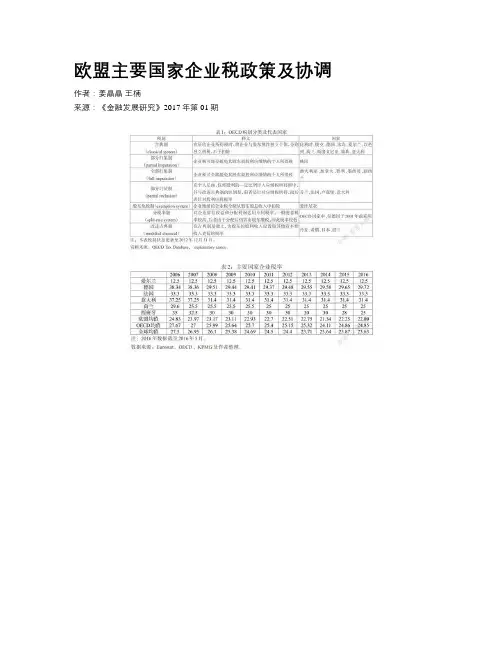
欧盟主要国家企业税政策及协调作者:姜晶晶王楠来源:《金融发展研究》2017年第01期摘要:当前欧盟主要成员国企业税在税制、税率、征税对象、应纳税额计算及扣免规则等方面差异较大。
差异化的企业税政策对跨国公司经营带来税负不公、双重征税、增加财务成本等后果,同时也增加政府税收的征管难度。
重启统一合并企业税税基(CCCTB)计划,是减少现行跨国企业跨境避税行为的关键举措。
未来欧盟企业税协调将沿着降税率、拓税基、企业税与个人所得税合并以及国际合作的方向开展。
关键词:企业税;CCCTB;税基中图分类号:F810.42 文献标识码:B 文章编号:1674-2265(2017)01-0042-07一、引言2016年欧盟裁定苹果公司向爱尔兰补缴130亿欧元税款,凸显欧盟企业所得税协调的必要性。
爱尔兰企业所得税仅为12.5%,远低于欧盟其他成员国,且对来自特定国家和地区的部分收入设置更优惠税率,加上独特的、可供企业转移利润的“双层爱尔兰”税制,使得跨國企业在爱尔兰开设分、子公司的实际税负远低于其他欧盟国家。
欧盟委员会认为,爱尔兰为苹果公司设置的优惠企业税率从2003年的1%降至2014年的0.005%,该税收优惠为苹果公司提供了巨大财务优势,构成非法国家援助。
但爱尔兰政府认为其税收政策并未违反欧盟规定,并就欧盟委员会的相关裁决向欧洲法院上诉。
这一案例引发各界对欧盟企业税协调的关注与讨论。
伴随欧洲经济一体化进程及统一市场的建立,欧盟已实现关税统一,消费税、增值税等间接税协调也取得显著进展。
但《马斯特里赫特》条约规定,欧盟成员国在不违背相关法令的前提下,可自行决定税收制度,企业税等直接税种由于更具国家主权特性而协调难度较大,进展有限。
当前主要成员国企业税在税制、税率、征税对象、应纳税额计算及扣免规则等方面差异较大。
差异化的企业税政策对跨国公司经营带来税负不公、双重征税、增加财务成本等后果,同时也增加政府税收征管难度。
在经济复苏乏力背景下,欧盟各国不仅面临严峻的财政整顿,还需应对数字经济发展导致的税源再分配需求。
ece英文法规
ece英文法规以下为您生成 20 个关于 ECE(Economic Commission for Europe,欧洲经济委员会)相关的英语内容:---## 法规1. The ECE regulations on vehicle emissions aim to reduce pollution.(欧洲经济委员会关于车辆排放的法规旨在减少污染。
)- 英语释义:Rules and laws established by the Economic Commission for Europe.- 短语:comply with ECE regulations(遵守欧洲经济委员会法规) - 单词:regulation(法规;规定)- 用法:regulate sth. according to ECE regulations(根据欧洲经济委员会法规规范某事)2. ECE standards for safety equipment in automobiles are strict. (欧洲经济委员会对汽车安全设备的标准很严格。
)- 英语释义:Criteria and norms set by the Economic Commission for Europe for a specific area.- 短语:meet ECE standards(达到欧洲经济委员会标准)- 单词:standard(标准;规格)- 用法:set ECE standards for sth.(为某事设定欧洲经济委员会标准)3. The new ECE directive on product labeling requires clear information. (欧洲经济委员会关于产品标签的新指令要求有清晰的信息。
)- 英语释义:An official instruction issued by the Economic Commission for Europe.- 短语:follow an ECE directive(遵循欧洲经济委员会指令)- 单词:directive(指令;命令)- 用法:issue an ECE directive(发布欧洲经济委员会指令)## 英语释义1. "ECE" stands for "Economic Commission for Europe". (“ECE”代表“欧洲经济委员会”。
外国税制第7章资料
2.2 The object of Tax
Income taxed on earnings
rental income pensions investment income
7 bands
Before the year of 2007
Tax Rate
Net Income Subject to Tax
2. 4 Taxable income
2.4.1. Remuneration • Remuneration paid by foreign and/or local employers is
taxable in France when the activity is performed in France even if the remuneration is paid outside France. Remuneration includes : salary, allowances, bonuses and benefits in kind (example : personal use of a company car, company-provided accommodation).
1.4 Main taxes in France
Corporation tax(9% to 12%) Individual income tax(16% to 21%) VAT(30% to 45%) Domestic tax of petrol goods and
sintaxes(5% to 10%) Local taxes(10% to 15%) Succession tax etc.(6% to 10%)
• Social security charges are deducted from remuneration when calculating net taxable income. Then, the amount declared in the tax return as professional income can benefit from other deductions, amounting to :
2011年英语二阅读text4
2011年英语二阅读text4一、文章题材结构分析本文选自The Economist ( 《经济学人》) 2010年7月8日一篇题为《Staring into the abyss》的文章。
本文是一篇说明文,说明欧盟统一的货币体系,它的现状,各国对其看法以及评价。
第一段段讲述欧盟今非昔比,问题严重。
第二段重点指出其面临的迫切问题,以及使用统一的货币带来的影响。
第三段指出问题的解决停滞不前的原因。
第四、五段分别介绍了德国和法国在欧盟统一货币方面方面的不同态度。
最后一段总结:现在为欧盟下定论. 还为时过早。
二、全文翻译Text 4Will the European Union make it(成功,固定词组)? The question would have sounded strange not long ago. Now even the project’s greatest cheerleaders talk of a continent(洲,大陆)facing a “Bermuda triangle” of debt, population decline and lower growth.欧盟会成功吗?若在不久之前有人提这样的问题,人们会感到奇怪。
但是现在即使是欧盟最有力的支持者们也都在谈论欧洲大陆所面临的“百慕大三角”一一债务、人口下降和低速增长。
As well as those chronic(长期的,慢性的)problems, the EU faces an acute(严重的,急性的;激烈的;敏锐的;尖声的)crisis in its economic core, the 16 countries that use the single currency. Markets have lost faith that the euro zone’s economies, weaker or stronger, will one day converge thanks to(汇聚到)the discipline of sharing a single currency, which denies uncompetitive members the quick fix of devaluation(货币贬值).译文:市场已经失去信心,不再相信欧元区的经济体,无论强弱,终有一天都会因遵循使用统一货币一,这可以阻止缺乏竞争力的成员国利用货币贬值快速解决经济问题一而走向融合。
欧盟会计国际化进程与启示
欧盟会计国际化进程与启示一、前言欧盟(European;Union,EU)是当今世界上区域合作最为紧密并逐步从经济一体化走向一体化的国家间联盟。
它的前身是1957年成立的欧洲经济共同体EEC,后改称欧共体EC,1993年11月才改组为欧盟。
欧共体EC自成立后一直致力于在地区范围内进行协调。
欧共体有关财务与会计指令的颁布与实施,一定程度上促进了欧盟内部各成员国之间经济贸易交流。
但是由于各国存在着差异,以及指令本身的不完善,随着世界经济的一体化和资本市场的全球化,欧盟不得不进一步采取有效措施,加强会计国际化协调。
采纳国际会计准则是欧盟市场一体化的一个重要里程碑。
根据欧盟制定的关于采纳国际会计准则的决议,要求所有的欧盟上市公司从2005年起必须按国际会计准则(Intemational;Accounting;Standards,IAS)以及未来的国际财务报告标准(International;Financial;Reporting;Standards,IFRS)编制合并会计报表。
欧盟之所以采用IAS和IFRS,主要原因是欧盟制定了金融服务行动计划(Aktionsplan;fuer;Finanzdienstleistungen,FSAP),即在2005年或者之后一段时间里建立欧盟统一的金融市场。
1999年制定的FSAP打算采取43条措施,以扫除欧洲金融市场一体化进程中一切障碍,尽快把欧盟各国造就成一个统一的经济实体,尤其是金融实体,以提高在国际上的竞争力。
毕业论文二。
欧盟会计协调的现状和存在的1.欧盟自70年代以来所做的协调努力。
欧盟自20世纪70年代起就一直致力于会计协调工作。
协调的主要形式是制定各种会计指令。
指令具有很强的约束力,要求各成员国将其写入本国相关的法律法规中,因此,取得了良好效果。
欧盟于1978年7月25日首次发布了关于公司年度财务报告规定格式的第四号指令(78/660/EWG)和在1983年6月13日发布了关于合并报告第七号指令(83/349/EWG),对欧盟会计协调产生了重大。