
五年级英语下册Unit1Myday第1课时课件人教PEP版
Expand
慵懒的西班牙作息时间
让我们先看看西班牙人的作息表。每天9~10点开始上班,中午2~3点吃 午饭,下午5点再开始工作,晚上8~10点吃晚饭,凌晨1点睡觉。
在上午十一点半左右,到咖啡馆吃个“课间餐”,而晚饭前则有种类繁多的 小吃作为下午茶的选择。大家都懂,饿的时候肚子咕咕叫,精神难以集中, 吃饱了又会犯困,刚开始工作的头半个小时效率其实很低,即使西班牙工作 人员的年平均工作小时数(1686)高于德国(1397)也于事无补,仍旧位于 经济合作与发展组织成员国的平均值(1765)以下。
Dialogue
Pedro: At 2:30. Classes start at 3 o’clock. Pedro: 在两点半。3点开始上课。 Zhang peng: When do you usually eat dinner in Spain ? Zhang peng: 你们在西班牙通常什么时候吃晚饭? Pedro: Usually at 9:30 or 10 o’clock. Pedro: 通常在九点半到10点。 Zhang peng: Wow! That’s too late. Zhang peng: 哇! 那也太晚了呀。
A. on
B. in
C. to
5. -- ______B_______.
--I get up at 5 o’clock.
A. What do you often do ?
B. When do you get up ?
C. How do you go to school everyday ?
Homework
Unit 1
My day
Introduce
A:When do you finish class in the morning ? B:We finish class at 1 o’clock. A:When do you usually eat dinner in Spain ? B:Usually at 9:30.
Practice the adverbs!
A. after B. in
Words
start [stɑ:t]
作动词,意为“开始”。 常用短语:start dinner 开始吃饭
start work 开始工作 eg: Let’s start a dinner . 让我们开 始吃饭吧。 小练习:----When do you often___B___ classes in the morning ?
---- At 8 o’clock. A. finish B. start
Words
usually [ˈju:ʒuəli]
频度副词,意为“通常地”,放在be动词后面。 eg:A woman usually carries a small mirror in her bag.
女人通常都在包里带着一面小镜子。 I usually go to bed at 9 o’clock. 我通常9点钟上床睡觉。 小练习:When ___B__ you usually ______dinner ? A. are; eating B. do; eat
Expressions
When do you usually eat dinner in Spain? 你们在西班牙通常什么时候吃晚饭?
常见频度副词按频率大小排列如下: always(100%)>usually(80%)>often(60%)>sometimes(40%) >seldom(20%)> never(0%) eg:We usually have a special family dinner on the Spring Festival.
小练习:--What do you do ? -- I buy some bananas _____B____ my grandpa.
A. with B. for
nish class in the morning ?
你们上午什么时候结束上课
一般现在时基本用法介绍:
eg: What time do you go to school? 你什么时候/几点上学?
(2)when回答既可以是具体的时间,也可以是范围大的时间。
eg: When do you go to the park?
你什么时候去公园?
I usually go to the park at 7 o’clock in the morning. 我通常早上7点钟去公园。
Words
after [ˈɑ:ftə(r)]
介词,意为“在(时间)后”。 常用短语:after the tree 在树的后面
after lunch 午餐之后 eg:I usually watch TV after dinner. 晚饭后我通常看电视。
Look ! Sam is after the tree. 看,Sam在树的后面。 小练习:We will go to swim ___A___ dinner.
2. --___C___ do you often do ?
--At 8 o’clock.
A. Where B. What
C. When
3. I usually go shopping ___A____ my mum.
A. with
B. for
C. to
Exercise
4. What do you do ___A___ the weekend ?
春节那天我们通常要吃一顿特殊的家庭晚餐。
Expressions
小练习:根据汉语意思补全句子: 在中国我们通常6点钟吃晚饭。 We _u_s_u_a_ll_y have __d_in_n_e_r_ at 6 o’clock.
Dialogue
Zhang peng: When do you finish class in the morning ? Zhang peng: 你们上午什么时候结束上课? Pedro: We finish class at 1 o’clock. Then we eat lunch at home. Pedro: 我们在上午1点钟结束。然后我们在家吃午饭。 Zhang peng: Wow! When do you go back to school after lunch ? Zhang peng: 哇!你们午餐之后什么时候回到学校?
Words
when [wen]
作疑问副词,引导特殊疑问句,意为“什么时候”。 小练习:--___B___ do you go to bed ?
-- At 9:30. A. Where B. When
Words
拓展:
what time VS. when :
(1)what time意为“几点”,问的是具体的时间,一般回答要具体到小时。
(1)一般现在时的功能:
①表示事物或人物的特征、状态。
The sky is blue.
天空是蓝色的。
②表示经常性或习惯性的动作。
I get up at six every day.
我每天六点起床。
③表示客观现实。
The earth goes around the sun. 地球绕着太阳转。
Expressions
(2) 一般现在时的构成 : ① be动词:主语+be(am, is, are)+其它。 I am a boy.我是一个男孩。 ②行为动词:主语+行为动词(+其它)。 We study English.我们学习英语。 注:当主语为第三人称单数(he, she, it)时,要在动词后加"-s"或"-es"。 Mary likes Chinese.玛丽喜欢汉语。
Words
for [fə(r)]
作介词,意为“表示接受某事物的人” 。 常用短语:for example举例
buy sth. for sb. 给某人买某物 eg:My mum will buy a car for me. 我妈妈将给我买一台小汽车。
Let’s go for a walk.
让我们去散步吧。
Summary
when
after
start
usually
for
When do you finish class in the morning ?
Exercise
1._____A___ you _______ to the park every day ? A. Do , go B. Are , going C. Did, go
人教PEP版五年下英语Unit1第1课《My-day》教案
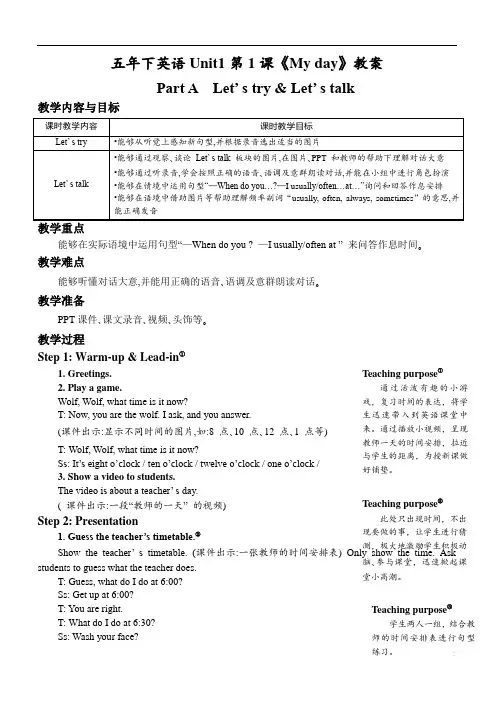
3五年下英语Unit1第1课《My day 》教案Part A Let’ s try & Let’ s talk教学内容与目标教学重点能够在实际语境中运用句型“—When do you ? —I usually/often at ” 来问答作息时间。教学难点能够听懂对话大意,并能用正确的语音、语调及意群朗读对话。教学准备PPT 课件、课文录音、视频、头饰等。教学过程Step 1: Warm-up & Lead-in ①1. Greetings.2. Play a game.Wolf, Wolf, what time is it now?T: Now, you are the wolf. I ask, and you answer.(课件出示:显示不同时间的图片,如:8 点、10 点、12 点、1 点等) T: Wolf, Wolf, what time is it now?Ss: It’s eight o’clock / ten o’clock / twelve o’clock / one o’clock / 3. Show a video to students.The video is about a teacher’ s day.( 课件出示:一段“教师的一天” 的视频)Step 2: Presentation1. Guess the teacher’s timetable.②Show the teacher’ s timetable. (课件出示:一张教师的时间安排表) Only show the time. Askstudents to guess what the teacher does.T: Guess, what do I do at 6:00?Ss: Get up at 6:00? T: You are right. T: What do I do at 6:30? Ss: Wash your face? Teaching purpose ①通过活泼有趣的小游戏,复习时间的表达,将学生迅速带入到英语课堂中来。
人教PEP版英语五年级下册Unit 1 My day Part A课件

Exercises
一、为下列短语选择正确的汉语翻译。 A.返回学校 B.在家 C.在西班牙 D.午饭后
( B ) 1. at home ( C ) 3. in Spain
( D ) 2. after lunch ( A ) 4. go back to school
Exercises
二、情景交际小能手。
Let's talk
知识点 3
usually
通常地;惯常地
用法:表示做事的频率,在句中放在实义动词的前面, 系动词和助动词之后,也可以放在句首。
选出错误的一项,并改正。
( B ) What do you do usually on the weekend?
A
B
C
__u_s_u_a_ll_y__d_o__
Let's talk
知识点 4
when 与 what time
when 和 what time都可以用来询问时间,意思是“什么时候”, 它们之间的区别如下:
当询问做某事的具体时间(几 --When / What time do you have dinner?
点钟)时,两者可以替换
--I have dinner at 6:00 p.m.
p.m.
Can you say
A: When do you _________________? B: At ___________.
ABCD EFGH
a.m.
Can you say
A: When do you _________________? B: At ___________.
p.m.
Let's talk When do you…?
人教版PEP小学英语五年级下册Unit 1 教案(一)
(1)教师请同学说说他的时间表,教师板书,并与Pedro的作比较。如:
S1 Pedro
6:30 a.m. get up 7:00 a.m. do morning exercises
7:00 a.m. eat breakfast 8:00 a.m. eat breakfast
2.能利用所学句型询问和表达周末做了什么事。如:—What do you do on the weekend?—I usually/often…on the weekend.
2.学习Let’s talk。
(1)播放Let’s talk录音。边播放边请同学们思考问题:When does Pedro finish class in the morning?When does Pedro go back to school after lunch?When does Pedro usually eat dinner in Spain?
T:When do you get up? S1:I get up at…
T:When do you eat breakfast? S2:I eat breakfast at…
2.Tell your partner about your tim Nhomakorabeatable.
通过师生间相互问候融洽课堂气氛,同时交谈内容也引出了新课。
Part B
教学导航
教学内容
第一课时Let’s learn Do a survey第二课时Let’s try Let’s talk
第三课时Read and write Let’s check
教学目标
【知识目标】1.能听、说、读、写clean my room, go for a walk等单词短语,并能熟练的掌握运用。
五年级下册英语课件-Unit 1 My dayLesson 4 我的周末(2) 人教(PEP)PPT课件

五年级下册英语课件-Unit 1 My dayLesson 4 我的周末(2) 人教(PEP)PPT课件
五年级下册英语课件-Unit 1 My dayLesson 4 我的周末(2) 人教(PEP)PPT课件
五年级下册英语课件-Unit 1 My dayLesson 4 我的周末(2) 人教(PEP)PPT课件
五年级下册英语课件-Unit 1 My dayLesson 4 我的周末(2) 人教(PEP)PPT课件
知识讲解
fun做名词时,意为“乐趣;有趣的事”。 Have fun!玩得开心! 它还可以做形容词,意为“有趣的”。 Swimming in the sea is fun. 在海里游泳很有趣。
五年级下册英语课件-Unit 1 My dayLesson 4 我的周末(2) 人教(PEP)PPT课件
五年级下册英语课件-Unit 1 My dayLesson 4 我的周末(2) 人教(PEP)PPT课件
知识讲解
1. Why are you shopping today? 为什么今天你来买东西? My mum worked last night. So I’m shopping today. 我妈妈昨晚工作了。所以今天我来买东西。 last意为“上一个的;刚过去的”,如last week, last night, last year,时态要用过去时。 练习: I ___________(do)my homework last night.
Warm up
五年级下册英语课件-Unit 1 My dayLesson 4 我的周末(2) 人教(PEP)PPT课件
新人教PEP版五年级英语下册Unit 1 My day 单元教学解读
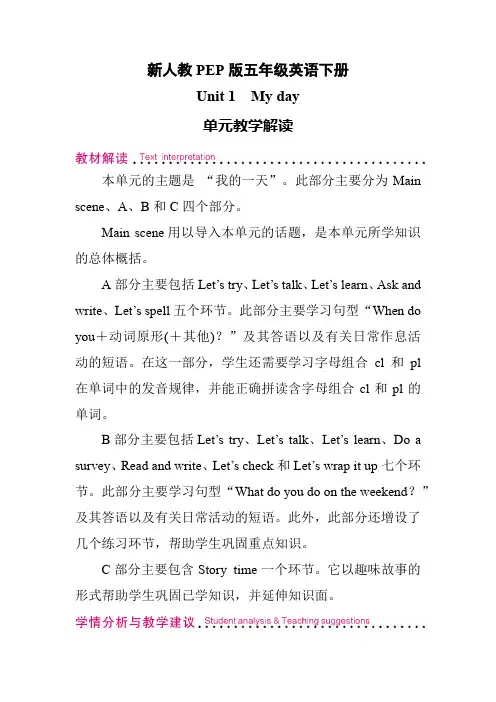
新人教PEP版五年级英语下册Unit 1My day单元教学解读本单元的主题是“我的一天”。
此部分主要分为Main scene、A、B和C四个部分。
Main scene用以导入本单元的话题,是本单元所学知识的总体概括。
A部分主要包括Let’s try、Let’s talk、Let’s learn、Ask and write、Let’s spell五个环节。
此部分主要学习句型“When do you+动词原形(+其他)?”及其答语以及有关日常作息活动的短语。
在这一部分,学生还需要学习字母组合cl和pl 在单词中的发音规律,并能正确拼读含字母组合cl和pl的单词。
B部分主要包括Let’s try、Let’s talk、Let’s learn、Do a survey、Read and write、Let’s check和Let’s wrap it up七个环节。
此部分主要学习句型“What do you do on the weekend?”及其答语以及有关日常活动的短语。
此外,此部分还增设了几个练习环节,帮助学生巩固重点知识。
C部分主要包含Story time一个环节。
它以趣味故事的形式帮助学生巩固已学知识,并延伸知识面。
本单元是本学期英语学习的第一单元,因此激发学生的学习热情至关重要。
教师在开展教学时,要注意结合多种趣味的教学方式,引导学生积极地参与到课堂上来。
本单元重点学习谈论某人一天的日程安排及周末的活动安排。
这一话题与学生的日常生活息息相关,学生的学习热情会相对较高。
而“周末的活动安排”这一话题在五年级上册第二单元的B部分已有所接触,教师在开展教学时,要注意以旧引新,循序渐进地引入本单元的教学内容,降低学生的学习难度。
1.能够听、说、读、写本单元的有关日常作息以及日常活动的短语;2.能够听、说、认读本单元的三会词汇;3.能够听、说、读、写句子:When do you finish class in the morning?We finish class at 1 o’clock.So what do you do on the weekend?I often watch TV and play ping-pong with my father.I usually wash my clothes.Sometimes I cook dinner.4.能够运用句型“When do you+动词原形(+其他)?”询问某人做某事的时间并作答;5.能够运用句型“What do you do on the weekend?”询问某人周末的活动安排并作答;6.能够掌握字母组合cl和pl在单词中的发音规律,并能正确拼读含字母组合cl 和pl 的单词;7.能够正确使用频度副词always 、usually 、often 、sometimes ;8.能够完成本单元教材上的相关练习。
人教版五年级英语下册教学课件 Unit 1 第六课时Read and write

class
running
kung fu
dinner
morning exercises
Second step: Choose and write the words.
go go swimming、go running、go shopping play play sports、play ping-pong、play the pipa have have...class、have dinner do do homework、do kung fu、do morning exercises
First step: Read and circle.
Second step: Read and underline(What does Robinson do?)
Third step : Intensive reading Read the letter, first finish the page 9 “Tick or cross”. Then write a letter to Robinson. Tick or cross Robinson and Friday always get up late in the morning.( ) Robinson only cleans his cave on Fridays.( ) Robinson and Friday play sports together in the afternoon.( )
【拓展】“do well in ”也可以用来表示“在(某方面)出色;擅长……”。 eg:Lily does well in dancing. 莉莉擅长舞蹈。
Listen and tick.
Tips: ①听音前,先仔细观察所给的四幅图片,知道每幅图片所描述的动 作。②听音时,注意听清迈克周末的活动,然后在对应的图片下打钩。
Unit 1 My day (复习课件) 五年级英语下册(人教PEP版)
9. 你需要一个机器人帮助你! _Y_o_u__n_ee_d__a__ro_b_o_t_t_o__h_el_p_y_o_u_! ____________________
A. always B. sometimes C. usually
C( )3. -________is your birthday party?
-It was great fun.
A. When
B. What
C. How
单项选择
C( )4. I often go _______ with my mother.
-我经常看电视, 和我爸爸打乒乓球。 _-_I_o_f_t_e_n_w_a_t_c_h_T__V_a_n_d__p_la_y_p_i_n_g-_p_o_n_g_w__it_h_m__y_f_a_t_h_er. 5.那听起来很有趣。_T_h_a_t _s_o_u_nd_s__li_k_e _a__lo_t_o_f__f_un_._____
具体日期和星期前面用介词on。
【eg】: 1.I do morning exercises at 7 o’clock. 2.I usually do my homework on Sundays.
牛刀小试
( B )1.-_______ do you have English class?
-At 9 o’clock.
A.Tuesday B.busy
( C )4.please
A.eggplant B.play
C.please C.clever
C.pupil C.party
人教PEP版英语五年级下册Unit1《MyDay》全单元课时说课稿
人教PEP版英语五年级下册Unit 1《My Day》全单元课时说课稿一. 教材分析人教PEP版英语五年级下册Unit 1《My Day》主要围绕日常生活展开,让学生学会描述自己的一天以及日常活动。
通过本单元的学习,学生能够听懂、会说、会读关于日常活动的词汇,如:go to school, have lunch, do homework等。
同时,学生还能够运用一般现在时描述自己的日常生活,提高他们的语言运用能力。
二. 学情分析五年级的学生已经具备了一定的英语基础,能听懂简单的英语指令,并能用英语进行简单的交流。
但是,学生在语言、词汇积累方面还存在一定的困难。
因此,在教学过程中,教师需要关注学生的个体差异,因材施教,引导他们积极参与课堂活动,提高他们的英语水平。
三. 说教学目标1.知识目标:学生能听懂、会说、会读关于日常活动的词汇,如:goto school, have lunch, do homework等。
2.能力目标:学生能够运用一般现在时描述自己的日常生活,提高他们的语言运用能力。
3.情感目标:通过本单元的学习,学生能够养成良好的学习习惯,合理安排自己的时间,提高生活质量。
四. 说教学重难点1.重点:学生能听懂、会说、会读关于日常活动的词汇,并能够运用一般现在时描述自己的日常生活。
2.难点:学生能够灵活运用一般现在时描述自己的日常生活,并在实际情景中进行交流。
五. 说教学方法与手段本节课采用任务型教学法,通过情境设定、小组合作、角色扮演等方式,激发学生的学习兴趣,提高他们的参与度。
同时,利用多媒体教学手段,如:图片、视频等,帮助学生更好地理解和掌握知识。
六. 说教学过程1.导入:教师通过提问方式引导学生谈论自己的日常生活,为新课学习做好铺垫。
2.呈现:教师展示教材图片,引导学生说出日常活动词汇,如:go toschool, have lunch, do homework等。
3.学习:教师带领学生学习一般现在时的表达方式,如:I go to schoolevery day.4.实践:学生分组进行角色扮演,运用一般现在时描述自己的日常生活。
新人教版PEP小学英语五年级下册《Unit1 My Day》B try talk课件
学 版 科:英语 本:人教版五年级下册
What do clean you do on the weekend? I usually my room on Saturdays.
Let's try
Where is Sarah?
Fill in the blanks !
Why are you shopping _______ today ? My mum worked last night . So I'm shopping today .
do you do on the weekend ? Good girl ! So what _________
TV play ping-pong with my father. I often watch ______ and ___________
That sounds like a lot of fun. cook dinner Sometimes I _________ .
my clothes Yes, but I'm also hard-working .I usually wash ___________ . you 're so busy! You need a robot to help you!
A: What do you do on the weekend ? B: I usually ___________ . Sometimes I ____________ . What about you ? A: I often _________ on the weekend.
ห้องสมุดไป่ตู้
2021春PEP版五年级英语下册 Unit 1 课时练4 授课+习题课件
Unit1My dayPEP五年级下册Let’s try &Let’s talkLet’s tryShopkeeper:Why are you shopping today? Sarah: My mum worked last night. So I’m shopping today.Shopkeeper:Good girl! So what do you do on the weekend?Sarah: I often watch TV and play pingpong with my father.Shopkeeper:That sounds like a lot of fun.Sarah: Yes, but I’m also hardworking. I usually wash my clothes. Sometimes I cook dinner. Shopkeeper:You’re so busy! You need a robot to help you!Question What does Sarah do on the weekend?知识点1why /waɪ/ adv.为什么考向发音:字母组合wh的发音为/w/。
ꢀ同音字母:yꢀ形近词:shy害羞的ꢀwho谁用法:用来引导特殊疑问句,询问做某事的原因,答句经常用because开头的句子。
Why do you have ice cream today?你今天为什么吃冰淇淋?Because it's too hot.因为天太热。
知识点2work /wɜːk/v.工作She’s working in a small house.她在一所小房子里工作。
考向发音:字母组合or发/ɜː/。
ꢀ形近词:word词ꢀfork叉子housework 家务劳动homework 家庭作业知识点3last /lɑːst/adj. 上一个的;刚过去的Mike and Peter played basketball last Sunday.上个星期天迈克和彼得打篮球了。