
最新人教版六年级英语下册第3单元Unit 3part A let's learn课件ppt
Where did you go?
学习目标
1.能够听、说、读4个词组。 2.学会句型How was your summer holiday?
并会根据所学单词进行回答。
第一次“先学后教”比正确翻译词组意思
自学指导 要求:
默看27页,结合单词表,2 分钟后比谁能正确翻译出词组 意思
ate fresh food 吃新鲜的食物
went swimming took pictures bought gifts
去游泳 照相 买礼物
第二次“先学后教”:比谁能最准确 读出词组
自学指导
要求:
请小组讨论,单词正确பைடு நூலகம் 音,4分钟后比谁能最准确读出 词组。
ate fresh food went swimming took pictures bought gifts
第三次“先学后教” 比谁能正确翻译句 型意思,并能进行情景对话
要求:
1.默看句型,结合所学单词,谁能 正确翻译出句型意思。(2分钟)
2.小组讨论,根据所学句型进行情 景对话(5分钟)
How was your summer holiday,yifan?
你暑假过得怎么样,一凡?
It was good.
很不错。
I went swimming every weenkend and took lots of pictures.
我每个周末都去游泳,还拍了很多照片。
课堂小结:
询问别人暑假过的怎么样用:How was句型,回答用过去式的语句。
当堂训练:
人教版PEp英语六年级下册Unit 3 Part A Let's learn.英文说课稿
Unit 3 Where did you go ?Hello, everyone. Today I’m very pleased to have an opportunity to talk about some of my teaching ideas. My topic is Part A Let’s learn from Unit 3 Where did you go ,Grade 6. It is made up of four parts.Part 1 My understanding of this lessonThe analysis of the teaching material:This lesson talks about verbs. It plays a very important part in the English teaching of this unit. By studying this, Ss can learn more new verbs. At the same time, we should get the students to understand some difficult sentences better. The Ss should do some listening, speaking and writing, too. Of course, the Ss should receive some moral education. Let the Ss understand the verbs better,.Teaching aims:1. Knowledge aim: Understand the words and expressions.2. Ability aim: Make new conversations.3. Emotional aim: Make the Ss care about themselves, and study hard to make better life.Key points / Teaching important points:How to use the verbs to make new conversations..Teaching difficult points:1. Use your own words to make new conversations..2. Discuss where they went and what they did.Something about the Ss:1.The Ss have known something about what sb did in the past.2. They don’t often use English to express themselves and communicate with others.3. Some Ss are not active in the class because they are afraid of making mistakes.Part 2 My teaching theories, methods and aidsBefore dealing with this lesson, I’ll do my best to carry out the following theories: Make the Ss the real masters in class while the teacher himself acts as director; Combine the language structures with the language functions; Let the students receive some moral education while they are learning the English language.Teaching method:Double activities teaching methodQuestion-and-answer activity teaching methodWatch-and-listen activityFree discussion methodTeaching aids:1.some cards2.some objects3. a tape recorder4. the blackboardPart 3. Teaching steps / proceduresI have designed the following steps to train their ability of listening, speaking, reading and writing.The entire steps are:Greetings, Revision, Lead-in and reading, Preparation for details of the lesson, Consolidation, Discussion, Homework.Step 1 GreetingsGreet the whole class as usual.Step 2. Revision1. T: Act,let the Ss guess.2.Ask students some questions to revise the last lesson(show them on the screen).a. What did you do last Saturday?b. What did he do last Sunday?c. What did he do yesterday?d.What did you do last Monday?Step 3. Lead-in and preparationShow them some pictures and let them talk each other, and then use the pictures about places and the things we or they did in the past . Purpose: Arouse the students’interest of study.Bring in new subject: Where we or they went and what we or they did there.Method: Talk about the pictures , read the words and expressions and act.Purpose: Help the Ss remember the words and expressions best.Step 5. Play a game.Look, act and guess.Purpose: Make the Ss learn the expressions best and feel interesting. Step 6. ConsolidationRead the words and expressions , finish the conversation. Purpose: Let the Ss can communicate better.Step 7. DiscussionShow them some words and expressions, let the Ss talk freely. Purpose: Give the Ss much ,they can give us more.Step 8. Listening and exercise.Purpose:Improve the Ss listening and writing ability .Step 9. SummaryLet the Ss make a summary.Purpose:Let the Ss remember the lesson better.Step 10. HomeworkRead the words and expressions and make new conversations.Part 4. Blackboard designUnit 3 Where did you go?A: Where did you go_____? go went camping / fishing B: I went to ____________. ride rode a horseA:What did you do there? rode a bikeB: I ___________________. hurt hurt my footThat’s all , Thank you for listening!。
人教pep英语六年级下册Unit3教案(全)3教案与反思
主备人:总第13课时满招损,谦受益。
《尚书》
原创不容易,【关注】,不迷路!
主备人:总第14课时
主备人:总第15课时
主备人:总第16课时
主备人:总第17课时
主备人:总第18课时
【素材积累】
岳飞应募参军,因战功累累不断升职,宋高宗亲手写了“精忠岳飞”四个字,制成旗后赐给他。
又召他到寝阁,对他说:“中兴的大事,全部委托给你了。
”金人攻打拱州、亳州,刘锜向朝廷告急,宋高宗命令岳飞火速增援,并在赐给岳飞的亲笔信中说:“设施之事,一以委卿,朕不遥度。
”岳飞于是调兵遣将,分路出战,自己率领轻装骑兵驻扎在郾城,兵锋锐气十足。
但是,后来高宗和秦桧决定与金议和,向金称臣纳贡。
就在岳飞积极准备渡过黄河收复失地的时候,高宗和秦桧却连发12道金字牌班师诏,命令岳飞退兵。
后岳飞被以“莫须有”的罪名毒死于临安风波亭,时年仅39岁。
PEP六年级英语下册Unit-3-PartA-Let’s-try课件精选全文
Mt.Tianshan
Turpan
Listen and answer
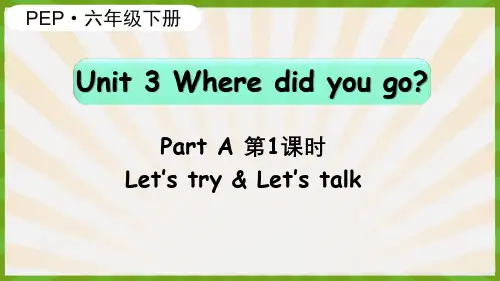
➢ Where did John go over his holiday? He went to Mt. Tianshan and Turpan in Xinjiang.
➢ What did he do there? He rode a horse and saw lots of grapes.
photos from the Labour Day holiday.
Listen, read and imitate
Amy: Where did you go? John: Mt. Tianshan, Xinjiang. I rode a horse.
Look, it’s very small! Amy: Oh, yes. It looks like a mule! Did you go
sorry I can’t come. Amy: OK. Bye.
What happened? I hurt my foot.
What happened? I had a cold.
John hurt his foot. He didn’t go to school. Did Amy go to John’s home? What happend to John?
1. Where is John now?
He is at the hospital.
2. Where is Amy now?
She is at school.
3. Why did Amy give a phone call to John?
Because John didn’t come to school.
新版pep六年级下册Unit3_partA__Let's_learn
• 1.听录音,跟读对话。 • 2.用本课所学句型,向同学介 绍你的假日生活。
Where did you go last weekend? I went to the park last weekend. What did you do there?
I rode a bike there.
Pair-work
• A: Where did you go last Saturday? • B: I went to ______. • A: What did you do there? • B: I ______.
hurt my foot hurt my foot
hurt my head
hurt my hand hurt my arm
Can you read?
hurt my foot rode a bike
hurt
rode
went fishing
went camping
went
rode a horse
went camping
slept
read a book
stayed
drank
watched
was
பைடு நூலகம்talked
微 博
This is my microblog. You can see my daily life from it.()
Where did you go last Saturday?
/went/
:I went to a forest park.
went swimming went hiking
Activity:单词大变身
go to school go for a picnic go home go shopping go hiking go swimming
人教版PEP六年级下册英语Unit 3 Part A Let's learn.英文说课稿

Unit 3 Where did you go ?Hello, everyone. Today I’m very pleased to have an opportunity to talk about some of my teaching ideas. My topic is Part A Let’s learn from Unit 3 Where did you go ,Grade 6. It is made up of four parts.Part 1 My understanding of this lessonThe analysis of the teaching material:This lesson talks about verbs. It plays a very important part in the English teaching of this unit. By studying this, Ss can learn more new verbs. At the same time, we should get the students to understand some difficult sentences better. The Ss should do some listening, speaking and writing, too. Of course, the Ss should receive some moral education. Let the Ss understand the verbs better,. Teaching aims:1. Knowledge aim: Understand the words and expressions.2. Ability aim: Make new conversations.3. Emotional aim: Make the Ss care about themselves, and study hard to make better life.Key points / Teaching important points:How to use the verbs to make new conversations..Teaching difficult points:1. Use your own words to make new conversations..2. Discuss where they went and what they did.Something about the Ss:1.The Ss have known something about what sb did in the past.2. They don’t often use English to express themselves and communicate with others.3. Some Ss are not active in the class because they are afraid of making mistakes.Part 2 My teaching theories, methods and aidsBefore dealing with this lesson, I’ll do my best to carry out the following theories: Make the Ss the real masters in class while the teacher himself acts as director; Combine the language structures with the language functions; Let the students receive some moral education while they are learning the English language.Teaching method:Double activities teaching methodQuestion-and-answer activity teaching methodWatch-and-listen activityFree discussion methodTeaching aids:1.some cards2.some objects3. a tape recorder4. the blackboardPart 3. Teaching steps / proceduresI have designed the following steps to train their ability of listening, speaking, reading and writing.The entire steps are:Greetings, Revision, Lead-in and reading, Preparation for details of the lesson, Consolidation, Discussion, Homework.Step 1 GreetingsGreet the whole class as usual.Step 2. Revision1. T: Act,let the Ss guess.2.Ask students some questions to revise the last lesson(show them on the screen).a. What did you do last Saturday?b. What did he do last Sunday?c. What did he do yesterday?d.What did you do last Monday?Step 3. Lead-in and preparationShow them some pictures and let them talk each other, and then use the pictures about places and the things we or they did in the past . Purpose: Arouse the students’ interest of study.Bring in new subject: Where we or they went and what we or they did there.Method: Talk about the pictures , read the words and expressions and act.Purpose: Help the Ss remember the words and expressions best. Step 5. Play a game.Look, act and guess.Purpose: Make the Ss learn the expressions best and feel interesting. Step 6. ConsolidationRead the words and expressions , finish the conversation. Purpose: Let the Ss can communicate better.Step 7. DiscussionShow them some words and expressions, let the Ss talk freely. Purpose: Give the Ss much ,they can give us more.Step 8. Listening and exercise.Purpose:Improve the Ss listening and writing ability .Step 9. SummaryLet the Ss make a summary.Purpose:Let the Ss remember the lesson better.Step 10. HomeworkRead the words and expressions and make new conversations.Part 4. Blackboard designUnit 3 Where did you go?A: Where did you go_____? go went camping / fishing B: I went to ____________. ride rode a horseA:What did you do there? rode a bikeB: I ___________________. hurt hurt my footThat’s all , Thank you for listening!。
最新人教版六年级英语下册第3单元Unit 3 part A let's learn 课件ppt
第三次“先学后教” 比谁能正确翻译句 型意思,并能进行情景对话
要求:
1.默看句型,结合所学单词,谁能 正确翻译出句型意思。(2分钟)
2.小组讨论,根据所学句型进行情 景对话(5分钟)
课堂小结:
1.询问对方过去去过哪里的句型:Where did +主语(+表示过去的时间状语)? 2.询问某人过去是否做过某事句型:Did +动词原形(+其他)?
当堂训练
went camping
went fishing
rode a horse rode a bikehurt my Nhomakorabeafoot
第二次“先学后教”:比谁能最准确 读出词组
自学指导
要求:
请小组讨论,单词正确读 音,4分钟后比谁能最准确读出 词组。
rode a horse rode a bike went camping hurt my foot went fishing
Unit Three
Where did you go?
学习目标
1.能够听、说、读5个词组。 2.学会句型Where did you go?
并会根据所学单词进行回答。
第一次“先学后教”比正确翻译词组意思
自学指导 要求:
默看25页,结合单词表,2 分钟后比谁能正确翻译出词组 意思
Last Saturday, I
人教pep版六年级下册英语Unit 3 Part A Let's learn.说课稿
Unit 3 Where did you go ?Hello, everyone. Today I’m very pleased to have an opportunity to talk about some of my teaching ideas. My topic is Part A Let’s learn from Unit 3 Where did you go ,Grade 6. It is made up of four parts.Part 1 My understanding of this lessonThe analysis of the teaching material:This lesson talks about verbs. It plays a very important part in the English teaching of this unit. By studying this, Ss can learn more new verbs. At the same time, we should get the students to understand some difficult sentences better. The Ss should do some listening, speaking and writing, too. Of course, the Ss should receive some moral education. Let the Ss understand the verbs better,. Teaching aims:1. Knowledge aim: Understand the words and expressions.2. Ability aim: Make new conversations.3. Emotional aim: Make the Ss care about themselves, and study hard to make better life.Key points / Teaching important points:How to use the verbs to make new conversations..Teaching difficult points:1. Use your own words to make new conversations..2. Discuss where they went and what they did.Something about the Ss:1.The Ss have known something about what sb did in the past.2. They don’t often use English to express themselves and communicate with others.3. Some Ss are not active in the class because they are afraid of making mistakes.Part 2 My teaching theories, methods and aidsBefore dealing with this lesson, I’ll do my best to carry out the following theories: Make the Ss the real masters in class while the teacher himself acts as director;Combine the language structures with the language functions; Let the students receive some moral education while they are learning the English language.Teaching method:Double activities teaching methodQuestion-and-answer activity teaching methodWatch-and-listen activityFree discussion methodTeaching aids:1.some cards2.some objects3. a tape recorder4. the blackboardPart 3. Teaching steps / proceduresI have designed the following steps to train their ability of listening, speaking, reading and writing.The entire steps are:Greetings, Revision, Lead-in and reading, Preparation for details of the lesson, Consolidation, Discussion, Homework.Step 1 GreetingsGreet the whole class as usual.Step 2. Revision1. T: Act,let the Ss guess.2.Ask students some questions to revise the last lesson(show them on the screen).a. What did you do last Saturday?b. What did he do last Sunday?c. What did he do yesterday?d.What did you do last Monday?Step 3. Lead-in and preparationShow them some pictures and let them talk each other, and then use the pictures about places and the things we or they did in the past . Purpose: Arouse the students’interest of study.Bring in new subject: Where we or they went and what we or they did there.Method: Talk about the pictures , read the words and expressions and act.Purpose: Help the Ss remember the words and expressions best. Step 5. Play a game.Look, act and guess.Purpose: Make the Ss learn the expressions best and feel interesting. Step 6. ConsolidationRead the words and expressions , finish the conversation. Purpose: Let the Ss can communicate better.Step 7. DiscussionShow them some words and expressions, let the Ss talk freely. Purpose: Give the Ss much ,they can give us more.Step 8. Listening and exercise.Purpose:Improve the Ss listening and writing ability .Step 9. SummaryLet the Ss make a summary.Purpose:Let the Ss remember the lesson better.Step 10. HomeworkRead the words and expressions and make new conversations.Part 4. Blackboard designUnit 3 Where did you go?A: Where did you go_____? go went camping / fishing B: I went to ____________. ride rode a horseA:What did you do there? rode a bikeB: I ___________________. hurt hurt my footThat’s all , Thank you for listening!。
新版pep六年级下册Unit3-partA--Let's-learn
: What happened then?
hurt-----hurt
Oh, I hurt my foot.
hurt my foot hurt my foot
hurt my head hurthumryt hmayndarm
went fishing
went camping
Catch the plane 找飞机,看谁快
Unit 3 Where did you go?
A Let's learn
read a book
slept stayed drank
was talked watche d
Pair work
A: What did you do the day before yesterday/yesterday/last weekend/?
知识回顾 Knowledge Review
祝您成功!
B: I ...
washed the clothes had a cold
cleaned the room
slept
watched TV
drank tea
read a film magazine
微博
This is my microblog. You can see my daily life from it.()
A:Where did you go on your holiday?
B: I went to Xinjiang.
A: What did you do there? B:I _r_o_d_e_a__h_or_s_e.
A:Where did you go on your holiday?
B: I went to Hangzhou.
人教版六年级英语下册 Unit3 Part A Let’s learn
Listen and repeat
Today was a sunny day. I went to a forest park. I rode a bike with my friends.
I rode too fast and fell off my bike. I hurt my foot.
John has some friends. Who are they?
B: I rode a bike with my father/ my mother …
John wore a helmet. But what happened?
He fell off the bike. He hurt his foot过去式
hurt
hurt my foot
went camping go的过去式
went swimming
went running
went fishing
went shopping
What did John do in Xinjiang?
He went camping.
Went, went, I went camping.
What else did John do in Xinjiang? went fishing
Carl
Meimei
Mr Guo
Listen, answer and write What did they do yesterday?
He ___________________ and _________________. Carl
She ____________________ ____________________.
What did John do in Xinjiang?
六年级下册英语课件-Unit3 PartA Let's learn 3_人教PEP
went fishing went shopping
went swimming went hiking
: Did you do anything else?
Yes,I rode a bike and then I rode a horse.
rode a bike ride a bike
rode a horse ride a horse
: What happened then?
hurt-----hurt
Oh, I hurt my foot.
hurt my foot hurt my foot
hurt my head hurthumryt hmayndarm
went fishing
went camping
Catch the plane 找飞机,看谁快
rode a bike
rode a horse
did
slept
hurt my foot
drank fixed
saw
A:Where did you go last
weekend?
B: I stayed at home.
A: What did you do there? B:I w__at_c_h_e_d_T__V_.
A:Where did you go on your holiday?
B: I went to Xinjiang.
A: What did you do there? B:I _r_o_d_e_a__h_or_s_e.
A:Where did you go on your holiday?
B: I went to Hangzhou.
B: I ...