
六年级下册英语课件-四个时态综合复习 全国通用
She has (have) lots of comic books.
3. Theyare going to ma(kemake)a snowman next winter holiday.
4. He is going to take (take) a trip tomorrow.
mountain tomorrow. 5.Did John____p__la_y__(play) football
yesterday? No,__h_e_d_i_d_n_’t____.
A.are
B.did
C.do
2、I played football ___B_.
A.tomorrow st weekend
C.every day
3、Did Lucy ___B_ the food yesterday?
A.cooking
B.cook
C.cooked
4.I stayed __C_ home with my grandma.
2、以不发音的e结尾去e+ing take—taking make—making write—writing ride--riding 3、以一个元音加一个辅音结尾双写+ing run—running swim—swimming
see- seeing draw-drawing listen-listening
1.My brother__is_r_e_ad_i_ng (read) a book now.
2.Listen! The girl __is_s_in_g_i_ng___(sing). 3. I am drawing(draw)pictures
in the park now. 4. We_ar_e_r_eading _(read) a book now. .
5. We are going to see (see) a film next Sunday.
一般现在时: 时间:often/ususlly/sometimes
always/never/on Sundays… 结构: 1.I/You/We/They/复数+动原 2.He /She / It /人名/ Everyone +动词三单遇到 do / does don’t / doesn’t 要用动词原形
一般过去时 结构 V+ ed
时间 last morning
last night yesterday the day before yesterday …ago before
构成规则
动
一般在动词原形末
词
尾加-ed
变 词尾是e的动词加
化
-d
末尾只有一个辅
规
音字母的重度闭音 节,先双写这个辅
则
音字母,再加-ed 结尾是“辅音字
一般将来时
结构: be going to + V原 will + V原
时间状语: this weekend next… tomorrow in the future one day (一天)
1. She is going to visit (visit) her grandparents next week.
一
母+y”的动词,变 “y”为“i”, 再加-ed
原形
look play
live hope
stop plan
study worry
过去式
looked played
lived hoped
stopped planned
studied worried
检测练兵
1、What ___Byou do last weekend?
A.with
B.by
8. Did you do __B_ else?
C.on
9. A.something B.anything C.nothing
现在进行时 结构 be + Ving 时间 now
at 3:00.
Look!
Listen!
动词现在分词构成规则 1、一般情况直接+ing play—playing work--working
1.We often__w_a_t_c_h_(waБайду номын сангаасch) TV on Sundays.
2.My sister usually__d_o_e_s_(do) homework on Saturday afternoon.
3.Look, the girl___is__d_a_n_c_in_g_(dance) 4.We_a_r_e__g_o_in_g__t_o_c_l_im__b_(climb)a
动词三单形式变化规则 1、一般情况直接+s play—plays work--works 2、以ch, sh, s, x 或o结尾+es wash—washes watch—watches go—goes do—does fix --fixes
3、以辅音字母加y结尾变y为i+es study—studies fly—flies
A.in
B.for
C.at
5.I __C_ some children’s shows on TV last night.
A.watch B.watches
6.How __B_ your weekend?
C.watched
A. were B.was
C.is
7.John went to the park __B__ bus yesterday.
play—plays stay—stays have- has
1.We often_w__a_tc_h__(watch) TV on Sundays. 2.My sister usually_d_o_e_s__ (do) homework on Saturday 3.They often_s_t_u_d_y__(study) English on the weekends. 4.Mike always_s_t_u_d_ie_s(study) English on the weekends.
六年级下册英语-小升初总复习-时态全解-人教版PEP(共29张PPT)

将来时理论
一、 概念:表示将要发生的动作或存在的状态及打算、 计划或准备做某事。 句中一般有以下时间状语: tomorrow, next day(week, month, year…),
soon, the day after tomorrow(后天) this morning , this afternoon , this evening等。
试题演练:
三、 选择正确的答案。 B presents for my parents yesterday. 1. I ____ A. buyed B. bought C. buying C 2. Susan _____ swimming yesterday. A. go B. goes C. went B 3. Danny _____ breakfast five times last week. A. eat B. ate C. eated C Tree Planting Day. 4. Last Sunday____ A. is B. were C. was
试题演练:
一、写出下列动词的过去式或动词原形。 went was 1. go_______ 2. is___________ Lorem ipsum dolor bought 3.buy_______ 5. have had ____
sit amet, consectetur adipisicing elit, sed do eiusmod tempor incididunt ut labore
swam 4.swim__________
6. watched watch _____
eat 7. ate______
get 8. got__________
六年级下册英语素材-小升初英语四大时态复习 全国通用
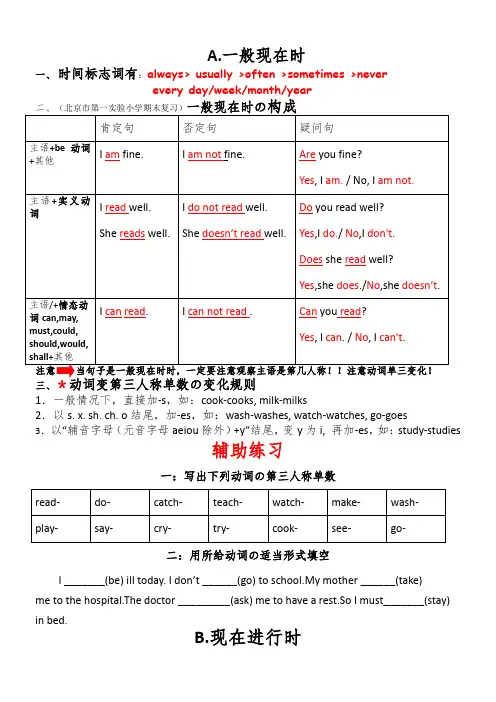
A.一般现在时一、 时间标志词有:always> usually >often >sometimes >neverevery day/week/month/year三、1.一般情况下,直接加-s ,如:cook-cooks, milk-milks2.以s. x. sh. ch. o 结尾,加-es ,如:wash-washes, watch-watches, go-goes3.以“辅音字母(元音字母aeiou 除外)+y”结尾,变y 为i, 再加-es ,如:study-studies辅助练习一:写出下列动词の第三人称单数二:用所给动词の适当形式填空I _______(be) ill today. I don ’t ______(go) to school.My mother ______(take)me to the hospital.The doctor _________(ask) me to have a rest.So I must_______(stay) in bed.B.现在进行时一、时间标志词有:now, Listen! Look!现在进行时构成主语+三、*动词加ing の变化规则1.一般情况下,直接加ing ,如:cook-cooking2.以一个不发音のe 结尾,去e 加ing ,如:make-making,take-taking3.末尾是“辅元辅”结构の重读闭音节,先双写末尾の辅音字母,再加ing ,如:run-running, stop-stopping ,swim-swimming, get-getting,begin-beginning 辅助练习二、用所给词の正确形式填空It's 5 o'clock now. Look at the boys!They are___________ ( play) football on the playground now. But Tom and Jerry _____________(clean) the room.Listen !Some girls _______________ ( sing)in the classroom .Some teachers are __________(read) books. Guess,what is Mr Gao _________(do) ?C.一般将来时一、时间标志词有:tomorrow,tomorrow morning(evening,afternoon),next day(week, month, year,Monday),in+一段时间,this morning (afternoon , evening,)等。
六年级下英语课件小升初专题总复习第五部分时态现在进行时全国通用(共11张PPT(完整版)2

are playing
用括号内所给单词的适当形a式re填ea空ti。ng 1.The children ________________________(play) football in the playground now.
2.It's 5 o'clock.The Smith _____________________ (eat) dinner.
点拨:第1题由now可知,本句为现在进行时。现在进行 时谓语的构成为:be+动词ing形式。主语the children是 复数,所以be动词用are;play的现在分词为playing,故 填are playing。第2题中的“It's 5 o'clock.”是具体的时 刻,意为“现在五点钟”。当句子中有表示现在时刻的 词、短语或句子时,用现在进行时。另外,英语中the与 姓氏复数连用表示夫妇二人或一家人,即the Smiths指 “史密斯一家”,是复数形式,所以be动词要用are。
make—making come—coming
末尾只有一个元音字母和一个 辅音字母的重读闭音节动词
双写末尾字母,再加-ing
put—putting swim—swimming
(二)现在进行时的句式结构 1.肯定句:主语+be动词(am,is,are)+现在分词(ing)+其 他.如: I am watching TV.我正在看电视。
4.特殊疑问句:疑问词+一般疑问句?如: What are you doing? 你正在做什么?
六年级英语时态复习.ppt
小学英语动词的时态练习
• 二、用动词的适当形式填空。 • 1、Tom will swim (swim) in the river the day
after tomorrow. • 2、Why were (be) they not here yesterday? • 3、Yesterday afternoon they played (play)
定义:表示将来发生的动作或情况。 时间状语:tomorrow/ next词组
构成方式:①主语+be going to +动词原形+其 它
②主语+ will+动词原形+其它
选择填空。
( C )1. We are going to _______ kites.
A. flies B. flying C. fly
is ____w__a_s___
get ____g_o_t ____
are ____w_e_r_e___ see ____sa_w_____
drink __d_r_a_n_k____ have___h_a_d_____
go_____w__e_n_t _ read ___r_ea_d_____
make ___m_a_d_e____ feel ____fe_l_t____
weekend.
3.Chen Jie is going to clean the room tomorrow.
4.There are (be)four seasons in a year. 5.Lily ____is____ (be) a tall girl. 6.I go (go)shopping once a week.
Ⅱ. 汉译英,每空一词。 1. 我正在看电视。 I ___a_m__ ____w__a__tc__h_i_n_g__TV. 2. 刘涛的父亲正在浇花。 Liu Tao’s father _i_s_____w__a_t_e_r_i_n_g____f_l_o_w__e_r_s___. 3. 孩子们正在操场上踢足球. The children ___a_re___ _p_la_y_i_n_g_ _fo_o_t_b_a_ll_ in the playground.
小升初时态综合复习(课件)人教PEP版英语六年级下册
非三单 三单
不变 变
一般现在时动词三单 变化规则
like-likes eat-eats tell-tells
一般情况直接加s
wash-washes watch-watches fix-fixes 以sh ch x s o结尾的动词,
kiss-kisses do-does
直接加es
study-studies fly-flies empty-empties 辅音加y结尾的动词,把y变i+es
Three. They are peter, doctor and a barman.
2.What's peter's problem? He can't sleep well.
3.Who help peter solve the problem at last? 最后是谁帮peter解决了存在的问题?
一般将来时
关键词:tomorrow, soon, tonight, this afternoon, this evening, in the future, next week, next month, next year
Amy is going to play the pipa tomorrow. I am going to play the pipa next week. They are going to play the pipa next month.
They will go to school by car.
be going to + 动词原形 will + 动词原形
小练习
1.He often
has
(have) dinner at home.
六年级英语时态综合复习现在进行时课件.ppt

现在进行时
The Present Continuous Tense
现在进行时态表示现在(说话瞬间)正在进行或发生的动作。 标志词:now(现在) look(看) listen(听)等。
现在进行时的基本构成
• 人称+be动词+动词ing形式 注:be动词随人称的变化而变化
Play a game (火眼金睛)
现在进行时的句子形式
第一人称+am+v-ing 第二人称+are+v-ing 第三人称+is+v-ing • 单数+is+v-ing • 复数+are+v-ing
我用am, 你用are, is跟着他,她,它
Fill in the blacks
1.The child ___is__o_p_e_n_in_g___the windows now.(open) 2.The boy ___is_d_r_a_w_i_n_g____ a picture now.(draw) 3.Look! She ___is_r_e_a_d_in_g______ a book.(read) 4.I __a_m__w_r_i_ti_n_g__an e-mail to my friend now.(write) 5.Look!Sarah__i_s_m__a_k_in_g__th_e__b_ed____.(make the bed) 6.Listen!The students__a_r_e_s_i_n_g_in_g_______.(sing) 7.We ____a_re__ru_n_n_i_n_g___ to school now.(run)
现在进行时的句子形式: 主语+be动词+动词的现在分词
小升初小学英语四大时态(课件)人教PEP版英语六年级下册
现在进行时
句型:主语+be+动词ing Tom is doing his homework.
第一人称+am+动ing 第二人称+are+动ing 第三人称+is+动ing 口诀:我用am,你用are,is用在他她它,单数名词使 用is ,复数名词使用are 定义:现在进行时表示现在或当前一般时间正在进行 的动作常与Listen,Look,now,Watch out…连用
cleaning
一般将来时
定义:表示将要发生的事或打算、计划、决定要 做的事情。常与tomorrow, tonight, next week/ weekend/ month/ year, this morning/ afternoon/ evening…连用
句型:主语+be going to+动词原形 主语+will+动词原形
现在进行时
动词ing的变化规律: 1)直接加ing ,如: open-opening, clean-
cleaning… 2) 去掉词尾不发音的e ,如:take-taking, come-
coming, have-having, become-becoming … 3) 重读闭音节的,双写最后的字母,加 ing , 如:
last year. 去年李梅总是步行上学。
动词过去式的规则变化
①一般情况,直接加上-ed。如:look-looked。 ②以不发音的字母e结尾的动词,加-d。如:
live-lived。 ③以重读闭音节结尾,先双写辅音字母,再加-
ed。如:stop-stopped
④辅音字母+y结尾的动词,先变y为i,再 加-ed。如:study-studied。
人教版(PEP)六年级下册英语Recycle 时态复习课件(共19张PPT)
过去式
study-studied stop- stopped play- played like- liked do- did have-had see- saw go- went
用所给动词的适当形式填空。
1. Five years ago, Mary ____c_o_u_ld__ ( can) draw and read.
(The Simple Past Tense)
作或存在的状态。
各时态常用的信息词
一般现在时: always, usually, often, sometimes , every day, every…
一般过去时:
last night, last…, two days ago, …ago, yesterday in 1999, in +过去的年份,
一般将来时: 将要发生的动作或存在的状态及打算、 计划或准备做某事。
时态常用的信息词
tomorrow, next day (week, month, year…)
谓语基本结构 1. be going to + do 2. will+ do
be going to = will 如:
I am going to go swimming tomorrow.
3. Jane and Peter ___a_r_e_g_oi_n_g_t_o_ta_k_e__ (take)
photos tomorrow.
will take
一般现在时: 经常或习惯性的动作或存
(The Simple
Present Tense)
过去某个时间或时间段发生的动
Recycle: Tense
现在进行时: 正在发生的动作或存在的状态
小升初必会四大时态(课件)人教PEP版英语六年级下册
2. have __h_a_d__
8. cook __co_o_k_e_d__
3. sleep__s_le_p_t_
9. clean __c_le_a_n_
4. read __r_e_a_d_
10. watch __w_a_tc_h_ed
5. make__m_a_d_e_
11. are __w__er_e_
一般过去时—— Exercises
一、写出下列单词的过去单三形式。
1. go _g_o_e_s
7. clean _cl_e_a_ns__
2. have __h_a_s__
8. walk __w_a_lk_s___
3. do_d_o_e_s__
9. work_w_o_r_k_s_
4.like__li_k_e_s_
3. 无明显时间词,默认为一般现在时
一般过去时—— Grammar
单三有哪些?
①人称代词he, she, it ②指示代词this, that ③人名、地名 ④可数名词单数、不可数
动词单三变化规则:
①一般直接+s ②以s/x/sh/ch/o结尾+es ③以辅音字母+y结尾,变y为i+es ④have变has
动词过去式变化规则:
1. 直接+ed 2. 不发音 e 结尾,直接+d 3. 辅音字母+y 结尾,变 y为 i +ed 4. 双写+ed: trip, plan, stop 5. 不规则变化:课本 P69
一般过去时—— Exercises
一、写出下列单词的过去式。
1. see _s_a_w_
7. wash _w_a_sh_e_d_
六年级下册英语总复习课件-第4章 时态解析 第一节 一般现在时|人教(PEP) (共15张)
1.一般疑问句及其回答 谓语是be动词,时把be动词放到主语前面,肯定回答为: Yes,主语+be动词;否定回答为:No,主语+be动词 +not。谓语是实义动词原形时,在主语前加do,肯定 回答为:Yes,主语+do;否定回答为:No,主语+ don't。谓语是实义动词的第三人称单数时,在主语前 加does,谓语动词还原成动词原形,肯定回答为:Yes, 主语+does;否定回答为:No,主语+doesn't。疑问 句句末用“?”结尾。如: She is a worker.她是一名工人。 —Is she a worker?她是一名工人吗? —Yes,she is./No,she isn't.是的,她是。/不,她 不是。
2.否定句 谓语是be动词时,在be动词后加not构成否定句;谓语 是实义动词原形时,在动词前加don't;谓语是实义动 词的第三人称单数时,在动词前加doesn't,并把动词 变成原形。如: I am a student.我是一名学生。→I am not a student.我不是一名学生。 She works hard.她工作很努力。→She doesn't work hard.她工作不努力。
day.
A.goes B.go C.gone D.going
( B )3.The earth ________ around the sun. A.move B.moves C.moved D.moving
( A )4.I usually ________ on a trip over my summer holiday. A.go B.goes C.gone D.going
They like studying English.他们喜欢学英语。 —Do they like studying English?他们喜欢学英语 吗? —Yes,they do./No,they don't.是的,他们喜欢。/ 不,他们不喜欢。 She gets up at 6:30.她6:30起床。 —Does she get up at 6:30?她6:30起床吗? —Yes,she does./No,she doesn't.是的,她是。/不, 她不是。