
人教版八年级英语下unit1what’sthemattersectiona(1a-2d)公开课教学
Unit 1 What'sthematter? Section A 同步练习--人教版八年级英语下册
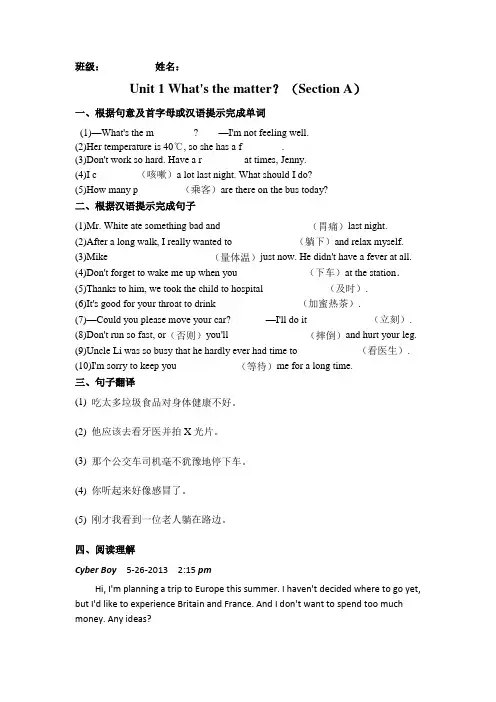
班级:姓名:Unit 1 What's the matter?(Section A)一、根据句意及首字母或汉语提示完成单词(1)—What's the m________? —I'm not feeling well.(2)Her temperature is 40℃, so she has a f________.(3)Don't work so hard. Have a r________ at times, Jenny.(4)I c________(咳嗽)a lot last night. What should I do?(5)How many p ________(乘客)are there on the bus today?二、根据汉语提示完成句子(1)Mr. White ate something bad and ________________ (胃痛)last night.(2)After a long walk, I really wanted to ____________(躺下)and relax myself.(3)Mike ____________________(量体温)just now. He didn't have a fever at all.(4)Don't forget to wake me up when you ____________ (下车)at the station.(5)Thanks to him, we took the child to hospital ____________(及时).(6)It's good for your throat to drink ________________(加蜜热茶).(7)—Could you please move your car? —I'll do it ____________(立刻).(8)Don't run so fast, or(否则)you'll _______________(摔倒)and hurt your leg.(9)Uncle Li was so busy that he hardly ever had time to____________(看医生).(10)I'm sorry to keep you____________(等待)me for a long time.三、句子翻译(1) 吃太多垃圾食品对身体健康不好。
Unit1What'sthematter词句篇情境练习课件人教版英语八年级下册
返回目录
Unit 1 What's the matter?
返回目录
考 点 2 lie的用法12考
教材P2
情境 Ben is 1 lying in bed, thinking
about what happened today. He was very angry with his best friend Ruby because she 2 lied to him.
themselves into trouble by have (no) difficulty (in) doing sth.。
拓help展ingtroothuebrles.作具体的某件麻烦事情讲时,为可数名词。
Unit 1 What's the matter?
返回目录
中考考法归纳
考法1:trouble的动词词义9考、名词词义6考;in trouble的词义3考; 考法2:trouble的拼写8考
Unit 1 What's the matter?
返回目录
情境 When good things 3 happen to us, it's important to celebrate and appreciate(感激) them.
讲考点 3 动词,意为“发生;出现”,常指偶然 、没有预料地发生,其主语通常是事(物 )。常用固定搭配:sth. happen(s)/happened+时间/地点状语, 意为“某时/某地发生某事”;sth. happen(s)/happened to sb.,意为“某人 发生某事”;
中考考法归纳 考法1:thanks to的词义4考; 考法2:thanks to的拼写6考; 考法3:thanks for的词义5考
人教版英语八年级下册Unit 1 Section A 1a-2d 课件
/eɪk/ have a headachehave a stomachache
v. /n. 疼痛
have a toothache
Look at the picture, and tell me what’s the trouble with them?
have/catch a cold
/fi:və(r)/
A: What’s the matter with Judy? B: She talked too much yesterday
and didn’t drink enough water. She has a very sore throat now.
Post-listening
1c Look at the picture. What are the students’ problems?
the first time. 8. If you agree, you can nod yohuera_d_____.
Look at the picture, and tell me what’s the matter with them?
Her eyes ached from lack of sleep. She felt an ache in her back.
Make conversations.
What’s the matter with Judy?
She talked too much yesterday and didn’t drink enough water. She has a very sore throat now.
Pre-listening
1. We look with our e_y__e_s___. 2. We listen with oure_a_r_s____. 3. We smell with ourn_o__s_e___. 4. We walk with our f_e_e_t____. 5. He carries a big bag on hbias_c_k____. 6. We doe_y_e__ exercises to protect our sight. 7. People sometimes shahkaen_d_s____ when they meet for
人教新目标版英语八下Unit1《What’sthematter》(SectionA(第2课时)说课稿

人教新目标版英语八下Unit 1《What’s the matter》(Section A(第2课时)说课稿一. 教材分析《人教新目标版英语》八下Unit 1《What’s the matter》Section A(第2课时)的主要内容是围绕询问和描述人们在不同情境下的情绪和感受展开。
本节课主要通过一个关于描述人们在不同情境下情绪的对话,让学生学会如何用英语询问和描述他人的情绪和感受,并能够运用所学知识进行实际交流。
二. 学情分析在进入八年级下学期时,学生已经掌握了基本的英语语法和词汇,具备了一定的听说读写能力。
通过对学生的和观察,我发现他们对学习英语有着浓厚的兴趣,并且希望能够通过英语学习了解更多的外国文化。
然而,学生在实际运用英语进行交流时,往往会出现表达不准确、语法错误等问题。
因此,在教学过程中,需要关注学生的语言运用能力,提高他们的语言表达准确性。
三. 说教学目标1.知识目标:学生能够掌握并运用本节课的重点词汇和句型,如“What’s the matter?”、“How do you feel?”等,描述他人的情绪和感受。
2.能力目标:学生能够在真实情境中运用所学知识进行交流,提高他们的语言运用能力。
3.情感目标:学生能够关爱他人,善于倾听和理解他人的情绪和感受,培养良好的人际交往能力。
四. 说教学重难点1.重点:本节课的重点是让学生学会如何用英语询问和描述他人的情绪和感受。
2.难点:学生在实际运用英语进行交流时,如何准确地表达自己的观点和情感。
五. 说教学方法与手段1.任务型教学法:通过设定不同的任务,让学生在完成任务的过程中运用所学知识进行交流。
2.情境教学法:创设真实的情境,让学生在实际情境中感受和体验所学知识。
3.小组合作学习:采用小组合作的形式,让学生在小组内进行讨论和交流,提高他们的合作能力。
六. 说教学过程1.导入:通过展示一组图片,让学生观察并描述图片中人物的表情和情绪,引出本节课的主题。
人教版八年级英语下Unit1What’sthematter(SectionA3a4c)说课稿

5.联系生活:将教学内容与学生的生活实际相结合,让学生感受到英语学习的实际意义,提高他们的学习兴趣。
三、教学方法与手段
(一)教学策略
我将采用任务型教学法、情境教学法和合作学习法作为主要教学方法。任务型教学法通过设计真实、有意义的任务,让学生在完成任务的过程中习得语言知识,提高语言运用能力。情境教学法则是通过模拟生活情境,让学生在情境中感知、体验和运用语言,增强学习的现实意义。合作学习法则强调学生之间的互动和协作,通过小组讨论、角色扮演等活动,促进学生之间的交流与合作,共同完成学习任务。选择这些方法的理论依据主要是交际语言学习理论、建构主义学习理论和人本主义学习理论,这些理论强调学习者的主动参与、意义建构和情感因素在学习过程中的重要性。
(三)互动方式
为了促进学生的参与和合作,我计划设计以下师生互动和生生互动环节:
1.师生互动:通过提问、回答、示范等方式,引导学生积极参与课堂讨论,及时给予反馈和鼓励,建立良好的师生互动关系。
2.生生互动:组织学生进行小组活动,如角色扮演、小组讨论、共同完成任务等,鼓励学生相互交流、相互学习,提高合作能力。
(三)学习动机
为了激发学生的学习兴趣和动机,我将采取以下策略或活动:
1.创设情境:设计有趣的情境,如医生就诊、朋友关心等,让学生在真实语境中运用所学知识;
2.小组合作:组织学生进行小组讨论、角色扮演等活动,提高他们的参与度和合作意识;
3.激励评价:对学生的表现给予及时、积极的评价,关注每个学生的进步,提高他们的自信心;
1.生活情境:通过展示一位学生在体育课上受伤的视频,引发学生对健康问题的关注,进而引出本节课的主题“What’s the matter?”。
人教英语八下_Unit 1 Section A 重点单词笔记

人教版八年级下册各单元重点单词笔记Unit1 SectionA1.mattern.问题;事情(1)询问某人的情况=problem重点句型怎么了? What’s the matter (with sb.)? 注意这里的the必须要加What’s wrong with sb.? What’s up? What’s the problem/trouble with sb.?互换(2)表示一个问题或一件事情e.g. They had some important matters to discuss.(3)关于...的问题a matter of sth./doing sth.e.g. Making a plan is a matter of choosing the best time and activities.补充:no matter who/what/when/where 无论...v.有影响matter to sb. 对某人有影响It doesn’t matter to me what you do. 你做什么对我没影响(你做什么我无所谓)2.重要的名词(身体部位)(下列均可数)arm n. 手臂back n. 背,背部ear n. 耳朵eye n. 眼睛foot n. 脚(复数为feet)hand n. 手head n. 头leg n. 腿mouth n. 嘴巴neck n. 脖子nose n. 鼻子stomach n. 胃tooth n. 牙齿(复数为teeth)3.表达生病的用法总结(用have表示得了某种病)(1)have a +疾病名称have a cold/fever/cough 感冒/发烧/咳嗽发高烧have a high fever He is coughing (2)have a +部位+ache n.表示疼痛have a stomach ache/tooth ache/head ache(3)have a +sore adj. 疼痛的;酸痛的+疼痛部位have a sore throat/back——have a very /really sore throat/back√4.liev. ①躺lie-lying-lay-laine.g. As long as you lie down and rest, you will feel much better tomorrow.The bus driver saw an old man lying on the side of the road.①撒谎lie-lying-lied-liede.g.lie to sb. 对某人说谎Don’t lie to me!n. 谎言tell a lie5.restn. ①休息时间(睡眠时间)have/take a good rest①剩余部分;其余the rest of sth.e.g. I would like to spend the rest of my life living with you.v. =relax 休息;放松e.g. Rest your eyes every half an hour.He won’t rest until he finds her.6.breakv. break-broke-broken已学,之前笔记有n. 间歇,休息,暂停(指短暂地歇了一下)①lunch/tea/class break 午饭/下午茶/课间的休息时间①take a break/ take breaksHe worked all day without a break=He worked all day without taking a breakYou need to take breaks away form the computers.7.hurtv. hurt-hurt-hurt①hurt sb./hurt oneself 使疼痛;使受伤He hurt his back /himself when he played tennis outside.If your head and neck still hurt tomorrow, then go to the doctor.①hurt oneself doing sth. 做某事弄伤了自己John hurt himself cutting up the carrots.①hurt one’s feeling 伤害某人的感情/使不快It hurt me to know that he lied to me.adj. 受伤的None of the passengers were badly hurt.8.off adv./prep. 本身意义一般指远离,主要总结含有off的动词短语get off 下车-get on 上车turn off 关上-turn on 打开take off 脱下;飞机火箭的起飞发射put off 推迟cut off 切除take/have three days off 请三天假9.to one’s surprise 一般位于句首,单独用(逗号隔开)10.onto prep. 本身意义一般指朝,向e.g. Some passengers helped Mr.Wang to move the man onto the bus11.troubleUCN(不可数名词). 困难;苦恼e.g. People don’t want to help others because they do not want any trouble.①be in trouble处于困境中Although we are in trouble, we won’t give up.e.g. Now he is in trouble, we should try our best to help him①get (sb.) into trouble (使某人)陷入困境中e.g. If I don’t arrive home on time, I’ll get into trouble!My brother always gets me into trouble with my parents.①have trouble with sth.=have trouble (in) doing sth.做某事有困难e.g. His son had trouble (in)working out the math problem.I had trouble in understanding the meaning of the word.补充:同义的还有have difficulties/problems with sth.=have difficulties/problems (in) doing sth. trouble也可做可数名词,意思是一件麻烦事,烦心事V. 使烦恼,使忧虑;麻烦某人trouble sb.e.g. Sorry to trouble you, but could you tell me the time?What is troubling you these days?12.hitV. hit-hit-hit击;打;撞击①hit sb. (with sth.)e.g. Bus No.26 hit an old man on Zhonghua Road.My parents never hit me when I was a child.①hit sb. +prep.+ the 身体部位hit me on the head/hit him in the facee.g. She hit him on his head with her umbrella.补充:hit常用于被动语态be done e.g. I was hit by a stone.13.right away =at once= in a minute= immediately 立刻;马上The old man had a heart problem and needed to go to the hospital right away.。
人教版八年级下册英语背记手册 Unit 1 Section A
UNIT 1 What's the matter?Section A (1a-4c)重点单词1. toothache n. 牙痛2. matter n. 问题,事情3. stomachache n. 胃痛,腹痛4. break n. 间歇,休息5. fever n. 发烧6. cough n. & v. 咳嗽7. throat n. 咽喉,喉咙8. lie v. 躺,平躺9. rest v. & n. 放松,休息10. Xray n. X射线,X光11. headache n. 头痛12. neck n. 颈,脖子13. hurt v. 使疼痛,受伤14. passenger n. 乘客,顾客15. off adv. & prep. 离开,不工作 16. trouble n. 问题,苦恼17. foot n. 脚,足18. onto prep. 向,朝19. herself pron. 她自己词形变换1. health—healthy (形容词)—unhealthy (反义词)2. break—broke (过去式)—broken (过去分词)3. lie—lay (过去式)—lain (过去分词)—lying (现在分词)4. hurt—hurt (过去式)—hurt (过去分词)5. foot—feet (复数)6. stomach—stomachs (复数)重点短语1. have a cold 感冒2. have a stomachache 胃痛3. lie down 躺下4. see a dentist 看牙医5. take one's temperature 量体温6. have a fever 发烧7. get into 陷入;参与8. agree to do sth. 同意做……9. to one's surprise 使……惊讶的是 10. right away 立即;马上11. get off 下车12. think twice 再三考虑13. fall down 落下;摔倒14. get an Xray拍 e medicine on sth. 在……上面敷一些药重点句型1. What's the matter (with sb. )?(某人)怎么了?/出什么事了?2. At 9:00 a. m. yesterday,bus No. 26 was going along Zhonghua Road when the driver saw an old man lying on the road. 在昨天上午九点,26路公交车正沿着中华路行驶,这时司机看到一位老人躺在路边。
八年级英语下册Unit1What’sthematter短语语法知识点汇总(新版)人教新目标版
Unit 1 What’s the matter一、必背短语Section A 部分have a cold have a stomachachehave a sore throat have a sore backlie down and rest take one’s temperaturetalk too much take breaks/a breakget off get an X-ray11.看见某人正在做.. see sb. doing think twiceexpect sb. to do 14.使…惊讶的to one’s surpriseagree to do sth. in time17.多亏,由于thanks to 18.陷入困境;惹麻烦get into troubleSection B 部分rest for a few days …放下;低下p ut…downtell sb. to do tell sb. not to dohave problems/trouble/difficulty (in) doing sth…感兴趣be interested in be used to doing sthused to do sth take risks/a risk10.由于/因为+n./pron. because of in a dangerous situationin a difficult13.用尽,耗光run out (of)situationbe ready to do cut off…以至于…s o…that…17.以便于;为了so that/in order that【教材内容解析】Section A1.What’s the matter? (P. 1)What’s the matter意为“怎么了?出什么事了?”,常用来询问对方遇到什么麻烦或者有什么不顺心的事,后接with sb./sth.表示“某人/某物怎么了”。
人教版 八年级英语 下册 Unit1_what's_the_matter课件(完整)
Conversation 4 Girl :What’s wrong with your face? Boy: It’s not my face.It’s my tooth.I have a toothache. Girl:You should see a dentist and get an X-ray. Boy:But will it hurt? Girl:No,and if you don’t go to the dentist now,it’ll hurt even more later!
night,I got a stomachache. I almost couldn’t get myself out of bed this morning.
Conversation 3 Nurse:What’s the matter,Ben?Can you move? Ben:Not really.I was playing soccer the other day and I hurt myself.It
foot n. 脚;足 neck n. 颈;脖子
Words and expressions
stomach n. 胃;腹部 throat n. 咽喉;喉咙 fever n. 发烧 lie v.躺;平躺
lie down 躺下 rest v. 放松;休息
cough v. 咳嗽 X-ray n. X射线;X光
Lisa: OK. Thanks, Mandy.
3b Read the passage again and check the things that happened in the story.
Unit1what’sthematter_SectionA知识点梳理人教版八年级英语下册
人教版八年级下册英语课本知识点梳理Unit 1 wh at’s the matter? sectionA课文内容:What's the matter? 怎么了? (教材第1页)【用法详解】What's the matter? 怎么了?/出什么事了?常用于询问某人患了何种疾病,遇到了什么困难等,也可用于询问某物出了什么故障,其后可接with sb./sth.,表示“某人/某物怎么了?”。
其中matter 用作名词,意为“问题;事情”matter前须加定冠词the。
【例句】What's the matter? 怎么了?Bad luck.I lost my pen. 真倒霉,我弄丢了钢笔.What's the matter with him? 他怎么了?He has a sore back.他背痛【拓展】matter[动词] 要紧;有关系多用在否定句、疑问句或条件句中It doesn't matter.没关系。
(通常用来回答对方的道歉)I have a cold. 我感冒了。
(教材第1页)【用法详解】have a cold (患)感冒。
其中have 用作及物动词,意为“患(病);遭受(病痛)”,常用于结构“have a/an +疾病名称”表示患病或身体某部位不舒服。
此时它不能用于进行时态,其第三人称单数形式为has,过去式为had。
常见的表示病痛的短语还有:have a fever 发烧have a toothache 牙疼have a headache头痛have a cough 咳嗽have a stomachache胃痛Do you often have a cold? 你经常感冒吗?Jim had a stomachache after supper yesterday.吉姆昨天晚饭后胃痛。
l have a stomachache.我胃痛。
( 教材第1 页)【用法详解】stomachache [名词]胃痛;腹痛是由“名词stomach(;腹部)+ache(疼痛)”构成的复合名词。