
苏教版五年级下册英语知识点总结
苏教版五年级下册英语知识点总结【篇一:苏教版五年级下册英语知识点总结】when do you do morning exercises? 你几点钟做早操?i usually eat breakfast at 7:00. 我通常七点钟吃早饭。
what do you do on the weekend? 你周末干什么?i often visit my grandparents. 我常常去看望祖父母。
苏教版小学生五年级下册英语知识要点:sometimes i go hiking.有时候我去远足。
do morning exercises eat breakfast get uphave english class play sports eat dinnerclimb mountains go shopping go hikingvisit grandparents play the pianowhen evening noon weekend usually often sometimesunit 2 what s your favourite season?what s your favourite season? =which season do you like best?你最喜欢的季节是什么?my favourite season is summer.=i like summer best.我最喜欢夏天。
why do you like winter? 你为什么喜欢冬天?because i can play with snow. 因为我可以在雪里玩。
what s the weather like in spring? 春天的天气怎样?it s windy and warm. 有风的,很暖和。
summer is good, but fall is my favourite season.夏天很好,但是秋天才使我最喜欢的季节。
spring summer fall winter season which why because best swimsleep fly kites skate plant trees make a snowmanunit 3 when is your birthday?when is your birthday? 你的生日在什么时候?my birthday is in may. 我的生日在五月。
is your birthday in may, too? 你的生日也在五月吗?no, my birthday is in april. 不,我的生日在四月。
how many birthdays are there in january? 一月里有多少个人过生日?when is the national day? 国庆节在什么时候?it s october 1st. 十月一日。
what s the date? 几号?january (jan.) february (feb.) march (mar.)april may june july august(aug.)september(sept.) october(oct.) november( nov.)december(dec.) birthdayunit 4 what are you doing?what are you doing? 你在干什么?i m doing the dishes. 我在洗碗碟。
are you drawing pictures? 你在画画吗?what s your father doing? 你爸爸在干什么?he is writing an e-mail. 他在写电子邮件。
【篇二:苏教版五年级下册英语知识点总结】苏教版五年级下册英语各单元知识点总结归纳,这是无意中看到的资料,下载了一份,来爱贝分享一下,希望对大家都有帮助。
【篇三:苏教版五年级下册英语知识点总结】五年级英语语法知识汇总一、词类: 1、名词这里强调两点:不可数名词都默认为单数,所以总是用 is 名词复数如何加后缀:各种不同情况变化方法一般情况直接加-s 以 s. x. sh. ch 结尾加-es 例词 book-books bag-bags cat-cats bed-beds bus-buses box-boxes brush-brushes watch-watches peach peaches glass--glasses 以辅音字母+y 结尾以 f或 fe 结尾变 y 为 i, 再加-es family-families study--studies 变 f或 fe 为 v,再加-es 不规则名词复数 knife-knives man-men woman-women policeman-policemen policewoman-policewomen mouse-mice foot-feet child-children fish-fish chinese-chinese 2、人称代词和物主代词人称代词物主代词单数复数单数复数主格宾格主格宾格形容词性形容词性第一人称第二人称 you(你) i(我) me we(我们)you you(你们)him her us you your(你的)his(他的)her (她的)my(我的)our(我们的) your(你们的)第三人称 he (他) she(她) they (他/她/它们)them their (他/她/它们的)it(它) it it(它的)人称代词:有主格和宾格之分。
一般动词前用主格,动词后用宾格。
3、指示代词指近处单数 this (这个)复数 these(这些)4、冠词有 a、 an、 the。
a 和 an 的区别: an 用于元音音素(一般就是元音字母 a、 e、 i、o、 u)前, a 用于辅音音素前。
二、否定句: be 动词(am、 is、 are) +not、情态动词 can+ not、助动词(do、 does) + not 如何将一个肯定的陈述句改为否定句: 1、看句中有无 be 动词,如有,直接在 be 动词后+ not。
2、看句中有无情态动词,如有,直接在情态动词后+ not。
指远处 that (那个) those(那些) 3、如上述二者都没有,就应用助动词+ not。
分四个步骤:(1)肯定陈述句中本来是没有助动词的,要加上去,位置在主语(某人或某物)后,动词前。
(2)确定助动词用 do、 does,根据句中动词,动词是原形的助动词就用 do,动词是第三人称单数的助动词就用 does,(3)在助动词后加 not。
(4)原句中动词假如发生变化就要恢复成原形。
强调一点,有 some 的要考虑是否要用 any。
三、一般疑问句。
如何将一个肯定的陈述句改为一般疑问句: 1、看句中有无 be 动词,如有,把 be 动词提到句首即可。
2、看句中有无情态动词,如有,把情态动词提到句首即可。
3、如上述二者都没有,就应把助动提到句首。
分四个步骤:(1)肯定陈述句中本来是没有助动词的,要加上去,位置在主语(某人或某物)后,动词前。
(2)确定助动词用 do 还是 does,根据句中动词,动词是原形的助动词就用 do,动词是第三人称单数的助动词就用 does (3)把助动词后提到句首。
(4)原句中动词假如发生变化就要恢复成原形。
强调一点,有 some 的要考虑是否要用 any。
四、特殊疑问句。
表示疑问,有疑问词(在开头),回答有很多种可能。
常用疑问词:疑问词意思 what time 什么时间 who 谁 whose 谁的where 在哪里 what 什么 what colour 什么颜色 how old 多大年纪how many 多少数量(可数名词) how much 多少钱;多少数量(不可数名词)五、时态 1、一般现在时(1)一般现在时中的 be 动词:一般用原形: am is are am 用于第一人称单数(i); is 用于第三人称单数(he she it 和其他人名或称谓,如: ben hissister等); are 用于第二人称单数(you)和所有复数(包括第一人称复数 we、第二人称复数 you;第三人称复数 they 和其他复数,如 the children 、 his parents 等)。
(2)一般现在时中的动词:第一种情况:主语是第三人称单数(he she it 和其他,如 helen 、 her cousin 等),动词后一般加s 或 es。
第二种情况:主语不是第三人称单数,动词都用原形。
(4)一般现在时判断依据(如何判断一个句子是一般现在时):△be 动词是 am、 is、 are △动词用原形或加 s、 es △没有时间状语或有 usually、 often、 everyday、 sometimes 等不是具体的时间用法问具体时间,如几点钟问人问主人问地点问东西、事物问颜色问年纪问数量问多少钱或数量(不可数) 2、现在进行时(1)构成形式: be 动词+动词的 ing 形式这里强调一点,两者缺少其中任何一种都不可以构成现在进行时。
(2)现在进行时表示动作正在进行或事情正在发生。
(3)有用的依据:一个句子中既有 be 动词,又有动词,且动词加了 ing 该句是现在进行时(4)句中往往有 now、 look、 listen 等词。
动词现在分词的变化见下表:词尾情况变化方式一般情况加 ing 例词 play 玩 playing do 做 doing go 去 going jump 跳 jumping sing 唱 singing ski 滑雪 skiing see 看见--seeing make 做making take 拿到 taking like 喜欢 liking come 来 coming write 写 writing dance 跳舞 dancing have 有 having close 关 closing swim 游泳 swimming sit 坐 sitting run 跑 running get 得到getting put 放 putting begin 开始 beginning jog 慢跑 jogging 以不发音的 e结尾去 e 加 ing 以重读闭音节结尾的动词,中间只有一个元音字母,词尾只有一个辅音字母同音词: too---two----to buy---by i---eye four----for there----their right----write sun----son no----know 双写最后一个辅音字母再加 ing here---hear who s----whose 近义词: many----a lot of / lots of large----big desk----table photo---picture lamp----light like----love 反义词或对应词: old----new go----come big----small open----close black----white here----there 完整形式: let s=let us(让我们) i d=i would can t=can not i m=i am 词性变换: one(序数词) first monkey(复数) monkeys skiing(原形)ski is(复数) are families(单数) family make(现在分词) making we are(缩略形式)we re do(第三人称单数)doeshave(第三人称单数)has photo(复数)photos fat(反义词)thin 做题目时一定要记住: 1. can+动词原形 2. like+动词 ing 3. like+名词复数4. play+足球类 play the +乐器类 5. how many +名词复数 6. would like +to+动词原形 7. let s+动词原形 8. 现在进行时:be(am,is,are)+动词 ing 9. 动词第三人称单数形式一课时: be 动词主讲与人称代词的搭配 1 、基本形式: am、 are、 is (1) am 第一人称 i+am (注意: i 无论何时都要大写,不管位于句首还是句中) 例: i am a beautiful girl. i am twenty. (2) are 第二人称you+are; 一人称复数 we+are;三人称复数 they+are 其他复数名词+are (注意:第二人称单复数同形,都为 you) 例: you are my good friend. we are in the same class. they are on the road. the books are on the desk. (3 is 第三人称 he(男) +is ; she(女)+is;it(不是人)+is;其他单数名词+is 例: he\she is a good student. it is a white cat. a dog is on that street. 2、肯定、否定、疑问(等于号后是简写)肯定否定 be 动词后加 not 一般疑问 be动词移到主语前一般疑问否定一般疑问回答肯定和否定 i am =i m . i am not =i m not ... am i ? am not i ? yes,i m. no,i m not. you are = you re you are not =you aren t are you ? are not you. ..? =aren tyou ? yes,you are. no,you are not. she\he\it is = she\he\it is not is she\he\it ? is not yes,she\he\it =she\he\it isn t she\he\it ? =isn t she\he\it ? is. no,she\he\it is not. we are=we re we are not =we aren t are we ? are not we ? =aren t we ? yes,we are. no,we are not. they are=they re they are not =they aren t are they ? are not they ? =aren t they ?yes,they are.no,they are not. 例: iam(not) from london. my eyes are(not) small. my hair is(not) long. am i a chniese? 回答:肯定: yes, you are. 否定: no, you aren t. is the cat fat? 回答:肯定: yes, it is. 否定: no, it isn t. 注意:在一般疑问回答中,肯定回答除 i m 不可简写,否定回答均可简写。
苏教版五年级下册英语复习重点总结
苏教版五年级下册英语复习重点总结一、句型1. I have two animal friends. 我有两个动物朋友。
2. One is red and the other is black. 一个是红的另一个是黑的。
3. They have big eyes and big bodies. 它们有大眼睛和大身体。
4. They have no legs and arms. 它们没有腿和手臂。
5. It has four legs and a short tail. 他有四条腿和一条短尾巴。
6. It has two legs and two nice wings. 它有两条腿和一双漂亮的翅膀。
7. He has a dog. 他有一只狗。
8. She has a bird. 她有一只鸟。
9. It can talk and fly. 它既会说话又会飞。
10. Do you have an animal friend? Yes, I do. 你有一个动物朋友吗? 是的,我有。
11. Does it have a long tail? Yes, it does. 它有一条长尾巴吗? 是的,它有。
12. Does he have a parrot? No, he doesn’t. 他有一只鹦鹉嘛? 不,他没有。
13. Does she have two fish? No, she doesn’t. 她有两条鱼吗? 不,她没有。
14. Do they have animal friends? No, th ey don’t. 他们有动物朋友吗? 不,他们没有。
15. Those are not legs. 那些不是腿。
16. Give it a cake. 给它一个蛋糕。
二、语音Uu / Λ / bus, duck, summer, sun, umbrella, mum, lunch, cup, rubber, run, but, much, jump,Sunday, subject,三、语法 have / has 的用法1、表示某人有某物。
新苏教版五年级下册英语知识点
新苏教版五年级下册英语知识点一. 词汇1. 动词 (Verbs)- 动词是句子的核心,表示动作或状态。
- 例如:run (跑),jump (跳),sing (唱)2. 名词 (Nouns)- 名词是用来指代人、动物、事物或概念的词。
- 例如:book (书),dog (狗),apple (苹果)3. 形容词 (Adjectives)- 形容词用来描述名词或代词的特征或性质。
- 例如:big (大),small (小),happy (快乐)4. 副词 (Adverbs)- 副词用来修饰动词、形容词、副词或整个句子。
- 例如:quickly (快速地),happily (快乐地),very (非常)二. 语法1. 现在进行时 (Present Continuous Tense)- 现在进行时表示目前正在发生的动作。
- 构成:主语 + am/is/are + 现在分词- 例如:I am running. (我正在跑步)2. 情态动词 (Modal Verbs)- 情态动词用来表示说话人的态度、能力或意愿。
- 例如:can (能),may (可以),must (必须)3. 冠词 (Articles)- 冠词用来限定名词的范围。
- 分为定冠词 (the) 和不定冠词 (a/an)。
- 例如:The dog is barking. (那只狗在叫)4. 一般现在时 (Simple Present Tense)- 一般现在时用来表示经常发生的动作或客观存在的事实。
- 构成:主语 + 动词原形- 例如:She likes to sing. (她喜欢唱歌)三. 句型1. 陈述句 (Declarative Sentences)- 陈述句用来陈述一个事实或提供信息。
- 例如:I am playing basketball. (我正在打篮球)2. 疑问句 (Interrogative Sentences)- 疑问句用来提问。
(完整word版)苏教版小学英语五年级下册重难点知识汇总.doc
U n i t1 C i n d e r e l l a短1. at the prince’ s在house王子的殿2.put on 穿上 (put it on/put them on)3.go to the party去参加聚会4.take off 脱下5.try on your shoe穿你的鞋子6.in the forest 在森林里7.be late for⋯到8. be bad/good for us 我有害 /有好法:一般的或候提,用when。
人提,用 who。
的提,用whose 提地点用 where 。
原因提,用why。
哪一个提,用which 。
提方式用 how。
提年用: How old提数量用 how many。
提多少用how much。
提色用: What color 。
Unit 2 H ow do you come to school法:地点提,用where (哪里)e.g. I live in Suzhou. ------ Where do you liveHe is on Moon Road. ---- Where is he方式方法提,用How (怎)e.g. I go to school by bike. ----- How do you go to schoolMy father goes to work by car. ------ How does your father go to work健康状况提,也用Howe.g. He is fine/strong.------- How is he☆home,here,there 副,前面不可以加 to。
如“走回家”, walk home ;但是“到达你的家” get to your home ,因里的 your home 名。
“ 去那儿”, ride a bike there 。
介短(短)意思on foot walk 步行by bike ride a bike 自行by bus take a bus 乘公共汽by metro take a metro 乘地by taxi take a taxi 乘出租by plane take a plane 乘机by car take a car 乘小汽by ship take a ship 乘船by boat take a boat乘船Unit 3 A sking the way法:1.many 用来修可数名, much 用来修不可数名。
(完整word版)苏教版小学英语五年级下册重难点知识汇总
U n i t1C i n d e r e l l a短语1. at the prince’s house 在王子的宫殿2.put on穿上(put it on/put them on)3. go to the party去参加聚会4. take off 脱下5.try on your shoe试穿你的鞋子6.in the forest在森林里7.be late for … 迟到8. be bad/good for us 对我们有害/有好处语法总结:对一般的时间或时候提问,则用 when。
对人提问,则用who。
对谁的提问,则用whose 提问地点则用 where。
对原因提问,则用why。
对哪一个提问,则用which。
提问方式用how。
提问年龄用:How old提问数量用how many。
提问多少钱则用how much。
提问颜色用:What color。
Unit 2 How do you come to school语法总结:对地点提问,用where (哪里)e.g. I live in Suzhou. ------ Where do you liveHe is on Moon Road. ---- Where is he对方式方法提问,用How (怎样)e.g. I go to school by bike. ----- How do you go to schoolMy father goes to work by car. ------ How does your father go to work对健康状况提问,也用Howe.g. He is fine/strong. ------- How is he☆home,here,there为副词,前面不可以加to。
如“走回家”,动词词组为walk home;但是“到达你的家”为get to your home,因为这里的your home为名词。
苏教版五年级下册英语知识点总结大全

苏教版五年级下册英语知识点总结大全一、单词和词组- Noun (名词): 单词列表- Verb (动词): 单词列表- Adjective (形容词): 单词列表- Adverb (副词): 单词列表- Phrase (词组): 词组列表二、语法- Present Simple (现在简单时): 用法、例句- Past Simple (过去简单时): 用法、例句- Future Simple (将来简单时): 用法、例句- Present Continuous (现在进行时): 用法、例句- Past Continuous (过去进行时): 用法、例句- Future Continuous (将来进行时): 用法、例句- Present Perfect (现在完成时): 用法、例句- Past Perfect (过去完成时): 用法、例句- Future Perfect (将来完成时): 用法、例句三、对话和口语表达- Simple Greetings (简单问候): 对话和表达方式- Asking for Permission (请求许可): 对话和表达方式- Giving Directions (给予方向指引): 对话和表达方式- Making Invitations (发出邀请): 对话和表达方式- Expressing Likes and Dislikes (表达喜好和厌恶): 对话和表达方式四、阅读和理解- Passage 1 (文章1): 阅读内容和问题- Passage 2 (文章2): 阅读内容和问题- Passage 3 (文章3): 阅读内容和问题五、写作技巧- Writing a Letter (写信): 结构和示例- Writing a Diary (写日记): 结构和示例- Writing a Story (写故事): 结构和示例- Writing a Description (写描述): 结构和示例以上是苏教版五年级下册英语知识点的总结大全。
苏教版五年级下册英语 unit1-unit5单元知识点汇总整理
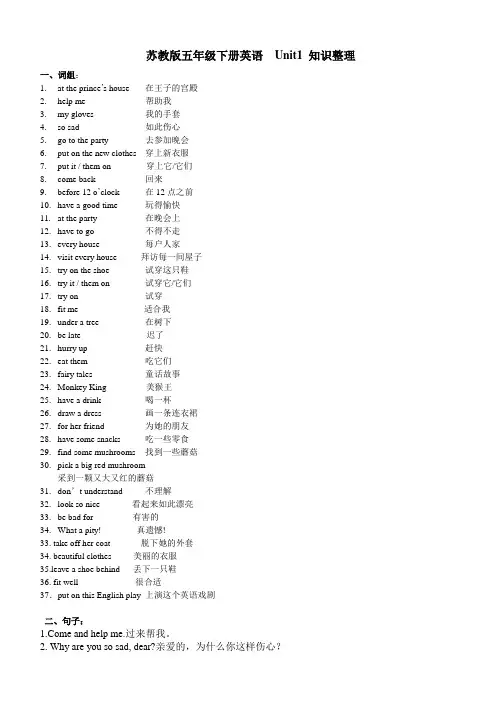
苏教版五年级下册英语Unit1 知识整理一、词组:1. at the prince’s house 在王子的宫殿2. help me 帮助我3. my gloves 我的手套4. so sad 如此伤心5. go to the party 去参加晚会6. put on the new clothes 穿上新衣服7. put it / them on 穿上它/它们8. come back 回来9. before 12 o’clock 在12点之前10. have a good time 玩得愉快11. at the party 在晚会上12. have to go 不得不走13. every house 每户人家14. visit every house 拜访每一间屋子15. try on the shoe 试穿这只鞋16. try it / them on 试穿它/它们17. try on 试穿18. fit me 适合我19. under a tree 在树下20. be late 迟了21. hurry up 赶快22. eat them 吃它们23. fairy tales 童话故事24. Monkey King 美猴王25. have a drink 喝一杯26. draw a dress 画一条连衣裙27. for her friend 为她的朋友28. have some snacks 吃一些零食29. find some mushrooms 找到一些蘑菇30. pick a big red mushroom采到一颗又大又红的蘑菇31. don’t understand 不理解32. look so nice 看起来如此漂亮33. be bad for 有害的34. What a pity! 真遗憾!33. take off her coat 脱下她的外套34. beautiful clothes 美丽的衣服35.leave a shoe behind 丢下一只鞋36. fit well 很合适37.put on this English play 上演这个英语戏剧二、句子:e and help me.过来帮我。
苏教版五年级下册英语复习重点总结
苏教版五年级下册英语复习重点总结期末考试就要到来了,五年级的孩子应该做好复习英语重点的准备。
下面就让店铺给大家分享几篇苏教版五年级下册英语复习重点吧,希望能对你有帮助!苏教版五年级下册英语复习重点篇一一、句型1. I have two animal friends. 我有两个动物朋友。
2. One is red and the other is black. 一个是红的另一个是黑的。
3. They have big eyes and big bodies. 它们有大眼睛和大身体。
4. They have no legs and arms. 它们没有腿和手臂。
5. It has four legs and a short tail. 他有四条腿和一条短尾巴。
6. It has two legs and two nice wings. 它有两条腿和一双漂亮的翅膀。
7. He has a dog. 他有一只狗。
8. She has a bird. 她有一只鸟。
9. It can talk and fly. 它既会说话又会飞。
10. Do you have an animal friend? Yes, I do. 你有一个动物朋友吗? 是的,我有。
11. Does it have a long tail? Yes, it does. 它有一条长尾巴吗? 是的,它有。
12. Does he have a parrot? No, he doesn’t. 他有一只鹦鹉嘛? 不,他没有。
13. Does she have two fish? No, she doesn’t. 她有两条鱼吗? 不,她没有。
14. Do they have animal friends? No, they don’t. 他们有动物朋友吗? 不,他们没有。
15. Those are not legs. 那些不是腿。
16. Give it a cake. 给它一个蛋糕。
(完整word版)苏教版五年级下册英语复习重点
苏教版五年级下册英语重点复习资料第一部分一、句型1.What do you like doing? 你喜欢干什么?Ilike playing basketball and football.我喜欢打篮球和踢足球。
2.I can play basketball well, but I’m not good at football.我篮球打得很好, 但我不擅长足球。
3.He likes playing football too.他也喜欢踢足球。
4.She also likes playing the piano.她也喜欢弹钢琴。
5.They both like swimming.她们都喜欢游泳。
6.What does he like doing? 他喜欢干什么?He likes drawing.他喜欢画画。
7.What does she like doing ? 她喜欢干什么?She likes reading stories.她喜欢读故事。
8.What do they like doing? 她们喜欢干什么?They like watching films.她们喜欢看电影。
9.Sam and Billy talking about their hobbies.山姆和比利谈论他们的爱好。
10.Let’s go skating this afternoon.咱们今天下午去滑冰。
11.Look out! 小心!12.There is a hole in the ice.冰里有一个洞。
13.Do you like wearing yellow? 你喜欢穿黄色的衣服?14.We all like climbing very much.我们都十分喜欢爬山。
二、语音Yy / j / year, yes, yellow, you, young三、语法1.询问别人喜欢干某事, What do/ does … like doing ?喜欢干某事 like doing sth, doing表示喜欢经常做一件事。
苏教版五年级下册英语单元复习知识点
苏教版五年级下册英语单元复习知识点Unit 1: My School Life- Vocabulary:- Grammar:- Present Simple Tense: affirmative, negative, and interrogative forms- Adjectives to describe school objects and subjects- Prepositions of place: in, on, under, next to, between, behind, in front ofUnit 2: My Family- Vocabulary:- father, mother, parents, brother, sister, grandfather, grandmother, uncle, aunt, cousin, family, baby, son, daughter, pet, cat, dog, rabbit, hamster, goldfish- Grammar:- Possessive pronouns: my, your, his, her- Plural nouns: adding -s or -esUnit 3: Food and Drinks- Vocabulary:- breakfast, lunch, dinner, fruit, apple, banana, orange, grapes, watermelon, tomato, carrot, broccoli, cabbage, milk, juice, water, ice cream, cake, bread, rice, noodles, hamburger, pizza, chicken, fish, egg, vegetable, meat, soup- Grammar:- Countable and uncountable nouns- Quantifiers: a/an, some, any, a lot of, a few, a little, much, manyUnit 4: Hobbies- Vocabulary:- hobby, swimming, dancing, singing, painting, drawing, playing basketball, playing football, playing tennis, playing badminton, playing volleyball, reading, cycling, hiking, traveling, watching TV- Grammar:- Present Continuous Tense: affirmative, negative, and interrogative forms- Adverbs of frequency: always, usually, often, sometimes, rarely, neverUnit 5: My Body- Vocabulary:- head, hair, face, eye, ear, nose, mouth, tooth, tongue, hand, arm, leg, foot, finger, toe, body, heart, stomach, back, shoulder, knee, neck, teeth, ears, eyes- Grammar:- There is/are: affirmative, negative, and interrogative forms- Plural nouns with irregular spelling: tooth - teeth, foot - feetUnit 6: On the Farm- Vocabulary:- farm, farmer, cow, pig, horse, sheep, chicken, duck, dog, cat, rabbit, mouse, rooster, hen, lamb, chick, calf, pony- Grammar:- Present Simple Tense: affirmative, negative, and interrogative forms (third person singular)- Singular and plural nounsUnit 7: Festivals- Vocabulary:- festival, Spring Festival, Lantern Festival, Tomb Sweeping Day, Dragon Boat Festival, Mid-Autumn Festival, National Day, celebration, tradition, customs, dragon, lantern, mooncake, dumpling, zongzi, firecracker- Grammar:- Using adjectives to describe festivals- Using prepositions to indicate time: on, in, atUnit 8: My City- Vocabulary:- city, supermarket, park, library, hospital, cinema, restaurant, post office, police station, museum, school, street, traffic light, bus stop, taxi, car, bike, pedestrian, subway, traffic, busy, quiet- Grammar:- Using prepositions to indicate location: in, on, atUnit 9: Daily Routine- Vocabulary:- get up, have breakfast, brush teeth, wash face, get dressed, go to school, have lunch, have dinner, do homework, watch TV, play, go to bed, weekend- Grammar:- Using the present simple tense to describe daily routines- Using adverbs of frequency to describe how often以上为苏教版五年级下册英语单元复知识点。
苏教版小学英语五年级下册知识点
5B Unit 1 Cinderella 一、单词:1. prince 王子2.fairy 仙女3.sad 伤心4.because因为5.back 回来6. fit 合适7.hurt受伤te迟的,晚的9.tale故事10.hurry 快点11.pick 摘12.mushroom 蘑菇13.pity 可惜14.leave 留下15.clothes衣服16.before在...之前17.understand 明白18.let让19. Cinderella灰姑娘二、词组:1. at the prince’s house 在王子的宫殿e and help me过来帮我3.my gloves 我的手套4.so sad 如此伤心5.put on穿上(put it on/put them on)6. go to the party去参加聚会7.nice shoes 漂亮的鞋子8. take off 脱下9.put on the new clothes and shoes 穿上新衣服和鞋子10.come back 回来11.before 12 o’clock 12点钟之前12.at the party 在聚会13. have to go 不得不走14.visit every house 参观每一间屋子15.try on your shoe试穿你的鞋子16. try it on 试穿它17.try them on 试穿它们18.have a good time/have a lot of fun/have great fun 玩得开心19.have parties 举行聚会20.whose shoe 谁的鞋子21.My foot hurts.我的脚伤了。
22.have a drink 喝一杯饮料23.draw a dress for her 画件裙子给她24.like reading fairy 喜欢读童话故事25.read stories about…读关于…的故事26. the Monkey King 美猴王27. in the forest在森林里28.have some snacks 吃一些零食29.some mushrooms under a tree 一些在树下的蘑菇30. Hurry up. 快点。