
新湘少版六年级上册英语复习资料
新湘少版六年级上册英语复习资料 Unit1 What did you do during the holidays?假期你做什么了? 单词: learn words and sentences 学习单词和句子 play games 玩游戏 learn writing 学习写作 practise listening 练习听力 句型:what did you do during the holidays?假期你做了什么? I read many books.我看了许多书。 语法:动词过去式的变化规则 一、规则动词的过去式变化规则 ①一般情况动词词尾直接加-ed。 如:work—worked play—played ②以不发音的-e结尾的动词,动词词尾加-d。 如:live—lived taste—tasted ③以辅音字母+y结尾的动词,把y变为i,再加-ed。 如:study—studied cry—cried ④以一个辅音字母结尾的,重读闭音节动词(即Vivi常说的辅元辅结构)双写词尾辅音字母,再加-ed. 如:stop—stopped clap—clapped 二、不规则变化动词没有变化规律,需要童鞋们好好识记。 如: go—went make—made get—got buy—bought learn—learnt do—did take—took have—had read—read speak—spoke teach—taught say—said Unit2 Katie always gets up early凯蒂总是很早起床 词汇: (频度副词:always总是、often常常、sometimes有时、never从不) get up 起床 return home 回家 take a walk 去散步 do her homework 做她的家庭作业 have breakfast/lunch/dinner吃早/ 中/ 晚餐 play chess 下象棋 wave goodbye 挥手再见 read a newspaper 读报纸 be late for school 上学迟到 句型:Peter always gets up at 7:00 a.m。 语法:一般现在时中,动词第三人称单数的用法你知道了么? 变化规则:①一般情况直接在动词词尾加-s。 如:get—gets take—takes ②以s、x、sh、ch、x、o结尾的动词,在词尾加-es。 如:teach—teaches go—goes ③以辅音字母+y结尾的动词,变y为i,再加es。 如:study—studies try—tries ④不规则变化 have—has Unit3 I like my computer 我喜欢我的电脑 词汇: email my friends给我的朋友们发电子邮件 send greetings 发送问候 search for a lot of things 查找许多事情 find out about countries 查明各国信息 on the computers 在电脑上 an interesting bird 一只有趣的鸟 句型:We can email our friends。 We can send greetings to our friends。(伙伴们记住了,情态动词can的后面只能用动词原形can do sth)
Unit4 The Mid-Autumn Festival is coming中秋节到了 词汇: a box of mooncakes 一盒月饼 go shopping 去购物 in the shopping centre在购物中心 have a look 看一看 here you are 给你 nearby 附近 lotus seed 莲子 red bean 红豆 the Mid-Autumn Festival 中秋节 enjoy eating mooncakes喜欢吃月饼 look at the moon赏月 drink tea 喝茶 talk about 谈论 open the gift 打开礼物 句型:I enjoy eating mooncakes。 I enjoy looking at the moon。(Hi,guys不止一次的提醒:喜欢做某事应该是enjoy doing sth ,enjoy后的动词词尾记得加ing哦) 描述自己想要某物的句型:I’d like+某物 如:I’d like a box of mooncakes.
Unit5 It will be sunny and cool tomorrow明天的天气是晴朗而又凉爽的 词汇: weather forecast 天气预报 sunny and warm晴朗而又暖和的 heavy rain 大雨 go to school 上学 have fun 玩的开心 light snow 小雪 light rain 小雨 strong wind 强风 sunny and cool 晴朗而凉爽 next Friday 下周五 stay at home 待在家里 句型:It will be sunny tomorrow。 There will be a light snow next Friday It’s time for the weather forecast. 描述未来天气的句型: ①It will be+天气形容词(sunny、rainy)+其他 如:It will be sunny tomorrow。 ②It will +天气类动词(rain、snow)+其他 如:It will snow tomorrow。
Unit6 I will bring a big bottle of orange juice我将带一瓶大的橙汁 词汇:have a picnic 野餐 wait for 等候 take out 拿出 have lunch 吃午饭 have a picnic 野炊 a bottle of orange juice一瓶橙汁 a box of cakes 一盒蛋糕 a few cans of Coke 几罐可乐 a few bars of chocolate 几条巧克力 bring带来 meet 遇见 peanut 花生 fruit 水果 candy糖果 句型:I will bring a bottle of orange juice。我将会带瓶橙汁。 I will bring a few cans of Coke。我将会带几罐可乐。
Unit7 What can I do?我能做什么? 词汇:an old woman 一位老太太 help old people on the road 帮助老人过马路 make tea 泡茶 clean their homes打扫他们家 get on the bus上车 enjoy themselves 玩的开心 make cakes做蛋糕 make them happy让他们高兴 get off the bus 下车 句型:What can I/you/he/she do?我/ 你/ 他/ 她能做什么? I/He /She can make them happy.我 /他 /她能使他们快乐。(盆友们还是强调,情态动词can的后面的动词用原形)
Unit8 We shouldn’t waste water 我们不应该浪费水资源 词汇:keep the rivers clean 保持河流干净 keep the air clean and fresh保持空气干净清新 plant more trees 种植更多的树 use bikes instead of cars 用自行车代替小汽车 shouldn’t kill wild animals 不应该杀害野生动物 shouldn’t waste water 不应该浪费水 shouldn’t litter 不应该乱扔垃圾 every drop of water 每一滴水 on the earth 在地球上 so much 如此多 句型: ① You need water.Everyone needs water.你需要水,每个人都需要水。 ②We must save every drop of water.我们必须节约每一滴水。 ③We should plant more trees.我们应该种植更多的树。 ④We shouldn’t kill wild animals.我不应该杀害野生动物。 (友友们,有木发现,到目前为止,除了情态动词can之外,must、should、shouldn’t后的动词都要用原形哦)
Unit9 This bird is bigger than the first one 这只鸟比第一只鸟大 词汇:welcome to 欢迎到。。。 take a look 看一看 the first one 第一个 look at 看。。。 Tom’s hair 汤姆的头发 one day 一天 listen to 听。。。 clay art show陶艺展 句型:
湘少版六年级上册英语期末复习
yesterday昨天 yesterday morning昨天早上 the day before yesterday前天 last night 昨晚 last week上周 last month上个月 last year去年 just now刚才 two days ago两天前 in 1990 …..
平日 起床 吃早餐 醒来 总是,一直 通常 经常 有时 从不 每天 迟的,晚的 上学迟到
家庭 挥手告别 去上学 上床睡觉 做她的家庭作业 看报纸 下棋 走路 返回 早的 伤害 科学家
family wave goodbye go to school go to bed do her homework read a newspaper play chess take a walk return early hurt scientist
Unit11 Shall we go to the theatre? 我们一起去剧院好吗?
Unit12 It’s Christmas again! 圣诞节又到了!
Unit 1 What did you do during the holidays?
单击此处添加大标题内容
5.不规则变化的动词过去式:
have--- am/is- get--- are--- say--- feel--- do/does--- go--- sit--- eat--- bring--- think---
had was got were said felt did went sat ate brought thought
翻译:
It will be sunny and cool tomorrow.
湘少版六年级上册英语复习重点

湘少版六年级上册英语复习重点Unit 1: What did you do during the holidays?During the holidays。
there are many things that you can do。
Some people like to speak with their friends and family。
while others prefer to learn new words and XXX is also a popular activity。
and some people like to learn writing or practice listening.In English。
we use the XXX。
last night。
and last week。
To form the past tense。
we add -ed to regular verbs like work and look。
For verbs that end in -e。
we add -d。
For verbs that end in -y。
we change the -y to -i and add -ed。
For verbs that end in aXXX consonant。
we double the final consonant and add -ed。
There are also many irregular verbs。
like have。
was。
and went。
that have their own unique past tense forms.XXX。
you can improve your English skills and have a fun and productive holiday.During the holidays。
I XXX by train and bus。
湘少版六年级上册英语复习重点
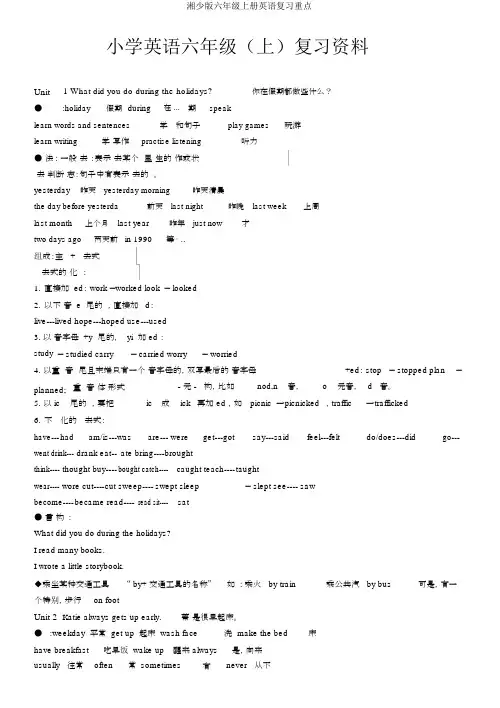
小学英语六年级(上)复习资料Unit 1 What did you do during the holidays?你在假期都做些什么?● :holiday假期during在 ...期speaklearn words and sentences学和句子play games玩游learn writing学写作practise listening听力● 法 : 一般去:表示去某个里生的作或状去判断志:句子中有表示去的。
yesterday昨天yesterday morning昨天清晨the day before yesterda前天last night昨晚last week上周last month上个月last year昨年just now才two days ago两天前in 1990等⋯ ..组成:主 +去式去式的化:1.直接加 ed: work —worked look — looked2.以不音 e 尾的,直接加 d:live---lived hope---hoped use---used3.以音字母 +y 尾的, yi 加 ed :study— studied carry— carried worry— worried4. 以重音尾且末端只有一个音字母的,双写最后的音字母+ed: stop— stopped plan—planned;5. 以 ic重音体形式尾的,要把ic成- 元 - 构,比如ick再加ed,如nod,n 音,picnic →picnickedo元音,,trafficd 音。
→trafficked6.不化的去式:have---had am/is---w as are---were get---got say---said feel---felt do/does---did go---went drink---drank eat--ate bring----broughtthink----thought buy----bought catch----caught teach----taughtwear----wore cut----cut sweep----swept sleep— slept see----sawbecome----became read----read sit----sat● 言构 :What did you do during the holidays?I read many books.I wrote a little storybook.◆乘坐某种交通工具“ by+ 交通工具的名称”如 : 乘火 by train乘公共汽 by bus可是,有一个特别,步行on footUnit 2 Katie always gets up early.蒂是很早起床。
湘少版六年级上册英语复习重点

湘少版六年级(Ji)上册英语复习重点Unit 1 What did you do during the holidays? 你在假(Jia)期都做些什么?●词(Ci)汇:holiday 假期 during 在(Zai)...期间 speak 说learn words and sentences 学习单词和句(Ju)子 play games 玩游戏learn writing 学习(Xi)写作 practise listening 练习听力●语(Yu)法:一(Yi)般过去时:表示过去某个时间里发生的动作或状态过去时判断标志:句子中有表示过去的时间。
yesterday昨天yesterday morning昨天早上the day before yesterda前天last night 昨晚last week上周last month上个月last year去年just now刚才two days ago两天前in 1990 等…..构成:主语+动词过去式动词过去式的变化规则:1.直接加ed:work—worked look—looked2.以不发音e结尾的单词,直接加d:live---lived hope---hoped use---used3.以辅音字母+y结尾的,变y为i加ed:study—studied carry—carried worry—worried4.以重读闭音节结尾且末尾只有一个辅音字母的,双写最后的辅音字母+ed:stop—stopped plan—planned;重读闭音节体现形式为辅-元-辅结构,例如nod,n为辅音,o为元音,d为辅音。
5.以ic结尾的动词,要把ic变成ick再加ed,如picnic→picnicked,traffic→trafficked6.不规则变化的动词过去式:have---had am/is---was are---were get---got say---said feel---felt do/does---did go---went drink---drank eat--ate bring----broughtthink----thought buy----bought catch----caught teach----taughtwear----wore cut----cut sweep----swept sleep—slept see----sawread----read sit----sat●语言结构:What did you do during the holidays?I read many books.I wrote a little storybook.◆乘坐某种交通工具“by+交通工具的名称” 如:乘火车by train 乘公共汽车by bus 但是,有一个特殊,步行on footUnit 2 Katie always gets up early.凯蒂总是很早起床。
六年级湘少版英语上学期期末整理复习知识点巩固练习

六年级湘少版英语上学期期末整理复习知识点巩固练习班级:_____________ 姓名:_____________【单词拼写】1. 看图写单词。
1.I ________ in Hainan last Sunday.2.Do you________ with your parents?3.He ________ yesterday.4.Plant the seeds in the ________ .5.The park is next to the ________ .2. 用be动词的适当形式填空。
( ) 1.I ________ an English teacher now.( ) 2.Helen and Nancy ________ good friends.( ) 3.Look, there ________ lots of sheep there.( ) 4.Today ________ the second of July.( ) 5. All the students ________ very excited.3. 根据图片或首字母,讲句子补充完整。
[1]The boy is a__________ of the dog.[2]He is so a__________ with the car.[3]--What’s wrong with Chen Jie? --She is ill. She shoulds__________ a __________.[4]He is a little heavy. He should d________ more ________.[5]It’s so cold outside. You should w_______ _______ clothes.4. 看图并阅读短文,将内容补充完整。
The Earth was and in the past,but now some parts are . We should stop throwing into rivers.We should stop cutting so many trees and using bags.5. 根据发音提示,补全单词。
新湘少版六年级总复习资料---课文标题篇

新湘少版六年级总复习资料---课文标题篇六年级上册英语标题.Unit 1 What did you do during the holidays? .Unit 2 Katie always gets up early..Unit 3 I like my computer..Unit 4 The Mid-Autumn Festival is coming. .Unit 5 It will be sunny and cool tomorrow..Unit 6 I will bring a big bottle of orange juice. .Unit 7 What can I do?.Unit 8 We shouldn't waste water..Unit 9 This bird is bigger than the first one. .Unit 10 I don't feel well today..Unit 11 Shall we go to the theatre?.Unit 12 It's Christmas again! 六年级下册英语标题.Unit 1 A family outing.Unit 2 Some stories are more interesting.Unit 3 We should learn to take care of ourselves. .Unit 4 Planting trees is good for us..Unit 5 Our earth looks like this in space..Unit 6 Anne wanted to dance..Unit 7 I'm not afraid!.Unit 8 International Children's Day..Unit 9 Look at these beautiful places in the world.三年级上册英语标题.Unit 1 Hello.Unit 2 Good morning.Unit 3 What's your name? .Unit 4 How old are you? .Unit 5 This is my family. .Unit 6 Who's he?.Unit 7 It's a dog..Unit 8 What's this?.Unit 9 It's a mouth..Unit 10 Tough your head. .Unit 11 I like the bird..Unit 12 Happy birthday! 三年级下册英语标题.Unit 1 How are you?.Unit 2 Are you Lingling?.Unit 3 What colour is this balloon? .Unit 4 Look at the T-shirts.Unit 5 What time is it?.Unit 6 How many pens are there? .Unit 7 Is this an orange?.Unit 8 I like a sunny day..Unit 9 What's the weather like?.Unit 10 Is he a farmer?.Unit 11 What's he?.Unit 12 I go to school by bus.。
湘少版英语六年级上册全册配套教案设计湘少版六年级上册英语复习资料
湘少版六年级上册英语复习资料Unit 1 What did you do during the holidays?三、读出下列句子,并写出它们的汉语意思。
1.描述过去发生的动作,动词要用过去式态。
(yesterday, during the holidays, last year, lastweek…)例如:A: What did you do during the holidays?B: I learnt writing.I read many books.I practiced listening.I played games.2.现在进行时:be动词(am, is , are)+动词-ing例如:A: What are you reading?B: I’m reading an English storybook.3. a+辅音音素an+ 元音音素(Aa, Ee, Ii, Oo, Uu)in English 用英语例如:Anne wrote a storybook in English during the holidays.4.to+ 代词宾格(me, you, him, her, us, them) 例如:Read it to us.Unit 2 Katie always gets up early.二、写出下列动词的第三人称单数形式。
三、读出下列句子,并写出它们的汉语意思。
在一般现在时中,当主语为第三人称单数时,动词要用第三人称单数形式。
1.Katie always gets up early.2.Katie often does her homework before dinner.3.Katie sometimes plays chess with her father after dinner.4.Katie never takes a walk.5.on+ 天,at+时,in+月,季,年weekdays, she always gets up 6:30 a.m.6.She waves goodbye to her mother.7.She is never late for school.Unit 3 I like my computer.一、写出下列单词或短语的汉语意思。
湘少版六年级上册英语复习重点
湘少版六年级上册英语复习重点Unit 1 What did you do during the holidays?During the holidays。
we have a lot of free time to do what we want。
Some people choose to learn new things。
like words and sentences。
while others prefer to play games。
Some may learn writing or XXX.When we talk about what we did during the holidays。
we use the past XXX place in the past。
We can XXX indicate past time。
XXX。
last week。
or two days ago.To form the past tense。
we add -ed to regular verbs。
like worked or looked。
For verbs that end in -e。
we simply add -d。
like lived or hoped。
For verbs that end in a consonant followed by -y。
we change the -y to -i and add -ed。
like XXX。
we double the consonant and add -ed。
like XXX.There are also irregular verbs that do not follow these rules。
Some examples include had。
was/were。
got。
said。
felt。
did。
went。
drank。
ate。
brought。